Proponents of Saudi Arabia’s audacious megacity project, as embattled by skepticism as enamored by ambition, have made their journey to China to solicit vital financial support for what is widely perceived to be either an overambitious venture or a looming debacle.
In an effort to secure funding for NEOM, an otherworldly initiative conceived by the de facto leader Crown Prince Mohammed bin Salman, they traversed a route touching Beijing, Shanghai, and finally, Hong Kong. The latter city played host to an extravagant museum where potential investors were privy to an array of vibrant artistic renderings depicting NEOM in its various developmental stages.
However, despite the glitz, no substantial agreements were inked, and high-ranking project officials steered clear of discussing recent whispers of backpedalling on NEOM’s grand development and population objectives.
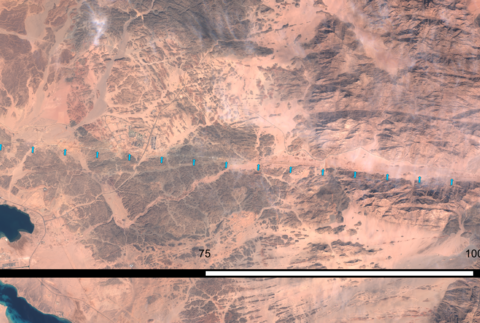
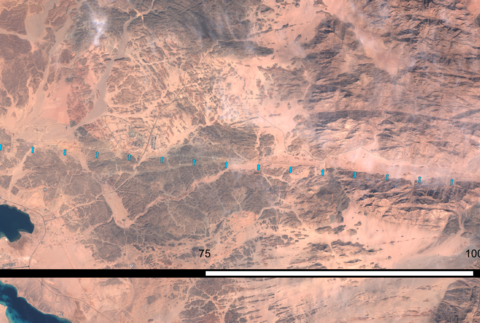
At the crux of this grand scheme is a marvel intended to manifest as two ultramodern skyscrapers – a dual entity stretching across 106 miles of Saudi wilderness, given the moniker ‘The Line.’ The anticipated milestones present an optimistic picture; a thriving habitat for one million denizens by 2030, and an eventual capacity to host nine million people.
Regrettably, recent reports suggest a visible downsize in the project’s scale, with only 300,000 inhabitants foreseen by the conclusion of this decade, and a modest 1.6 miles of the skyscraper infrastructure to be erected.
Simultaneously, Saudi Arabia is embarking on a mission to fly financiers from across the globe to the kingdom for a meticulous audit of the project, hoping to secure the financial backing NEOM sorely requires.
The Middle East briefing 3,000+ readers start their day with.
One email. Every weekday morning. Free.
The expansive city of the future, christened NEOM, is an amalgamation of ‘neo’ signifying new, and ‘m’, the initial of the Arabic word ‘mustaqbal’, translating as future. Disclosed by the Prince in 2017, the reported cost soared from an initial $500 billion to an astounding $1.5 trillion over subsequent reviews.
NEOM represents the jewel in the crown of a host of developmental initiatives launched under Vision 2030, the Prince’s endeavor to prepare the globes leading oil exporter for a future less dependent on oil. ‘The Line’ forms the centerpiece of this grand design.
When ‘The Line’ made its debut in 2022, Prince Mohammed forecasted a population upward of one million by 2030, further expanding to nine million by 2045.
NEOM’s executive director, Tarek Qaddumi, envisages a city carved through the arid mountains by a maze of tunnels, complete with an airport designed to handle 100 million voyagers annually. He told investors in Hong Kong, ‘Your baggage will be sent to your address directly.’
Despite the dazzling promises and futuristic exhibitions, the progress of the project lags markedly behind timelines. Until now it has been propped up by Saudi Arabia’s sovereign wealth fund but has become increasingly dependent on foreign capital to continue rising.
The aim of the exhibitions in Beijing and Hong Kong was to demystify NEOM, as Leonard Chan, chair of the Hong Kong Innovative Technology Development Association pointed out. He, however, mentioned prospective investor responses as ‘neutral’ and expressed some reservations about ‘The Line’.
There are also stern timelines for several other elements of NEOM- such as the Sindalah yachting island, luxurious ski resort Trojena with its artificial lake and ski slopes spanning 22 miles, slated for completion before 2029, and some waterfront residential developments planned for after 2030
However, considering the far-reaching scale of NEOM, the size of an equivalent patch of desert matching Belgium, the practicality and accomplishability of the project have been severely doubted.
Culminating in a perceived slow march, a spate of complications has beleaguered the project. These range from insensitive eviction of the indigenous population to the high rate of staff turnover, leading to employees quitting due to an toxic work culture and accusations of reckless overspending.
To add to the pressure, Saudi Arabia is already committed to meet preparation timelines for the 2034 FIFA World Cup. Analysts say that the Kingdom needs a more reliable, sustainable foreign investment growth from various sectors, a phenomenon that has yet to materialize.