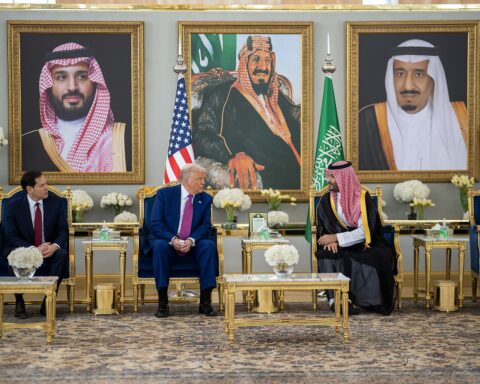
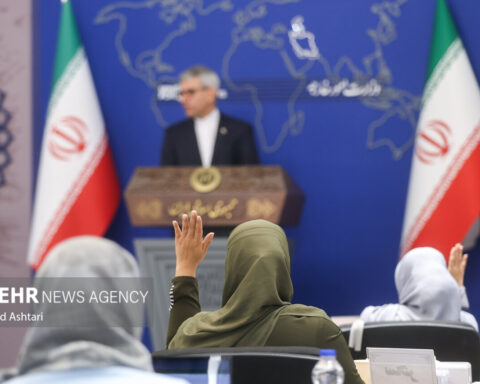
RIYADH — U.S. Secretary of State Marco Rubio called Saudi Foreign Minister Prince Faisal bin Farhan on April 18, a day in which four separate crises converged on Riyadh simultaneously: the sealing of the Hajj security cordon around Makkah, the expiry of OFAC General License U for Iranian oil purchases, an IRGC gunboat attack on an Indian-flagged supertanker in the Strait of Hormuz, and the first full day of a fragile Lebanon ceasefire that Saudi Arabia helped broker. The call’s stated agenda, according to the Saudi Ministry of Foreign Affairs, covered Hormuz shipping and Lebanon ceasefire consolidation. It contained no language on the Iran nuclear track.
That omission defines Saudi Arabia’s structural position in the crisis more precisely than any of the agenda items that were discussed. Riyadh is being asked to absorb the implementation costs of a war it did not start and a ceasefire architecture it cannot shape — paying in interceptor inventory, fiscal exposure, diplomatic capital, and physical security for Hajj pilgrims — while the actual US-Iran negotiation runs through Pakistan, Oman, and a mediator table from which Saudi Arabia is explicitly excluded.
Table of Contents
- What Did the Rubio-Faisal Call Actually Cover?
- The Hormuz Attack That Framed the Call
- A Lebanon Ceasefire Already Breaking
- What Does GL U Expiry Mean for Saudi Revenue?
- The Hajj Cordon and the Air Defense Arithmetic
- Why Is Saudi Arabia Excluded from the Iran Nuclear Track?
- Iran’s Forward Pressure on Riyadh
- FAQ
What Did the Rubio-Faisal Call Actually Cover?
The Saudi Ministry of Foreign Affairs readout described a “telephone call” — not an in-person meeting, despite initial wire-service confusion caused by an ANI bureau dateline from Beirut. The readout identified two agenda items: “efforts to ensure the continued flow of shipping through the Strait of Hormuz” and “the need to consolidate the ceasefire in Lebanon.” Both sides “underscored the importance of prioritizing dialogue and diplomatic solutions to achieve security and stability across the region,” according to the Saudi MFA via Asharq Al-Awsat on April 18.
The language is diplomatic boilerplate. No specific commitments, dollar amounts, security guarantees, or binding agreements emerged from either side’s account of the conversation. No readout from Washington or Riyadh mentioned Iran’s nuclear program, the Islamabad mediation track, enrichment thresholds, or the expiring US-Iran ceasefire.
This is the second time in eleven years that a US-Iran nuclear bargain has been constructed without Gulf representation. The 2015 JCPOA excluded Saudi Arabia, the UAE, Israel, and the wider GCC from the negotiating table. In 2026, the same exclusion pattern is repeating — with the added complication that Saudi Arabia’s financial patronage is now structurally necessary for talks whose output it cannot shape. Pakistan’s $5 billion Saudi loan matures in June 2026. The mediator running the US-Iran channel simultaneously holds Saudi Arabia’s debt.
“They underscored the importance of prioritizing dialogue and diplomatic solutions to achieve security and stability across the region.”
The HOS Daily BriefThe Middle East briefing 3,000+ readers start their day with.
One email. Every weekday morning. Free.
— Saudi Ministry of Foreign Affairs readout, April 18, 2026
Andrew Leber, an analyst at the Carnegie Endowment, captured the Gulf perspective on Hormuz diplomacy in blunt terms: Gulf states “care about whether the strait is actually open to traffic, rather than Trump claiming as such.” What the call offered was language about ensuring shipping flow. What the strait delivered on the same day was IRGC gunfire.
The Hormuz Attack That Framed the Call
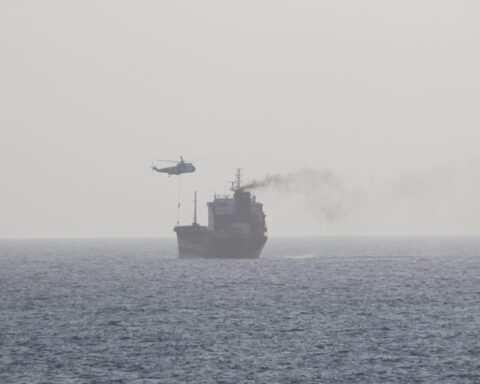
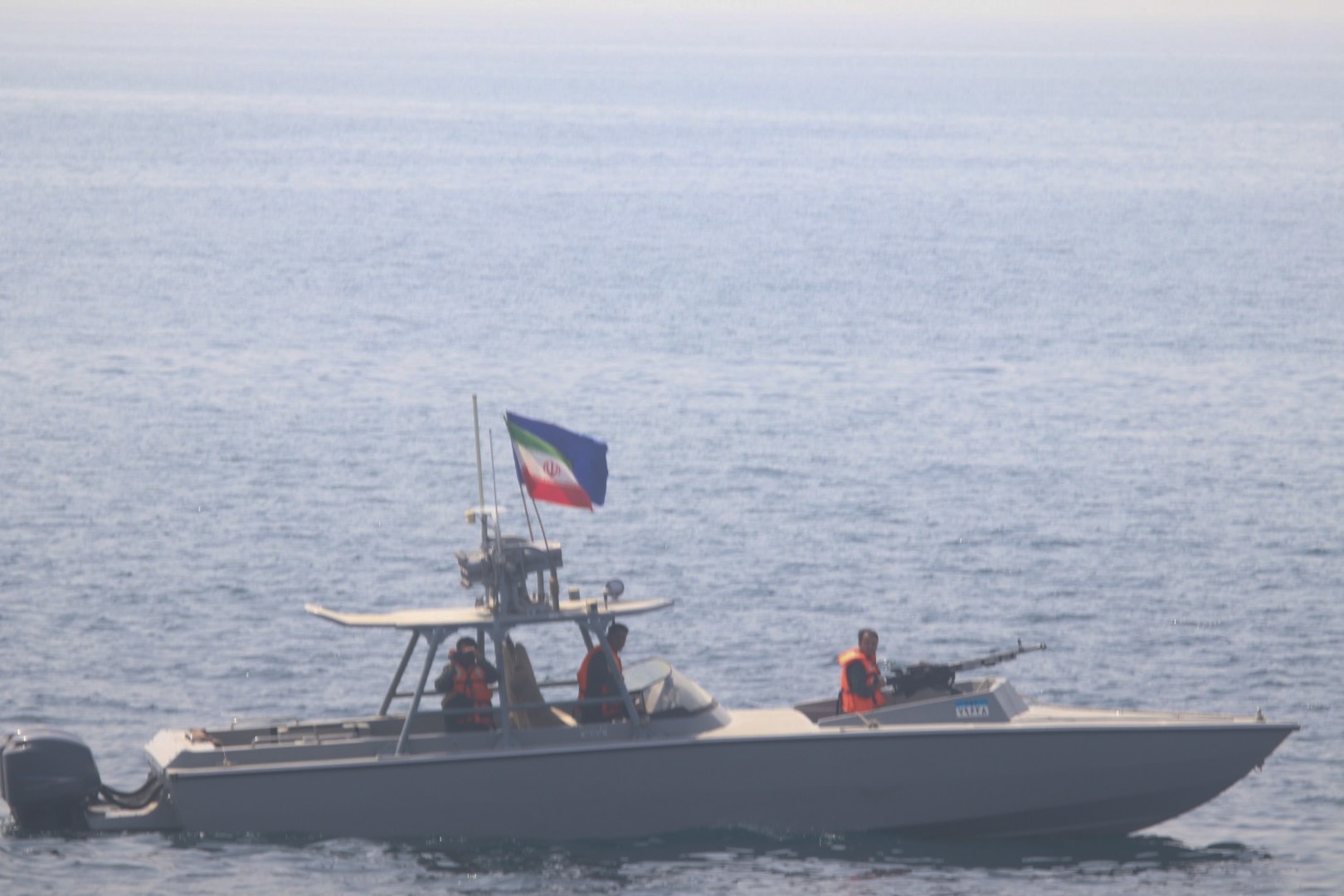
Hours before or around the time of the Rubio-Faisal call on April 18, IRGC gunboats fired on an Indian-flagged supertanker approximately 20 nautical miles northeast of Oman. UK Maritime Trade Operations reported that the “master of a tanker reports being approached by two IRGC gunboats, no VHF challenge, that then fired upon the tanker.” The crew was unharmed. The vessel was forced to reverse course, according to UKMTO, Military.com, and the Irish Times.
India summoned the Iranian ambassador in response. The diplomatic escalation from New Delhi added a third government reacting to Hormuz conditions on a day when Rubio’s call with Faisal was supposed to address precisely that problem. The attack on the Indian tanker occurred against a backdrop of 21 ships turned back by the CENTCOM blockade since April 13, with 10,000-plus US personnel and 12 or more warships enforcing the cordon, according to Military.com.
Iran’s Supreme National Security Council had already reversed Foreign Minister Araghchi’s April 17 declaration that Hormuz was “completely open.” Within hours of the Lebanon ceasefire taking effect, the SNSC announced the strait had “returned to previous state, strict management and control,” according to NBC News and Al Jazeera. The justification: “as long as the enemy intends to disrupt the passage of vessels and apply its naval blockade, Iran will view that as a violation of the ceasefire.”
The Hormuz toll system Iran announced has collected zero revenue in 36 days — 60 permits issued, eight payment requests sent, none paid, according to HOS reporting. The IRGC’s enforcement mechanism has shifted from administrative fees to live fire.
A Lebanon Ceasefire Already Breaking
The Lebanon ceasefire — 10 days, effective April 17 at 21:00 GMT — arrived on the call’s agenda in a condition that made “consolidation” an optimistic framing. A French UNIFIL peacekeeper was killed in southern Lebanon on April 18 in a small-arms attack in Ghandouriyeh. UNIFIL called it “a deliberate attack.” Hezbollah denied responsibility. French President Macron condemned the killing, according to Al Jazeera and UN News.
Israeli violations began within hours of the ceasefire’s nominal start. Artillery fire was reported around Beit Lif, al-Qantara, and Toul. Israeli bulldozers continued demolition operations. Israel maintains control of 55 towns and a 10-kilometer buffer zone inside Lebanese territory, according to Al Jazeera and Asharq Al-Awsat. The ceasefire has no formal enforcement mechanism. Hezbollah did not sign it. Ali Fayyad, a Hezbollah official, said the group would approach it “with caution and vigilance,” warning that “any targeting of Lebanese sites by Israeli forces will constitute a breach,” according to Al Jazeera on April 17.
Maha Yahya, director of the Carnegie Middle East Center, described the Lebanese public reaction on NPR: “With a massive sigh of relief. I think people are just, at least, happy with even a 10-day reprieve from the bombing.” On the ceasefire’s durability: “Will that lead to a permanent peace agreement or even a permanent cessation of hostilities? — is a big question mark.” Approximately 40,000 homes have been destroyed or damaged in Lebanon, according to Al Jazeera.
Saudi Arabia’s role in the ceasefire was acknowledged at the highest levels. Lebanese President Aoun and Parliament Speaker Berri both thanked Saudi Arabia by name at the ceasefire announcement, according to a Saudi Press Agency dispatch reported by Globalsecurity.org on April 16. Berri dispatched an aide to Riyadh citing Saudi Arabia’s “influential role.” The Saudi MFA statement of April 16 reiterated support for “the Lebanese state in extending its sovereignty, confining weapons to the state and its legitimate institutions.”
That language — weapons confined to the state — is the Saudi condition that the ceasefire structurally cannot deliver. Yahya, at Carnegie, identified the core problem: “You cannot disarm an armed nonstate actor that has often acted and has often proved to be stronger than the state in some places without strengthening central state institutions.” Israeli occupation of 55 villages in the south complicates the state-sovereignty framework Saudi Arabia publicly demands. Riyadh is being credited for a ceasefire whose terms contradict its stated conditions for Lebanese engagement.
What Does GL U Expiry Mean for Saudi Revenue?
OFAC General License U expired at 12:01 AM EDT on April 19 — less than 24 hours after the Rubio-Faisal call. Treasury Secretary Bessent confirmed the non-renewal on April 15-16. In the same week, Russia’s General License 134A was quietly extended — carving Iran out as a coercive asymmetry signal while maintaining Russian energy trade protections, according to OFAC records.
The expiry tightens sanctions enforcement on Iranian oil at a moment when Saudi Arabia’s own fiscal position is deteriorating. Brent crude traded at approximately $90.38 on April 18, according to market data — $17 to $21 below the Saudi fiscal break-even of $108 to $111 per barrel estimated by Goldman Sachs and Bloomberg using PIF-inclusive methodology. Saudi March production fell to 7.25 million barrels per day, according to the International Energy Agency, down from 10.4 million bpd pre-war — a 30 percent decline.
Aramco’s June Official Selling Price was set at a $3.50 per barrel premium, a $16 reset from May’s $19.50 war-premium, according to Aramco pricing data. Goldman Sachs estimated a war-adjusted fiscal deficit of 6.6 percent of GDP, roughly double the official 3.3 percent projection. The IEA called the Saudi production disruption “the largest on record.” Asian exports fell 38.6 percent, according to Kpler tanker-tracking data.
For Saudi Arabia, the GL U expiry removes one category of Iranian oil from global markets — but does not raise the price of Saudi crude above the fiscal threshold Riyadh needs to fund both the war’s costs and Vision 2030’s capital commitments.
The Hajj Cordon and the Air Defense Arithmetic
The Hajj security cordon sealed on April 18 — the same day as the Rubio-Faisal call, the Hormuz tanker attack, the UNIFIL killing, and the GL U expiry eve. Saudi air defenses are operating with approximately 400 PAC-3 MSE interceptors, roughly 14 percent of pre-war inventory, to defend 1.2 to 1.5 million pilgrims, according to HOS reporting on the wartime Hajj.
Indonesia’s 221,000 pilgrims — the largest single national contingent — begin departure on April 22, according to the Wego Travel Blog’s Hajj 2026 tracking. April 22 is also the day the US-Iran ceasefire expires. The Lebanon ceasefire expires April 27. The Day of Arafah falls on May 26 — 34 days after ceasefire expiry, well inside the window of renewed hostilities if no extension is agreed.
The Rubio-Faisal call’s agenda — Hormuz shipping and Lebanon — did not address Hajj security, air defense resupply, or the interceptor deficit. Amr Hamzawy, also at the Carnegie Endowment, assessed the mediator structure: Pakistan, Egypt, and Turkey as mediators “will likely seek to ensure that any potential US-Iran agreement secures an end to all military operations across the Middle East.” Saudi Arabia’s Hajj security depends on that outcome. Saudi Arabia has no seat at that table.
Iran has cancelled the April 20 Islamabad round. No replacement date has been announced. The US-Iran ceasefire expires in days with no extension mechanism identified by the Soufan Center or any mediator party.
Why Is Saudi Arabia Excluded from the Iran Nuclear Track?
The mediation architecture for US-Iran talks runs through Pakistan as the primary relay, Oman as a back channel, and Qatar, Egypt, and Turkey as supporting mediators. No GCC state has formal observer status. Saudi Arabia was excluded from the April 10 Islamabad bilateral between Vice President Vance and Iranian Parliament Speaker Ghalibaf, and from the now-cancelled April 20 round, according to the ACLED Gulf report and negotiation tracking.
Saudi Arabia publicly broke with the US maximum-pressure posture on April 14, calling for the United States to end the naval blockade and return to negotiations. Prince Faisal called Iranian Foreign Minister Araghchi on April 13 — the day the CENTCOM blockade took effect — according to the ACLED Gulf report and Iran MFA Telegram. The Saudi position inadvertently aligned with Iran’s stated demand: that the blockade constitutes a ceasefire violation preventing Hormuz’s conditional reopening.
Kaitlyn Hashem at the Stimson Center assessed Saudi nuclear ambitions as reflecting “not only Iran’s program but also eroding U.S. security guarantees.” The 123 Agreement draft under discussion between Washington and Riyadh does not forbid Saudi enrichment — an asymmetry with the enrichment constraints Washington is demanding of Iran. Saudi Arabia is simultaneously excluded from the table where Iran’s nuclear future is decided and pursuing its own nuclear capacity partly because of that exclusion.
Oman’s Daily Observer editorialized: “A truce that excludes Lebanon is not the beginning of peace.” The same logic applies to a nuclear framework that excludes Saudi Arabia. Prince Faisal’s earlier assessment of the relationship with Iran — “What little trust there was before has completely been shattered” — was delivered before the Hormuz toll, before the Petroline strike, before the compensation demand, according to NBC News.
The Lebanon track Saudi Arabia is being asked to consolidate is itself destabilizing. The nuclear track Saudi Arabia is excluded from determines whether destabilization becomes permanent.
Iran’s Forward Pressure on Riyadh
Iran’s UN Representative Amir Saeid Iravani declared on April 14 that Saudi Arabia and four Gulf states’ “international responsibility has been established and they must make full reparation for the damage caused” — categorizing Gulf hosting of US forces as “internationally wrongful acts,” according to Pajhwok Afghan News. Iran’s war-loss figure: $270 billion. Rystad Energy estimated $50 to $58 billion in energy infrastructure repair costs alone, according to Al Jazeera reporting on April 15.
PressTV, Iran’s English-language state broadcaster, framed the Lebanon ceasefire on April 18 as a product of Iranian “multifaceted pressures,” not US diplomacy. Iranian military advisers told state media the ceasefire resulted from “the resistance of Hezbollah’s fighters and Iran’s multifaceted pressures,” according to PressTV and the Manila Times. The narrative positions Iran as the ceasefire’s author — and Saudi Arabia, by extension, as a secondary actor implementing Iranian terms.
The compensation demand is a forward pressure tactic. Any post-ceasefire normalization between Riyadh and Tehran requires Saudi Arabia to navigate Iranian liability claims that treat the entire Gulf hosting arrangement as actionable under international law. The signing ceremony MBS cannot attend — whatever emerges from the Islamabad track — comes with a $270 billion Iranian invoice addressed to Riyadh.
Pakistan occupies a triple role in this architecture: mediator between the US and Iran, Saudi Arabia’s military ally via the September 2025 Saudi-Pakistan Mutual Defense Agreement, and Iran’s protecting power in the United States since 1992. The actor running the ceasefire talks holds Saudi Arabia’s $5 billion loan (maturing June 2026), commands the sole enforcement relay for any deal, and simultaneously serves as Iran’s diplomatic channel to Washington.
FAQ
Was the Rubio-Faisal contact on April 18 an in-person meeting?
No. The Saudi Ministry of Foreign Affairs readout explicitly described a “telephone call” (هاتفية). Initial wire reports from ANI and the Tribune India carried a “Beirut” dateline, which was the location of ANI’s bureau, not Secretary Rubio’s. Rubio was not in Beirut. The confusion illustrates how bureau datelines in wire-service copy can be mistaken for event locations — a common issue in fast-cycle conflict reporting where multiple agencies relay the same dispatch with different header conventions.
Has Saudi Arabia formally requested a seat at the Islamabad US-Iran talks?
No public request has been reported. Saudi Arabia’s approach has been parallel diplomacy — Prince Faisal’s April 13 call to Araghchi, the April 14 public call for blockade removal — rather than a formal bid for observer or participant status. The JCPOA precedent suggests Gulf states may prefer bilateral channels with both Washington and Tehran over formal inclusion in a multilateral framework whose terms they cannot control. The risk of formal inclusion is being bound by outcomes shaped by others; the risk of exclusion is being bound by those same outcomes without input.
What happens if the US-Iran ceasefire expires on April 22 without extension?
No extension mechanism has been identified by the Soufan Center or any mediator party. Iran cancelled the April 20 Islamabad round. If the ceasefire lapses, IRGC operational autonomy — already demonstrated by the Hormuz reversal and the tanker attack — faces no diplomatic constraint. The Hajj pilgrimage would then proceed under active hostilities, with Indonesian departures beginning the same day as ceasefire expiry. Saudi Arabia’s five-layer air defense system would shift from wartime-with-ceasefire to wartime-without-ceasefire posture while protecting the largest annual mass gathering on earth.
Why did the US extend Russia’s General License 134A while letting Iran’s GL U expire?
Treasury Secretary Bessent publicly denied any asymmetry, but the timing speaks for itself. The simultaneous extension of Russian energy trade protections and termination of Iranian oil purchase authorizations creates a coercive signal directed specifically at Tehran — and at the refiners in India, China, and Turkey who had been purchasing Iranian crude under GL U’s legal cover. For Saudi Arabia, the move theoretically removes competing Iranian barrels from the market, but the supply reduction has not translated into price recovery sufficient to close the gap between current Brent and Riyadh’s fiscal break-even.
What are Saudi Arabia’s stated conditions for Lebanon engagement?
The Saudi MFA’s April 16 statement identified three conditions: full extension of Lebanese state sovereignty, confinement of weapons to the state and its “legitimate institutions,” and IMF structural reforms. These conditions predate the 2026 crisis — they were established during Saudi Arabia’s conditional re-engagement with Lebanon after years of diplomatic withdrawal following the Saad Hariri incident. The 10-day ceasefire satisfies none of them: Hezbollah retains its arsenal, Israel occupies 55 towns, and the IMF program remains stalled. Saudi credit for the ceasefire comes without Saudi conditions being met.