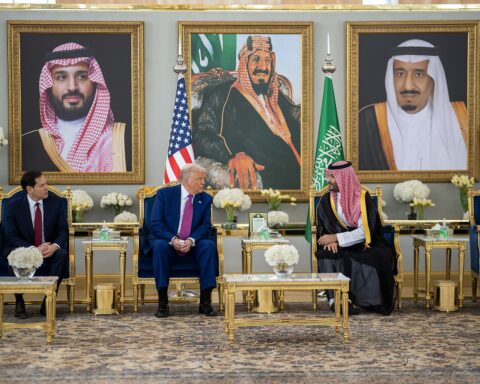
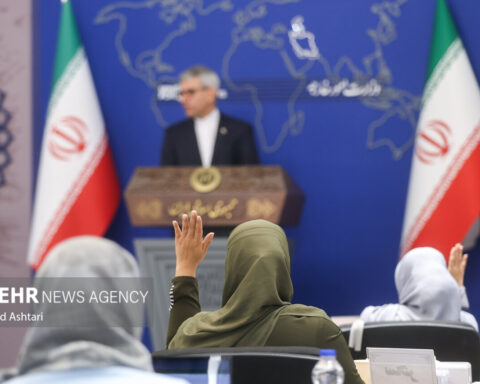
WASHINGTON — The US-Saudi 123 Agreement framework, formalized during President Trump’s May 13 visit to Riyadh, contains no prohibition on Saudi uranium enrichment — the structural opposite of the “gold standard” Washington established with the UAE in 2009 and the enrichment moratorium it is simultaneously demanding from Iran in Muscat. The gap is not an oversight. The Biden administration insisted on enrichment and reprocessing prohibitions as preconditions for any Saudi nuclear cooperation agreement in 2023. Saudi Arabia rejected both. The Trump administration dropped both conditions in November 2025, substituting unspecified “additional safeguards and verification measures.” Senator Edward Markey’s S. 4243, the No Nuclear Weapons for Saudi Arabia Act of 2026, would require affirmative congressional approval of the agreement — a higher bar than the default 90-day auto-entry mechanism under Section 123 of the Atomic Energy Act. The bill has six Democratic cosponsors, no Republican support, and no committee action. In Muscat, on the day the Saudi framework was signed, US negotiators were demanding Iran accept up to a 20-year enrichment moratorium and surrender approximately 400 to 440 kilograms of uranium enriched to 60 percent.
Table of Contents
- What Does the US-Saudi 123 Agreement Actually Say About Enrichment?
- The UAE Gold Standard and Why Washington Abandoned It
- How Did the Enrichment Ban Disappear Between Abu Dhabi and Riyadh?
- The Bilateral Safeguards Gap
- What Would S. 4243 Change — and Why Can It Not Pass?
- The Muscat Paradox
- Iran’s Article IV Argument and the NPT Review Conference
- The Khan Network’s Shadow
- Who Opposes the Deal and Why Does the Coalition Matter?
- KACARE and the Commercial Logic of Saudi Enrichment
- Frequently Asked Questions
What Does the US-Saudi 123 Agreement Actually Say About Enrichment?
The framework replaces an enrichment prohibition with “additional safeguards and verification measures to the most proliferation-sensitive areas,” including enrichment. It does not require Saudi Arabia to conclude an IAEA Additional Protocol. A bilateral safeguards agreement will cover only declared facilities where US-Saudi nuclear cooperation occurs — not Saudi Arabia’s broader nuclear footprint, including any domestically developed enrichment capability.
The operative language of the 2009 US-UAE 123 Agreement sets the comparison. The UAE “shall not possess sensitive nuclear facilities within its territory or otherwise engage in activities within its territory for, or relating to, the enrichment or reprocessing of material.” That sentence — 34 words — is the gold standard. It prohibits not only enrichment facilities but activities “relating to” enrichment. The scope is territorial, not facility-specific.
No equivalent sentence exists in the Saudi framework.
| Provision | US-UAE 123 Agreement (2009) | US-Saudi 123 Framework (2025-26) |
|---|---|---|
| Uranium enrichment | Explicitly prohibited | Not prohibited; “additional safeguards” applied |
| Reprocessing | Explicitly prohibited | Not prohibited; “additional safeguards” applied |
| IAEA Additional Protocol | Required | Not required; bilateral safeguards substituted |
| Safeguards scope | Territorial (all nuclear activities) | Facility-specific (declared cooperation sites only) |
| Congressional review mechanism | Standard 90-day auto-entry | Standard 90-day auto-entry (S. 4243 would change) |
The distinction carries operational weight because Saudi Arabia has stated since January 2023 its intent to develop the full nuclear fuel cycle — uranium mining, conversion, enrichment, and fuel fabrication. The Kingdom holds confirmed domestic uranium deposits. Any enrichment infrastructure built with non-US technology, at facilities outside the cooperation framework, would fall beyond the bilateral safeguards’ reach.
In September 2023, Saudi Energy Minister Prince Abdulaziz bin Salman announced the Kingdom would rescind its IAEA small quantities protocol — the weakest available safeguards arrangement — and move to a full Comprehensive Safeguards Agreement. The transition has been under way since 2024. Even a full CSA, however, covers only declared facilities and materials. The Additional Protocol, which grants IAEA inspectors access to undeclared sites and activities, remains absent from the Saudi safeguards picture — and the 123 framework does not require it.
The Middle East briefing 3,000+ readers start their day with.
One email. Every weekday morning. Free.
The UAE Gold Standard and Why Washington Abandoned It
The Obama administration established the UAE agreement as the template for regional nuclear cooperation. The logic was explicit: if a US partner in the Gulf could build and operate a civilian nuclear program without domestic enrichment, future agreements in the region should meet the same bar. The UAE accepted permanent enrichment prohibition in exchange for guaranteed fuel supply assurances. Abu Dhabi’s Barakah plant — four APR-1400 reactors, now fully operational — runs entirely on imported fuel from a KEPCO-led consortium.
In 2017-2018, both the outgoing Obama team and the first Trump administration stated publicly that any Saudi 123 agreement must match the gold standard. Congressional resolutions reinforced the position. Saudi Arabia rejected the condition. The Kingdom’s position did not waver across three US administrations: it would not accept restrictions the UAE had voluntarily adopted, in part because Riyadh regarded Abu Dhabi’s renunciation as a strategic concession the larger Gulf power could not afford to replicate.
During Biden-era negotiations in 2023, the US held to both requirements — the Additional Protocol and enrichment/reprocessing prohibitions. Saudi Arabia again refused. The impasse appeared to close the window for any near-term agreement. When the Trump administration returned to office, it dropped both conditions in November 2025, framing unspecified “additional safeguards and verification measures” as functional substitutes for the prohibitions the previous three administrations had demanded.
Kelsey Davenport, director for nonproliferation policy at the Arms Control Association, described the implications in structural terms. “The precedent this could set for how states engage with the United States on future nuclear cooperation agreements could be profound,” she told PBS NewsHour in February 2026, “and the U.S. is facing a new age of proliferation risks.”
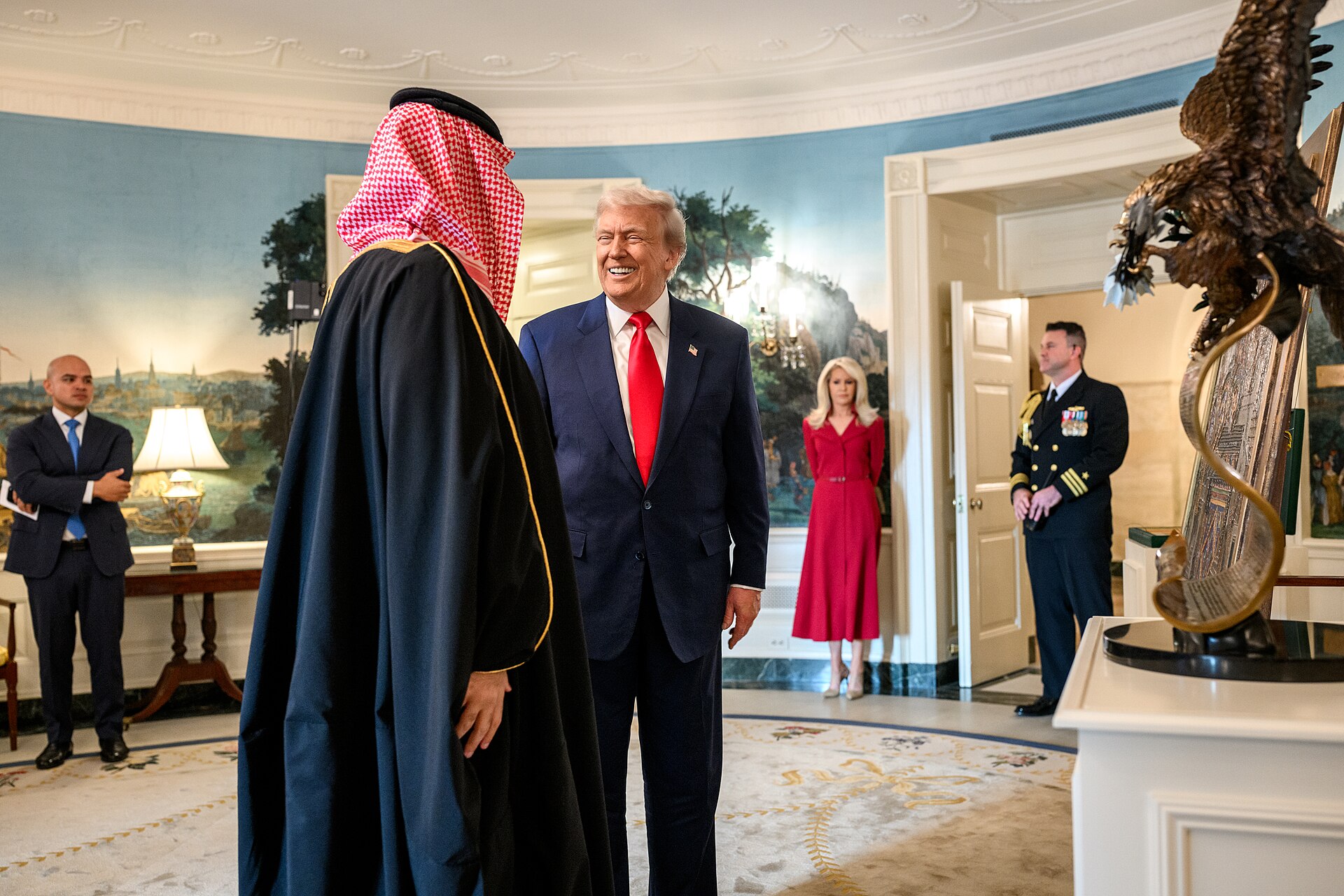
The Foundation for Defense of Democracies — not an organization typically aligned with arms control advocacy — reached a parallel conclusion from opposite premises. Research fellow Andrea Stricker wrote in February 2026 that the administration “has shown willingness to relax longstanding U.S. restrictions on sensitive fuel-cycle technologies” and should instead “require Riyadh to forgo enrichment and reprocessing under any 123 agreement.” FDD’s analysis carried a title that left little room for diplomatic ambiguity: “Washington Must Not Relax Nonproliferation Standards for Saudi Arabia.”
How Did the Enrichment Ban Disappear Between Abu Dhabi and Riyadh?
Saudi Arabia rejected enrichment and reprocessing prohibitions across three consecutive US administrations. The Trump administration dropped both conditions in November 2025 — substituting unspecified “additional safeguards and verification measures” — because conditioning the framework on those prohibitions risked a broader US-Saudi alignment package the administration had structured as indivisible from the nuclear deal.
Congressional efforts to codify the gold standard requirement predate S. 4243 by nearly a decade. S.Res.541 in the 115th Congress (2017-18) expressed the sense of the Senate that any Saudi nuclear cooperation agreement should include enrichment and reprocessing prohibitions. H.Con.Res.23 in the 116th Congress (2019-20) made the same argument in the House. Neither advanced out of committee. The pattern is consistent: legislative intent expressed, institutional follow-through absent.
In 2018, the gold standard was bipartisan consensus expressed in congressional resolutions. By 2026, the executive branch had moved in the opposite direction, and the legislative response — S. 4243 — is a minority Democratic bill with no Republican cosponsors in a Republican-controlled Senate. The congressional dynamics that constrain Iran diplomacy apply with equal force to Saudi nuclear oversight.
The economic incentive is part of the explanation. Decades of fuel supply, maintenance, and consulting contracts follow construction of a reactor fleet the scale Saudi Arabia envisions. US nuclear industry access to this market — Westinghouse and Bechtel foremost among the contenders — depends on a permissive 123 framework.
The strategic context tightened the incentive further. The 123 framework was formalized on May 13, 2026, alongside a $142 billion defense cooperation package that included basing arrangements, air defense integration, and intelligence-sharing provisions. The nuclear deal was one clause in a broader architecture of US-Saudi alignment the Trump administration structured as indivisible. Conditioning the framework on enrichment prohibitions Riyadh had already rejected twice risked the entire package — at a moment when Washington needed Saudi cooperation on oil production, the Iran ceasefire, and regional stability during an active Gulf conflict.
The Bilateral Safeguards Gap
Under a standard IAEA Additional Protocol, a signatory state submits to inspections of both declared and undeclared nuclear facilities and activities. The protocol grants IAEA inspectors the legal authority to investigate suspicious sites anywhere in the country, request complementary access within 24 hours, and use environmental sampling to detect undeclared nuclear material. One hundred and forty states have Additional Protocols in force. Saudi Arabia is not among them.
The Saudi 123 framework substitutes a bilateral safeguards agreement covering “declared facilities where US-Saudi nuclear cooperation occurs.” A State Department letter sent to Senator Markey on May 18, 2026 — reported by Reuters — confirmed this formulation without elaboration on its practical scope.
Saudi Arabia can develop nuclear facilities outside the cooperation framework — using non-US technology, non-US nuclear material, or domestically sourced uranium — that fall entirely outside the bilateral safeguards’ scope. The agreement monitors the rooms it knows about. It has no mandate to look for rooms it does not know about.
An analyst at the Washington Institute framed the problem as self-defeating. “Will it be more challenging to negotiate enrichment limits and insist on the additional protocol,” the analyst asked, “if the United States is greenlighting a Saudi enrichment program with less intrusive safeguards?” The question was rhetorical. The two diplomatic tracks — Saudi cooperation and Iranian restriction — pull against each other, and the 123 framework locks in the contradiction.
The bilateral arrangement also sets a precedent for future 123 agreements. If the US accepts facility-specific bilateral safeguards as a substitute for the Additional Protocol in the Saudi case, other prospective nuclear partners — in the Gulf, Southeast Asia, or North Africa — will demand the same terms. Davenport at the Arms Control Association warned in February 2026 that the framework “will open the door for Saudi Arabia to acquire uranium enrichment technology or capabilities — possibly even from the United States. Even with restrictions and limits, it seems likely that Saudi Arabia will have a path to some type of uranium enrichment or access to knowledge about enrichment.”
What Would S. 4243 Change — and Why Can It Not Pass?
S. 4243 would require an affirmative joint resolution of congressional approval for the US-Saudi 123 Agreement to enter force — replacing the default 90-day auto-entry mechanism under which the agreement takes effect unless Congress enacts a joint resolution of disapproval. The inversion shifts the constitutional burden from Congress blocking the executive to the executive persuading Congress.
The mechanics of the default mechanism favor the executive branch systematically. Under Section 123 of the Atomic Energy Act, a proposed nuclear cooperation agreement is transmitted to Congress and enters into force after 90 days of continuous session unless both the House and Senate pass an identical joint resolution of disapproval. The president may veto that resolution. Overriding the veto requires two-thirds supermajorities in both chambers — a threshold that grants the president effective unilateral authority over 123 agreements whenever his party controls one-third-plus-one of either chamber.
S. 4243 applies the approval mechanism — the more demanding standard reserved for agreements that seek exemptions from standard Section 123 requirements. Under this pathway, the agreement cannot enter force until Congress votes affirmatively to authorize it. No vote, no agreement. The president cannot override congressional inaction with a veto.
Senator Markey described the stakes without euphemism. The administration’s proposed agreement, he wrote, “would appear to allow Saudi Arabia to acquire both enrichment and reprocessing technologies, which could enable Riyadh to produce weapons-grade uranium and plutonium.” He characterized the Trump administration’s concessions as “caving to the Saudis on nuclear nonproliferation.”
The bill was introduced March 26, 2026. Its six cosponsors — Senators Merkley, Kaine, Van Hollen, Wyden, Welch, and Sanders — are all Democrats or Democratic-aligned independents. House companion legislation is led by Representatives Castro and Lieu. The Senate Foreign Relations Committee, to which S. 4243 was referred, has scheduled no markup, no hearing, and no committee action as of May 20, 2026.
The legislative math leaves the bill functionally dead absent a political shock. In a Republican-controlled Senate, a joint disapproval resolution would need to pass both chambers and survive a presidential veto — mathematically impossible with current margins. S. 4243’s approval mechanism would need to clear committee, reach the floor, and secure a majority — none of which is probable without Republican defections that have shown no sign of materializing. The 90-day clock, once triggered by formal transmission of the agreement, functions as automatic approval.
The Muscat Paradox
On May 13, 2026, the Trump administration ran two simultaneous negotiating tracks whose enrichment terms contradicted each other.
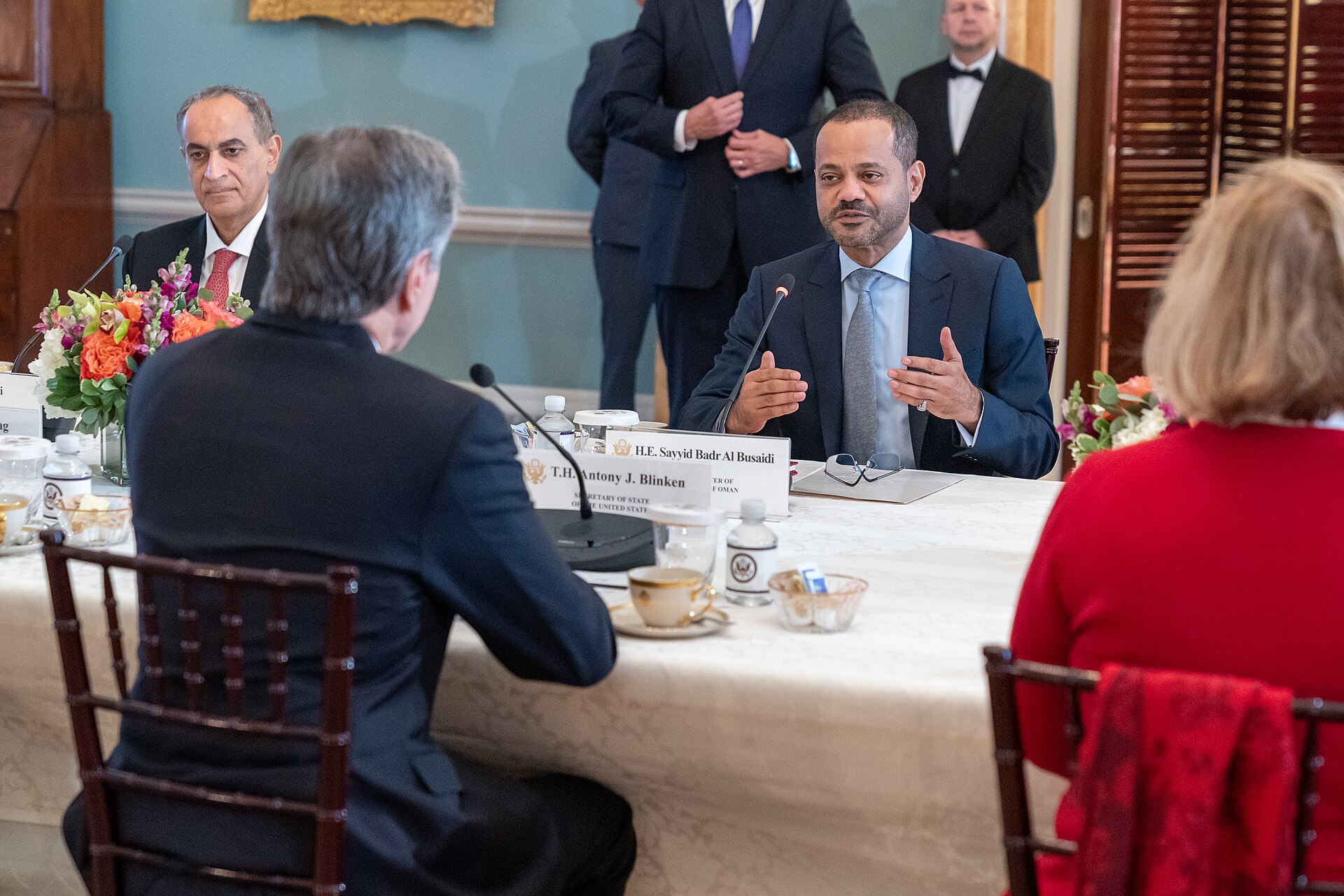
In Riyadh, the president formalized a nuclear cooperation framework placing no prohibition on Saudi enrichment and no time limit on the arrangement’s permissive terms. The ceremony accompanied a $142 billion defense package. Crown Prince Mohammed bin Salman stood beside Trump for the signing.
In Muscat, US negotiators were simultaneously pressing Iran to accept a moratorium on uranium enrichment lasting 12 to 20 years. Tehran had proposed five. The gap — with 12 to 15 years reportedly under discussion as of early May — applied to a state that US Energy Secretary Chris Wright characterized as “a small number of weeks away” from producing weapons-grade uranium.
The asymmetry sharpened on May 24 when a White House official claimed Iran had agreed to dispose of its HEU stockpile — the very material Washington demanded Tehran surrender while simultaneously permitting Riyadh to enrich. Tasnim denied the claim within hours. ‘Under No Circumstances’: Iran Denies HEU Agreement the White House Says Already Exists maps the contradiction between the US public claim and Iran’s categorical denial, and what a collapsed HEU track would mean for the 123 agreement’s enrichment architecture.
Iran holds approximately 400 to 440 kilograms of uranium enriched to 60 percent purity — the last IAEA-verified figure before Iran terminated inspector access on February 28, 2026. From 60 percent, the technical step to weapons-grade enrichment (90 percent) via Iran’s IR-6 centrifuge cascades is estimated at roughly 25 days to produce sufficient material for one device. Washington was negotiating to extend that timeline to decades. It was offering Riyadh a framework that imposes no timeline at all.
“Saudi Arabia’s nuclear pursuit seems less about rapid weaponization and more about preserving long-term options by anchoring technical autonomy while remaining formally within NPT commitments” — and that path “will not depend on Iran or the war’s outcome.”
— Nour Eid, Stimson Center, 2026
The administration has not publicly reconciled the two positions. When asked, officials have pointed to Saudi Arabia’s NPT membership, its stated peaceful intent, and the bilateral safeguards arrangement as distinguishing the Saudi framework from the Iranian nuclear file. Iran is in noncompliance with IAEA safeguards obligations. Saudi Arabia is not. But as critics observe, the standard Saudi Arabia is complying with — a Comprehensive Safeguards Agreement without an Additional Protocol, at facilities where US cooperation occurs — asks far less than what Washington is demanding Tehran accept.
Iran’s Article IV Argument and the NPT Review Conference
For twenty years, Iran has cited NPT Article IV — “the inalienable right of all the Parties to the Treaty to develop research, production and use of nuclear energy for peaceful purposes” — as the legal basis for its enrichment program. The US, the EU-3, and successive IAEA Boards of Governors have rejected the argument as inapplicable to a state in noncompliance with its safeguards obligations. The rejection rests on a specific legal reading: Article IV rights are conditioned on Article III compliance, and Iran has failed to meet its Article III obligations since at least 2003.
The Saudi 123 Agreement’s silence on enrichment prohibition does not explicitly validate Iran’s position. But it structurally concedes the underlying principle — that NPT signatories possess a sovereign right to enrich uranium for civilian purposes — by granting that right to a US partner without requiring the conditions Washington applies to adversaries. Iran’s foreign minister made precisely this argument in 2019, decrying “US hypocrisy” over planned nuclear transfers to Saudi Arabia.
At the 2026 NPT Review Conference, Iran’s delegation has pressed the discrimination argument with renewed force. The position draws support from non-nuclear-weapon states that view US nonproliferation enforcement as selectively applied — a concern The Diplomat described as doubt in “the treaty’s capacity to ensure uninterrupted, non-discriminatory access to nuclear technology.” The complaint predates the Saudi 123 framework. The framework gives it documentary evidence.
The pattern extends beyond the Gulf. The Trump administration has also relaxed US enrichment restrictions for South Korea, reversing decades of opposition. Critics at both FDD and the Stimson Center have described the emerging approach as “friendly proliferation” — a de facto policy of permitting enrichment for allies while treating the same capability as a potential casus belli for adversaries.
Iranian parliamentary spokesman Ebrahim Rezaei stated in May 2026 that Iran could enrich to 90 percent if attacked again. The statement was declaratory, not operational. But it reflected a political environment in Tehran where the Saudi enrichment concession is received as confirmation that the NPT’s bargain has been voided on selective terms — a reading that strengthens hardliners arguing Iran’s own enrichment should face no limits.
The Khan Network’s Shadow
Saudi Arabia’s nuclear history includes an episode the 123 framework does not acknowledge. In 1999, Prince Sultan bin Abdulaziz — then Second Deputy Prime Minister and defense minister, and a full brother of King Fahd — visited Pakistan’s Kahuta enrichment facility outside Islamabad. Western intelligence services reported that the Saudi delegation was shown components of a Pakistani nuclear weapon. The visit produced a formal US diplomatic protest to both Riyadh and Islamabad.
A.Q. Khan’s proliferation network sold centrifuge designs and components to three confirmed customers: Iran, Libya, and North Korea. Western officials — cited by the Center for Strategic and International Studies and the Washington Institute for Near East Policy — have described Saudi Arabia as an undisclosed fourth customer. The allegation has not been confirmed by either government. It has also not been denied in terms that satisfy the intelligence services that made it.
The connection carries present-day weight because the 123 Agreement’s bilateral safeguards apply only to US-origin nuclear cooperation. If Saudi Arabia retains access to non-US enrichment knowledge — whether from the Khan era, from parallel nuclear discussions with South Korea’s KEPCO, or from future partnerships with France or China — that knowledge base sits outside the agreement’s monitoring scope entirely.
Crown Prince Mohammed bin Salman addressed the weapons question directly in a March 2018 CBS “60 Minutes” interview. “Saudi Arabia does not want to acquire any nuclear bomb,” he said, “but without a doubt if Iran developed a nuclear bomb, we will follow suit as soon as possible.”
The statement has not been retracted. MBS has not repeated it publicly, but he has not walked it back. Read against the 123 framework’s permissive enrichment terms, Wright’s assessment that Iran is “a small number of weeks” from weapons-grade capability, and the fourteen-point nuclear proposal Washington sent to Tehran, the 2018 pledge describes a conditional weapons commitment by the leader of a state that is simultaneously securing the technical prerequisites to fulfill it.
Who Opposes the Deal and Why Does the Coalition Matter?
Opposition to the Saudi 123 framework’s enrichment terms spans the full ideological range of US foreign policy analysis — from the Arms Control Association to the Foundation for Defense of Democracies. The two organizations share almost no policy overlap on Iran sanctions, Israeli settlements, or defense budgets. On the Saudi 123 Agreement’s enrichment gap, they agree.
The Arms Control Association, a center-left organization with decades of nonproliferation work, has produced the most detailed public analysis. Davenport’s February 2026 issue brief — “Is Trump Jeopardizing Nonproliferation Efforts?” — mapped the legal and strategic implications of dropping the gold standard. A March follow-up, “US-Saudi Deal Said to Loosen Nonproliferation Vows,” documented the specific departures. The organization’s coverage has been continuous, technically precise, and consistently sourced to the agreement’s own language.
FDD’s Stricker reached the same conclusion from premises diametrically opposed to ACA’s institutional position. FDD has spent two decades advocating maximum pressure on Iran, defending Israeli security requirements, and criticizing arms control frameworks as insufficiently rigorous. Its opposition to the Saudi framework — that Washington should “require Riyadh to forgo enrichment and reprocessing under any 123 agreement” — is informed by the same proliferation concern that drives its Iran hawkishness.
Responsible Statecraft, a restraint-oriented publication, characterized the framework as Trump giving Saudi Arabia a “sweet nuclear deal” amid regional turmoil. The Stimson Center’s Nour Eid offered a structural assessment rather than a policy objection: the Saudi nuclear path would proceed regardless of the Iran war’s outcome, making the enrichment concession permanent rather than contingent.
The Bulletin of the Atomic Scientists added a temporal dimension, noting that the framework arrives during an active Gulf conflict and a live NPT Review Conference — conditions that amplify the precedent’s international visibility. Their convergence on the Saudi 123 Agreement is documented, public, and unrefuted by the administration.
KACARE and the Commercial Logic of Saudi Enrichment
Saudi Arabia’s enrichment ambitions are not purely strategic. The King Abdullah City for Atomic and Renewable Energy has framed the full nuclear fuel cycle as an economic sovereignty project under Vision 2030 — the same diversification logic that drives Saudi fiscal restructuring and megaproject investment across sectors from hydrogen to tourism to semiconductor fabrication.
KACARE’s original 2011 roadmap called for 16 nuclear reactors distributed across the Kingdom. Budget constraints and shifting priorities narrowed the near-term scope. Current plans center on a pair of large pressurized water reactors at Khor Duweihin on the Persian Gulf coast, with estimated construction costs of $18 to $22 billion. First concrete is targeted for the late 2020s. Commercial operation is expected in the early 2030s. The longer-term target — 17.6 GW of nuclear electricity by 2040 — would require additional reactor complexes and a domestic fuel supply chain to be commercially viable at scale.
The commercial argument for enrichment follows directly. Saudi Arabia holds confirmed uranium deposits. Importing enriched fuel from Russia’s Rosatom, France’s Orano, or US suppliers means permanent dependence on foreign entities for a strategic energy input at a moment when the Kingdom is spending hundreds of billions to reduce exactly that kind of dependence in hydrocarbons. Domestic enrichment and fuel fabrication would let Saudi Arabia supply its own reactors and potentially export nuclear fuel to emerging nuclear states across the Gulf and beyond.

This is the trade the UAE made in reverse. Abu Dhabi accepted permanent enrichment prohibition in exchange for guaranteed fuel supply assurances and the political credibility that the gold standard label conferred. Barakah’s four reactors run entirely on imported fuel. Saudi Arabia looked at that model and declined it — not because the economics were wrong for the UAE, but because the Kingdom regards fuel cycle autonomy as a prerequisite for a nuclear program of the scale KACARE envisions.
The enrichment question, in this framing, is not principally about weapons latency. It is about whether Saudi Arabia will be a consumer or a producer in the global nuclear fuel market. The 123 Agreement’s silence on enrichment prohibition answers that question in Riyadh’s favor — and incidentally provides the industrial infrastructure that could, under different political circumstances or a different reading of MBS’s 2018 CBS statement, serve military purposes at timescales measured in months.
Frequently Asked Questions
Has any other US 123 agreement besides the UAE’s included an explicit enrichment prohibition?
No. The US has signed 123 agreements with 48 countries; the UAE agreement is the only one containing an explicit enrichment and reprocessing prohibition. Japan maintains enrichment and reprocessing capabilities under its US 123 agreement, as does EURATOM. The UAE’s voluntary renunciation was unprecedented among US nuclear cooperation partners, which is why proponents labeled it a “gold standard” — it exceeded the legal baseline that Section 123 of the Atomic Energy Act requires. The term has always described an aspirational ceiling, not a regulatory floor.
What does the US-Saudi 123 framework actually permit to be transferred?
A 123 agreement authorizes transfers of nuclear material, equipment, components, and technology for peaceful purposes. Under the standard framework, this includes reactor fuel, reactor components, technical data, and potentially enrichment-related knowledge subject to bilateral safeguards. The Saudi framework does not publicly enumerate specific permitted technology categories. What it permits is bounded by the bilateral safeguards’ monitoring scope — and the safeguards cover only declared cooperation sites, leaving the permitted-technology list effective only at facilities the US already knows about.
What is the technical difference between 60 percent and 90 percent enriched uranium?
The gap is smaller than the numbers suggest. Enriching natural uranium (0.7 percent U-235) to 60 percent requires approximately 90 percent of the total separative work units. Moving from 60 percent to weapons-grade 90 percent requires only the remaining 10 percent. This asymmetry is why Iran’s stockpile at 60 percent — roughly 400 to 440 kilograms as of the last IAEA verification — is treated as near-weapons-grade material. The final enrichment step can be completed using a fraction of existing centrifuge capacity in an estimated one to four weeks, depending on cascade configuration and the number of devices sought.
Has Saudi Arabia signed the Comprehensive Nuclear-Test-Ban Treaty?
Saudi Arabia signed the CTBT on September 24, 1996, but has not ratified it. The treaty has not entered into force globally because eight Annex 2 states — including the United States, China, Egypt, Iran, and Israel — have also failed to ratify. Saudi Arabia’s signature without ratification creates a legal obligation not to act to defeat the treaty’s object and purpose under the Vienna Convention on the Law of Treaties, but it is not bound by the CTBT’s verification, on-site inspection, or enforcement provisions. Ratification would require Saudi Arabia to accept International Monitoring System stations on its territory.
What role does the US Nuclear Regulatory Commission play in approving 123 agreements?
The NRC must make a formal finding that a proposed 123 agreement meets the nonproliferation requirements of the Atomic Energy Act before the agreement can be transmitted to Congress and the 90-day review clock can begin. For the Saudi framework, the NRC would need to assess whether the bilateral safeguards arrangement provides adequate nonproliferation assurance — a determination that has historically relied on the presence of IAEA Additional Protocol-level verification. How the NRC will evaluate a framework that substitutes bilateral safeguards for the Additional Protocol has not been publicly addressed. The NRC’s internal deliberations on the Saudi agreement remain classified. When the Trump administration described the Iran deal framework as “largely negotiated” on May 23, the simultaneous operation of the 123 agreement and the Iran enrichment moratorium crystallised the asymmetry this article documents; a structural cost analysis is published here. The broader diplomatic context in which the 123 agreement sits shifted further on May 20, when Saudi FM bin Farhan publicly endorsed Trump’s decision to cancel the Iran strike, aligning Riyadh publicly with Washington’s restraint posture for the first time since the war began.