NEOM has cancelled its EUR 1.4 billion ($1.6 billion) high-speed rail contract with Italian construction firm Webuild, effective May 27, eliminating the only planned surface-level transport link between the megaproject’s industrial port and its linear city. It is the second Webuild termination at NEOM in sixty days, and it pushes total known contract cancellations at the $500 billion development past $8.45 billion since late 2025.
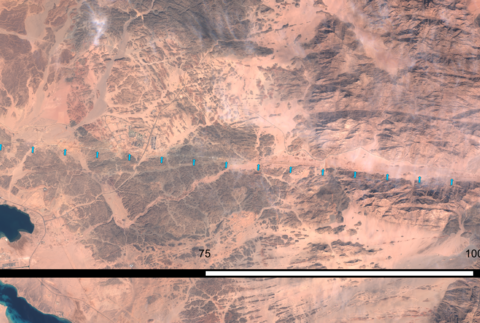
The Connector High-Speed Line was a 57-kilometre rail system designed to link Oxagon — NEOM’s octagonal industrial hub on the Red Sea coast — to The Line, the 170-kilometre linear city that remains Vision 2030’s most internationally recognised and most visibly stalled component. Works were roughly 20 per cent complete when NEOM pulled the plug, according to a Webuild press release issued May 21. The cancellation lands six weeks after PIF Governor Yasir Al-Rumayyan told reporters that “PIF has not cancelled any project in NEOM” — a statement now contradicted by contract terminations whose combined value exceeds the GDP of several Gulf states.
Table of Contents
What the Connector Was Designed to Do
The Connector HSR contract was awarded to a Webuild-led joint venture on May 11, 2023, covering the design and construction of two high-speed passenger rail lines and two freight lines, along with viaducts, road bridges, and underpasses across 57 kilometres of desert terrain. Webuild held 70 per cent of the joint venture through its Saudi subsidiary Salini Saudi Arabia, with local partner Shibh Al Jazira Contracting Company (SAJCO) holding the remaining 30 per cent. The design speed was set at up to 230 km/h — fast enough to make the run from The Line to Oxagon in under 20 minutes, and fast enough to make the two zones function as a single economic unit rather than isolated nodes separated by open desert.
The route was not ornamental. It ran through Neom City Station, Neom Bay Mansions, and Neom Bay Airport before terminating at Oxagon, threading the planned residential and commercial core of The Line to the industrial port that PIF has since designated as NEOM’s priority node. In the original masterplan, the Connector served as the external mobility spine between zones, while a separate underground system called The Spine was designed to run the full 170-kilometre length of The Line internally, carrying passengers and freight beneath the mirrored walls.
The airspace disruption adds another layer to NEOM’s connectivity deficit. KLM extended its suspension of Riyadh and Dammam flights through July 12, the fourth extension since European carriers were grounded in March 2026 — closing the primary European route into the region that was to supply international contractors, tourists, and residents to a project already losing its transport infrastructure from within.
A critical junction linked the two systems. The Spine’s Delta Junction — the interchange where the internal underground rail was to meet the external Connector — was part of a 12.5-kilometre tunnel contract held by a consortium of Hyundai Engineering & Construction, Samsung C&T, and Archirodon. That contract was also terminated, in late 2025 or early 2026, with Hyundai confirming the cancellation was “due to a request for contract termination due to the client’s project restructuring.” The interchange between NEOM’s two rail networks no longer exists in any active construction programme, and the Connector’s cancellation removes the last remaining rail link between the megaproject’s zones.
The Middle East briefing 3,000+ readers start their day with.
One email. Every weekday morning. Free.
Sixty Days, EUR 4.2 Billion: Webuild’s Complete Exit
The Connector is the second time in approximately sixty days that NEOM has exercised a “termination for convenience” clause against Webuild. The first came on March 29, when NEOM terminated Webuild’s EUR 2.8 billion contract for the Trojena dam system — three dams designed to feed a 2.8-kilometre artificial freshwater lake at NEOM’s planned mountain resort, where Trojena was scheduled to host the 2029 Asian Winter Games. That contract was roughly 30 per cent complete at the point of termination, meaning more engineering had been delivered and then discarded at Trojena than at the Connector.
Combined, NEOM has cancelled EUR 4.2 billion in Webuild-only backlog in fewer than two months. “Termination for convenience” is a standard contractual mechanism that allows a client to end a contract without alleging performance failure on the contractor’s part; NEOM reimburses sunk costs and demobilisation expenses but owes nothing beyond that. Webuild stated in both instances that it would be “left unharmed by the effects of the termination,” and confirmed that no arbitration or compensation claims have been filed in either case.
With the May 27 termination, Webuild made the exit explicit: “This termination concludes all of Webuild’s activities for NEOM.” The Italian firm — one of the world’s largest infrastructure contractors, with a global order book exceeding EUR 60 billion — has been fully removed from Saudi Arabia’s flagship gigaproject barely three years after being awarded what was then marketed as one of the largest rail contracts in the Middle East. At the point of cancellation, approximately EUR 1 billion in Connector backlog remained undelivered, though Webuild had already confirmed the contract would generate no revenue in 2026. Contract awarded May 2023, terminated May 2026, with 80 per cent of the work never built.
“This termination concludes all of Webuild’s activities for NEOM.”
— Webuild Group press release, May 21, 2026
The $8.45 Billion Termination Ledger
Webuild is not alone. When its two terminations are combined with the Hyundai E&C tunnel, Eversendai Corporation’s structural steel and fireproofing contract for the Trojena ski village (terminated late March 2026), and the Moonlight desalination plant (cancelled at the tender stage before any construction contract was signed), total known NEOM contract backlog terminated since late 2025 exceeds $8.45 billion, according to figures derived from contractor disclosures tracked by Construction Week Online and MEED.
| Contractor | Contract | Value | Terminated | Completion |
|---|---|---|---|---|
| Webuild / SAJCO (70/30 JV) | Connector HSR — Oxagon to The Line (57 km) | EUR 1.4bn (~$1.6bn) | May 27, 2026 | ~20% |
| Webuild / SAJCO | Trojena dam system + The Bow | EUR 2.8bn (~$3.2bn) | March 29, 2026 | ~30% |
| Hyundai E&C / Samsung C&T / Archirodon | Delta Junction tunnel — The Spine (12.5 km) | Not separately disclosed | Late 2025 / Early 2026 | Not disclosed |
| Eversendai Corporation | Trojena ski village structural steel & fireproofing | Not separately disclosed | Late March 2026 | Not disclosed |
| N/A (tender stage) | Moonlight desalination plant | N/A — pre-award | 2026 | Pre-construction |
| Total known NEOM contract backlog terminated since late 2025: >$8.45 billion (Sources: Webuild, Hyundai E&C, Eversendai disclosures; Construction Week Online; MEED) | ||||
The scale has to be read against what PIF itself has disclosed. Total PIF construction spending commitments across all portfolio companies dropped from $71 billion to $30 billion — a 58 per cent reduction — according to AGBI reporting in January 2026. The $8.45 billion in known NEOM terminations alone accounts for more than a quarter of that surviving $30 billion envelope. Tim Callen, visiting fellow at the Arab Gulf States Institute in Washington and a former IMF mission chief for Saudi Arabia, has argued the cuts reflect a necessary correction: “It makes sense they are cutting capex because previous ambitions were too lofty,” he told AGBI.
What distinguishes the NEOM terminations from a typical procurement adjustment is the nature of what has been cut. These are not peripheral contracts for landscaping or fit-out — they are the rail, tunnel, dam, and water systems that were supposed to turn a collection of branded zones into a functioning city. Without them, the zones do not connect, the resort does not have water, and the linear city does not have a transport spine.
Has PIF Cancelled Projects at NEOM?
On April 15, 2026, Al-Rumayyan appeared before reporters to unveil PIF’s board-approved 2026–2030 strategy. He was asked directly about NEOM contract cancellations and gave a categorical answer: “PIF has not cancelled any project in NEOM.” He described the changes as delays to projects “not on the critical path” and pushed back against what he called a “misconception” that The Line represents the entirety of NEOM. The comments, carried by Al Arabiya Business, Zawya, and Arabian Business, became the official framing.
“Transparent adjustments to the projects would be well received by investors and should not be seen as ‘losing face’. It is a sign of mature policymaking to adjust projects as new information becomes available.”
— Tim Callen, Visiting Fellow, Arab Gulf States Institute in Washington; former IMF Mission Chief for Saudi Arabia
The framing is careful but it is now running into hard facts moving in the opposite direction. Since Al-Rumayyan made that statement, an additional EUR 1.4 billion in contracts has been terminated. The contractor holding the largest single share of NEOM’s cancelled backlog has publicly confirmed that all of its Saudi megaproject activities are finished. There is a semantic distinction between cancelling a project and cancelling every active contract within a project, but it is a distinction that requires The Line (suspended, 1.4 per cent built), the Trojena dam system (terminated at 30 per cent), the Connector HSR (terminated at 20 per cent), the Delta Junction tunnel (terminated), and the Trojena ski village steelwork (terminated) all to be classified as merely “delayed” despite none of them having an active construction contract or an announced replacement.
No statement has been issued by NEOM or PIF specifically addressing the May 27 Connector cancellation. The pattern across all five known terminations is the same: NEOM exercises its contractual right quietly, the contractor discloses through regulatory filings, and PIF’s public messaging remains unchanged. Whether “not on the critical path” can credibly describe the only rail line connecting NEOM’s two primary zones is a question the framing was not designed to answer.
Where Does the Money Go Instead?
The contraction at NEOM is unfolding against a fiscal backdrop that makes continued spending at prior levels arithmetically difficult. Saudi Arabia posted a first-quarter deficit of $33.5 billion (SR125.7 billion) in 2026 — already 194 per cent of its full-year target — driven in part by a 26 per cent surge in defence expenditure linked to the Iran war. Bloomberg Economics puts the Saudi fiscal breakeven oil price at $108–111 per barrel; Brent has recently traded below $100 on Iran deal optimism, widening the gap between what the government needs and what the market will give it.
PIF’s response is visible in where the capital is going. The fund’s 2026–2030 strategy commits 80 per cent of new investment domestically but has reweighted decisively toward technology and defence over physical infrastructure. The most prominent beneficiary is HUMAIN, PIF’s artificial intelligence subsidiary, which secured $5.3 billion in Goldman Sachs financing in May 2026 for a 2-gigawatt data centre build at Oxagon — a sum that nearly matches the EUR 4.2 billion ($4.8 billion) in Webuild contracts that NEOM discarded in the same two-month window. As Bloomberg has reported, Saudi Arabia “brought forward some planned spending on infrastructure and food imports to soften the impact of the Iran war,” and the megaproject capital freed by terminations becomes part of that reallocation arithmetic.
The substitution has its own internal logic. Vision 2030’s construction-led showcase is being replaced, contract by contract, by a technology-led pivot anchored in Oxagon and oriented toward locking in NVIDIA chip access and sovereign AI capacity before the geopolitical window narrows further. Al-Rumayyan signalled as much when he told reporters that having The Line operational by 2030 was “not important” but that “what we must have is Oxagon.” What remains open is whether the rail, the tunnels, and the water infrastructure were deferred to some future budget cycle or have been abandoned as relics of a spending era that the war and the oil price have jointly closed.
The reason Al-Rumayyan’s assessment of Oxagon diverges so sharply from the rest of the NEOM portfolio is explained by the war itself: Oxagon’s port infrastructure is the one component whose commercial thesis the Iran conflict has strengthened rather than destroyed, with DataVolt’s $5 billion data-centre campus and the Port of NEOM’s multimodal corridor both advancing while billions in contracts elsewhere were cancelled.
What Is Left of NEOM’s Transport Network?
Before The Line’s suspension in September 2025, approximately 2.4 kilometres of foundation work had been completed out of a planned 170 kilometres — roughly 1.4 per cent of the total structure. PIF subsequently wrote down approximately $8 billion from the project, and the 2030 population target was slashed from 1.5 million to fewer than 300,000, an 80 per cent reduction. The mirrored cladding that dominated the renders and the press conferences exists only in those renders.
The Connector HSR was to provide the external rail link between zones. The Spine was to run internally along The Line’s full 170-kilometre length. The Delta Junction tunnel was to connect the two systems. All three have been terminated, with no replacement procurement announced and no alternative surface transport strategy disclosed by NEOM or PIF. There is, as of May 27, no active rail-construction programme at NEOM connecting any zone to any other zone.
What remains is Oxagon, which PIF has elevated to priority status, and a set of zone-level infrastructure packages whose status is not systematically disclosed. The industrial port does not need a high-speed passenger rail link to function — it needs roads, a jetty, and a grid connection, all of which are understood to be further advanced than The Line’s rail infrastructure ever was. But a NEOM in which Oxagon operates as a standalone industrial site while The Line consists of a 2.4-kilometre trench in the desert is a fundamentally different proposition from the one that attracted EUR 4.2 billion in Webuild contracts three years ago.
Webuild’s language remains the cleanest epitaph for what was promised. “This termination concludes all of Webuild’s activities for NEOM.” For one of the world’s largest infrastructure firms, the megaproject is already past tense. For PIF, it is something “not on the critical path.” The rails that were supposed to hold the future together are not being built, and the gap between the two framings is now measured in billions.
Frequently Asked Questions
What happens to the 2029 Asian Winter Games at Trojena?
Trojena was selected to host the 2029 Asian Winter Games, and the now-cancelled three-dam system was the water-supply backbone for the venue — designed to feed a 2.8-kilometre freshwater lake used for snow-making and venue operations. No public statement has been issued by either NEOM or the Olympic Council of Asia regarding the status of the Games following the March 2026 dam cancellation. The Games are currently scheduled for February 2029, fewer than three years away, and no alternative water-supply infrastructure has been announced.
Is Webuild pursuing compensation or arbitration?
No. Both NEOM terminations were executed under “termination for convenience” clauses, which allow the client to end the contract without alleging contractor default. NEOM reimburses work completed and demobilisation costs but is not liable for lost future revenue or profits. Webuild confirmed in both its March and May 2026 disclosures that it expected to be “left unharmed” by the terminations and that no arbitration proceedings have been initiated against NEOM.
Has the cancellation affected Webuild’s financial guidance?
Webuild maintained its full-year 2026 revenue and profitability guidance following both NEOM terminations. The remaining EUR 1 billion in Connector HSR backlog was not expected to generate revenue in 2026, and Webuild’s total global order book exceeds EUR 60 billion, meaning its NEOM exposure — large in absolute terms — represented a contained share of the group’s forward pipeline.
What is the Moonlight desalination plant?
Moonlight was a planned desalination facility at NEOM that was cancelled after reaching only the tender stage, before any construction contract was formally awarded. Its termination carries less financial weight than the Webuild or Hyundai E&C cancellations but extends the pattern of scope reduction into NEOM’s water and utility layer, where procurement is being halted before contracts are even signed — suggesting the cuts are not confined to projects that proved difficult to build but extend to ones that were never allowed to begin.
Are any major international contractors still active at NEOM?
Increasingly difficult to confirm from public disclosures. Webuild has confirmed its complete exit, Hyundai E&C’s Delta Junction tunnel has been terminated, and Eversendai’s Trojena steelwork is cancelled. Construction activity continues at Oxagon and on zone-level packages, but NEOM has not published a systematic update on which international contractors retain active work since it began exercising termination clauses in late 2025. The most visible remaining activity is at Oxagon’s port and industrial infrastructure, where road and utility works are understood to be continuing under separately contracted packages.