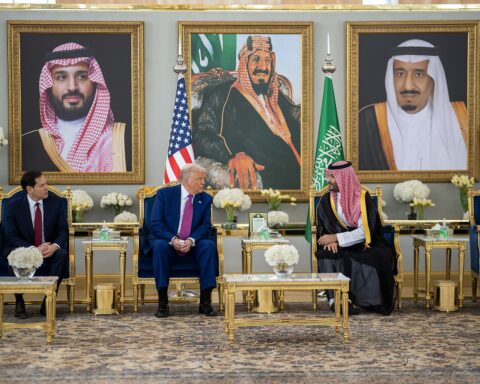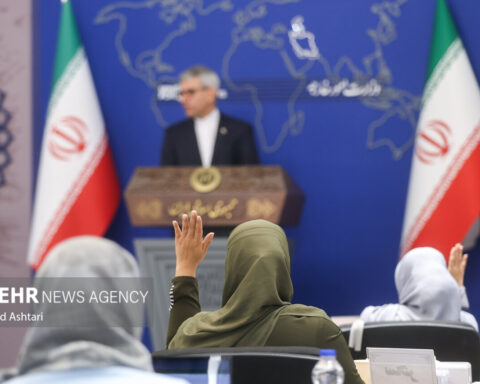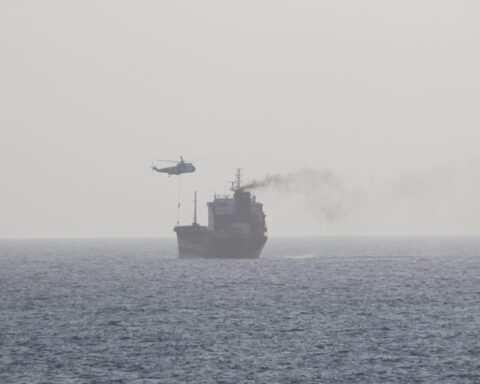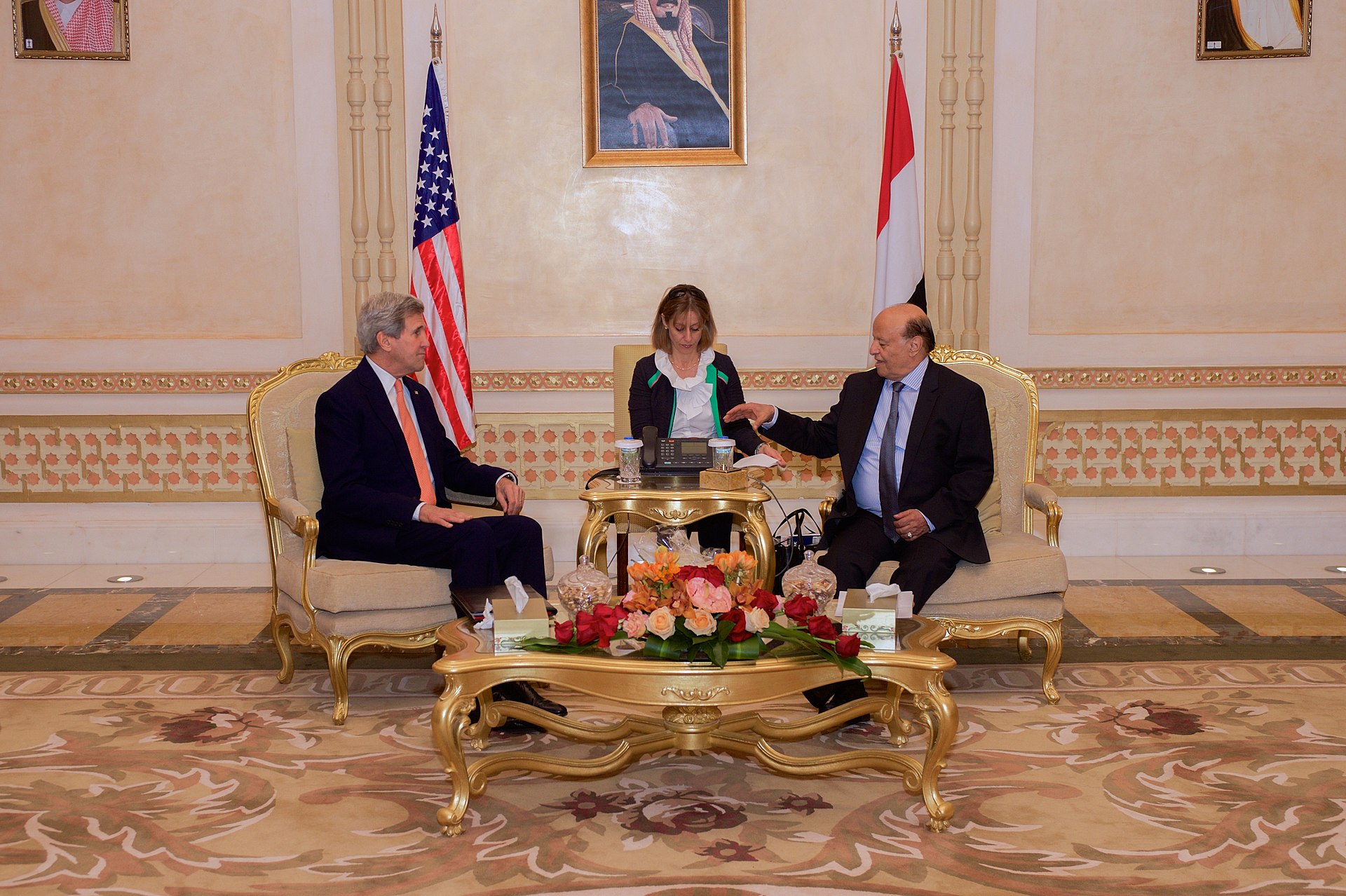

RIYADH — Abd Rabbuh Mansur Hadi, the exiled former president of Yemen whose March 2015 letter to the Arab League and United Nations provided the sole legal predicate for Saudi Arabia’s longest military campaign, died of a heart attack in Riyadh on May 28, 2026. He was 80. The legal architecture his signature sustained had already collapsed four years earlier, when Crown Prince Mohammed bin Salman forced him to surrender the presidency to a council handpicked in Riyadh. No equivalent instrument has been constructed for the war Saudi Arabia is fighting now.
Hadi’s death is being mourned in Sana’a and noted in diplomatic cables. But its significance is structural. Every military intervention Saudi Arabia has conducted since 1990 operated under a specific legal mechanism: a victim state’s written request invoking the UN Charter’s collective self-defense provisions. The 1990 Gulf War had Kuwait’s Amir. The 2015 Yemen intervention had Hadi’s letter. The 2026 war against Iran — in which the Royal Saudi Air Force has conducted strikes on Iranian territory, Saudi energy installations have absorbed Iranian missiles, and Saudi military personnel have suffered casualties acknowledged only in a Hajj logistics itinerary — has nothing.
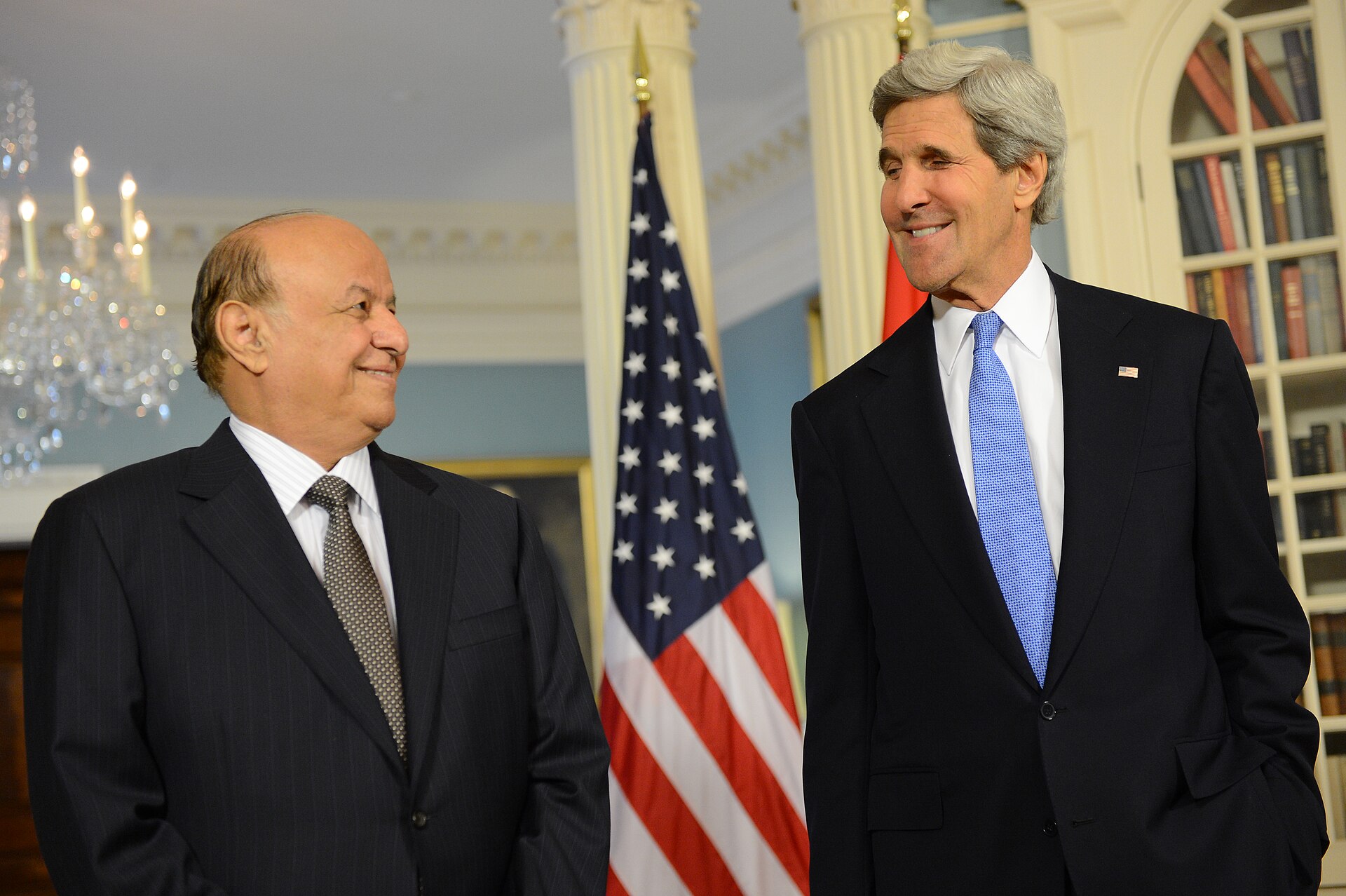
Table of Contents
- The Letter That Started a Decade of War
- What Legal Authority Did Hadi’s Signature Actually Carry?
- The President Saudi Arabia Kept and Then Discarded
- How Did Decisive Storm Outlive Its Own Legal Basis?
- The 1990 Template Saudi Arabia Cannot Repeat
- What Legal Framework Covers Saudi Arabia’s 2026 War?
- Does the GCC Article 51 Filing Authorize Saudi Strikes on Iran?
- The Silence That Serves Two Governments
- Frequently Asked Questions
The Letter That Started a Decade of War
On March 24, 2015, Hadi — by then already in exile, having fled Sana’a as Houthi forces advanced on Aden — transmitted a letter through Yemen’s permanent representative to the United Nations. Addressed to the presidents of the UN Security Council, the Arab League, and the Gulf Cooperation Council, it requested “immediate support, by all necessary means and measures, including military intervention, to protect Yemen and its people from the continuing aggression by the Houthis.”
The letter invoked “the principle of self-defense in Article 51 of the Charter of the United Nations” and “the Charter of the Arab League and the treaty of joint Arab defense.” Two days later, on March 26, Saudi Arabia launched Operation Decisive Storm, a coalition air campaign involving ten countries — the UAE, Bahrain, Kuwait, Qatar, Jordan, Egypt, Morocco, Sudan, Senegal, and Saudi Arabia itself, which led the operation. Three weeks after that, UNSC Resolution 2216 — adopted 14-0 with Russia abstaining on April 14, 2015 — referenced Hadi’s letter in its preamble and affirmed the legitimacy of his government.
The legal sequence mattered. International law requires that collective self-defense be exercised at the request of the state under attack. Without Hadi’s letter, there was no requesting state. Without a requesting state, there was no Article 51 basis. Without an Article 51 basis, a ten-nation bombing campaign inside a sovereign country would constitute an act of aggression under the UN Charter.
Hadi was not a popular president. He had won a single-candidate election in February 2012 as part of a GCC-brokered transition plan following the departure of Ali Abdullah Saleh. His two-year transitional mandate, endorsed by UNSC Resolution 2014, had expired in February 2014. He had submitted a resignation letter in January 2015 — which he later rescinded, though Iran and the Houthis argued the rescission was invalid. Tom Ruys and Luca Ferro, writing in the International and Comparative Law Quarterly in 2016, concluded that “the self-defence justification, primarily relied upon, does not provide a convincing legal basis for the operation.”
The Middle East briefing 3,000+ readers start their day with.
One email. Every weekday morning. Free.
None of this prevented the letter from functioning as intended. It gave Saudi Arabia and nine partner states a legal instrument they could file at the United Nations. Whether that instrument was persuasive to international law scholars was secondary to the coalition’s operational requirements. It existed. It bore a presidential signature. It cited the correct article of the correct charter.
What Legal Authority Did Hadi’s Signature Actually Carry?
Hadi’s letter rested on a specific claim: that he was the legitimate president of Yemen, and that his government was under armed attack by a non-state actor supported by a foreign power. The Article 51 invocation required both elements — a recognized government, and an armed attack from outside — to hold.
The first was contested from the start. Hadi’s transitional mandate had expired a year before his letter was written. He had resigned under duress in January 2015 before rescinding that resignation. The Houthis and their allies controlled the capital, the presidential palace, and most government ministries. The question of who constituted “the government of Yemen” was, at minimum, a matter of competing claims — though the UN and most member states continued to recognize Hadi.
The second element was more straightforward but legally awkward. Article 51 of the UN Charter addresses the right of self-defense “if an armed attack occurs against a Member of the United Nations.” The Houthis were not a foreign army. They were Yemeni nationals fighting a civil war on Yemeni soil. The scholarly consensus was that Article 51 was designed for interstate conflict, not internal insurgencies.
“The intervention is problematic from the perspective of the intervention by invitation doctrine and undeniably exposes its indeterminacy and proneness to abuse.”
— Tom Ruys and Luca Ferro, International and Comparative Law Quarterly, 2016
Hadi’s letter papered over this distinction by framing the Houthi advance as Iranian aggression conducted through a proxy — arms shipments, advisory personnel, missile technology transferred across the Gulf of Aden and through Oman. This framing was politically useful but legally novel. It required accepting that Iranian material support for the Houthis constituted an “armed attack” by Iran against Yemen, which would trigger the right to collective self-defense.
As Lawfare noted at the time, the international legal justification for the Yemen intervention was something you could “blink and miss.” The coalition did not wait for a Security Council authorization to use force; Resolution 2216 came three weeks after the bombing started, and it imposed an arms embargo and travel bans rather than authorizing military action. The legal basis was, in practice, Hadi’s letter and nothing else.
The President Saudi Arabia Kept and Then Discarded
From 2015 until his death, Hadi lived in Saudi Arabia. His presence in Riyadh served a dual function: he was the head of state whose request legitimized the military campaign, and he was a guest whose movements and communications the Saudi government controlled.
The Wall Street Journal reported in April 2022 that Hadi was “effectively under house arrest at his residence in Riyadh without access to phones.” A few Yemeni politicians had been permitted to visit, but only with Saudi government approval. The house arrest reportedly intensified after Hadi met privately with a US official — a meeting Riyadh had not authorized. The arrangement reduced Hadi to his legal function: a name on a letter, a signature on a request, a title recognized by the United Nations. His political agency was immaterial; his legal person was indispensable.
Abdulmalik al-Mekhlafi, Hadi’s former foreign minister, wrote on X after the death was announced: “I believe that the man was not given his due justice as he deserved, neither during his period of rule nor even before it, as an image was formed around him in the media that was often far from his true reality.”
The irony is structural. Saudi Arabia needed Hadi’s legal person — his signature, his title, his recognition by the United Nations — but did not need, or want, his political agency. A president who could authorize a war was useful. A president who might negotiate independently with the Houthis, or establish a back channel to Washington without Saudi knowledge, was a liability.
On April 7, 2022, Hadi announced he was transferring all presidential powers to a newly formed Presidential Leadership Council, chaired by Rashad al-Alimi — a former interior minister with close ties to both Riyadh and Washington. The council included eight members representing competing Yemeni factions, several of them aligned with the UAE rather than Saudi Arabia. The transfer was structured as Hadi’s voluntary decision. The Wall Street Journal, Middle East Eye, and Al Mayadeen reported that MBS presented Hadi with a written decree transferring his authority and that Saudi officials threatened to publicize allegations of corruption if he resisted.
MBS pledged $3 billion in economic support for Yemen following the transfer. The PLC took office. Hadi disappeared from public life entirely. Yemen’s presidency declared three days of national mourning after his death on May 28, but the man had been politically dead since April 2022. Asharq al-Awsat, the Saudi-owned broadsheet, described him in its obituary as “a quiet institutional figure who preferred to work behind the scenes” — a framing that captured his forced passivity while eliding the hands that enforced it.
How Did Decisive Storm Outlive Its Own Legal Basis?
Operation Decisive Storm lasted 27 days. On April 21-22, 2015, Saudi Arabia announced that its military objectives had been “successfully achieved” and renamed the campaign Operation Restoring Hope. The name changed. The airstrikes did not stop.
Hadi’s letter had authorized “military intervention.” It did not specify a duration, a scope of operations, or conditions for termination. When the coalition transitioned from Decisive Storm to Restoring Hope, no new legal instrument was issued. No updated Article 51 notification was filed. The original letter — written by a president in exile against forces that continued to control the capital — was treated as a perpetual authorization.
This mattered because the nature of the conflict changed beyond anything Hadi’s letter contemplated. By 2017, the coalition was conducting airstrikes on civilian infrastructure — hospitals, school buses, wedding halls — that bore no relationship to the original Houthi advance on Aden. By 2019, the UAE had largely withdrawn its ground forces while maintaining proxy fighters in the south. By 2022, the year Hadi was forced to transfer power, the military campaign had evolved into a stalemate sustained by inertia rather than legal mandate.
The April 2022 power transfer formally severed the legal chain. Hadi was no longer president. The PLC, which replaced him, did not issue a new intervention request. Resolution 2216 remained technically in force, but its preamble referenced “the President of Yemen” — a title Hadi no longer held, and one the PLC chairman did not inherit in the same legal sense. The UN-mediated truce that followed in April 2022 effectively suspended military operations without resolving the underlying legal question.
Hadi’s death on May 28, 2026, is a biological footnote to a legal event that occurred four years earlier. The instrument died in April 2022. The man who signed it died in May 2026. No one built a replacement for either.
The 1990 Template Saudi Arabia Cannot Repeat
Saudi Arabia has participated in three major military conflicts since 1990. Each followed a distinct legal architecture — until the third abandoned the pattern entirely.
| Element | 1990-91 (Desert Storm) | 2015-22 (Decisive Storm) | 2026 (Iran conflict) |
|---|---|---|---|
| Victim state request | Amir of Kuwait, August 12, 1990 | President Hadi, March 24, 2015 | None received by Saudi Arabia |
| Article 51 filing | Kuwait + coalition members | Saudi Arabia citing Hadi letter | GCC joint filing (March 26, 2026) + Saudi individual filing (~April 4-5) — both cite Kuwait |
| UNSC resolution | Res. 678: “all necessary means” | Res. 2216: arms embargo, travel bans | Res. 2817: affirms Kuwait self-defense; no force authorization |
| Named operation | Desert Shield / Desert Storm | Decisive Storm / Restoring Hope | None |
| War declaration (domestic) | N/A (Basic Law adopted 1992) | Not issued | Not issued |
| Saudi combat role | Host nation + coalition member | Coalition leader | Undeclared co-belligerent |
| Legal basis for offensive ops | UNSC Res. 678 + Kuwait request | Hadi letter + Article 51 | None publicly stated |
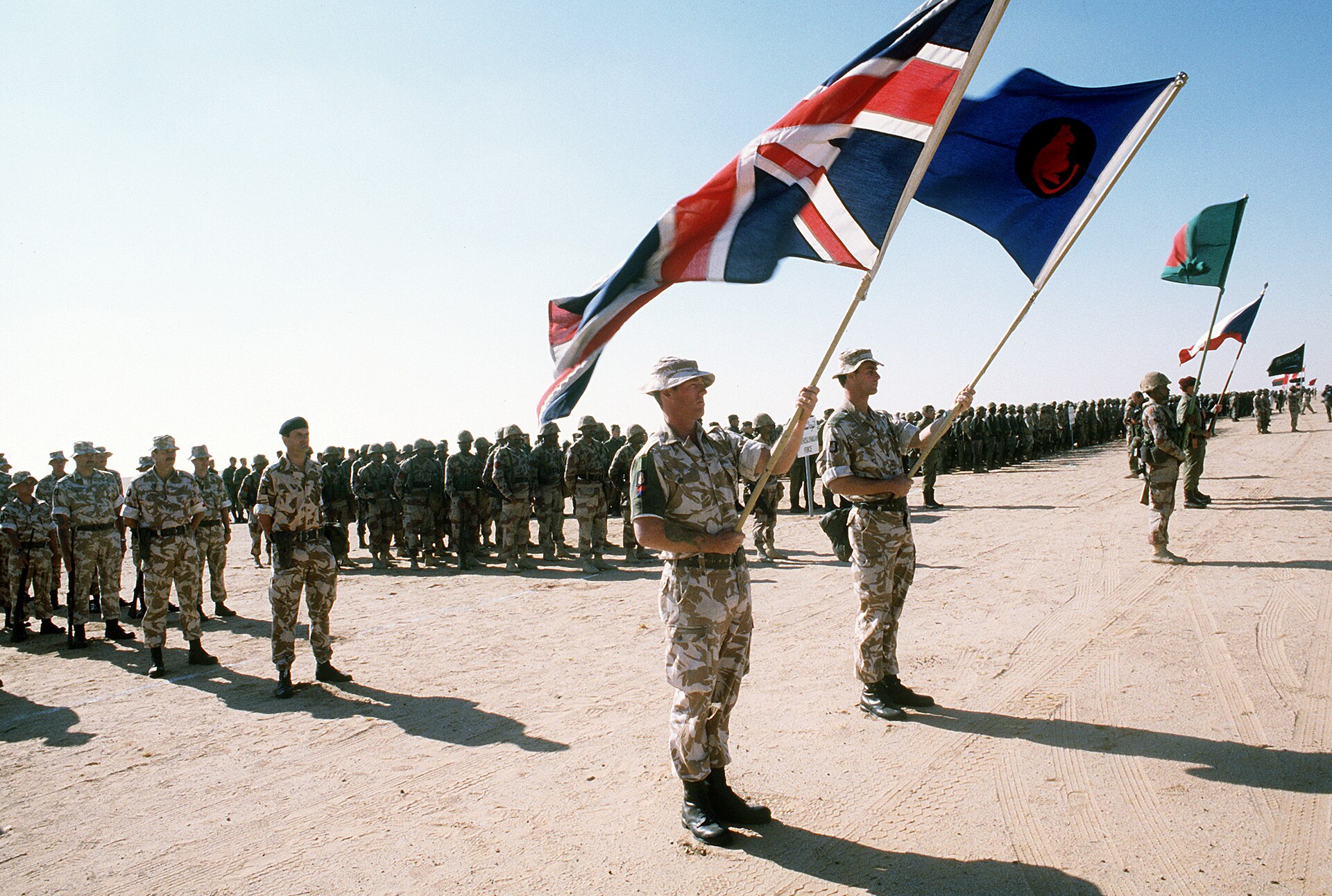
The 1990 model was the cleanest. Iraq invaded Kuwait on August 2, 1990. The Amir of Kuwait sent a formal request for military assistance on August 12. Kuwait and its allies filed Article 51 notifications. The Security Council passed a series of resolutions culminating in Resolution 678 on November 29, 1990, which authorized “all necessary means” to restore Kuwaiti sovereignty. The coalition launched Operation Desert Storm on January 17, 1991, with international legal cover at every layer: victim state request, Article 51 notification, and Security Council authorization.
Saudi Arabia’s role in 1990 was primarily as host — King Fahd invited the US-led coalition to deploy on Saudi territory. The legal machinery was external to Saudi Arabia.
The 2015 model was a Saudi-constructed copy of this template, built with thinner materials. With no Iraqi-style invasion to point to and no Security Council pre-authorization, the coalition constructed its legal basis on a single document: Hadi’s letter. It was weaker than the 1990 precedent — scholars contested it, the Security Council never authorized force, and the requesting president’s own legitimacy was disputed — but it followed the same structural logic. A recognized head of state requests military assistance, which triggers Article 51 collective self-defense.
The 2026 model has no equivalent at any layer. No head of state has requested Saudi military intervention against Iran. Saudi Arabia’s Article 51 filings cite collective defense of Kuwait, not self-defense of Saudi territory. The kingdom is conducting offensive military operations against a sovereign state without a requesting state, without a named operation, without a royal decree, and without a publicly stated legal basis for its strikes on Iranian soil.
What Legal Framework Covers Saudi Arabia’s 2026 War?
The answer, as of May 30, 2026 — Day 92 of the conflict — is that no single legal instrument authorizes Saudi Arabia’s military operations against Iran.
Saudi Arabia has not issued a Royal Decree under Basic Law Article 61, which states: “The King declares a state of emergency, general mobilization and war, and the law defines the rules for this.” No such decree has been published, debated, or acknowledged. Article 62, which provides for “urgent measures” when national security is threatened, is the operative provision MBS appears to rely on implicitly — but Article 62 creates executive authority for domestic emergency action. It does not confer international legal standing for cross-border strikes on another sovereign state’s territory.
Saudi Arabia has not filed an individual Article 51 notification citing self-defense of Saudi territory. Its filings reference Kuwait. Article 51 permits both individual and collective self-defense, but the framing carries consequences. Saudi Arabia has absorbed direct Iranian missile strikes on its own soil — Prince Sultan Air Base struck, Aramco facilities hit, military personnel killed — yet its legal posture at the United Nations describes a country fighting on behalf of a neighbor, not defending itself.
Foreign Policy reported on April 24, 2026, that Riyadh positioned itself as a neutral arbiter, “expressing vague ‘concern over escalation’ and urging ‘self-restraint’ from all sides, as if Iran had not struck at least four Saudi energy installations, inflicting billions worth of damage.” The magazine also reported that Saudi Arabia conducted “multiple unpublicized strikes on Iranian territory in late March 2026” — offensive combat operations with no named operation, no legal instrument, and no public acknowledgment.
Saudi Arabia has not named its military operations. There is no “Decisive Storm” for the Iran conflict, no operational designation, no Saudi military spokesman briefing the press. When MBS thanked his generals at the Mina Palace Eid reception, his language referenced “the crises the region is experiencing” — acknowledging military service without naming a war, an enemy, or an operation.
Professor Ben Saul, an international law scholar, has argued that international law “does not permit states to use force to eliminate a perceived future threat” and that strikes against another country’s capabilities “are unlawful unless in response to an actual or truly imminent armed attack.” Yusra Suedi, assistant professor of international law at the University of Manchester, assessed that there are grounds to believe the attacks against Iran “may amount to a crime of aggression — an act of use of force that was unjustified.”
In the 1990 and 2015 models, Saudi Arabia could point to a document. The document might have been contested by scholars and adversaries, but it existed and carried a signature. In 2026, the Royal Saudi Air Force is bombing a country across the Gulf while the foreign ministry issues no statements explaining why.
Does the GCC Article 51 Filing Authorize Saudi Strikes on Iran?
On March 26, 2026 — exactly eleven years to the day after Operation Decisive Storm launched against Yemen — Saudi Arabia joined five other Arab states in a joint declaration invoking Article 51 of the UN Charter against Iran. The filing cited Iranian missile and drone attacks on GCC member states and affirmed the right to collective self-defense.
Saudi Arabia subsequently filed an individual Article 51 notification in early April 2026, citing collective self-defense on behalf of Kuwait. UNSC Resolution 2817, adopted 13-0 on March 11, 2026, with 135 co-sponsors, affirmed Kuwait’s right to self-defense. The resolution did not authorize coalition use of force against Iran.
The legal problem is one of framing. Saudi Arabia’s Article 51 filings describe the kingdom as defending Kuwait, not itself. This creates an asymmetry: Saudi Arabia has absorbed direct Iranian strikes on its own soil, yet its legal posture at the United Nations is that of a third party acting in solidarity with a threatened neighbor. The 1990 model worked this way — Saudi Arabia fought to liberate Kuwait — but in 1990, the Security Council authorized “all necessary means” under Resolution 678. Resolution 2817 contains no equivalent language.
There are practical reasons for this framing. Filing an individual Article 51 notification for Saudi territory would constitute a formal Saudi acknowledgment that it is in a bilateral armed conflict with Iran. That step carries obligations under international humanitarian law, triggers questions about why the kingdom is conducting strikes without a named operation or military spokesman, and invites scrutiny of what the war aims are and when they will be considered achieved. MBS has avoided each of these consequences.
The GCC joint filing provides a thin layer of legal cover without the political cost of a bilateral war declaration. It is sufficient for defensive operations — intercepting incoming missiles, deploying Patriot batteries, providing targeting data to US CENTCOM. Its application to offensive Saudi strikes on Iranian drone factories and missile-launch sites is, at minimum, legally untested.
The UK-France coalition governing the Strait of Hormuz — a 40-nation structure organized under the Northwood Permanent Joint Headquarters — operates under a separate legal authority entirely. Saudi Arabia is not a participant. Between the GCC filing, the Hormuz coalition, and the US-led CENTCOM architecture, three distinct legal frameworks govern military operations in the Gulf. Saudi Arabia’s offensive strikes fit cleanly within none of them.
The Silence That Serves Two Governments
The legal vacuum around Saudi Arabia’s role in the 2026 Iran conflict is not an accident of bureaucratic neglect. It is maintained by both belligerents.
Iran has not formally named Saudi Arabia as a party to the conflict. IRNA and Tasnim, the Islamic Republic’s state-affiliated news agencies, describe Iranian strikes on Gulf states as targeting “US military assets” — a formulation that denies Saudi Arabia the status of an independent combatant. When the IRGC struck Prince Sultan Air Base in three separate attacks, damaging an E-3 AWACS aircraft and multiple KC-135 tankers, the language was directed at the American military presence on Saudi soil, not at the Saudi host nation.
This is not carelessness. If Iran formally acknowledged Saudi Arabia as a co-belligerent, it would strengthen Riyadh’s Article 51 self-defense claim — the very claim Saudi Arabia has declined to make on its own behalf. Iran’s legal position benefits from treating Saudi Arabia as a passive bystander hosting American forces, even as Saudi aircraft return from bombing runs over Iranian territory. Iran’s UN envoy told the Security Council on May 23, 2026, that Gulf states should be held accountable for “aiding US-Israeli aggression” — framing Saudi Arabia as an accessory, not a declared combatant.
Saudi Arabia, for its part, has issued no MOFA statement attributing combat operations to the kingdom. The Saudi foreign ministry has been silent on military matters for weeks at a stretch. Bin Farhan’s last substantive diplomatic statement on the conflict endorsed the Hormuz negotiation framework without acknowledging Saudi combat operations. When the Ministry of Defense published a Hajj logistics notice that included provisions for “martyrs and injured personnel” — the first official Saudi government document acknowledging casualties — the disclosure came buried in a pilgrim services itinerary, not in a military communiqué or a defense ministry briefing.
The structural logic is circular. Iran benefits from Saudi legal ambiguity because it prevents Saudi Arabia from claiming victim status at the United Nations. Saudi Arabia benefits from its own legal ambiguity because it avoids the domestic and international consequences of a formal war declaration — consequences that would include pressure to state war aims, define an exit strategy, and submit military operations to the scrutiny that a declared conflict invites.
Hadi’s 2015 letter disrupted exactly this kind of mutual convenience. It was a document that stated, in writing and on the record, what Saudi Arabia was doing and why. It assigned roles: Yemen as victim, Houthis as aggressors, the coalition as defenders. It created obligations and accountability. Whatever its legal deficiencies — and they were real — it was an act of political clarity in a region that has learned to treat clarity as a liability.
Hadi died on May 28. Yemen declared three days of mourning. Asharq al-Awsat published an obituary calling him “the last president to lead the unified country under full international recognition before state institutions fragmented.” It did not mention his letter. It did not mention Decisive Storm. It did not mention the legal architecture his signature built, or the war his country is fighting without one.
Frequently Asked Questions
Has the Presidential Leadership Council issued any intervention request since Hadi’s 2022 transfer?
No. The PLC, chaired by Rashad al-Alimi, has not issued any document analogous to Hadi’s March 2015 letter requesting foreign military intervention. The council’s formation was oriented toward internal Yemeni governance and the UN-mediated truce process, not toward renewing the legal basis for external military operations. Its eight-member structure — which includes representatives from competing factions backed by Saudi Arabia and the UAE, including Southern Transitional Council leader Aidarous al-Zubaidi — makes consensus on such a request politically impractical. The PLC’s collective mandate does not replicate the unitary presidential authority Hadi exercised when he signed the 2015 letter, and no individual member has the standing to issue an equivalent invitation under international law.
Could Saudi Arabia file a retroactive Article 51 notification for strikes already conducted on Iranian territory?
International law does not impose a strict deadline for Article 51 notifications, and states have filed them days or weeks after commencing military action — the United States did so after several counterterrorism operations. However, retroactive filings carry compounding risks. A late filing implies that the state recognized its legal obligation but chose to delay, undermining the claim of imminent self-defense that Article 51 contemplates. For Saudi Arabia, an individual filing citing its own territory would also constitute the first formal Saudi government acknowledgment that the kingdom is engaged in bilateral armed conflict with Iran — a political step the entire Saudi diplomatic posture since February 28 has been engineered to avoid. The longer the delay, the weaker the self-defense claim; at 92 days, the temporal gap between the first Iranian strikes on Saudi soil and any future individual filing would be without precedent in Article 51 practice.
What happens to UNSC Resolution 2216 now that Hadi is dead?
Resolution 2216 remains technically in force — Security Council resolutions do not expire upon the death of individuals referenced in them. Its operative provisions, including the arms embargo on Houthi leaders and targeted travel bans, remain binding. However, the resolution’s preamble — which anchors the intervention’s legitimacy in “a letter dated 24 March 2015 from the President of Yemen” — describes a legal relationship that no longer exists. The president who wrote the letter transferred his powers in 2022 and died in 2026. The PLC that succeeded him operates under a different mandate. No state has requested a formal review of Resolution 2216 in light of either the power transfer or Hadi’s death, and none is expected to — the resolution’s utility to the coalition was always in its existence, not in its enforcement.
Why has Iran not challenged Saudi Arabia’s legal standing at the UN Security Council?
Iran’s silence on Saudi Arabia’s legal status is strategic. By treating Saudi Arabia as a passive host for American military operations rather than an independent belligerent, Iran avoids granting Saudi Arabia the acknowledged combatant status that would strengthen Riyadh’s Article 51 position. If Iran formally named Saudi Arabia as a party to the conflict at the Security Council, it would open the door for Saudi Arabia to claim self-defense rights for its own territory — rights the kingdom has so far declined to assert. Iran’s preferred framing, through PressTV and its UN envoy, characterizes Gulf states as accessories to “US-Israeli aggression” rather than independent actors. This framing serves a second purpose: it supports Iran’s narrative that the 2026 conflict is fundamentally a US-Iran confrontation, not a regional war — a narrative that would collapse if Tehran acknowledged Saudi Arabia as a co-equal belligerent conducting independent offensive operations.