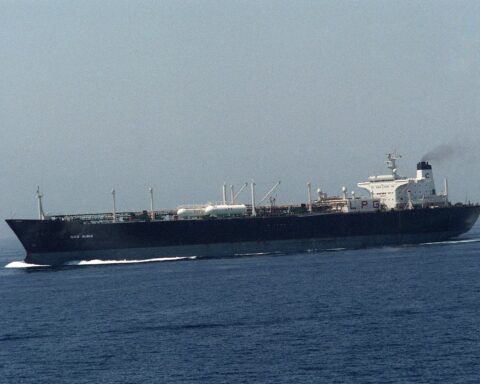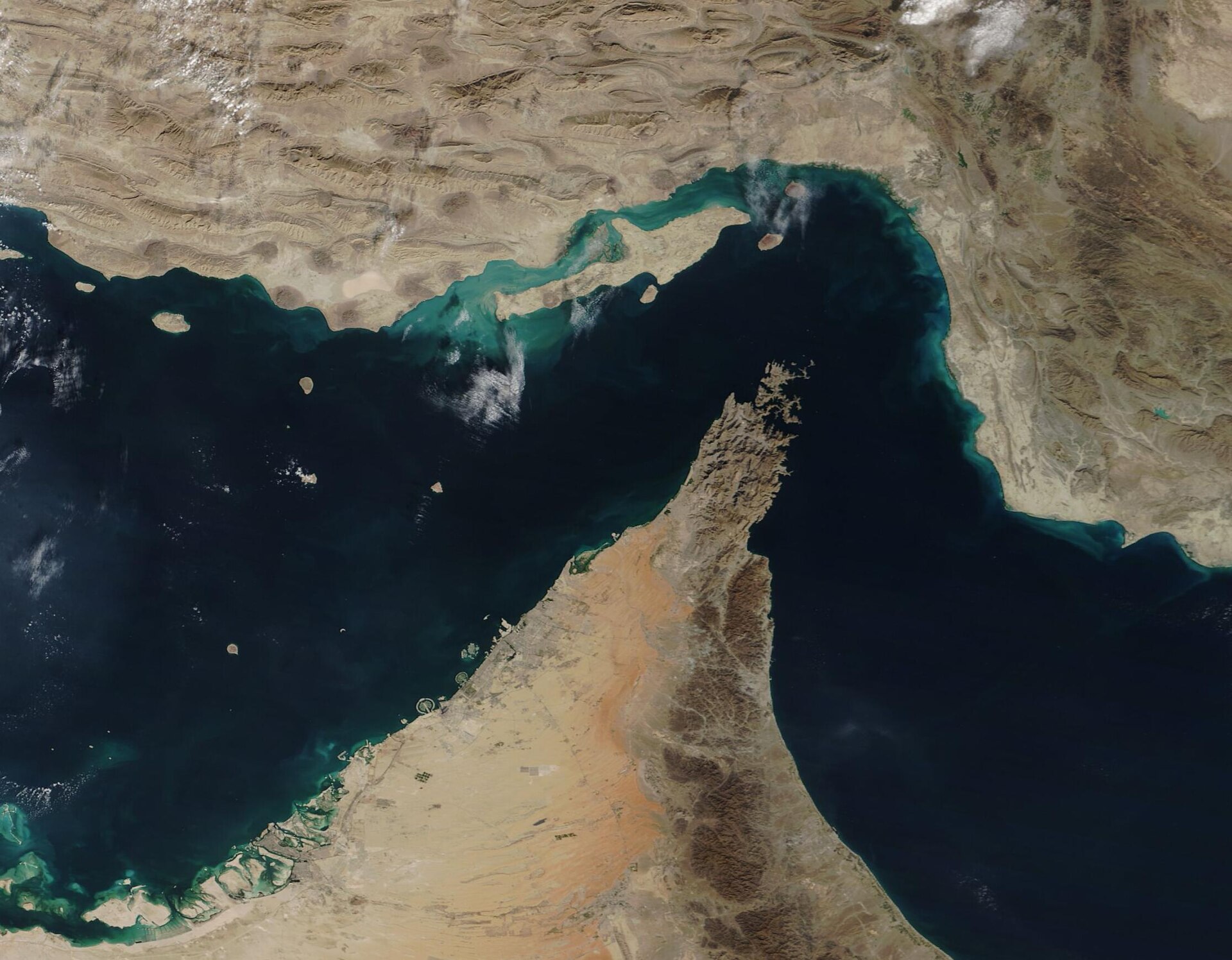

MANAMA — At 20:35 GMT on November 7, a US military aircraft fired precision munitions into the stern of the cargo vessel M/V Huda in the Gulf of Oman, according to US Central Command — the latest in a series of American enforcement actions against commercial ships under Washington’s naval blockade of Iran. Twenty-one minutes later, at 20:56 GMT, Iran’s Islamic Revolutionary Guard Corps announced that two oil tankers had struck mines and caught fire in the Strait of Hormuz, in the latest of a series of mine claims the IRGC has made since late October, according to Xinhua. For the first time since the war began in late February, both sides announced the disabling of commercial vessels on the same calendar day, in overlapping waters, under competing legal frameworks.
The timing was almost certainly coincidental, the product of two rival naval bureaucracies operating independently in a waterway where daily transits have collapsed from approximately 138 vessel movements pre-war, per the US Navy’s Joint Maritime Information Center, to roughly 31 under American escort in early November, according to Gulf News. But the pattern it represents — simultaneous enforcement of rival blockades against commercial shipping, with war-risk premiums now reaching 6 to 10 percent of hull value according to brokers cited by the Financial Times, and no neutral corridor between the two navies — is not coincidental at all.
The House of Saud Daily Briefing
Saudi Arabia's news in 3 minutes, every morning. Free. See today's issue
Table of Contents
- What Did CENTCOM Do to the M/V Huda?
- What Did the IRGC Claim?
- Why Does Same-Day Enforcement Matter?
- Two Blockades, Two Legal Frameworks
- How Reliable Are the IRGC’s Mine Claims?
- The Cumulative Toll on Hormuz Shipping
- What Is This Costing the Oil Market?
- Does Mutual Enforcement Lead to War or Equilibrium?
- Frequently Asked Questions
What Did CENTCOM Do to the M/V Huda?
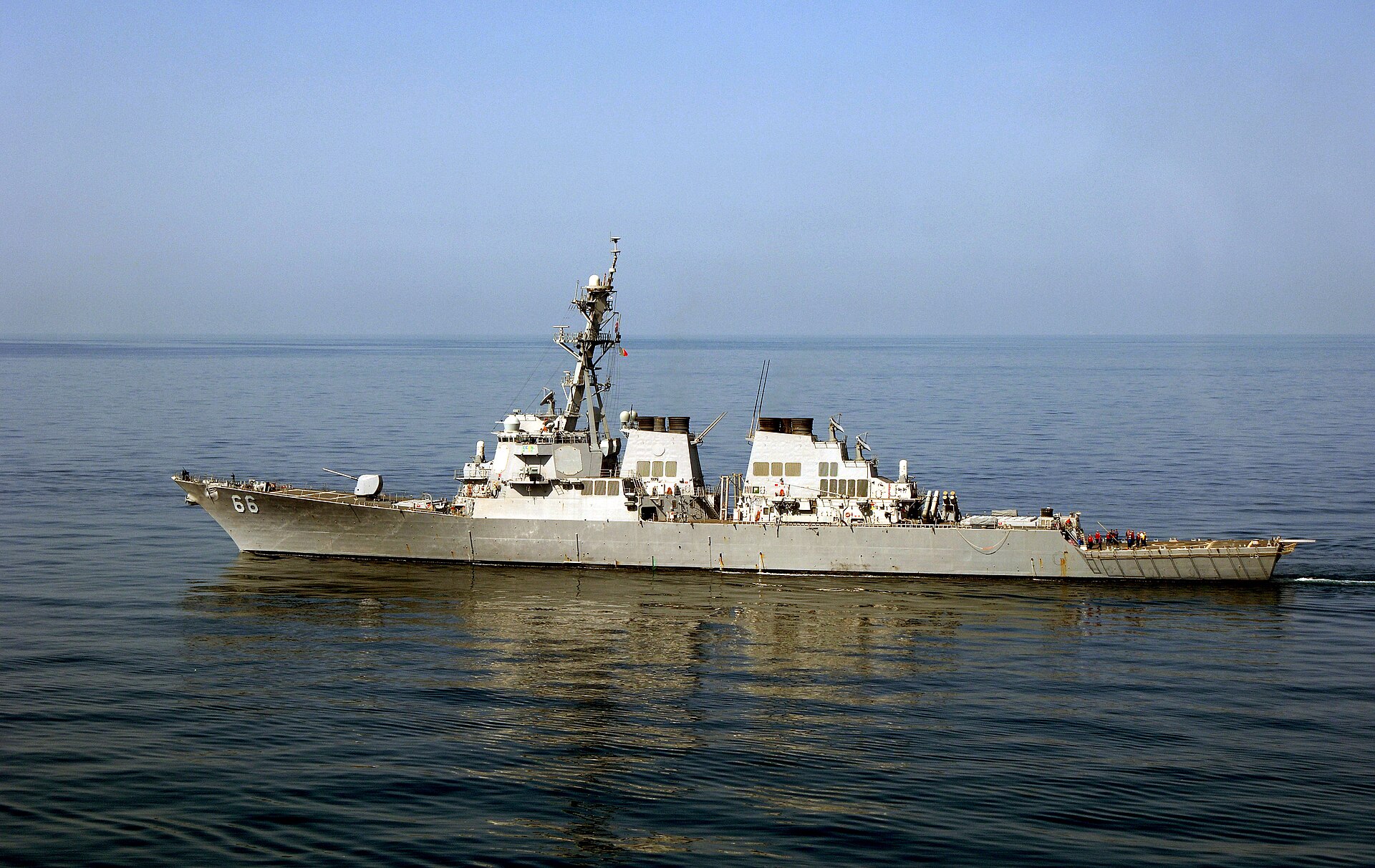
CENTCOM fired precision munitions at the stern of the St. Kitts-flagged cargo vessel M/V Huda in the Gulf of Oman at approximately 20:35 GMT on November 7, after the ship’s crew “ignored repeated warnings and attempted to violate the naval blockade against Iran multiple times,” according to ABC News, citing CENTCOM. The vessel had made a port call in Iran and was attempting to leave regional waters, per Anadolu Agency.
The crew had been directed to leave the targeted area before the strike, according to Xinhua — a procedural step that CENTCOM has cited in previous enforcement actions to distinguish disabling a ship from attacking it. Precision munitions against the stern suggests an intention to kill propulsion rather than sink the vessel, though CENTCOM offered no tactical rationale. Crew status aboard the M/V Huda was not addressed in CENTCOM’s statement, a gap that Anadolu Agency specifically flagged, and whether anyone was injured, whether the crew abandoned ship, or whether the vessel was subsequently boarded remains unresolved.
CENTCOM’s statement cited a cumulative enforcement tally since the blockade’s reinstatement on July 14: 147 commercial vessels redirected, five merchant ships disabled, and 10 Iranian commercial oil tankers destroyed as part of what CENTCOM calls an IRGC-run “multibillion-dollar shadow network,” according to Anadolu Agency and Xinhua. ABC News, however, described the M/V Huda as “the 11th ship” CENTCOM had disabled since the blockade began — a figure that conflicts with CENTCOM’s own stated count of five, and neither outlet explained the discrepancy. The gap may reflect different counting methodologies, different baselines, or a distinction between “disabled” and “destroyed” that CENTCOM does not publicly define, but the practical effect is that the most basic metric of the blockade’s severity — how many commercial ships the US military has put out of action — is contested even within American media.
“U.S. forces continue to strictly enforce America’s naval blockade against Iran,” CENTCOM said in its statement, per Anadolu Agency — a formulation that treats the disabling of a foreign-flagged cargo vessel in international waters as routine procedure. The framing tells you as much about the current state of the Hormuz crisis as the strike itself: enforcement has become so normalised that the US military no longer treats it as requiring justification beyond the standard boilerplate.
What Did the IRGC Claim?
The IRGC Navy announced at 20:56 GMT on November 7 that two oil tankers had struck mines and caught fire in the Strait of Hormuz — one in the eastern approaches of the strait, one inside the waterway itself — according to TASS. No vessel names, flags, or ownership details were given, and no independent maritime tracking service has confirmed either vessel’s identity or location.
The IRGC said both vessels had switched off their navigation and GPS systems and were transiting “unauthorized routes,” according to Xinhua — language consistent with Iran’s ongoing position that any vessel cooperating with the US military’s escort corridors is operating outside the maritime authority Tehran claims over the strait. The absence of identifiers is not new — Iran’s mine claims, which have recurred since late October, rarely include verifiable vessel details — but it makes independent assessment of whether the incidents occurred as described, or at all, functionally impossible.
“Any vessel cooperating with the aggressive US Army and entering the area will definitely hit mines.”
— IRGC Navy, via Xinhua, November 8, 2026
The warning issued alongside the claim was blunt: any vessel cooperating with the US military in the prohibited zone would “definitely” hit mines, according to Xinhua. That language positions the IRGC’s announcements not merely as reports of maritime incidents but as enforcement declarations — statements that Iran’s closure of the strait remains operative regardless of CENTCOM’s parallel assertion that American forces have cleared the shipping lanes. Iranian state television had reported “explosion-like sounds” along the Persian Gulf coast at 19:57 GMT, before either official announcement, according to Iran International, and a third incident was reported at 21:32 GMT when UKMTO received word of a bulk carrier encountering military forces approximately 18 nautical miles east of Khor Fakkan, UAE, with crew status and damage unknown.
Why Does Same-Day Enforcement Matter?
November 7 marked the first time since the US-Iran war began that both sides announced the disabling of commercial vessels on the same calendar day. The overlap — twenty-one minutes apart in the same strategic waterway — transforms what had been a pattern of sequential enforcement actions into a simultaneous dual-interdiction reality, with implications for every shipowner, insurer, and oil trader operating in the Gulf.
The individual incidents are each consistent with the patterns both sides have established over months, and neither represents an escalation in kind. The IRGC has been making mine claims since late October, and CENTCOM has been disabling non-compliant vessels and destroying Iranian tankers since the blockade’s July reinstatement. What makes November 7 different is the simultaneity — two enforcement bureaucracies operating in overlapping waters without coordination, awareness, or any deconfliction mechanism, producing a twenty-one-minute window in which the Gulf of Oman and the Strait of Hormuz each saw a commercial vessel disabled or claimed disabled by opposing forces.
A Chatham House analysis published in May 2026 documented the emergence of this dual-interdiction pattern, noting that the US had already boarded a tanker carrying Iranian oil in the Indian Ocean while Iran had seized two container ships. The authors recommended splitting interdiction tasks into separate working groups to manage escalation risk. Five months later, those working groups do not exist. The pattern has intensified, and November 7 demonstrated that the two enforcement regimes can now produce incidents in the same narrow waterway on the same evening — without either side treating the overlap as a problem requiring a response.
For the commercial vessels still transiting the strait, the consequence is a waterway with no safe heading. Ships using the US-facilitated corridors face the IRGC’s declared mine field. Ships avoiding the US corridors face CENTCOM’s enforcement actions. That earlier report — before either official announcement — suggests the evening’s activity may have been broader than what either side chose to disclose.
Two Blockades, Two Legal Frameworks
The legal architecture underpinning both enforcement regimes is, to put it diplomatically, contested. Iran signed the United Nations Convention on the Law of the Sea in 1982 but never ratified it, declaring at the time of signing that the transit passage regime — which guarantees all vessels the right to continuous and expeditious passage through international straits — does not constitute customary international law, according to the legal analysis published by Penningtons Manches Cooper LLP in April 2026. Iran treats the Strait of Hormuz under an innocent-passage framework that requires full coordination with Iranian maritime authorities, a position that most international law experts reject as baseless under the convention, and one that Iran enforces through mine-laying and interdiction rather than through legal proceedings at The Hague.
Marc Weller of Chatham House wrote in April that under UNCLOS, the Strait of Hormuz is an international strait that “cannot be closed for any reason.” Ann Marsden and Laura Stigaitė of Penningtons Manches Cooper described Iran’s closure as “a breach of international maritime law” under UNCLOS Articles 26, 38, and 44, which bar coastal states from suspending or impeding transit passage. The clarity of the legal argument against Iran’s position has not, over eight months, prevented Iran from enforcing it — a gap between legal consensus and physical reality that the November 7 simultaneous-enforcement incident makes harder to bridge with each passing week.
The US position is less straightforward than CENTCOM’s confident enforcement language suggests. Washington invokes the laws of armed conflict to justify the naval blockade, treating UNCLOS as customary international law binding on non-parties — an argument that, as Marsden and Stigaitė noted, occupies “legally uncertain territory.” The Center for Strategic and International Studies described the US approach as “blockading the blockaders.” The phrase captures the circularity at the heart of the situation: Washington enforces freedom of navigation in Hormuz by restricting navigation through Hormuz, while both Iran and the US claim authority to disable commercial vessels that fail to comply with their respective, mutually exclusive, enforcement regimes.
How Reliable Are the IRGC’s Mine Claims?
No independent maritime authority has confirmed any IRGC mine claim since the series began in late October. CENTCOM explicitly disputed the September 14 El Gaia mine claim, calling it “FALSE,” and gCaptain reported that “evidence remains elusive” for Iran’s assertions about mine strikes, while JMIC maintains a “SEVERE” threat rating for Hormuz transits.
The El Gaia precedent from September is the most detailed case study available. The IRGC claimed the Panama-flagged tanker had struck a mine in the strait, and CENTCOM responded on its official X account by stating that Iran had hit the ship first with a missile and then with a drone — not a mine — before attributing the damage to the vessel itself.
“The IRGC’s false claim is yet another example of their lies and intimidation attempts.”
— US Central Command, X post, September 14, 2026
No comparable CENTCOM rebuttal of the specific November 7 mine claims has been found, which could mean CENTCOM has not examined them, considers them not worth disputing, or regards the situation as less clear-cut than the El Gaia case. The IRGC has made mine claims on at least eight separate days since October 17, in some cases claiming multiple vessels in a single announcement, according to the context record and Tehran Times — a volume of claims that, if accurate, would represent a mine-strike rate that is difficult to reconcile with Admiral Brad Cooper’s assertion in May that US forces had “eliminated more than 90 percent of Iran’s once-massive inventory of over 8,000 naval mines,” per Stars and Stripes.
The resolution, such as it is, may lie in the ambiguity that both sides find useful. JMIC’s mine-threat rating and its warnings about drifting or uncharted mines suggest that whatever the truth of any individual IRGC claim, the physical mine threat in the strait has not been neutralised to a level that maritime authorities are willing to certify. For the insurance market, the distinction between a confirmed mine strike and a plausible one is worth very little — both get priced in.
The Cumulative Toll on Hormuz Shipping
At least 125 ships have been attacked in the Strait of Hormuz and neighbouring waters since the war began in late February, according to IMO Secretary-General Arsenio Dominguez, speaking to The National on November 2. October alone saw 34 ship attacks — the highest monthly total since the conflict began — and Dominguez said the true count was likely higher, because shadow-fleet vessels and ships with false flags often do not report attacks to international authorities.
UKMTO reported 11 attacks on commercial shipping in the seven days to November 4, of which eight occurred in the Strait of Hormuz and three in the Arabian Gulf, according to Middle East Eye. Of those 11, three vessels sank, five required assistance, and three continued their voyages. Jakob Larsen, the head of maritime security at BIMCO, the world’s largest international shipping association, told CNBC on October 30 that “ships are attacked really on a daily basis” — a characterisation that the UKMTO weekly figure supports.
| Metric | Pre-War | Nov 2026 | Source |
|---|---|---|---|
| Daily vessel transits | ~138 | ~31.5 (US-facilitated) | JMIC; Gulf News |
| War-risk premium (% of hull) | ~0.25% | 6–10% | Marsh / FT (Oct 2026) |
| Max cost per supertanker voyage (insurance) | Negligible | Up to $20M | Marcus Baker, Marsh |
| Transport cost per barrel | ~$6.50 | ~$21 | CNBC / Braemar (Oct) |
| Ships attacked (cumulative since Feb) | 0 | 125+ | IMO (Nov 2) |
| Ships attacked (October alone) | — | 34 | IMO (Nov 2) |
| UKMTO attacks, week to Nov 4 | — | 11 | UKMTO / MEE |
| IMF PortWatch transits, Nov 1 | ~85/day | 1 | Straits.live (Nov 8) |
Michelle Wiese Bockmann of Windward, a maritime intelligence platform, calculated that Iran attacked roughly two ships for every 100 vessels that crossed the strait in the third quarter of 2026. That rate sounds survivable until you register that the denominator has collapsed alongside the numerator — from 138 daily transits pre-war to a single vessel recorded by IMF PortWatch on November 1, per Straits.live — meaning the attack frequency relative to the remaining traffic is far higher than the percentage suggests.
“I don’t think there would be many shipowners willing to take the risk if they didn’t have that air cover.”
— Jakob Larsen, Head of Maritime Security, BIMCO, CNBC, October 30, 2026
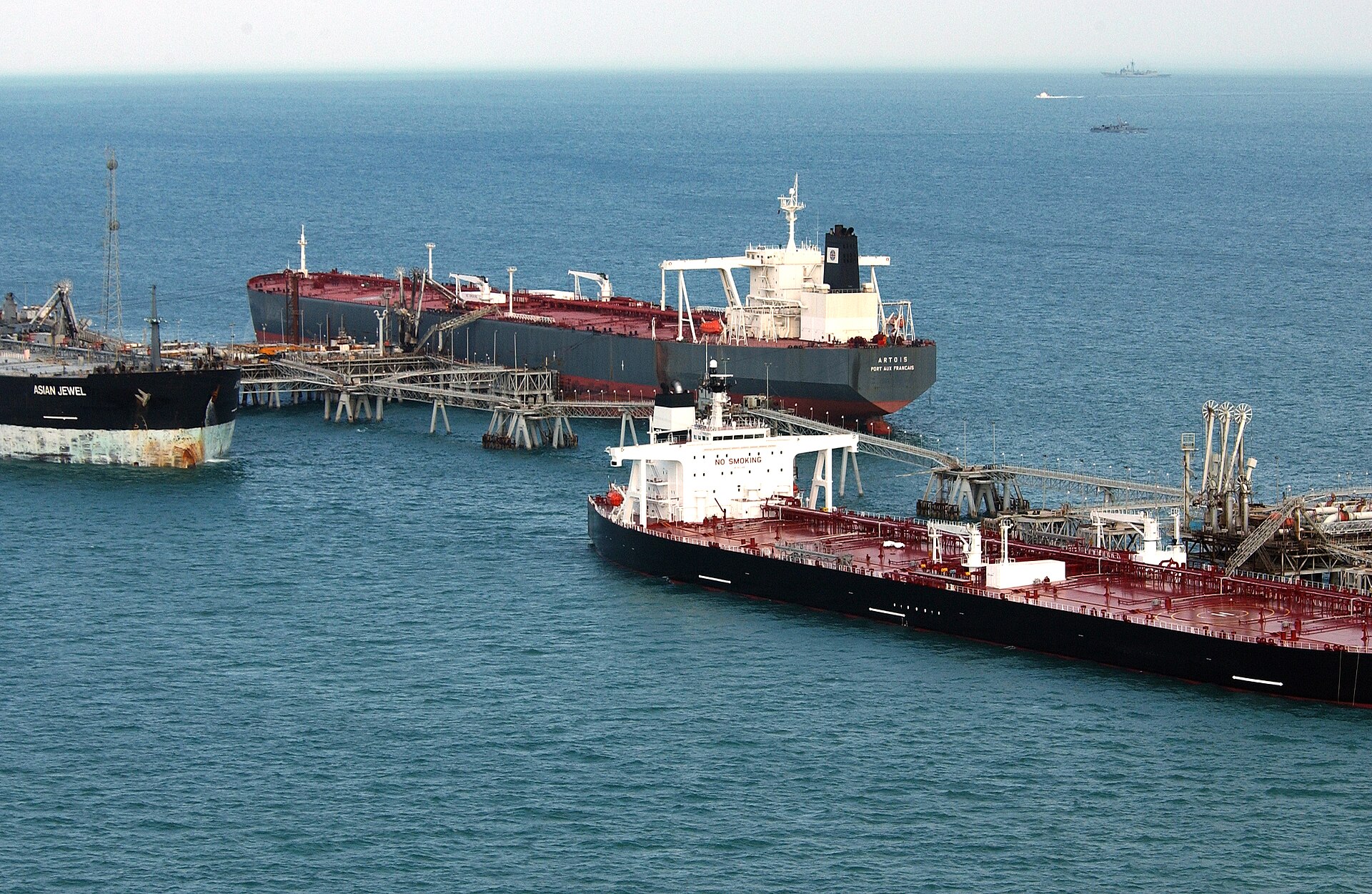
Larsen’s observation about air cover captures the dependency at the core of the remaining transit traffic: the roughly 31 vessels per day still moving through the strait do so because CENTCOM provides armed escort. Without it, the traffic would likely drop to whatever volume Iran’s exempted nations — India, China, Iraq, and Qatar — can sustain independently. The strait is not closed in any formal, internationally recognised sense, but the practical difference between “formally closed” and “one ship per day on the PortWatch tracker” is one that the insurance industry, rather than the international legal system, has been left to adjudicate.
What Is This Costing the Oil Market?
Brent crude closed at $98.32 on November 7, per Straits.live — a figure that reflects a roughly 18 percent decline from the $117-plus peak recorded on October 30, before the US midterm elections, according to Vantage Markets. The post-midterm price drop represented a brief burst of market optimism that a Democratic congressional majority might constrain the Trump administration’s Iran policy — optimism that both navies’ enforcement actions on November 7 did nothing to sustain.
The deeper cost sits below the headline price. Transport costs per barrel for Hormuz crude reached approximately $21 in early October, up from roughly $6.50 in September, according to CNBC, citing Braemar shipping analyst Mary Melton. War-risk premiums — the insurance surcharge for crossing a conflict zone — climbed from approximately 0.25 percent of hull value before the war to between 6 and 10 percent by October, according to Marsh. Marcus Baker of Marsh put the maximum cost at up to $20 million for a single supertanker voyage, a figure absorbed by the cargo owner and passed, eventually, to the consumer buying the refined product in Mumbai or Shanghai or Rotterdam.
Melton offered a counterpoint worth weighing: “On balance in terms of oil coming out, there hasn’t been a massive impact,” she told CNBC on October 30, adding that Asian importers were “used to paying almost nothing for freight” and were absorbing the increases. The assessment is defensible as a description of crude volume — oil is still moving, rerouted through Saudi Arabia’s East-West pipeline and through tankers willing to pay the premium — but it sits uneasily alongside a single recorded transit on November 1, and it was made before both navies demonstrated on November 7 that they could disable commercial vessels simultaneously without either side treating the overlap as an escalation requiring a policy response.
For traders, the November 7 double enforcement introduces a pricing problem that existing models handle poorly: how do you quantify the probability of an accidental exchange between two navies that are both, separately, firing on commercial shipping in the same waterway? Brent at $98 assumes this situation is stable. Whether it is depends on what happens the next time a CENTCOM escort convoy and an IRGC mine field overlap not by twenty-one minutes but by zero.
Does Mutual Enforcement Lead to War or Equilibrium?
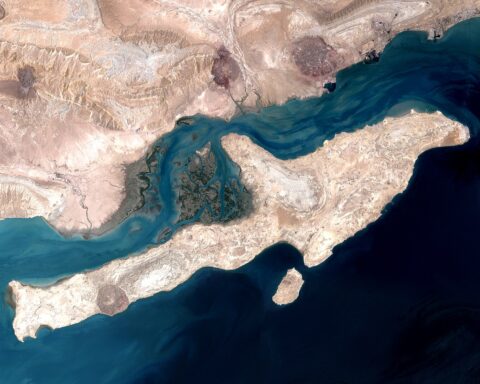
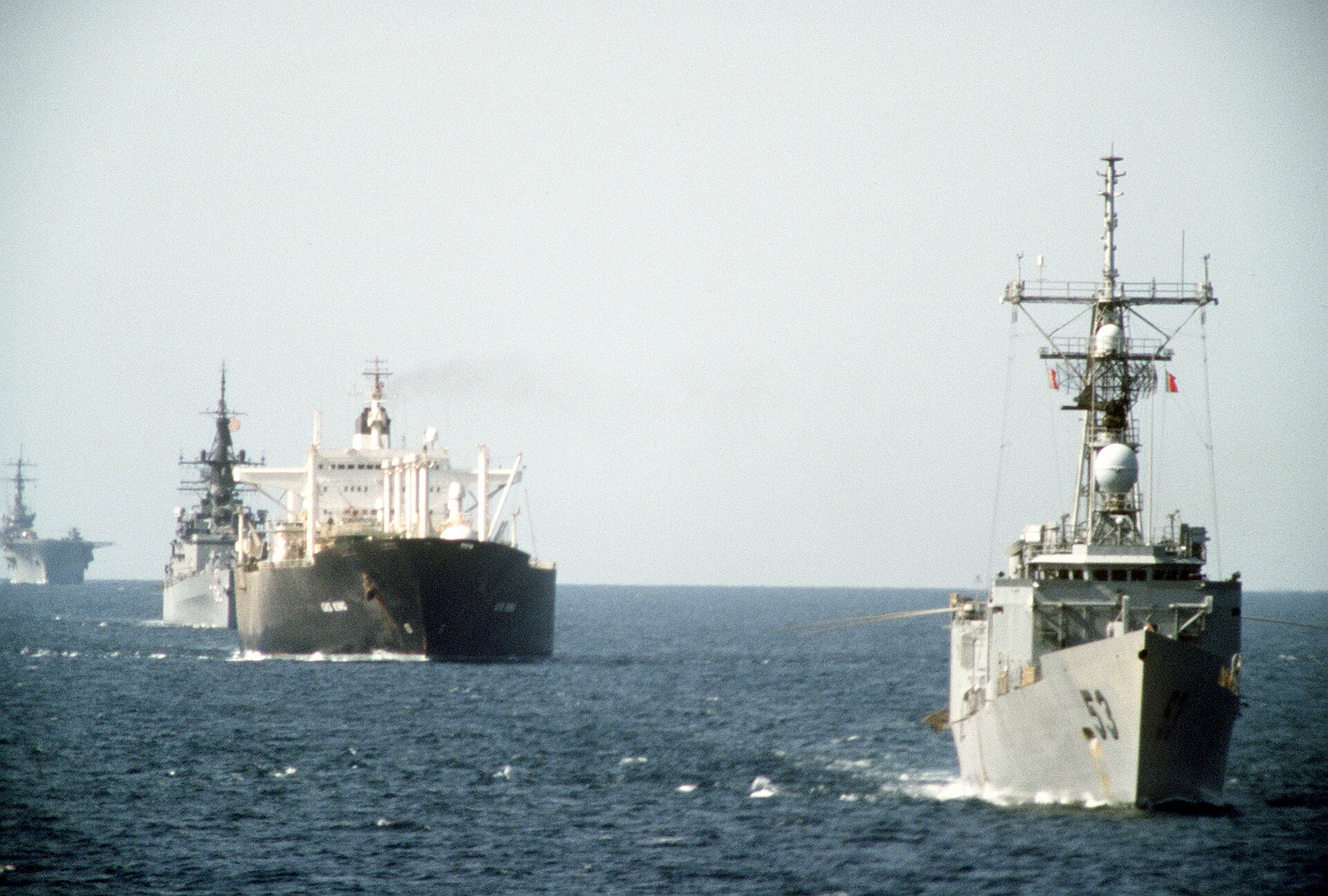
The dual-enforcement pattern of November 7 has a partial precedent in the 1987–88 Tanker War, when the US launched Operation Earnest Will, running approximately 127 convoys through the Persian Gulf to protect reflagged Kuwaiti tankers, according to the US Institute of Peace. The key structural difference is not tactical but political: in the late 1980s, Iran sought to impose costs on Gulf shipping without provoking all-out war with the United States at sea, and crossed that line only once, at the Battle of the Persian Gulf in April 1988, after which it retreated. The current conflict operates under no comparable restraint — the US has already conducted strikes on Iranian territory including Qeshm Island, and Iran has fired on US aircraft over the strait.
That Chatham House analysis recommended what amounts to a deconfliction protocol — splitting enforcement tasks into working groups, establishing communication channels, managing escalation risk. None of this has materialised, and the November 7 overlap suggests that neither Washington nor Tehran regards the dual-enforcement pattern as a problem requiring institutional solutions. Both sides appear to treat it as the operating environment, not as an aberration within it — a distinction that matters because aberrations get fixed while environments get adapted to.
Whether this adaptation holds depends on variables the public record cannot resolve: the density and condition of remaining Iranian mines, the reliability of CENTCOM’s deconfliction with allied and commercial shipping, and the degree to which tactical commanders on both sides have standing orders that leave room for judgment rather than demanding automatic engagement when a vessel enters the wrong zone. The IRGC’s statement that vessels in the prohibited area will “definitely” hit mines reads less like a targeted threat than like an admission that the mine field — whether real in the physical sense or maintained as a deterrent claim — operates independently of real-time Iranian decision-making, which makes it a hazard rather than a weapon, and hazards are harder to negotiate away.
As of November 8, Straits.live counted 138 AIS-visible vessels holding position in the Hormuz and Gulf watch box — roughly the same number that used to transit the strait every day before the war began. They sit in anchorage, hull insurance ticking upward with each additional day of dual enforcement, cargo contracts being renegotiated at rates that assume this is the new baseline, and neither navy has offered them a timeline for when the waiting ends.
Frequently Asked Questions
How many countries has Iran exempted from the Hormuz closure?
Iran has exempted India, China, Iraq, and Qatar from Hormuz transit restrictions, according to CBS News and Iranian media. The exemptions apply to vessels carrying cargo to or from those countries, though the operational mechanism — whether exempted vessels transit under Iranian naval coordination, use their own routes, or rely on US-facilitated corridors — has not been publicly clarified. The exemptions effectively create a two-tier transit system in which ships from non-exempted nations must either accept US escort or face the IRGC’s declared enforcement zone.
What happened to the US Navy’s minesweeping capability in the Gulf?
The US withdrew its four Avenger-class minesweepers from Naval Support Activity Bahrain in January 2026 — before the conflict reached its current intensity — leaving the region without any surface mine-clearance vessels when the blockade was reinstated in July, according to Fortune. The Navy has relied on air-delivered clearance methods instead. The gap matters because surface sweepers detect and neutralise moored and bottom mines in shipping lanes; air-delivered methods are faster but less systematic, which is why JMIC’s mine-threat rating has remained at its highest level throughout the campaign despite CENTCOM’s clearance claims.
Has any international body formally declared Hormuz a war zone?
No international body has formally reclassified the Strait of Hormuz as a war zone. IMO Secretary-General Dominguez noted on November 2 that the true count of ship attacks “could be higher” than the official 125 because shadow-fleet vessels and ships with false flags often do not report incidents, according to The National. In the absence of a formal reclassification, the private insurance market — not governments or international organisations — is effectively determining which ships can afford to transit, through war-risk premiums that have made a Hormuz voyage economically prohibitive for any operator without deep pockets or US military escort.
What was the UKMTO third incident on November 7?
At 21:32 GMT on November 7, UKMTO received a report of a bulk carrier encountering military forces approximately 18 nautical miles east of Khor Fakkan in the UAE, with crew status and damage unknown, according to Iran International. No state has claimed responsibility. UKMTO routinely publishes these unclaimed-incident reports without attribution, and they typically generate no official government response — meaning they enter the weekly attack count without producing any public investigation. November 7 may therefore have involved three enforcement or enforcement-adjacent incidents rather than two; the third remains unexamined in the public record.
How does the 2026 crisis compare to the 1987–88 Tanker War?
The 1987–88 Tanker War saw the US run approximately 127 Operation Earnest Will convoys escorting 259 ships through the Persian Gulf, according to the US Institute of Peace. The Bridgeton mine strike in July 1987 — in which a US-escorted tanker hit an Iranian mine on its maiden convoy voyage — exposed the Navy’s lack of deployed minesweeping capability, forcing reliance on improvised countermeasures and allied vessels. The structural difference from 2026 is that Iran in the 1980s operated under a strategic ceiling, avoiding direct naval confrontation with the US except once; the current conflict includes strikes on Iranian territory and Iranian fire on US aircraft, meaning the maritime theatre is embedded in a broader war with fewer guardrails.
The House of Saud Daily Briefing
Saudi Arabia's news in 3 minutes, every morning. Free. See today's issue