ISLAMABAD — Saudi Arabia transferred $3 billion to Pakistan in five days last week, preventing Islamabad from defaulting on $3.45 billion in maturing UAE deposits — and in the same week, withdrew financing from a $1.5 billion Pakistani arms deal with Sudan and pressured Islamabad to freeze a separate $4 billion weapons contract with Libya, erasing $5.5 billion in arms export revenue from a country it had just rescued from insolvency. The trigger, according to three sources who spoke to Al-Monitor, was Army Chief Field Marshal Asim Munir’s three-day visit to the IRGC’s Khatam al-Anbiya Central Headquarters in Tehran, where he was received by the commander MBS least wanted him sitting across from: Major General Ali Abdollahi, the man whose delegation wrecked the Islamabad ceasefire talks two weeks earlier.
No public statement accompanied the withdrawal. No diplomatic protest, no press briefing, no Saudi ambassador summoned for consultations. Riyadh’s response was denominated entirely in dollars — a financial instrument so precisely calibrated that Pakistan’s military, air force, and foreign ministry absorbed the blow without issuing a single word of public acknowledgment.
Table of Contents
- The 48-Hour Timeline: From Tehran to Financial Freeze
- What Was in the $1.5 Billion Sudan Arms Package?
- Credit With One Hand, a Chokehold With the Other
- Why Did Saudi Arabia Block Pakistan’s $4 Billion Libya Deal Too?
- The SMDA Contradiction: Treaty Ally and Neutral Mediator
- How Much Financial Leverage Does Saudi Arabia Hold Over Pakistan?
- Iran Reads the Signal — and Disqualifies the Mediator
- Burhan Came to Jeddah and Left Empty-Handed
- Pakistan’s Silence as Survival Strategy
- What Happens to the Ceasefire If the Enforcer Is Captured?
The 48-Hour Timeline: From Tehran to Financial Freeze
Munir arrived at Khatam al-Anbiya’s headquarters in Tehran on approximately April 16, concluding a visit that two Pakistani security sources described to Al-Monitor as a continuation of Pakistan’s role as the ceasefire’s sole enforcement mechanism. He was there because no one else could be — Pakistan has served as Iran’s protecting power in the United States since 1992, and the 27th Constitutional Amendment placed ceasefire diplomacy squarely within the army chief’s operational authority, not the elected government’s. His host was Abdollahi, commander of the IRGC’s construction and logistics arm and one of the five men the FDD assesses are actually running Iran in Khamenei’s 50-plus-day absence.
Within 48 hours of Munir’s departure, Saudi Arabia withdrew its financing commitment for the $1.5 billion Sudan deal. Al-Monitor reported that a preliminary Saudi decision had been taken at a Riyadh meeting with Sudanese military leaders in March 2026, but the IRGC visit accelerated the timeline from gradual disengagement to immediate termination. The speed matters: this was not a policy review that happened to coincide with the Tehran trip — it was a disciplinary action timed to land while the diplomatic cables were still warm.
The sequencing is worth stating plainly. On April 15-21, Saudi Arabia disbursed $3 billion to Pakistan in two tranches ($2 billion followed by $1 billion), money Islamabad immediately routed to repay maturing UAE deposits of $3.45 billion, completing the transfer on April 23-24 according to Daily Pakistan and Bloomberg. Within the same window, Riyadh pulled the Sudan financing and communicated its displeasure over the Libya contract. Pakistan’s government received $3 billion in life support and lost $5.5 billion in export revenue in a period shorter than a standard work week.
What Was in the $1.5 Billion Sudan Arms Package?
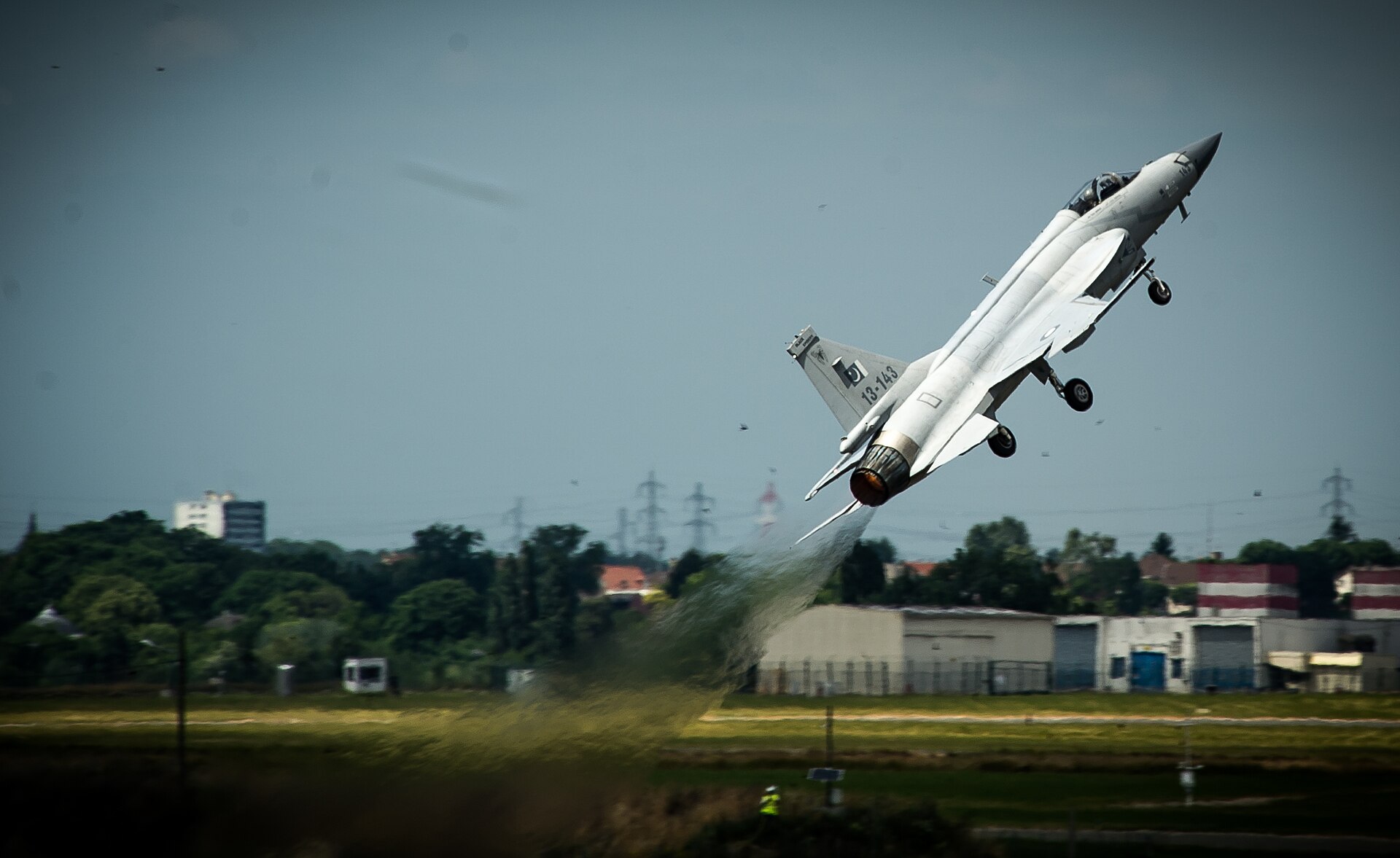
The $1.5 billion Sudan package, detailed by The Defense Post in January 2026, was Pakistan’s largest single defence export contract — a full-spectrum air power transfer including 10 Karakoram-8 aircraft, 200-plus drones, and air defense systems. Islamabad had built it as a proof of concept for Africa-wide arms expansion, financed from the start by the same party that just cancelled it.
The Middle East briefing 3,000+ readers start their day with.
One email. Every weekday morning. Free.
The package also included Super Mushshak trainer aircraft and had JF-17 Thunder multirole fighters under discussion as a potential addition. For Pakistan’s defence industry — which has spent decades trying to break out of small-ticket sales into strategic-scale contracts — Sudan represented the first proof that Islamabad could compete for full-spectrum air power contracts against established exporters.
The deal carried a particular irony that made Saudi Arabia’s reversal doubly pointed: Riyadh had originally brokered the arrangement as part of broader defence cooperation between Pakistan and Sudan, making the withdrawal not a veto of Islamabad’s independent foreign policy but a retraction of Saudi Arabia’s own initiative. Profit by Pakistan Today reported that Saudi financing was embedded in the deal’s structure from inception, meaning Pakistan had no fallback funding mechanism and no way to fulfill the contract without Riyadh’s continued participation. When the money disappeared, the deal didn’t just stall — it structurally collapsed.
Credit With One Hand, a Chokehold With the Other
What makes April 2026 different from previous episodes of Saudi financial pressure on Pakistan — the 2018 bailout that extracted diplomatic alignment from Imran Khan, the 2023 deposit that arrived literally one day before Pakistan’s IMF board vote — is the simultaneity and precision of the mechanism. MBS did not choose between rewarding Pakistan and punishing it; he did both in the same week, using different financial instruments aimed at different pressure points, in a display of what the International Institute for Strategic Studies described in its 2023 Gulf Bailout Diplomacy research as the capacity to “use political leverage coercively over vulnerable recipients by threatening to withhold aid or recall maturing deposits to extract political or economic concessions.”
The $3 billion deposit kept Pakistan solvent — without it, Islamabad would have faced a $3.45 billion UAE repayment it could not fund, a default that would have cratered its recently stabilized IMF program and sent the rupee into freefall. The arms deal withdrawal blocked Pakistan’s most promising revenue diversification away from Saudi dependency. One hand extended a lifeline; the other shortened the leash. Saudi Finance Minister Mohammed al-Jadaan signaled this shift as early as 2023 at the World Economic Forum, when he declared that Saudi Arabia “used to give direct grants and deposits without strings attached, and we are changing that.”
The strings are now visible. Al-Jadaan’s statement, which seemed like fiscal reform rhetoric at the time, reads in April 2026 as a doctrinal announcement — the moment Riyadh disclosed that its checkbook had been reclassified from aid to instrument.
Why Did Saudi Arabia Block Pakistan’s $4 Billion Libya Deal Too?
The Sudan freeze did not arrive alone. Saudi Arabia simultaneously applied pressure to a separate $4 billion contract with Libya’s Khalifa Haftar — a deal that predated the Tehran visit, indicating that Riyadh’s intervention targeted Pakistan’s Africa arms strategy as a whole, not just the single meeting that triggered the Sudan financing withdrawal.
Arab News and Araweelo News Network reported that Saudi Arabia simultaneously requested Pakistan to reconsider a separate $4 billion arms package with forces loyal to Libya’s Khalifa Haftar, a contract that included 16 JF-17 Thunder jets partially delivered as recently as March 2026. The combined Saudi veto across both deals — $1.5 billion for Sudan and $4 billion for Libya — puts $5.5 billion in Pakistani defence export revenue at risk, effectively blocking Islamabad’s entire Africa arms expansion at the moment it was gaining traction.
The Libya pressure is harder to read as a direct response to the IRGC visit, since the JF-17 deliveries were already underway before Munir went to Tehran. What it suggests instead is a broader Saudi decision to establish financial veto authority over Pakistan’s defence export policy as a structural condition, not merely a one-off punishment. Riyadh is telling Islamabad that its arms industry operates within boundaries defined by Saudi strategic interests — and that those boundaries will be enforced through the funding architecture that makes the contracts possible in the first place. Pakistan does not have the independent export credit capacity to finance deals of this scale without Gulf backing, which means Saudi consent is not optional but foundational.
The SMDA Contradiction: Treaty Ally and Neutral Mediator
The structural impossibility at the center of Pakistan’s position has been obvious since September 17, 2025, when Islamabad and Riyadh signed the Strategic Mutual Defence Agreement — the first collective security pact between an Arab Gulf state and a nuclear-armed power, containing a clause that defines aggression against one party as aggression against both. Under the SMDA, Pakistan is formally treaty-bound to Saudi Arabia’s defence in a war where Saudi Arabia is absorbing Iranian missile strikes on its oil infrastructure, hosting the US air operations Iran is fighting against, and losing 30 percent of its production capacity to a conflict that has no ceasefire in sight.
Pakistan is simultaneously serving as Iran’s relay to Washington — the channel through which Araghchi’s ceasefire drafts reach American negotiators — and as the protecting power representing Iranian interests in the United States, a role Islamabad has held continuously since 1992. The SMDA makes this dual positioning theoretically impossible: you cannot be a mutual defence ally of one belligerent and a diplomatic agent of the other without one role contaminating the other. Azeema Cheema, founder of Verso Consulting, told Al Jazeera that Pakistan’s troop deployment to Saudi Arabia under the SMDA framework reflected “significant restraint shown by the Saudis,” suggesting the arrangement was pre-agreed as a signal of seriousness to Iran — but the Sudan financing withdrawal reveals the limits of that restraint.
MBS did not invoke the SMDA. He didn’t need to. The financial dependency creates a coercive channel that operates below the treaty’s formal obligations, where Saudi Arabia can discipline Pakistani behavior without triggering the mutual defence clause’s political and legal complexities. The arms deal freeze accomplished what a diplomatic protest could not: it reminded Munir that Pakistan’s ceasefire role exists within a financial architecture controlled from Riyadh.
How Much Financial Leverage Does Saudi Arabia Hold Over Pakistan?
Saudi Arabia holds approximately $9.2 billion in discretionary financial exposure over Pakistan as of late April 2026 — spread across deposits, deferred oil payments, and now weaponised arms financing. Each instrument targets a different vulnerability, and they are structured so that removing one triggers cascading pressure across the others.
Saudi Arabia’s discretionary financial exposure in Pakistan as of late April 2026 totals approximately $9.2 billion: a $5 billion deposit that has been extended on longer-term terms, the $3 billion in new deposits disbursed during the week of April 15-21, and a $1.2 billion annual deferred oil payment facility whose renewal remains pending. Pakistan routed the fresh $3 billion directly to the UAE repayment — the Saudi money did not sit in Pakistan’s reserves as a buffer but flowed through as a bridge loan, leaving Islamabad no less dependent than before.
| Saudi Financial Instrument | Amount | Status (April 2026) | Coercive Function |
|---|---|---|---|
| Central bank deposit (legacy) | $5.0 billion | Extended, longer-term | Rollover discretion = annual leverage point |
| New deposit (April 2026) | $3.0 billion | Disbursed in two tranches | Timed to prevent UAE default |
| Deferred oil facility | $1.2 billion/year | Renewal pending | Energy dependency overlay |
| Sudan arms financing (withdrawn) | $1.5 billion | Frozen | Export revenue blocked |
| Libya arms deal (pressure applied) | $4.0 billion | Under review | Defence industry expansion vetoed |
The table reveals a layered structure operating on different timescales. The deposits create a recurring dependency — each rollover is a decision point where Riyadh can extract concessions or signal displeasure. The deferred oil facility adds energy dependency on top of financial dependency. The arms deal vetoes attack Pakistan’s revenue diversification, the one channel through which Islamabad might reduce its Saudi exposure over time.
Pakistan’s predicament is that every instrument reinforces the others. Default on the UAE deposits (avoided only by the Saudi transfer) would have crashed the IMF program, which would have frozen the deferred oil facility, which would have triggered an energy crisis that would have made the arms export contracts irrelevant. MBS doesn’t need to pull all the levers at once — moving one creates cascading pressure across the entire structure, and Islamabad knows it.
Iran Reads the Signal — and Disqualifies the Mediator
The Saudi financial intervention produced an immediate diplomatic casualty. On April 26, Ebrahim Rezaei, spokesperson for Iran’s National Security and Foreign Policy Commission, publicly declared that “Pakistan is our good friend and neighbour, but it is not suitable as a mediator for negotiations and does not have the necessary authority to fulfil this role.” He went further, alleging that Pakistani officials “always take into account the interests of Trump and do not say anything that would go against the wishes of the Americans” — the first formal Iranian rejection of Pakistan’s mediator status from a parliamentary body with oversight of the Supreme National Security Council.
Rezaei’s statement, reported by Iran International, arrived days after the Saudi arms deal freeze became public knowledge, and its timing suggests Tehran read the financial squeeze as confirmation of what the SMDA already implied: Pakistan is not a free agent. The logic is straightforward — if Riyadh can freeze $5.5 billion in Pakistani arms revenue within 48 hours of a diplomatic meeting it disapproves of, then every conversation Munir has with Iranian commanders carries an implicit Saudi veto. Iran’s response was not to protest the Saudi pressure but to disqualify the mediator it produced, a move that further narrows the already threadbare channel between Tehran’s civilian government and the IRGC commanders who actually control the war.
Burhan Came to Jeddah and Left Empty-Handed
Sudan’s military chief Abdel Fattah al-Burhan traveled to Jeddah on approximately April 20-21 to meet MBS directly, seeking to revive the frozen arms deal. He left without it — but not without making concessions. Sudan Tribune and Al Bawaba reported that Burhan renewed his commitment to freeze plans for a Russian naval base at Port Sudan, the Red Sea facility located roughly 340 kilometers across the water from Jeddah that Saudi Arabia has spent years keeping out of Moscow’s hands.
The Burhan visit revealed the second layer of the Saudi financial intervention: the Sudan deal freeze was not only a message to Pakistan but a tool for extracting strategic concessions from Khartoum, a dynamic HOS examined in detail last week. MBS converted $1.5 billion in frozen arms financing into a mechanism that simultaneously disciplined Pakistan’s Iran diplomacy, blocked weapons from reaching IRGC-adjacent networks inside Sudan’s military coalition (the US State Department designated Sudan’s Muslim Brotherhood as a terrorist group on March 9 for receiving “training and other support from Iran’s IRGC”), and extracted a renewed Russian naval base freeze from Burhan — three strategic objectives accomplished with a single financial withdrawal.
Areig Elhag of the Washington Institute warned that Pakistan’s arms dealing in Sudan signals a shift “from diplomacy toward military escalation, which may prolong the war,” adding that weapons “rarely remain instruments of political pressure for long — they rapidly become fuel for expanded warfare.” From Riyadh’s perspective, the IRGC contamination risk provided additional justification for the freeze, but the timing leaves little doubt that Munir’s Tehran visit was the proximate cause, not the weapons proliferation concern Saudi Arabia has lived with since the deal was first brokered.
Pakistan’s Silence as Survival Strategy
Islamabad’s response to the simultaneous credit extension and revenue freeze has been total silence — no denial, no acknowledgment, no background briefing to favored reporters, no parliamentary question, no military spokesperson statement. Pakistan’s military, air force, and foreign ministry have all declined to comment on either the Sudan deal suspension or the Saudi pressure on the Libya contract, a posture Profit by Pakistan Today described as conspicuous in its completeness.
The silence is itself a calculated position. Public protest would accomplish nothing — Pakistan has no alternative funding source for the arms deals and no financial buffer against Saudi deposit withdrawals — while simultaneously confirming the scale of Saudi leverage to an audience (Iran, the US, other potential arms customers) that Islamabad would prefer kept guessing. By absorbing the blow without acknowledging it, Pakistan preserves the fiction that it operates as an independent actor in the ceasefire process, a fiction that is necessary for its continued utility to all parties even as the underlying reality becomes more transparent with each Saudi financial intervention.
The pro-Iran outlet The Cradle framed the episode as “Pakistan cancels $1.5 billion weapons deal with Sudan after Saudi Arabia pulls funding,” a formulation that strips Islamabad of agency entirely and presents it as a Saudi instrument. Pakistan’s silence does nothing to counter this framing — but contesting it publicly would require acknowledging the Saudi role, which would inflict more damage on Islamabad’s mediator credibility than the Cradle article ever could.
What Happens to the Ceasefire If the Enforcer Is Captured?
The April 2026 financial intervention has publicly demonstrated that Pakistan’s mediation role operates within Saudi-defined boundaries — a fact Iran has now formally acknowledged by disqualifying Islamabad as a negotiating channel. With the ceasefire expired and no replacement enforcer available, the gap between the two sides has no institutional bridge left standing.
The ceasefire expired on April 22 without extension, the Islamabad talks produced no binding framework, and the only state that both Iran and the United States accepted as a relay — Pakistan — has just been publicly demonstrated to operate within Saudi financial constraints that neither party can ignore. Rezaei’s disqualification statement from Tehran’s National Security Commission is the diplomatic expression of a structural problem that the Saudi quartet diplomacy architecture cannot resolve: a mediator who depends on one belligerent for solvency cannot credibly promise the other belligerent that the mediation channel is clean.
The deeper damage is to the enforcement architecture itself. The Islamabad Accord — the immediate ceasefire MOU that Pakistan was building as an alternative to the US-backed 45-day phased framework — requires an enforcer with enough independence to hold both sides accountable. Pakistan was the only candidate because no other state has simultaneous channels to Washington, Riyadh, and Tehran’s military command. But MBS’s financial intervention has created a new condition: every future meeting between Munir and IRGC commanders will carry an implicit Saudi price tag, and both Tehran and Washington now know the exchange rate.
We used to give direct grants and deposits without strings attached, and we are changing that.
Mohammed al-Jadaan, Saudi Finance Minister, World Economic Forum, 2023
Al-Jadaan was describing a fiscal policy shift. What April 2026 reveals is that the “strings” extend well beyond economic reform conditionality into the domain of military diplomacy, ceasefire enforcement, and the management of Pakistan’s relationships with states Saudi Arabia considers adversaries. The $9.2 billion in outstanding Saudi financial commitments to Pakistan is not aid — it is an operating system, one that determines which arms deals go through, which diplomatic meetings are tolerated, and how much independence Islamabad can exercise before the next rollover decision arrives.
Munir visited Abdollahi in Tehran because no one else could. He returned to an Islamabad where the cost of that visit had already been deducted — $5.5 billion withdrawn from Pakistan’s defence export pipeline, with Prince Faisal’s parallel diplomatic track now the only mediation architecture Saudi Arabia is willing to fund. The enforcer remains at his post, but the post now comes with a Saudi billing address.
Frequently Asked Questions
Why did Pakistan agree to visit IRGC headquarters when it knew Saudi Arabia would object?
Pakistan’s 27th Constitutional Amendment places foreign military diplomacy under the army chief’s authority, not the civilian government’s, and Munir’s visit was a continuation of his April 16 meeting with Abdollahi at Khatam al-Anbiya — the same command structure that Pakistan’s Inter-Services Intelligence has maintained back-channel contact with since the 1990s through the protecting power arrangement. Munir likely calculated that maintaining the Iran channel was worth the Saudi financial backlash because Pakistan’s utility to Washington depends on being the only state that can relay messages from IRGC commanders — a positioning the US has actively encouraged through Witkoff’s own engagement with the Islamabad process. The bet was that Saudi Arabia would punish the optics but not sever the relationship; the $3 billion deposit that arrived simultaneously suggests Munir was right about the floor, even if he underestimated the ceiling.
Could Pakistan fund the Sudan arms deal without Saudi financing?
Pakistan’s State Bank holds approximately $10-11 billion in gross reserves as of April 2026, roughly half of which consists of borrowed Saudi and Chinese deposits that cannot be deployed for export credit purposes. Pakistan’s Export-Import Bank equivalent, the Export Finance Scheme, operates with annual disbursement limits of approximately $3 billion across all sectors and is not structured for single-contract defence financing at this scale. China’s EXIM Bank could theoretically step in, but Beijing has avoided financing Pakistani arms exports to African conflict zones since the UN imposed sanctions-adjacent restrictions on weapons flows to Sudan in 2023. In practice, no alternative funding source exists that could be mobilized on a timeline that would keep the contract alive.
What is the IRGC connection to Sudan that concerned Saudi Arabia?
The US State Department designated Sudan’s Muslim Brotherhood (SMB) as a terrorist organization on March 9, 2026, citing documented “training and other support from Iran’s IRGC.” A former Sudanese minister, quoted by The National in April 2026, warned that Iranian arms were already being sent to Islamist army factions within the Sudanese military coalition — meaning Pakistani weapons delivered to Sudan’s official armed forces risked being redirected to IRGC-trained elements embedded within those same forces. The designation created a US legal framework under which Saudi-financed, Pakistani-manufactured weapons flowing to IRGC-adjacent recipients would generate sanctions exposure for all three parties, giving Riyadh a compliance rationale on top of its geopolitical motivations.
How does the $1.2 billion deferred oil facility work as leverage?
Pakistan imports approximately 85 percent of its crude oil, and the Saudi deferred payment facility allows Islamabad to purchase $1.2 billion in Saudi crude annually with payment delayed by 90-180 days — effectively an interest-free trade credit that reduces Pakistan’s immediate dollar outflows during periods of reserve pressure. The facility requires annual renewal, which Saudi Arabia can condition, delay, or reduce at each cycle. Because Pakistan’s refinery infrastructure is calibrated to Saudi crude grades (Arab Light and Arab Medium), switching suppliers would require both alternative credit arrangements and blending adjustments that take 6-12 months to implement. The pending renewal status as of April 2026 means this instrument is currently live as a pressure point, adding energy dependency to the financial and military-export dependencies already in play.
Has Saudi Arabia used financial pressure against Pakistan before?
The 2018 episode is the closest precedent: Saudi Arabia provided a $6 billion package ($3 billion in deposits plus a $3 billion deferred oil facility) to the newly elected Imran Khan government, then applied pressure when Khan attended the Kuala Lumpur Summit in December 2019 against explicit Saudi wishes — a gathering Riyadh viewed as a rival Islamic leadership forum. Khan was reportedly warned that the deposits could be recalled, and Pakistan subsequently withdrew from the summit’s organizing committee. The 2023 intervention was subtler: Saudi Arabia pledged $2 billion in April but withheld the actual deposit until July 12, one day before Pakistan’s IMF Executive Board vote, making the timing unmistakably conditional. The April 2026 episode is the most sophisticated iteration yet — credit extended and revenue blocked in parallel, using different instruments against different pressure points, within the same five-day window.
Saudi Arabia applied the same financial discipline to Pakistan’s $1.5 billion arms contract with Sudan on April 20, withdrawing financing the same day MBS received Sudan’s council chairman in Jeddah — the latest iteration of Riyadh’s leverage architecture examined in Saudi Arabia Blocked Pakistan’s $1.5 Billion Sudan Arms Deal.