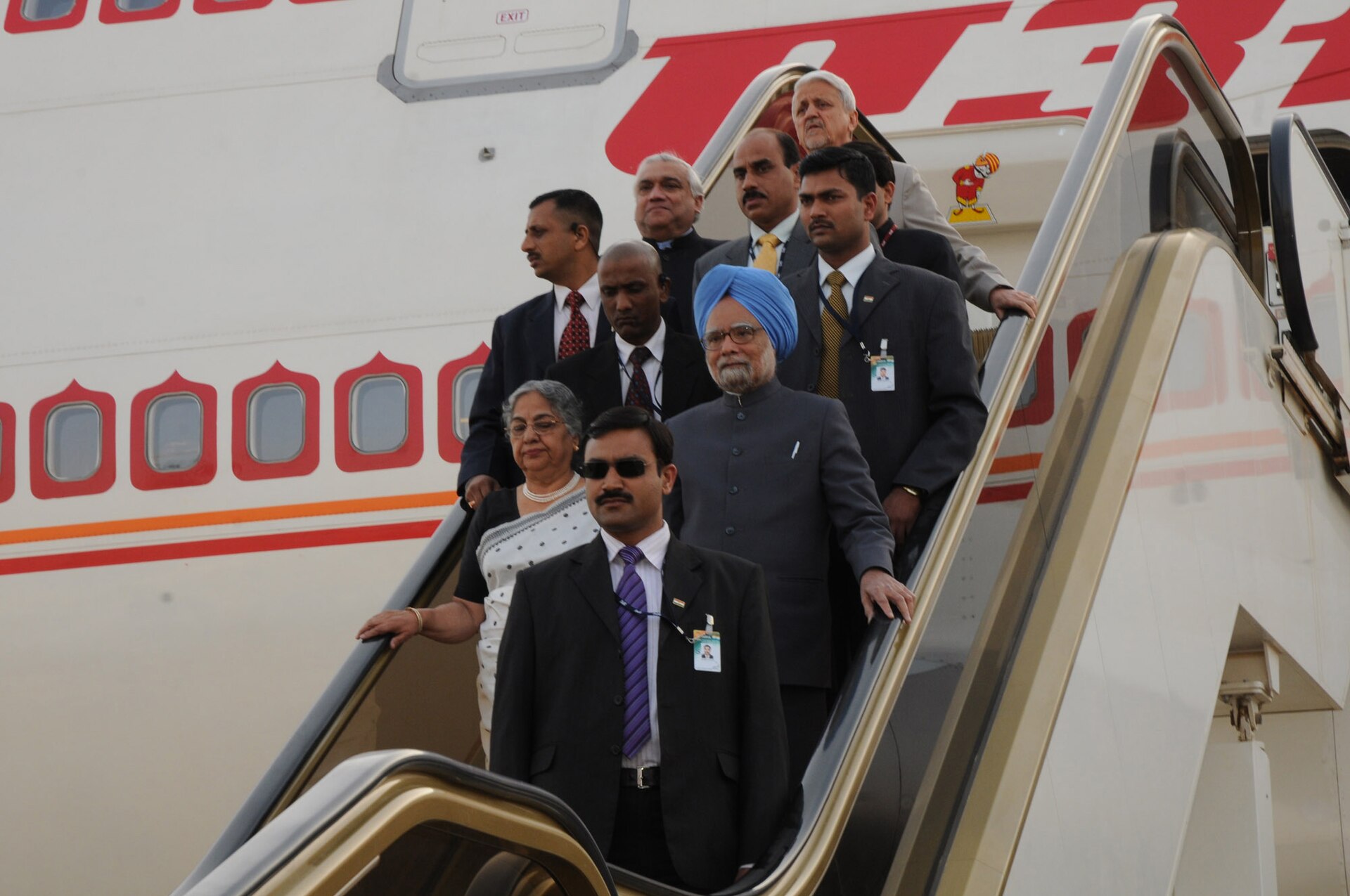

RIYADH — The Indian Embassy in Riyadh issued a fresh safety advisory on 20 October 2026 telling approximately 2.65 million Indian nationals in Saudi Arabia to “take due precautions under the prevailing situation,” the latest in a series of embassy notices since Houthi missile and drone strikes began hitting Saudi airports in early October (News on AIR, 20 October 2026).
The advisory — issued while King Khalid International Airport remained closed and three Indian carriers kept Saudi-bound flights suspended — does not order evacuation. One Indian national has been killed in the 10 October KKIA strike. Eleven others were wounded. India’s Ministry of External Affairs has called the attacks “totally unacceptable” and “dastardly” (WION, 18 October 2026; Al Jazeera, 11 October 2026). The strongest departure guidance the advisory offers: nationals wanting to leave “may consider transiting via Bahrain, Kuwait, or Qatar, subject to obtaining the necessary visas.”
India’s exposure in Saudi Arabia — 2.65 million nationals, $41.07 billion in bilateral trade, 16 percent of its crude oil imports, roughly $9 billion in annual remittances — makes the advisory as much a diplomatic document as a safety one. The Philippines, with seven nationals wounded, is the only major expat-source country to have begun organized repatriation flights. Every other government, India’s included, has chosen advisory language over action.
Table of Contents
What the Advisory Says — and What It Leaves Out
The 18 October version of the advisory — the most detailed publicly available text, whose language the 20 October notice appears to reiterate — instructs Indian nationals to follow Saudi Civil Defence directives issued through the National Early Warning Platform for Emergencies (BusinessToday, 18 October 2026). When an alert sounds, Indians should move to an interior room away from windows, avoid balconies, rooftops, and open areas, and — if driving — pull over away from bridges and high-rise buildings.
The advisory adds a restriction with implications beyond safety: Indians should refrain from “filming, publishing or sharing any information, photos or videos related to the ongoing events” (BusinessToday, 18 October 2026). The clause passes on a Saudi government directive — Saudi law imposes penalties for distributing sensitive security-related content — but it also limits the flow of ground-level information back to families in India and to media organizations tracking the strikes.
The embassy established 24-hour emergency control rooms in both Riyadh and Jeddah (NewsBytes, 18 October 2026).
The Middle East briefing 3,000+ readers start their day with.
One email. Every weekday morning. Free.
What the advisory omits matters more than what it includes. There is no evacuation order. There is no government-chartered repatriation flight. There is no recall of non-essential personnel. The departure guidance reads: “Indian nationals requiring urgent departure may consider transiting via Bahrain, Kuwait, or Qatar, subject to obtaining the necessary visas” (WION, 18 October 2026). The word “consider” places the financial and logistical burden on the individual. The word “may” makes departure optional.
The 20 October advisory is at least the fifth embassy notice since Houthi attacks began on 6 October. India’s consular apparatus had been issuing warnings before the October strikes: on 28 February 2026, the embassy told Indian nationals to “remain vigilant” (News on AIR, 28 February 2026). The escalation from February’s general caution to October’s specific shelter-in-place instructions tracks the deterioration of the security environment across eight months. The vocabulary has not reached the word “evacuate.”
One Death, Eleven Injured, 2.65 Million Exposed
Mohammed Yousuf Ali of Hyderabad died on 11 October from injuries sustained in the previous day’s Houthi strike on King Khalid International Airport, according to Gulf News (11 October 2026) and WION (18 October 2026). His death raised the attack’s confirmed toll to 13 dead and more than 300 wounded (BBC, 11 October 2026). The MEA has not publicly confirmed his identity. His funeral was held in Riyadh on 12 October, per his family’s wishes (Khaleej Times, October 2026).
Eleven other Indian nationals were injured in the same attack. As of mid-October, four remained in intensive care — stable, according to embassy updates — with four others in normal hospital wards and three discharged (Khaleej Times, October 2026). Embassy officials continued visiting hospitals and maintaining contact with the families.
Ali was one person among 2.65 million. The MEA places the Indian community in Saudi Arabia at approximately that figure — the single largest concentration of Indian nationals anywhere abroad (Arab News, citing MEA). The 2023 Saudi census recorded a lower count of 1.88 million, listing Indians as the kingdom’s second-largest expatriate group (Arab News). The majority hold blue-collar positions in construction, services, retail, and domestic work.
The October 6–11 attack campaign across Saudi airports killed 20 people and injured more than 370 (BBC, 11 October 2026). The 10 October KKIA strike alone accounted for 13 dead and 308–309 wounded (BBC, 11 October 2026; Al Jazeera, 10 October 2026). Nationalities among the dead included Saudis, Bangladeshis, a US citizen, and one Indian.
Air India and IndiGo extended Saudi flight suspensions through at least 24 October. Akasa Air suspended through 27 October (Revoi.in, 18 October 2026). Saudi national carrier Saudia continued operating from Dammam, Jeddah, and Medina. KKIA remained closed. For Indians in Riyadh without the means, visa documentation, or employer permission to travel overland to another airport or cross into a neighbouring Gulf state, the advisory’s suggestion to transit through Bahrain, Kuwait, or Qatar is a paragraph of text, not a route out.
How Have Other Countries Responded?
India’s advisory sits within a pattern. No government with a large expatriate workforce in Saudi Arabia has ordered mass evacuation. But within that shared restraint, responses differ in specificity and in action.
| Country | Known Casualties (Oct 2026) | Government Response | Organized Repatriation |
|---|---|---|---|
| India | 1 killed, 11 injured | Shelter-in-place advisory; MEA condemned attacks as “totally unacceptable” | No |
| Philippines | 7 wounded (3 critical) | Government-funded repatriation assistance; solidarity with Saudi Arabia | Yes |
| Pakistan | 1 killed (11 Oct) | Condemned at UN; called for immediate halt | No |
| Bangladesh | 2 killed (10 Oct) | Embassy notice: avoid crowded places, follow Saudi directives | No |
| United States | 1 killed (10 Oct) | Staff travel restricted; “expect further airport attacks” | No |
| United Kingdom | Not reported | Advises against travel within 10 km of Yemen border | No |
The Philippines is the outlier. Seven Filipino workers were wounded in the Riyadh strikes, three critically (Arab News). Manila moved from condemnation to logistics: a first repatriation flight of 26 overseas Filipino workers landed at Ninoy Aquino International Airport on 10 October (Tribune, 10 October 2026). By 16 October, the Department of Migrant Workers had processed 149 OFWs and announced plans for approximately 200 more, with the government covering costs (Tribune, 16 October 2026). The Philippines reaffirmed solidarity with Saudi Arabia while repatriating its nationals — a balance no other country has attempted.
Pakistan lost one resident in the 11 October strike on KKIA Terminal 4 (CNN, 11 October 2026). Pakistan’s UN envoy condemned the attacks and called for an immediate halt (Tribune). Islamabad stations troops in Saudi Arabia. No formal evacuation advisory has been issued.
Bangladesh lost two nationals in the 10 October strike (Arab News). The Bangladesh Embassy in Riyadh issued an urgent notice on 12 October advising nationals to avoid crowded places and follow Saudi instructions, and — echoing India — warned against filming or sharing images of interceptions and impact sites (bdnews24, 12 October 2026). Dhaka condemned the attacks and called for dialogue. No repatriation was announced.
The United States bars government employee travel within 20 miles of the Yemen border and requires Chief of Mission authorization for any US government employee to use any Saudi airport. The US advisory warned Americans to “expect further airport attacks” (WION, 18 October 2026). One American was among the 10 October dead. No evacuation flights have been organized.
The United Kingdom advises against all travel within 10 kilometres of the Yemen border (BBC, 11 October 2026). No broader restriction for Saudi Arabia has been issued.
The Philippines is the only major expat-source country to have moved beyond advisory to organized repatriation — and its numbers so far remain in the dozens to low hundreds. For India, with a community more than three times larger than any other national group in the kingdom, even a proportional response would require an operation the October advisory shows no sign of contemplating.
What Keeps India From Ordering an Evacuation?
The advisory’s restraint is not bureaucratic inertia. It reflects the scale of an economic relationship that turns a government-ordered evacuation from a consular event into a systemic one.
Bilateral trade reached $41.07 billion in FY2025-26 (Indian Embassy Riyadh Economic Brief). Saudi Arabia is India’s fifth-largest trade partner; India is Saudi Arabia’s third-largest. Saudi investment in India — including the Public Investment Fund’s stakes in Reliance Jio Platforms and Reliance Retail — totals approximately $10 billion (Indian Embassy Riyadh Economic Brief). Indian companies registered in Saudi Arabia grew from roughly 500 in 2020 to more than 6,000 by 2025.
Energy ties add structural depth. Saudi Arabia supplied approximately 16.03 percent of India’s crude oil imports in the first quarter of 2026, making it India’s third-largest source behind Iraq at 19.89 percent and Russia at 17.92 percent (TradeInt). A crude supplier can be replaced on a spot market. The pricing relationships, refinery joint ventures, and supply guarantees embedded in the broader diplomatic partnership take years to build and cannot be reconstituted by a single cargo tender.
Remittances flow in the opposite direction. India’s total diaspora remittances reached a record $135.46 billion in FY2025-26 (PressInsider, citing RBI). Saudi Arabia accounts for approximately 6.7 percent of India’s remittance receipts, per the Reserve Bank of India’s sixth survey — roughly $9 billion annually (Drishti IAS, citing RBI). For households in Kerala, Andhra Pradesh, Telangana, and Uttar Pradesh that depend on those transfers, a mass return of workers would produce an immediate and concentrated income shock.
A government-ordered evacuation would also send a diplomatic signal: that India considers Saudi Arabia too dangerous for its nationals. The kingdom cancelled its flagship Future Investment Initiative conference on 20 October, the same day India’s latest advisory was issued (Al Jazeera, 20 October 2026). Riyadh is managing perception alongside security. An Indian evacuation order would cut against that effort at the worst possible moment.
The MEA’s posture — “totally unacceptable,” “solidarity with Saudi Arabia,” “attacks on civilians must cease immediately” — condemns the attacker without placing any obligation on the host government. The advisory shelters people. The diplomacy shelters the relationship.
From Yemen to Saudi Arabia: Why 2026 Is Not 2015
India has extracted nationals from this region before. Operation Raahat in April 2015 evacuated 4,741 Indians and 1,947 nationals from 41 other countries from Yemen as the Saudi-led coalition’s air campaign began (Wikipedia). The Indian Navy ran sea evacuations from Aden between 1 and 11 April; the Indian Air Force flew missions from Sanaa between 3 and 9 April. The government had issued advisories from January 2015, but more than 5,000 Indian citizens had not heeded them and required rescue.
Operation Raahat is the precedent Indian commentators reach for when they ask why New Delhi has not done more in October 2026. The comparison does not hold.
In 2015, India was pulling people out of Yemen — a failing state that Saudi Arabia was bombing. There was no bilateral relationship to manage, no crude oil flowing, no $41 billion in trade, no remittance pipeline to protect. In 2026, India’s nationals are in Saudi Arabia — the country being attacked, not the country launching strikes. Saudi Arabia is a sovereign host state, a strategic partner, and the workplace of 2.65 million Indian citizens.
The logistical scale compounds the diplomatic constraint. Operation Raahat moved fewer than 5,000 people. The Indian community in Saudi Arabia exceeds that by a factor of more than five hundred. Even a partial evacuation — 10 percent of the community — would mean moving 265,000 people with Riyadh’s airport closed, Indian carriers grounded, and overland alternatives running through Gulf states that require separate visa clearance.
The February advisory — “remain vigilant” — was issued seven months before the first October strike. The embassy read the environment early. The distance between February’s general vigilance and October’s shelter-in-place instructions is not a trajectory toward evacuation. It is a calibration of language within a framework that has already decided the word is off the table.
Frequently Asked Questions
What emergency numbers should Indian nationals in Saudi Arabia call?
Saudi Arabia’s unified emergency number is 911 in Makkah, Madinah, Riyadh, and the Eastern Province, and 998 in all other areas. The Indian Embassy in Riyadh and the Consulate General in Jeddah have both established 24-hour emergency control rooms. The PBSK (Pravasi Bharatiya Sahayata Kendra) helpline for Indian nationals is 8002471234. All numbers were listed in the embassy’s October advisories (NewsBytes, 18 October 2026).
Has India’s prime minister addressed the attacks?
As of 20 October 2026, no public statement from Prime Minister Narendra Modi specifically addressing the Houthi attacks on Saudi Arabia or the death of Mohammed Yousuf Ali has been identified in English-language sources. India’s official response has been channelled through MEA spokesperson Randhir Jaiswal, who called the attacks “totally unacceptable” and expressed “solidarity with Saudi Arabia” (WION, 18 October 2026).
Are Indian workers who want to leave dependent on their employers?
Saudi Arabia’s sponsorship system ties residence and exit documentation to the employer for many worker categories. The embassy advisory’s suggestion to transit through neighbouring countries assumes the individual can obtain exit clearance from their sponsor, a visa for the transit country, and the funds to cover overland or commercial travel. For blue-collar workers — who form the majority of the 2.65 million Indian nationals in the kingdom — these requirements represent a barrier the advisory acknowledges implicitly but does not resolve.
What is the current status of Indian airlines serving Saudi Arabia?
Air India and IndiGo suspended all Saudi-bound flights through at least 24 October 2026. Akasa Air extended its suspension through 27 October. Saudia, the Saudi national carrier, continues to operate from Dammam, Jeddah, and Medina (Revoi.in, 18 October 2026). King Khalid International Airport in Riyadh — the primary hub for Indian travellers to the kingdom — remained closed as of 20 October. No Indian government-chartered repatriation flights have been announced. The Philippines is the only major expat-source country to have organized such flights, with 26 OFWs returned on 10 October, 149 more processed and ready as of 16 October, and approximately 200 planned for repatriation (Tribune, 10 and 16 October 2026).