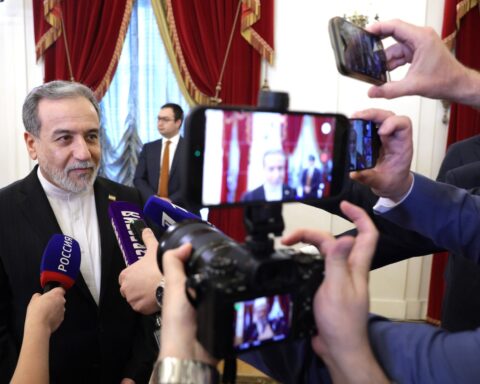

RIYADH — Brigadier-General Hossein Mohebbi, the IRGC’s spokesman, stood in Tehran’s Sacred Defence Museum on 19 October and told Iran’s state television that seven major internet cables run beneath the Strait of Hormuz — and that they “could become Iran’s new targets.” Saudi Arabia has spent months defending its airports against Houthi attack — intercepting ballistic missiles over Riyadh, deploying coalition forces under the Makkah pact, drawing in Pakistani, Turkish and French air defences according to the coalition — but Mohebbi’s statement identified a category of infrastructure that none of that apparatus can reach. The International Cable Protection Committee counts five active cable segments in the strait, not seven, but the discrepancy is not the point: Iran has moved from threatening ships, airports and oil infrastructure to threatening the digital connective tissue on which Saudi Arabia has staked its entire economic future, and Riyadh has never publicly addressed whether Vision 2030 can survive it.
Mohebbi’s language was conditional, not declarative — a threat broadcast on IRIB and disseminated by Fars news agency, not an operational order. But it arrived at the end of a progression that began in May 2026, when Iran’s military spokesman Ebrahim Zolfaghari said Tehran would “impose fees on internet cables” transiting its claimed offshore territory in the Strait of Hormuz. Five months later the IRGC dropped the pretence of a commercial claim and framed the cables as military targets. Prediction market Polymarket prices the probability of Iran or its proxies physically damaging undersea cable infrastructure at 4% by end-October and 12% by end of year, according to Benzinga. The editorial question is not whether Iran will cut them tomorrow but whether Riyadh has ever priced the possibility into a modernisation programme that runs on the assumption of uninterrupted connectivity.
Table of Contents
- What Iran Actually Said (and What It Didn’t)
- The Cables Iran Is Threatening
- Why Does the Repair Problem Matter More Than the Attack?
- What Does This Mean for Vision 2030’s Digital Layer?
- Who Has Actually Done This Before?
- Can International Law Protect Undersea Cables?
- What Are Riyadh’s Options?
- Frequently Asked Questions
What Iran Actually Said (and What It Didn’t)
Two Iranian officials, at two levels of authority, framed undersea cables as potential targets within the same month — and neither committed to actually striking them. Mohebbi, speaking at the Sacred Defence Museum on 19 October, told Fars news agency that “all of the world’s internet and commercial data” depend on the cables beneath Hormuz, and that “new targets will be unveiled, new weapons will be unveiled.” Mohsen Rezaei, secretary of Iran’s Supreme National Security Council, had gone further earlier in October, warning that undersea cables, data centres and AI facilities linked to US interests could be targeted if the conflict widened — but then added a qualifier that inverted the threat: “We have not yet included these assets among our targets.”
Andreas Krieg, a senior lecturer in security studies at King’s College London, called Rezaei’s warning “fundamentally about deterrence” aimed at Abu Dhabi, Riyadh and Doha “as much as at Washington.” The threat, Krieg said, “reflects a new category of strategic infrastructure tying Gulf economic diversification to US technology.” That reading reframes the cables not as a military target in the conventional sense but as a pressure point in the broader contest over who controls the economic future of the Gulf — and who can threaten it at low cost.
The precedent for reading Iran’s conditional language as something more than rhetoric was set in May 2026, when Zolfaghari’s announcement about cable fees appeared at first to be a revenue play, an attempt to monetise Iranian territorial claims in the strait. Within five months, the IRGC had moved from charging for access to the kind of two-track posture it has applied to every other dimension of the Hormuz crisis — offering mediation while expanding the target set.
The Cables Iran Is Threatening
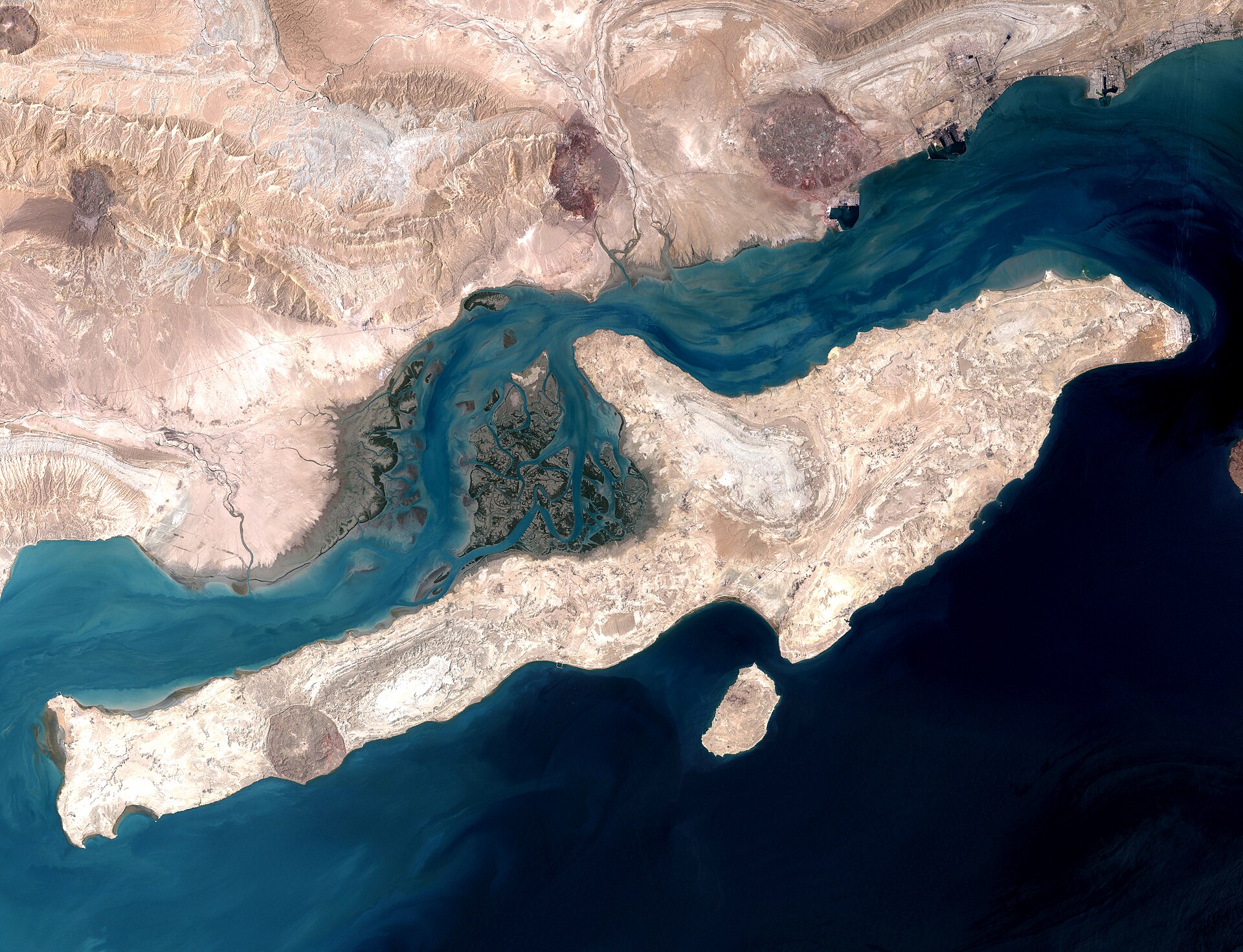
TeleGeography, the industry authority on subsea infrastructure, identifies three active cable systems crossing the Strait of Hormuz: AAE-1 (Asia-Africa-Europe 1), which connects Southeast Asia to Europe via Egypt with landing points in the UAE, Oman, Qatar and Saudi Arabia; FALCON, linking India and Sri Lanka to Gulf countries; and the Gulf Bridge International Cable System, known as GBICS or MENA, which connects all Gulf states including Iran itself. TATA TGN-Gulf also appears on TeleGeography’s submarine cable map of the region. The ICPC’s count of five active cable segments exceeds the three named systems because some run multiple segments through the strait, but falls short of Mohebbi’s claimed seven — a discrepancy that suggests the IRGC is either counting planned systems that have not been laid, or inflating the number for rhetorical effect.
The Middle East briefing 3,000+ readers start their day with.
One email. Every weekday morning. Free.
| Cable system | Route | Key Gulf landing points |
|---|---|---|
| AAE-1 | Southeast Asia to Europe via Egypt | UAE, Oman, Qatar, Saudi Arabia |
| FALCON | India and Sri Lanka to the Gulf | Multiple Gulf states |
| Gulf Bridge International (GBICS/MENA) | Intra-Gulf connectivity | All Gulf states including Iran |
| TATA TGN-Gulf | India to the Gulf | Gulf states |
The critical nuance that most coverage of Mohebbi’s threat has missed is that Saudi Arabia is not the Gulf state most exposed to a Hormuz cable cut. The kingdom draws most of its international bandwidth from cables on its Red Sea coast — the PEACE cable lands at Jeddah — and AAE-1 reaches Saudi Arabia via the Gulf of Oman and the UAE side, not directly through Hormuz. John Wrottesley, ICPC’s operations manager, has noted that cable traffic through the Strait of Hormuz represents “under 1% of global international bandwidth,” and that “cable networks are built around resilience and redundancy.”
That fraction sounds reassuring until you consider who it serves. Qatar, Kuwait, Bahrain and Iraq are the states most acutely exposed to Hormuz-route disruption because they have fewer alternative cable routes, and for those states a severed Hormuz cable would be the primary disruption, not a secondary one. An attack on Bahrain’s bandwidth is an attack on GCC financial clearing systems that Saudi banks depend on — and Riyadh has no mechanism to defend fibre that sits on the seabed in waters Iran now treats as its own.
Why Does the Repair Problem Matter More Than the Attack?
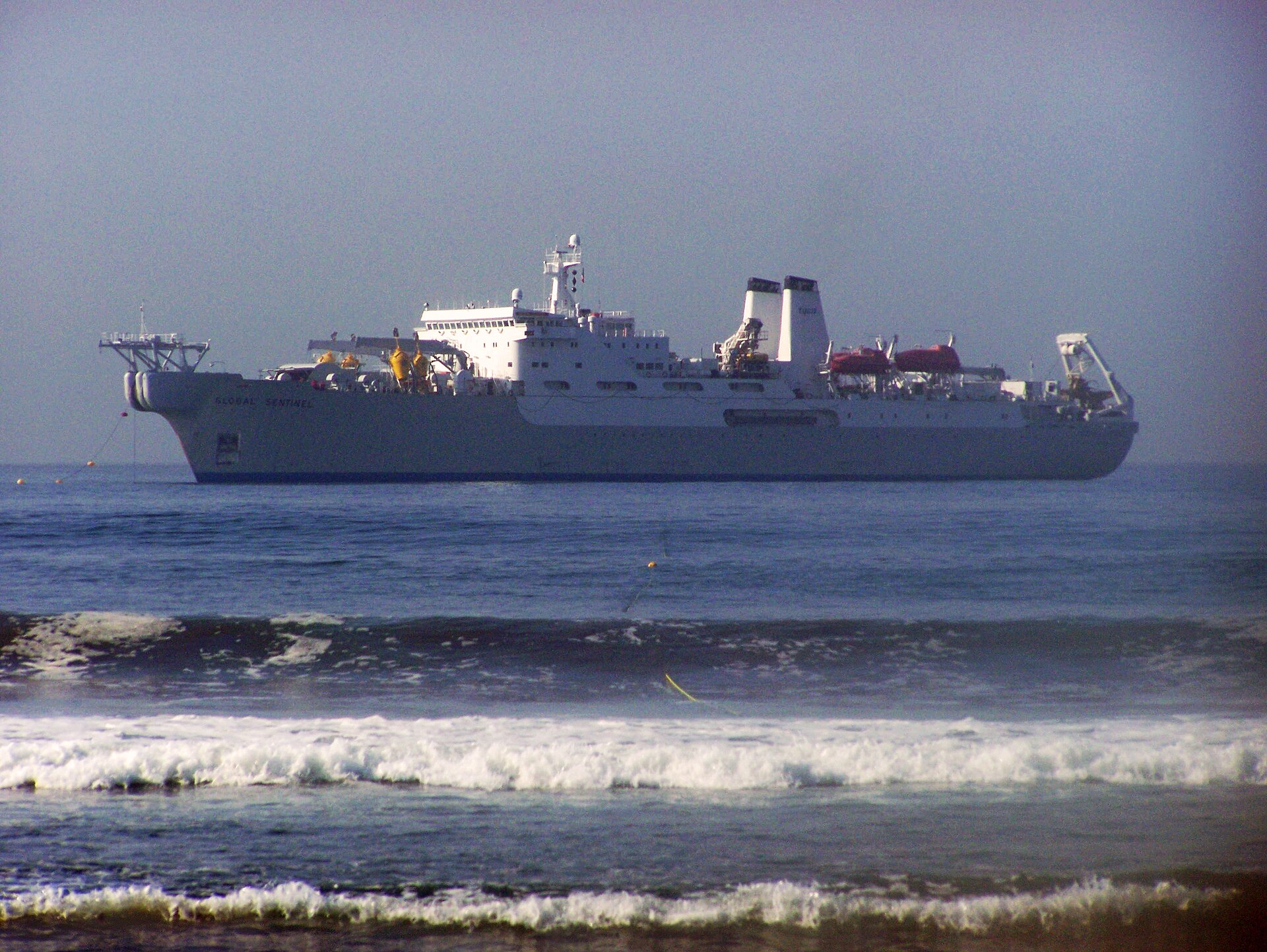
The immediate damage from a cable cut is measurable: degraded bandwidth, rerouted traffic, latency spikes that financial systems can tolerate for hours but not for weeks. The lasting damage comes from what happens after — or, more precisely, what does not happen, because the infrastructure that makes cable repair possible has already withdrawn from the region. France-based Alcatel Submarine Networks, one of the world’s largest cable repair operators, paused all regional repair operations as of May 2026, according to The National News. Maritime data provider Windward warned that, with Red Sea cables already degraded by 2024 damage, the Alcatel pause “threatens the primary remaining data link between Europe and Asia.”
Alan Mauldin, research director at TeleGeography, has identified the deeper structural problem: even when a repair vessel is available, permitting to enter territorial waters is “possibly the biggest source” of delays. Repair ships operate under flags that require transit permissions from every coastal state whose waters they must cross — and in the Strait of Hormuz, where Iran has declared that passage requires coordination with Iranian forces, those permits could take months rather than weeks, assuming Tehran grants them at all. On the satellite question, Mauldin’s assessment was categorical.
“It’s not as though you could just switch to satellite. That’s not an alternative.”
Alan Mauldin, research director, TeleGeography
Masha Kotkin, a geopolitical and energy analyst, reinforced that assessment, calling Starlink “a boutique solution, which is not scalable to millions of users, at this time.” Kotkin warned that “damaged cables mean the internet slowing down or outages, e-commerce disruptions, delayed financial transactions” — and added the dimension that makes the repair problem worse than the attack itself: “The longer this conflict lasts, the higher the likelihood of unintentional damage.” A mine drifting into a cable route, an anchor dragging across fibre during evasive manoeuvres, a repair crew blocked from getting permits — these are not hypotheticals but the actual conditions in a mined strait where Alcatel has stopped working and Iran has declared the seabed part of the battlefield.
The ICPC records approximately 150 to 200 cable faults per year globally, attributing 70 to 80 per cent to accidental causes — fishing gear and ship anchors. Hormuz vessel transits ran at roughly 120 per day under normal conditions, according to Gulf News citing Kpler data, and had fallen to approximately 105 commodity-carrying vessels in the first 18 days of the conflict — even reduced traffic in a mined, contested strait poses more risk to seabed infrastructure than normal traffic in a peaceful one.
What Does This Mean for Vision 2030’s Digital Layer?
Saudi Arabia designated 2026 as the Year of AI. The kingdom’s data centre capacity grew from approximately 68 megawatts in 2021 to 467 megawatts in early 2026, according to IMARC Group — a nearly sevenfold expansion in five years, all of it predicated on the assumption that the bandwidth connecting those facilities to the global internet would remain available. SDAIA’s Hexagon Data Center in Riyadh, with a planned capacity of 480 megawatts, had its foundation stone laid in January 2026. Microsoft confirmed in March that its Saudi Arabia cloud region would be available from Q4 2026, intended to “power Vision 2030 cloud and AI ambitions,” as reported by Intelligent CIO.
When Saudi Arabia built the East-West pipeline — designed to carry approximately 7 million barrels per day from the Eastern Province to Yanbu on the Red Sea, according to Saudi Gazette — it created a terrestrial bypass for oil that could circumvent Hormuz disruption. The pipeline was a physical answer to a physical chokepoint, and despite operational interruptions during the current conflict it remains the structural insurance policy that keeps Saudi crude flowing when the strait does not. No equivalent exists for data. There is no East-West fibre trunk carrying Saudi Arabia’s internet traffic from the Gulf coast to the Red Sea in a hardened terrestrial corridor, and no public plan to build one.
The AWS drone attacks of early March 2026, which struck data centres in the UAE and Bahrain, already demonstrated that Gulf digital infrastructure is a live target — the first confirmed attacks on cloud facilities in the current conflict, causing physical damage, power disruptions and outages, according to Benzinga. Those attacks hit the physical plants that store data; an attack on the cables would hit the connections that move it, and the combination of both — degraded physical infrastructure and severed connectivity — is the scenario that Vision 2030’s risk model has never publicly addressed.
The kingdom’s revised 2026 deficit estimate of 245 billion riyals, up from a budgeted 165 billion according to Reuters via Zawya, already reflects the cost of a conflict that has hammered oil revenues and delayed investment timelines. FII, the flagship investment summit, has been postponed to 2027. Riyadh Season was due to open on 21 October; the EU-GCC summit was set for Riyadh on 24 October. Every one of these events depends on the kind of connectivity that Mohebbi’s threat puts at risk — not just for Saudi Arabia, but for the Gulf states whose delegates, investors and broadcasters would rely on Hormuz-routed bandwidth to participate.
Who Has Actually Done This Before?
In February 2024, three submarine cables in the Red Sea — AAE-1, the Europe India Gateway and Seacom — were damaged, not by a deliberate military strike but by anchor drag from the Rubymar, a cargo vessel hit by a Houthi missile that drifted for days before sinking. HGC Global Communications reported that the damage disrupted approximately 25% of internet traffic flow between Asia, Europe and the Middle East. Repairs on AAE-1 were completed by July 2024 — five months for a single cable, in waters that were dangerous but not under active naval blockade — while EIG and Seacom were repaired by E-Marine, an Etisalat subsidiary.
The Hormuz environment is worse in every dimension that matters for cable repair. The strait is narrower, the territorial claims are more aggressively enforced, the repair infrastructure has already withdrawn, and the coastal state whose permits would be required for any repair operation is the same state whose military spokesman just identified the cables as potential targets. If an accident in the Red Sea — a drifting anchor, not a military operation — took five months to repair on one system and disrupted a quarter of intercontinental traffic, a deliberate cut in Hormuz, or even accidental damage in an environment where supertankers have hit mines, could leave Gulf states with degraded connectivity for far longer.
The Baltic Sea offers the other recent case study. Between December 2025 and January 2026, a Congressional Research Service report documented at least six instances of suspected sabotage or disruption to undersea cables in the Baltic. German Defence Minister Boris Pistorius stated that “no one believes that these cables were cut accidentally,” but attribution proved elusive — Swedish prosecutors ruled that damage to a Sweden-Latvia cable by the vessel Vezhen was accidental, and Finland’s intelligence service Supo cautioned against over-reliance on the “hybrid warfare” label. The Baltic cases illustrate the problem that makes cable sabotage attractive to a state actor: even when the damage is real and the suspects are obvious, proving intent under international law is functionally impossible.
Meredith Primrose Jones, a researcher at RMIT University’s Oceania Cyber Security Centre, has identified the Red Sea, Bab el-Mandeb, the Suez Canal and the Strait of Hormuz as the world’s “digital chokepoints” — places where geography forces bandwidth through narrow corridors that a single hostile act can disrupt. The Strait of Hormuz in October 2026, where mines are in the water, Alcatel has withdrawn its repair operations, and vessel traffic has fallen to its lowest sustained level since the conflict began, is the hardest of those chokepoints by every measure that matters for cable survivability.
Can International Law Protect Undersea Cables?
UNCLOS Article 113 requires signatory states to criminalise wilful or culpably negligent damage to submarine cables beyond the territorial sea. The article sounds like protection until you read its limitations: jurisdiction covers only the prosecuting state’s own nationals or vessels flying its flag, many UNCLOS parties have not implemented it in domestic legislation, and penalties set by states that have implemented it are often monetary and disproportionately low. Scholars at the Observer Research Foundation and elsewhere have argued that Article 113 is structurally too narrow for deliberate state-directed sabotage — it was written for an era of accidental damage by fishing trawlers, not for an IRGC that announces on state television which cables it might cut.
Primrose Jones has noted that cable sabotage “is hard to attribute and legally ambiguous,” which raises the risk of escalation precisely because the legal framework cannot keep pace with the threat. A state that cuts a cable in its claimed territorial waters can argue sovereign prerogative; a state that cuts a cable in international waters can deny attribution; and a state that simply creates the conditions in which cables are damaged by mines, anchors or conflict — without ever issuing the order to cut — occupies the grey zone that Article 113 was never designed to address.
More than 95% of all international data traffic travels on subsea cables, according to researchers cited in The Conversation. The Red Sea alone carries approximately 17% of the world’s internet traffic, per Gulf News. The legal architecture protecting this infrastructure was drafted in 1982, before the internet existed in any form that would have made cable protection a strategic concern, and there is no active negotiation to update it — in part because the permanent members of the Security Council disagree on whether cable damage in the Baltic constitutes a hostile act, let alone what should be done about it in the Gulf.
What Are Riyadh’s Options?
Saudi Arabia is, by an accident of geography, less exposed to Hormuz cable disruption than any other major Gulf state — its primary bandwidth routes west through the Suez corridor, not east through the strait. That advantage is real but incomplete, because the digital economies of the GCC do not operate in isolation, and the Gulf states with the most acute Hormuz cable exposure are the same states whose financial, logistics and cloud systems Saudi Arabia’s economy depends on daily.
Kuwait said after the 10 October airport strikes that Saudi security is “an inseparable part of the security” of Kuwait and the GCC, according to Fortune and the Associated Press. The same principle applies to digital infrastructure: a cable cut that degrades Kuwaiti government connectivity or takes Bahraini clearing systems offline is a Saudi problem, regardless of whether Riyadh’s own internet stays up. Riyadh has spent years building a regional economic architecture that assumes integrated digital connectivity across the Gulf, and that architecture is only as resilient as its weakest cable route.
The options are limited and none of them are fast. Cable rerouting — building new submarine systems that bypass Hormuz — is a multi-year, multi-billion-dollar undertaking, and multiple new systems planned for the region are already on hold or delayed, according to TeleGeography. Satellite backup sounds intuitive but, as both Kotkin and Mauldin have established, it cannot carry enterprise cloud traffic, financial settlement systems or AI workloads at the scale Vision 2030 requires — and permitting a repair vessel into Hormuz would take months under present conditions even if one were available. A hardened terrestrial fibre route across the Arabian Peninsula, connecting Gulf-coast data centres to Red Sea cable landing points, would be the digital equivalent of the East-West pipeline — but no Gulf state has announced such a project, and the engineering lead time would be measured in years.
Krieg framed the deeper problem by describing the cable threat as directed “as much as at Washington” as at the Gulf capitals, which means it serves Iran’s purpose whether or not a cable is ever cut — it forces Gulf planners to factor digital infrastructure risk into every investment decision, every cloud contract, every AI deployment. The physical risk in Hormuz has already been priced by markets: vessel transit rates and war risk premiums have repriced dramatically. The digital risk has not been priced at all, and the question Vision 2030’s planners have not answered is whether they have a contingency for the day it is.

Frequently Asked Questions
Would a Hormuz cable cut affect Saudi Arabia’s internet immediately?
Not as severely as it would affect Qatar, Kuwait, Bahrain or Iraq, which have fewer Red Sea routing alternatives. The more consequential impact would be indirect: Bahrain hosts GCC clearing and settlement systems, Kuwait’s sovereign wealth infrastructure runs cross-border financial flows, and the shared enterprise platforms and cloud architectures that Vision 2030’s regional supply chains depend on span all five GCC states. A cable cut that degrades Bahraini or Kuwaiti connectivity degrades Saudi Arabia’s financial infrastructure, regardless of whether Riyadh’s own internet stays up.
How long would it take to repair a severed cable in the Strait of Hormuz?
In peacetime, cable repairs typically take two to four weeks from fault identification to restoration. In the Strait of Hormuz right now, that baseline is irrelevant: there is no available repair operator in the region, and even if one agreed to deploy, its vessel would require transit permits from the state whose military spokesman just named the cables as targets. The closest real-world comparison — 2024 Red Sea damage, in far less restricted waters — took five months on the AAE-1 system alone, a timeline that becomes a floor, not a ceiling, in Hormuz.
Has any state deliberately cut an undersea cable as an act of war?
No confirmed case of deliberate state-on-state cable cutting exists in modern international law, which is precisely what makes the threat attractive as a tool of coercion. The Baltic Sea incidents of 2025-2026 involved at least six cable disruptions that Western intelligence services attributed to hostile action, but Swedish prosecutors ruled at least one case accidental. Cable sabotage occupies a grey zone — it causes measurable economic damage, is extremely difficult to attribute with legal certainty, and the primary international legal instrument, UNCLOS Article 113, applies only to the saboteur’s own flag state or nationals.
What would happen to Gulf financial markets if Hormuz cables were severed?
Geopolitical analyst Masha Kotkin has warned that cable damage would mean “the internet slowing down or outages, e-commerce disruptions, delayed financial transactions.” Bahrain’s role as a regional financial hub — hosting clearing systems and fintech platforms that serve the wider GCC — makes it the most acutely vulnerable. Gulf stock exchanges, interbank payment systems and real-time settlement infrastructure would face latency spikes or outages whose duration would depend entirely on repair access, which currently does not exist in the strait.
Could Starlink or other satellite systems replace undersea cables for Gulf internet traffic?
Not at any scale that would matter. Subsea cables carry more than 95% of all international data traffic globally, and a single modern submarine cable can carry tens of terabits per second — the entire global Starlink fleet provides a fraction of that capacity. The applications Vision 2030 is building toward — enterprise cloud services, real-time financial settlement, AI workloads — require sustained, low-latency, high-bandwidth connections that no satellite constellation yet deployed can provide. Treating satellite as a backup for submarine cable capacity is the infrastructure equivalent of replacing a motorway with a bicycle path.
Mohebbi’s claim about seven cables was wrong — the ICPC counts five — but the number that matters is not how many cross the strait. It is how many months it would take to repair one of them in waters where Alcatel has stopped working, the tankers have slowed their transits, and Iran’s military has stopped pretending the seabed is not part of the battlefield. Microsoft’s Saudi cloud region is due in Q4 2026, and the cables that would carry the data to fill it run through a corridor that an IRGC general just identified as a target, in a strait whose legal protections were written before the internet existed.