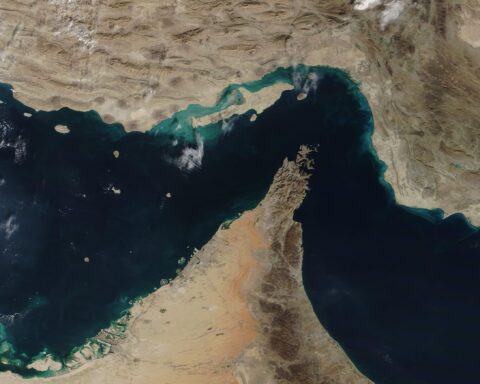

DUBAI — Iran’s IRGC Navy announced on Monday, 16 November, that two oil tankers struck naval mines on an “unauthorized” southern route through the Strait of Hormuz, according to Mehr News Agency. Hours earlier, the country’s regular Army Navy had separately claimed a tanker hit a mine in the eastern strait on Sunday night, per PressTV. The United Kingdom Maritime Trade Operations centre then issued Warning 207-26 on Monday, reporting that a tanker leaving Hormuz had been struck by an “unknown projectile” and an engine-room fire had broken out, according to IBTimes.
The incidents unfolded as a third US carrier strike group reached the CENTCOM area of operations. No shipowner, flag state, or insurer had confirmed any of the IRGC-claimed vessel identities as of Monday morning in Europe.
The House of Saud Daily Briefing
Saudi Arabia's news in 3 minutes, every morning. Free. See today's issue
Table of Contents
What Did the IRGC Navy Claim on November 16?
The IRGC Navy said the two tankers had been sailing the southern route through the strait when “several very strong” explosions struck, “lighting up the skies over the Strait of Hormuz for hours,” according to Mehr News Agency. The IRGC provided no vessel names, flag states, or crew details for either tanker.
The force described the events as “punitive measures in response to the U.S. military’s illegal blockade,” per Mehr News. It said the tankers had been operating “under the direct guidance of American officers and with the support of U.S. military fighter jets.”
The southern American route is “mined with fiery walls.” Oil company owners should not trust American military assurances.IRGC Navy statement, via Middle East Eye, 16 November 2026
The two newly reported tankers exploded “a short distance from two previously targeted tankers,” the IRGC Navy said, per Mehr News. The IRGC put its cumulative total at “six tankers caught fire in similar incidents in the strategic waterway on Sunday and Monday,” according to Reuters, as reported by the Jerusalem Post. The state news agency IRNA had separately put the count at five tankers in 48 hours as of Sunday. No vessel-by-vessel breakdown was offered, and part of that aggregate likely includes a supertanker reported on 15 November that the IRGC separately claimed had sunk.
In a separate development on Monday, the IRGC Navy said it seized an MQM-170 drone south of Qeshm Island, according to mlq.ai. The United States had not commented on the claim as of Monday morning.
What Did Iran’s Army Navy Report on November 15?
Iran’s regular Army Navy — the Artesh naval branch, distinct from the IRGC Navy — announced late on Sunday that an oil tanker had struck a naval mine in the eastern Strait of Hormuz and caught fire, according to PressTV. The force said the vessel had been sailing in a “designated restricted zone.”
The tanker had switched off its navigation systems before entering the restricted area “without coordination with Iranian armed forces,” the Army Navy said, according to PressTV. The statement framed the incident as a consequence of the vessel violating Iranian-imposed maritime rules, warning that ships navigating without coordination with Iran’s armed forces risked striking a sea mine.
The Army Navy’s Sunday claim covered a different geographic sector from the IRGC Navy’s Monday announcement: the Army Navy cited the eastern approach to the strait, while the IRGC Navy focused on the southern route.
UKMTO Warning 207-26 and the ON PHOENIX
UKMTO issued Warning 207-26 on Monday at 5:58 a.m. UTC, classifying the event as an “ATTACK,” according to IBTimes. The advisory said a tanker leaving the Strait of Hormuz had been “hit by an unknown projectile,” causing an engine-room fire. All crew members were accounted for and no casualties were reported.
The Monday warning followed a separate UKMTO advisory issued on Sunday, 15 November, reporting that a tanker had “come under attack” elsewhere in the Gulf, with all crew safe, according to mlq.ai. No vessel name or attacker identity was provided for the Sunday incident. The two UKMTO advisories — issued within 24 hours — covered different vessels in different locations.
UKMTO did not identify the vessel in Warning 207-26, its operator, or any responsible party. It did not describe the event as a mine strike — the word used was “projectile,” a classification that cannot be reconciled with the IRGC’s and Army Navy’s mine claims without further investigation. Whether the ON PHOENIX incident corresponds to any of the tankers in Iran’s announcements remains unclear across all reporting lines.
Maritime security monitor Vanguard identified the vessel as the Panama-flagged ON PHOENIX, IMO 9893228, struck approximately 3 nautical miles off the coast of Oman, according to Seatrade Maritime. Neither Vanguard nor any official source attributed the strike to a specific party. A maritime security monitoring service tracking UKMTO and JMIC advisories reported that the regional maritime threat level had been raised to “Severe” in connection with ongoing Iranian military activity.
How Do Iran’s Two Naval Forces Differ?
Iran maintains two naval forces under separate chains of command. The IRGC Navy operates within the Islamic Revolutionary Guard Corps, reporting to the IRGC Commander-in-Chief. The Artesh Navy — Iran’s regular army naval branch — reports through the Armed Forces General Staff, which answers directly to the Supreme Leader. Both chains ultimately fall under Supreme Leader Mojtaba Khamenei, who assumed the position on 8 March 2026. Iran’s Ministry of Defence and Armed Forces Logistics handles procurement and logistics but exercises no operational command over either force.
The IRGC Navy has traditionally focused on the Persian Gulf, the Strait of Hormuz, and asymmetric warfare — fast boats, mines, and coastal defences. The Artesh Navy operates Iran’s larger warships and has historically been responsible for blue-water operations in the Gulf of Oman and beyond, though the operational boundaries have blurred during the current conflict.
Both forces issued public mine-strike claims within the same 24-hour window this weekend, covering different areas of the strait. Each branch used similar language, characterising the tanker strikes as consequences of vessels violating Iranian-imposed restrictions on Hormuz navigation. The IRGC Navy focused on the southern route and directed its rhetoric at American military escorts; the Army Navy cited the eastern approach and emphasised the vessel’s decision to switch off navigation systems. The parallel messaging from two forces with separate command chains pointed to a degree of coordination in Iran’s public posture on maritime operations, even as the operational details of each claim differed.
Oil Markets and the CENTCOM Position
Brent crude (January contract) stood at approximately $95.43 on Monday, down 0.43 percent from Friday’s settlement of $95.84, and dipped below $95 in early European trade, according to mlq.ai. West Texas Intermediate (December) was at $88.38, down 0.20 percent. Goldman Sachs, in a report issued on 15 November, projected a 2027 oil surplus and forecast Brent averaging $88 per barrel, per mlq.ai.
The muted market response reflected a broader pattern. Market monitors noted that traders had been discounting unverified Iranian mine claims, particularly given the absence of confirmed vessel names, flagged operators, or insurance reports for any IRGC-claimed tanker since the mine campaign intensified in October, per mlq.ai. The International Energy Agency said this week that global oil supply was topping demand for the first time since the Iran conflict began, a finding that weighed on prices despite the continuing maritime disruptions in the strait.
CENTCOM’s most recent public statement on strait mine clearance came on 28 October, when CENTCOM said in a post on X that “all internationally recognized primary transit routes through the Strait of Hormuz have been cleared of sea mines,” according to Gulf News. No new CENTCOM statement specifically addressing the 15–16 November incidents had been issued as of Monday morning. Up to 200 US military advisers were providing targeting data in Saudi Arabia, officials said this week, while the third carrier strike group arrived in the region on the same day as the dual mine announcements.
Background
Iran declared the Strait of Hormuz closed on 18 April 2026, following the start of a US naval blockade on 13 April. A temporary June agreement briefly reopened the waterway before Iran re-closed it on 12 July; the US blockade was reinstated on 14 July. The strait has remained contested since, with recurring mine claims from the IRGC Navy — none independently verified by name — alongside confirmed projectile strikes reported by UKMTO and other maritime monitoring bodies.
Mine claims from the IRGC Navy have been a recurring feature of the conflict since mid-October, with the force periodically announcing tanker fires and explosions on what it describes as unauthorized routes through the strait. None of the IRGC’s mine claims have been independently verified with vessel names or operator confirmation. UKMTO, by contrast, has issued specific advisories with incident classifications, though it too has rarely identified responsible parties.
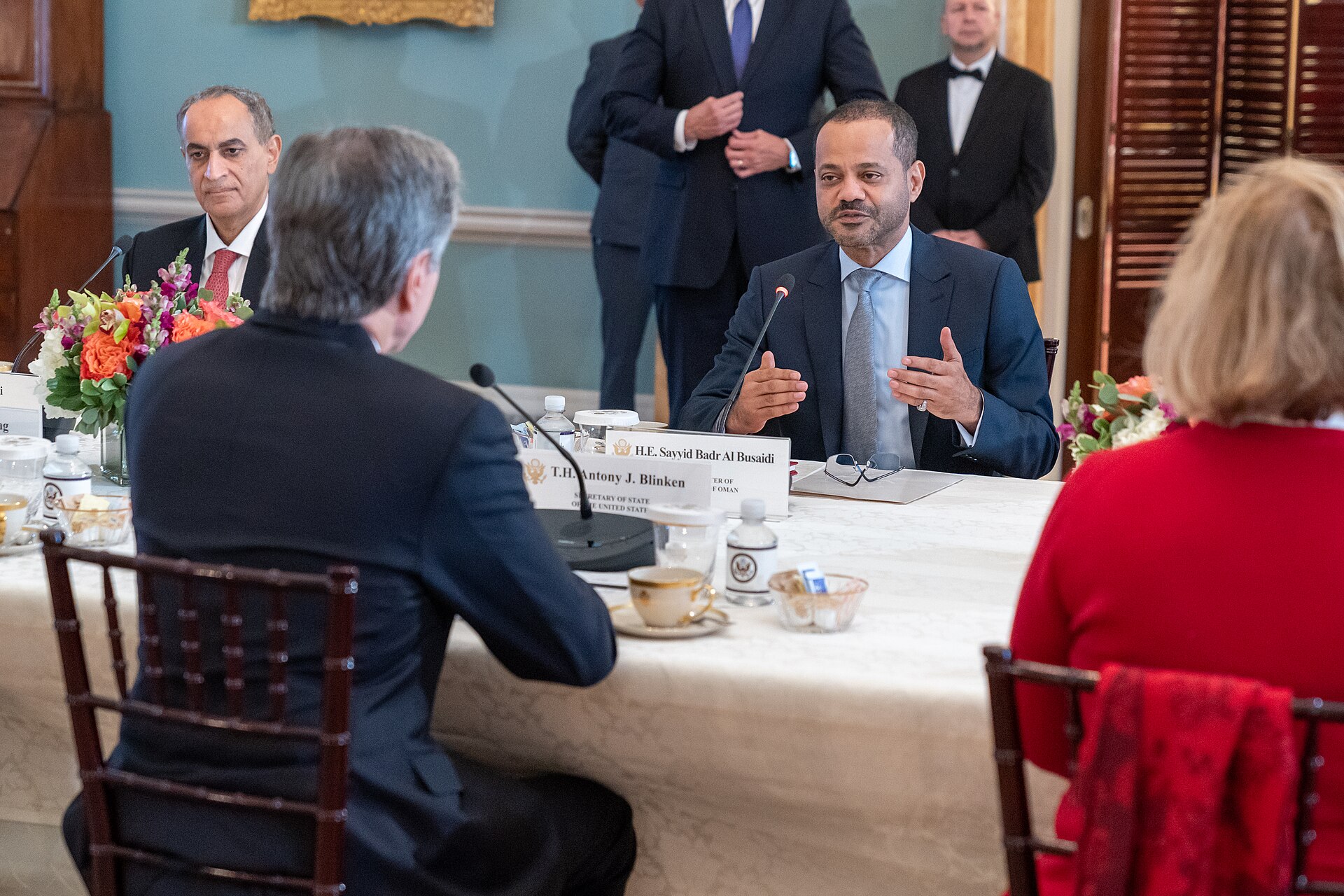
The diplomatic track has continued alongside the maritime confrontation. Iran’s Foreign Minister Abbas Araghchi was due to meet Oman’s foreign minister Badr al-Busaidi in Muscat on 17 November, a meeting that could bear on strait tensions given Oman’s geographic position at the southern edge of Hormuz. Saudi Arabia’s foreign minister sought European naval escorts and diplomatic pressure on Iran during a visit to Brussels on 15 November. Turkey’s Makkah Joint Defence Pact entered into force this month, with Pakistani forces deploying under its provisions.
Frequently Asked Questions
What is UKMTO and how does it monitor shipping in the Gulf?
The United Kingdom Maritime Trade Operations centre is a Royal Navy-sponsored facility based in Dubai that provides 24-hour maritime security information to commercial shipping in the Gulf, Strait of Hormuz, Gulf of Oman, and Arabian Sea. UKMTO issues numbered warnings when it receives reports of attacks, suspicious approaches, or navigational hazards, and its advisories are distinct from Iranian military statements. The centre does not typically attribute responsibility to a specific party unless a formal investigation has concluded.
How much shipping normally transits the Strait of Hormuz?
Before the current conflict, the Joint Maritime Information Centre recorded a baseline of approximately 138 transits per day through the strait. JMIC now describes current traffic levels as “single-digit to low-double-digit” per day, a fraction of the pre-crisis volume. Separate weekly estimates published by UKMTO and the United Against Nuclear Iran monitoring group use different counting methodologies from the JMIC daily figure, and percentage declines derived from those estimates should not be conflated with JMIC’s own assessment.
Has Iran identified any of the tankers it claims struck mines?
Neither the IRGC Navy nor the Army Navy has named a single vessel in any mine-strike claim during the current conflict. Standard maritime incident reporting includes the IMO number, flag state, and registered owner — the data points that allow cross-referencing with the International Maritime Organization registry, AIS tracking systems, and flag-state port-state control authorities. Without those identifiers, insurers, charterers, and shipping firms cannot independently verify an incident occurred. The only vessel from this round of incidents independently confirmed by a neutral party is the ON PHOENIX, identified by Vanguard from UKMTO data, not from any Iranian military statement.
What is the difference between a mine strike and a projectile hit?
Naval mines are stationary explosive devices, either anchored to the seabed or floating freely, that detonate on contact or proximity with a vessel’s hull. A projectile strike — the term UKMTO used for the ON PHOENIX incident — could indicate a missile, rocket-propelled grenade, or other launched weapon. The distinction matters for assessing the nature of the threat: mines suggest pre-positioned area denial across a shipping lane, while projectile strikes indicate active, directed targeting of a specific vessel. Iran’s forces have described all their reported incidents as mine strikes; UKMTO’s classification of the ON PHOENIX event as an “unknown projectile” remains a separate and unreconciled reporting line.
The House of Saud Daily Briefing
Saudi Arabia's news in 3 minutes, every morning. Free. See today's issue