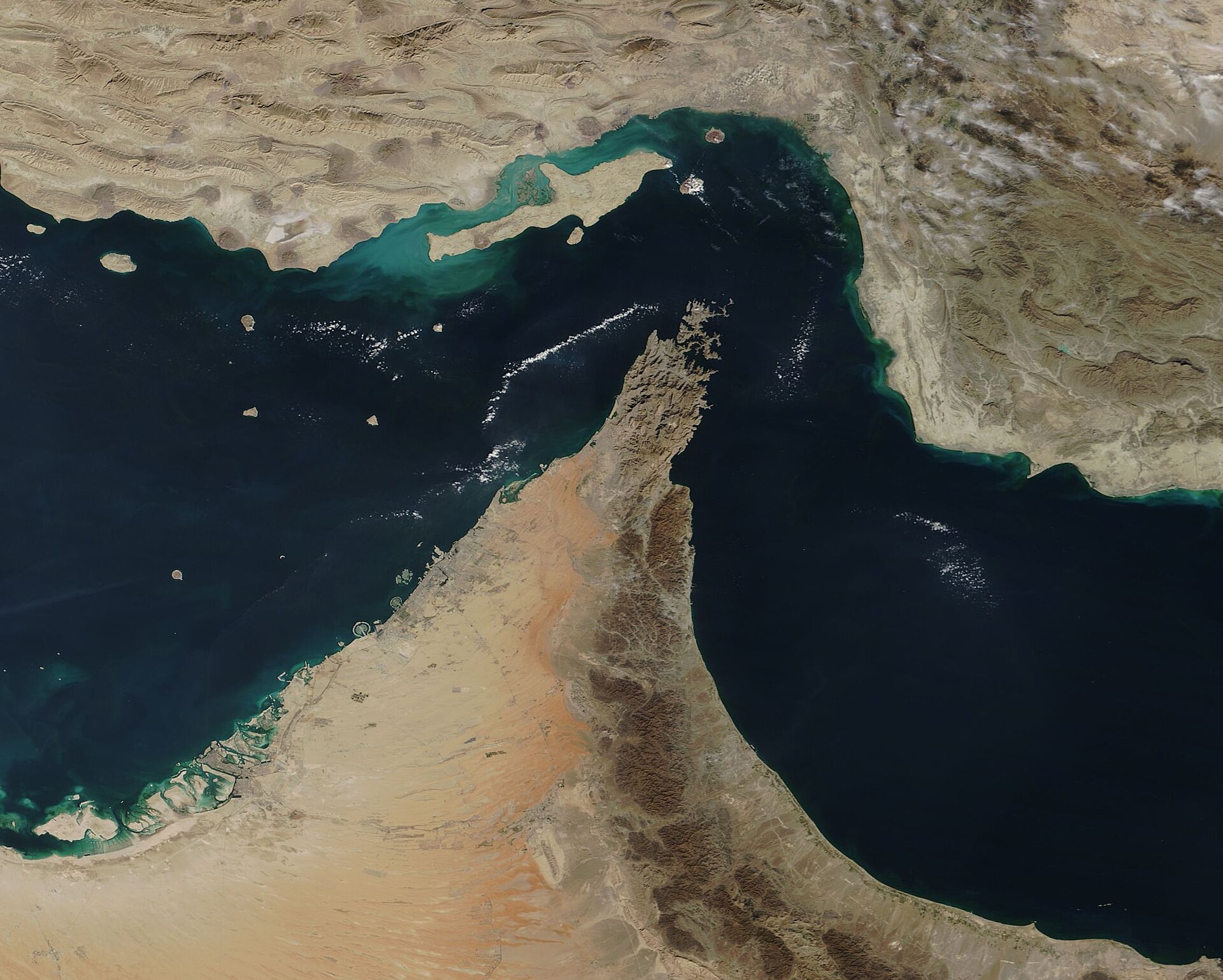
MUSCAT — Oman’s Maritime Security Centre issued an alert on May 30 after a floating object suspected to be a naval mine was sighted in Omani territorial waters at the Strait of Hormuz, west of the Inshore Traffic Zone — the precise jurisdictional seam that Iran and Oman have been negotiating as the basis for bilateral co-management of the waterway. The alert made zero attribution. Within hours, Iran’s Khatam al-Anbiya Central Headquarters ordered all commercial vessels to travel through “designated routes” and obtain advance IRGC Navy authorization before transiting the strait.
The mine’s reported location — west of the Inshore Traffic Zone, inside Omani territorial sea — maps directly onto the inbound lane of the IMO Traffic Separation Scheme, the mandatory shipping corridor established under the 1974 Iran-Oman maritime boundary agreement. That treaty is the legal foundation for the bilateral co-management framework Iran and Oman have been drafting since at least May 13. Oman’s silence on where the mine came from is not ambiguity. It is the structural cost of keeping the Muscat channel open — the only diplomatic track Iran has not shut down.
Table of Contents
What the Maritime Security Centre Said
The Oman Maritime Security Centre posted its alert on May 30, 2026. The full statement described “a floating object suspected to be a floating mine west of the Inshore Traffic Zone in the Strait of Hormuz within Omani territorial sea.” The MSC urged “all seafarers, fishermen, and vessels to exercise the utmost caution while navigating in the area” and advised all maritime users to “keep a safe distance from any suspicious objects and report them immediately to the relevant authorities” (Oman Observer, May 30; Arab News, May 30; Times of Oman, May 30).
No coordinates were released publicly. No country or armed force was named as the source. The statement identified neither the type of mine nor its probable origin — only that a floating object consistent with a mine had been sighted inside Oman’s territorial waters. Xinhua, Arab News, and Times of Oman all carried the alert factually. None connected it to the Iran-Oman co-management negotiations or to the insurance market structure that has already closed Hormuz to commercial traffic without a formal blockade order.
The MSC alert is the first publicly confirmed sighting of a specific mine-like object by Omani authorities in their territorial waters since the conflict began on February 28. The Joint Maritime Information Centre had rated the Arabian Gulf and Strait of Hormuz at CRITICAL risk as of May 5 and cited “possible mines in and near the TSS” in its Advisory Note 041. The Oman MSC alert converts that generic warning into a confirmed sighting tied to a specific jurisdiction.
Where the Mine Was Found
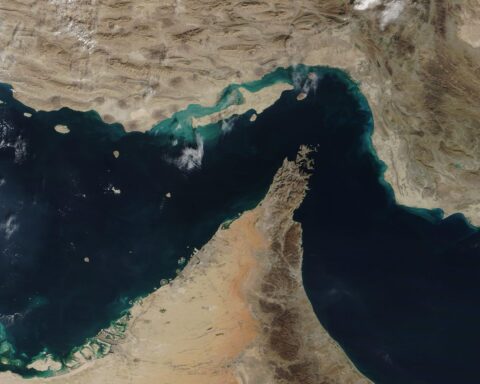
The 1974 Iran-Oman maritime boundary agreement (US State Department Limits in the Seas No. 67) places the TSS inbound lane within Omani territorial waters. The boundary, agreed on July 25, 1974, covers the area north of the Musandam Peninsula and encompasses the mandatory shipping lanes. This is the same legal boundary that underpins the current Iran-Oman bilateral co-management track — the framework under which Iran has positioned Oman as its preferred partner for Hormuz governance, to the exclusion of the United States and Saudi Arabia.
The Middle East briefing 3,000+ readers start their day with.
One email. Every weekday morning. Free.
A mine in the inbound TSS lane does not just threaten individual vessels. It contaminates the legal space Oman needs to keep clean for the co-management negotiations to function. Iran has spent three months building a framework in which Oman is the cooperative coastal state and the strait operates under bilateral Iran-Oman authority. A mine in Omani waters — attributed or not — introduces a physical hazard into the precise corridor that framework is designed to govern. Oman’s five-state IMO protest non-signature, its role as the sole GCC member that did not sign IMO Circular Letter 5028 on May 20, and its hosting of Iranian legal delegations all depend on Muscat maintaining the posture that co-management is a viable governance model. A mine in Omani waters tests that posture.
Iran’s Khatam al-Anbiya Declaration
Within hours of the Oman MSC alert, Iran’s Khatam al-Anbiya Central Headquarters issued a statement on May 31 ordering all commercial vessels to “travel through designated routes” and obtain advance IRGC Navy authorization before transiting Hormuz. The statement warned that “any action taken by foreign warships to interfere in the management of the Strait of Hormuz… will be directly and instantly targeted by the Armed Forces of the Islamic Republic” (Voice of Emirates, May 31; Republic World, May 31; Middle East Eye, May 31).
The timing creates an implicit attribution framework. If all traffic is required to flow under IRGC authority through designated routes, then mines in the inbound lane are consistent with IRGC governance infrastructure — whether or not they were deliberately placed. Iran does not need to claim the mine. The Khatam al-Anbiya declaration absorbs its presence into a broader assertion of control: the strait operates under Iranian management, and all objects within it are part of that managed space.
This is not Iran’s first assertion of expanded Hormuz authority. On May 12, IRGC Navy Deputy Political Director Mohammad Akbarzadeh described the IRGC’s operational zone as a “complete crescent” extending “more than 200-300 miles” from Jask to Siri Island (US News; Eurasia Review, May 12-14). The Khatam al-Anbiya statement extends that claim from a geographic zone to an operational mandate — not just presence in the strait, but pre-authorization authority over every vessel that transits it.
Mohammad Ghalibaf, the IRGC-affiliated speaker of Iran’s parliament, said on May 31 there was “no trust in enemy’s promises” (CBS News, May 31). Trump’s Situation Room meeting on May 29 ended without a signature on the MOU. Trump reportedly sent toughened counter-draft terms on HEU disposal on May 31 (Al Jazeera, May 31). The mine alert and the Khatam al-Anbiya declaration arrived in the gap between the failed signing session and the counter-draft that has no verified nuclear baseline to anchor it.
The Co-Management Negotiations
Iran and Oman have been negotiating a bilateral framework for Hormuz transit governance since at least May 13, when Iranian legal drafting teams were confirmed in Muscat. PressTV reported on May 27 — three days before the mine alert — that Iran and Oman were negotiating “a new framework for maritime transit” through the strait. Ali Bagheri Kani, Iran’s Supreme National Security Council Deputy Secretary, stated that “passage through the strategic waterway will no longer follow previous arrangements” (PressTV, May 27). Iran’s Deputy Judiciary Chief Kazem Gharibabadi visited Muscat on May 24. Bloomberg reported ongoing negotiations on a permanent toll system.
The co-management track operates on a legal foundation that no other Hormuz actor can replicate. The 1974 boundary agreement gives Iran and Oman — and only Iran and Oman — territorial jurisdiction over the TSS. Iran told the United States to leave Hormuz and invited only Oman to stay — a framing that Iranian Foreign Ministry spokesman Nasser Kanaani’s successor Esmail Baqaei made explicit on May 30 when he said the strait “has nothing to do with the US” (Tasnim). The bilateral framework is legally complete without any third party’s consent.
Oman’s non-attribution of the mine is the operational expression of this structural position. Attributing the mine to Iran would collapse the co-management framework that Muscat has spent months building. Not attributing it preserves the fiction that the strait is a shared governance space rather than a contested one. The MSC alert is written in the passive voice — “a floating object suspected to be a floating mine” — without an actor, without an origin, without a motive. That construction is not diplomatic hedging. It is the only language compatible with maintaining Muscat’s position as Iran’s co-management partner while simultaneously warning commercial traffic that the co-managed space contains an explosive hazard.
Saudi Arabia is structurally excluded from every active Hormuz governance track. When US Treasury Secretary Bessent named Oman publicly, the ambassador was called back — illustrating the fragility of even indirect third-party involvement in the Muscat channel. The mine alert deepens that exclusion. Saudi Arabia cannot pressure Oman on attribution without jeopardizing the only remaining diplomatic back-channel to Tehran. Riyadh’s 2.5 million barrels per day of Hormuz-dependent crude exports transit the same inbound lane where the mine was sighted.
What Does the Mine Mean for Hormuz Insurance?
The mine alert lands on an insurance market that has already priced Hormuz as a war zone. The Joint War Committee added Oman to its Listed Areas (JWLA-033) on March 3, meaning every vessel entering Omani waters must carry Additional War Risk Premium or sail uninsured (Insurance Journal, March 3). Britannia P&I Club’s War Risks Notice of Cancellation came into effect at 00:00:00 UTC on March 5, with a replacement buy-back facility capped at 7-10 day voyages (Britannia P&I, March 17). Zero commercial transits were recorded at Hormuz as of May 29 (gCaptain).
The MSC alert does not change the insurance calculus — it confirms it. Lloyd’s Market Association reported on March 23 that 88% of Lloyd’s market participants retained appetite to underwrite international hull war risks and over 90% for cargo. But LMA also stated that “safety concerns — not insurance availability — are the primary driver of reduced vessel traffic.” A confirmed mine sighting in the TSS inbound lane is precisely the type of safety concern that prevents traffic from returning even if cover is technically available. Insurance Business reported in 2026 that “a ceasefire won’t reopen the insurance market — not yet,” with underwriters citing the physical and legal risk environment as too uncertain to unwind exclusions.
The Chevron CEO’s confirmation of unreported kinetic activity at Hormuz earlier the same week — “kinetic activity this week, some not reported,” Mike Wirth told Bloomberg Surveillance on May 29 — adds a second data point. The MSC alert is a confirmed sighting. The Chevron disclosure suggests additional incidents that never reached public reporting. For P&I clubs deciding whether to reinstate cover, confirmed mines and unreported kinetic events are additive signals in the same direction.
Iran’s PGSA transit fee system — approximately $2 million per vessel in yuan or BTC — was added to the OFAC Specially Designated Nationals list on May 28. Any vessel paying the fee now faces US sanctions exposure. Any vessel not paying faces IRGC enforcement. The mine in the inbound lane adds a third constraint: physical hazard in the transit corridor itself. The three pressures — sanctions compliance, IRGC authorization requirements, and mine risk — now operate simultaneously in the same water.
Iran’s Mine Campaign Since February 28
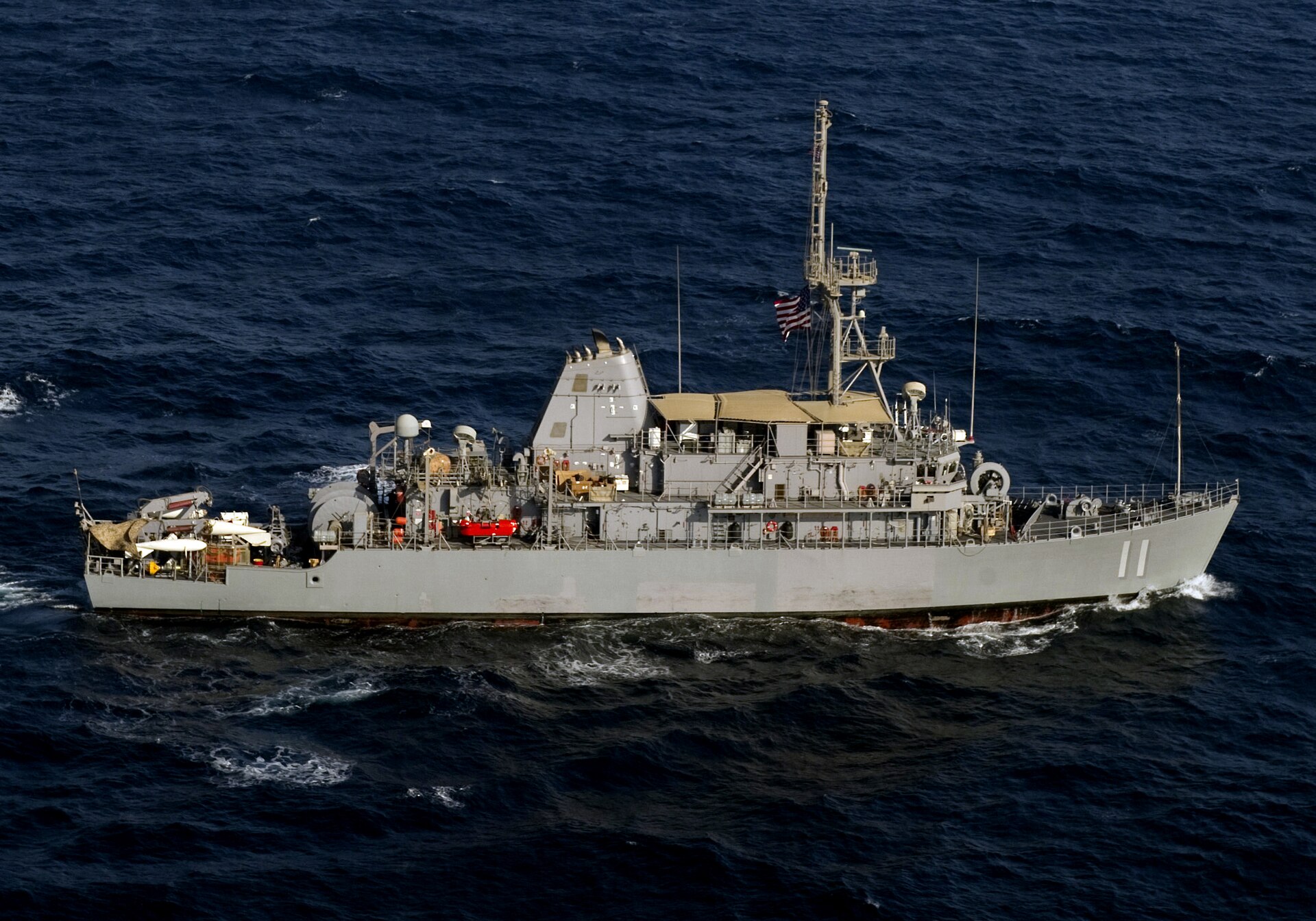
Iran began mine-laying operations at approximately March 10, according to CNN. Identified mine types include the Maham-3 (moored, with magnetic and acoustic sensors), the Maham-7 (seabed limpet-style, designed to evade sonar), and the Sadaf-03, specifically engineered for the high-current conditions of the Strait of Hormuz (Gulf News; CNN, March 10). The IRGC retained the bulk of its small-boat and minelaying fleet despite US strikes. The US military stated it destroyed 16 Iranian minelayers. Additional mine deployment was recorded in late April (Axios, April 23; JMIC Advisory Note, May 5).
The 1987-88 Tanker War provides the closest historical precedent. Iran conducted the most extensive naval mine campaign since World War II during that conflict. The USS Samuel B. Roberts struck an Iranian mine on April 14, 1988, injuring 10 sailors. US Navy SEALs had seized the Iranian minelayer Iran Ajr in September 1987 while it was in the act of laying mines. Operation Praying Mantis — the largest US Navy surface engagement since World War II — followed four days after the Roberts mining. The current mine campaign has already exceeded the 1987-88 effort in geographic scope: the IRGC’s declared operational crescent from Jask to Siri Island covers a substantially larger area than the mine threat zone during the Tanker War.
The MSC alert does not identify the mine type, and Omani authorities have not released photographs or technical details. Whether the object is a drifting mine that broke its mooring or a deliberately positioned device is unknown from public reporting. Both possibilities carry implications for the co-management framework: a drifting mine suggests Iranian mine-laying operations have placed ordnance in areas that cannot be controlled, while a deliberately positioned mine in Omani territorial waters would represent a direct challenge to Omani sovereignty — one that Muscat cannot acknowledge without abandoning the co-management posture.
FAQ
Has Oman confirmed it is a mine?
No. The MSC statement describes “a floating object suspected to be a floating mine.” Omani authorities have not released coordinates, photographs, technical specifications, or a confirmed identification. Mine clearance operations in the Strait of Hormuz are complicated by high tidal currents in the TSS and by the density of shipping infrastructure including submarine cables and pipelines. The International Mine Countermeasures Exercise (IMCMEX), a multinational drill conducted periodically in the region, has rehearsed TSS mine-clearance scenarios, but no such multinational operation has been publicly activated for the current conflict.
Why did Oman not attribute the mine to Iran?
Structural position, not ambiguity. Oman maintains the same studied non-attribution posture it held during the 2019 Gulf of Oman tanker attacks — when Washington named Iran explicitly but Muscat withheld public judgment and kept its back-channel to Tehran intact. That restraint preserved the diplomatic access Oman later used to broker the 2023 US-Iran prisoner exchange and preliminary nuclear discussions. The current mine alert follows the same template: public non-attribution as the price of continued diplomatic utility. No other GCC state is positioned to sustain this role.
Could the mine have drifted from outside Omani waters?
Possible but operationally irrelevant for insurance purposes. The Strait of Hormuz has strong tidal currents that can move floating objects across the Iran-Oman maritime boundary within hours. A mine laid in Iranian waters could drift into the TSS inbound lane — which sits in Omani territorial sea under the 1974 boundary agreement — without any deliberate Iranian action in Omani jurisdiction. However, P&I clubs and war-risk underwriters do not distinguish between deliberately placed and drifted mines when assessing route safety. A mine in the TSS is a mine in the TSS regardless of how it arrived.
What is the Inshore Traffic Zone?
The Inshore Traffic Zone (ITZ) is a defined area between the coast of Oman’s Musandam Peninsula and the inbound (eastbound) lane of the IMO Traffic Separation Scheme at Hormuz. It is reserved primarily for local traffic, fishing vessels, and smaller craft that do not use the main TSS lanes. The MSC alert specifies the mine-like object was found west of the ITZ — placing it in or near the inbound TSS lane itself, the corridor used by laden tankers entering the Persian Gulf. This corridor handled the bulk of Hormuz crude transit volume before the conflict began on February 28.
Is this the first mine found in Omani waters during the 2026 conflict?
It is the first publicly confirmed sighting by Omani authorities. The JMIC rated the strait at CRITICAL risk on May 5 and cited “possible mines in and near the TSS,” indicating intelligence assessments had already flagged the mine threat in the traffic separation scheme. US and coalition minesweeping operations have been ongoing since March, and the US Fifth Fleet has not publicly disclosed specific mine recoveries or neutralizations in Omani territorial waters. The MSC alert is the first time Oman itself has confirmed a mine-like object in its own jurisdiction.