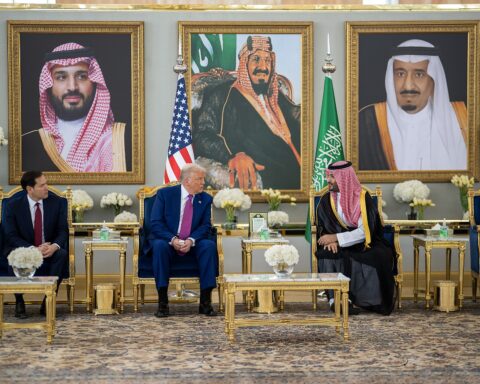

RIYADH — Crown Prince Mohammed bin Salman told American evangelical leader Mike Evans in a private meeting — attended by Saudi Foreign Minister Prince Faisal bin Farhan and one of MBS’s brothers — that he would “acknowledge Israel today” but that “his problem was his father,” according to an account Evans gave the Jerusalem Post published this week. King Salman bin Abdulaziz, 90 years old and hospitalized in January for medical tests his Royal Court called “reassuring,” holds the only pen in the kingdom that can legally sign a recognition treaty into force.
The claim, which Saudi Arabia has not publicly addressed and which the Jerusalem Post itself cannot independently verify, nonetheless crystallizes what multiple institutional analysts have stated on the record for months: that the obstacle to Saudi-Israel normalization is not Palestinian conditionality, not Iranian deterrence, and not public opinion — but a single article of Saudi constitutional law that requires a Royal Decree for any international agreement, and a single man whose signature that article demands.
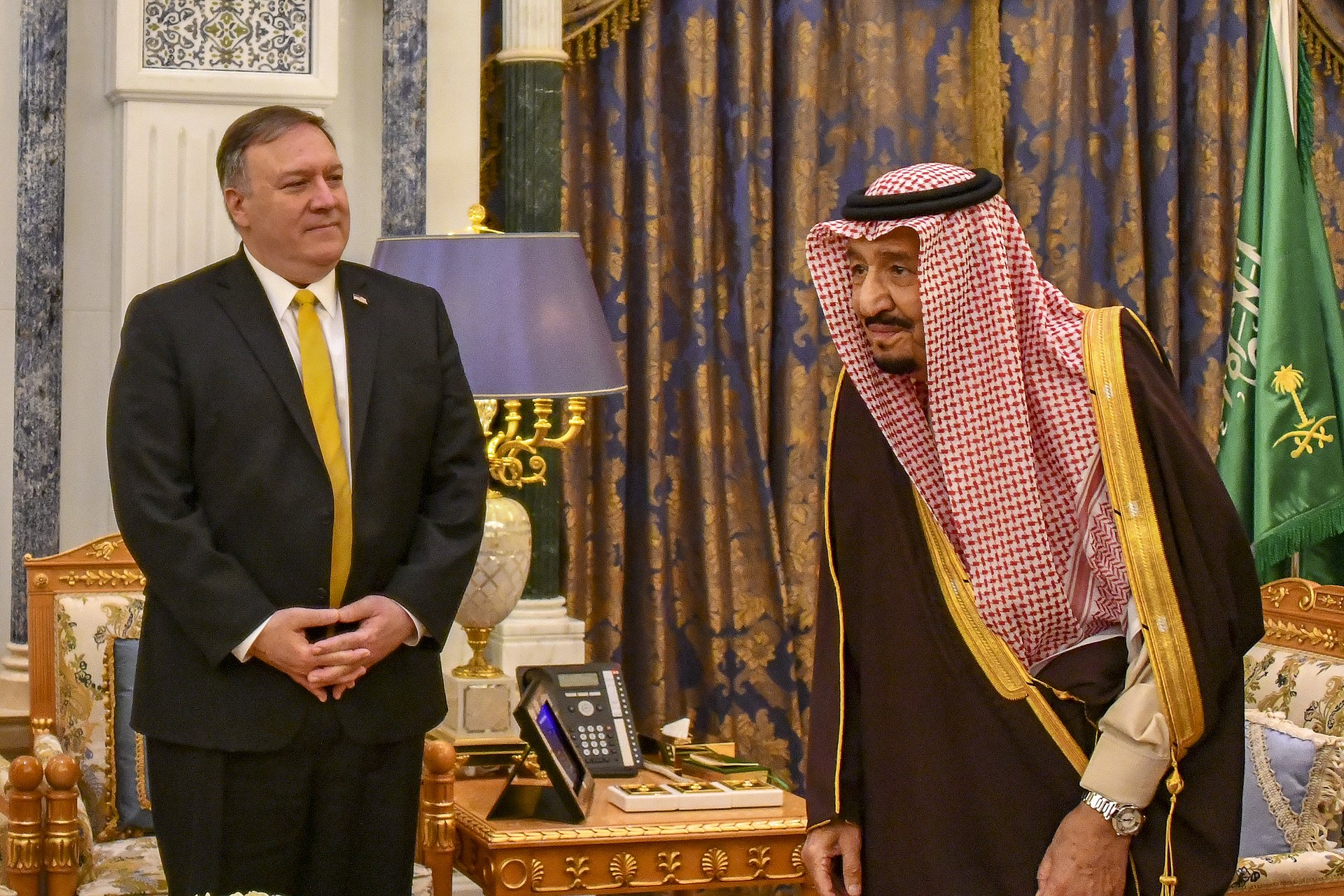
Table of Contents
- What Evans Claims MBS Said — and What He Has Claimed Before
- Why King Salman’s Signature Cannot Be Bypassed
- Has MBS Already Told Washington the Same Thing?
- The War Made Normalization More Expensive, Not Less Likely
- What Washington and Markets Are Mispricing
- From ‘Every Day We Get Closer’ to ‘Genocide’
- FAQ
What Evans Claims MBS Said — and What He Has Claimed Before
Evans, founder of the Friends of Zion Heritage Center and a longtime Trump evangelical ally, described a two-hour meeting with MBS in which the crown prince reportedly told him he would recognize Israel immediately if not for his father’s objection. On Jerusalem specifically, Evans quoted MBS as saying that “if there was ever two capitals in Jerusalem, it’d be a terror capital” — a position that would represent a stark departure from Saudi Arabia’s official demand for East Jerusalem as a Palestinian capital, a demand King Salman has personally anchored for decades.
Evans has a documented pattern of reporting maximally favorable, unverifiable statements from private conversations with Arab leaders. In 2019, he publicly claimed MBS told him “my mother is Jewish” — a statement no Saudi official has ever confirmed, denied, or addressed in any capacity, and which Middle East Monitor reported at the time. The Jerusalem Post noted Evans’s history of such claims in the same article that carried the normalization quote, a rare editorial flag from the outlet breaking its own story.
Saudi Arabia’s non-response is itself consistent. The kingdom has never publicly acknowledged Evans as an interlocutor, never confirmed or denied any of his prior claims, and has issued no statement on this latest account. The meeting Evans described — with the foreign minister present alongside a royal sibling — would represent a remarkably senior audience for a private citizen with no diplomatic portfolio, which either elevates the claim’s plausibility or underscores the performative nature of the audience, depending on how much weight one assigns Evans’s track record.
Why King Salman’s Signature Cannot Be Bypassed
Saudi Basic Law Article 70 states with the kind of brevity that leaves no room for creative interpretation: “Laws, international agreements, treaties and concessions shall be approved and amended by Royal Decrees.” Recognition of a state — the creation of diplomatic relations, the exchange of ambassadors, the establishment of an embassy — is an international agreement. It requires a Royal Decree. A Royal Decree requires the king’s signature. MBS, despite serving as prime minister and de facto ruler since 2022, cannot legally execute what Article 70 reserves to the crown.
The Middle East briefing 3,000+ readers start their day with.
One email. Every weekday morning. Free.
This is not an academic distinction. When Saudi Arabia’s legal authority to wage war in Yemen died with Hadi, the kingdom discovered that constitutional formalities it had treated as rubber stamps could become structural constraints once the underlying political conditions shifted. The UAE faced a structurally different situation when Mohammed bin Zayed exercised de facto power during President Khalifa’s incapacity after 2014 — Emirati constitutional architecture permitted that flexibility in ways Saudi Basic Law does not for treaty-making authority.
Kristin Smith Diwan, Senior Resident Scholar at the Arab Gulf States Institute in Washington, has stated the operative conclusion plainly: “Saudi Arabia will not pursue full diplomatic relations with Israel while King Salman is in power.” The analytical consensus — from AGSIW, from Israel’s own INSS, and from Gulf-based regional analysts — treats this not as a probability assessment but as a near-certainty bounded only by the king’s lifespan.
Has MBS Already Told Washington the Same Thing?
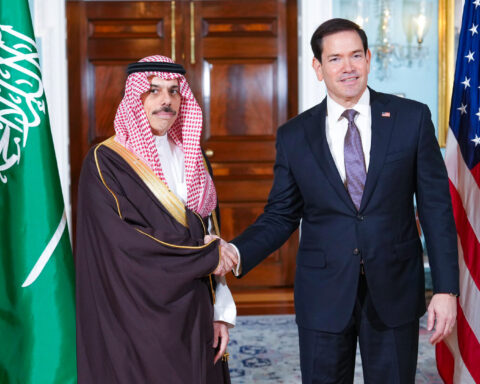
If Evans’s account is accurate, it is not news to Washington — it is confirmation of what American officials have heard from MBS directly. In January 2025, the crown prince told Secretary of State Blinken in terms that US officials subsequently paraphrased to reporters: “Do I care personally about the Palestinian issue? I don’t, but my people do, so I need to make sure this is meaningful.” The statement, reported by Responsible Statecraft and analyzed in INSS Insight No. 2103, draws the same line Evans describes — personal willingness constrained by external factors — while substituting “my people” for “my father” as the named constraint.
Both framings may be simultaneously true. King Salman’s Palestinian commitment is not a private eccentricity — it is the public legitimacy architecture of the Custodian of the Two Holy Mosques, a role the king has defined through decades of Palestinian advocacy. MBS cannot override his father’s signature requirement and cannot afford to be seen publicly contradicting the king’s legacy while the king lives, because the religious legitimacy that flows from that custodianship is inherited, not earned independently. The “my people” constraint and the “my father” constraint are the same constraint expressed at different registers.
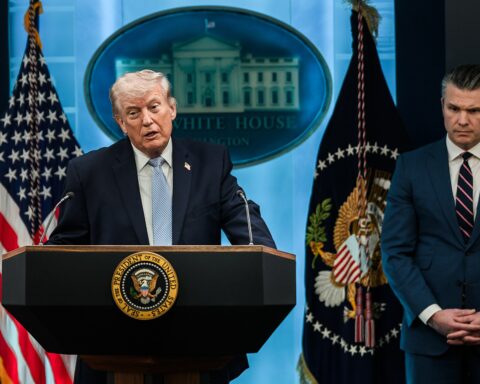
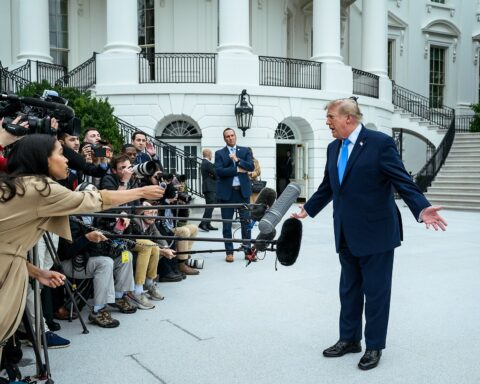
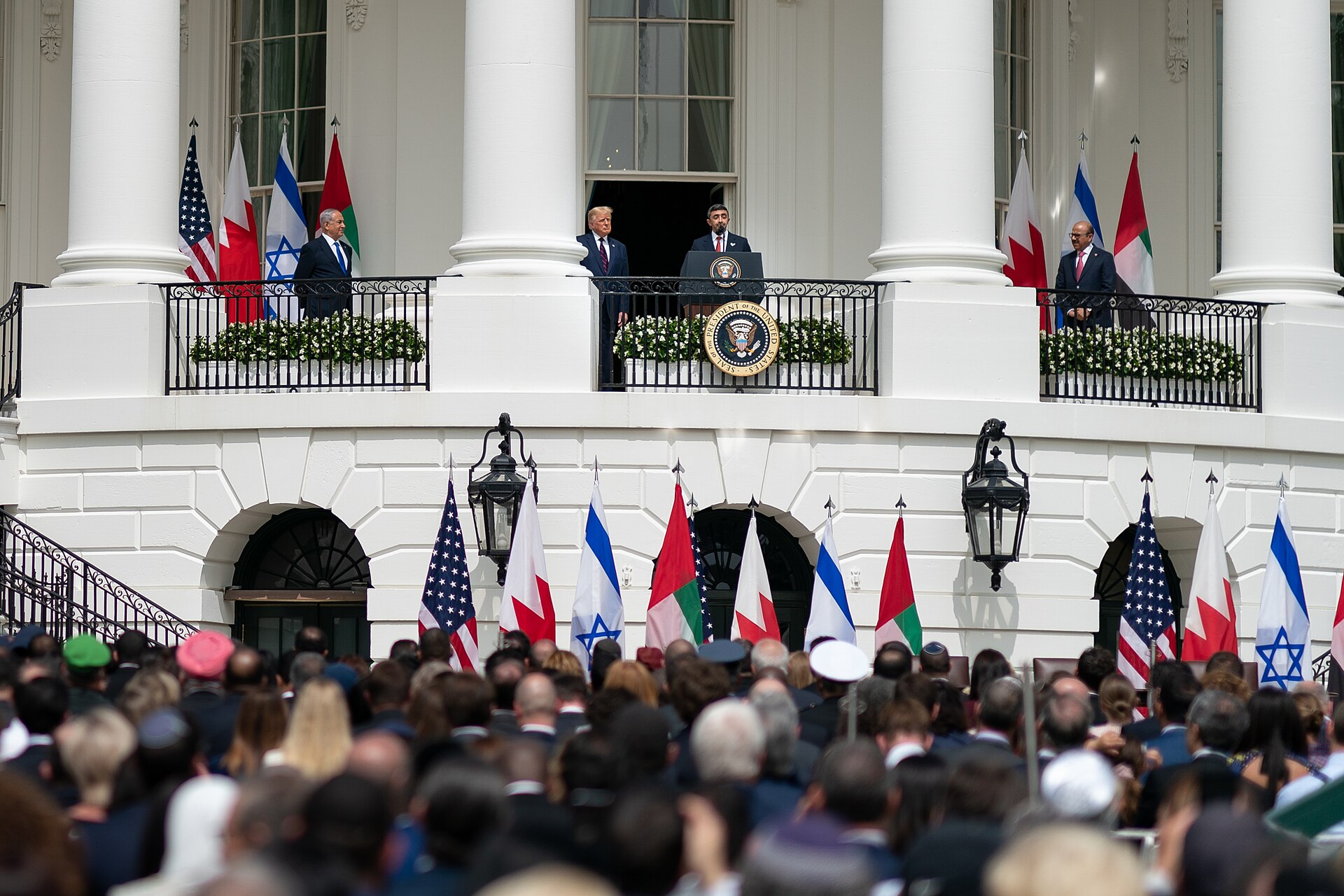
Trump, for his part, appears to be operating as though the constraint does not exist. On May 24, he posted on Truth Social that “it should be mandatory that all of these Countries, at a minimum, simultaneously, sign onto the Abraham Accords,” and on May 27 threatened to withhold the Iran MOU unless Muslim-majority countries comply. When he made the demand on a call with regional leaders, according to Axios, “there was silence on the line, and Trump joked and asked if they are still there.” Saudi Arabia responded the same day by formally rejecting the premise: normalization remains conditional on a “credible, irreversible” path to a Palestinian state on 1967 borders with East Jerusalem as capital.
The War Made Normalization More Expensive, Not Less Likely
The structural deterrent Iran has imposed on Abraham Accords membership is no longer theoretical. Jason Campbell, Senior Fellow at the Middle East Institute, told RFE/RL this month that “it is important to remember that Bahrain and the UAE have been targeted substantially more than other regional states by Iran over the past three months, ostensibly due to their membership in the Abraham Accords.” The two Arab states that normalized in 2020 have absorbed disproportionate Iranian fire in the current war — a demonstrated cost that any prospective signatory must now price into its calculations.
For Saudi Arabia, that calculation is existential rather than marginal. The kingdom has already expended roughly 2,400 PAC-3 interceptors in 38 days with an estimated 80 to 150 remaining, it has borrowed for a budget that no longer exists at $91 Brent against a $108-111 breakeven, and it has watched Iran strike US bases on Saudi soil without a Saudi declaration of war or an American defense treaty to invoke. Adding formal Israeli recognition to this environment would — in the IRGC’s explicitly stated threat framework — elevate Saudi Arabia from co-belligerent to ideological target, a distinction that carries operational meaning for Iranian targeting doctrine. The diplomatic cost of Saudi Arabia’s silence on Iran shifted on June 5, when Lebanese President Aoun accused Iran of using Lebanon as a bargaining chip on CNN — supplying Riyadh with a cross-sectarian, constitutionally grounded argument it could not have generated from its own foreign ministry without triggering the sectarian coding Tehran exploits to deflect Arab complaints.
Saudi public opinion has moved in lockstep with events. The Arab Center for Research and Policy Studies measured opposition to normalization at 38% in 2022, growing to 68% by February 2024 — before October 7’s full political aftermath had registered, and before the current Iran war began. INSS’s August 2025 assessment found opposition approaching 99-to-1, a shift the institute described as the sharpest recorded movement in Saudi public opinion on any foreign policy question in its survey history. MBS’s own Shura Council speech in late 2024, in which he accused Israel of committing “genocide against the Palestinians,” was calibrated to that domestic reality.
What Washington and Markets Are Mispricing
The Foundation for Defense of Democracies published “Saudi Arabia’s Voodoo Diplomacy Is Sabotaging Middle East Peace” on May 26 — Arafah Day, the holiest single day of the Islamic calendar — with FDD research fellow Hussain Abdul-Hussain characterizing Saudi conditions as “classic Saudi flowery language and voodoo diplomacy.” The piece accused Riyadh of pursuing unconditional engagement with Tehran while conditioning Jerusalem engagement on Palestinian statehood. It represents a rare direct institutional break from a think tank that normally operates within the US-Saudi-Israel consensus, and its publication timing suggests frustration with what Washington’s pro-normalization establishment increasingly recognizes as a structural impasse masquerading as a diplomatic process.
The Jerusalem Post’s own opinion desk — the same outlet that broke the Evans story — published a separate analysis arguing that “MBS secured access to advanced American military platforms, nuclear technology transfers, and the formal reaffirmation of the US security umbrella without making a single concession to Jerusalem. The marginal utility of normalization has evaporated.” Saudi Arabia obtained Major Non-NATO Ally designation in November 2025, secured approval for up to 48 F-35 aircraft (albeit downgraded relative to Israel’s variants, missing advanced weapons integration and electronic warfare modifications), and locked in a $142 billion arms framework — all without signing the Abraham Accords or making any binding normalization commitment. Saudi Arabia’s decision to ground Project Freedom follows the same logic: the fiscal arithmetic of war continuation cost Riyadh less than a peace deal that would collapse the oil premium underpinning every commitment MBS has made.
What remains mispriced is the timeline variable. Markets, diplomatic planning cycles, and US electoral calculations all treat Saudi normalization as a policy decision that could be made at any point given sufficient incentive. It is not. It is a succession event — bounded by the lifespan of a 90-year-old king whose January hospitalization produced a one-line Royal Court statement and no public appearances for weeks afterward. INSS has concluded that normalization probability “likely grows after King Salman dies” while noting MBS would still face severe public opposition even then. The variable is actuarial, not diplomatic.
From ‘Every Day We Get Closer’ to ‘Genocide’
In September 2023, MBS told an Atlantic Council audience that Saudi-Israel normalization was advancing and “every day we get closer.” A deal was described by multiple US officials as “within weeks” of announcement. Then came October 7, an operation Hamas partly designed to detonate the normalization track before it could close. Within thirteen months, MBS had moved from proximity language to delivering a “genocide” speech at the Shura Council — a political arc that tracks the movement of Saudi public opinion more faithfully than it tracks any shift in MBS’s private calculations, if Evans and Blinken’s accounts of those calculations are accurate.
By September 2024, MBS’s public position had hardened into formal declarative language: “The kingdom will not stop its tireless work towards the establishment of an independent Palestinian state with East Jerusalem as its capital. We affirm that the kingdom will not establish diplomatic relations with Israel without that.” This is the position Saudi Arabia reiterated on May 24, 2026, in response to Trump’s “mandatory” demand. It is a position that functions simultaneously as diplomatic posture and as political cover — cover for a constitutional constraint that Saudi Arabia cannot publicly name without drawing attention to the king’s declining capacity.
The Allegiance Council confirmed MBS as Crown Prince in June 2017 with a 31-to-3 vote, and King Salman simultaneously amended Basic Law Article 5(b) to enable father-to-son succession for the first time since 1953. The succession itself is not in doubt. What is in doubt — and what every diplomatic track currently running through the region must account for — is timing. Not whether MBS will eventually hold the pen that Article 70 requires, but when.
FAQ
Could MBS use a regency or power-of-attorney mechanism to sign a recognition treaty?
No documented Saudi legal precedent exists for a Crown Prince executing international agreements under delegated royal authority while the king remains alive. MBS holds the prime minister title and chairs the Council of Ministers, but Article 70’s “Royal Decrees” language has been consistently interpreted by Saudi legal scholars as requiring the reigning monarch’s personal authorization. The kingdom has no formal regency law equivalent to those in European constitutional monarchies, and creating one would require publicly acknowledging King Salman’s incapacity — a step the Royal Court has never taken and shows no indication of considering.
What did Saudi Arabia actually get from the $142 billion arms framework without normalizing?
Major Non-NATO Ally designation (November 18, 2025), approval for up to 48 F-35 aircraft, THAAD system delivery (originally purchased 2018, arriving approximately 2026), civil nuclear cooperation framework expansion, and the security umbrella reaffirmation the kingdom sought since the 2019 Abqaiq attack exposed US hesitancy. Israel objected to decoupling the F-35 sale from normalization and lost — the US proceeded regardless. The F-35 variants Saudi Arabia will receive omit Israeli-specific advanced weapons integration and electronic warfare modifications, preserving Israel’s qualitative military edge while giving Riyadh the platform.
How does the Evans claim relate to Trump’s current Iran MOU negotiations?
Trump has explicitly linked the Iran MOU to Abraham Accords compliance, threatening on May 27 to withhold the ceasefire agreement unless Muslim-majority countries sign. Saudi Arabia rejected the linkage within hours. The Evans claim — if publicized with Saudi acquiescence — could serve as a signal to Washington that MBS’s private orientation remains favorable even as his public position hardens, buying diplomatic space without requiring any legal commitment the crown prince cannot currently make. The same structural bind — no channel to Netanyahu, no constitutional authority for MBS to act unilaterally — became the decisive factor on June 1 when Iran cited Lebanon to freeze MOU talks, handing the restart key to a government Riyadh cannot reach.
What happens to the normalization timeline if King Salman dies this year?
MBS would ascend immediately under the 2017 succession amendments. INSS assesses normalization probability “likely grows” post-succession but flags that MBS would still face near-99% public opposition (August 2025 survey), an active regional war that penalizes Accords members with disproportionate Iranian fire, and a domestic legitimacy transition period during which controversial foreign policy moves carry elevated risk. INSS’s assessment, and the working assumption among Gulf analysts who write off the record, is that normalization becomes structurally possible only after the new king has consolidated his succession — a transition period typically measured in months, not days.
Is Saudi Arabia’s Palestinian statehood demand a genuine condition or diplomatic cover?
Both, simultaneously, and the distinction may not matter as much as Washington assumes. MBS told Blinken in January 2025 that he does not personally care about the Palestinian issue but that his people do — which means Palestinian conditionality serves a real domestic function regardless of his private views. At the same time, the body of the article argues that the statehood demand also provides cover for the constitutional constraint Saudi Arabia cannot publicly name: that King Salman’s signature is required and unavailable. The two functions reinforce each other. Dropping the Palestinian condition without normalization actually occurring would strip MBS of his domestic shield while giving him nothing; maintaining it costs nothing and preserves his political position regardless of how the diplomatic track resolves. INSS’s assessment is that even after succession, MBS would need the Palestinian cover to manage domestic opposition running near 99-to-1 — which means the condition is likely to persist in some form well beyond King Salman’s death.
Rubio’s June 3 Senate testimony added a further dimension to this analysis: his explicit opposition to West Bank annexation, while stopping short of affirming Palestinian statehood, revealed that Washington itself cannot deliver the one element Saudi Arabia’s four-part normalization precondition requires. That gap is examined in Rubio Opposed Annexation. Saudi Arabia Required Statehood.