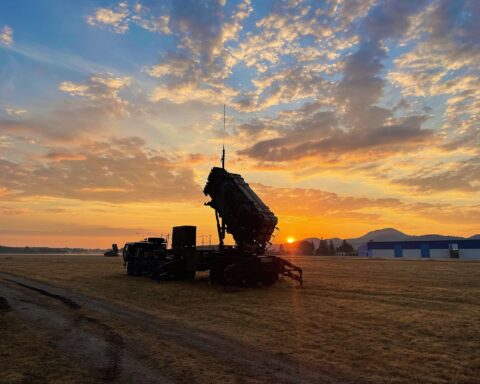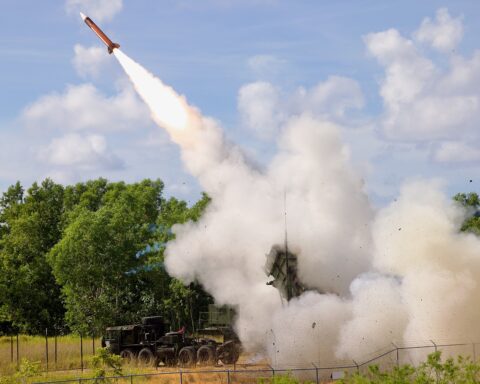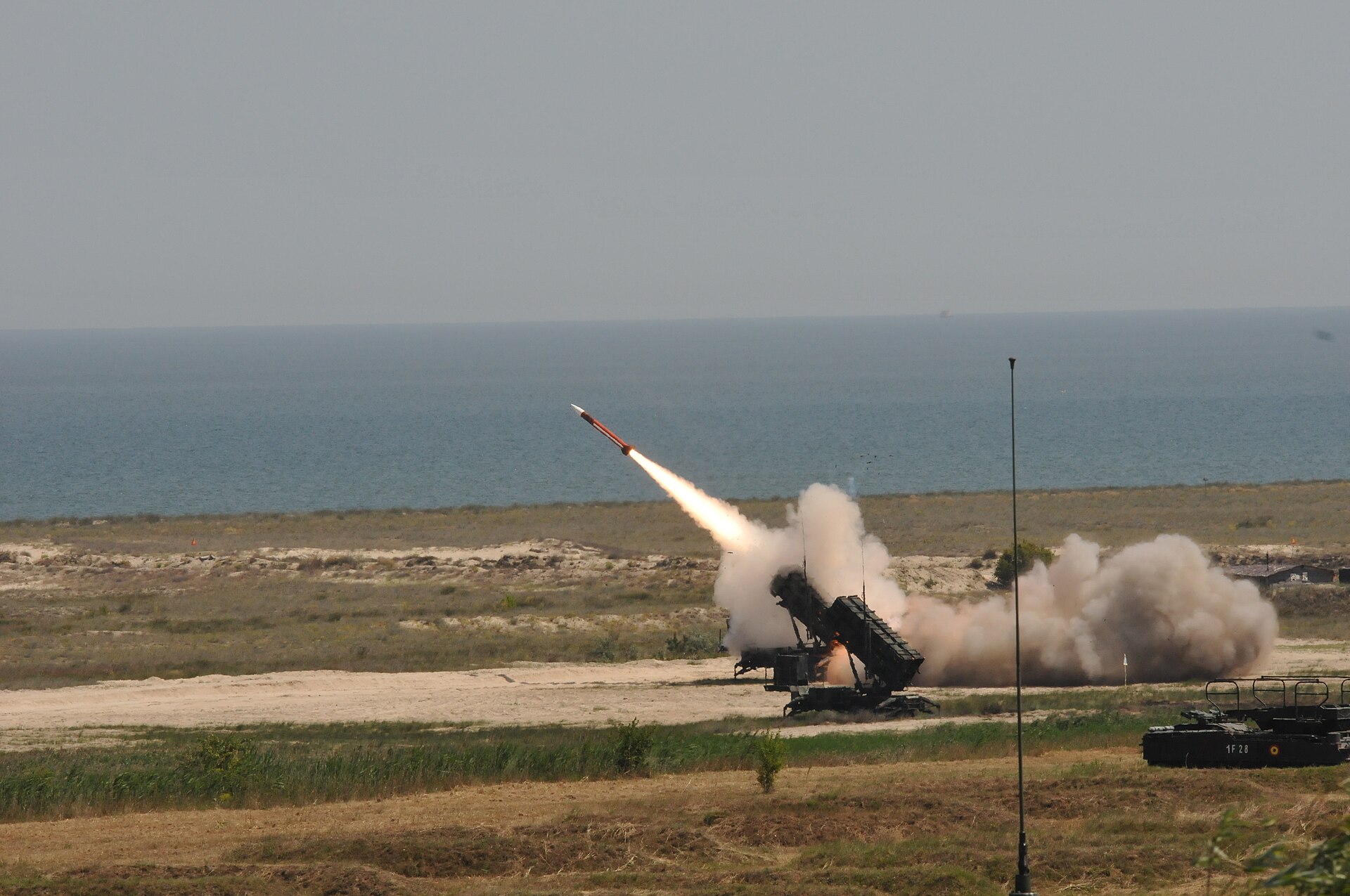

RIYADH — On July 16, the State Department approved $1.96 billion in laser-guided rockets for Saudi Arabia — 20,000 APKWS-II kits manufactured by BAE Systems in Nashua, New Hampshire, half configured to shoot down drones and half to hit ground targets. On the same day, Houthi ballistic missiles struck southern Saudi Arabia, consuming more of a PAC-3 MSE interceptor stockpile that the sale does nothing to replenish. Riyadh has roughly 400 interceptors left from a pre-war inventory of 2,800 — an 86 percent depletion accumulated in four months of war — and Washington’s answer was to approve weapons that shoot forward while the shield overhead approaches empty.
The structure is not accidental. In May, Washington withheld PAC-3 and THAAD deliveries to coerce Saudi Arabia into reopening Prince Sultan Air Base for US operations; Riyadh reversed its ban within four days. The July 16 sale confirms the pattern: offensive reach approved, defensive resupply withheld, and a single factory in Camden, Arkansas controlling when — or whether — Saudi Arabia can replenish the interceptors standing between incoming warheads and its cities.
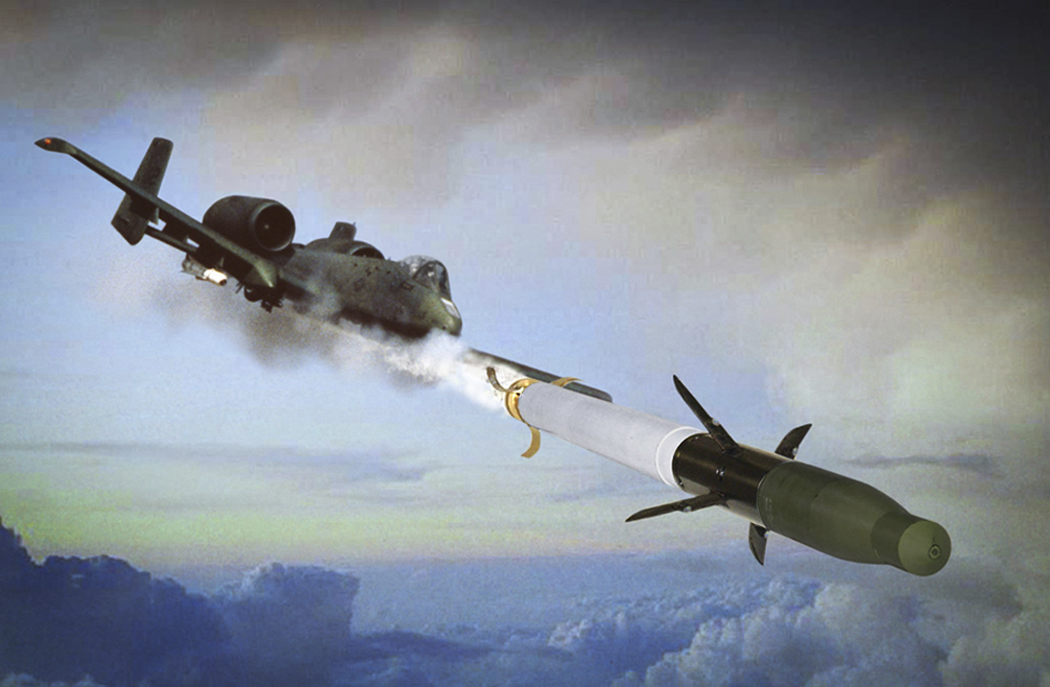
Table of Contents
What Did $1.96 Billion Actually Buy?
The Foreign Military Sales notification cleared 20,000 APKWS-II guidance sections — the laser-seeking mid-body kit that converts a standard 2.75-inch Hydra 70 unguided rocket into a semi-active laser homing precision munition. The package includes LAU-131 air-to-air launchers, Mk-152 high-explosive warheads, MK66 rocket motors, and proximity fuzes, with BAE Systems as principal contractor. At roughly $35,000 per assembled round — the guidance section alone runs between $22,000 and $25,000 — APKWS-II costs approximately one-hundredth of the PAC-3 MSE interceptor it does not replace, a ratio that makes the sale politically presentable while being operationally irrelevant to the interceptor crisis consuming Saudi air defense.
Half the kits are air-to-air, a role with operational pedigree: US F-16 pilots flying Operation Poseidon Archer missions downed Houthi drones over the Red Sea with APKWS-II as early as March 2025, a round that cost about as much as the drone it destroyed. The other half are air-to-ground, intended for precision strikes on launch sites, weapons caches, and logistics nodes in Houthi-controlled territory, fired from Saudi F-15SAs, AH-64E Apaches, or adapted ground platforms. The operative word is “intended” — the ground-attack mission depends on locating mobile targets in terrain where eighteen months of US-UK air campaign, using far more expensive munitions, failed to suppress the launch infrastructure these kits are meant to destroy.
What the $1.96 billion does not contain is a single interceptor missile, a single Patriot battery component, or a single element of the terminal defense system standing between incoming Houthi and Iranian ballistic missiles and the cities, refineries, and air bases they target. The sale is entirely offensive, and in a war where Saudi Arabia’s existential exposure is defined by its shrinking capacity to absorb incoming fire, the package equips Riyadh to project force into Yemen while the interceptor count defending Saudi airspace drops with each new salvo. The APKWS-II kits will reach Saudi warehouses long before the last PAC-3 has been fired — and the sale does not answer what fills the gap between the last interception and the first replacement delivery from Arkansas.
| Attribute | APKWS-II (approved) | PAC-3 MSE (not approved) |
|---|---|---|
| Role | Offensive: drone intercept, ground strike | Defensive: ballistic missile interception |
| Cost per round | ~$35,000 | $3.9M base; $6.25–7M export |
| Units in sale | 20,000 guidance sections | Zero |
| Sale value | $1.96 billion | N/A |
| Intercepts ballistic missiles | No | Yes |
| Suppresses mobile launchers | Only if located first | Not applicable |
| Contractor | BAE Systems, Nashua NH | Lockheed Martin, Camden AR |
Four Hundred Rounds Left
Saudi Arabia entered the Iran campaign in March 2026 with an estimated 2,800 PAC-3 MSE interceptors — the product of nearly two decades of Patriot procurements, every round manufactured at Lockheed Martin’s sole global facility in Camden, Arkansas. By mid-July, roughly 2,400 of those rounds have been expended, leaving an estimated 400 in inventory. In dollar terms, the consumed interceptors — at export packages averaging $3.9 million per unit before logistics, which routinely push the figure toward $6.25 to $7 million — represent approximately $9.4 billion in destroyed defensive assets.
The Middle East briefing 3,000+ readers start their day with.
One email. Every weekday morning. Free.
Half of the entire US pre-war PAC-3 MSE inventory was expended in the first 39 days of the Iran campaign… no comparable precedent in the system’s operational history.
Mark Cancian and Chris Park, CSIS, “Last Rounds?”, April 24, 2026
In industrial terms, Saudi Arabia has burned through approximately four years of Camden’s entire annual global production in four months of combat — a deficit that cannot be closed by writing larger checks or accelerating existing contracts. Each Houthi ballistic missile or Iranian Zolfaghar costs a fraction of the PAC-3 round required to stop it, and even when the interception succeeds, the defending force loses a multi-million-dollar asset to defeat a threat that cost an order of magnitude less. The IISS described the dynamic in May 2026 as “a strategic vulnerability… forcing Gulf defenders into an unfavorable cost exchange” against “far cheaper threats.”
That cost exchange narrowed further on July 17, when Mohsen Rezaei, Iran’s Supreme Leader military adviser, declared on state television that “the conditions for both war and negotiation are over” — closing the diplomatic track at precisely the moment Saudi Arabia has the fewest interceptors left to absorb what follows. Rezaei’s 48-hour ultimatum and what it means for the remaining 400 rounds is analyzed here.
The exchange is not merely unfavorable — it is finite, because the factory manufacturing replacement rounds cannot produce them at the rate Riyadh is spending them. At the observed engagement rate, the remaining 400 rounds can absorb an estimated four to seven more major salvos before terminal air defense of Saudi population centers drops below any level a military commander would consider adequate. The arithmetic here is not an estimate that requires sophisticated modeling; it is division.
Houthi military spokesman Yahya Saree confirmed the latest salvo against Abha International Airport on July 13, claiming the attack used “ballistic missiles and unmanned aerial vehicles” in retaliation for Saudi airstrikes on Sanaa Airport’s runway. Coalition spokesman Turki al-Maliki confirmed interception over “the southern region” — each confirmed interception consuming rounds that the July 16 sale does not replace, at a pace that makes the production capacity of a single factory in rural Arkansas the most consequential variable in Saudi air defense.
Can Camden Keep Up?
Every PAC-3 MSE interceptor on earth — every round defending Riyadh, every round on NATO’s eastern flank, every round in the US Army’s own magazines — is manufactured at a single Lockheed Martin facility in Camden, Arkansas, population 10,500. The plant produces approximately 620 interceptors per year, a figure constrained by specialized seeker components from a narrow vendor base and the physical limits of tooling never designed to sustain a shooting war consuming rounds at ten times its annual output. A January 2026 Pentagon framework agreement aims to triple production to 2,000 per year by the end of 2030 — a timeline that provides zero relief in 2026, zero in 2027, and only marginal improvement by 2028, at which point Saudi Arabia’s current stockpile will have been exhausted for well over a year at observed consumption rates.
Saudi Arabia’s $9 billion FMS request for 730 PAC-3 MSE interceptors, notified to Congress on January 30, represents approximately fourteen months of Camden’s entire global annual output — and those 730 rounds sit in a queue behind the US Army’s FY2027 budget request for 2,798 rounds and the Navy’s 405, a combined domestic demand of 3,200 interceptors worth roughly $14 billion, more than five times what the factory can produce in a year. The first replacement rounds under the Saudi notification cannot reach Riyadh before mid-2027 at the earliest, probably not before 2028, by which point the question of how many rounds the kingdom needs will have been settled by events rather than procurement calendars.
| Demand source | Rounds requested | Years at 620/year |
|---|---|---|
| Saudi Arabia FMS (Jan. 2026) | 730 | ~1.2 |
| US Army FY2027 | 2,798 | ~4.5 |
| US Navy FY2027 | 405 | ~0.7 |
| Combined (three claimants only) | 3,933 | ~6.3 |
The production bottleneck is the structural feature that makes the dependency possible: one factory, one country’s allocation authority, and a demand queue the Pentagon controls. Camden’s constraints are real — materials, tooling, workforce — but they do not explain why the July 16 APKWS-II sale contained zero interceptor content, not even a symbolic allocation or an accelerated delivery commitment on the January FMS request. The omission has precedent.
The May Precedent
Washington has used arms-transfer dependency to coerce Saudi behavioral change before, and the record is not ambiguous. In January 2021, within days of inauguration, the Biden administration froze all offensive weapons sales to Saudi Arabia over civilian casualties in Yemen while explicitly preserving PAC-3 and THAAD supply — cutting the munitions the air campaign required while maintaining the defensive systems Saudi Arabia needed to survive. The coercion worked as designed: Saudi Arabia effectively ended its bombing campaign, the April 2022 ceasefire followed, and the freeze held for three and a half years until its August 2024 reversal, by which point the behavioral shift it induced had been locked in for over two years.
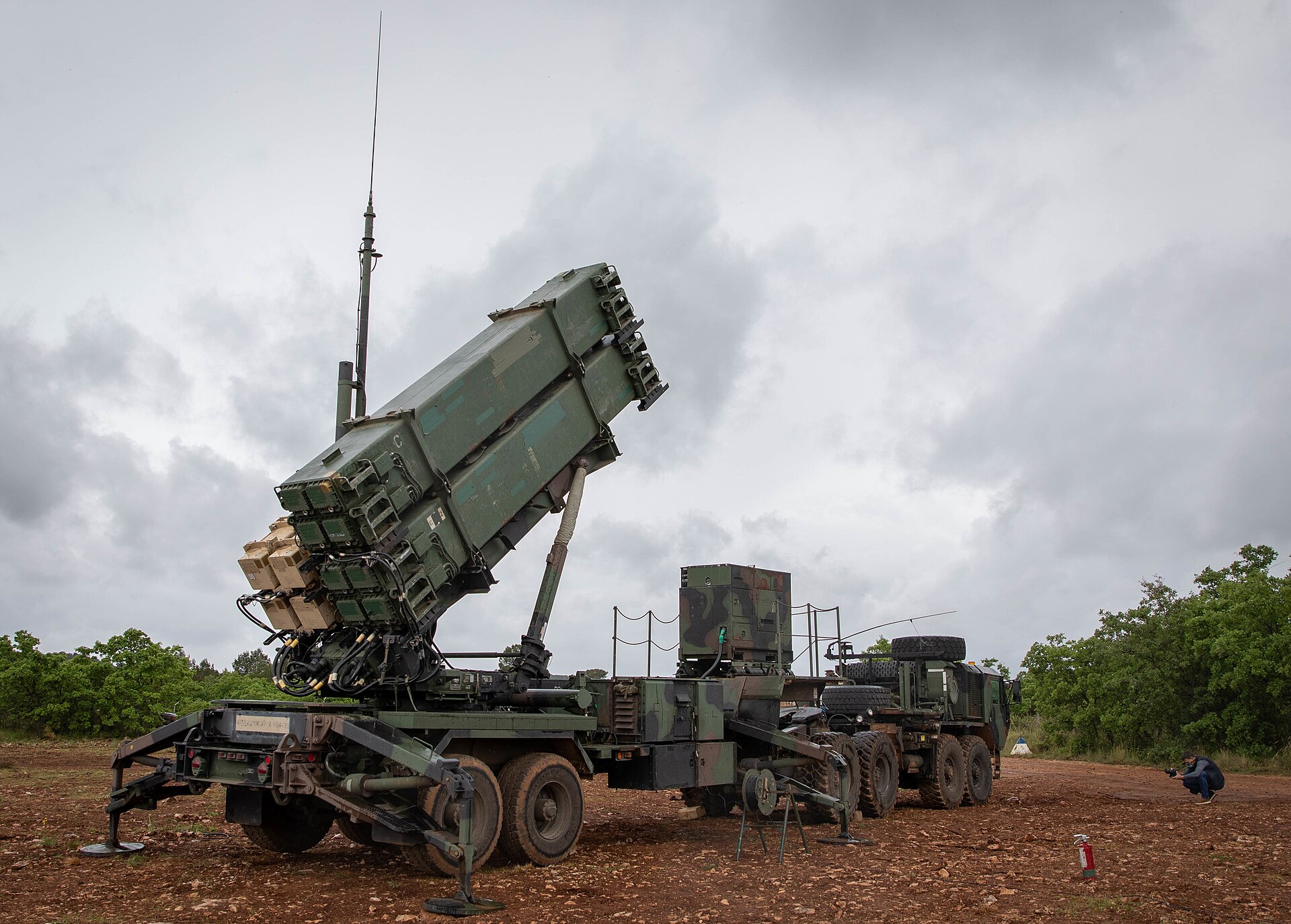
The instrument was sharpened to a finer point in May 2026. When Saudi Arabia imposed a ban on US use of Prince Sultan Air Base and Saudi airspace during Operation Project Freedom — grounding forty-three American warplanes for four days — Washington responded by withholding PAC-3 and THAAD interceptor deliveries. Not future contracts, not conditional approvals: rounds already in the pipeline, interceptors Riyadh expected to receive, held back until the airspace ban was reversed. Saudi Arabia complied within four days, a capitulation reported by the Jerusalem Post, the Wall Street Journal, and the Times of Israel, and denied by no official in either capital.
The July 16 APKWS-II sale extends the pattern rather than breaking it. By approving offensive capability — rockets that can hit Houthi positions — while leaving the interceptor deficit unaddressed, Washington maintains a dependency structure that gives it influence over Saudi military decisions without requiring a phone call or a diplomatic communiqué. If Riyadh uses the APKWS-II kits to escalate against Yemen in ways Washington opposes, the response is already embedded in the production schedule: slow the interceptor queue, and Saudi air defense capacity drops another increment. A Washington Institute for Near East Policy analysis assessed that the US ability to use arms transfers as a coercive tool would diminish once the structural preconditions no longer held — single-source production, Pentagon allocation authority, an existential threat environment. Those preconditions are exactly the conditions currently in force.
The 2021 freeze showed that withholding offensive weapons changes Saudi behavior in the field. The May 2026 episode showed that withholding defensive weapons changes Saudi behavior in hours. The July 16 sale, by providing the former and withholding the latter, maintains the architecture that makes the latter possible — and the $1.96 billion price tag provides the political cover of arms-sale generosity without delivering the one category of weapon Saudi Arabia cannot do without.
Did Launcher Suppression Work the Last Time?
The APKWS-II air-to-ground kits are sold on the premise that precision strikes can reduce the incoming missile threat by hitting Houthi launch infrastructure before the missiles fly — a premise tested exhaustively between January 2024 and January 2025 during Operation Poseidon Archer, the year-long US-UK air campaign that struck weapons storage, command nodes, launch sites, and radar installations across Houthi-controlled territory. The International Institute for Strategic Studies assessed the result in March 2025: Iranian resupply replaced destroyed systems faster than coalition aircraft could strike them, the Houthis relocated infrastructure underground and into dispersed civilian areas, and the campaign was assessed internally by US officials as ineffective at suppressing mobile launches. The Houthis ended the campaign with more operational missile launchers than they had at its start.
High-end interceptors, such as Patriot PAC-2 and PAC-3 missiles, each costing millions of dollars, have repeatedly been used against far cheaper threats, creating a strategic vulnerability and forcing Gulf defenders into an unfavorable cost exchange.
International Institute for Strategic Studies, “Challenge for the Gulf States,” May 2026
The Houthi supply chain compounds the structural problem. An IISS Missile Dialogue Initiative analysis of seized weapons caches found that only 5 percent of more than 800 documented components originated in Iran; the remaining 95 percent came from sixteen other countries, a multi-vector procurement network that makes supply-chain interdiction impossible without a level of multilateral enforcement that does not exist. The finished missiles — Palestine-1 and Palestine-2 variants derived from Iranian Kheibar Shekan and Fattah designs, alongside liquid-propellant Zulfiqar MRBMs based on Iran’s Rezvan — are assessed as “too complex for local Yemeni production,” confirming that Iran ships complete or near-complete systems through channels that ten waves of IRGC strikes and eighteen months of prior air campaign have not closed.
APKWS-II at its price point is cheaper than Paveway-series precision bombs for the same ground-attack mission, which makes it cost-competitive for high-volume engagements against known fixed positions — and that efficiency matters in a long campaign against dispersed infrastructure. But the Houthis have spent two years demonstrating that mobile launcher suppression in mountainous, resupply-enabled terrain is a problem they have solved from the defender’s side, and cheaper-per-shot against a target you cannot find is not a cost advantage but a budgetary consolation. The guidance the incoming missiles are using, meanwhile, has shifted in ways that make each surviving launcher more dangerous than the one Poseidon Archer failed to destroy.
The BeiDou Problem
Iran’s Zolfaghar ballistic missiles — and the Houthi-deployed derivatives reaching Saudi territory — now use China’s BeiDou-3 encrypted satellite navigation rather than GPS or inertial guidance alone. BeiDou-3 employs a triple-frequency architecture that eliminates ionospheric positioning delays, applies frequency-hopping and Navigation Message Authentication to resist spoofing, and delivers sub-five-meter terminal accuracy. Analysts cited by TechTimes on July 12 assessed that BeiDou-3-guided Zolfaghar variants achieve roughly 98 percent accuracy even under heavy US electronic warfare jamming — a figure whose underlying methodology has not been publicly released, but whose directional implication is difficult to dismiss: GPS jamming, which had served as a first-line defense allowing US and Saudi forces to degrade incoming missile accuracy before the physical interception phase, is now partially neutralized.
The operational consequence falls directly on the interceptor stockpile. Every missile that maintains its terminal accuracy through the electronic warfare screen is a missile that must be physically intercepted with a PAC-3 round, and every physical interception draws down the 400 remaining. The BeiDou shift does not make Saudi air defense impossible — it makes each engagement more expensive in interceptor terms, which in a war defined by stockpile attrition amounts to compressing the timeline. China is not selling missiles to Iran or the Houthis; it is providing the navigation constellation that makes their missiles accurate enough to require interception rather than tolerate, and the precision it enables against Saudi critical infrastructure means that the margin for missed interceptions has narrowed to a point where a single salvo leaking through the defense could produce consequences measured in millions of barrels per day.
The September 2019 Abqaiq-Khurais attack achieved its results against GPS-jammable threats using air defenses that were, at the time, fully stocked — an outcome examined in the next section. BeiDou-3 guidance makes the incoming threat resistant to the electronic countermeasures that were themselves inadequate in 2019, which shifts the entire burden of defense onto the physical interceptor inventory — the inventory that stands at 400 rounds and falling, with no resupply in the July 16 sale and none visible in the production queue before 2028.
What Protects Abqaiq After Round Four Hundred?
On September 14, 2019, a coordinated strike of cruise missiles and drones hit the Abqaiq oil processing facility and the Khurais oil field, temporarily halving Saudi crude output — roughly 5.7 million barrels per day taken offline in a single attack. Saudi air defense intercepted none of the inbound projectiles; the entire Patriot and Shahine architecture failed to prevent the strike despite the interceptor inventory being at full peacetime strength. The $3.5 billion in additional Patriot battery purchases that followed was itself a concession that the system had failed at full capacity — a detail that reframes the current 400-round inventory not as “depleted” but as “below the level that already proved insufficient.”
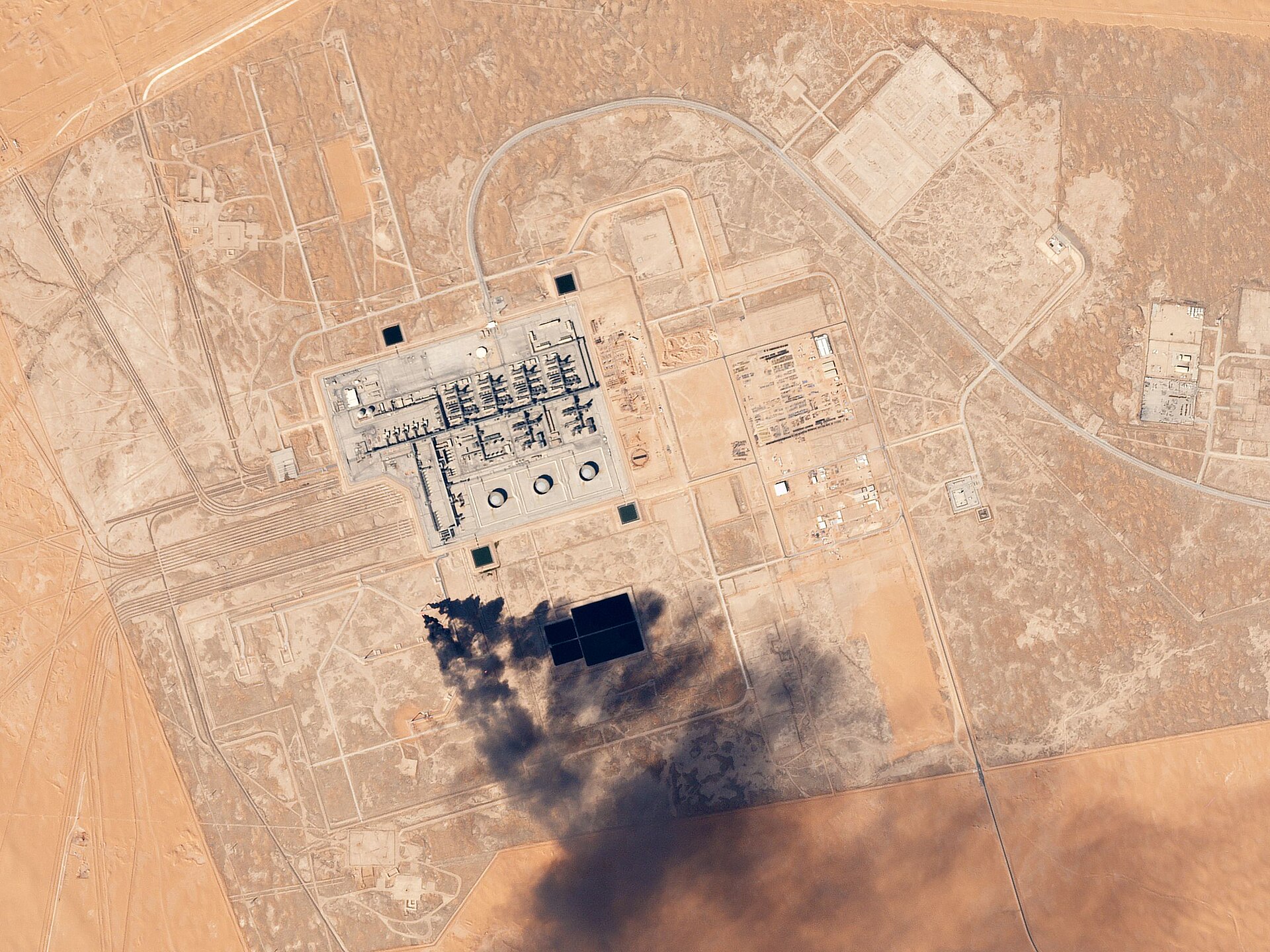
At 400 PAC-3 MSE rounds, the exposure of Abqaiq, Ras Tanura, Yanbu, and the network of Aramco processing nodes that make Saudi Arabia the world’s swing producer is qualitatively different from any prior period — not because the threat has changed in kind, but because the defensive margin was already inadequate when it was full. Saudi Arabia has purchased counter-drone systems and invested in layered air defense concepts, but the terminal-phase interception of ballistic missiles arriving at Mach 8 on steep reentry trajectories remains a PAC-3-exclusive mission, and there is no substitute, no second source, and no workaround that changes the arithmetic of a shrinking inventory against a sustained campaign.
No US or Saudi official has publicly named the interceptor floor — the number below which terminal defense of the kingdom’s critical infrastructure stops being a question of allocation and becomes a question of mathematics. The calculation has almost certainly been performed, the answer almost certainly classified, and the possibility that the floor has already been crossed is one that neither Riyadh nor Washington has any reason to confirm publicly. The 730 interceptors Saudi Arabia requested in January sit in a production queue behind 3,200 rounds the US military has claimed for itself, at a factory that makes 620 a year, and the relationship between Washington and Riyadh is now mediated less by diplomacy than by the output schedule of a manufacturing plant in the Arkansas Delta. The APKWS-II kits will reach Saudi Arabia months before the first replacement PAC-3 round does, and the missiles arriving from Yemen and Iran will not wait for Camden to catch up. On July 17, Saudi Arabia’s General Directorate of Civil Defense activated alarms at Al-Kharj Governorate — 120 kilometres from PSAB — and Yanbu, then lifted them without explanation. Saudi Arabia Sounded the Alarms It Cannot Explain examines what Saudi Arabia’s silence about the trigger reveals.
The interceptor arithmetic above was written before IRGC Nasr-2 entered what Brigadier General Mohebbi described as its “next phases.” On July 17, 2026, Iran struck Al Udeid Air Base in Qatar — the base hosting the Combined Air Operations Center that directs every US sortie over Iran — wounding four people including a child. Qatar’s Ministry of Defence confirmed it intercepted the ballistic missiles, but interception consumes rounds from a Gulf-wide stockpile that is already at critical levels. The question of what defends Riyadh after round four hundred is inseparable from the question of what defends Doha in the meantime. On July 17, Khalid bin Salman met Defense Secretary Hegseth at the Pentagon — the first defense-principal meeting between Washington and Riyadh since the interceptor depletion crossed 86 percent — to discuss, among other things, the PAC-3 resupply timeline and King Fahd Air Base access.
Frequently Asked Questions
What is APKWS-II and why can it not intercept ballistic missiles?
APKWS-II (Advanced Precision Kill Weapon System II) is a mid-body laser guidance kit that converts the standard 2.75-inch Hydra 70 unguided rocket into a semi-active laser homing precision munition, fired from seven-round LAU-131 pods compatible with F-15SA, AH-64E Apache, and other platforms in the Saudi inventory. The round reaches approximately Mach 2.7 at motor burnout with a maximum effective range of roughly five kilometers and a warhead optimized for fragmentation against soft targets or proximity detonation against small UAVs. Incoming Houthi and Iranian ballistic missiles arrive at terminal velocities exceeding Mach 8 on steep reentry trajectories at altitudes where APKWS-II physically cannot operate — the intercept problem is not one of guidance precision but of physics, and no volume of $35,000 rockets compensates for the absence of $3.9-million interceptors designed for a fundamentally different engagement envelope.
Could Saudi Arabia source PAC-3 interceptors from anywhere other than the United States?
No. PAC-3 MSE is manufactured exclusively at Lockheed Martin’s Camden, Arkansas facility, with no licensed production abroad, no qualified second source, and no allied nation holding transferable surplus inventory. Japan manufactures an older PAC-3 variant (not the MSE model Saudi Arabia uses) under license for domestic use, and in December 2023 Tokyo amended its arms export rules to permit re-transfer to the United States — but those rounds replenish US inventory rather than becoming available for third-party sale. South Korea has explored indigenous missile defense production but has no PAC-3-class system in its industrial pipeline. The single-source dependency is the structural precondition for Washington’s ability to control Saudi Arabia’s defensive ceiling, and neither the Pentagon nor Lockheed Martin has expressed interest in diluting it through co-production or second-source qualification.
Has the United States ever accelerated interceptor deliveries to a dependent ally during active combat?
The closest recent comparison is the April 2024 Iranian attack on Israel (Operation True Promise), during which US Aegis destroyers provided direct interception support in real time. But Israel’s core interceptor systems — Iron Dome, David’s Sling, Arrow — are domestically produced by Rafael and Israel Aerospace Industries, meaning Israel’s interceptor pipeline does not depend on US production allocation in the way Saudi Arabia’s does. The 1991 Gulf War saw Patriot GEM interceptors pulled from US Army depots and rushed to Saudi Arabia, a politically feasible step when the war lasted six weeks and the total draw was modest relative to inventory. At current Saudi consumption rates, the requirement is not for a few dozen depot transfers but for years of factory output that competes directly with the US military’s own modernization demands — a qualitatively different ask that no presidential directive can resolve without physically building more missiles than the factory can currently produce.
What is the estimated timeline before Saudi interceptor stocks reach critical levels?
At the pace observed in July 2026 — multiple salvos per week across Kuwait, Bahrain, Qatar, Jordan, and Saudi territory — the remaining 400 rounds could be exhausted within two to six weeks. The first Camden-produced rounds under the January 2026 FMS notification cannot arrive before mid-2027 at the earliest, opening a resupply gap of ten to twelve months from the point of potential stockpile exhaustion. That gap is the duration Saudi Arabia would need to absorb incoming ballistic missiles with no terminal-phase interception capability — and it is a gap the APKWS-II sale shortens by zero days.
Could APKWS-II ground-attack kits meaningfully reduce the incoming missile threat by suppressing Houthi launchers?
The empirical record from Operation Poseidon Archer suggests the answer is no. APKWS-II is cheaper per round than the GBU-12 Paveway II and GBU-38 JDAM used during Poseidon Archer, which means more shots per dollar against identified positions — a real advantage against fixed infrastructure. The bottleneck, however, was never cost per engagement: it was persistent surveillance to locate mobile launchers before they fired and relocated. APKWS-II’s five-kilometer effective range also requires the delivery aircraft to close inside air-defense envelopes that Houthi ground forces have demonstrated they can defend. Without dedicated ISR — persistent unmanned surveillance tied directly to a strike-authorization chain short enough to catch launchers in the open — cheaper munitions produce cheaper misses.
The threat to civilian water systems is no longer theoretical: Iran’s targeting of Kuwait’s Shuaiba water plant on July 17 demonstrated that the Nasr-2 campaign has moved beyond military and communications infrastructure to desalination complexes — facilities on which Saudi Arabia’s Jubail and Ras Al-Khair plants share identical structural vulnerability.
One potential gap-filler entered the picture on Night Eight: Pakistan confirmed deployment of HQ-9 surface-to-air batteries to Saudi Arabia, adding a supplemental intercept layer outside the PAC-3 inventory — though the system’s integration with Saudi IADS command structures and its coverage radius relative to PSAB remain unconfirmed. Pakistan’s HQ-9 — deployed to PSAB as the PAC-3 replacement — has zero confirmed combat intercepts across three theatres.
Whether the HQ-9 batteries were tested on July 18 is one of three questions no government has answered: Iranian missiles struck Prince Sultan Air Base that night, and Pakistan — whose 8,000 troops at the base would be reclassified as legitimate military targets the moment Islamabad acknowledged engagement — has said nothing.
The question of who defends Riyadh acquired a diplomatic dimension on July 18: Khamenei’s repudiation of the Islamabad MOU eliminated the last formal constraint on Iran targeting Saudi Arabia directly, meaning the interceptor shortage documented above now operates without the diplomatic ceiling that had previously offset it.