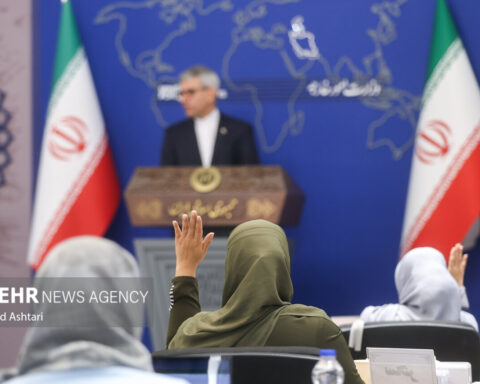
ISLAMABAD — Iran’s state broadcaster declared Hormuz sovereignty and a Lebanon ceasefire as non-negotiable preconditions for talks with the United States on the morning of April 11 — hours before any formal session had convened in Islamabad. IRIB’s broadcast, timestamped between 7:03 and 10:26 AM, was not a negotiating position aimed at the American delegation. It was an internal command signal from Tehran’s security establishment confirming that Foreign Minister Abbas Araghchi had not conceded on the two items the IRGC considers non-transferable: Iran’s sovereign control over the Strait of Hormuz, and the inclusion of Lebanon in any ceasefire framework.
By mid-afternoon, a senior US official told Reuters the meetings had “not even started yet.” The denial was directed at a Reuters report suggesting the US had agreed to release frozen Iranian assets. But the more consequential fact was temporal: IRIB had already closed the negotiating space before anyone entered a room. Saudi Arabia, excluded from the bilateral format, was reading the same broadcast feed as every other capital in the region — with no back-channel to distinguish posture from policy.
Table of Contents
- The 7:03 AM Broadcast and What It Foreclosed
- Why Is Iran Broadcasting Red Lines Before Talks Begin?
- The Gatekeeper Who Is Not in the Room
- How Do Lebanon and Hormuz Differ as Preconditions?
- What Can Saudi Arabia See from Outside the Room?
- The April 15 Window and Why It Probably Closes
- Three Clocks Running Without a Process
- Who Is Actually Negotiating in Islamabad?
- Frequently Asked Questions
The 7:03 AM Broadcast and What It Foreclosed
The sequence matters. IRIB’s reporter in Islamabad stated explicitly on Saturday morning that “the schedule for negotiations with the United States will be announced later” and that “talks won’t be held if these two preconditions are not met” — the two being a Lebanon ceasefire and the release of blocked Iranian assets. This was published at 7:03 AM and updated at 10:26 AM, according to PressTV’s timestamp.
The US delegation’s response came later. A senior American official, responding to a separate Reuters report about frozen assets, said: “False. The meetings have not even started yet.” Vice President JD Vance, who arrived in Islamabad leading the US side, had said the previous evening: “If they’re going to try to play us, then they’re going to find the negotiating team is not that receptive.”
The timing distinction is not incidental. A broadcast that follows a failed negotiating session is a reaction — a signal that talks broke down over specific demands. A broadcast that precedes any session is pre-emptive. It does not describe what happened in the room. It prescribes what cannot happen in the room. IRIB was not reporting on Islamabad. It was setting the boundaries of Islamabad before the doors opened.
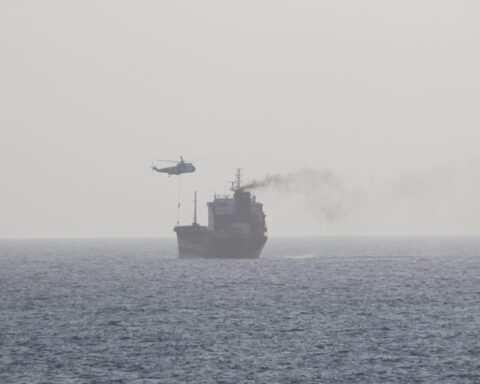
Tasnim News Agency, the semi-official outlet with close IRGC ties, reinforced the framing from a different angle on the same morning: Iran “has maintained the current conditions for tanker transit through the Strait of Hormuz” in response to what Tehran characterises as US breaches of the ceasefire. Only two ships passed through Hormuz on April 10, according to NBC News — down from 138 per day before the war began on February 28.
The Middle East briefing 3,000+ readers start their day with.
One email. Every weekday morning. Free.
Why Is Iran Broadcasting Red Lines Before Talks Begin?
Iran’s state media has a dual function during negotiations that most Western analysis collapses into one. IRIB is simultaneously an external propaganda instrument and an internal command channel. During the JCPOA negotiations between 2013 and 2015, Supreme Leader Khamenei used state media to broadcast public red lines that were not aimed at the P5+1 delegations in Geneva or Vienna. They were aimed at Iranian reformists who might argue that Foreign Minister Javad Zarif had the authority to cross them. The broadcasts created a domestic documentary record: any concession Zarif made could be measured against Khamenei’s publicly stated position, and the gap between the two could be weaponised internally as evidence of betrayal.
The 2026 version of this mechanism operates under different structural conditions but serves the same function. IRIB declaring on the morning of April 11 that “Iran’s position on the Strait of Hormuz has not changed and will not change” — a standing formulation the broadcaster has used since at least March 23 — creates a public ledger against which Araghchi’s conduct in Islamabad will be judged. Any flexibility he shows on Hormuz transit, toll architecture, or naval coordination becomes a deviation from stated national doctrine, attributable and prosecutable in IRGC terms.
The Foundation for Defense of Democracies published an assessment on April 6 identifying the five men now running Iran’s decision-making apparatus: IRGC Commander-in-Chief Ahmad Vahidi, SNSC Secretary Mohammad Bagher Zolghadr, military adviser Mohsen Rezaei, Parliament Speaker Mohammad Bagher Ghalibaf, and — nominally — Mojtaba Khamenei. FDD’s characterisation was blunt: “This is not a government with a military wing; it is a military establishment with a civilian ornament.” Araghchi, in this framing, is the ornament.
“Iran is entering negotiations with the US in Pakistan with complete distrust due to Washington’s repeated breaches of commitment.”
— Abbas Araghchi, Iranian Foreign Minister, PressTV, April 11, 2026
Araghchi’s own public statement — “complete distrust” — is itself a signal aimed at Tehran rather than at Washington. It pre-emptively establishes that whatever he agrees to, he entered the room sceptical. If a deal emerges and the IRGC later repudiates it, Araghchi can point to the statement as evidence he was constrained, not complicit. The language of distrust is insurance, filed in advance.
The Gatekeeper Who Is Not in the Room
Mohammad Bagher Zolghadr was appointed SNSC Secretary on March 25 in an arrangement engineered by Vahidi. His biography is IRGC from end to end: first-generation revolutionary, Iran-Iraq War veteran, eight years as IRGC Joint Staff chief, eight more as deputy commander-in-chief. Al Jazeera’s Tehran correspondent Ali Hashem reported at the time of the appointment: “An important thing to note is that whoever is sitting at the negotiation table will have to get Zolghadr’s approval before anything passes.”
The Jerusalem Post reported on April 10 that Vahidi pushed to include Zolghadr on the 71-member Iranian delegation travelling to Islamabad. The delegation resisted. Vahidi and the IRGC Aerospace Force commander then formally insisted that the team “refuse to negotiate on Iran’s missile program.” The compromise — if it can be called that — was to keep Zolghadr physically in Tehran while requiring his sign-off on any substantive agreement.
This arrangement means that Islamabad operates as a relay station, not a negotiating venue. Araghchi can listen, can transmit, can signal — but cannot commit. Any concession requires a call back to Tehran, where Zolghadr holds veto authority under the SNSC’s constitutional mandate. The SNSC’s own post-ceasefire statement on April 8 framed the dynamic explicitly: “Negotiations are continuation of the battlefield.”

How Do Lebanon and Hormuz Differ as Preconditions?
The two demands IRIB broadcast on April 11 are structurally different, and the difference determines whether any diplomatic window exists at all. Lebanon is a Phase 1 precondition — a gateway condition that must be met before any formal session begins. Hormuz sovereignty is classified as a Phase 2 item in Iran’s 10-point peace plan, meaning it is theoretically deferrable to a later stage of negotiations.
This distinction has been stated explicitly and repeatedly by senior Iranian officials. Parliament Speaker Ghalibaf, arriving in Islamabad: “Two of the measures mutually agreed upon between the parties have yet to be implemented: a ceasefire in Lebanon and the release of Iran’s blocked assets prior to the commencement of negotiations. These two matters must be fulfilled before negotiations begin.” FM Spokesperson Esmaeil Baqaei, April 10: “The halting of the war in Lebanon is an integral part of the ceasefire understanding proposed by Pakistan.” And: “The holding of any talks is conditional upon obtaining assurance of the US’ fulfillment of its obligations regarding a ceasefire on all fronts.”
The operational consequence: even if the Hormuz question were set aside entirely — even if Iran’s March 31 parliamentary bill authorising transit fees and rial-denominated tolls were somehow bracketed — the Lebanon precondition alone blocks any formal negotiating session from convening. Israeli strikes on Lebanon on April 9 killed at least 203 people according to Lebanon’s health ministry, the deadliest single day since the Iran conflict began on February 28. Carnegie’s Marwan Muasher, a former Jordanian foreign minister, called it “the most severe since the Iran conflict began.”
Iran’s 10-point plan places Hormuz separately. Point 7 requires that Hormuz transit occur “in coordination with the Iranian Armed Forces.” Point 8 demands US withdrawal from all regional military bases. Both are Phase 2 items. But the March 31 parliamentary bill — which passed Iran’s legislature and authorises the armed forces to impose transit fees and prohibit US and Israeli vessels — creates a domestic legal framework that makes Phase 2 deferral politically hazardous for any Iranian negotiator. Araghchi cannot defer what Parliament has already codified.
| Demand | Phase | Status (April 11) | Resolution Mechanism |
|---|---|---|---|
| Lebanon ceasefire | Phase 1 (gateway) | Unmet — April 9 strikes killed 203 | April 15 State Dept talks (Israel-Lebanon) |
| Blocked asset release | Phase 1 (gateway) | Unmet — US official: “False” | None identified |
| Hormuz sovereignty / transit coordination | Phase 2 | Parliament bill passed March 31 | None — IRGC considers non-negotiable |
| US base withdrawal | Phase 2 | Prince Sultan AB hosts 2-3K troops | None identified |
| UNSC codification | Phase 2 | Russia/China veto architecture blocks | None identified |
What Can Saudi Arabia See from Outside the Room?
Saudi Foreign Minister Prince Faisal bin Farhan spoke with Araghchi on April 9 — the first direct Saudi-Iran foreign minister contact since the war began on February 28, according to Al Arabiya. The call produced no publicly documented outcome. Riyadh has no seat at the Islamabad bilateral. It had a co-guarantor role during the March 29-30 multilateral round but was excluded from the April 10-11 format, which was structured as a US-Iran proximity talk with Pakistan as sole mediator.
This means Saudi Arabia’s read on the negotiations comes from the same sources available to any government with a satellite dish: IRIB, Tasnim, PressTV, Reuters, and whatever Vance’s team chooses to share through American diplomatic channels. Andrew Leber of the Carnegie Middle East Program observed that Gulf rulers “care about whether the strait is actually open to traffic” rather than nominal agreements. With two ships transiting Hormuz on April 10 versus the pre-war throughput of 138 per day, the strait is not open to traffic in any operationally meaningful sense.
Riyadh’s information deficit is compounded by the format itself. In the March 29-30 multilateral round, Saudi Arabia could observe body language, corridor conversations, delegation compositions — the ambient intelligence of physical presence. In the April 10-11 proximity format, that visibility is gone. Pakistan relays messages between the American and Iranian delegations in separate rooms. Saudi Arabia is not in either room and has no guaranteed relay from Pakistan.
The Faisal-Araghchi call raises a question it does not answer. Did Araghchi convey the IRGC’s position to the Saudi foreign minister directly, or did he convey his own — which may be different? If Araghchi told Faisal that flexibility existed on Hormuz, and IRIB then broadcast that no flexibility exists, Riyadh is left to determine which channel carries the actual signal. The JCPOA precedent suggests the broadcast does. Eric Lob of Florida International University told Carnegie that Tehran views the ceasefire as “a pause in hostilities rather than anything permanent” — a framing that applies equally to whatever Araghchi may have said on the phone.
Saudi Arabia’s Hajj calendar imposes its own deadline independent of any diplomatic process. April 18 is the date the Hajj permit cordon seals and Umrah access closes. Indonesia’s 221,000 pilgrims begin departing on April 22 — the same day the ceasefire expires. Pakistan’s 119,000 arrive starting April 18. The Soufan Center has noted that no extension mechanism exists for the ceasefire. These dates are fixed. The diplomatic process behind them is not.
The April 15 Window and Why It Probably Closes
One narrow mechanism exists that could technically dissolve Iran’s Phase 1 Lebanon precondition: the Israel-Lebanon talks scheduled at the State Department for April 15. If Secretary Rubio extracts a temporary pause in Israeli operations from Netanyahu before that date, the gateway condition disappears — at least formally — and Islamabad’s sessions could begin on substance.
The obstacle is not ambiguous. Israel’s defence minister has stated that Israel “will not withdraw from southern Lebanon.” The April 9 strikes — 203 dead in a single day — were not the actions of a government preparing to pause. Netanyahu’s domestic coalition depends on continued military pressure, and any concession to American diplomatic sequencing would be framed by his right flank as capitulation to Iran’s precondition architecture.
Even if Lebanon were somehow resolved by April 15, the Zolghadr mechanism remains. Araghchi still cannot commit without calling Tehran. The IRGC’s insistence that the delegation “refuse to negotiate on Iran’s missile program” was a separate red line imposed independently of the Lebanon and Hormuz preconditions. And the frozen-asset demand — the second Phase 1 gateway — has no resolution mechanism at all. The last confirmed movement on Iranian assets was the $6 billion Doha escrow arrangement in September 2023, frozen after October 7. No new escrow structure has been proposed.
April 15 resolves one precondition, at best. The second has no window. Behind both sits the Zolghadr veto — not a precondition but a structural feature of Iran’s decision-making apparatus that persists regardless of what happens in any room, in any capital, on any date.
Three Clocks Running Without a Process
The Islamabad proximity talks exist inside a convergence of deadlines that no single negotiation can satisfy. The ceasefire expires approximately April 21-22, and no extension mechanism has been identified. The US War Powers Resolution’s 60-day clock falls around May 1, after which Congressional authorization is required for continued military operations. The Hajj cordon seals April 18.
| Date | Event | Consequence If Unresolved |
|---|---|---|
| April 15 | Israel-Lebanon State Dept talks | Last mechanism to dissolve Phase 1 precondition |
| April 18 | Hajj permit cordon seals | 2M+ pilgrims in transit; security architecture locked |
| April 21-22 | Ceasefire expires | No extension mechanism (Soufan Center) |
| April 22 | Indonesia 221K pilgrims depart | Largest single-country Hajj movement begins |
| ~May 1 | War Powers 60-day clock | Congressional authorization required |
The gap between April 22 and May 1 — nine days — is the interval during which a lapsed ceasefire could resume as full military conflict without Congressional constraint on the American side. The IRGC’s statement, relayed through IRIB, that “the hands of Iran’s armed forces remain on the trigger despite the ceasefire until the country’s interests are secured” was broadcast during this same period of convergence.
Saudi Arabia’s PAC-3 MSE stockpile stands at approximately 400 interceptor rounds, down from an estimated 2,800 before the war — an 86 percent depletion rate across 42 days of conflict. The Lockheed Martin facility in Camden, Arkansas produces roughly 620 rounds per year for all global customers, including NATO allies who have their own replenishment queues. Poland refused a Patriot battery transfer to Saudi Arabia on March 31. A $9 billion Saudi DSCA order sits in a 14-month production queue. If the ceasefire lapses, Riyadh’s air defence margin is measured in days of sustained bombardment, not weeks. The generals Pezeshkian cannot fire know this arithmetic as well as the Saudi military does.
Who Is Actually Negotiating in Islamabad?
Ghalibaf arrived with a 71-member delegation and a public statement calibrated for both audiences: “We have goodwill, but we do not trust.” His biography — commander of IRGC Aerospace Force from 1997 to 2000 — places him inside the military establishment, not adjacent to it. But Ghalibaf is Parliament Speaker, not SNSC Secretary and not IRGC Commander-in-Chief. His authority to negotiate is bounded by the same authorization ceiling that constrains Araghchi.
The structural question is not whether Iran wants a deal. President Pezeshkian’s warning that the economy faces “collapse in 3-4 weeks” suggests at least one faction urgently does. The question is whether anyone in Islamabad has the authority to make one. Zolghadr is in Tehran. Vahidi’s demands — no missile negotiations, SNSC sign-off on any agreement — were transmitted to the delegation before departure. Khamenei has been absent from public view for over 40 days, with the Times of London reporting a memo describing him as “unconscious in Qom.”
In 1988, Supreme Leader Khomeini accepted UN Security Council Resolution 598 — ending the Iran-Iraq War — only after IRGC commander Mohsen Rezaei personally informed him that military victory was “impossible within five years.” The critical structural difference in 2026: in 1988, the IRGC delivered the assessment that unlocked the Supreme Leader’s decision. In 2026, the IRGC holds the veto, and there is no Supreme Leader functioning to override it. The poison chalice has no one to drink it.
Pakistan brokered the ceasefire. It cannot enforce it. The Islamabad Accord has no enforcement clause. Ghalibaf’s own record includes at least three violations of prior frameworks — on Lebanon, on the Lar drone incident, on enrichment limits — all occurring outside Pakistan’s jurisdiction or capacity to adjudicate. The 27th Constitutional Amendment consolidated Pakistani foreign policy under Chief of Army Staff Munir’s operation, not the elected government’s. Pakistan is simultaneously Iran’s protecting power in the United States — a role it has held since 1992 — and Saudi Arabia’s treaty ally under the September 2025 Saudi-Pakistan Mutual Defence Agreement, with a $5 billion Saudi loan maturing in June 2026.
“Don’t try to play the US in peace talks.”
— JD Vance, US Vice President, NBC News, April 10, 2026
Vance’s warning was directed at Iran’s delegation. But the structural problem in Islamabad is not that Iran is playing the US. It is that the Iranian delegation may not be authorised to play at all. The broadcast came first. The talks — if they come — will operate inside the space IRIB has already defined. Phase 2 was dead before the ceasefire started. Phase 1, as of April 11, has not technically begun.
Frequently Asked Questions
What are Iran’s specific preconditions for beginning formal talks in Islamabad?
Iran has set two explicit Phase 1 gateway conditions: a comprehensive ceasefire in Lebanon (not limited to the Iran-US theatre) and the release of blocked Iranian financial assets held abroad. Both were stated publicly by Parliament Speaker Ghalibaf, FM Spokesperson Baqaei, and confirmed by IRIB broadcasting from Islamabad on April 11. A third implicit condition — recognition of Iran’s sovereign role over Hormuz transit — is formally classified as Phase 2 but has been reinforced by the March 31 parliamentary bill that codified transit fees into Iranian domestic law, making deferral politically dangerous for any negotiator.
Has the United States agreed to release frozen Iranian assets?
No. A Reuters report on April 11 suggested the US had agreed to release frozen assets. A senior US official denied the report explicitly, stating: “False. The meetings have not even started yet.” The denial is consistent with the broader US negotiating posture. The last confirmed movement on Iranian assets was the $6 billion Doha escrow arrangement in September 2023, which was frozen after October 7, 2023. No new escrow mechanism has been publicly proposed for the 2026 talks. Iran’s blocked assets across South Korea, Japan, and Iraq total an estimated $80-120 billion by Tehran’s accounting, though Western estimates are lower.
Why does Saudi Arabia not have a seat at the Islamabad talks?
The April 10-11 format was structured as a US-Iran proximity talk with Pakistan as sole mediator, narrower than the March 29-30 multilateral round where Saudi FM Prince Faisal bin Farhan held a co-guarantor role. The format shift reflects Iran’s preference for bilateral engagement with Washington — Tehran views Riyadh as a US proxy rather than an independent interlocutor, a position reinforced by Point 8 of Iran’s 10-point plan demanding US withdrawal from bases on Saudi soil. The Saudi-Pakistan Mutual Defence Agreement signed in September 2025, and Pakistan’s $5 billion Saudi loan maturing June 2026, complicate Islamabad’s neutrality as mediator — a tension neither side has publicly acknowledged.
What happens if the ceasefire expires without an agreement?
The ceasefire has no built-in extension mechanism, according to the Soufan Center. The approximate expiry window of April 21-22 opens a nine-day gap before the US War Powers Resolution 60-day clock (~May 1), during which military operations could resume without new Congressional authorization. The procedural question — who holds authority to extend the ceasefire on Iran’s side — is unresolved: the Islamabad Accord contains no extension clause, and Zolghadr’s SNSC, which holds constitutional authority over such decisions under Article 176, has not publicly acknowledged the ceasefire as anything other than a tactical pause. Pakistan, as the accord’s sole mediator, has no enforcement mechanism to compel renewal.
What is the SNSC’s role in approving any Islamabad agreement?
Iran’s Supreme National Security Council, now led by Secretary Mohammad Bagher Zolghadr — a first-generation IRGC veteran appointed March 25 at Vahidi’s direction — holds constitutional authority over national security decisions under Article 176. Al Jazeera’s Ali Hashem reported that “whoever is sitting at the negotiation table will have to get Zolghadr’s approval before anything passes.” Zolghadr is under both US and EU sanctions. His appointment was the structural move that shifted the authorization ceiling from the absent Khamenei to the IRGC’s institutional chain of command, making the SNSC effectively an IRGC subcommittee for the duration of the crisis.