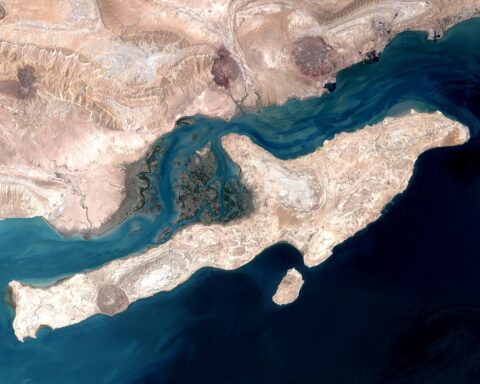

JEDDAH — Iran’s threat to Saudi Arabia’s export routes is no longer implicit, conditional, or confined to the Strait of Hormuz. On April 15, Maj. Gen. Ali Abdollahi, commander of Khatam al-Anbiya Central Headquarters — the body that coordinates Iran’s joint military operations — stated that “the powerful armed forces of the Islamic Republic will not allow any exports or imports to continue in the Persian Gulf, the Sea of Oman, and the Red Sea.” The declaration names three bodies of water. Saudi Arabia’s entire wartime export architecture depends on one of them staying open.
Abdollahi’s statement is not a diplomatic signal of the kind Ali Akbar Velayati issued three days earlier. It comes from the operational chain of command. Khatam al-Anbiya is the headquarters that would issue targeting directives to subordinate formations — including, through the Quds Force coordination structure documented by Israel Hayom in January, the Houthis. The three-sea doctrine does not require Iranian ships. It requires a phone call to Sanaa.
Table of Contents
- Who Is Abdollahi and Why Does His Statement Matter?
- The Proxy Execution Architecture
- Yanbu’s Ceiling and the Loading Gap
- The SAMREF Strike as Proof of Concept
- Can the Houthis Actually Close Bab al-Mandeb?
- What Happens to Saudi Exports Under Three-Sea Interdiction?
- The Fiscal Floor Below Zero Exports
- Saudi Arabia’s Missing Third Option
- The Behavioral Evidence That Riyadh Already Knows
- FAQ
Who Is Abdollahi and Why Does His Statement Matter?
Khatam al-Anbiya Central Headquarters is not the IRGC and not the Artesh. It is the joint operational command responsible for coordinating Iran’s military branches during wartime — the body that translates political authorization into targeting orders. Abdollahi commands it. When Velayati, Khamenei’s senior foreign policy adviser, equated Hormuz and Bab al-Mandeb on April 12, the statement carried political weight. When Abdollahi did the same three days later and added the Sea of Oman, the statement carried operational specificity.
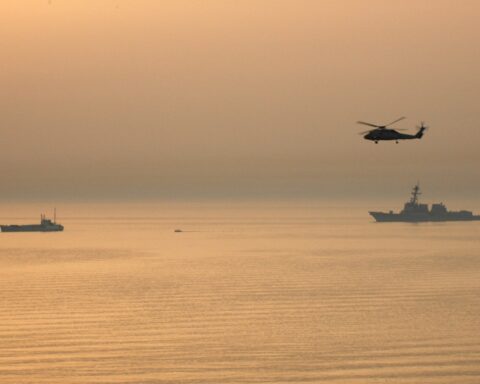
The distinction matters because Iran’s war has produced a growing gap between political rhetoric and military capability. The IRGC Navy’s surface fleet has been functionally destroyed — CENTCOM confirmed 30-plus ships sunk by March 5, the flagship Soleimani went down, and IRGCN commander Tangsiri was killed on March 26. Iran cannot independently project conventional naval power to Bab al-Mandeb. CIMSEC assessed before the war that the strait “falls out of the operating range of most of the IRGC Navy’s vessels.” After the losses of 2026, the gap is absolute.
Abdollahi’s statement therefore reads as an instruction rather than a capability briefing. He framed it as conditional: “If the aggressive and terrorist America wants to continue its illegal action in the naval blockade in the region and create insecurity for Iranian commercial ships and tankers, this US action will be a prelude to violating the ceasefire.” The condition — the US blockade — has been active since April 13. The ceasefire expires April 22. The statement’s conditionality is already satisfied.
The Proxy Execution Architecture
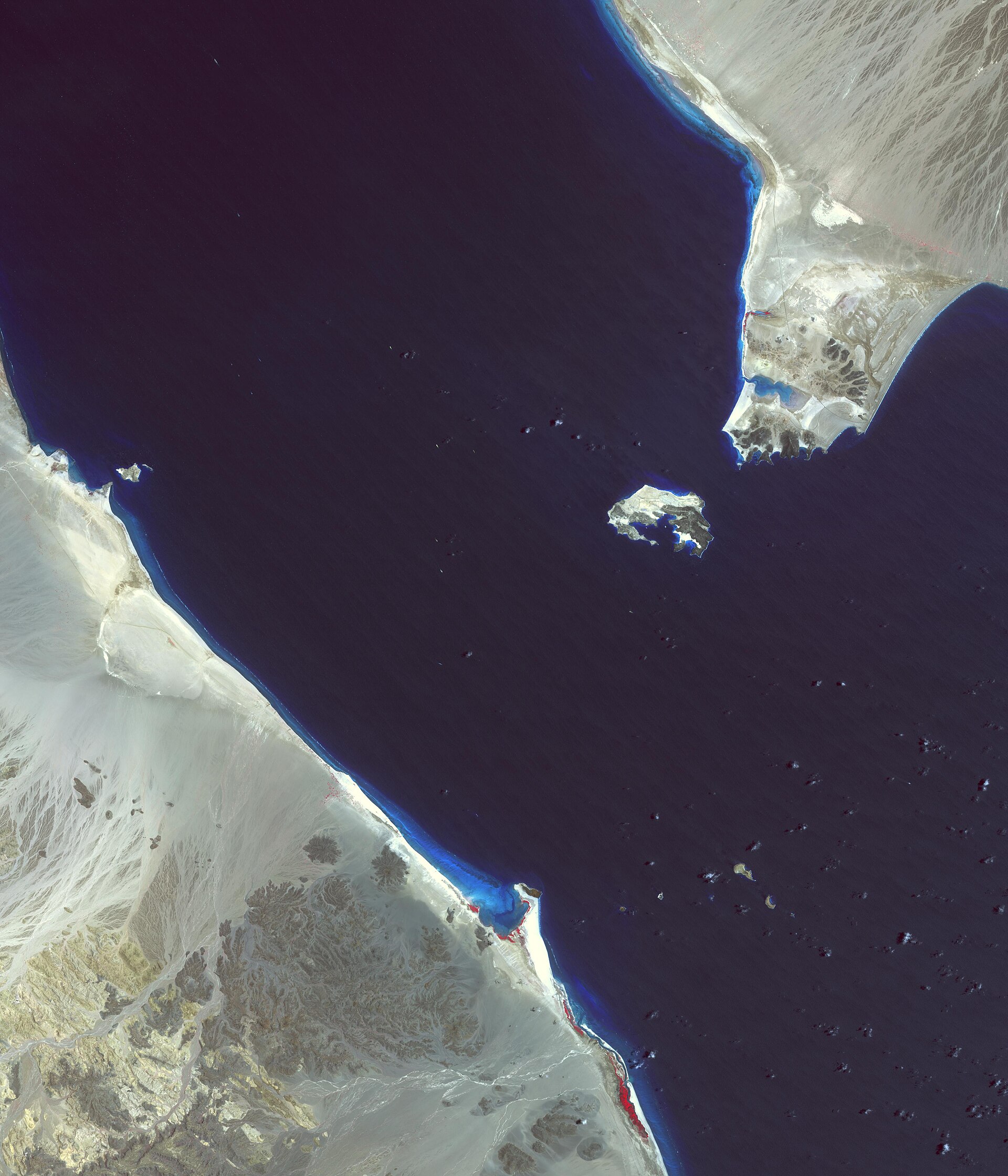
Iran does not need ships to interdict the Red Sea. It needs the Houthis. The division of labor was formalized well before the 2026 war. Israel Hayom reported in January 2026 on Quds Force-Houthi coordination meetings that explicitly addressed “division of responsibilities” for the Red Sea and Bab al-Mandeb. The Houthis hold Perim Island, which sits in the center of the strait and divides the shipping channel. Shore-based anti-ship missiles, one-way attack drones, and sea-borne unmanned systems can be launched from positions that require no vessel to reach.
The Middle East briefing 3,000+ readers start their day with.
One email. Every weekday morning. Free.
The Houthi arsenal is Iranian-supplied and documented in operational use. During 2023-25, Houthi forces attacked more than 130 commercial vessels, sank four ships, and reduced Bab al-Mandeb oil throughput from 8.7 million bpd to 4.0 million bpd — a 54 percent cut — according to EIA data. Their anti-ship ballistic missiles have demonstrated ranges exceeding 200 kilometers. Cruise missiles and Shahed-variant drones cover the full width of the southern Red Sea. Mohammed al-Bukhaiti, a senior Houthi politburo member, stated in March that the group was considering a naval blockade targeting vessels belonging to “aggressor countries” as a “strategic measure to support Iran’s ongoing confrontation with the US and Israel.”
What makes the three-sea doctrine operationally distinct from a Houthi decision to resume attacks is the coordination layer. A Houthi campaign in 2023-25 was opportunistic, politically motivated by Gaza, and selectively enforced. A campaign activated under Khatam al-Anbiya coordination would be target-curated, timed to Iranian operational needs, and integrated with whatever residual Hormuz interdiction — fast boats, mines, or drone launches — the IRGC can still execute. The three-sea label is less a geographic description than an organizational claim: these are not three separate theaters but one campaign with three fronts.
Yanbu’s Ceiling and the Loading Gap
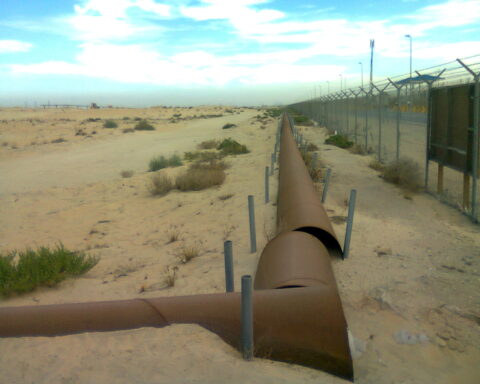
Saudi Arabia’s wartime export strategy since March has rested on the East-West Pipeline, a 1,201-kilometer conduit from Abqaiq to Yanbu on the Red Sea coast. Aramco CEO Amin Nasser confirmed on April 12 that the pipeline had been restored to its full 7-million-bpd nameplate capacity following the IRGC ceasefire-day strike on April 8. The restoration was treated as strategic reassurance. It should not have been.
The pipeline’s capacity is not the constraint. Yanbu’s port infrastructure is. Vortexa, the cargo-tracking firm, estimates a wartime operational ceiling of approximately 3 million bpd at Yanbu’s loading terminals. The IEA recorded peak loading of 5.9 million bpd on March 9 — a surge that shipping data suggests was not sustained beyond 48 hours. Current loading runs approximately 2.72 million bpd. Domestic refinery offtake along the pipeline route, including the 400,000-bpd SAMREF refinery (a Saudi Aramco-ExxonMobil joint venture), absorbs additional volume before crude reaches the terminal.
| Metric | Value | Source |
|---|---|---|
| East-West Pipeline nameplate capacity | 7.0 million bpd | Aramco / Bloomberg |
| Yanbu wartime loading ceiling | ~3.0 million bpd | Vortexa |
| Peak recorded loading (March 9) | 5.9 million bpd | IEA |
| Current actual loading (mid-April) | ~2.72 million bpd | Vortexa |
| Pre-war Hormuz exports | 7.0–7.5 million bpd | Bloomberg / Aramco |
| Structural export gap (Yanbu ceiling vs. pre-war) | 4.0–4.5 million bpd | Calculated |
| SAMREF refinery domestic offtake | 400,000 bpd | Aramco / ExxonMobil |
The arithmetic is unforgiving. Even at maximum theoretical throughput, Yanbu replaces less than half of Saudi Arabia’s pre-war Hormuz exports. The kingdom pre-positioned 7.3 million bpd of exports in February before the war began. The Yanbu corridor, at its documented best, delivers 5.9 million bpd for a single day and sustains roughly 2.7 million bpd over weeks.
The SAMREF Strike as Proof of Concept
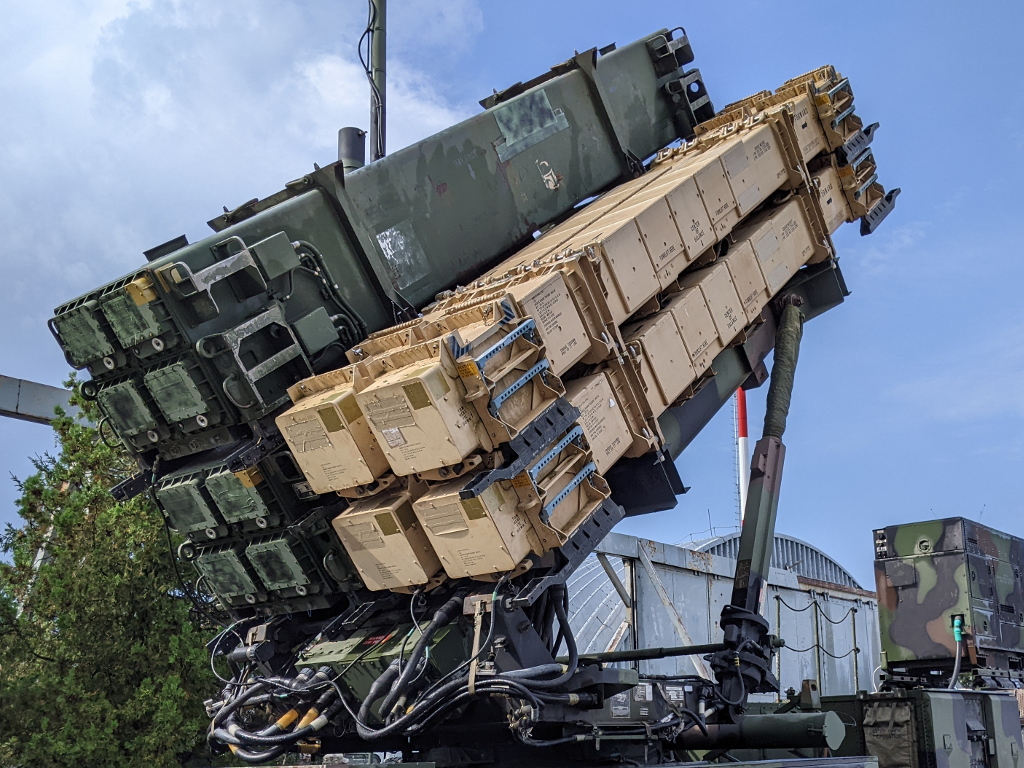
On April 3, an Iranian Shahed-type one-way attack drone struck the SAMREF refinery at Yanbu. The drone penetrated Saudi air defenses. A Greek-operated PAC-3 Patriot battery simultaneously intercepted two ballistic missiles aimed at the same complex — confirmation that Yanbu was targeted by multiple vectors in a single attack. Anadolu Agency and Marine Insight reported the strike. Diaplous, a maritime security firm, subsequently issued an advisory warning of “credible threat involving USV (sea drones), UAVs (aerial drones), missiles, or other forms of attack” targeting Yanbu facilities.
The SAMREF strike established three things. First, Iranian drones can reach Yanbu — a Red Sea facility roughly 1,300 kilometers from the nearest Iranian launch point. Second, Saudi air defenses at Yanbu are not impenetrable; the drone got through. Third, the simultaneous ballistic missile attack suggests coordinated multi-axis targeting of the kind Khatam al-Anbiya would plan, not a Houthi freelance operation.
Saudi Arabia’s air defense posture compounds the problem. After intercepting 799 drones and 95 missiles between March 3 and April 7, the kingdom’s PAC-3 MSE stockpile has fallen to approximately 400 rounds — an 86 percent drawdown from pre-war levels. Camden, Arkansas produces roughly 620 replacement rounds per year. Yanbu sits at the far western end of Saudi Arabia’s air defense coverage, away from the Eastern Province concentrations built to protect Ras Tanura and Abqaiq. Sustained attrition targeting of Yanbu — even with high interception rates — would exhaust the remaining stockpile faster than it can be replenished.
Can the Houthis Actually Close Bab al-Mandeb?
They did it before. Between November 2023 and January 2026, Houthi attacks reduced transit through Bab al-Mandeb by more than half. The EIA recorded throughput falling from 8.7 million bpd to 4.0 million bpd. Four ships were sunk. Nine seafarers were killed. Major container lines — Maersk, MSC, CMA CGM, Hapag-Lloyd — rerouted around the Cape of Good Hope, adding 10-14 days and $1 million per voyage. War-risk insurance premiums for Red Sea transit exceeded 1 percent of hull value.
The Houthi capability set has not degraded. They retain anti-ship ballistic missiles with demonstrated ranges above 200 kilometers, Iranian-supplied cruise missiles, and fleets of one-way attack drones and unmanned surface vessels. Perim Island — their position in the center of Bab al-Mandeb — allows shore-based interdiction without any naval vessel. The strait is 29 kilometers wide. The eastern shipping channel is 3 kilometers across.
What has changed is the Houthi posture. Since the Iran-US war began in late February 2026, the Houthis have been — by their standards — restrained. One missile was fired at Israel on March 28. Red Sea shipping attacks have not resumed as of April 15. Analysts at The National and FDD’s Long War Journal attribute the restraint to strategic patience and possible instruction from Tehran to hold the Red Sea card in reserve. Arash Azizi, an Iranian-American historian, told the Wall Street Journal on April 14 that the Houthis were “likely planning to close Bab al-Mandeb in the next round” if escalation continues.
Abdollahi’s statement may be the activation signal for that next round — or, more precisely, the public framing that converts Houthi restraint from a held card into a conditional threat with a named trigger. That trigger — the US blockade — has been active since April 13.
What Happens to Saudi Exports Under Three-Sea Interdiction?
Saudi Arabia currently has two export routes. Hormuz is closed by war and US blockade. Yanbu — through the Red Sea and Bab al-Mandeb — is the only functioning corridor. If Bab al-Mandeb is interdicted, the options narrow to overland pipeline exports to third-country ports, none of which exist at scale.
The kingdom has no functioning pipeline to a Mediterranean port. The Trans-Arabian Pipeline (Tapline) to Sidon, Lebanon was decommissioned in 1990. The Iraqi Pipeline through Saudi Arabia (IPSA) was built for Iraqi crude and has been closed since 1990. No pipeline connects Saudi oil fields to Oman’s Indian Ocean coast, to the UAE’s Fujairah terminal (which itself depends on the Sea of Oman that Abdollahi named), or to any port outside the three seas Abdollahi designated.
| Route | Status | Capacity |
|---|---|---|
| Hormuz (Ras Tanura, Ju’aymah) | Closed — war/blockade | 0 bpd |
| Yanbu → Bab al-Mandeb → Suez | Threatened — Abdollahi doctrine | ~2.72 million bpd (current) |
| Yanbu → Red Sea (north to SUMED/Suez only) | Partially viable if Bab al-Mandeb closed southbound only | Limited to European/Mediterranean buyers |
| Tapline to Lebanon | Decommissioned (1990) | 0 bpd |
| IPSA pipeline | Closed (1990) | 0 bpd |
| Overland to Fujairah (UAE) | No pipeline exists; Sea of Oman named in threat | 0 bpd |
A partial mitigation exists if Bab al-Mandeb is closed only at the southern end — tankers from Yanbu could still transit north through the Red Sea to the Suez Canal and SUMED pipeline, reaching Mediterranean and European buyers. But Asia takes roughly 70 percent of Saudi crude exports. Northbound-only routing would strand the majority of Saudi Arabia’s customer base behind either Hormuz or Bab al-Mandeb. The Suez Canal and SUMED together handle approximately 5.5 million bpd of total throughput (not exclusively Saudi); absorbing a major redirection of Saudi volumes would create its own bottleneck.
The effective Saudi export volume under a three-sea interdiction — with Hormuz closed and Bab al-Mandeb contested — falls to whatever fraction of Yanbu’s output can reach buyers through the northern Red Sea and Suez. That number is difficult to estimate precisely. It is not zero — but it is not 2.72 million bpd either.
The Fiscal Floor Below Zero Exports
Saudi Arabia’s fiscal breakeven oil price — the price at which government revenue covers expenditure — depends on which line items are included. The IMF’s central government estimate is $86.60 per barrel. Bloomberg Economics, incorporating off-budget spending, puts it at $94. With full PIF capital expenditure included, the figure reaches $111 per barrel. Brent crude trades at approximately $91-95 as of mid-April.
These calculations assume Saudi Arabia can produce and sell oil. Under a three-sea interdiction, the question is not what price balances the budget but what volume can reach market at any price. At current Yanbu loading of 2.72 million bpd — already less than half of pre-war exports — Saudi Arabia is running a structural revenue deficit that Goldman Sachs estimates at $80-90 billion for 2026, against an official projection of $44 billion. The kingdom has authorized $57.87 billion in debt issuance for the year.
A further reduction in export volumes — from Bab al-Mandeb interdiction, sustained Yanbu targeting, or both — would push the deficit beyond the range that debt issuance alone can cover. The PIF has already cut construction commitments from $71 billion to $30 billion and written down $8 billion. The Line has been formally suspended. Aramco’s dividend has been cut by roughly one-third. These measures were taken at 2.7 million bpd of exports. The fiscal position at 1.5 million bpd, or 500,000 bpd, has no precedent in the post-oil era of Saudi state finance. The first legal quantification of what that damage means for Saudi industrial capital markets is the Sadara Chemical debt cliff — a $3.7 billion grace-period expiry on June 15 that is now the earliest hard deadline in the kingdom’s war-damage balance sheet.
Aramco’s May OSP for Arab Light to Asia — set at a record premium of $19.50 per barrel above the benchmark — was calibrated when Brent was $109. With Brent now near $91-95, every term contract cargo Aramco loads at Yanbu ships at a price roughly $13-17 above spot. The premium compensates partly for the loss of volume, but it also makes Saudi crude the most expensive feedstock in Asia at precisely the moment when Abdollahi is threatening the route that delivers it.
Saudi Arabia’s Missing Third Option
The East-West Pipeline was built in the late 1980s to solve the problem the Tanker War created: Iranian attacks on Gulf shipping. Its design assumption was that the Red Sea would remain open. For nearly four decades, it did. The pipeline’s existence allowed Saudi planners to treat Hormuz disruption as a manageable risk — costly but survivable. That calculation held because the threat was one-dimensional.
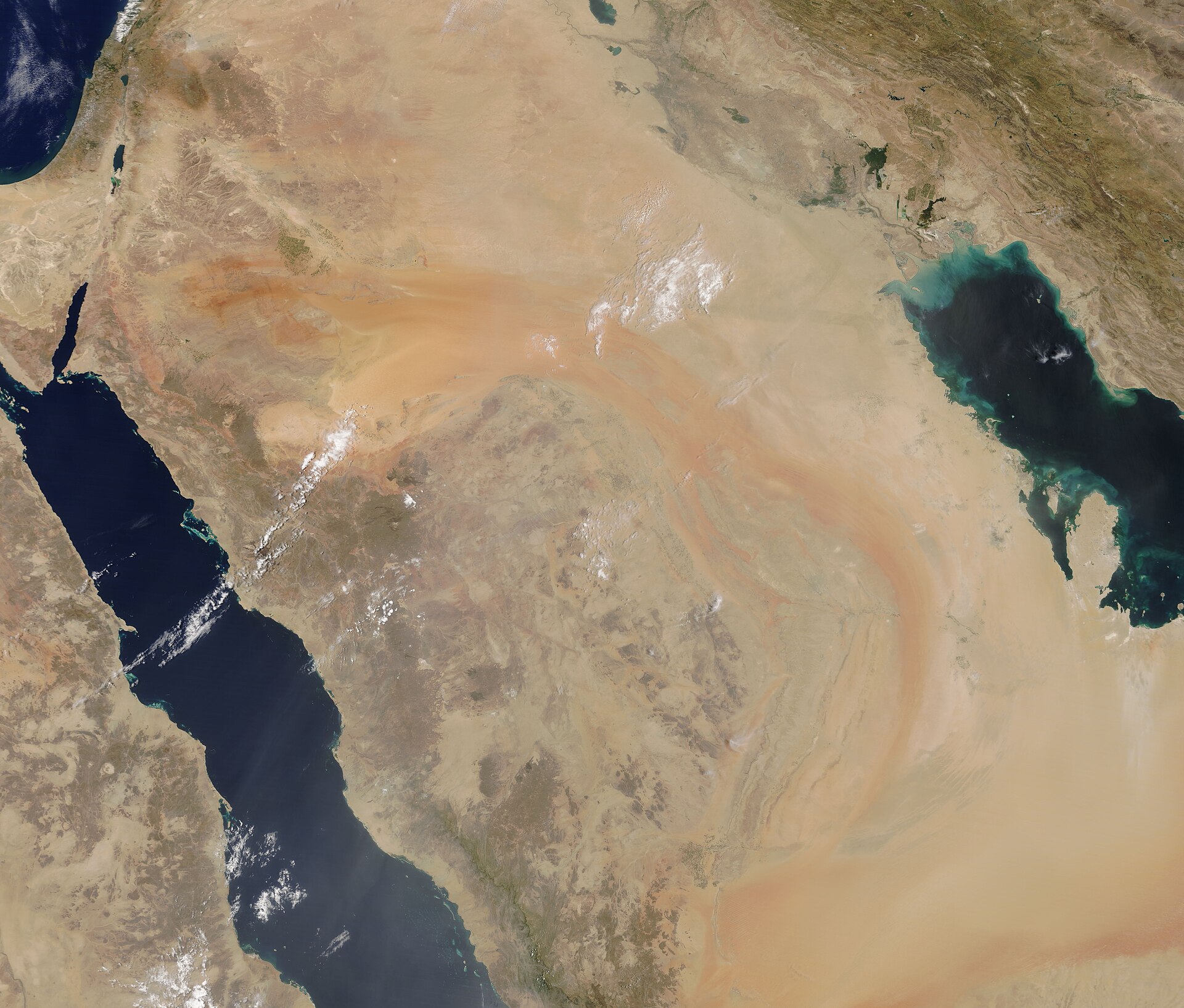
Abdollahi’s three-sea doctrine makes it two-dimensional, and Saudi Arabia has no infrastructure for the second dimension. There is no pipeline to a port on the Indian Ocean outside the Sea of Oman. There is no pipeline to the Mediterranean. There is no overland route to a non-threatened coast. The kingdom is a peninsula, bounded by the three seas Abdollahi named and by the Empty Quarter. Its oil is in the east. Its bypass port is in the west. Both coasts are now inside the declared interdiction envelope.
Building new infrastructure would take years. A pipeline to Oman’s Duqm port on the Indian Ocean — outside both Hormuz and Bab al-Mandeb — would cross roughly 1,500 kilometers of desert and require sovereign transit agreements. Floating storage and offshore loading — the kind of ship-to-ship transfer architecture that Iranian sanctions-evasion networks have perfected — could in theory operate in the open Red Sea north of Houthi missile range, but Saudi Arabia has never built or operated such a system, and improvising it under wartime conditions would be unprecedented for a state producer.
The 1984 precedent is instructive in a different way. During the Tanker War, Iran covertly mined the Gulf of Suez using the vessel Iran Bir, disguised under a Panamanian flag. Nineteen mines damaged at least 19 vessels before clearance operations neutralized the threat. CSIS and the Naval Institute have estimated Iran’s current mine stockpile at more than 2,000, including sophisticated bottom-influence mines. Mining the southern Red Sea or Bab al-Mandeb approaches would not require Houthi cooperation — though it would be easier with it.
The Behavioral Evidence That Riyadh Already Knows
The strongest evidence that Saudi Arabia understands its exposure is behavioral, not rhetorical. The Wall Street Journal reported on April 14 that Saudi Arabia is pressing the United States to end the Iran blockade — not because Riyadh sympathizes with Tehran but because Riyadh calculates that the blockade is the trigger for Red Sea escalation that would close its last export route. Arab officials cited by the Journal made the case explicitly: the blockade provokes the very retaliation that threatens Saudi Arabia more than it threatens Iran.
Ahmed Alkhuzaie, a Bahraini analyst, captured the asymmetry: “A US blockade would paradoxically harm its allies more than Iran.” Iran exports approximately 1.5 million bpd under sanctions, much of it through shadow-fleet transfers that the blockade cannot fully intercept. Saudi Arabia exports 2.7 million bpd through a single port that Houthi missiles can reach. The blockade’s costs fall on Iran; the Houthi response’s costs fall on Saudi Arabia.
Farea Al-Muslimi, a research fellow at Chatham House, framed the downstream effect: “Any sustained disruption will drive up shipping costs, increase oil prices and place additional strain on a fragile global economy that is already reeling from the situation in the Strait of Hormuz.” The price signal would be dramatic — Brent above $120 or higher if both Hormuz and Bab al-Mandeb were simultaneously contested. But for Saudi Arabia, the price signal is secondary to the volume signal. High prices do not help a producer that cannot load tankers.
Diaplous’s advisory on Yanbu — warning of credible USV, UAV, missile, and “other forms of attack” threats — suggests the security industry is already pricing in the risk that Abdollahi’s doctrine will move from declaration to execution. The advisory does not name a timeline. The ceasefire expires April 22. The Hajj pilgrimage cordon seals April 18 — four days before, and four days after the blockade trigger went live.

FAQ
What is Iran’s Khatam al-Anbiya headquarters?
Khatam al-Anbiya Central Headquarters is Iran’s joint military operations command, responsible for coordinating the IRGC, Artesh (regular military), and associated forces during wartime. It was established to unify Iran’s parallel military structures under a single operational chain of command. Its commander issues targeting directives and operational orders that subordinate formations — including, through Quds Force liaison channels, proxy forces — are expected to execute. The headquarters shifted from a “defensive” to “offensive” doctrinal posture on March 22, 2026, as reported by Tasnim and Tehran Times.
Has Iran attempted Red Sea interdiction before?
Yes. During the Tanker War in 1984, Iran deployed the vessel Iran Bir — disguised under a Panamanian flag — to covertly lay 19 mines in the Gulf of Suez and Red Sea approaches. The mines damaged at least 19 commercial vessels before Egyptian and multinational clearance operations neutralized the threat. The operation demonstrated both Iran’s willingness to extend interdiction beyond the Persian Gulf and its preference for deniable methods — a pattern consistent with the proxy-execution model of 2026, in which Houthi forces provide the deniable capability layer that Iran’s destroyed surface fleet can no longer offer.
Why have the Houthis not resumed Red Sea attacks during the 2026 war?
Houthi restraint since February 2026 appears to be deliberate sequencing rather than incapacity. The group’s arsenal — anti-ship ballistic missiles, cruise missiles, drones, and unmanned surface vessels — remains intact, and its infrastructure on Perim Island and the Yemeni coast has not been targeted by US or coalition strikes during the current conflict. Analysts at FDD’s Long War Journal and The National assess that Tehran instructed the Houthis to hold the Red Sea card in reserve, preserving it as escalation leverage. Abdollahi’s April 15 statement may represent the public authorization framework for deploying that card, converting Houthi restraint from a banked asset into an active conditional threat.
Could Saudi Arabia export crude northward through Suez if Bab al-Mandeb closes?
Partially. Tankers loading at Yanbu could transit the Red Sea northward to the Suez Canal without passing through Bab al-Mandeb, reaching Mediterranean and European buyers. The SUMED pipeline from Ain Sukhna to Sidi Kerir offers an additional 2.5 million bpd of capacity for crude that bypasses the canal itself. But approximately 70 percent of Saudi crude exports go to Asia — primarily China, Japan, South Korea, and India — and these buyers sit on the wrong side of both chokepoints. Northbound routing would redirect Saudi crude to a secondary market while stranding its primary customer base, compressing both volume and the price premium that Asian term contracts command.
What is the timeline risk for Abdollahi’s threat becoming operational?
The ceasefire expires April 22. The US blockade of Iranian ports — the explicit condition Abdollahi named — has been active since April 13. The Hajj pilgrimage cordon seals April 18, after which Saudi Arabia’s political tolerance for military escalation near its western coast drops sharply. Between April 15 and April 22, the threat exists in a zone of maximum leverage: the blockade trigger is active, the ceasefire provides nominal cover, and the Houthis retain full capability. After April 22, if no ceasefire extension is reached, the restraint framework dissolves entirely and Houthi operations revert to unconstrained status.