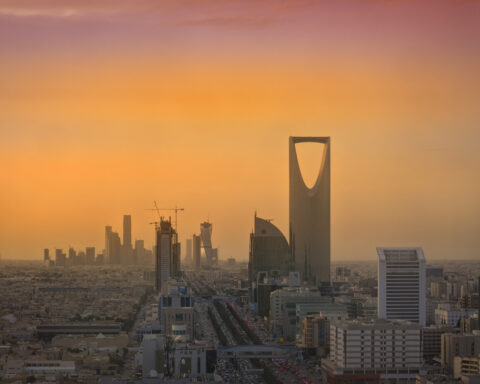
RIYADH — The Public Investment Fund’s 2026-2030 strategy, formally published this spring, does what no Saudi official has been willing to say plainly: it kills The Line, crowns Humain as the new center of Vision 2030, and uses a war that has set SABIC plants on fire and depleted 86% of PAC-3 interceptor stocks as the political justification for a retreat that was already underway before the first Iranian missile crossed the Gulf. PIF Governor Yasir Al-Rumayyan told the fund’s Private Sector Forum in February that the revised strategy is “aimed at becoming a more efficient and returns-driven investment vehicle” — language that, translated from sovereign-wealth-fund dialect, means the era of pouring concrete into the desert at any price is over.
The numbers tell the story in two columns. Construction commitments have been slashed from $71 billion to $30 billion. Meanwhile, Humain — PIF’s AI subsidiary launched during Trump’s May 2025 visit to Riyadh — has signed $23 billion in technology partnerships with NVIDIA, AMD, AWS, Qualcomm, and Cisco in under a year. The war did not interrupt Vision 2030; it selected its survivors. And the survivors do not require open sea lanes, imported construction labor, or a functioning Strait of Hormuz. The IMF’s revised 3.1% Saudi growth forecast is built on a Hormuz normalisation assumption the mine-clearance timeline makes impossible before late Q3 — a conditional the PIF strategy does not appear to have priced in.
Table of Contents
- Was The Line Already Dead Before the War?
- The $41 Billion Retreat
- Humain: The New Flagship
- Why Does Hormuz Immunity Matter for a Sovereign Wealth Fund?
- PIF’s Balance Sheet Under Stress
- What Happens to NEOM?
- The Capital Recycling Machine
- Can AI Data Centers Replace the Construction Multiplier?
- The Deadlines MBS Cannot Move
- The War as Selection Mechanism
- Frequently Asked Questions
Was The Line Already Dead Before the War?
The Line was formally suspended on September 16, 2025, by Al-Rumayyan, with only 2.4 kilometers of foundation completed out of the planned 170 kilometers — a delivery rate of 1.4%. The population target for 2030 had already been slashed from 1.5 million to fewer than 300,000 before a single family moved in. An internal audit leaked to the Wall Street Journal projected the full buildout would cost $8.8 trillion and take until 2080 to complete, against an original public estimate of roughly $500 billion.
That gap — from $500 billion to $8.8 trillion — is not a cost overrun. It is an order of magnitude, the kind of discrepancy that separates a development plan from a conceptual rendering. Fitch Ratings estimates that only $115 billion in giga-project contracts have been awarded in total since 2019 across all PIF mega-developments, meaning The Line was never meaningfully funded relative to its stated ambitions. The December 2024 PIF board review, which approved a minimum 20% spending reduction across more than 100 portfolio companies and triggered layoffs throughout the NEOM apparatus, was a fiscal decision driven by Brent crude spending much of 2024-2025 below $70 per barrel.
The contract cancellations that followed in early 2026 confirmed the trajectory. Hyundai E&C received formal termination notice on March 12 for a $540 million tunnel contract for The Line, originally signed in June 2022 with Samsung C&T and Archirodon. Bloomberg reported that NEOM scrapped Eversendai’s structural steel contract for Trojena, the mountain ski resort, explicitly “due to the current geopolitical situation in the Middle East.” Webuild, the Italian construction group, confirmed cancellation of its contract to build three dams for Trojena’s artificial lake. Even the 2029 Asian Winter Games, which Trojena was supposed to host, went to Almaty, Kazakhstan, in February 2026 — before the war’s worst escalation.
The war gave Mohammed bin Salman something the budget numbers alone could not: a publicly acceptable reason to walk away from the single most visible promise of his reign. No crown prince wants to admit his signature project was 17.6 times over budget before the first resident arrived. A regional conflict that has put Kharg Island in the dark and sent war-risk insurance premiums up over 800% provides cleaner political cover than a spreadsheet.
The Middle East briefing 3,000+ readers start their day with.
One email. Every weekday morning. Free.
The $41 Billion Retreat
PIF’s construction commitments have dropped from $71 billion to $30 billion according to AGBI’s January 2026 reporting — a $41 billion reduction that represents the single largest capital expenditure reversal in the fund’s history. The 2026-2030 strategy adds an additional 15% cut on top of the 20% reduction approved at the December 2024 board meeting, compounding into a fund that will spend roughly a third less on physical infrastructure than it planned as recently as mid-2024.
The $8 billion write-down on giga-project valuations recorded in 2024, with overall giga-project valuations declining 12% during the year, reflects money already spent on projects that will never deliver their original scope. The Arab Gulf States Institute (AGSI), which tracks PIF finances more closely than any other independent body, noted that the fund’s total return to shareholders averaged 7.2% per year between September 2017 and the end of 2024, down from 8.7% reported in its 2023 annual report — a decline that implies the rate of return in 2024 was close to zero.
| Metric | Pre-Restructuring | Post-2026-2030 Strategy | Source |
|---|---|---|---|
| Construction commitments | $71B | $30B | AGBI, Jan 2026 |
| Portfolio company spending cut (Dec 2024) | Baseline | -20% minimum | AGBI, Mar 2025 |
| Additional 2026-2030 capex reduction | — | ~15% further | PIF Private Sector Forum, Feb 2026 |
| Giga-project write-down (2024) | — | $8B | AGSI |
| Giga-project valuation change (2024) | Baseline | -12% | AGSI |
| Total giga-project contracts awarded since 2019 | — | $115B (all projects) | Fitch Ratings via AGBI |
A $41 billion construction cut is not an adjustment. It is a strategic repositioning that affects every contractor, every subcontractor, and every labour camp built to service projects that will now either shrink or disappear. The question is whether what replaces it can absorb the economic multiplier that construction spending was supposed to generate — and the answer, so far, is Humain.
Humain: The New Flagship
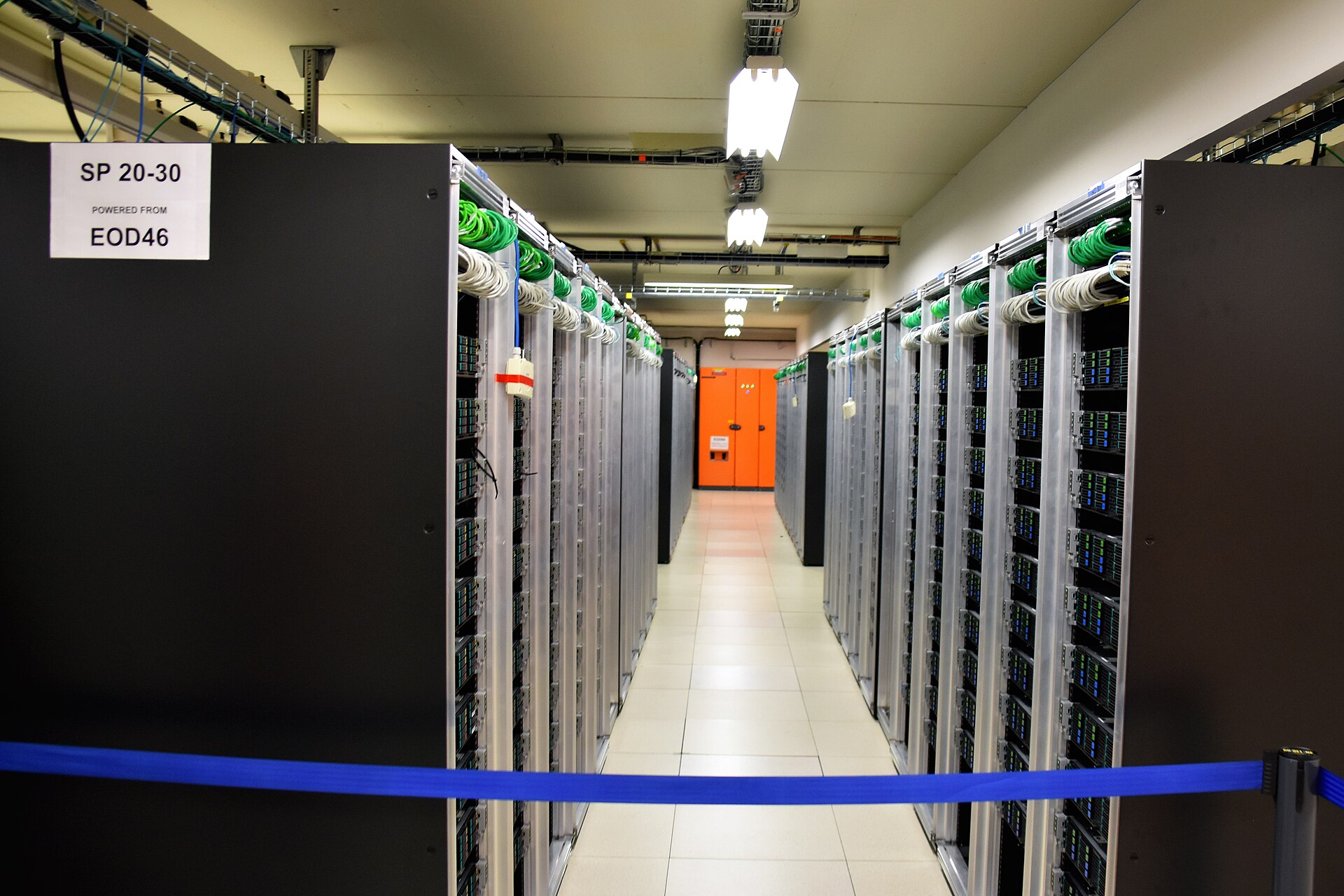
Humain launched in May 2025 during Donald Trump’s first post-election visit to Saudi Arabia, and the timing was not incidental — it was a signal to Washington that the kingdom’s AI ambitions were structurally aligned with American technology supremacy. Within eleven months, it has assembled a partnership portfolio that dwarfs any single giga-project’s foreign participation in the same period — $23 billion in strategic technology deals signed at the US-Saudi Investment Forum, with individual commitments large enough to be national-scale investments in most countries.
AMD and Humain have agreed to deploy 500 megawatts of AI compute over five years, an estimated $10 billion programme. AWS is investing over $5 billion in a dedicated AI Zone in Saudi Arabia. Blackstone, partnering with AirTrunk (co-owned by CPPIB), is building and operating data centers across the kingdom in a $3 billion deal with Humain. The Saudi National Infrastructure Fund has committed up to $1.2 billion in financing for up to 250 megawatts of AI data center capacity.
The xAI investment is the most telling commitment. Humain put $3 billion into Elon Musk’s xAI Series E round in February 2026, becoming what the company called a “large minority shareholder” with stakes that convert to SpaceX equity — approximately 0.24% of the combined $1.25 trillion valuation of Musk’s companies, as reported by Bloomberg and Semafor. A joint xAI-Humain data center in Saudi Arabia will house 18,000 NVIDIA GB300 GPUs in its first cluster, with Grok deployed nationwide as what xAI described as a “unified national AI layer.” As this publication reported when PIF’s SpaceX exposure first emerged, Saudi capital is now embedded in the operating layer of American AI infrastructure, not just parked in passive financial instruments.
The shift from construction to compute is not cosmetic. PIF’s giga-projects required tens of thousands of imported labourers, decades-long construction timelines, and physical supply chains that run through the Strait of Hormuz. A data center requires power, fibre, and chips — all of which can be sourced, installed, and operated without a single cargo container transiting the Gulf.
Why Does Hormuz Immunity Matter for a Sovereign Wealth Fund?
Since March 3, 2026, Saudi Arabia has intercepted 894 Iranian drones and missiles. Shipping container costs have doubled. Saudi non-oil PMI collapsed to 48.8 in March — the first contraction since August 2020, with a 7.3-point monthly fall that was the second-largest in the survey’s history since 2009. Every Vision 2030 project that depends on imported materials, international tourist arrivals, or open maritime corridors is now operationally compromised. NEOM, located on the Red Sea coast at the northwestern tip of the kingdom, was supposed to be sheltered from Gulf instability — but its supply chains were not, and its workforce was overwhelmingly expatriate.
The Hormuz-immune logic behind the AI pivot is structural, not rhetorical. Data centers require electricity (which Saudi Arabia generates domestically from gas), cooling (desert air plus engineered systems), and semiconductor hardware (which arrives by air freight, not container ship). Once built, a data center generates revenue from cloud computing, AI model training, and data processing services that are delivered over fibre-optic cables, not through shipping lanes. The East-West Pipeline can bypass Hormuz for crude oil; Humain bypasses Hormuz for economic diversification itself.
Dr. Neil Quilliam of Chatham House identified the underlying vulnerability before the pivot was complete: “The issue for Saudi Arabia beyond the immediate crisis is the impact it will have on the country’s ability to attract and retain expatriate senior executives, persuade international businesses to establish their regional headquarters in Riyadh and continue to implement Vision 2030.” The AI pivot does not solve the talent problem entirely, but it does shift the talent requirement from a hundred thousand construction workers to a few thousand engineers — a pool that is both smaller and more willing to relocate to a country offering premium compensation packages in a wartime economy.
PIF’s Balance Sheet Under Stress
PIF’s assets under management stand at $930 billion as of early 2026, making it the fifth-largest sovereign wealth fund globally. But the headline number obscures the fund’s liquidity position, which has deteriorated sharply. Cash reserves fell to approximately $15 billion in late 2024 — their lowest level since 2020 — according to AGSI analysis, and the income pipeline from Aramco, PIF’s single largest holding at 16%, is shrinking.
Aramco’s 2025 dividend was cut by approximately one-third to around $84.5 billion, translating to at least a $6 billion income decline for PIF on its 16% stake alone. AGSI’s assessment was blunt: “Aramco is unlikely to be able to sustain its current dividend payout absent a strong rebound in oil revenue.” In 2024, Aramco paid $124 billion in dividends against net income of roughly $112 billion — paying out more than it earned by drawing down cash reserves. The IMF estimates Saudi Arabia’s fiscal breakeven oil price at above $90 per barrel, and Brent spent much of 2024-2025 well below that threshold. The current war has pushed Brent above $100, but the revenue gain is partially offset by Aramco’s own export constraints and the physical damage to Eastern Province infrastructure. The full fiscal arithmetic behind Saudi Arabia’s export losses — including why the kingdom cannot publicly acknowledge the ceasefire it helped broker is now costing it $78 million per day — is set out in the kingdom’s compounding fiscal deficit. The EIA’s April STEO now quantifies the forward path: the $96 annual Brent average for 2026 sits $12–15 below the PIF-inclusive break-even that the 2026-2030 strategy was built around.
| Indicator | Figure | Context | Source |
|---|---|---|---|
| AUM (early 2026) | $930B | 5th largest SWF globally | PIF / The National |
| Cash reserves (late 2024) | ~$15B | Lowest since 2020 | AGSI |
| Annual return (2024) | ~0% | Down from 8.7% avg (2017-24) | AGSI |
| Aramco dividend cut (2025) | ~$84.5B (total) | Down ~one-third | AGSI |
| PIF income loss from Aramco | -$6B+ (minimum) | 16% stake exposure | AGSI |
| AUM growth (2024) | +19% | Largely Aramco equity transfer | AGSI |
The 19% AUM growth recorded in 2024 came predominantly from the Aramco equity transfer — paper gains from moving shares between government-controlled entities, not from investment returns. When AGSI reports that PIF’s 2024 return was close to zero, it means the fund’s active investment strategy produced essentially nothing while the headline AUM figure grew through accounting reclassification. The 2026-2030 strategy’s emphasis on becoming “returns-driven” is Al-Rumayyan’s acknowledgment that AUM growth through equity transfers is not a sustainable substitute for actual performance.
That performance gap has grown sharper since SABIC’s Tadawul disclosure on April 8, which formalized what balance-sheet analysis had implied: the fund’s petrochemical equity — acquired from PIF for $69 billion in 2020 — is now generating zero revenue while carrying $3.7 billion in near-term Sadara debt. How SABIC’s war-damage filing compounds PIF’s balance-sheet crisis traces the arithmetic from the Jubail shutdown through Aramco’s dividend reduction and the June 15 grace-period deadline that now falls on a fund already at near-zero return.
What Happens to NEOM?
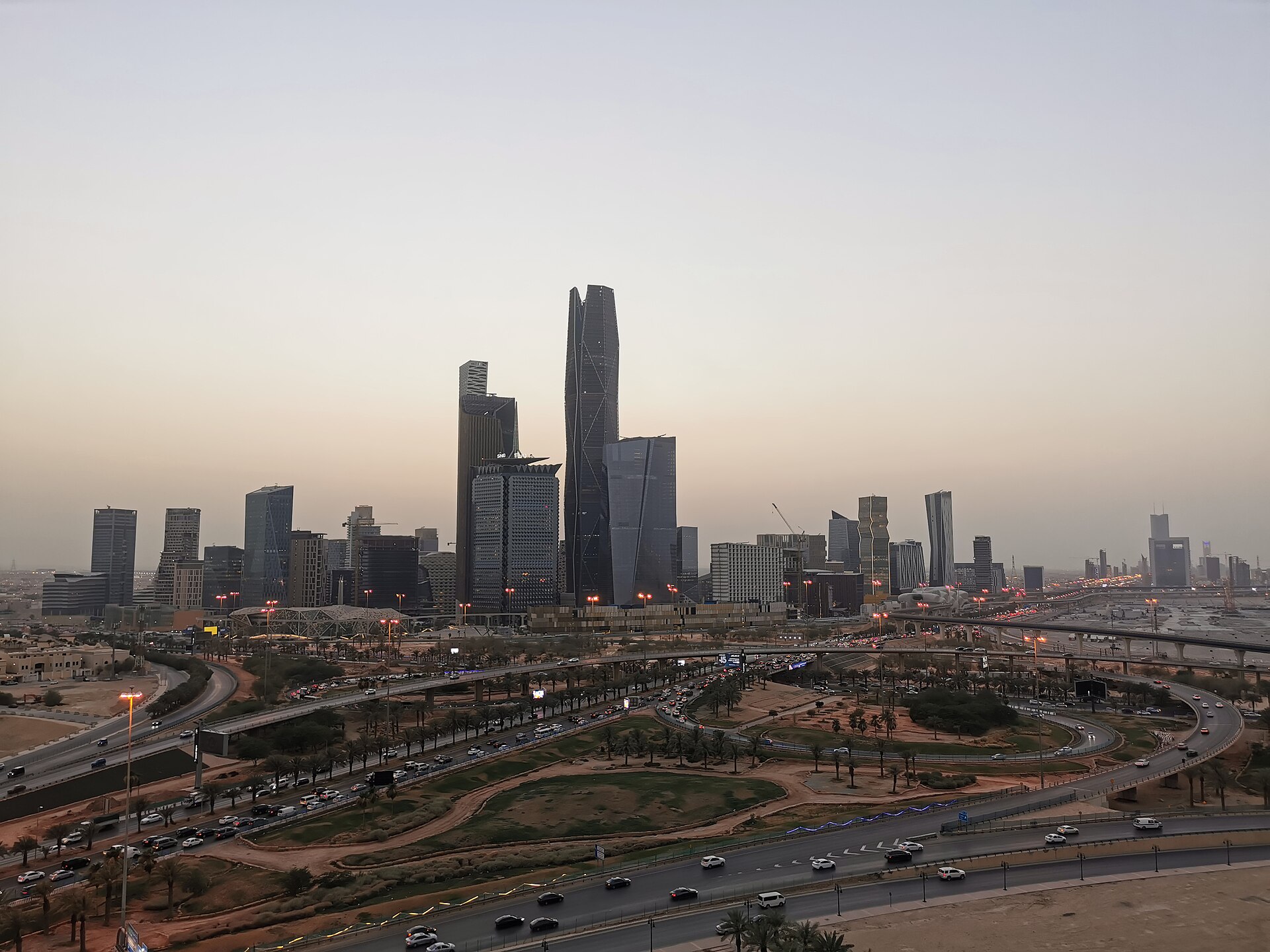
NEOM is not being cancelled — it is being disassembled and reassigned. By March 2026, components of the original NEOM vision had been transferred to Aramco (the Oxagon industrial district), the Ministry of Sport (sports venues), and Red Sea Global (island and coastal properties). What remains under the NEOM brand is increasingly defined by a single February 2026 announcement: a $5 billion partnership with DataVolt to build an AI data center campus at Oxagon.
The trajectory is unmistakable. Oxagon was originally designed as a floating industrial port city — a physical logistics hub requiring deep-water access and container shipping. It is now being repositioned as a data center campus, which requires fibre connectivity and electricity but not a single cargo ship. NEOM CEO Nadhmi Al-Nasr, who was replaced in 2025, presided over a period in which 60% of The Line’s construction was contracted but only 2.4 kilometers were built — a gap between committed spend and delivered physical reality that reflected governance failure independent of oil prices or geopolitics.
The Trojena cancellations are the clearest indicator that the mountain component is finished in any recognizable form. With Webuild’s dam contracts, Eversendai’s structural steel work, and the Asian Winter Games hosting all formally terminated, what the kingdom retains is the land designation, the regulatory authority, and the brand — all of which can be repurposed toward lower-capital-intensity uses. The phrase “NEOM 2.0” is already circulating in Riyadh investment circles, though no official has used it publicly. Its meaning is clear enough: NEOM as a regulatory zone and technology platform, not as a city.
The Capital Recycling Machine
PIF has eight IPOs planned for 2026, including Sela (the entertainment and events company), Saudi Global Ports, ArcelorMittal Jubail, Alkhorayef Petroleum, and CloudKitchens, according to Semafor’s January 2026 reporting. The IPO pipeline is not an expansion strategy — it is a liquidity mechanism. With cash reserves at $15 billion and Aramco dividend income declining, PIF needs to sell equity in mature portfolio companies to fund the Humain buildout and meet its remaining construction obligations.
The mathematics are straightforward but uncomfortable. Humain’s announced partnerships total at least $23 billion in committed spending. PIF’s share of those commitments, even assuming substantial partner financing, likely exceeds $10 billion over the 2026-2030 period. Add the $30 billion in remaining construction commitments, the $7.8 billion government allocation for Expo 2030 Riyadh (which PIF will partially fund), and the ongoing operational costs of a 100-plus company portfolio, and the fund faces a minimum annual capital requirement that its current income cannot cover without asset sales.
The IPO strategy carries a wartime discount. International investor appetite for Gulf assets has contracted since March 2026, and domestic market liquidity — while supported by Saudi retail participation — is finite. Aramco itself has demonstrated the ceiling: its secondary offering in June 2024 raised $11.2 billion, but that was before the Iran war made Saudi industrial assets targets of direct missile attack. The question for PIF’s IPO pipeline is whether the Tadawul can absorb eight listings in a year when the non-oil economy is contracting and insurance premiums make foreign participation more expensive.
Can AI Data Centers Replace the Construction Multiplier?
The construction sector has been the primary engine of Saudi non-oil economic activity since 2017, employing hundreds of thousands of workers, generating demand for cement, steel, heavy equipment, and logistics services, and creating a domestic supply chain that amplified every dollar of PIF spending into several dollars of GDP. The March 2026 non-oil PMI reading of 48.8 — below the 50 threshold that separates expansion from contraction — reflects what happens when that multiplier stalls.
AI data centers do not generate the same economic multiplier. A 500-megawatt data center campus employs a few hundred permanent staff once operational, compared to the tens of thousands of workers required for a single giga-project construction phase. The capital is concentrated in imported hardware — NVIDIA GPUs, server racks, cooling systems — rather than in domestically sourced materials. The economic value created by data centers accrues through services (cloud computing, AI processing) rather than through physical transformation of land and materials, and those services generate high revenue per employee but low employment volume.
This is the structural weakness in the Humain-as-Vision-2030 thesis. The S&P Global/Riyad Bank PMI commentary attributed the March collapse partly to the war’s trade disruption costs — but the underlying driver was that construction activity, the sector most sensitive to PIF spending decisions, was already decelerating before the first missile hit. PIF’s pivot from $71 billion in construction to $30 billion, with the savings redirected toward data centers, removes the single largest source of non-oil economic multiplier from the Saudi economy at the precise moment the war has eliminated most others.
Al-Rumayyan’s “returns-driven” language signals that PIF is prioritizing financial returns over economic development impact — a rational choice for a sovereign wealth fund, but a potentially destabilizing one for a kingdom whose social contract under MBS has been predicated on visible, large-scale economic transformation that ordinary Saudi citizens can see and touch. The construction worker who built NEOM’s foundation trench and the shopkeeper in Tabuk who sold him groceries both understood what Vision 2030 meant for them; neither has an equivalent relationship with a GPU cluster in an air-conditioned warehouse outside Riyadh.
The Deadlines MBS Cannot Move
Two dates constrain the entire restructuring: Expo 2030 Riyadh and the 2034 FIFA World Cup. Both have fixed international commitments, both are centered on Riyadh (inland, Hormuz-immune), and both require infrastructure that PIF must either fund or facilitate regardless of its broader spending cuts. The $7.8 billion government allocation for Expo 2030 is a floor, not a ceiling, and the 15 stadiums under construction for the World Cup represent a multi-billion-dollar programme with a non-negotiable deadline.
These two events now serve as the disciplining architecture of the 2026-2030 strategy. Every remaining construction dollar must be evaluated against whether it contributes to one of these deadlines or whether it serves a project — like The Line or Trojena — that can be delayed, scaled down, or quietly abandoned. The war has made this triage easier politically but has not changed the underlying fiscal constraint: PIF cannot fund a Humain buildout, meet two mega-event deadlines, maintain a 100-company portfolio, and continue giga-project construction at anything close to original scope. Something had to go, and The Line went first because its deadline was the only one that was self-imposed.
The 2034 World Cup, in particular, represents the kind of project the 2026-2030 strategy actually favours: inland (no Hormuz exposure), tourism-generating (creating recurring revenue), deadline-fixed (external accountability), and globally visible (reputational return on investment). The stadiums being built in Riyadh, Jeddah, and other inland cities are the concrete-and-steel equivalent of what Humain represents in the digital sphere — assets that produce value on a schedule that cannot be quietly extended to 2080.
The War as Selection Mechanism
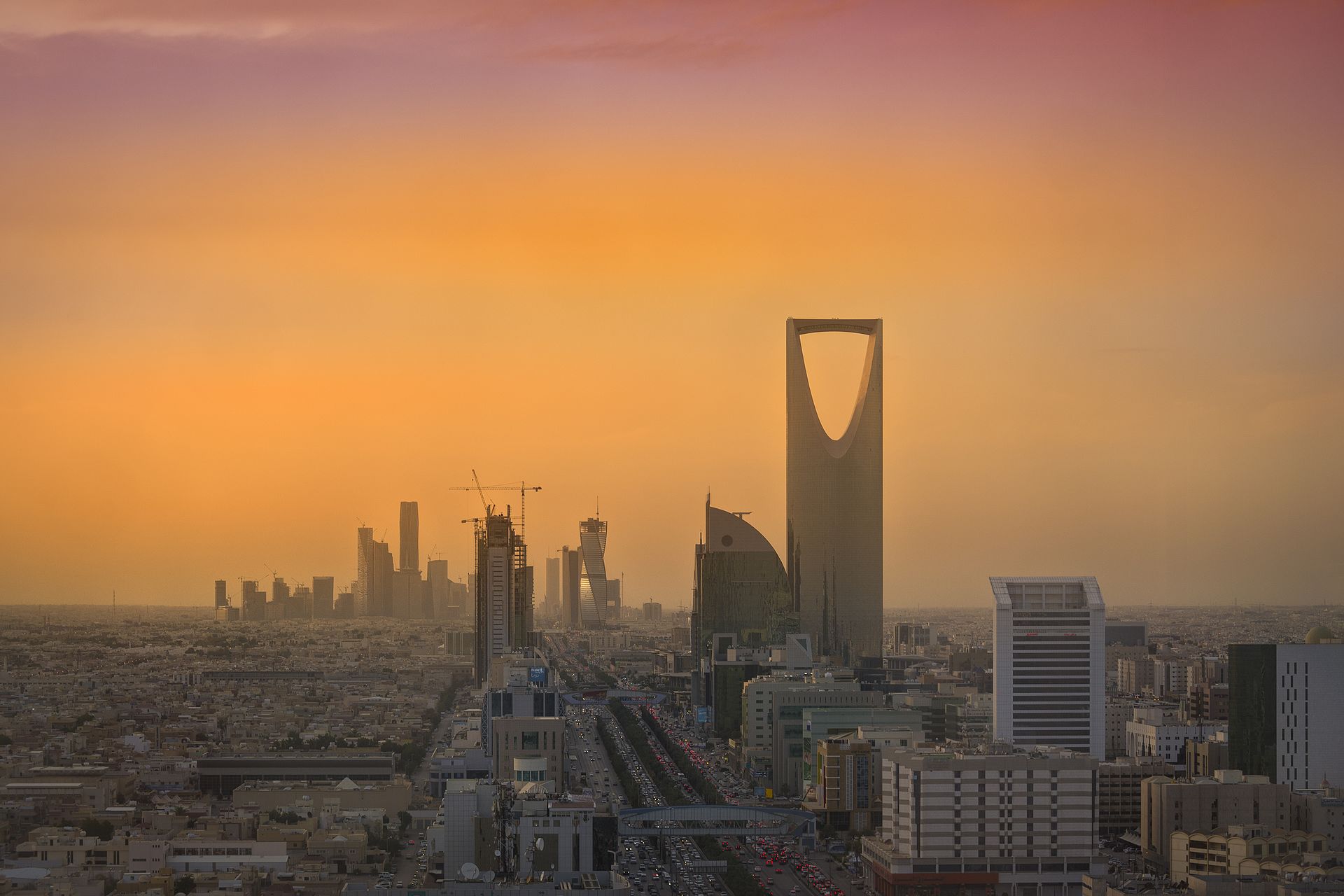
The conventional narrative positions the Iran war as a disruption to Vision 2030 — an external shock that forced Saudi Arabia to shelve its most ambitious projects. The 2026-2030 strategy, read carefully, tells a different story. The war arrived in an economy that was already restructuring away from undeliverable giga-projects toward capital-light technology investments, and it accelerated a selection process that fiscal reality had already begun. The projects that survived — Humain, Expo 2030, the World Cup stadiums, Riyadh metro, data center campuses — share a common characteristic: they either have fixed external deadlines that make cancellation reputationally catastrophic, or they generate financial returns without requiring physical supply chains that transit contested waterways.
The projects that did not survive — The Line, Trojena’s ski resort, Oxagon’s floating port city — shared a different characteristic: they were capital-intensive, physically dependent on imported materials, and lacked any deadline except MBS’s own statements. The Wall Street Journal’s leaked internal audit, projecting $8.8 trillion and a 2080 completion date, was the clearest possible signal that these projects existed as aspirational branding, not as investment-grade infrastructure programmes. PIF’s near-zero return in 2024, against AUM growth that was almost entirely a paper transfer from the government’s Aramco holdings, confirmed that the fund’s actual investment performance could not sustain even the reduced scope.
“The PIF’s total return to shareholders averaged 7.2% per year between September 2017 and the end of 2024, down from an 8.7% annual return reported in its 2023 annual report. This drop in average return suggests that the rate of return in 2024 was close to zero.”
Arab Gulf States Institute (AGSI) analysis
The risk is that MBS has replaced one credibility problem with another. Monocle’s assessment that the kingdom faces a “credibility gap” with foreign investors who built pipelines around original megaproject commitments applies equally to the AI pivot: if Humain’s $23 billion in partnerships do not produce visible, measurable returns within the 2026-2030 window, the kingdom will have abandoned its construction-driven economic model without successfully transitioning to a technology-driven one. The PMI contraction to 48.8 suggests the transition gap is already opening, with construction slowing and data centers not yet operational at scale.
What the 2026-2030 strategy amounts to is MBS’s bet that the form factor of a modern economy matters less than its financial return profile. The Line was supposed to be the most visible city on earth, a physical monument to Saudi ambition that could be photographed from space. Humain is invisible — a network of air-conditioned warehouses full of GPUs, generating revenue through algorithms that no tourist will ever visit and no drone can photograph for a propaganda video. For a crown prince who built his domestic legitimacy on the promise of transformation you could see — entertainment districts, concert venues, ski resorts, a mirrored city in the desert — the pivot to invisible infrastructure is a political gamble as much as an economic one. The next four years will determine whether Saudi citizens, and the foreign investors MBS needs to fund the transition, accept a vision they cannot see.
Frequently Asked Questions
How large is PIF compared to other sovereign wealth funds?
PIF’s $930 billion in assets under management ranks it fifth globally, behind Norway’s Government Pension Fund Global ($1.7 trillion), Abu Dhabi Investment Authority ($993 billion), China Investment Corporation ($1.35 trillion), and Kuwait Investment Authority ($969 billion). Unlike Norway’s fund, which invests almost entirely abroad, PIF allocates roughly 70% of its portfolio domestically — a structure that makes it simultaneously an investment fund and the kingdom’s primary economic development engine. This dual mandate is what makes the pivot from construction to AI so consequential: when PIF reallocates capital, it does not just change its portfolio; it reshapes the Saudi labour market, contractor ecosystem, and domestic supply chain.
What happens to workers on cancelled giga-projects?
The December 2024 board review triggered layoffs across more than 100 PIF portfolio companies, with NEOM bearing the heaviest reductions. Saudi Arabia’s construction sector employs an estimated 2.5-3 million workers, overwhelmingly expatriate, and the $41 billion reduction in PIF construction spending will reduce demand for imported labour by tens of thousands of positions. Unlike in economies with unemployment insurance systems, most affected workers hold employer-sponsored visas and must either find new positions or leave the country. The planned IPO of Sela and other entertainment companies may absorb some domestic Saudi employment, but the skills mismatch between construction workers and data center technicians is nearly total.
Is the Humain-xAI relationship a technology partnership or a geopolitical transaction?
Both. The $3 billion xAI investment gives Saudi Arabia equity in what may become the world’s most valuable private technology company (xAI stakes convert to SpaceX shares at a combined $1.25 trillion valuation), while Grok’s deployment as a “unified national AI layer” gives Elon Musk’s company privileged access to a nation-state’s data infrastructure. The geopolitical dimension is that US export controls on advanced AI chips to the Gulf were relaxed specifically to enable deals like Humain’s NVIDIA procurement of 18,000 GB300 GPUs — a relaxation that required White House approval and reflects Washington’s preference for Saudi AI development happening through American companies rather than Chinese alternatives like Huawei’s Ascend chips.
Could PIF reverse course and restart The Line if the war ends?
Technically possible, practically inconceivable. The contractor ecosystem has been dismantled — Hyundai E&C, Eversendai, and Webuild have all received formal termination notices and redeployed resources to other projects. Reassembling a construction workforce and contractor base of the required scale would take two to three years, by which point the 2026-2030 strategy period would be nearly complete. More fundamentally, the Wall Street Journal’s leaked cost projection of $8.8 trillion means that even restoring The Line to its pre-war scope would require PIF to commit capital it does not have, at a scale that exceeds Saudi Arabia’s total GDP ($1.1 trillion in 2024) by a factor of eight. The Line as originally conceived was never coming back; the war merely determined whether its death would be announced or simply observed.
What is PIF’s biggest risk over the next four years?
Aramco dividend sustainability. If Brent crude settles below the IMF’s fiscal breakeven after the war, PIF faces a forced choice between three options, none comfortable: accelerate asset sales into an IPO market trading at wartime discounts; slow the Humain buildout before its partnerships produce measurable returns; or seek additional government equity transfers that inflate AUM on paper while diluting the fund’s credibility as an active investment vehicle. The 2026-2030 strategy assumes revenue stability it may not receive. What AGSI’s analysis makes plain is that the fund’s three-year window to demonstrate “returns-driven” performance — Al-Rumayyan’s phrase — coincides exactly with the period when Aramco’s dividend sustainability is most uncertain, the Humain buildout requires the most capital, and the Tadawul must absorb eight IPOs while the non-oil economy contracts. All three stresses peak simultaneously between 2026 and 2028. On April 8 — ceasefire day — an IRGC drone struck a pump station on the East-West Pipeline, the bypass route underpinning Aramco’s wartime export revenue and the May OSP pricing assumption, compressing both the volume and price variables that PIF’s dividend model depends on simultaneously. The stress on the JV model extends beyond Aramco’s own balance sheet: Sadara Chemical, the $20 billion Aramco-Dow joint venture in Jubail, faces a $3.7 billion debt cliff on June 15 with zero revenue and no restart date — a live case study in how wartime industrial shutdown converts Vision 2030’s flagship foreign-investment partnerships into contingent liabilities. The full anatomy of this ownership loop — PIF, Aramco, SABIC, and Sadara as one simultaneous balance-sheet crisis — is examined in The $3.7 Billion Debt Clock Saudi Arabia Cannot Stop.
The activation of Saudi Arabia’s four special economic zones on April 16 — offering 5% corporate tax and zero withholding — tests whether the PIF’s strategy pivot can attract foreign capital under active war conditions. The regulatory and investor calculus is examined in Saudi Arabia’s Four Special Economic Zones Activate Wednesday — Into a War.
PIF Governor Al-Rumayyan’s April 15 statement that completing The Line by 2030 is “not a must-have” formalises the strategic retreat documented here and restructures what Vision 2030 looks like without The Line — examining what Humain, Expo 2030, and FIFA 2034 can and cannot replace.
The most legible single expression of this strategic reset is PIF’s decision to end LIV Golf funding after 2026 — a $5.3 billion soft-power programme terminated on the same day four Special Economic Zones opened for hard capital. The full analysis is in PIF Just Killed the Architecture It Built to Apologise for Khashoggi.