

The Saudi Arabian Red Sea is one of the last great frontiers for marine life encounters. With over 1,200 reef-associated fish species, more than 300 species of hard coral, and a cast of megafauna that includes whale sharks, scalloped hammerheads, manta rays and hawksbill turtles, these waters rival anywhere on earth for underwater biodiversity. What sets this coastline apart is how little of it has been dived: only around one per cent of Saudi Arabia’s 1,800-kilometre Red Sea shoreline is developed, leaving vast reef systems effectively untouched. Whether you are planning a dedicated shark expedition or building marine encounters into a wider Saudi Arabia diving itinerary, this guide covers every species you are likely to see, where to find them, and when to go.
Best Time to Visit: March to May (spring) for best all-round conditions; February to May for whale sharks; October to April for hammerheads
Getting There: Fly to Jeddah (King Abdulaziz International) for central Red Sea sites, or Yanbu Airport for northern reef systems
Visa Required: Yes — tourist e-visa
Budget: USD 150–400/day (day-boat diving USD 80–150/two dives; liveaboards USD 250–500/night all-inclusive)
Must-See: Whale sharks at Al Lith, hammerheads at Seven Sisters (Yanbu), hawksbill turtles on any reef wall
Avoid: Touching or standing on coral — Saudi Arabia enforces marine protection strictly, and reef damage carries fines
Why the Red Sea Is Special
The Red Sea is a young ocean basin still widening at roughly 15 millimetres per year. Its semi-enclosed geography produces conditions found almost nowhere else: salinity of 41 PSU (compared with 35 for open ocean), surface temperatures that stay between 21°C and 32°C year-round, and virtually no river inflow, which means visibility routinely exceeds 30 metres and can reach 60 metres off Yanbu. These conditions have incubated extraordinary endemism. Roughly 15 per cent of Red Sea fish species — more than 165 — are found nowhere else on earth, with some families showing far higher rates: over 83 per cent of Red Sea dottyback species are endemic.
Saudi Arabia holds the lion’s share of this biodiversity. The Kingdom’s coral reef systems cover approximately 6,660 square kilometres and are ranked as the eighth-largest reef community globally. The Saudi stretch of the Red Sea also sits on UNESCO’s tentative World Heritage list as “Coral Reefs of the Gulf of Aqaba and the Red Sea in the Kingdom of Saudi Arabia,” reflecting their global significance. For divers, the practical result is simple: you will see more life per dive here than in most places you have dived before.
Sharks of the Saudi Red Sea
Shark encounters are the headline draw for many divers visiting Saudi Arabia. The Red Sea’s relative isolation and the Kingdom’s low-density coastal development have preserved shark populations that are declining elsewhere. Seven species are regularly encountered, and several sites produce sightings on the majority of dives.
Whale Sharks
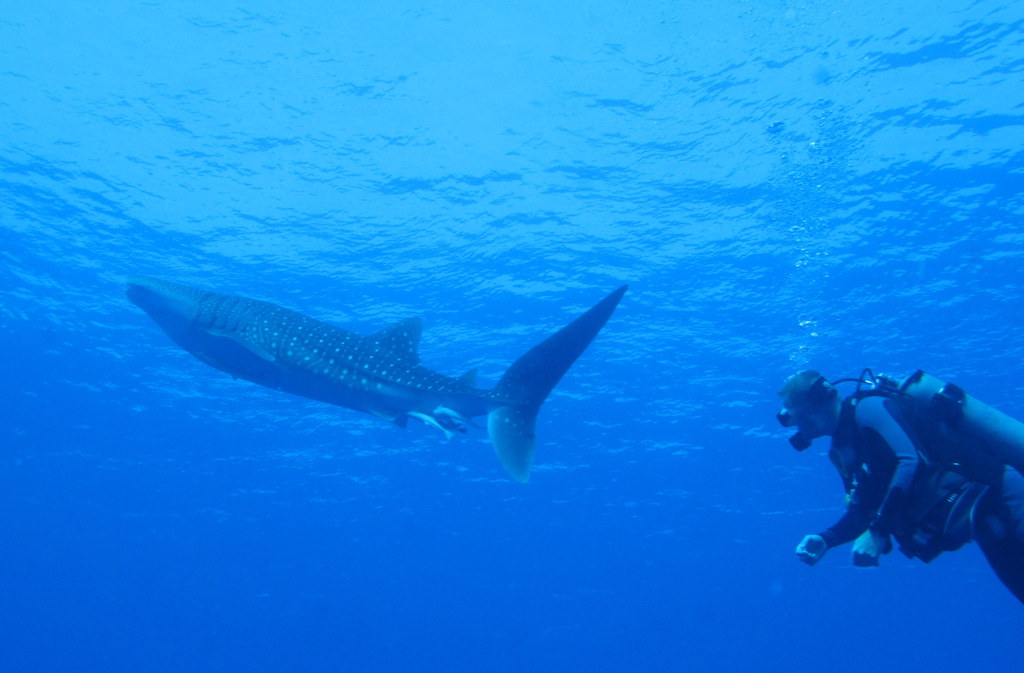
The world’s largest fish — reaching lengths of 12 metres — gathers in significant numbers off the Saudi coast. More than 100 juvenile whale sharks have been documented congregating on shallow reef platforms south of Jeddah near Al Lith, making this one of the most reliable aggregation sites globally. Peak season runs from February to May, with liveaboard operators extending the window from November through May at the Farasan Banks. Unlike many whale shark destinations where encounters are snorkel-only, Saudi sites allow scuba diving with the animals at relatively shallow depths. For dedicated coverage of this species, see our whale shark diving guide.
Scalloped Hammerheads
Scalloped hammerheads are the second most-sought species and Saudi Arabia delivers two distinct seasonal windows. At the Farasan Banks in the south, large schools appear between January and April and again in October and November, often in groups of 20 or more cruising off reef walls. At Seven Sisters reef near Yanbu, hammerheads are present almost year-round, with peak encounters from June to September — a period when most divers head north as southern waters warm. The difference between these two sites gives Saudi Arabia one of the longest hammerhead seasons of any destination worldwide.
Oceanic Whitetip Sharks
The oceanic whitetip is a large, unmistakable pelagic shark — heavy-bodied with rounded, white-tipped dorsal and pectoral fins. It is encountered at open-water sites and deeper reef walls, particularly around the Farasan Banks and on liveaboard routes running offshore. While not as predictable as hammerhead or whale shark encounters, oceanic whitetips are a genuine possibility on any deep-water dive in Saudi Arabia, and sightings have increased as the species recovers from historic overfishing.
Grey Reef Sharks and Whitetip Reef Sharks
These are the everyday sharks of the Saudi Red Sea. Grey reef sharks patrol the outer edges of reef walls and channels, often in groups of three to five, and are a near-certainty at the Farasan Banks and Five Sisters reef near Rabigh. Whitetip reef sharks prefer to rest under ledges and overhangs during the day and are active at night — divers on morning dives regularly find them sleeping in small caves. Both species are harmless to divers and provide excellent photographic opportunities.
Silky Sharks and Tiger Sharks
Silky sharks appear between January and May and again in September and October, often at the same sites as hammerheads. Tiger sharks are rarer but regularly reported from January to April, with additional sightings in October. The combination of five or more shark species on a single dive is not unusual at the Farasan Banks during peak season — something very few dive destinations can match.
Rays: Mantas, Eagles and Stingrays
Reef Manta Rays
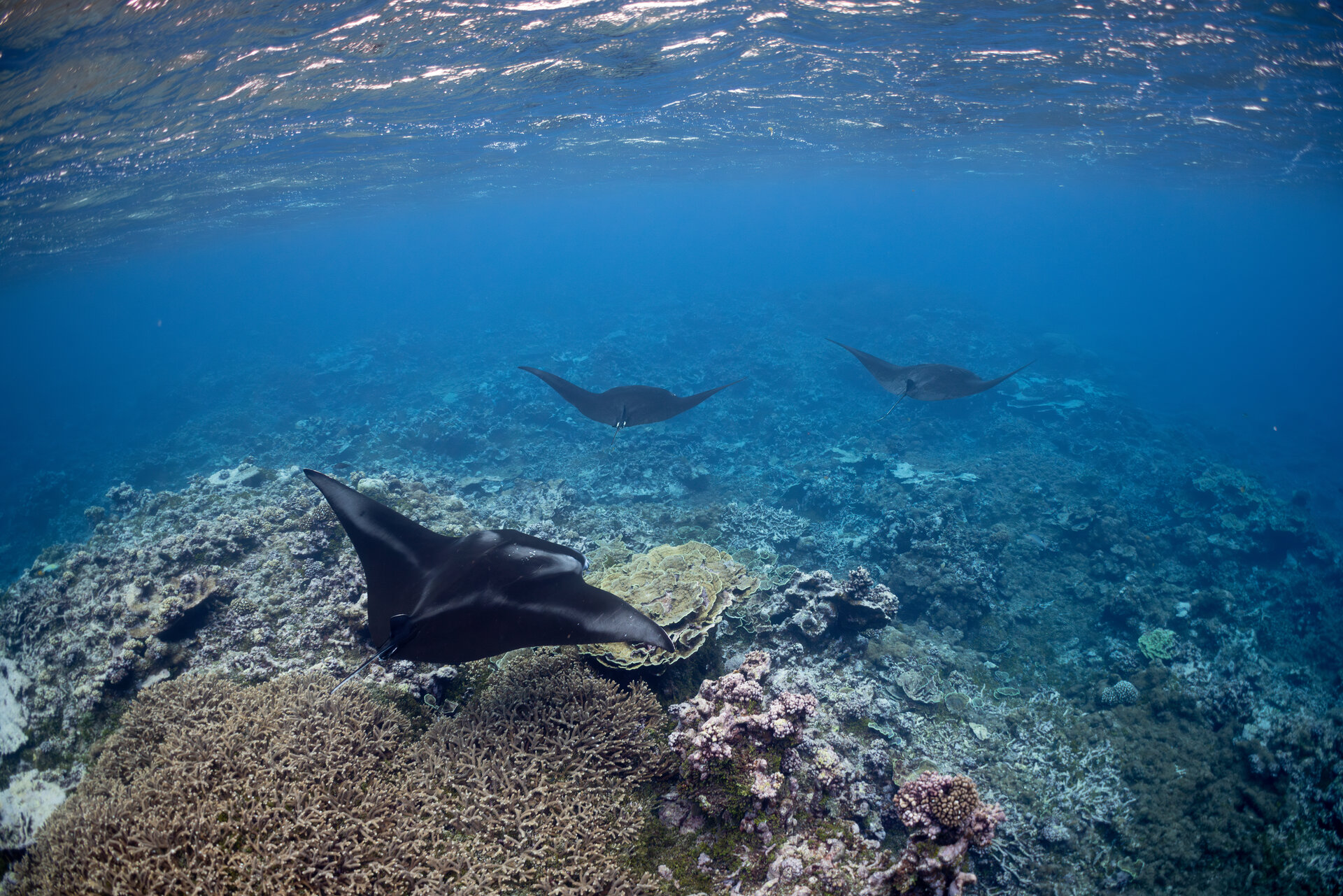
Reef manta rays (Mobula alfredi) with wingspans exceeding seven metres cruise through Saudi Red Sea waters year-round, though encounters peak between January and May and again from October to December. They are most often found at cleaning stations on reef plateaus and at plankton-rich channels between reef structures. The Farasan Banks and the offshore reefs south of Jeddah are the most reliable sites. Mantas are curious and will often circle divers who remain still at a cleaning station — some of the longest and most intimate encounters with this species happen in Saudi Arabia precisely because the sites see so few divers.
Spotted Eagle Rays
The spotted eagle ray (Aetobatus narinari) is one of the most photogenic species on any Red Sea dive. Dark-bodied with a constellation of white spots and a wingspan of up to three metres, it is typically seen cruising in mid-water along reef walls or over sandy channels. Eagle rays are found throughout the Saudi Red Sea coast and are common at dive sites near Jeddah as well as the northern reefs around Yanbu and Umluj.
Stingrays
Several stingray species inhabit the sandy flats adjacent to reef structures. Blue-spotted ribbontail rays are the most commonly sighted, resting on sandy patches during the day and often startling divers who swim too close. They are present at virtually every reef site along the Saudi coast and are a reliable encounter for snorkellers in shallow water as well as divers.
Turtles
Hawksbill Turtles
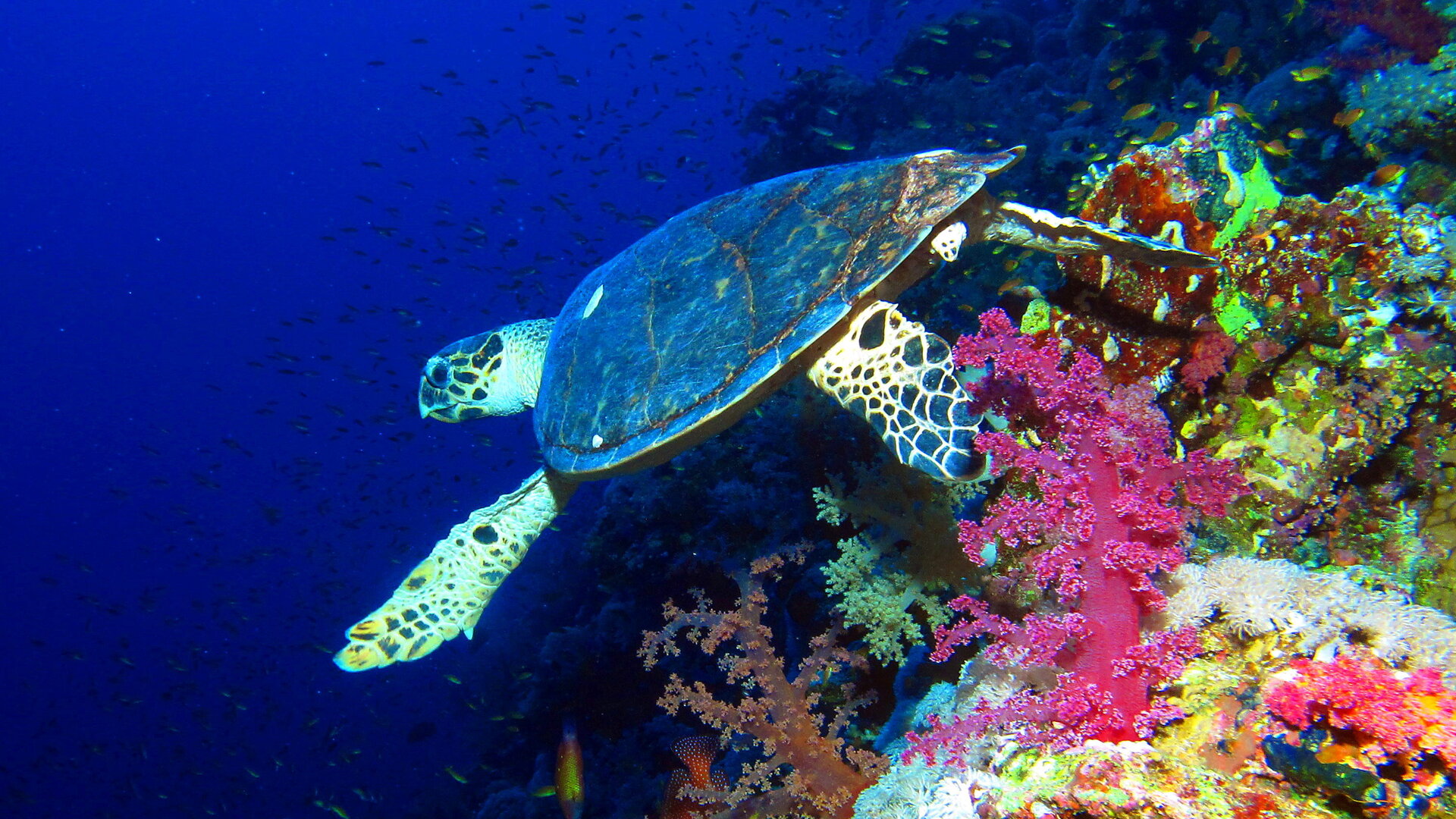
The critically endangered hawksbill turtle (Eretmochelys imbricata) is paradoxically one of the easiest large animals to see in the Saudi Red Sea. Hawksbills feed on sponges and soft corals growing on reef walls, which means they are resident at dive sites rather than passing through. It is common to see two or three individuals on a single dive at any established reef site along the Jeddah, Yanbu, or Farasan coasts. They are remarkably tolerant of divers and will continue feeding while you photograph them from a respectful distance.
Green Turtles
Green turtles (Chelonia mydas) are found primarily in seagrass beds, particularly around the Farasan Islands in the far south. While less commonly encountered on reef dives than hawksbills, they are frequently seen by divers transiting between reef structures and by snorkellers in shallow coastal lagoons. The Farasan archipelago, designated a UNESCO Biosphere Reserve in 2021, supports one of the healthiest green turtle populations in the western Indian Ocean.
Other Marine Life You Will See
Dugongs
The dugong — a marine mammal related to the manatee — is one of the rarest encounters in the Saudi Red Sea but one of the most rewarding. Growing to three metres and weighing up to 400 kilograms, dugongs are herbivores that graze on seagrass beds. The Farasan Islands support a dedicated dugong sanctuary, and the archipelago’s seagrass meadows host one of the region’s most significant populations. Sightings are unpredictable but possible for divers and snorkellers visiting Farasan between October and May.
Napoleon Wrasse
The Napoleon wrasse (Cheilinus undulatus), also called the humphead wrasse, is a giant reef fish reaching nearly two metres in length. Its distinctive bulbous forehead and thick lips make it unmistakable. These fish are surprisingly curious and will sometimes approach divers closely. They are found at reef walls and drop-offs throughout the Saudi Red Sea, with particularly reliable sightings at the Farasan Banks and Seven Sisters.
Giant Moray Eels
The giant moray (Gymnothorax javanicus) reaches three metres and is the largest moray eel species in the Red Sea. Nocturnal hunters that spend the day wedged into reef crevices, they are found at virtually every dive site along the Saudi coast. Look for their heads protruding from holes in the reef wall, mouths rhythmically opening and closing as they pump water over their gills. While intimidating in appearance, they are not aggressive toward divers.
Red Sea Clownfish
The Red Sea clownfish (Amphiprion bicinctus) is endemic to these waters — you will not find it anywhere else. Vivid orange with two white bands, it lives in symbiosis with anemones on the reef and is fiercely territorial for its size. Every reef in the Saudi Red Sea hosts anemone stations with resident clownfish pairs, making them one of the most reliably encountered endemic species.
Nudibranchs
For macro photography enthusiasts, the Red Sea hosts approximately 350 species of nudibranchs and sea slugs, including the endemic Red Sea chelidonura — a velvet-black species with iridescent blue spots. Night dives and early morning dives at reef walls near Jeddah and Yanbu produce the greatest variety.
Schooling Fish and Pelagics
Beyond the headline species, every dive in the Saudi Red Sea features dense aggregations of reef and pelagic fish. Schools of barracuda — sometimes numbering in the hundreds — form tornado-like columns at reef walls. Snappers, coral trout, and fusiliers carpet the reef edge. At deeper sites and offshore pinnacles, king mackerel and sailfish patrol the blue water. Tasselled scorpionfish, perfectly camouflaged against the reef, reward divers with a sharp eye. The sheer volume of fish life at Saudi sites frequently surprises divers who have previously dived more heavily trafficked Red Sea destinations in Egypt.
Where to See Marine Life: Key Dive Sites
Jeddah Area
Jeddah is the most accessible base for Red Sea diving, with the city itself offering a full range of day-boat operators. Key sites include:
- Ann Ann Wreck — sunk in 1977, this is Jeddah’s largest wreck dive. The stern sits at 32 metres with the bow rising to just five metres, and the hull is encrusted in soft corals that attract dense fish life including moray eels, lionfish, and schooling glassfish.
- Boiler Wreck — a complex site with caves, a swim-through tunnel, and a reef wall covered in black, pink, and red corals, ranging from 15 to 45 metres.
- Chicken Wreck (M.V. Glaros) — a 60-metre refrigerator vessel that ran aground in November 1976. Resting on its side at around 20 metres, it still contains its original cargo of frozen chickens — now encrusted in coral.
- Sharm Obhur — north of Jeddah, known for calm waters and a vibrant house reef that supports snorkelling as well as diving.
- KAUST Coral Restoration Initiative (KCRI) — the world’s largest coral restoration project, operating from Shushah Island at NEOM. The primary nursery, operational since April 2024, produces 40,000 corals annually using floating nurseries with a 97 per cent survival rate. An advanced facility targeting 400,000 corals per year and a total deployment of two million coral fragments across 100 hectares is under development.
- Red Sea Decade Expedition (2022) — Saudi Arabia’s National Centre for Wildlife deployed 126 researchers to survey 1,800 kilometres of coastline and 90 offshore islands using DNA sequencing, producing the largest environmental baseline study ever conducted in the region.
- 30 per cent conservation target — Saudi Arabia has committed to conserving 30 per cent of its Red Sea waters, aligning with the global 30×30 framework.
- Saudi Red Sea Authority (SRSA) — established to regulate all marine tourism, the SRSA licenses beach and marina operators and enforces environmental protection standards including marine zoning, carrying capacity assessments, and mandatory safety protocols.
- AMAALA’s net conservation benefit — the AMAALA resort development targets a 30 per cent net conservation benefit to local ecosystems by 2040, caps annual visitors at 500,000, and operates on 100 per cent renewable energy.
- Saudi Arabia Diving and Snorkelling Guide — The complete guide to Red Sea diving in the Kingdom
- Whale Shark Diving Saudi Arabia — Where and when to see the world’s largest fish
- Yanbu Diving Guide — Best sites, operators and what to see at Seven Sisters
- Farasan Islands Diving — Saudi Arabia’s most pristine reefs and UNESCO Biosphere Reserve
- Red Sea Liveaboard Diving — Best boats and routes for offshore expeditions
- Snorkeling in Saudi Arabia — Best Red Sea sites for non-divers
- Scuba Diving in Saudi Arabia — Sites, operators and what to see
- Red Sea vs Maldives — Which is better for diving and beaches?
- Saudi Arabia Travel Guide 2026 — The complete guide to visiting the Kingdom
- Saudi Arabia Visa Guide — Every visa type explained
Yanbu and Seven Sisters
Yanbu, roughly 350 kilometres north of Jeddah, is the gateway to some of Saudi Arabia’s most spectacular reef systems. The Seven Sisters — a collection of reef islands 30 to 45 minutes by boat from Yanbu harbour — are famous for near-guaranteed hammerhead sightings almost year-round, with peak encounters from June to September. The reefs feature shallow coral gardens plunging into walls patrolled by barracuda, snapper, and grey reef sharks. Abu Galawa, within the Seven Sisters system, is a coral grotto that attracts schools of hammerheads. The Iona Wreck nearby is one of Saudi Arabia’s most celebrated wreck dives. For the full Yanbu dive guide, see our dedicated page.
Rabigh — Five Sisters Reef
Five Sisters reef at Rabigh comprises five coral atolls with steep walls, plateaus, and columns draped in anemone beds. Hammerheads and manta rays are sighted regularly, and the area remains one of the least-dived quality reef systems in the Red Sea.
Al Lith and the Farasan Banks
The Farasan Banks — remote offshore reefs accessed primarily by liveaboard — are Saudi Arabia’s premier big-animal destination. Whitetip reef sharks, grey reef sharks, silky sharks, hammerheads, whale sharks, and manta rays are all encountered during peak season (November to May). The reefs range from shallow platforms to walls dropping beyond 500 metres, and the combination of pelagic and reef life at sites like Choppy Reef — with its signature bright-red sponges — places this area among the top ten shark diving destinations on earth.
Farasan Islands
The Farasan archipelago, off the coast of Jazan in the far south, was designated a UNESCO Biosphere Reserve in 2021 and holds the greatest combined marine and terrestrial biodiversity of any Red Sea site. Its seagrass beds support dugongs and green turtles, while the surrounding reefs host a full complement of Red Sea reef species. The best diving runs from October to May. Access is by ferry from Jazan or by liveaboard.
NEOM and the Far North
Saudi Arabia’s far-northern coastline around NEOM and the AMAALA development holds the longest continuous stretch of Red Sea reef in the Kingdom. These waters are crystal-clear and largely unexplored — true frontier diving territory. An 800-year-old coral colony, the largest discovered in the Red Sea, was found near AMAALA during baseline surveys. As resort infrastructure develops, this region will become one of the most significant new dive destinations globally.
Seasonal Guide: When to See What
| Species | Peak Season | Best Location |
|---|---|---|
| Whale sharks | February – May | Al Lith, Farasan Banks |
| Scalloped hammerheads | January – April, October – November | Farasan Banks, Five Sisters (Rabigh) |
| Hammerheads (Yanbu) | June – September (peak), year-round | Seven Sisters, Yanbu |
| Manta rays | January – May, October – December | Farasan Banks, southern reefs |
| Tiger sharks | January – April | Farasan Banks |
| Silky sharks | January – May, September – October | Southern offshore reefs |
| Reef sharks (grey, whitetip) | Year-round | All sites |
| Hawksbill turtles | Year-round | All reef sites |
| Dugongs | October – May | Farasan Islands |
| Dolphins | Year-round | All regions |
Tip: April is widely considered the sweet spot for the Saudi Red Sea — warm weather, calm seas, excellent visibility, and overlap between the whale shark and hammerhead seasons. Summer diving (June to September) shifts north to Yanbu and Umluj as southern waters approach 32°C.
Diving Conditions
Water Temperature
The Saudi Red Sea stays diveable year-round. Winter temperatures (November to March) range from 21°C to 23°C in the north, warming to 28°C at the Farasan Banks. Summer temperatures reach 32°C in the south. A 3mm wetsuit suffices for most of the year; a 5mm suit is recommended for winter diving north of Jeddah. Our scuba diving guide covers equipment recommendations in detail.
Visibility
Visibility is exceptional by global standards: 20 to 40 metres is typical, with conditions off Yanbu regularly exceeding 50 metres. The absence of river discharge and low plankton density (outside seasonal blooms that attract filter-feeders like whale sharks and mantas) produce some of the clearest tropical water anywhere.
Currents
Conditions vary by site. Exposed reef walls and channels can produce strong currents that attract pelagic species — these sites are suited to experienced divers comfortable with drift diving. Protected reef areas and wreck sites around Jeddah are typically calm and suitable for all certification levels, including freedivers and newly qualified open-water divers.
Conservation and Responsible Diving
Saudi Arabia has invested significantly in marine conservation in recent years, and divers should be aware of both the regulations and the wider context.
Rules for divers: Do not touch, stand on, or collect coral. Maintain neutral buoyancy at all times. Do not chase, ride, or harass marine life. Use reef-safe sunscreen. These rules are enforced — violations carry fines under SRSA regulations.
Practical Information
Certification Requirements
All internationally recognised dive certifications (PADI, SSI, NAUI, BSAC) are accepted in Saudi Arabia. Tourist divers need only their certification card and passport — the Saudi dive permit requirement applies only to residents holding an iqama. Non-certified visitors can try a Discover Scuba Diving (DSD) experience — a pool session followed by a shallow open-water dive to a maximum of 12 metres with an instructor — at all major dive centres in Jeddah and Yanbu.
Getting There
Fly to King Abdulaziz International Airport (JED) in Jeddah for access to central Red Sea dive sites, wreck dives, and liveaboard departures to the Farasan Banks. Fly to Yanbu Airport (YNB) for the Seven Sisters and northern reef systems. The Farasan Islands are reached by ferry from Jazan in the far south. All visitors need a Saudi tourist e-visa, which is processed online in minutes.
Best Operators and Access
Day-boat diving from Jeddah and Yanbu costs approximately USD 80–150 for two dives including equipment. Liveaboard expeditions to the Farasan Banks and Seven Sisters run USD 250–500 per night all-inclusive and are the best way to access remote offshore sites. Most operators run liveaboard seasons from October to May. For other watersports and surface-level marine encounters, glass-bottom boat tours and guided snorkelling trips are available from all major coastal towns.