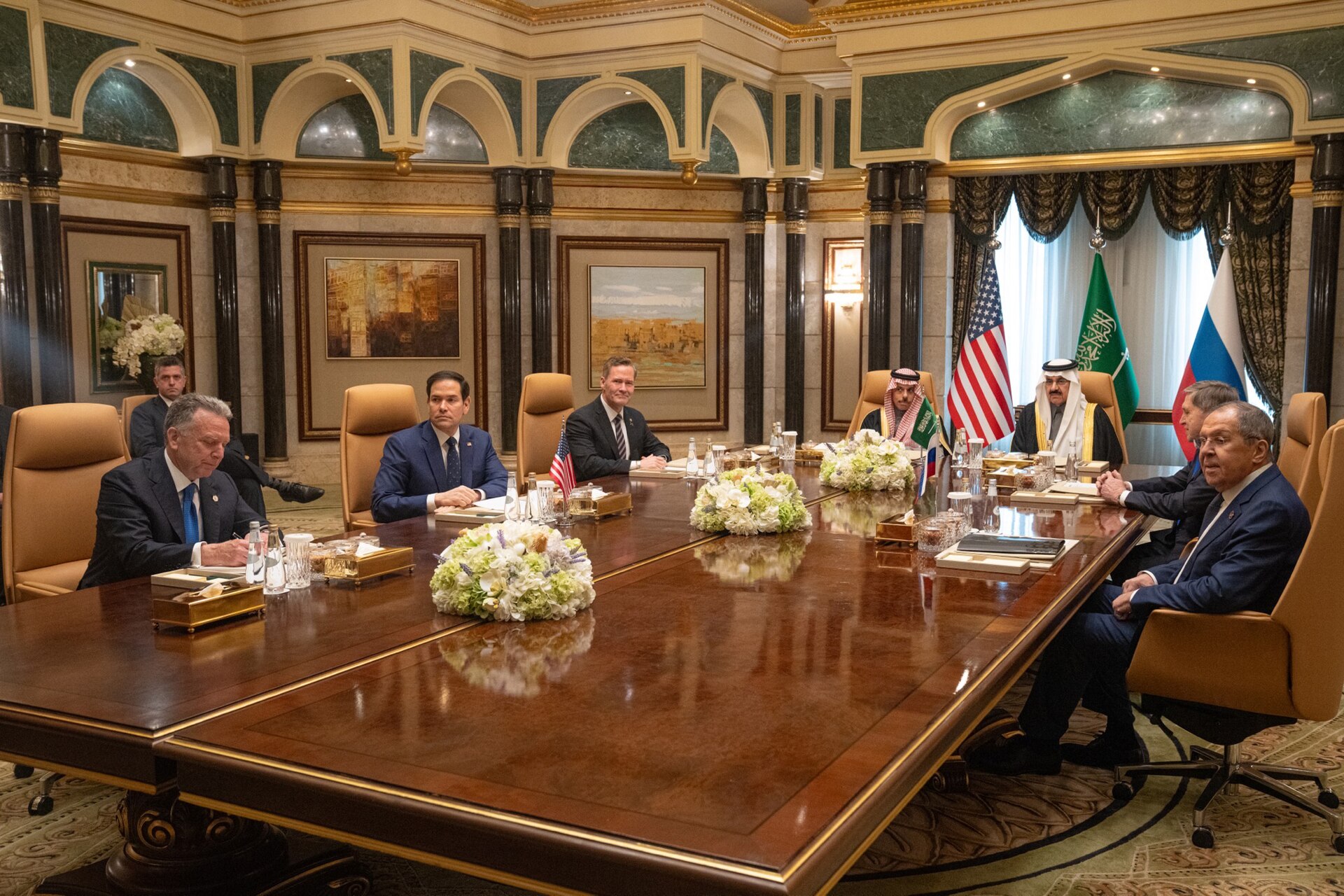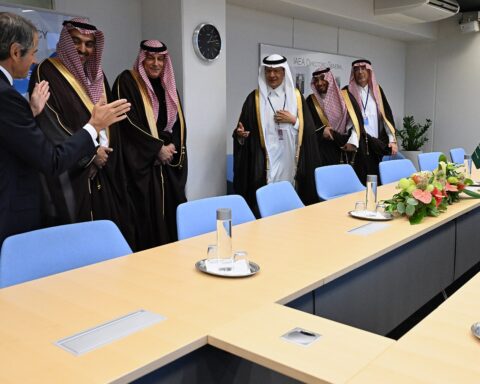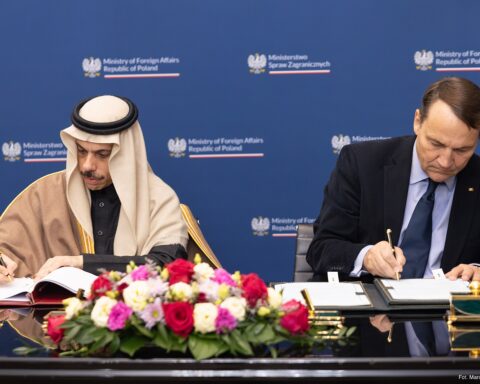

RIYADH — The GCC spent 45 years as a security club where every member needed protection and none could provide it — six buyers, zero sellers. STEP, the Saudi–Turkey–Egypt–Pakistan quadrilateral that has held four foreign-minister-level meetings since March 18, operates on inverted logic: each member contributes a structurally irreplaceable capability that no other member possesses and no amount of money alone can substitute.
This matters now because the architecture is being stress-tested in real time. Day 71 of the Iran war has produced a double blockade of the Strait of Hormuz, a GCC that its own members publicly describe as “the weakest in history,” and a US president arriving in Riyadh on May 13 to negotiate with a kingdom that stopped an American naval operation with a phone call. STEP is not a reaction to this war. The war is the crisis that made STEP’s pre-existing logic visible — and, potentially, permanent. What follows maps the institutional logic, capability matrix, structural limits, and adversary objections — including the unresolved contradiction at its center.
Contents
- Why Did the GCC Fail as a Security Institution?
- What Is STEP — And What Isn’t It?
- The Capability Matrix: What Each Member Sells
- Turkey’s Defense-Industrial Weight
- Can Pakistan Be Both Mediator and Enforcer?
- Does STEP Have a NATO Problem?
- The Baghdad Pact Objection and Structural Limits
- What Happens When the War Ends?
Why Did the GCC Fail as a Security Institution?
The Gulf Cooperation Council failed as a collective defense mechanism because it was structurally incapable of defending anything. Founded in Abu Dhabi on May 25, 1981 — six months after Iraq invaded Iran — it was designed as a coordination forum for monarchies with shared regime-type interests, not as an alliance with pooled military sovereignty. Chatham House described the foundational problem in 2025: power imbalance between Saudi Arabia and five smaller states made consensus impossible on any “big ticket” foreign or security affair.
The result was an institution that could convene but not act. The GCC had no integrated command structure, no treaty-based foreign policy authority, and no mechanism for binding collective response. Its one military deployment — Peninsula Shield forces crossing the King Fahd Causeway into Bahrain in 2011 — was a Saudi unilateral decision wearing a multilateral costume. The other five members contributed presence, not capacity.
Anwar Gargash, the UAE’s diplomatic adviser, delivered the autopsy at the Gulf Influencers Forum on April 27, 2026: “The GCC countries supported each other, but politically and militarily, I think their position was the weakest in history.” He said this four days before the UAE exited OPEC without informing Riyadh — learning of it from a press release. The Arab Center DC’s retrospective is blunter: the GCC was “neither a political nor a military alliance.”
Andrew Leber of the Carnegie Middle East Program and Sam Worby of Global Repute published their post-war GCC assessment on April 16, 2026. Their most-likely scenario: “status quo Gulf” with limited coordination beyond wartime ad hoc arrangements, with historical GCC divisions persisting even under fire. The institution’s failure is not a future risk — it is an accomplished fact.
The Middle East briefing 3,000+ readers start their day with.
One email. Every weekday morning. Free.
What Is STEP — And What Isn’t It?
STEP is a fluid consultation and coordination mechanism between Saudi Arabia, Turkey, Egypt, and Pakistan that has accelerated since the Iran war began on February 28, 2026. It has no formal charter, no secretariat, no joint command structure, and no treaty instrument beyond the pre-existing Saudi-Pakistan bilateral defence agreement. The IISS described it in May 2026 as something less than an alliance but more than a talking shop — a framework that has met four times at foreign-minister level in under eight weeks.
The timeline: March 18 in Riyadh, March 29 in Islamabad, April 17 in Antalya, May 6 in Ankara. Each meeting produced coordination communiqués, not treaty instruments. Turkish FM Hakan Fidan stated the objective at the March 19 Riyadh session: “We are exploring how, as countries with a certain degree of influence in the region, we can combine our strengths.” Egypt’s FM Badr Abdelatty was more explicit on April 18: the four countries are “currently hammering out a security deal designed to end the current conflict and prevent it from breaking out again.”
What STEP is not: it is not NATO. Ankara’s preferred model, according to the IISS, is a defense cooperation framework stopping short of mutual defense commitments — enabling arms co-production, intelligence sharing, joint training, and coordinated diplomatic positions. An unnamed Turkish diplomatic source told Al-Monitor in May 2026 that the goal was “to underscore the importance of strengthening regional ownership to ensure lasting security and stability in the region.” The language is deliberately below the treaty threshold.
The foundational bilateral anchor, however, is considerably harder. The Saudi-Pakistan Strategic Mutual Defence Agreement, signed September 17, 2025 by MBS and PM Shehbaz Sharif, contains a collective defense clause modeled explicitly on NATO Article 5: “any aggression” against one signatory constitutes an attack on all. Turkey is in “advanced stage” talks to accede to the SMDA — confirmed publicly by Pakistan’s Minister of Defence Production in January 2026. Egypt has not signed.
The Capability Matrix: What Each Member Sells
The structural logic of STEP is that each member fills a gap the others cannot. The GCC failed because all six members occupied the same position — wealthy, small-population states that needed to purchase security from external guarantors. STEP’s membership is selected, whether by design or emergence, to ensure no single capability is duplicated and none is dispensable.
| Member | Primary Capability | Key Metric | Source |
|---|---|---|---|
| Saudi Arabia | War financing + theater | SAR 64.7B military spending Q1 2026 (+26% YoY); $100B war financing offer | Saudi MoF, May 2026 |
| Turkey | Defense-industrial production + NATO adjacency | $10.054B defense exports 2025 (record); fastest-growing major arms exporter | Daily Sabah / Anadolu Agency, 2025 |
| Pakistan | Nuclear deterrence + Iran interlocutor + troop mass | 685,000 active troops; 13,000 deployed to Saudi Arabia April 2026 | Al Jazeera / The Researchers, April 2026 |
| Egypt | Suez geography + largest Arab conventional force | 438,500 active troops; Suez Canal transit control | GlobalMilitary.net, 2026 |
Saudi Arabia’s contribution is money and geography — but at a cost. The kingdom’s Q1 2026 deficit reached SAR 125.7 billion (~$33.5 billion), the largest since 2018, driven by military spending that rose 26% year-on-year. Total Q1 spending hit SAR 386.7 billion against revenues of only SAR 261 billion. MBS reportedly offered $100 billion in war financing in early May. The money is real, but it is being spent at a rate that makes the war’s duration a first-order strategic variable.
Egypt’s contribution remains latent but structurally irreplaceable. Its 438,500-troop military — the largest Arab conventional force — includes two Mistral-class amphibious assault ships, FREMM and MEKO A-200 frigates, and a two-fleet naval structure covering both the Mediterranean and the Red Sea from the new Berenice base. Cairo controls the Suez Canal, the only maritime link between the Mediterranean and the Indian Ocean shipping lanes now disrupted by Hormuz’s closure. But Egypt has not deployed forces, signed into the SMDA, or made explicit military commitments beyond diplomatic coordination and the Thunder 2 joint special forces exercise with Pakistan, which concluded April 21.
The $350 million Egypt-Turkey defense pact signed February 4, 2026 is instructive about how the quadrilateral’s bilateral layers stack. Turkey exports the Tolga short-range air defense system ($130 million) and builds a 155mm ammunition factory on Egyptian soil — giving Egypt production capacity it previously lacked, while giving Turkey a manufacturing footprint south of the Suez. The joint venture company created for regional exports means Egyptian-assembled Turkish ammunition could supply Saudi Arabia without transiting Hormuz at all.
Turkey’s Defense-Industrial Weight
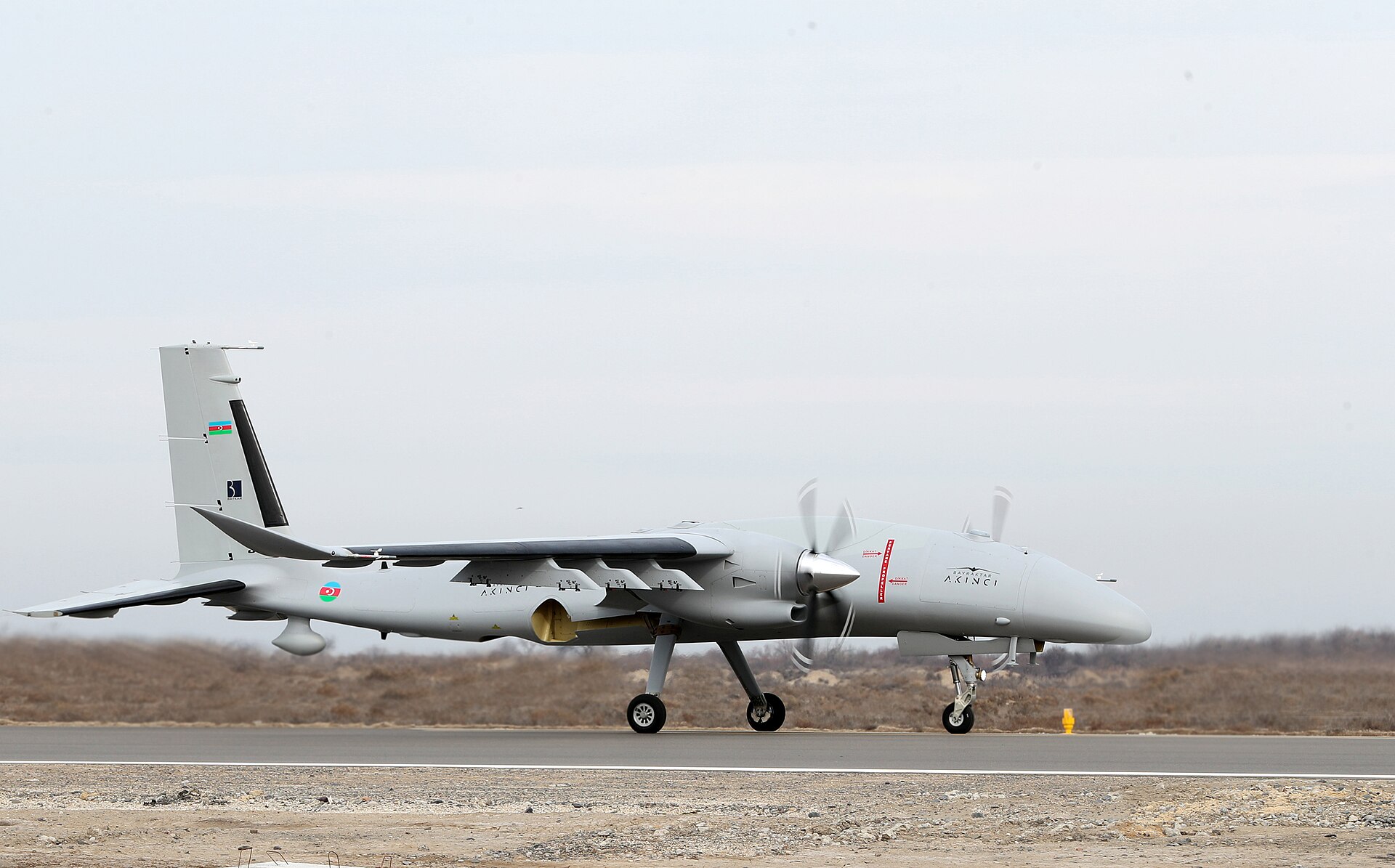
Turkey’s value to STEP is not its army — it is its factories. Turkish defense and aerospace exports hit $10.054 billion in 2025, up approximately 30% year-on-year, making Turkey the world’s fastest-growing major arms exporter. Baykar alone exported $2.2 billion in armed drones that year, holding contracts with 37 countries. The TB2 operates in 36 national inventories. The Akinci heavy combat drone serves 16.
The production numbers matter more than the export numbers. Baykar’s current TB2 capacity is 250 units per year, scaling to 500. The Kizilelma — an uncrewed fighter jet that reportedly achieved the first beyond-visual-range air-to-air missile kill by a drone — enters Turkish military inventory in 2026. The Altay main battle tank entered serial production on September 5, 2025, and Turkish Army service on October 28, scaling to 96 units per year. Turkey is in talks for a $6 billion defense package with Saudi Arabia including Altay tanks and missile defense systems, according to Quwa Defence News.
The bilateral foundation was laid in February 2026, when Turkey and Saudi Arabia signed a series of defense-industrial agreements covering a fifth-generation fighter program, utility helicopters, and unmanned naval platforms over ten days. SAMI, Saudi Arabia’s state defense company, completed technology-transfer agreements with three Turkish defense firms in 2025. A ~$3 billion Bayraktar Akinci deal was signed in 2023. The Egypt-Turkey $350 million defense pact signed the same month — detailed above — extends this manufacturing logic south of the Suez.
What Turkey sells to STEP is what the GCC could never produce internally: indigenous manufacturing capacity that does not depend on Washington’s export-license approval process. Every Bayraktar TB2 delivered to a STEP partner is a system that cannot be embargoed by a future US administration. For Saudi Arabia, which watched its PAC-3 interceptor stocks drain to approximately 400 rounds — 14% of pre-war levels — the value of a supplier inside the coalition is existential, not theoretical.
Can Pakistan Be Both Mediator and Enforcer?
Pakistan occupies the most structurally contradictory position in STEP. It is simultaneously Iran’s protecting power in the United States (since 1992), the only STEP member with an active diplomatic channel to Tehran, and the signatory of a collective defense agreement obligating it to treat Iranian strikes on Saudi Arabia as attacks on itself. It has deployed 13,000 troops and 10-18 fighter jets to the kingdom — the 25th Mechanised Division to the Saudi-Yemen border, an air contingent to King Abdulaziz Air Base — while its intelligence chief, Munir, visited IRGC commander Abdollahi’s headquarters on April 16 to discuss ceasefire enforcement.
Pakistan has not formally invoked the SMDA despite Iranian ballistic missile strikes on Saudi territory. Asia Times noted in April 2026 that Islamabad has prioritized its mediator role over its defense commitment — a choice that is functionally a refusal to activate the treaty’s core clause. Iran has an interest in preserving exactly this ambiguity. As long as Pakistan remains Tehran’s interlocutor, the IRGC has implicit leverage over Islamabad’s willingness to fight.
The fiscal dimension compounds the contradiction. Pakistan’s FY2025-26 defense budget rose 20% to 2.55 trillion rupees (~$9 billion) — the largest increase in a decade — while the country remains under a $7 billion IMF austerity program. A $5 billion Saudi loan matures in June 2026. Pakistan cannot afford to lose Saudi financing, but it also cannot afford to lose its mediating position, which gives Islamabad diplomatic weight far beyond its economic station. Natasha Lindstaedt of the University of Essex characterized the entire STEP arrangement as “relationships of convenience” — “these four nations are not necessarily natural allies.”
The 27th Constitutional Amendment, passed in late 2025, concentrated foreign policy authority in Pakistan’s national security apparatus rather than its elected government. Ceasefire diplomacy is Munir’s operation, not the prime minister’s. This means the contradiction — mediator versus enforcer — is not a political choice awaiting resolution. It is a structural feature of how Pakistan’s security state operates, and STEP must function around it rather than resolve it.
Does STEP Have a NATO Problem?
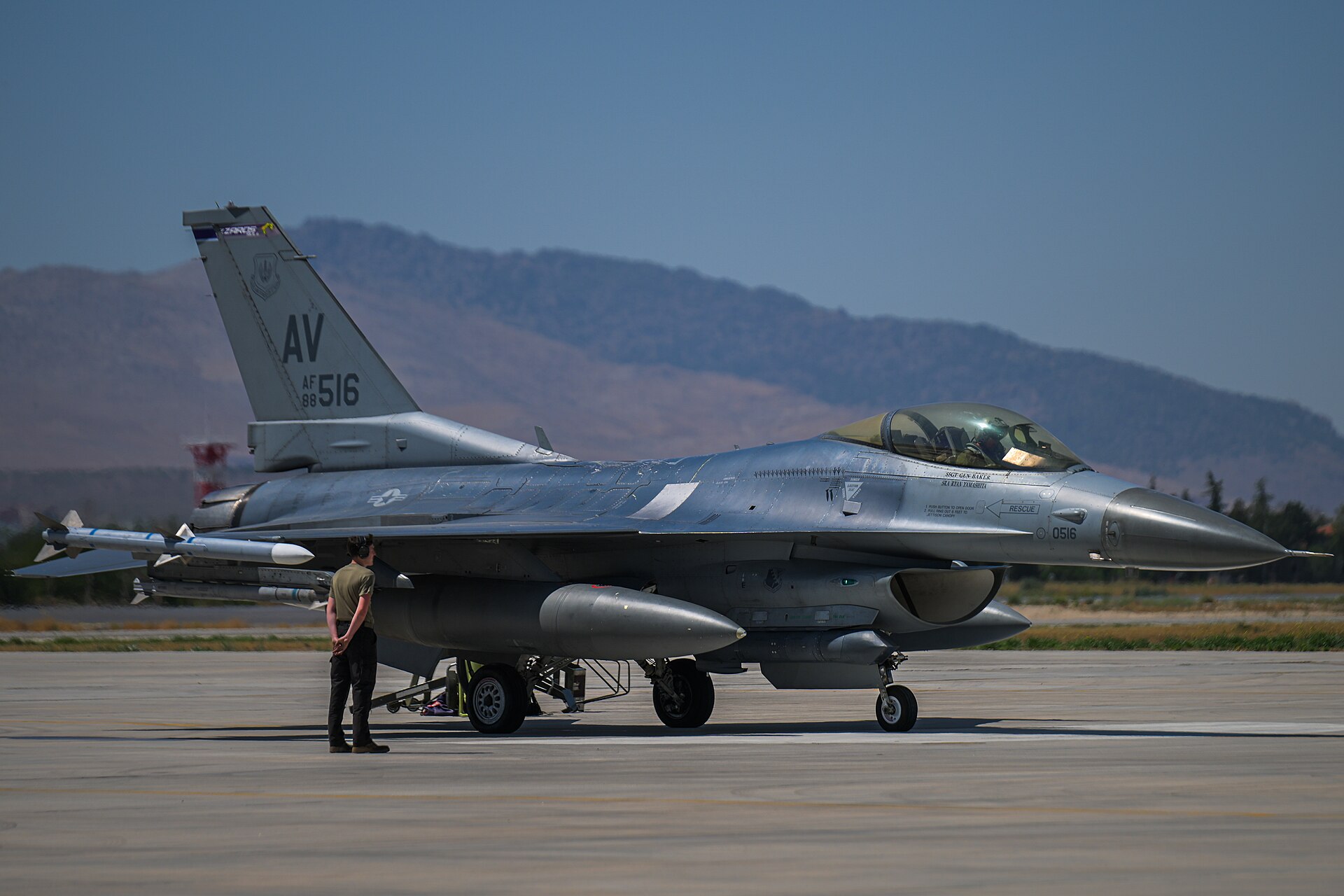
Turkey is a NATO member. The SMDA contains a collective defense clause modeled on NATO Article 5. If Turkey accedes to the SMDA and is subsequently attacked in connection with STEP operations, it could theoretically invoke NATO’s Article 5 — giving STEP a deterrence umbrella it never formally negotiated.
NATO Secretary-General Mark Rutte closed that door in March 2026 after an Iranian missile was shot down entering Turkish airspace. His statement: “the bar is high.” NATO has invoked Article 5 exactly once in its history — after September 11, 2001. The demonstrated threshold is considerably higher than Iranian ordnance transiting Turkey. The Foundation for Defense of Democracies published “Turkey is the NATO ally Trump should pressure first” on April 1, 2026, framing Ankara’s STEP engagement as a strategic liability for NATO’s southern flank and arguing Turkey is “profiting from Atlanticist chaos.”
The asymmetry cuts both ways. Turkey’s NATO membership gives STEP a theoretical escalation ceiling that deters adversaries — no rational actor wants to trigger Article 5 consultations, even if invocation is unlikely. But it also gives Washington and Brussels a veto vector. If Turkey’s STEP commitments produce a crisis that threatens to entangle NATO, the pressure to restrain Ankara will come from inside the alliance. Fidan’s insistence that STEP “would not replicate NATO commitments” (Middle East Eye, March 2026) is not modesty — it is a deliberate firewall between Turkey’s two security architectures.
The practical result: Turkey brings NATO-standard interoperability, NATO-certified defense production, and NATO-adjacent deterrence signaling to STEP without formally coupling the two systems. STEP gets the benefit of Turkey’s capabilities and some of its umbrella without acquiring the constraints of NATO membership. Whether this arrangement survives a crisis in which Turkey must choose between its STEP obligations and NATO solidarity is the question no one in Ankara, Riyadh, or Islamabad wants answered.
The Baghdad Pact Objection and Structural Limits
Critics invoke the Baghdad Pact of 1955 — the Cold War-era collective defense arrangement that fragmented within years as member states pursued divergent national interests. İbrahim Karataş, Associate Professor of International Relations in Istanbul, identifies “fundamental limitations” preventing STEP from achieving formal alliance status, including “competing interests” and “economic weakness.” His sharpest warning concerns peacetime sustainability.
“Without formal frameworks and shared command structures, the Quadrilateral Coalition runs a risk of being driven by events and unable to sustain pace in peacetime.”İbrahim Karataş, Associate Professor, International Relations, Istanbul
The historical parallel is real but imprecise. The Baghdad Pact failed because its anchor state — Iraq — experienced a revolution in 1958 that reversed its foreign policy orientation overnight. STEP’s anchor state is Saudi Arabia, whose regime continuity is not in question. The more relevant structural risk is what Karataş identifies: peacetime sustainability. STEP has met four times in eight weeks because a war is underway. The test is whether it meets quarterly when the missiles stop.
The trust deficit is recent, not ancient. Turkey and Egypt ruptured in 2013 over the Muslim Brotherhood and only achieved full rapprochement in 2025. Turkey and Saudi Arabia cratered after the Khashoggi murder in October 2018 and recovered only with the Erdoğan-MBS reconciliation in 2022. Lindstaedt’s “relationships of convenience” framing, introduced above, applies here precisely: these are states that were not speaking to each other four years ago.
The Russian Council for International Affairs labels STEP an “Islamic NATO” in its analytical framing — a characterization designed to trigger Western suspicion. Their critique echoes Karataş: lack of institutionalization, competing national interests, Baghdad Pact precedent. Iran’s state media has not engaged with STEP as an institution directly, focusing instead on the bilateral SMDA and Pakistan’s troop deployment. Tehran’s strategic interest is narrower: preserve Pakistan’s mediating role, which implicitly constrains Islamabad’s SMDA activation.
Five structural limits deserve honest accounting. First, no charter or secretariat as of May 10, 2026 — all output has been coordination, not treaty. Second, Egypt’s military contribution is potential, not committed. Third, Pakistan’s fiscal ceiling ($7 billion IMF program, $5 billion Saudi loan maturing June 2026, 20% defense budget hike) constrains sustained deployment. Fourth, no dedicated STEP joint exercise format exists — exercises remain bilateral (Thunder 2, Jinnah 2026, PATS 2026) or multilateral with non-STEP states (Spears of Victory 2026). Fifth, the Ankara May 6 meeting produced visa exemptions and a coordination council session, not a defense pact.
What Happens When the War Ends?
STEP absorbs strategic space vacated by two simultaneous collapses: the GCC’s demonstrated irrelevance and the UAE’s unilateral departure from the Gulf’s collective economic architecture. The Iran war did not create STEP — the SMDA predates it by five months, Turkey’s defense-industrial deals with Saudi Arabia by three years. But the war made the logic legible by demonstrating what happens when the Arab world’s largest defense budget cannot source interceptors, cannot clear mines, and cannot enforce a ceasefire without a nuclear-armed intermediary.
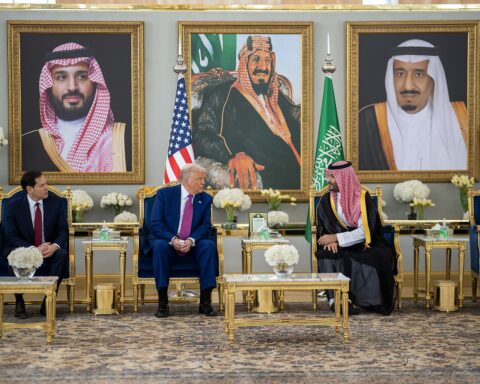
Trump arrives in Riyadh on May 13 — three days from now. He comes having deferred to MBS on Operation Project Freedom, the naval escort operation paused within 48 hours of launch after a Saudi phone call on May 4-5 (NPR, May 6, 2026). The power dynamic is instructive: the kingdom that once depended entirely on US security guarantees just vetoed a US military operation. If STEP members have filled portions of the security gap the US left — Turkish drones replacing American ones that require export licenses, Pakistani ground forces substituting for the tens of thousands of American personnel who did not deploy — then the question at the Riyadh summit is not whether America will protect Saudi Arabia. It is what Saudi Arabia will pay for services it is already sourcing elsewhere.
Nihat Ali Özcan, an Ankara-based strategist, framed the broader context: countries are “developing new mechanisms to identify friends and foes” as the US “prioritizes regional interests above regional stability.” STEP is one such mechanism — imperfect, uninstitutionalized, freighted with contradictions. It works today because a war demands it. Whether it survives peace depends on whether its members can answer a question the GCC never could: what do we owe each other when no one is shooting?
The Ankara meeting on May 6 suggests the answer is still being negotiated. The third session of the Turkish-Saudi Coordination Council — established in 2016, dormant until 2025 — produced a diplomatic passport visa exemption and discussion of Hormuz de-escalation. Not a defense pact. Not a joint command. A conversation between states that have decided they need each other but have not yet agreed on the price of permanence.
The GCC had 45 years of peacetime to get past the consultation stage and never did — because the incentive to formalize disappears when no one is shooting. STEP has had eight weeks under fire and is further along, which says more about the pressure than the architecture. The question is whether STEP can outlast the specific emergency that made it necessary — or whether its members will discover, as the Baghdad Pact’s did, that shared enemies are easier to agree on than shared obligations.

Frequently Asked Questions
Is STEP replacing the GCC?
Not formally — the GCC continues to exist as an institution, and Saudi Arabia has not withdrawn. The replacement is functional rather than legal. GCC members Bahrain, Kuwait, Qatar, Oman, and the UAE are excluded from STEP’s security consultations entirely. The practical effect is that Saudi Arabia has built a parallel track for decisions the GCC proved incapable of making — force deployment, defense procurement, and ceasefire enforcement — while maintaining the GCC for economic coordination and ceremonial diplomacy. No state has proposed dissolving the GCC, but no state has proposed using it for anything that matters since February 28.
Why isn’t the UAE in STEP?
The UAE’s exclusion predates its May 1 OPEC exit but is reinforced by it. Abu Dhabi deployed Iron Dome batteries via Israel (Axios, April 26, 2026) and pursued a separate ceasefire framework demanding Iranian reparations — a position incompatible with Saudi Arabia’s zero-accountability language. The UAE also absorbed 2,819 Iranian strikes (563 ballistic missiles, 2,256 drones, 26 cruise missiles) and responded by deepening bilateral ties with Israel and India rather than with its GCC neighbors. Gargash’s public statement that the GCC was “not fit for purpose” was an exit speech, not a reform proposal. STEP’s logic requires contributors, not consumers — and the UAE positioned itself as a bilateral actor, not a coalition member.
Could STEP expand to include other members?
Jordan and Morocco have been discussed in think-tank assessments as potential fifth and sixth members. Jordan offers a land bridge between the Gulf and Turkey plus a 100,000-troop military with US interoperability. Morocco brings Atlantic access and a 195,000-troop force with French-standard equipment. Neither has been invited to STEP’s FM-level consultations. The IISS assessment suggests expansion would require formalizing what currently works as a four-party consultation — and formalization is precisely what Turkey and Egypt are resisting. Karataş’s warning applies: each new member adds a national interest that must be reconciled without an institution designed to reconcile them.
What is the SMDA’s legal relationship to STEP?
The SMDA is a bilateral Saudi-Pakistan treaty with a collective defense clause — it is not a STEP document. Turkey’s accession would make it trilateral. Egypt has no announced timeline for joining. The SMDA is the only binding defense commitment within the STEP framework; everything else is consultation and coordination. This creates a two-speed architecture: Saudi Arabia and Pakistan (and soon Turkey) operate under mutual defense obligations, while Egypt participates in diplomatic coordination without military commitment. The gap between the SMDA’s binding language and STEP’s fluid consultations is the central institutional ambiguity.
Has STEP conducted any joint military operations?
No. STEP members have conducted bilateral exercises — Thunder 2 (Pakistan-Egypt special forces, concluded April 21, 2026), Jinnah 2026 (Turkey-Pakistan commando exercise), PATS 2026 (Pakistan Army Team Spirit, 19 countries including all four STEP members), and Spears of Victory 2026 (Saudi-hosted multinational air exercise with Pakistan and Turkey). Pakistan’s 13,000-troop deployment to Saudi Arabia operates under bilateral SMDA authority, not STEP command. No STEP-branded operation, joint command post, or integrated force package has been announced or is known to exist.