
RIYADH — Saudi Arabia will spend seventy-two hours hosting the most consequential diplomatic sequence of the Iran war — and will not be in the room for any of it. Between May 13 and May 15, Donald Trump lands in Riyadh to celebrate a $600 billion investment forum, then flies to Beijing for a summit with Xi Jinping where the Strait of Hormuz and Iran’s nuclear programme will dominate the agenda, while Iran’s newly launched Persian Gulf Strait Authority consolidates an administrative stranglehold over the waterway that carries 20 percent of the world’s oil.
Three powers need Riyadh for three different reasons — Trump for political legitimacy, Xi for oil and capital, Iran for strategic neutrality — and none of them are offering Mohammed bin Salman a chair at the table where the war’s endgame will be decided. The three-day window is structurally the most important since the first Iranian missiles hit Saudi oil infrastructure on February 28, and the kingdom is simultaneously indispensable and voiceless.
Table of Contents
- The $600 Billion Stage Set
- What Does Trump Need from Riyadh That He Can’t Get Anywhere Else?
- Xi’s Hormuz Problem — and Why Beijing Won’t Solve It for Free
- The PGSA Clock
- Why Is Saudi Arabia Excluded from Every Negotiation That Will Decide Its Future?
- The Prince Sultan Veto
- What Happens Now That Iran Ignored the Rubio Deadline?
- The GCC That Wasn’t
- Can Seventy-Two Hours Produce a Deal — or Just Another Deadline?
- FAQ
The $600 Billion Stage Set
The US-Saudi Investment Forum on May 13 is being packaged as a triumph of commercial partnership — “$600 billion in Saudi commitments to the United States,” as the White House fact sheet puts it, with MBS having upgraded the figure to “almost $1 trillion” during his November 2025 Oval Office visit. The number is real enough: $35 billion from a Google Cloud and PIF artificial intelligence hub, $20 billion from DataVolt for AI data centres and energy infrastructure, $4.8 billion in Boeing orders, and a defence package that the White House calls the largest in history. The breakdown across more than a dozen US defence contractors covers air force modernisation, space capabilities, air and missile defence, maritime security, border security, land forces, and information systems — a procurement list that reads like a country re-arming from scratch, which is roughly what Saudi Arabia is doing.
The centrepiece is the first authorised sale of F-35 stealth fighters to Saudi Arabia — two squadrons, approximately 24 jets, bundled with nearly 300 tanks and a designation as a major non-NATO ally. Delivery will not begin before 2029, which means the most advanced fighter in the package will arrive three years after the war it was purchased to deter. The $9 billion PAC-3 MSE interceptor sale, approved in January, carries the same structural delay: at least 18 months before the first rounds ship, leaving a gap in the kingdom’s air defence at precisely the moment 1.2 million Hajj pilgrims are arriving under the flight path of Iranian ballistic missiles.
The $142 billion defence package gives Trump a domestic talking point — jobs, exports, alliance management — and gives MBS the long-term hardware the Saudi military needs to avoid dependence on a single patron. What it does not give either man is a solution to the crisis unfolding 400 kilometres east of Riyadh, where 1,500 commercial vessels sit anchored because Iran’s PGSA has made Hormuz impassable without submission to a 40-plus-question application form and a toll regime that the US Treasury has warned triggers sanctions exposure.
What Does Trump Need from Riyadh That He Can’t Get Anywhere Else?
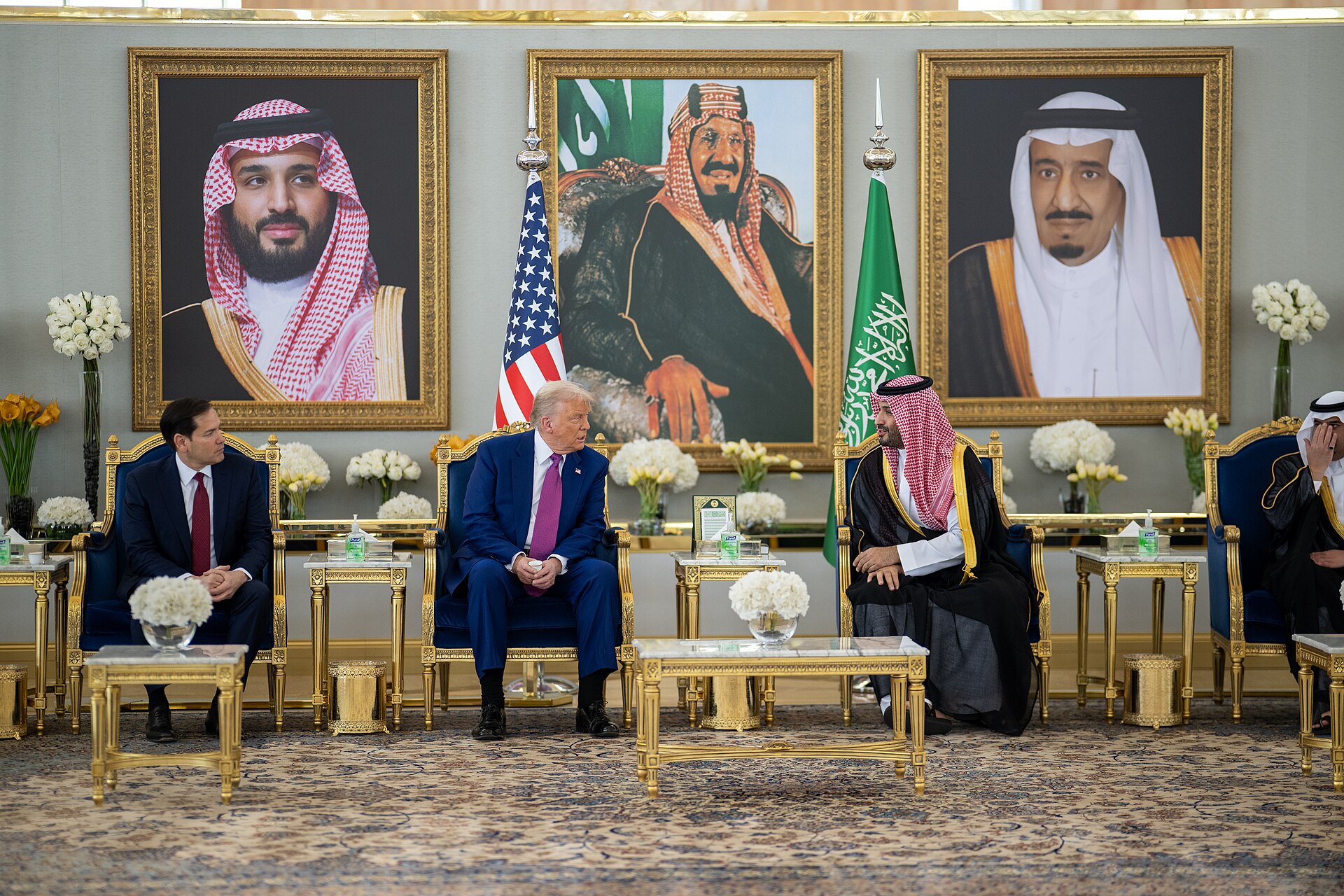
Trump needs three things from MBS, and all of them are things only Riyadh can provide. The first is the stage itself — the Investment Forum as political theatre, the handshake photographs, the billion-dollar announcements that give the Riyadh stop a domestic headline before the harder conversations in Beijing. A president who promised to end the war in “24 hours” and is now entering its third month needs a visual that projects momentum, and a signing ceremony in the Saudi capital delivers that more convincingly than a bilateral readout from the Zhongnanhai compound ever could.
The Middle East briefing 3,000+ readers start their day with.
One email. Every weekday morning. Free.
The second is oil market management. Saudi production collapsed from 10.4 million barrels per day in February to 7.25 million in March — a 30 percent drop that the IEA called “the largest disruption on record.” Yanbu, the Red Sea terminal fed by the East-West Pipeline, is operating at a ceiling of 4 to 5.9 million barrels per day against a pipeline design capacity of 7 million, leaving a structural gap of at least 1.1 million barrels per day that no amount of infrastructure improvisation can close. Trump arrives into a market where Brent dropped from $116.55 on the day Iran launched the PGSA to $100.54 three days later — a $16 collapse that reflected not relief but the market’s grim realisation that the PGSA might be a paper tiger unable to actually collect the tolls it announced, meaning the real price discovery hasn’t happened yet.
The third is what Trump cannot say publicly: he needs Saudi acquiescence to whatever deal framework emerges from the Trump-Xi summit on May 14-15, even though Riyadh has had no input into its terms. The one-page MOU leaked to Axios on May 6 — a 14-point framework proposing an end to hostilities and a 30-day negotiation window on Hormuz, nuclear limits, and sanctions — was negotiated by Steve Witkoff and Jared Kushner with Iranian intermediaries through Pakistani channels. Saudi Arabia was not consulted. As the Atlantic Council noted with clinical understatement, “the GCC states were not parties to the Islamabad talks that collapsed on April 12, and they do not appear to have been formally consulted at the time.”
Xi’s Hormuz Problem — and Why Beijing Won’t Solve It for Free
China’s interest in the three-day window is narrower than Washington’s and therefore more achievable — Beijing needs Hormuz functional, not Iran disarmed. Approximately 40 percent of China’s oil imports transit the Middle East, CNPC and Sinopec hold contracted offtake of 8 million tonnes per annum from Qatar’s North Field plus 5 percent equity in North Field East, and every day the strait remains closed is a day Xi’s domestic energy security deteriorates in ways that make the tariff agenda look trivial. When Wang Yi met Araghchi in Beijing on May 6 and called for “an immediate end to hostilities” and “a prompt resumption of shipping traffic through the Strait of Hormuz,” he was speaking the language of Chinese self-interest dressed in diplomatic neutrality.
The problem is that Wang Yi got nothing concrete in return. Araghchi’s official readout of the meeting, published through Iran’s foreign ministry Telegram channel, omitted any commitment to reopen the strait — the single point that mattered most to Beijing. China’s hold over Iran is real but limited: it is Iran’s largest remaining oil customer, it operates the yuan-denominated payment architecture through Kunlun Bank that keeps Iranian crude flowing outside SWIFT, and it has the commercial relationship to make sanctions-proofing viable. What it lacks is the willingness to use that hold coercively, because doing so would shatter the “partnership without conditions” narrative that anchors Beijing’s Middle East positioning against Washington’s.
Xi arrives in Beijing on May 14 needing to show Trump that Chinese pressure on Iran can deliver what American bombing could not — a reopened strait. But Xi also arrives needing to show his own domestic audience that the summit produced concrete economic deliverables: Boeing orders, agricultural purchases, a “Board of Trade” framework for non-sensitive sectors, and limited tariff adjustments. CNBC reported on May 8 that “Iran focus at the Trump-Xi summit may delay progress on tariffs and rare earths,” which is the polite way of saying that the war Trump started is eating the trade agenda Xi came for. The clock only Xi controls is the one that determines whether Beijing’s Hormuz pressure is performative or operational — and three days is not enough time to find out.
The PGSA Clock
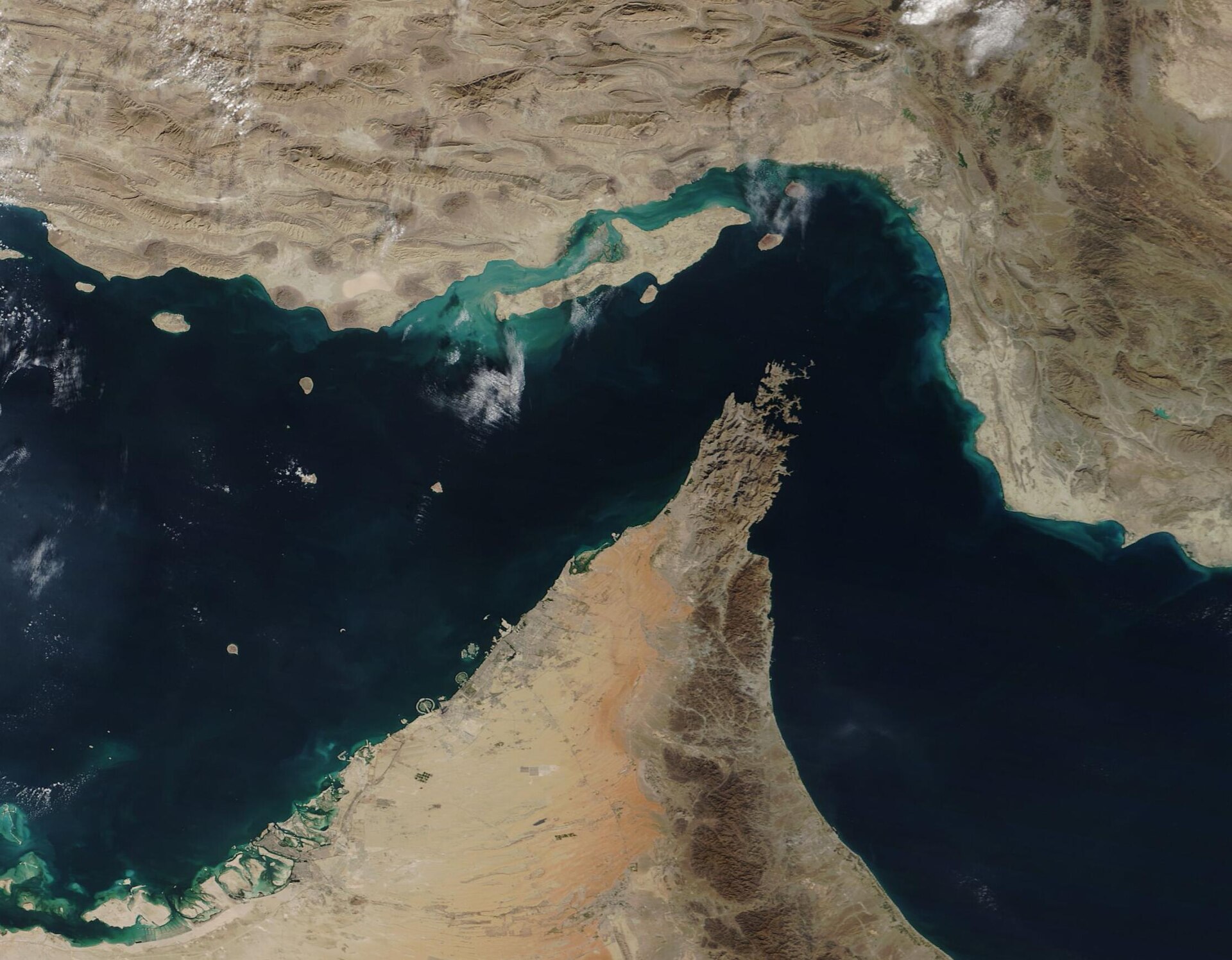
While diplomats negotiate frameworks and presidents stage investment forums, Iran is building an institution. The Persian Gulf Strait Authority, launched on May 5 as a formally constituted government body, requires every transiting vessel to submit a “Vessel Information Declaration” — a 40-plus-question application covering cargo type, crew composition, ownership structure, and insurance details — to an IRGC-linked bureaucracy and pay tolls that have been quoted at up to $2 million per transit, settled in Chinese yuan. The PGSA is not a negotiating position; it is an administrative fait accompli designed to accumulate precedent with every passing day.
The Atlantic Council estimates that if the PGSA toll regime becomes institutionalised, Iran could extract $50 billion per year in transit fees, with 80 to 95 percent of that burden falling on Gulf states — a direct levy on Saudi, Emirati, Kuwaiti, and Qatari oil revenue collected by the country that has been bombing their infrastructure for seventy days. The OFAC advisory issued May 1 warned that payments to Iran for Hormuz passage expose both US and non-US persons to sanctions liability, creating a compliance trap where the act of complying with Iran’s transit authority triggers American sanctions. Lloyd’s List Intelligence recorded the first complete Hormuz standstill on May 7: zero transits, 1,500 commercial vessels anchored, daily throughput collapsed from 138 vessels to single digits.
The institutional clock matters more than the diplomatic one. Shipping insurers and flag-state registries typically formalise new risk categories within 30 to 60 days of operational reality. The Joint War Committee has already designated the entire Persian Gulf as high-risk under circular JWLA-033, and war-risk premiums have exploded from 0.15 percent of hull value pre-crisis to between 2.5 and 7.5 percent — meaning a VLCC valued at $138 million now costs $10 to $14 million extra per voyage just in insurance. If Lloyd’s and its syndicate members begin treating PGSA compliance as standard operating procedure, the administrative architecture becomes permanent regardless of what any summit produces. That formalisation window opens roughly June 4 and closes around July 4. The three-day diplomatic sequence in Riyadh and Beijing falls five weeks before it.
Why Is Saudi Arabia Excluded from Every Negotiation That Will Decide Its Future?
The structural exclusion of Saudi Arabia from the negotiations that will determine whether Hormuz reopens, whether Iran’s nuclear programme is constrained, and whether the PGSA becomes permanent is not an oversight — it is a design feature of how the three principals (Washington, Beijing, Tehran) have chosen to negotiate. Each of them benefits from keeping Riyadh out of the room, for different reasons, and none of them wants to add a fourth voice that would complicate the bilateral simplicities they prefer.
Washington excludes Riyadh because the Witkoff-Kushner channel operates through Pakistani intermediaries and adding a Gulf Arab voice would multiply the sequencing disputes that already torpedoed the Islamabad talks in April. The US proposal is a bilateral framework — America and Iran, with verification and enforcement to be determined later — and inserting Saudi demands for a comprehensive settlement that addresses proxy networks, Hormuz permanence, and Iranian deterrence would transform a one-page MOU into a multi-party treaty negotiation that Trump has neither the patience nor the diplomatic infrastructure to manage. Beijing excludes Riyadh because China’s influence over Iran depends on a bilateral relationship — oil purchases, yuan settlement, SWIFT avoidance — that would be diluted by introducing a Gulf Arab party with competing commercial interests and an American security guarantee. Tehran excludes Riyadh because Iran’s entire negotiating strategy rests on sequencing Hormuz before nuclear commitments, and Saudi Arabia’s insistence on a comprehensive settlement would blow up that sequencing on day one.
The CSIS assessment captured the deeper irony: “Saudi Arabia previously invested considerable diplomatic efforts in reaching a modus vivendi with Iran because entering a military conflict would invite far greater Iranian retaliation, potentially causing long-lasting damage to the Saudi economy and its reputation as a safe destination for investors and tourists.” That is precisely what happened. And now the country that invested most in avoiding this war is excluded from the negotiations to end it, while the country that started the bombing campaign (Washington), the country that enables Iran’s economy (Beijing), and the country that closed the strait (Tehran) divide the table among themselves.
The GCC states were not parties to the Islamabad talks that collapsed on April 12, and they do not appear to have been formally consulted at the time. This is a significant concern because any deal that does not secure buy-in from the Gulf states risks undermining both their security and their relations with the United States.
Atlantic Council dispatch, May 2026
The Prince Sultan Veto
Saudi Arabia does have one form of power, and it used it the week before Trump’s arrival. When the White House announced “Operation Project Freedom” — a US-led naval and air escort mission to force Hormuz open — Riyadh denied the use of Prince Sultan Airbase, the sprawling facility southeast of the capital that maintains US fighter aircraft, refuelling tankers, and air defence systems. Saudi Arabia also closed its airspace to Project Freedom flights, forcing Trump to pause the entire operation. NBC reported that the kingdom “felt Operation Project Freedom was not well thought-out and could result in an escalation with Iran,” and a phone call between Trump and MBS did not resolve the standoff.
The veto was the most consequential Saudi decision of the war — a refusal that stopped at the waterline but redrew the operational geometry of American power projection in the Gulf. Prince Sultan Airbase is the US military’s primary operating hub in Saudi Arabia, and without it, CENTCOM’s ability to sustain simultaneous air operations over Iran and the Hormuz approaches drops to whatever can be staged from Al Udeid in Qatar, Al Dhafra in the UAE, and carrier decks in the Arabian Sea. The veto did not close the base to routine US operations — Saudi sources told AFP that regular access continued — but it demonstrated that Riyadh retains the ability to make American military options more expensive and slower, even if it cannot shape the diplomatic outcome those operations are meant to support.
The timing matters as much as the substance. Saudi Arabia exercised its veto on May 7, six days before Trump’s Investment Forum arrival, at the precise moment it needed maximum negotiating weight over a president who was about to land in Riyadh expecting a $600 billion celebration. The message was legible: we will be your investment partner, your defence customer, and your regional anchor, but we will not be your aircraft carrier without a voice in the war being fought from our territory. Whether Trump received that message or simply routed around it by pausing Project Freedom and moving on to Beijing will become clearer in the 72-hour window itself.
What Happens Now That Iran Ignored the Rubio Deadline?
Secretary of State Marco Rubio told reporters on May 8 that “we expect an Iranian response to President Trump’s proposal by the end of today.” Iran’s Foreign Ministry spokesman Esmail Baghaei responded with a sentence that deserves to be framed: “We are not bound by their deadlines or timelines very much.” Tehran did not provide a formal response by Friday. It did not provide one over the weekend. As of Trump’s departure for Riyadh, Iran’s position was that the US proposal was “under review” — a formulation that simultaneously rejects the deadline, preserves the negotiating channel, and buys time for the PGSA to accumulate another week of institutional precedent.
Iran’s actual counter-proposal, delivered through intermediaries, is a 14-point document that would end the war within 30 days, withdraw the US naval blockade, release frozen Iranian assets, require American reparations, lift all sanctions, and — the critical clause — create a new mechanism for Hormuz governance that amounts to Iranian sovereignty recognition over the strait. Ghalibaf, the Parliament Speaker and former IRGC Aerospace Force commander, posted his assessment of the Axios “closing in” report in English on social media: “Operation Trust Me Bro failed.” The mockery was aimed at Washington, but the message was meant for Tehran’s own hardliners — confirmation that the legislative branch regards any deal short of full American withdrawal and reparations as capitulation.
The Rubio deadline’s failure reshapes the three-day window in a specific way: Trump arrives in Riyadh on May 13 without a deal framework to display, which turns the Investment Forum into political theatre without a strategic anchor. The pressure then shifts entirely to the Beijing summit on May 14-15, where Trump must convince Xi that Chinese pressure on Iran can deliver what American deadlines could not — and Xi must decide whether extracting a Hormuz commitment from Tehran is worth burning the “partnership without conditions” positioning that makes China credible in the Middle East. If Beijing produces nothing, the PGSA’s 30-day formalisation clock runs without interruption, and the zero-transit regime becomes the new baseline.
The GCC That Wasn’t
The diplomatic exclusion of Saudi Arabia would matter less if the Gulf Cooperation Council functioned as the collective security organisation its name implies. It does not. The Carnegie Endowment’s February 2026 assessment was blunt: the GCC “has never operated as a unified actor” on Iran and is unlikely to do so in the post-conflict period, whatever that looks like. The UAE’s departure from OPEC on May 1 — timed to coincide with the April 28 GCC extraordinary summit in Jeddah that MBS was chairing — was a public repudiation of Saudi-led energy coordination at the moment when coordination mattered most.
The numbers tell the story of divergence. ADNOC expanded its production capacity to 4 million barrels per day with a target of 5 million by 2027, and The Diplomat estimated the annual opportunity cost of OPEC quota constraints to the UAE at $50 to $70 billion — a figure that made staying inside the Saudi-led cartel architecture economically irrational once the war removed the political incentive to maintain Gulf solidarity. Anwar Gargash, the UAE’s diplomatic adviser, publicly described the GCC’s collective response to Iranian attacks as the “weakest historically” — a statement that was simultaneously an accusation against Saudi leadership and a justification for Abu Dhabi’s unilateral departure. The Carnegie assessment proposed that the GCC “could work to deliberately leverage its members’ different worldviews,” with “the UAE’s edge in military technology and Oman’s diplomatic positioning as complementary assets,” but this reads like an architectural blueprint for a building whose tenants have already moved out.
| State | Position on Iran Deal | Relationship to Negotiations | Key Constraint |
|---|---|---|---|
| Saudi Arabia | Comprehensive settlement — proxy networks + Hormuz permanence | Not consulted; hosting Trump May 13 | Excluded from Witkoff channel and Beijing summit |
| UAE | Escalation until “decisive defeat” (Times of Israel) | Not consulted; exited OPEC May 1 | Iron Dome deployed; wants reparations + security guarantees |
| Qatar | De-escalation; protecting North Field LNG | Indirect — Al Udeid hosts CENTCOM | 8 MTPA contracted to China; needs Hormuz open |
| Oman | Mediation — traditional Iran interlocutor | Back-channel role; not at main table | Rejected Hormuz toll concept (Transport Minister Al Maawali) |
| Kuwait | Solidarity with Saudi; infrastructure hit by IRGC | Not consulted | KPC HQ struck; desalination plants targeted |
| Bahrain | Hawkish — hosting Fifth Fleet, airspace closed since Feb 28 | Not consulted | Bapco storage struck; sole international access was King Fahd Causeway |
The table amounts to a roll call of countries whose infrastructure was bombed by Iran, whose economies depend on Hormuz, and whose governments have no formal input into the framework that will determine whether the strait reopens. The Times of Israel reported that “Gulf allies” are “privately pushing Trump to keep up war until Iran decisively defeated” — but “Gulf allies” in this context means primarily the UAE and Bahrain, not Saudi Arabia, whose preferred outcome the Atlantic Council described as “a settlement comprehensive enough to curtail Iranian support for armed proxies and resolve the Strait of Hormuz question on a lasting basis — but not one that destabilises Iran to the point of collapse.” That formulation — comprehensive but not destabilising — is precisely the outcome no bilateral US-Iran or US-China negotiation is structured to deliver.
Iran has sought to preempt that hawkish Gulf coalition by targeting Bahrain directly: Tehran’s parliamentary security commission warned Manama that backing the US-drafted UNSC Hormuz resolution would result in the strait being permanently closed to Bahraini vessels. The threat, timed four days before Trump’s Riyadh arrival, uses the hosting of NSA Bahrain as a liability rather than an asset — an attempt to fracture the Gulf states’ unified posture before the summit. The full context of Iran’s selective denial strategy and the Azizi warning is here.
Can Seventy-Two Hours Produce a Deal — or Just Another Deadline?
The structural problem with the May 13-15 window is that the three principals want incompatible things and the party with the most at stake has no mechanism to enforce its preferences. The US needs Hormuz open before the Beijing summit so Trump arrives with momentum — but Iran’s sequencing demand puts Hormuz first and nuclear commitments second, which means Washington must concede on ordering before it can claim a win. China needs functional shipping to protect its import lines and Qatar LNG equity — but extracting that from Iran requires coercive pressure Beijing refuses to apply because the “partnership without conditions” brand is worth more to Xi’s Middle East strategy than any single transit agreement. Iran needs the US naval blockade lifted, its frozen assets released, and the PGSA institutionalised as a permanent revenue mechanism — but accepting the one-page MOU framework means submitting to a 30-day clock that gives Washington the initiative on nuclear verification, which the IRGC’s parallel command structure is structurally incapable of accepting.
When Trump’s summit with Xi in Beijing convenes on May 14, the Hormuz framework that emerges will be set by the two parties in the room — a dynamic analysed in detail here — with Riyadh holding no vote on an outcome that determines the fiscal arithmetic of its reconstruction.
Saudi Arabia’s preferred outcome — comprehensive, permanent, covering proxies and Hormuz and nuclear — is not on any negotiating table. The Witkoff-Kushner channel is bilateral. The Beijing summit is bilateral. The PGSA is unilateral. Every format currently in play is designed to produce a narrow output (ceasefire, Hormuz transit framework, nuclear moratorium) that leaves the broader regional architecture unresolved. The Atlantic Council warning about Gulf exclusion producing deals that undermine both Gulf security and US-Gulf relations stands unanswered — but warning and influence are different things, and Riyadh has the first without the second.
| Party | Primary Need | Blocking Constraint | Leverage Instrument |
|---|---|---|---|
| United States | Hormuz reopened + 12-15 year nuclear moratorium | Iran demands Hormuz sequenced before nuclear | Naval blockade (effective April 13); bombing campaign |
| China | Functional shipping through Hormuz | Unwilling to coerce Iran; needs “neutral mediator” brand | 40% of Iran’s oil customer base; yuan payment architecture |
| Iran | Blockade lifted; assets unfrozen; PGSA institutionalised | IRGC parallel command rejects nuclear moratorium | PGSA administrative control; 1,500 vessels as hostages |
| Saudi Arabia | Comprehensive settlement — proxies + Hormuz + nuclear | No seat at any table; influence is structural and negative | Prince Sultan Airbase denial; hosting legitimacy; oil market coordination |
The mine-clearance timeline adds a physical constraint that no amount of diplomatic choreography can overcome. Even if a deal is signed on May 15 — the most optimistic scenario, which would require Iran to reverse the PGSA, accept a nuclear moratorium framework, and submit to verification, none of which the IRGC command structure has shown any capacity to authorise — the physical reopening of Hormuz would take 51 days minimum based on the 1991 Kuwait benchmark, with only two Avenger-class mine countermeasures ships currently in theatre (four were decommissioned from Bahrain in September 2025). A framework signed May 15 means the strait cannot physically reopen before mid-July. The PGSA’s insurance-formalisation window opens June 4. The Hajj pilgrimage is already under way. The talking points were written in Beijing before Riyadh got the memo, and the 72-hour window may produce another deadline rather than a deal — but every deadline that passes without a framework is another day the PGSA hardens into permanent architecture.
FAQ
What is the Persian Gulf Strait Authority and when was it created?
The PGSA was formally launched on May 5, 2026, as an Iranian government body requiring all vessels transiting the Strait of Hormuz to submit a 40-plus-question “Vessel Information Declaration” form and pay tolls of up to $2 million per transit, settled in Chinese yuan through IRGC-linked accounts. The US Treasury’s OFAC issued an advisory on May 1 warning that payments to the PGSA expose both US and non-US persons to sanctions liability, creating a dual compliance trap where vessels face Iranian administrative penalties for non-compliance and American sanctions for compliance. By May 7, Lloyd’s List Intelligence recorded the first complete Hormuz standstill — zero transits — with 1,500 commercial vessels anchored.
Why did Saudi Arabia block Operation Project Freedom?
Riyadh denied the US military access to Prince Sultan Airbase and Saudi airspace for the Hormuz escort mission in early May after concluding, according to NBC, that the operation was “not well thought-out and could result in an escalation with Iran.” The decision was strategic rather than ideological — Saudi Arabia continues to host routine US military operations from the base and remains a $142 billion defence customer — but it reflected MBS’s calculation that being used as a launchpad for an American forced transit of Hormuz would make Saudi oil infrastructure the primary Iranian retaliation target without giving Riyadh any control over the escalation ladder. A direct phone call between Trump and MBS failed to reverse the decision.
How long would it take to physically reopen the Strait of Hormuz even with a deal?
Mine clearance alone would require a minimum of 51 days based on the 1991 Kuwait benchmark, and the US has only two Avenger-class mine countermeasures ships in theatre after decommissioning four from Bahrain in September 2025. Beyond mines, the physical reopening requires IRGC naval forces to stand down from the “danger zone” designation covering standard shipping lanes (imposed February 28), insurers to reduce war-risk premiums from their current 2.5 to 7.5 percent of hull value back to pre-crisis levels of 0.15 percent, and flag-state registries to rescind the advisory notices that currently deter commercial traffic. Even under the most optimistic diplomatic timeline — a framework signed May 15 — the strait would not be physically functional before mid-July 2026.
What is the $142 billion Saudi defence package?
Announced May 13 during the US-Saudi Investment Forum, the package includes the first authorised sale of F-35A stealth fighters to Saudi Arabia (two squadrons, approximately 24 jets, delivery not before 2029), 730 PAC-3 MSE interceptor missiles ($9 billion, delivery in 18-plus months), THAAD system components supplementing the four batteries deployed in March 2026, 20 C-130J-30 Super Hercules transport aircraft and 5 KC-130J aerial refuelling tankers ($6.7 billion), nearly 300 tanks, and classified maritime security and information warfare systems. The package requires Saudi Arabia’s designation as a major non-NATO ally — a status that carries arms-transfer privileges but not the mutual defence obligations MBS would prefer given the war currently being fought on Saudi territory.
Could the UAE’s OPEC exit affect the outcome of the three-day window?
The UAE’s departure from OPEC, effective May 1, removes the second-largest Gulf producer from the Saudi-led output coordination framework at a moment when coordinated supply management is the primary tool available to stabilise a market where an estimated several million barrels per day of Gulf production was shut in during April alone. ADNOC’s trajectory toward 5 million barrels per day by 2027 means Abu Dhabi will be adding supply into a market where Saudi Arabia is simultaneously trying to use production restraint as a bargaining tool. The fracture also signals to Beijing and Washington that the GCC cannot deliver a unified energy-security guarantee as part of any Hormuz deal, which reduces the bloc’s value as a negotiating partner and reinforces the bilateral formats that exclude it.
The diplomatic preparation behind that forum stage — Faisal’s Ankara visit, his calls to Lavrov and Abdelatty, and the nine-day pre-visit multilateral sequence — is documented in Saudi Arabia’s pre-visit multilateral architecture. The broader question of why the STEP grouping has succeeded where the GCC failed is examined in GCC Was a Club With No Sellers. STEP Fixed That.