{“content”: “
RIYADH u2014 Four days before Donald Trump lands in the Saudi capital with a $142 billion arms deal in his briefcase and Elon Musk and Sam Altman in his entourage, Prince Faisal bin Farhan picked up a phone and called Sergey Lavrov. Then he called Egypt’s Badr Abdelatty. Both calls, on the same Saturday, May 9, were explicitly framed around Hormuz u2014 and both produced public readouts endorsing a Saudi de-escalation framework that uses Riyadh’s vocabulary, not Washington’s.
n
The TASS readout of the Lavrov call called for “restoring the navigation regime as it used to be before late February” u2014 language the US State Department has not used, and would not use, because it concedes that the pre-war regime included Iranian transit authority. By the time Trump steps off Air Force One on May 13, the Hormuz framing he is being asked to bless will already carry a Russian endorsement. Saudi Arabia is not preparing to receive an American visit. Saudi Arabia is preparing the script the visit will be read from.
n
The Middle East briefing 3,000+ readers start their day with.
One email. Every weekday morning. Free.
Table of Contents
n
- n
- The Two Calls That Set the Table
- Why Did Saudi Arabia Call Russia First?
- Egypt, Ankara, and the Quartet Already Built
- The Vocabulary War Behind “Restoring the Navigation Regime”
- What Did Project Freedom Actually Prove About Saudi Power?
- The Pre-Visit Ledger
- What Trump Walks Into on May 13
- The Oil-Price Paradox at the Heart of the $600 Billion Pledge
- Frequently Asked Questions
- n
n
n
n
n
n
n
n
n
n
n
n
n
n
The Two Calls That Set the Table
n
The May 9 sequence was tight, deliberate, and choreographed for a Trump arrival on May 13. Faisal phoned Lavrov first; the Russian Foreign Ministry readout u2014 pushed through TASS within hours u2014 said both ministers called for “preventing further escalation” and for resuming “an all-round long-term normalization of relations between Iran and Arab monarchies.” That is not Washington’s preferred phrasing. It is closer to Tehran’s.
n
The Egyptian call followed the same day, with an Asharq Al-Awsat readout citing “Saudi-Egyptian coordination” on regional developments. Cairo and Riyadh have been in lockstep on the post-war architecture since the April 28 Jeddah GCC summit, where UAE President Mohammed bin Zayed sent his foreign minister rather than appear in person u2014 a snub Anwar Gargash later softened by calling the GCC’s war response “the weakest in its history.” The Saudi-Egyptian phone call, three days before Trump’s wheels-down, served notice that the diplomatic record had a Cairo signature on it before Washington arrived to add its own.
n
Three days earlier, on May 6, Faisal had been in Ankara at the Turkish-Saudi Coordination Council, meeting Recep Tayyip Erdogan and Hakan Fidan, signing a bilateral visa exemption, and framing the entire session u2014 per Al-Monitor u2014 around “stepping up coordination amid the Iran war.” Fidan, on the same trip, told reporters the talks would “underscore the importance of strengthening regional ownership to ensure lasting security and stability in the region.” Translation, in plain English: regional ownership means the states that border the Gulf, not the one that owns the carriers.
n
By May 9, Faisal had filed three multilateral entries into the diplomatic record before Trump even boarded the plane u2014 Ankara on the 6th, Lavrov and Abdelatty on the 9th. None of them had a US footprint. All of them concerned Hormuz.
n
Why Did Saudi Arabia Call Russia First?
n
Russia is the one outside actor that can kill any US-drafted Hormuz resolution at the Security Council, and it has already done so once. On April 7, when the Bahrain-led, US-backed UNSC resolution came to a vote, eleven of fifteen members supported it. Russia and China vetoed. Russian Ambassador Vasily Nebenzia explained the veto by accusing the draft of “presenting Iranian actions as the sole source of regional tensions while illegal attacks by the United States and Israel were not mentioned at all.” Chinese Ambassador Fu Cong said the draft “failed to capture the root causes and the full picture of the conflict.”
n
A second resolution is now reportedly in US hands, and Washington needs Moscow not to use the veto a second time. The fastest way to make that happen is to get Russia inside the framing u2014 to have Lavrov publicly co-sign a Hormuz formula before the resolution language is finalized. By calling Lavrov on May 9, Faisal handed Russia the chance to be a co-author of the de-escalation script rather than a spoiler. Russia took it. Iran, meanwhile, escalated its coercion of smaller Gulf states co-sponsoring the resolution: Tehran’s parliamentary security commission warned Bahrain that backing a new UNSC Hormuz draft would result in the strait being closed to Bahraini vessels “forever” — a direct threat to NSA Bahrain and the Fifth Fleet base underpinning the US blockade. Iran’s selective denial doctrine and the Azizi warning, timed to Trump’s Riyadh arrival, are analyzed in full here.
n
Lavrov’s readout went further than was strictly necessary for a courtesy call. He talked about “preventing a return to escalation” and “ongoing diplomatic contacts” aimed at “a sustainable long-term agreement on all aspects of resolving the crisis as soon as possible.” Russia does not normally volunteer that kind of granularity unless it is being asked to. Saudi Arabia asked. Russia answered. The line about “restoring the navigation regime as it used to be before late February” was the operative concession u2014 Moscow signing onto a temporal anchor that pre-dates the war, which is a frame Iran will accept and the US has not wanted to.
n
The pattern echoes Riyadh’s February 2025 hosting of the first direct US-Russia talks since Ukraine. Saudi Arabia has done this before: act as the venue and the convening authority, then pre-position itself before Washington arrives. The difference now is that Saudi Arabia is not just hosting the diplomacy. It is writing it, and the May 13 forum is the read-through.
n
Egypt, Ankara, and the Quartet Already Built
n
The Egyptian call closed a circuit that has been forming for months. The IISS, in its May 2026 online analysis, identified what it called “a new geopolitical bloc” u2014 Egypt, Pakistan, Saudi Arabia, Turkey u2014 “poised to tackle shared security concerns together” in the wake of the Iran war. The four states have already conducted joint exercises: Saudi-led “Spears of Victory,” the Turkish-Pakistani “Atatu00fcrk-XIII” and “Jinnah-XIII,” the Egyptian-Pakistani “Thunder 2” special-forces drill, and PATS 2026 with all four. Riyadh, the IISS wrote, has “realised that it cannot rely solely on US protection.”
n
That assessment did not come out of thin air. Four foreign ministers, three meetings, and one architecture in Ankara on May 6 made the quartet operational in everything but the formal communiquu00e9. The visa exemption signed there was the signal u2014 bureaucratic pipework that lets defense personnel and government officials move between Riyadh, Ankara, Cairo, and Islamabad without the friction the old GCC framework imposes. The military exercises were the muscle. The Faisal-Abdelatty call on May 9 was the diplomatic confirmation u2014 Egypt locked into the same posture as the rest of the bloc, three days before Trump landed.
n
The quartet is not an alternative to the US relationship. It is a hedge built into the same week as the largest defense procurement deal in American history. That is the design. Saudi Arabia wrote the regional-framework playbook originally for Iran to use against the US; now it is using the same playbook against the assumption that the US is the only architecture in the room.
n
Egypt is the linchpin because Cairo brings the Arab League’s political mass and the canal at Suez. Pakistan brings nuclear weapons and an Afghanistan-facing border. Turkey brings NATO membership and Bayraktar-class attritable airpower already deployed on Saudi pads. Saudi Arabia brings the money and the holy sites.
n
None of them, individually, can replace the US security guarantee u2014 and none of them is trying to. What they are doing is building a structure in which the US guarantee becomes one input among several, rather than the only one.
n
The Vocabulary War Behind “Restoring the Navigation Regime”
n
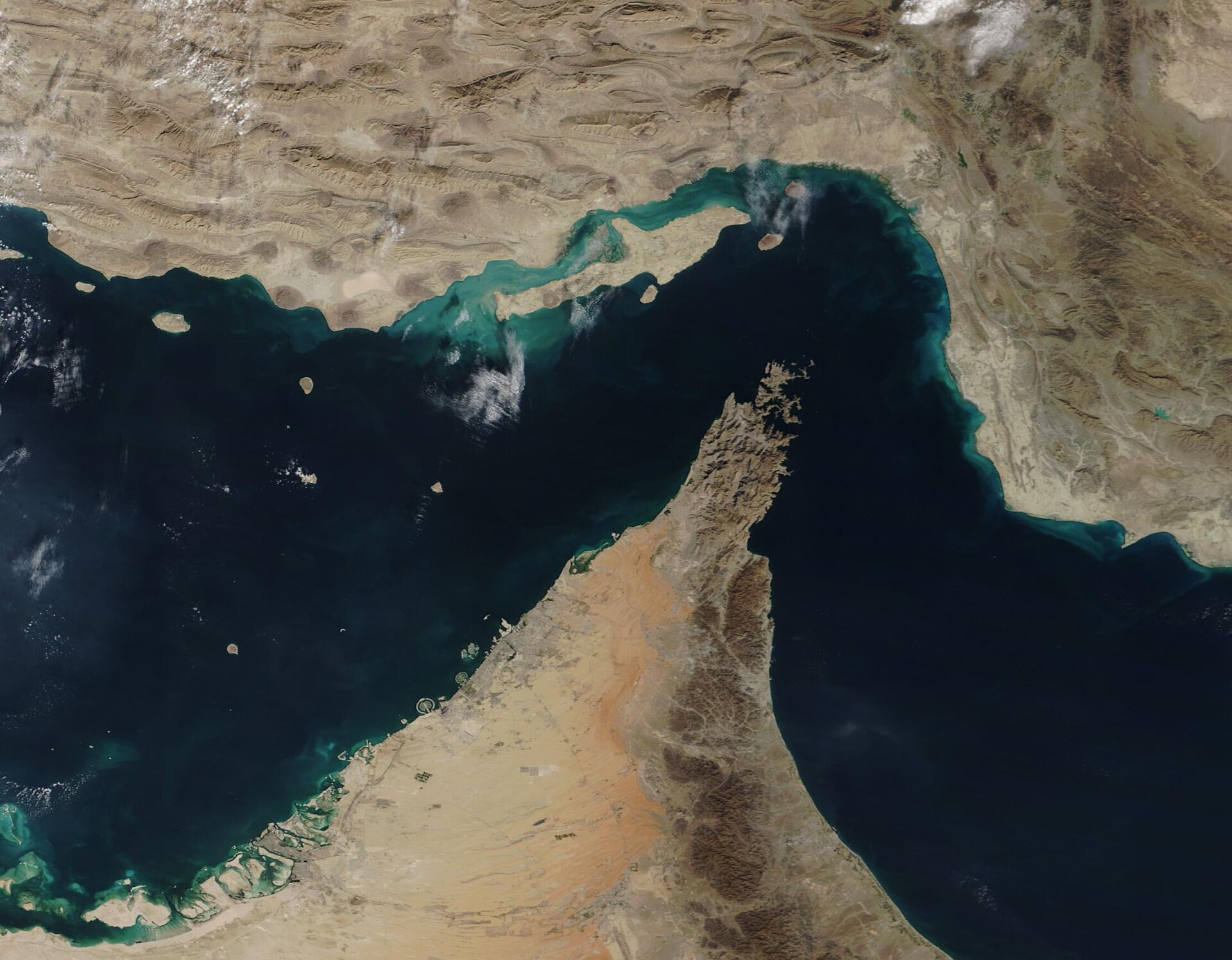
Three competing phrases now sit on the table for what Hormuz is supposed to look like after the war ends. The US and CENTCOM use “freedom of navigation” u2014 language that implies an unencumbered international right and frames Iran’s actions as encroachment. Iran uses “sovereignty over the Strait,” with the parliament advancing a 12-article Hormuz sovereignty law that would treat transit as a privilege Tehran grants. Saudi Arabia, via the Lavrov readout, has now lodged a third frame: “restoring the navigation regime as it used to be before late February.”
n
That formulation is the most consequential single line of the entire May 9 sequence, because it pre-commits both Saudi Arabia and Russia to a regime that existed before the war u2014 a regime in which the IRGC monitored Hormuz transits, Iran charged informal fees on certain cargoes, and the US Fifth Fleet operated openly out of Bahrain. It is not a US victory frame. It is not an Iranian victory frame. It is a Saudi compromise frame, and getting Lavrov to endorse it on the record before Trump arrives is what makes the May 13 summit’s announcements operate within Saudi Arabia’s syntax instead of Washington’s.
n
| Frame | User | Implicit Concession | Pre-Trump Status |
|---|---|---|---|
| “Freedom of navigation” | US, CENTCOM | Iran has no transit authority | Awaiting summit endorsement |
| “Sovereignty over the Strait” | Iran (12-article law) | Transit is a privilege Tehran grants | Domestic legislation in motion |
| “Restoring the navigation regime as it used to be before late February” | Saudi Arabia, endorsed by Russia May 9 | Pre-war Iranian transit role accepted | Already on the diplomatic record |
n
n
Whichever frame the May 13 summit communiquu00e9 picks up, it now has to argue against an existing record that Saudi Arabia and Russia have jointly endorsed. That is the function of the call. Trump can announce whatever he likes from the Diriyah forum stage; the communiquu00e9 his Saudi hosts will sign onto has already been seeded with vocabulary that constrains what the announcement can mean.
n
n
What Did Project Freedom Actually Prove About Saudi Power?
n
Project Freedom proved that Saudi Arabia can publicly halt a named presidential military operation, extract two presidential phone calls, and dictate the rules of engagement under which the operation resumes u2014 all within roughly 72 hours. CENTCOM launched the Hormuz escort operation on May 4 without pre-notifying the Gulf allies whose airspace and bases the operation required. Saudi Arabia denied basing access within 24 to 48 hours, refusing to allow CENTCOM aircraft to fly from Prince Sultan Airbase southeast of Riyadh, or through Saudi airspace, to support the operation. Kuwait moved in parallel, suspending its own US base and airspace access.
n
NBC News, citing US officials, reported that “Saudis feared Trump’s Project Freedom would spur Iran to attack” and that the first Trump-MBS phone call “did not resolve the issue.” Trump paused the operation. A second call followed. After the second call, Riyadh and Kuwait restored access on terms that included a US commitment to joint US-GCC retaliation against any IRGC aggression linked to Project Freedom. The whole cycle ran in roughly 72 hours.
n
That is the new physics of the relationship. The operational reach of the veto, as Riyadh’s veto stopping at the waterline made clear, has limits u2014 Saudi Arabia could not block the destroyers themselves, only the air support u2014 but the political reach is now demonstrated, public, and on the record.
n
The May 13 summit will be performed against that backdrop. Trump is flying to a partner that, four days earlier, made the most powerful military in the world reschedule a presidentially-announced operation. The forum stage and the $142 billion arms deal are the choreography. The choreography is being filmed inside a building that just proved it could lock the door from the inside.
n
The 72-hour sequence that defines what “Saudi Arabia can stop a US operation” actually means in practice — and how Iran immediately exploited the revealed red line — is reconstructed in detail in the 72-hour veto that mapped MBS’s red line.
The Pre-Visit Ledger
n
Read as a sequence, the diplomatic record Saudi Arabia has built between May 4 and May 9 is already more substantial than anything the May 13 ceremony will produce. Each of these dates is a public, time-stamped entry u2014 wire copy, ministerial readouts, treaty paperwork u2014 and each one independently constrains what the May 13 summit can claim to be initiating. The cumulative effect is a calendar that runs ahead of Trump’s own.
n
| Date | Event | Counterparty | What It Locked In |
|---|---|---|---|
| May 4 | Project Freedom launched without consultation | CENTCOM | Triggering event |
| May 4u20135 | Saudi/Kuwait suspend base + airspace access | Pentagon | Veto demonstrated |
| May 5 | First Trump-MBS call fails to resolve | White House | Riyadh holds the line |
| May 6 | Faisal in Ankara u2014 Erdogan, Fidan, visa pact | Turkey | Quartet operationalized |
| May 7u20138 | Second Trump-MBS call; access restored on terms | White House | Joint US-GCC ROE concession |
| May 9 | Faisal-Lavrov call: pre-Feb regime endorsed | Russia | UNSC veto holder co-signed |
| May 9 | Faisal-Abdelatty call: regional coordination | Egypt | Arab League political cover |
| May 10 | Aramco Q1 results (~$29B forecast) | Markets | Fiscal narrative reset |
| May 13 | Trump arrival, $142B deal, $600B pledge | USA | The ceremony |
n
n
By the time Trump reads his prepared remarks, the diplomatic structure those remarks will sit inside has already been built, signed, and publicly endorsed by Russia, Egypt, and Turkey. The summit becomes a ratification event for choices Saudi Arabia made in the preceding nine days, not the originating event for choices Saudi Arabia is being asked to accept.
n
That is what a successful pre-visit looks like when the visiting party is the more powerful one. You do not bargain at the table; you bargain before the table is set, with everyone the table’s most powerful guest will need afterwards. Saudi Arabia did that. The May 13 stage is the receipt.
n
The contrast with how Saudi diplomacy used to work u2014 wait for the American visit, take the deliverables, host the photographs, hope for the best u2014 is the entire point. Chatham House described Riyadh’s posture in March 2025 as “managing multipolarity,” engaging the US, Russia, China, and regional blocs simultaneously rather than choosing among them. The May 4-9 sequence is what managing multipolarity looks like when it stops being academic and starts being operational, with named ministers, dated calls, and public readouts that constrain the next set of moves before they are made.
n
What Trump Walks Into on May 13
n
The forum’s guest list reads like a Davos invitation crossed with a Pentagon procurement office: Musk, Sam Altman, BlackRock’s Larry Fink, Blackstone’s Stephen Schwarzman, Nvidia’s Jensen Huang. The deliverables are designed to be enormous. A $142 billion arms package u2014 described by CBS News as “the largest defense cooperation agreement” in US history. A $600 billion Saudi investment commitment to the United States over four years. Saudi Arabia designated a Major Non-NATO Ally and a Strategic Defense Agreement signed on the same day.
n
The Saudi side will perform receipt of all of it. The Saudi side will also be operating inside a diplomatic perimeter it has spent the previous nine days constructing u2014 one that has Russian and Egyptian fingerprints on the Hormuz framing, Turkish and Pakistani signatures on the regional-security architecture, and a freshly-demonstrated veto over US base access still on the table as a reminder of what the relationship looks like when it disagrees.
n
The seventy-two hours in Riyadh earlier in the week were the rehearsal. The May 13 ceremony is the dress performance. The script is already on the prompter, and Faisal’s phone calls were the people who wrote it walking off the page.
n
n
Saudi Arabia is likely to continue to diversify its international partnerships in the aftermath of the conflict, adjusting to long-term divergences from U.S. regional interests and structural limits to U.S. security provisions. u2014 New Lines Institute, 2026
n
n
The New Lines framing matters because it names what Riyadh is doing without melodrama. “Diversification” is the polite word; what the May 9 calls demonstrate is that diversification is now operational, time-stamped, and on the wire-service record. Trump is not arriving in a country that needs his visit to validate its regional standing. He is arriving in a country that has just used its regional standing to set the terms of his visit.
n
The Oil-Price Paradox at the Heart of the $600 Billion Pledge
n
The $600 billion Saudi investment pledge to the US has a structural problem that Riyadh has not advertised and Washington does not seem to be discussing. Saudi Arabia’s Q1 2026 budget deficit was $33.6 billion u2014 the largest in eight years. Saudi production in March 2026, per the IEA, was 7.25 million barrels per day, against a pre-war level of 10.4 million. The deficit is a function of the war and of the production crash that came with it.
n
To meet a $600 billion outbound capital commitment over four years, Saudi Arabia needs sustained high oil prices. Trump has spent his term publicly pressuring OPEC and Saudi Arabia for lower oil prices. The arithmetic does not close u2014 and the people doing it know it does not close. Aramco’s Q1 2026 results, due May 10, are forecast at roughly $29 billion in net profit despite the production drop, which means the market is paying war prices for war volumes. That is the only way the books work, and the moment the war ends and prices fall, the books stop working.
n
That is one reason the Lavrov call matters in oil terms as well as diplomatic ones. A Russian endorsement of the “pre-late-February” navigation regime is a Russian endorsement of returning to a market the OPEC+ producers know how to run together. Russia, sanctioned and excluded from Western capital markets, needs OPEC+ discipline as much as Saudi Arabia does. Riyadh is signaling, in advance of Trump’s arrival, that the post-war price regime will be coordinated with Moscow, not dictated by Washington.
n
The Aramco numbers will land May 10. Trump will land May 13. Between those two events, the entire fiscal premise of the $600 billion pledge becomes legible to anyone willing to read the press release alongside the IEA tables. The $25 crash that kills its own catalyst is the same dynamic, viewed from the other side of the deal: peace would crater the prices that the deal needs to function, which is why the deal’s architects keep the war option visible even as they negotiate the de-escalation.
n
That is the paradox the May 13 ceremony will perform around without naming. The arms deal and the strategic upgrade are real. The investment pledge is real on paper and conditional on a price regime nobody at the forum will guarantee out loud. Faisal’s call to Lavrov was, among other things, the first public down-payment on the coordination that pledge will need to survive its own announcement.
The complication is that Russia is not simply a participant in the framework Saudi Arabia is building — it is simultaneously supplying Iran with the drone components that have degraded the shipping lanes the framework is meant to reopen. Moscow called Riyadh on May 8 to restore Hormuz navigation while Caspian cargo vessels were loading Shahed-derivative parts for Bandar Anzali: the architecture problem and the arms-supply problem share the same author.
n
n
Frequently Asked Questions
n
What does the phrase “restoring the navigation regime as it used to be before late February” actually concede?
n
The phrase is more consequential for what it rules out than for what it establishes. The US “freedom of navigation” formula is legally incompatible with any Iranian transit role u2014 accepting the “pre-late-February” anchor forecloses it as the settlement language. By contrast, Iran’s 12-article Hormuz sovereignty law treats transit as a privilege Tehran grants; the Saudi formula rejects that too. Getting Russia to endorse this middle position before Trump arrives means any US attempt to insist on a stronger formulation at the May 13 summit would require overturning a joint Russian-Saudi record already on the wire, not just negotiating with Riyadh directly.
n
How does the Faisal-Abdelatty call differ from the Lavrov call in strategic function?
n
The Lavrov call neutralizes Russia as a UNSC veto threat against a future Hormuz resolution. The Abdelatty call brings the Arab League’s political mass behind the Saudi framework u2014 Egypt remains the largest Arab country by population, holds the Suez Canal, and chairs Arab League diplomatic processes. With Cairo locked in, any Iranian attempt to fracture an Arab consensus by appealing to Egypt directly is closed off. Russia neutralizes the Security Council; Egypt neutralizes the regional consensus.
n
Did Project Freedom permanently change the US-Saudi basing relationship?
n
The terms of Project Freedom’s revival included a written US commitment to joint US-GCC retaliation against any IRGC action linked to the operation u2014 a concession the Pentagon has historically resisted because it constrains American escalation discretion. The episode also set a precedent: any future named US military operation in theatre will require pre-clearance from Riyadh and Kuwait, not just consultation after launch. That changes Pentagon planning assumptions for Gulf operations in ways that go well beyond a single Hormuz escort mission.
n
What is the Egypt-Pakistan-Saudi Arabia-Turkey quadrilateral’s practical limit as a security architecture?
n
The quartet’s structural gap is air defense depth. Turkey’s S-400 acquisition bars full NATO interoperability; Pakistan’s air defense is oriented northeast toward India, not west toward the Gulf; Egypt’s S-300VM systems are Soviet-era and not integrated with Saudi THAAD and PAC-3 networks. The quartet produces useful interoperability in ground and special-operations domains, but against a ballistic-missile threat from Iran u2014 the scenario most relevant to the current war u2014 it cannot backstop the US umbrella. The IISS noted Riyadh has “realised that it cannot rely solely on US protection,” but the exercises have yet to demonstrate a collective air-defense architecture that could operate independently of US assets.
n
Why does the timing of the Aramco Q1 results matter relative to Trump’s arrival?
n
Aramco’s Q1 2026 results are forecast at roughly $29 billion in net profit u2014 a figure that arrives May 10, three days before the summit. The number will be read by markets as a signal about the durability of war-time pricing. If the analyst consensus holds and the profit figure is strong despite the production drop, it implicitly validates the continuation of the conditions u2014 strained Hormuz, reduced Saudi output, elevated Brent u2014 that the May 13 summit is nominally trying to end. Saudi Arabia benefits from both outcomes: strong Aramco numbers demonstrate fiscal resilience ahead of the $600 billion pledge announcement, while the underlying logic of those numbers quietly argues against the price collapse that a genuine peace settlement would trigger. That logic ran into a new variable on May 9: the Rainbow Site tritium allegation, timed to the MOU’s deadline, which introduced a parallel weaponisation track into negotiations that the Riyadh summit was hoping to treat as purely a Hormuz and enrichment question.
n”} The IRGC timed its own intervention to the same window: Mousavi’s “missiles locked” declaration on May 9 — 72 hours after the MOU terms were published and four days before Trump’s Riyadh arrival — was designed to foreclose a signed agreement that would have allowed Pezeshkian to claim diplomatic credit on the eve of the summit. The Saudi MFA issued its formal condemnation of the May 10 strikes the following day — two days before Trump’s arrival — in language that carefully avoided naming the IRGC or invoking Article 51, signalling the limits of Riyadh’s public posture even as it hosts the summit.