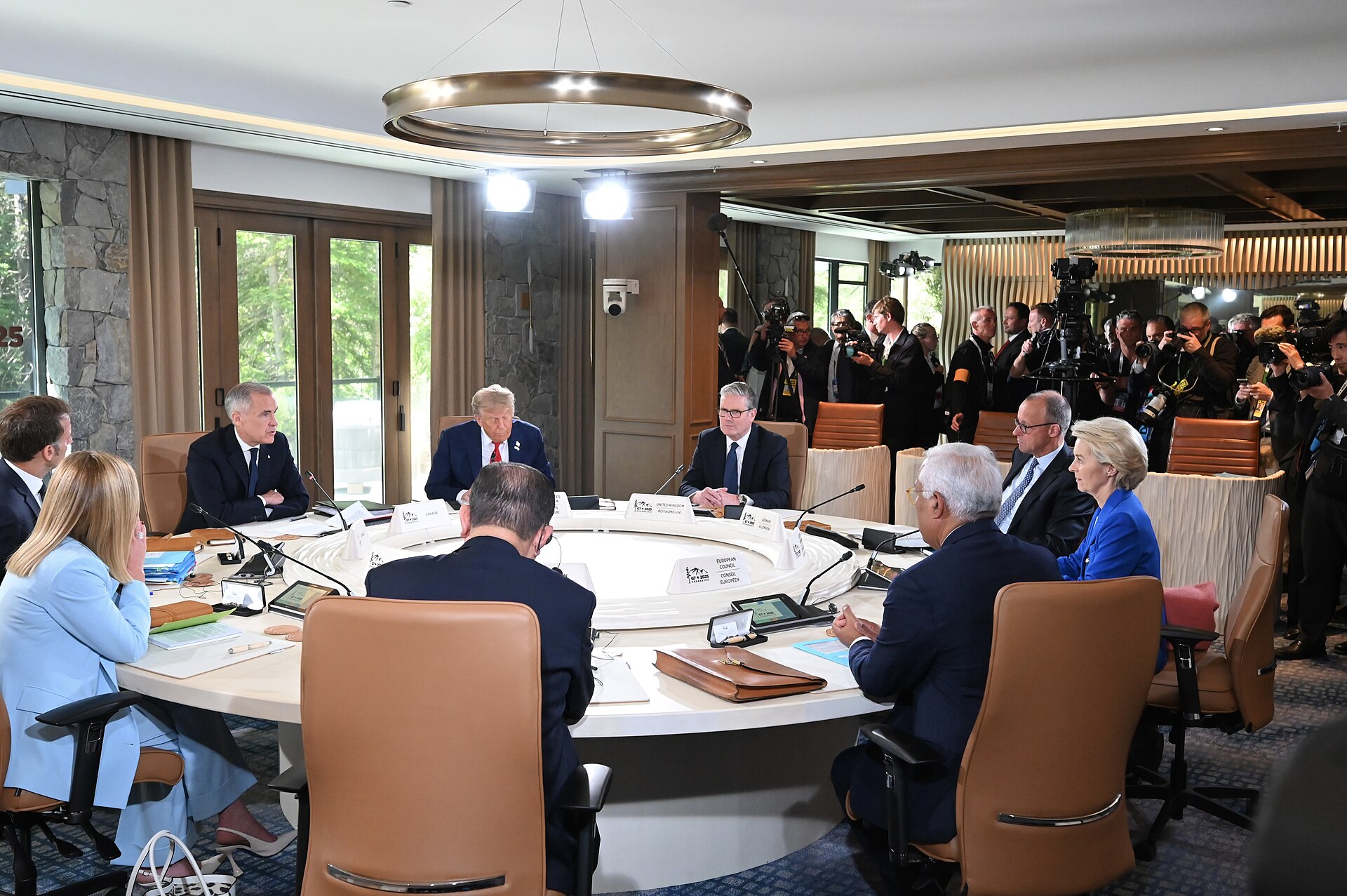

PARIS — French President Emmanuel Macron convened a dedicated Arab-leaders session on the Strait of Hormuz at the G7 summit in Evian on Tuesday with Egypt, Qatar, and the UAE at the table. Saudi Arabia — the country that ships 5.5 million barrels per day through the strait, more than double any of its three Arab partners present — sent no delegation.
Crown Prince Mohammed bin Salman declined the invitation weeks ago, citing “prior commitments” — the same two-word formula he used to skip last year’s G7 in Kananaskis, Canada. It marks the third consecutive year MBS has refused a G7 leaders-level summit, and the first time the refusal locked Saudi Arabia out of a session explicitly structured around Hormuz reopening, mine clearance authorization, and the Iran deal’s unresolved nuclear gaps — the three issues that bear most directly on Saudi revenue and strategic positioning.
Table of Contents
What Did Macron Put on the Evian Table?
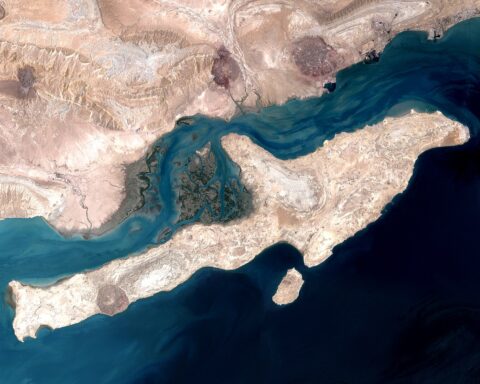
Macron told reporters on Monday that the Arab-leaders session would address “the consequences of this agreement, support for Lebanon, the lasting reopening of Hormuz, and of course the concluding of an accord on nuclear and ballistic activities in Iran.” He added that the leaders would examine “the ways and means of diversifying energy routes from the region, to get away from their dependence” — language aimed squarely at the Gulf states’ concentration risk on a strait that Iran has functionally controlled since the war began.
France came to Evian with a military offer attached to the diplomatic agenda. Macron stated that the Charles de Gaulle carrier group could reach the Hormuz region “within two or three days” and that Paris was “ready to move within days to deploy assets, including mine-clearing vessels” once the MOU is formally signed. The UK and France jointly presented a Europe-led mine-clearing operation to President Trump for endorsement, with more than 15 countries contributing military planners to what would be the largest multilateral demining effort in the Persian Gulf since 1991.
Trump offered a markedly different timeline. “The Strait is already partially opened, as you know they’re doing a little hunting for a couple of mines that they’ve already found, but it’s essentially ships are starting to go out now; on Friday it will be completely opened,” he told reporters on Monday — placing full reopening on June 19, the same day the formal Geneva MOU signing is scheduled. The gap between Macron’s “within days” deployment offer and Trump’s declaration that it is already essentially done captures the transatlantic divide over Hormuz normalization that the Arab session was designed to help narrow.
The transatlantic split on mine clearance timelines went deeper than scheduling: Trump’s hesitation to integrate the European MCM coalition has concrete costs — CENTCOM started its own clearance clock on June 16 without the 15-nation force France and the UK assembled.
The Middle East briefing 3,000+ readers start their day with.
One email. Every weekday morning. Free.
Macron called the US-Iran pact “a very important step for peace of the whole world.” The session’s practical work — endorsing mine clearance frameworks, discussing energy route alternatives, bridging the American and European timelines — required leaders-level authorization from the Gulf states directly affected. Three of the four invited Arab governments provided it in person.
Three Bilaterals, No Saudi Delegation
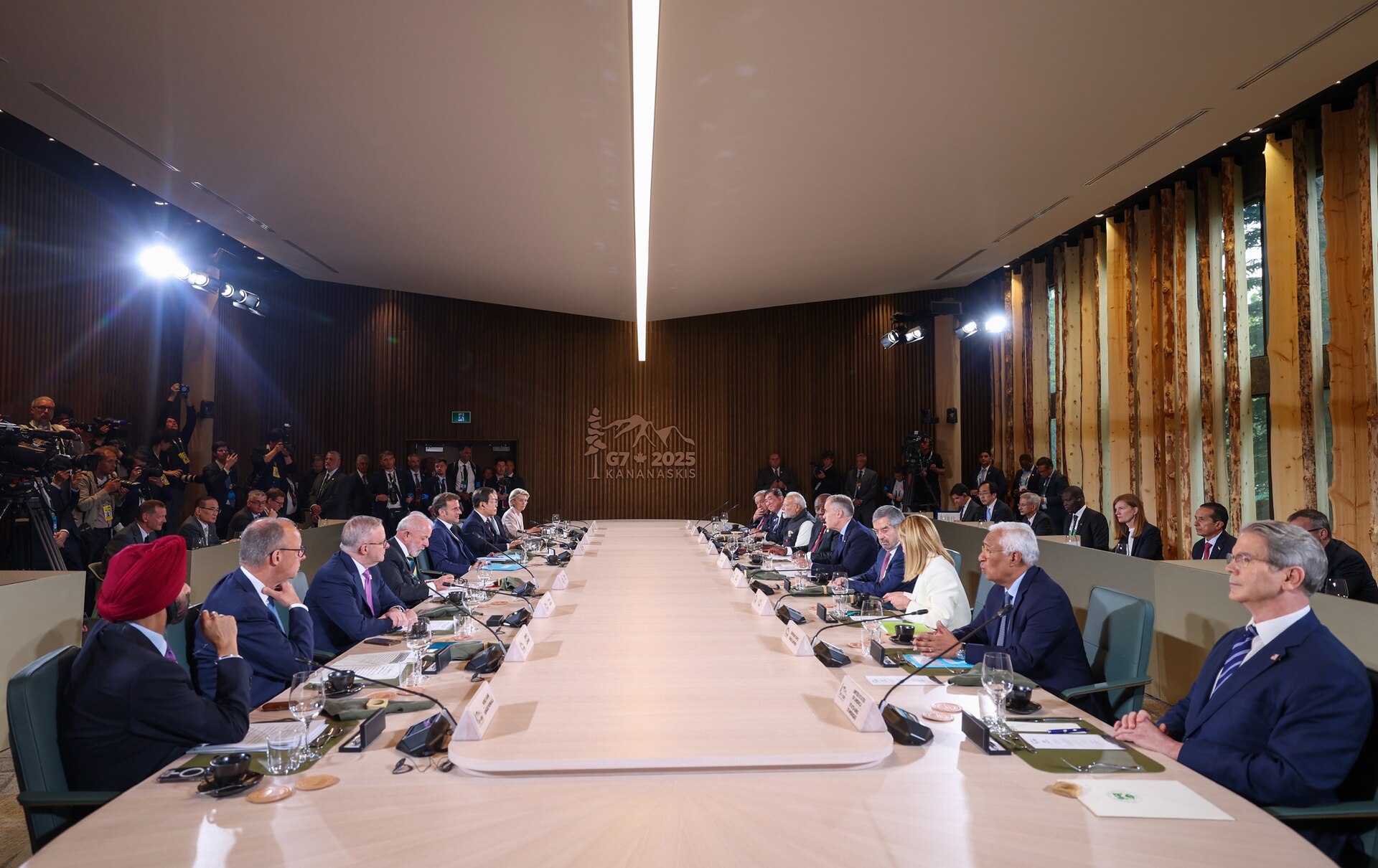
Trump held separate bilateral meetings at Evian with all three attending Arab leaders. He met UAE President Mohamed bin Zayed Al Nahyan on investment commitments and Hormuz transit security, Qatar’s Emir Sheikh Tamim bin Hamad Al Thani on Doha’s mediation role and Gaza, and Egypt’s President Abdel Fattah el-Sisi on regional stability and the political framework shaping the Iran deal’s implementation. Each bilateral carried operational weight: UAE and Qatar both maintain direct channels to Tehran that feed into demining sequencing and the deal’s implementation mechanics.
Saudi Arabia had no bilateral with Trump at Evian — not because one was refused, but because no Saudi delegation was present to hold one. The kingdom that approved the Iran MOU draft and was named among its 12 “approver” states had no representative at the leaders-level table where those approvals translate into operational decisions about mine clearance timelines, PGSA fee challenges, and the energy route alternatives that Macron placed at the center of his agenda.
France’s Foreign Minister Jean-Noël Barrot visited Riyadh bilaterally before Evian, and Saudi FM Faisal bin Farhan participated in the G7 Foreign Ministers meeting at Abbaye des Vaux-de-Cernay in March — the first multilateral Hormuz discussion under French institutional sponsorship. FM-level engagement, however, does not carry the same authorization weight as a leaders-level session where heads of state endorse mine clearance frameworks, agree on energy diversification routes, and set the political terms for Hormuz’s reopening architecture.
Who Bears the Largest Hormuz Cost?
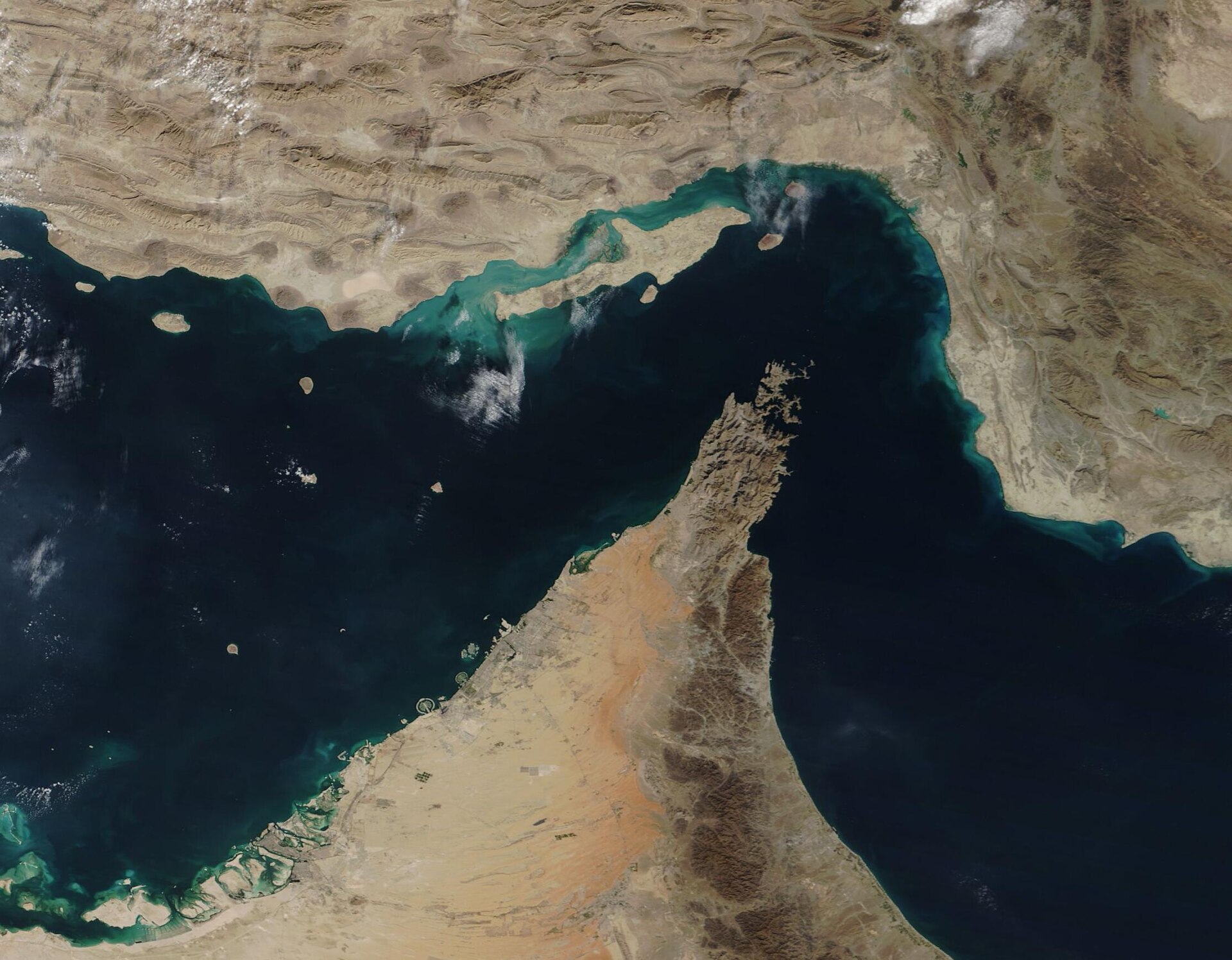
The financial gap between the Arab states in the room and the one that stayed home is the sharpest asymmetry in the summit’s agenda. Saudi Arabia ships roughly 5.5 million barrels per day through the Strait of Hormuz — more than double the UAE’s approximately 2.5 million. At the Persian Gulf Security Administration’s rate of approximately $1 per barrel, that translates to roughly $5.5 million per day or about $2 billion per year in fees that Iranian Foreign Minister Abbas Araghchi has rebranded as charges “for services rendered,” a formulation that survives the MOU’s prohibition on “tolls”.
| Country | Hormuz Exposure | Est. Daily PGSA Liability | Present at Evian |
|---|---|---|---|
| Saudi Arabia | ~5.5M bpd crude | ~$5.5M | No |
| UAE | ~2.5M bpd crude | ~$2.5M | Yes |
| Qatar | ~20% of global LNG trade | Primarily LNG-linked | Yes |
| Egypt | Indirect (Suez/Red Sea) | Minimal direct | Yes |
The PGSA’s exemption list — which shields Russia, China, India, Iraq, and Pakistan from the per-barrel charge — does not include Saudi Arabia. Iran’s parliament codified the fee structure into law in March, before the MOU draft existed, creating a statutory mechanism that no multilateral outcome document at Evian can override without Tehran’s consent. The three Arab governments present at Macron’s session face a fraction of Saudi Arabia’s per-barrel exposure, and none confronts the same structural exclusion from the PGSA exemption regime.
Saudi Arabia’s broader fiscal position amplifies the stakes. The kingdom posted a record Q1 2026 deficit of SAR 125.7 billion — roughly $33.5 billion — with its breakeven oil price at $108 to $111 per barrel against a Brent price of approximately $80.94 on Tuesday. PIF cash reserves sit at $15 billion, a six-year low. And the Sadara Chemical Company’s $3.7 billion in guaranteed senior debt — backed by Aramco at 65 percent and Dow at 35 percent — saw its grace period expire on June 15, with Dow confirming “no fresh charges” in language that sidesteps whether the underlying default has been formally resolved.
Three Summits, Three Refusals
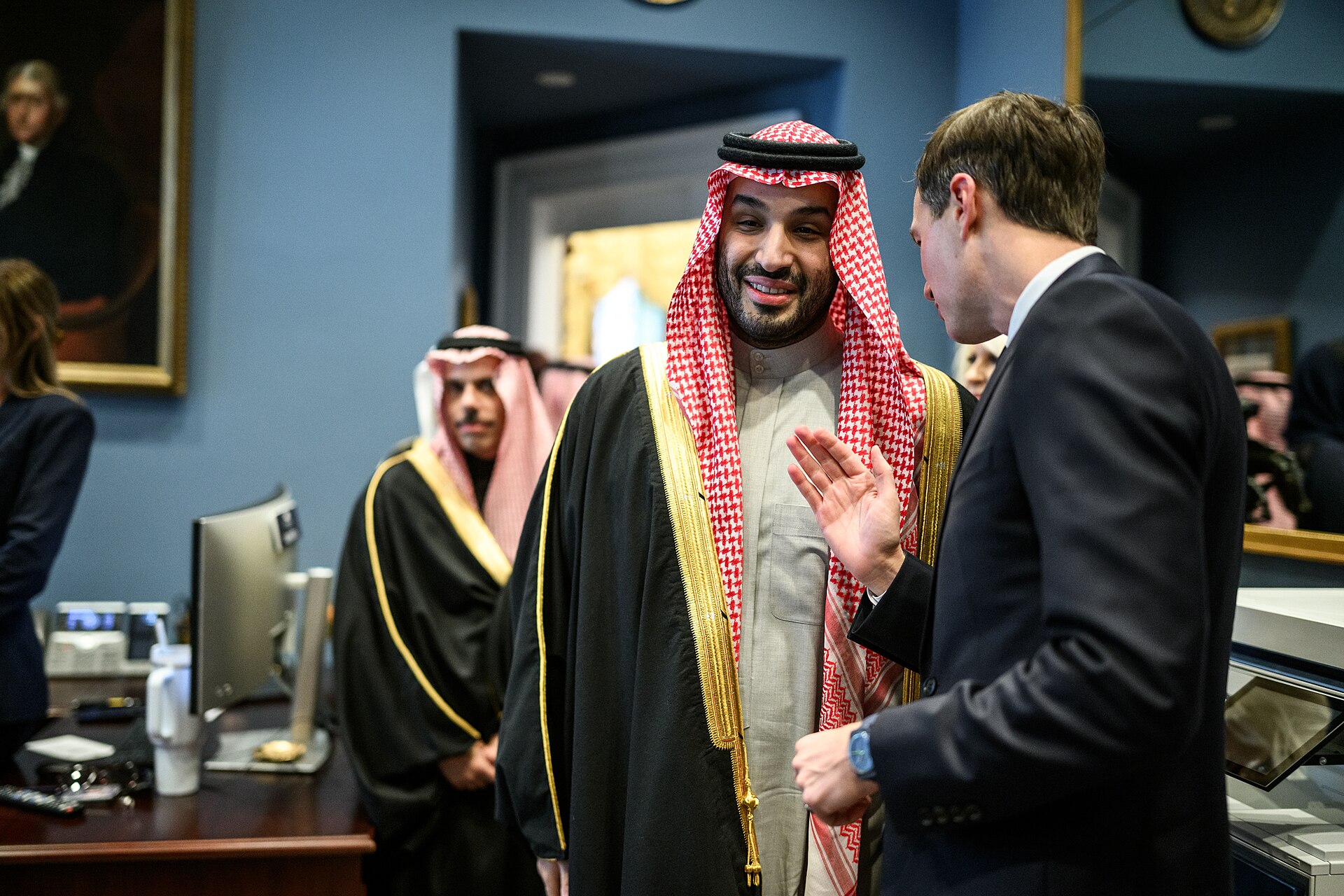
The pattern is now documented across three consecutive years. At the 2024 G7 in Puglia, Italy, MBS cited Hajj season — a concrete, calendar-specific rationale that drew little scrutiny. At Kananaskis 2025, eight weeks into the Iran war, the formula shifted to the generic “prior commitments,” and Saudi Arabia was absent from the first wartime G7 session that directly addressed the strait carrying its crude. At Evian 2026, with Macron personally inviting the crown prince to a session structured around Saudi Arabia’s most acute strategic exposure, MBS used the identical phrase. No named engagement has been disclosed for any of the three refusals beyond 2024.
The consistency suggests doctrine rather than scheduling conflict. Saudi Arabia’s diplomatic approach to the Iran crisis has favored bilateral channels throughout — the Pakistan intermediary track through which General Munir and PM Sharif’s separate letters reached Khamenei on June 7, the Faisal-Dar phone call that broke 24 days of MOFA silence on the MOU, the unnamed mediation routes through Gulf intermediaries — over the multilateral formats where positions are negotiated among competing interests and outcomes reflect coalition arithmetic. At a leaders-level G7 session with Macron, Trump, Sisi, MBZ, and Tamim at the table, Saudi Arabia would be one voice among several, bound by the dynamics of a room rather than the bilateral leverage Riyadh prefers to exercise.
The cost of that preference is becoming visible in the outcomes it forecloses. The three Arab leaders who attended Evian will shape the G7’s understanding of what a “lasting reopening” requires, what role European navies play in mine clearance, and how energy route diversification is structured across the Gulf. Those decisions affect Saudi revenue, Saudi shipping costs, and Saudi strategic positioning more than any other country in the region. Riyadh’s input on all three arrives secondhand, filtered through allies running their own Hormuz calculations.
Can Evian Deliver Anything Without a Communiqué?
Even for the leaders who showed up, Evian’s capacity to produce binding outcomes is structurally constrained. For the second consecutive year, G7 leaders are forgoing a joint communiqué — opting instead for narrower outcome documents on critical minerals, migration, and drug trafficking. Iran and Hormuz are not expected to produce standalone binding text, meaning the session’s conclusions on mine clearance endorsement, PGSA fee legitimacy, and energy diversification carry political momentum but no institutional enforcement mechanism that can compel Tehran to adjust its fee regime.
Trump signaled that the G7’s attention has already begun to pivot away from the Iran file. “Now that this is finished,” he said of the Iran deal, “we’re going to be focusing on that” — gesturing toward Ukraine, which dominates the summit’s second day. The shift means whatever Hormuz framework emerges from Evian will receive diminishing American bandwidth in the weeks ahead, precisely when implementation disputes over PGSA fee legitimacy and mine-clearance sequencing are expected to intensify between Tehran and the coalition countries organizing demining operations.
For Saudi Arabia, the absence of both a binding communiqué and a Saudi delegation in the room compounds into a specific vulnerability. A Chatham House report published in May concluded that “the closure of the Strait of Hormuz has revealed a key threat to Saudi Arabia’s Vision 2030 strategy and plans for economic transformation,” attributing Riyadh’s “reluctance to engage directly in the war against Iran and its lobbying against further escalation” to the dual threat of Hormuz export disruption and Red Sea pressure from Houthi operations. The PGSA fee structure that Araghchi defends as charges “for services rendered” now faces no multilateral challenge mechanism that Riyadh helped build.
Background
The G7 Evian summit follows a volatile sequence in the Iran deal process. Iran’s Foreign Ministry confirmed on June 13 that the planned June 14 MOU signing would not proceed, with spokesman Esmail Baghaei attributing the delay to American “hesitation” and “instability.” The formal signing is now scheduled for June 19 in Geneva — the same date Trump told reporters the strait would be “completely opened.”
The strait itself remains functionally restricted despite Trump’s characterization. Roughly 2,000 commercial vessels are held in the Persian Gulf region, with war risk premiums running at three to eight percent of vessel value and major underwriters still triggering BIMCO CONWARTIME clauses. Iran’s Maham-7 sonar-evading mines require an estimated 40 to 50 days of clearance under optimistic Pentagon assessments, and no formal clearance operation has launched.
The Sadara grace period expired on June 15 — the day before Evian opened. Riyadh arrived at the summit’s most consequential Hormuz session as a country with a six-year-low sovereign wealth fund, an unresolved $3.7 billion debt event, and no seat at the table where the terms of reopening are being set.
The day after Evian, an analysis of the MOU signing documents the specific military obstruction that now governs the reopening timeline: the IRGC warned a US minesweeper off the same morning Iran signed the deal, a contradiction that Saudi Arabia’s absence from Evian left it with no platform to address.
What Évian produced instead was a political statement without a legal document behind it. Five G7 nations endorsed an MOU whose text had not been released — omitting any reference to the PGSA fee structure, the mine-clearance mandate, or the arbitration framework that would govern Saudi Arabia’s $2 billion annual exposure.
Frequently Asked Questions
Which countries were represented at Macron’s Arab-leaders session?
Egypt (President Abdel Fattah el-Sisi), Qatar (Emir Sheikh Tamim bin Hamad Al Thani), and the UAE (President Mohamed bin Zayed Al Nahyan) attended the session on Tuesday. Saudi Arabia was the only one of the four invited Arab governments that did not send a delegation. G7 leaders including Trump, Macron, and other heads of state from the G7 nations were also present, along with representatives from the European Commission.
Has Saudi Arabia sent any representative to G7-related meetings in 2026?
Saudi FM Faisal bin Farhan participated in the G7 Foreign Ministers meeting at Abbaye des Vaux-de-Cernay on March 26-27, which included the first multilateral Hormuz discussion under French institutional sponsorship. France’s FM Jean-Noël Barrot also visited Riyadh bilaterally before Evian to brief the Saudi side on the summit’s agenda.
What is the Europe-led mine-clearing coalition discussed at Evian?
The UK and France jointly presented plans for a multinational Hormuz mine-clearing operation, with more than 15 countries contributing military planners. Germany, Italy, and the UK have prepared mine-sweepers, autonomous mine-hunting systems, and maritime support assets for deployment. Macron said France’s Charles de Gaulle carrier group could reach the region “within two or three days” once the MOU is signed. The operation remains contingent on the formal MOU signing, currently scheduled for June 19 in Geneva.
When does Trump say Hormuz will fully reopen?
Speaking at Evian on Monday, Trump stated the strait would be “completely opened” by Friday, June 19 — the same day as the formal Geneva MOU signing. Pentagon estimates put mine clearance alone at 40 to 50 days at minimum, and the UK-France demining coalition has not formally launched operations. Trump’s framing that ships “are starting to go out now” also runs against reporting from The National that approximately 2,000 vessels remain in the Persian Gulf region as of early June.
What happened with the Sadara debt deadline?
Sadara Chemical Company’s $3.7 billion in guaranteed senior debt — backed by Aramco ($2.405 billion, 65 percent) and Dow ($1.295 billion, 35 percent) — saw its grace period expire on June 15. All 26 Sadara units at the Jubail Industrial City have been offline since late March with zero revenue for 11 weeks. Dow confirmed “no fresh charges,” characterizing the outcome as “easing a key overhang,” but neither guarantor has filed a material event notice with the SEC, leaving the formal status of the underlying obligation unresolved.