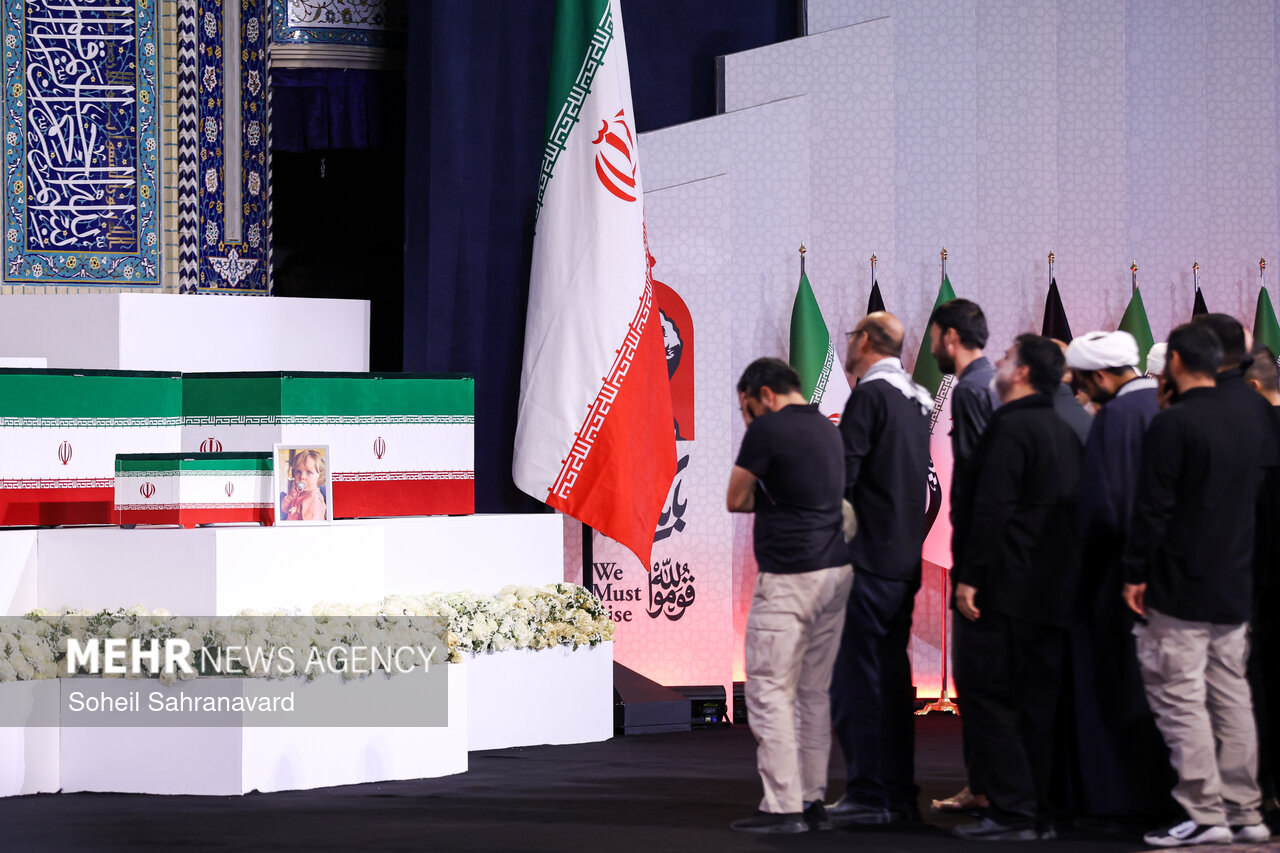

TEHRAN — Donald Trump stood at Mount Rushmore on the Fourth of July and told a cheering crowd that Iran was “dying to settle.” At almost the same hour, a eulogist inside Tehran’s Grand Mosalla was telling a vast crowd of mourners that they had come “not for the funeral but for revenge” — and the crowd, holding a flag reading #KillTrump, chanted back a single word: revenge.
Both men were talking about the same six-day pause in the same war, and neither was talking to the other. Trump was addressing an American electorate on Independence Day and needed the Iran story to be a story about American strength; the eulogist was addressing a domestic audience the caretaker regime cannot afford to lose, and needed the funeral to be a story about unfinished business.
The MOU clock reads Day 17 of 60, and Doha round three is scheduled — in principle — for July 10. The man who has to walk into that room, Mohammad Bagher Ghalibaf, is watching every hour of the funeral cycle harden the ceiling above his own negotiating mandate.
Table of Contents
- Trump’s Independence Day and the Cost of Being “Nice”
- Why the Funeral Window Is Not Diplomatically Neutral
- What Ghalibaf Was Saying When the Cameras Cut
- Who Is the Paydari Front and Why Does It Speak Louder Than the Government?
- Vahidi Returns, and the IRGC Speaks Again
- Mojtaba Was Not There
- What Doha Round Three Looks Like From July 5
- The August 18 Bill Arrives Either Way
- Where This Leaves Riyadh
- Frequently Asked Questions
Trump’s Independence Day and the Cost of Being “Nice”
The words are on the record and NBC News has the tape: “We knocked the hell out of Iran. They’re dying to settle. They want to settle so badly. We gave them a week off for a funeral because we’re nice.” Trump delivered the line to a crowd primed for it, on a stage built for the American self-image, on the one day of the year when the American self-image is the entire product. As domestic political rhetoric, it worked; as diplomatic messaging into a country burying its Supreme Leader, it was something else.
The “we gave them a week off” framing is the load-bearing sentence — not because it is untrue, but because it collapses a two-way pause into a one-way concession. The funeral cycle running July 4 through July 9 was not granted by Washington. It was announced by Tehran and accommodated by the negotiators in Doha, who said the third round would resume “at the earliest possible time following the funeral processions.” Trump has now retroactively framed that accommodation as American generosity. In Tehran, that reframing costs Ghalibaf something specific: any concession he brings back from the third round can now be labelled by the Paydari Front as gratitude for a favour Iran was granted, not a right Iran already had.
Compare the register of Trump’s Fourth of July line with the register of what was said in Doha in late June, when the same team — via Qatari and Omani intermediaries — was telling counterparts the pause was “structural,” a period during which no side would take escalatory action. Trump did not repeat that language at Mount Rushmore. He replaced it with a description of Iranian humiliation and American magnanimity. That is a domestic-political product, and the domestic-political product travels. Iranian state television plays it back, edits it into segments, and hands it to the Paydari commentariat, which uses it to argue that Ghalibaf’s Memorandum of Understanding is precisely what its critics have called it: America’s dictation, achieved through Iranian weakness.
The Middle East briefing 3,000+ readers start their day with.
One email. Every weekday morning. Free.
Why the Funeral Window Is Not Diplomatically Neutral
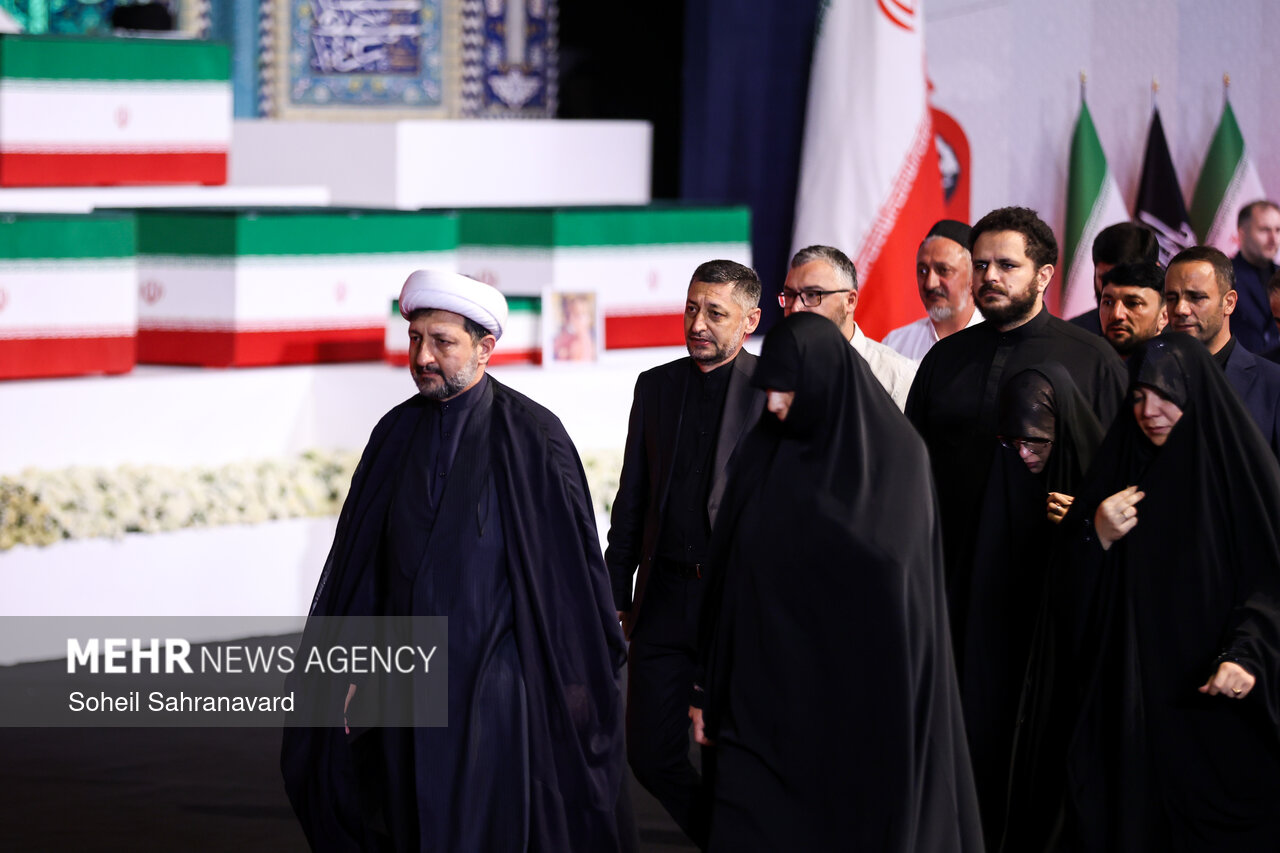
Every state funeral is a political act, but this one is a political act at industrial scale. Iranian authorities have projected 15 to 20 million mourners across the six-day cycle, with more than 10 million in Tehran alone — stated to be the largest state funeral in the Islamic Republic’s history. The scale is not the point. The point is what happens inside a scale that large, on cameras that are running continuously, with every senior figure in the security state required to say something on record.
At the Grand Mosalla on the first day, the eulogist delivered two lines that will now sit in the archive of Iranian state media until the archive is deleted: “We have come not for the funeral but for revenge,” and “we’re never going to give up your blood, which is the reddest line.” Reuters ran a mourner interview — Arash Rahimi, 40 — who used almost the same construction unprompted: “We will certainly avenge his blood. Everyone here has come to avenge the blood of their Supreme Leader. As our leader has said, we have a blood feud with the United States.” Tasnim, the IRGC-affiliated news agency, told its readers the nation must “convey the nation’s call for avenging the blood of the martyred Leader to the world.”
These are not off-the-cuff mourner sentiments. They are the frame the funeral is being staged inside — a state funeral repurposed as a war council, held during the exact window in which the government’s own negotiators are supposed to be preparing for Doha round three. Any Iranian minister, deputy minister, or parliamentary chairman who returns from Doha in the second week of July and tries to sell a concession will be tried against the tape of what was said at the Grand Mosalla on July 4. The tape does not soften over time. It hardens.
The strategic implication is mechanical. The five days between July 4 and July 9 are producing tens of hours of on-camera oath-taking by every senior military and clerical figure who is politically obliged to attend. Each hour of oath-taking removes a corresponding hour of Ghalibaf’s future ambiguity. He cannot claim, on July 11, that Iran is willing to accept a narrower Hormuz revenue mechanism when the caretaker IRGC commander-in-chief has just sworn on the coffin of the Supreme Leader that this nation will “rise higher day by day through this pure blood.” The words become the ceiling.
What Ghalibaf Was Saying When the Cameras Cut
On July 1, Iran’s state broadcaster IRINN cut roughly 20 minutes of a Ghalibaf interview mid-transmission, without explanation. Parliament’s media office confirmed the cut had been made “without any prior notice.” The Speaker had been walking viewers through the actual mechanics of the MOU: the phased asset-release schedule for the $6 billion in frozen Qatari-held Iranian funds, the two-track IAEA arrangement, and the $300 billion reconstruction credit that Ghalibaf had described — according to reporting by Iran International on the censored segment — as a precondition for durable de-escalation. He had also delivered the line that made him a target: the MOU, he said, was “America’s defeat, and we achieved it with dignity.”
That is the sentence the cut protected the Iranian public from hearing. Not “America won,” which the Paydari Front already believes and would have preferred. “America’s defeat” — because if the MOU is framed to the Iranian public as a victory, the public may support it, and if the public supports it, the domestic political coalition Paydari is assembling against it becomes harder to hold. IRINN’s producers, aligned with hardline networks around the office of the late Supreme Leader, did the political work that the Paydari Front could not have done in front of a live audience. They removed the frame from circulation.
What replaced it, the following day, was Ghalibaf himself narrowing his own mandate on Al Jazeera: “Currently, inspectors only have access to two locations: Bushehr power plant and Tehran reactor.” That was not the position he had held at Doha, where broader IAEA access was one of the items still being negotiated. It was the position he was now required to hold in public in order to survive the week. As the analysis of Ghalibaf’s five-article MOU framework showed, the Speaker had built enough structural veto points into the document to defend it against most attacks. What he did not build into it was protection against being publicly cornered into narrower positions by his own domestic media.
“This document is America’s defeat, and we achieved it with dignity.”Mohammad Bagher Ghalibaf, in the section of his IRINN interview that state television cut on July 1
The pattern here is the one Zarif walked into during the JCPOA negotiations of 2015 — Khamenei’s “heroic flexibility” doctrine was public authorisation for concessions the domestic base was never told the full price of, and when Trump withdrew from the deal in 2018, the domestic base retroactively agreed with the hardliners that they had been sold a lie. Zarif was sidelined. Ghalibaf is watching that same architecture form around him in real time, except the sidelining is happening while the negotiation is still open, not after.
Who Is the Paydari Front and Why Does It Speak Louder Than the Government?
The Paydari Front — the Endurance Front — is the hardline faction the international press keeps calling “ultraconservative” without ever quite explaining. Its institutional legitimacy runs through Saeed Jalili, who took 13 million votes in the 2024 presidential runoff on a platform of maximum confrontation with the West. Its media reach runs through Kayhan, whose editor is appointed by the office of the Supreme Leader, and through the IRGC-adjacent networks that operate inside IRIB. Its constitutional theory, since the MOU was signed, has been that Ghalibaf and Pezeshkian conducted what its senior parliamentarian Mahmoud Nabavian has called a “coup” against the framework Khamenei was still alive to enforce.
Nabavian’s exact word for what the MOU makes Iran, if it is implemented as drafted, is “colony.” That word does not exist in the diplomatic lexicon. It exists in the political-mobilisation lexicon, which is the register Paydari has been operating in since June 30, when it began pushing legislation asserting sovereign parliamentary control over the Strait of Hormuz — a direct challenge to Ghalibaf’s authority to negotiate the revenue mechanism at Doha.
The Assembly of Experts amplified the same frame on July 1. Sixty-two of eighty-eight members — 70 per cent of the body constitutionally charged with selecting the Supreme Leader — declared that killing Trump and Netanyahu is “a religious duty,” classifying them as Mahdur al-Dam, those whose blood may lawfully be shed. This is the same body that four days earlier called the Hormuz reopening a “strategic mistake,” a coordinated position that senior clerics used to reset the domestic red lines below what Ghalibaf had signed in Doha.
The Paydari operating theory is that Mojtaba Khamenei — 16 weeks in office, still without the Grand Ayatollah credentials the doctrine of velayat-e faqih requires, physically absent from his own father’s funeral due to Israeli assassination threats — cannot arbitrate factional disputes the way his father did. That vacuum is the space Paydari is moving into. It is not clear yet whether the Front is powerful enough to break the MOU. What is clear is that it is already powerful enough to narrow what Ghalibaf can defend of the MOU in public — and narrowing what a negotiator can defend in public is functionally the same as narrowing what he can concede in private.
Vahidi Returns, and the IRGC Speaks Again
Ahmad Vahidi had not appeared in public since early February, well before Iran’s full ceasefire talks began. His two predecessors as commander-in-chief of the IRGC — the men who ran the force before him — were both killed in US-Israeli strikes during the war. On July 4, Vahidi sat next to Ali Khamenei’s coffin on Iranian state television and delivered a sentence intended to be carried on every news wire that touches the region: “They will take to their graves the wish to see this nation surrender. This nation will rise higher day by day through this pure blood.”
Vahidi is not a rhetorical figure. He is the caretaker of an institution that was structurally decapitated during Operation Epic Fury and has spent the last three weeks reassembling its chain of command. His appearance is the IRGC’s first institutional statement since the war, and the choice of venue — coffin-side, on state broadcast, during the funeral cycle — was deliberate. It signals that the corps has recovered a public voice, that it has recovered it in the register of vengeance rather than continuity, and that any future MOU implementation which requires IRGC cooperation now has to be reconciled with what Vahidi said on July 4.
Major General Amir Hatami, commander-in-chief of the Iranian Armed Forces, matched the register within hours: “With a firmer resolve we declare to the enemies of the Iranian nation — America and the criminal Zionist regime — that we will avenge the blood of the martyred leader.” The formal IRGC statement, carried by France 24, added the operational escalator: “Any miscalculation will be met with a decisive and more crushing response than ever before.”
These are the three most senior serving military figures in Iran, delivering the same message in coordinated sequence, on the country’s largest broadcast platform, while the government’s negotiators are supposed to be preparing to walk into Doha and discuss the fee structure for the Strait of Hormuz. The Ghalibaf public commitment to “resume proportionate actions” if the US fails to comply with Article 1 of the MOU was delivered before the funeral cycle began. It now looks conservative against the temperature of what has been said on state television since.
Mojtaba Was Not There
The single most important political fact of July 4 is not what was said. It is who was not on the platform to say it. Mojtaba Khamenei — the man the June Assembly of Experts process installed as Supreme Leader on March 9 — did not attend his own father’s funeral. Israeli assassination threats were the stated reason. He has not appeared in public since his inauguration; he communicates exclusively through written statements, mediated by the office he inherited and the IRGC network that shielded him during the war. As of Day 18, Mojtaba’s absence has extended to 120 days — an absence the Office of the Supreme Leader attributed to “full health” on May 8, a claim examined in detail in the health and governance analysis of Mojtaba Khamenei’s 120-day disappearance.
The problem with absence in a system built around a single arbiter is that absence is not neutral. When Ali Khamenei disappeared into extended silence during the 2009 protests, the factions read the silence as tacit endorsement of the crackdown, and the crackdown intensified. Mojtaba’s absence during the funeral cycle is being read by Paydari as tacit endorsement of the vengeance framing, because he is not there to reframe it. The office is speaking through Ali Larijani’s written statements and through the AoE amplifications — none of which carry the personal authority of a Leader physically present at the moment of transition. As the underlying dynamics of Mojtaba’s non-attendance were already producing structural consequences before the funeral began, they have accelerated inside the funeral window.
The consequence for Ghalibaf is direct. The MOU he signed was signed under the authority of the government, subject to the presumed final ratification of the Supreme Leader; if the Supreme Leader is unable — for security reasons or otherwise — to publicly ratify or defend the document during a period in which every other major security-state figure is publicly demanding vengeance, the MOU is left hanging in a legitimacy gap. It cannot be defended by the man whose office would ordinarily defend it, and cannot be repudiated without the government losing its authorising fiction. It sits, and it becomes politically flammable.
What Doha Round Three Looks Like From July 5
Doha round three has no confirmed date. The parties have said only that talks resume “at the earliest possible time following the funeral processions.” The earliest plausible date is July 10 — a day after the funeral cycle ends, and 39 days before the PGSA fee suspension expires. Ghalibaf will walk into that room carrying commitments he made in Doha round two, and the political temperature that has been generated in Tehran during the intervening funeral days.
Round two ended with two narrow wins and everything real still on the table. The MOU dispute communication channel was established — Iran promptly used it, on July 3, to notify the US of a claimed Article 1 violation in Lebanon. Preliminary discussion opened on the mechanism for releasing the $6 billion in Qatari-held Iranian assets, using a goods-purchase mechanism rather than direct cash transfer, following the 2023 Biden-era template. What did not resolve: the Hormuz transit fee dispute — Iran calling them “service fees” under UNCLOS Article 26(2), Rubio calling them a “game of semantics”; the PGSA fee structure; the demand for zero enrichment; and IAEA access to the bombed Fordow, Natanz, and Isfahan sites, on which the second Doha round produced process wins but no substantive breakthrough.
The mechanical implication is that Ghalibaf arrives at round three with less room, not more. The Paydari Front has publicly narrowed the IAEA position to two sites. The Assembly of Experts has publicly narrowed the acceptability of any US-side leadership to “religiously permissible to kill.” The IRGC caretaker has publicly narrowed the acceptability of any concession to “wish to see this nation surrender.” Each of these public narrowings can be quoted back at Ghalibaf in the negotiating room by counterparts who have Persian-speaking analysts reading the same tapes he is.
| Doha round-two outstanding item | Ghalibaf position in Doha | Public Tehran position, July 1–4 |
|---|---|---|
| IAEA access to bombed sites | Under discussion, staged access | Two sites only (Bushehr, Tehran Research Reactor) — Ghalibaf, Al Jazeera, July 2 |
| Hormuz transit fees | “Service fees” defensible under UNCLOS Art 26(2) | Parliamentary legislation asserting sovereign control — Paydari draft |
| Zero enrichment | Not accepted; enrichment tied to reconstruction | AoE “strategic mistake” reversal of Hormuz reopening — 62/88 members |
| Any concession to US leadership | MOU as “America’s defeat with dignity” | Killing Trump/Netanyahu a “religious duty” — AoE, July 1 |
| PGSA fee suspension continuation | Suspension linked to broader implementation | Expiration August 18 — no domestic constituency for extension |
The table does not tell the story. The story is that on every one of these files, the Iranian public position has moved further from the Iranian negotiating position in the space of four days, and the movement was produced by the funeral. Ghalibaf does not get to reset when the mourners go home. The tape stays where the tape is.
The August 18 Bill Arrives Either Way
Forty-five days separate the first day of the funeral from the expiration of the PGSA fee suspension. On the day after the suspension lapses, $5.5 million per day auto-activates in Iranian-collected transit fees — the mechanism Ghalibaf negotiated as a structural check on non-implementation. The US sanctions waiver expires three days later, on August 21. Neither deadline is discretionary. Neither can be quietly extended without the party doing the extending appearing to reward the other side’s intransigence.
Trump’s Independence Day framing has locked him into a public posture of Iranian weakness. He cannot, on August 15, quietly extend the sanctions waiver — the extension would contradict the “dying to settle” line. Ghalibaf’s censored interview and the Paydari Front’s parliamentary manoeuvres have locked Tehran into a public posture of American humiliation. Tehran cannot, on August 15, quietly agree to indefinite suspension of the PGSA fees — the concession would contradict everything Vahidi and Hatami said at the coffin.
What this means, in the mechanical language of MOU implementation, is that both sides are approaching the 60-day expiration window with less room to compromise than they had on Day 1. The document was drafted assuming a decreasing-tension trajectory, in which the atmospheric pressure of the war would fade as the days accumulated and the implementation cadence built its own momentum — the funeral has broken that assumption. The pressure is not decreasing; it is being reset by each successive on-camera oath-taking, and reset upward. As the analysis of the deadline dynamics has shown, the private and public tracks were already diverging before the funeral cycle began, and they are now diverging faster.
Whether Doha round three even happens on July 10 is now a live question. A funeral-cycle spillover, a Vahidi statement that sits too hot in the international press, an Israeli action taken against a target in Iran during the funeral days — any of these could push the round to July 12 or July 15, compressing the negotiating window further. Every day Doha slips is a day the August 18 mechanical trigger arrives less negotiated and more automatic.
The most acute complication arrived on July 5 itself: the state funeral’s official emcee delivered an IRGC-podium declaration that killing Trump was a religious duty, producing a mandate-hardening event Ghalibaf must now carry into Doha round three.
Where This Leaves Riyadh
Saudi Arabia has been the party paying the running cost of the war since the first Israeli strike, and it will be the party paying the running cost of the failure to end it. Aramco cut the July Arab Light OSP by $6 per barrel — a $900 million per month revenue loss at 5 million barrels per day — because the market priced Hormuz credibility into the barrel. If the PGSA fees activate on August 18 and Iran begins collecting transit revenue on the vessels that still transit, the credibility gap will widen. If the fees do not activate but the MOU visibly stalls, the credibility gap widens anyway.
Riyadh has no seat in Doha. Its exclusion from the round was structural on Day 1 and has hardened since — Faisal bin Farhan was in Beijing during round two, not Doha, and the Pakistani channel that Islamabad has been running on Riyadh’s behalf is a substitute for direct participation, not a replacement for it. What this means for the Kingdom is that every hardening of Ghalibaf’s ceiling by the Paydari Front translates directly into a hardening of the terms under which Saudi assets, Saudi airspace, and Saudi shipping remain exposed after August 18.
The Saudi answer, so far, has been to build the Turkey-Pakistan-Egypt-Qatar security axis — a signalling architecture rather than a deterrent, and one that the recent multilateral signings frame as post-war repositioning. The signalling does not stop the August 18 clock. Nothing stops the August 18 clock except an implementation cadence that both Doha rooms have to protect against their own domestic constituencies. Right now, one of those rooms is holding a state funeral. The other just told a Fourth of July crowd that the funeral was a favour.
Frequently Asked Questions
How does Iranian domestic media traditionally treat comments by US presidents during Iranian mourning periods?
Historically, Iranian state media has amplified perceived Western disrespect during Shia mourning cycles — the Ashura amplification patterns during the 2009 protests and the framing of Trump’s January 2020 statements during the Qassem Soleimani funeral cycle are the two clearest recent templates. Both were used to consolidate hardline coalitions that were fractured before the amplification began.
What is the legal basis for the Assembly of Experts’ July 1 “religious duty” declaration?
The AoE invoked the Shia jurisprudential category of Mahdur al-Dam — “one whose blood may be shed” — which historically applies to individuals judged to have committed capital offences against Islam and requires either a formal fatwa or a competent judicial ruling under velayat-e faqih. The July 1 declaration is theologically contested by senior Qom clerics who argue it bypasses the required procedural steps, and it has no binding effect on Iranian state policy without Supreme Leader ratification.
Could the PGSA fee suspension be extended without a formal Doha round three agreement?
Yes, technically — the suspension is a US Treasury Office of Foreign Assets Control administrative determination and can be extended by executive action. The political constraint is not legal. Any extension issued without a visible Iranian implementation step would be read domestically in both capitals as unilateral concession, which is why the mechanism was designed to auto-activate rather than to require positive renewal.
Who represents Iran at Doha round three if Ghalibaf’s mandate is publicly narrowed further before July 10?
The formal Iranian delegation remains under Foreign Minister Abbas Araghchi with Deputy Foreign Minister Kazem Gharibabadi as lead negotiator, but Ghalibaf’s role as Speaker of Parliament makes him the domestic ratification pivot regardless of who sits at the table in Doha. If his mandate is narrowed further, the delegation still travels — it simply arrives with less to offer, which is the negotiating equivalent of arriving with less time.
What precedent does the 2015 JCPOA offer for how domestic opposition can unravel a negotiated agreement?
The JCPOA collapsed in 2018 not because Iran violated it but because Trump withdrew, validating retroactively everything Iranian hardliners had argued since 2015 — that the concessions were real and the benefits were not. Zarif was sidelined domestically long before the deal died internationally. The structural risk for Ghalibaf is identical: the domestic opposition does not need to kill the MOU directly. It only needs to narrow what he can defend of it long enough for the other side’s domestic politics to do the rest. The physical incapacitation dimension of that mandate rewrite sharpened on July 5, when Reuters sources confirmed Mojtaba Khamenei’s facial disfigurement and leg injuries — a constitutional confirmation challenge now layered on top of the political one.