TEHRAN — King Salman and Crown Prince Mohammed bin Salman sent condolences for the death of Iran’s Supreme Leader through Deputy Foreign Minister Waleed El-Khereiji — the same official who had attended Ali Khamenei’s funeral at Tehran Mosalla on July 3 without appearing on any published delegation roster. When President Ebrahim Raisi died in a helicopter crash in May 2024, Saudi Arabia sent its full Foreign Minister, Prince Faisal bin Farhan, to Tehran; when Khamenei died on June 30, 2026 — holder of Iran’s highest constitutional office, the authority that commands the IRGC, sets foreign policy boundaries, and issues the religious edicts governing nuclear weapons and the Strait of Hormuz — Riyadh sent the deputy.
The Saudi Foreign Ministry confirmed the condolence delivery “early Saturday” on July 5, placing it within the active mourning window of funeral ceremonies running through July 9 at Tehran Mosalla, before the procession through central Tehran on July 6 and the Qom ceremonies through July 9. The message was addressed to President Masoud Pezeshkian, not to Mojtaba Khamenei, the dead leader’s son and newly installed successor, a distinction that acknowledges the death through the elected executive while withholding recognition of a succession whose legitimacy Riyadh has yet to formally accept. The choice of El-Khereiji for both functions — funeral attendee and condolence vehicle — reveals a doctrine of calibrated distance in which the channel itself has been designed as a boundary, not a pathway toward normalisation.
Table of Contents
- The Rank Fell as the Stakes Rose
- Why Did Saudi Arabia Downgrade Its Representative for a Higher-Protocol Funeral?
- Who Is Waleed El-Khereiji?
- What Does Addressing Pezeshkian Instead of Mojtaba Signal?
- Did China and Saudi Arabia Make the Same Calculation?
- The Verse Tehran Chose for the Saudi Delegation
- The Thread Riyadh Cannot Cut
- The Ceiling Holds
- Frequently Asked Questions
The Rank Fell as the Stakes Rose
The Raisi precedent is the cleanest measure of what Saudi Arabia chose not to do. In May 2024, when the Iranian president — the country’s second-highest constitutional authority — died in a helicopter crash in mountainous terrain near the Azerbaijan border, Prince Faisal flew to Tehran for the funeral ceremonies, his second visit to the Iranian capital since the March 2023 Beijing Agreement restored diplomatic ties after a seven-year rupture (Al Arabiya English; Asharq Al-Awsat). A head of government died, the foreign minister attended, the relationship was affirmed at the appropriate rank — a transaction so routine it barely registered outside the region.
Fourteen months later, the stakes were incomparably higher and the representative incomparably lower. Ali Khamenei was not a president, a post constrained by the Supreme Leader’s veto in every consequential policy domain; he was the Supreme Leader himself, the office that commands the Islamic Revolutionary Guard Corps, sets the red lines on nuclear enrichment, and whose June 30 death restructured Iranian politics in ways that will take years to resolve. Saudi Arabia responded by sending Waleed El-Khereiji, the Deputy Foreign Minister, whose delegation was described by Iranian state publications as “not officially expected” (The Print; Times of Israel), arriving without the pre-funeral announcement that Oman’s and Qatar’s delegations had received.
| Iranian Decedent | Year | Constitutional Rank | Saudi Representative | Saudi Rank |
|---|---|---|---|---|
| President Ebrahim Raisi | 2024 | #2 (President) | Prince Faisal bin Farhan | Foreign Minister |
| Supreme Leader Ali Khamenei | 2026 | #1 (Supreme Leader) | Waleed El-Khereiji | Deputy Foreign Minister |
The timing of the condolence delivery — “early Saturday” on July 5 — placed it on the second day of the Tehran Mosalla mass ceremony, during maximum diplomatic visibility and before the procession through central Tehran. As this publication reported when El-Khereiji’s attendance first became clear, the delegation’s unannounced appearance caught Iranian media off guard, the kind of diplomatic surprise that occurs only when the decision to attend was finalised late, kept quiet, and calibrated to avoid the choreography that would have invited rank comparisons with the larger delegations from Pakistan, China, and Turkey. The Saudi absence from every pre-funeral published delegation list, combined with the late confirmation, transforms El-Khereiji’s presence from routine courtesy into deliberate insertion — a presence that as recently as July 2 most analysts, including those at this publication, had expected Riyadh to withhold entirely.
Why Did Saudi Arabia Downgrade Its Representative for a Higher-Protocol Funeral?
The downgrade — from foreign minister for a president to deputy foreign minister for a supreme leader — separates two diplomatic functions that normally travel together: acknowledging a death and endorsing a succession. Prince Faisal’s attendance at the Raisi funeral in May 2024 performed both; Saudi Arabia mourned the dead president and, by sending its top diplomat, treated the event as a bilateral engagement between two states whose relationship was functional and trending upward. El-Khereiji’s attendance at the Khamenei funeral performed only the first function, and the rank of the messenger told Tehran that the relationship’s upper limit had not risen with the institutional rank of the deceased.
The Middle East briefing 3,000+ readers start their day with.
One email. Every weekday morning. Free.
The condolence itself arrived as a two-part instrument, a structural detail that no competing coverage has examined. El-Khereiji delivered the oral message from King Salman and Crown Prince MBS to President Pezeshkian, and he separately filed a written condolence letter for Khamenei — a distinct diplomatic act reported by both Arab News and Iran International. The oral message maintains the bilateral channel through the elected government; the written letter satisfies the protocol of mourning without conferring recognition on the successor who now controls that government’s strategic direction. One act looks forward through the institutional presidency, the other closes a chapter addressed to a man already in his grave, and neither required a foreign minister to carry it.
Prince Faisal was available and in contact with Tehran throughout. He and Foreign Minister Abbas Araghchi had spoken by phone as recently as June 25, “discuss[ing] regional developments and underscore[ing] the importance of continuing efforts to advance dialogue and diplomatic solutions in a manner that serves the shared interests of the countries and peoples of the region” (Asharq Al-Awsat), a call whose readout contained no condolence element and no reference to funeral logistics. The last Saudi physical presence in Tehran above El-Khereiji’s rank was Defence Minister Khalid bin Salman’s meeting with the still-living Khamenei on April 17, where the Crown Prince’s brother delivered a personal King Salman letter whose “tone and substance,” according to informed sources cited by Amwaj.media, reflected “a clear readiness to deepen and expand relations” across Palestine, Yemen, bilateral security, and Iran-US negotiations. Between April’s personal letter to a living Supreme Leader and July’s deputy-level condolence for a dead one, the occupant of the chair changed — and with that change, the rank Riyadh was willing to send to Tehran dropped by a full ministerial tier.
Who Is Waleed El-Khereiji?
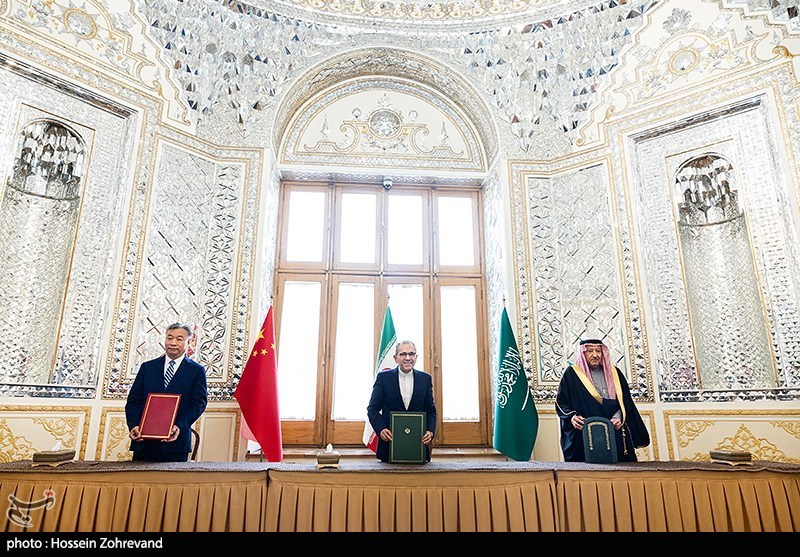
El-Khereiji is not a randomly selected deputy filling in for an absent principal, and understanding why he was chosen requires understanding the institutional architecture Saudi Arabia has built for its Iran relationship since the 2023 restoration. He chairs the Saudi side of the China-Saudi Arabia-Iran Trilateral Joint Committee, the mechanism established to implement the Beijing Agreement, and at the committee’s third meeting in Tehran on December 9–10, 2025, he sat opposite Iranian Deputy Foreign Minister Majid Takht-Ravanchi and Chinese Vice Foreign Minister Miao Deyu while the three delegations reaffirmed their “commitment to all provisions of the Beijing Agreement” and pledged “continued high-level contacts and mutual visits between Iranian and Saudi officials across sectors” (PRC Ministry of Foreign Affairs joint press release, December 10, 2025).
This institutional role anchors a two-track diplomatic architecture that Saudi Arabia operates with Iran. Track One runs through Prince Faisal and Araghchi at foreign minister level — high visibility, covering bilateral crises and public-facing diplomacy, last activated on June 25. Track Two runs through El-Khereiji and the trilateral committee at sub-FM level — lower visibility, covering the operational mechanics of the Beijing Agreement, the institutional plumbing that keeps the relationship functional even when Track One is under strain. The funeral visit and the condolence delivery both ran through Track Two, the same institutional layer through which Pakistan’s Foreign Minister Ishaq Dar briefed Prince Faisal on the outcome of the second Doha round of US-Iran talks — a channel defined by its proximity to operational detail rather than its political symbolism.
El-Khereiji’s selection was a deployment of the only Saudi official whose presence in Tehran could be explained through an existing mandate rather than a bespoke appointment, and whose rank carried royal authority without carrying the political weight of a ministerial visit. The trilateral committee gave Riyadh a built-in answer to any question about why it sent who it sent — El-Khereiji is the Iran channel, he was performing his institutional function, and the fact that the institutional function sits below the foreign minister is the architecture working exactly as designed. His arrival in Tehran for the funeral, unannounced and unremarked upon by Saudi state media until after the fact, carried the same quiet operational logic that characterised the December trilateral session seven months earlier.
What Does Addressing Pezeshkian Instead of Mojtaba Signal?
The Saudi condolence’s addressee carries as much diplomatic freight as its messenger’s rank. King Salman and Crown Prince MBS directed their message to President Masoud Pezeshkian — the elected head of the executive branch, whose constitutional legitimacy is settled and uncontested — not to Mojtaba Khamenei, who assumed the Supreme Leadership after his father’s death on June 30 and whose installation remains under pressure from Iran’s clerical establishment, the Assembly of Experts, and rival IRGC factions. Mojtaba lacks Grand Ayatollah status, had been in office fewer than five days when the condolence arrived, and faces an Assembly of Experts whose members — 62 of 88 — had called the Hormuz reopening under the MOU a “strategic mistake” before his father’s death. Addressing Pezeshkian routes the condolence through the constitutional office whose standing is unambiguous, avoiding any gesture that could be interpreted as formal recognition of a succession that is still consolidating its own domestic mandate.
Gulf states have used this addressee technique before during contested or ambiguous transitions — channelling condolences through the elected executive rather than staking a position on the power struggle above. The technique preserves Riyadh’s freedom of action in both directions: if Mojtaba’s hold weakens, Saudi Arabia has not prematurely endorsed him; if it solidifies, the condolence to Pezeshkian can be retroactively framed as standard protocol rather than a deliberate snub. The royal court’s silence on Mojtaba is sustained either way, and sustained silence toward a newly installed supreme leader is itself a position — one that every faction in Tehran’s internal power struggle will read through its own lens, whether as caution, hostility, or strategic patience.
The contrast with the last direct Saudi contact with the Supreme Leader’s office sharpens the point. Khalid bin Salman’s April 17 meeting with the elder Khamenei was conducted with a living Supreme Leader whose authority Riyadh recognised, carried a personal King Salman letter covering the full bilateral agenda, and was held at Defence Minister rank — the Crown Prince’s brother, a member of the ruling family, with an instrument from the King. Between April and July, the office changed hands, and the Saudi channel to it went dark. The condolence to Pezeshkian confirms that Riyadh has no intention of reopening it on Mojtaba’s terms, at least not yet, and not through this funeral.
Did China and Saudi Arabia Make the Same Calculation?
Beijing sent NPC Vice Chairman He Wei to the Khamenei funeral — sub-FM rank, the same diplomatic tier as El-Khereiji — and the parallel is too precise to be incidental in its effect, even if no formal coordination preceded it. China is the co-guarantor of the 2023 Beijing Agreement and the diplomatic architect of the Saudi-Iran restoration, which means Beijing’s rank choice set a calibration reference that Riyadh could match without appearing to undercut the funeral’s gravity or insult the Iranian government. If the agreement’s architect was comfortable sending a representative below foreign minister level, the agreement’s other signatory could do the same.
The rank match served a structural function for the trilateral committee that El-Khereiji chairs. All three members of the China-Saudi Arabia-Iran mechanism sent sub-FM representatives to the funeral: El-Khereiji for Saudi Arabia, He Wei for China, and Iran’s own deputy-level officials managing the ceremony. The trilateral architecture held its shape at the funeral, which means the institutional framework for implementing the Beijing Agreement survived the Supreme Leader’s death without any member escalating or downgrading beyond the pre-existing committee rank — a signal, directed as much at Washington and Doha as at Tehran, that the Beijing Agreement’s operational infrastructure remains intact even as its political context has been destabilised by Mojtaba’s succession and the ongoing US-Iran MOU negotiations.
Pakistan, by contrast, sent the highest possible delegation: Prime Minister Shehbaz Sharif and Army Chief General Asim Munir, the latter a co-signatory of Iran-Pakistan military cooperation agreements who carries dual credentials in both Islamabad and Tehran and whose funeral presence extended the diplomatic channel he had been building through the Doha rounds. The gap between Pakistan’s delegation rank and Saudi Arabia’s was among the largest at the funeral, and it reflected not disrespect from Riyadh but a structural difference in what each country needed from the event. Pakistan was claiming a seat at the next round of diplomacy; Saudi Arabia was establishing the limits of a seat it already holds — and letting Tehran’s own liturgical choices confirm how it views the difference.
The Verse Tehran Chose for the Saudi Delegation
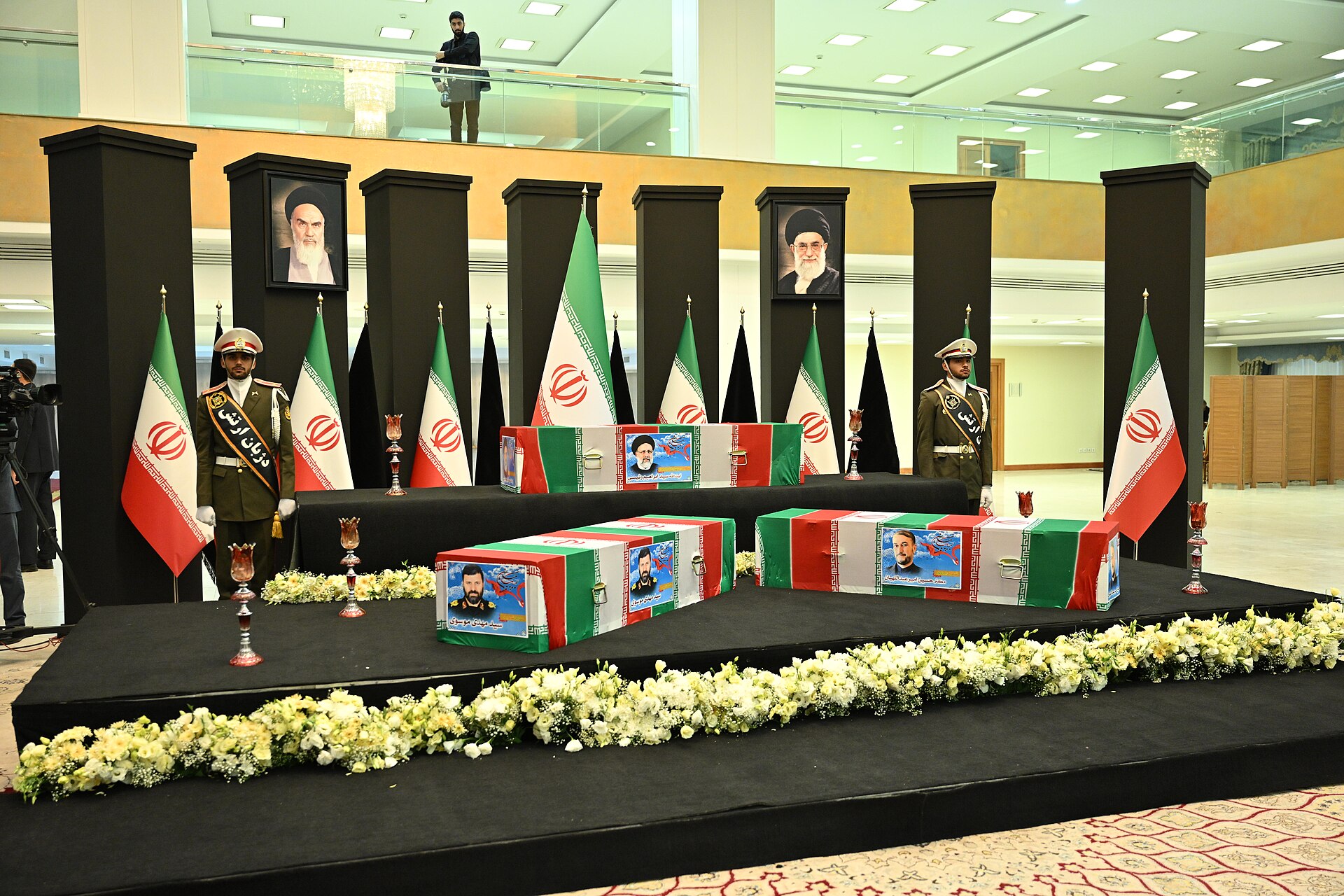
The Khamenei funeral’s liturgical choreography was as carefully staged as its guest list, and Iran used it to rank its visitors geopolitically through Quranic text — a form of diplomatic communication that operates below the threshold of formal statements but above the threshold of plausible deniability. When the Saudi delegation paid respects at Khamenei’s coffin, the verse recited was Al Imran 3:13, the Surah of the Battle of Badr, which describes one side “fighting in the cause of Allah” and the other as “disbelievers” who are defeated (Iran International, July 3). The verse invokes the foundational battle of Islamic history, a confrontation that ended in total victory for the Prophet’s forces against a numerically superior Quraysh army, and its selection for the Saudi delegation carried an edge that no amount of condolence-letter protocol could dull.
Saudi delegation’s Khamenei tribute overshadowed by controversial Quran verse
Iran International headline, July 3, 2026
Middle East Eye characterised the verse selections as a “theatre of state” in which Iran ranked visiting nations through Quranic taxonomy — resistance allies including Hamas, Hezbollah, and the Houthis received martyr and victory verses, while Saudi Arabia received a battle verse whose dual-edged interpretation positioned the Kingdom in shared Islamic memory but with the unmistakable implication of which side, in the Quranic telling, lost. Pakistan’s delegation received Surah Al-Isra 17:80, a personal prayer for “honourable entrance and honourable exit” — a verse so different in register from the Saudi selection that the contrast functions as Iran’s internal ranking made audible. Pakistan is a diplomatic asset whose relationship Tehran wants to deepen; Saudi Arabia remains an ambivalent actor whose presence is accepted within parameters that the verse, recited over a coffin, did nothing to soften.
Iran issued no hostile official statement about the Saudi attendance or the condolence. Pezeshkian accepted the message; Iranian armed forces commanders directed their public funeral rhetoric at “America and the criminal Zionist regime,” not at Saudi Arabia; and Iranian state media reported El-Khereiji’s visit matter-of-factly, without protest or editorial rebuke. The absence of an official Iranian objection is itself a diplomatic signal — Tehran accepted the calibrated gesture as falling within acceptable parameters, which means the limit that El-Khereiji’s rank established is one that both sides, for now, can live beneath. Whether they can live beneath it through August 18 is a different question, and one whose answer runs through a channel that has nothing to do with funeral protocol.
The Thread Riyadh Cannot Cut
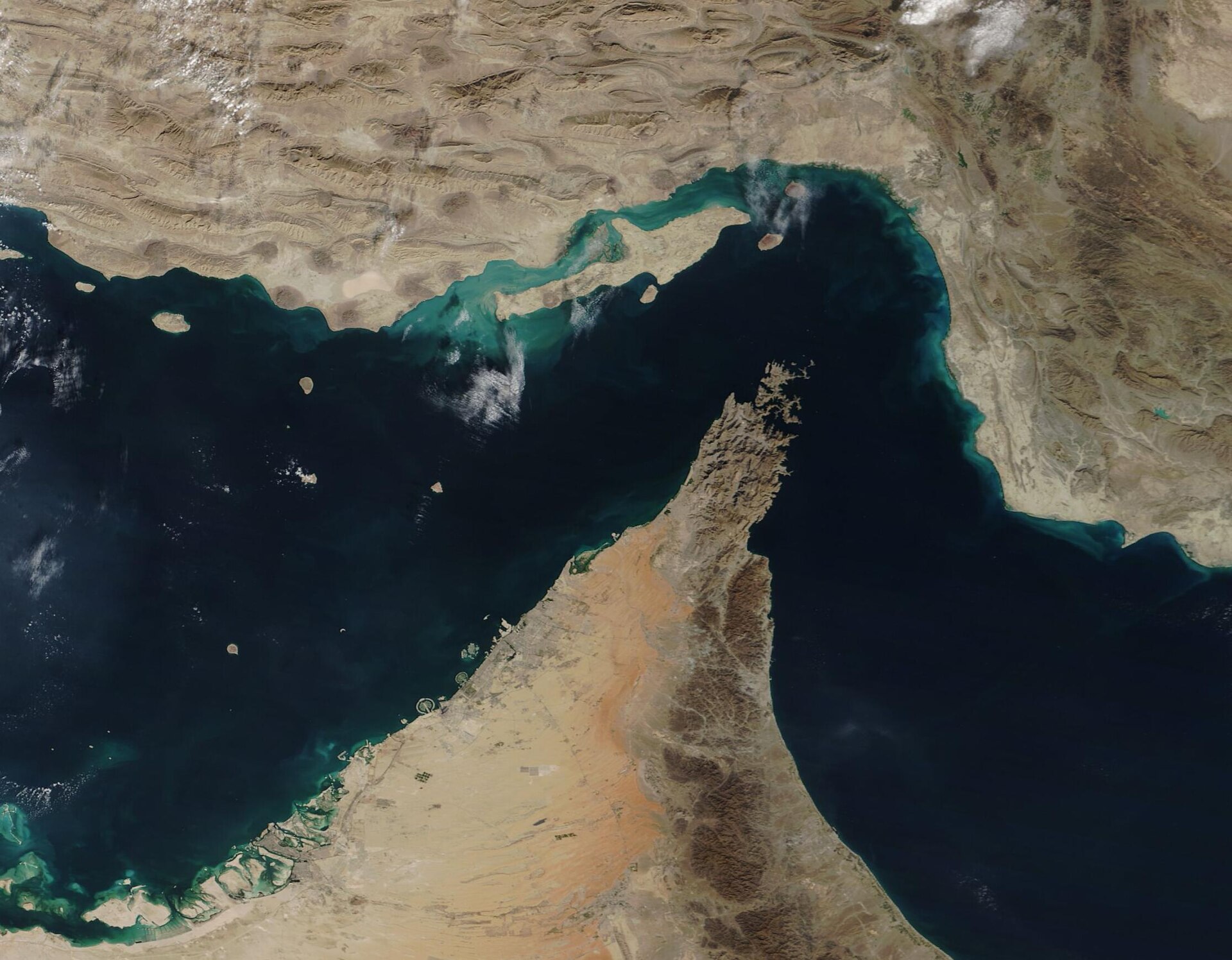
The calibrated distance of Saudi Arabia’s condolence masks a harder calculation: Riyadh needs the El-Khereiji channel more than the channel’s modest rank suggests, and the MOU timeline running between Washington and Tehran is the reason. The Iran-US Memorandum of Understanding signed on June 20 expires on Day 60, with the Persian Gulf Security Arrangement fee suspension lapsing on August 18, 2026 — forty-four days from El-Khereiji’s departure from Tehran. Saudi Arabia carries $253 million in total PGSA exposure at $5.5 million per day across the MOU window, exposure that continues to mount whether or not the deal produces an extension framework, and Riyadh holds no seat at the US-Iran negotiating table in Doha, no channel to Mojtaba Khamenei, and no military-to-military line of communication with the IRGC.
The military channel collapsed on March 22, 2026, when Saudi Arabia declared Iran’s military attaché and four staff personae non gratae — a response, issued twenty-four hours after the fact, to Iranian missile and drone strikes on Saudi civilian infrastructure. Embassies remained open in both capitals, but the military-to-military thread was severed, and the concurrent withdrawal of American troops and the degradation of the joint integrated air defence architecture compounded the problem: Saudi Arabia cannot deter Iran militarily on its own, cannot negotiate with Iran directly at the level that determines the MOU’s outcome, and cannot afford to let the only channel it does control atrophy during the remaining window that will determine whether the PGSA fees activate or whether both sides find a framework worth extending.
Prince Faisal acknowledged the underlying tension in a formulation that predates the funeral but explains its logic. “Recent hostilities had significantly eroded the trust” that emerged following the 2023 Beijing-brokered diplomatic restoration (The Print), a statement that describes both the condition of the relationship and the reason El-Khereiji’s channel remains structurally necessary despite that erosion. The trust is damaged — Saudi Arabia expelled military attachés, Iran struck Saudi infrastructure, and the Strait of Hormuz remains a contested space where Saudi tankers pay war-risk premiums and transit a Joint War Committee-designated Listed Area — but the channel persists because both sides need it to, and El-Khereiji’s funeral appearance was, in structural terms, a maintenance call on the only piece of diplomatic infrastructure Riyadh can service on its own terms.
The Ceiling Holds
MBS did not call Mojtaba, Faisal did not fly to Tehran, and the condolence reached Pezeshkian through El-Khereiji — filed through the trilateral channel at sub-FM rank, directed at the elected president rather than the newly installed Supreme Leader, timed to land during maximum funeral visibility without producing a single photograph of a Saudi minister standing alongside Mojtaba Khamenei. The two-part condolence instrument, the rank inversion from the Raisi precedent, the unannounced arrival, and the addressee choice function as a single integrated architecture — one that carries royal imprimatur while insulating it behind a deputy who chairs a committee and holds no portfolio beyond the channel he was sent to maintain.
El-Khereiji stood at the coffin while the Battle of Badr was recited over the Saudi delegation, delivered the King’s message to the president, filed the written letter for the dead Supreme Leader, and left Tehran with the channel intact. Whether the ceiling he established there survives the forty-four days to August 18 is a question that neither the trilateral committee mandate nor the funeral protocol can answer, and Faisal — whose absence from Tehran was as carefully chosen as El-Khereiji’s presence — will be watching from Riyadh as the answer takes shape in places he did not go.
Frequently Asked Questions
Has any Gulf Cooperation Council state formally recognised Mojtaba Khamenei as Supreme Leader?
No GCC member state had issued formal recognition of Mojtaba Khamenei’s succession as of July 5, 2026. The UAE and Bahrain were absent from the funeral entirely — neither sent representatives at any rank — while Oman and Qatar sent delegations but directed their condolences through the Iranian Foreign Ministry or President Pezeshkian’s office rather than addressing Mojtaba directly. The recognition gap mirrors the broader international uncertainty around a succession that the Assembly of Experts ratified under contested circumstances, with 62 of 88 members having publicly criticised the strategic direction their votes were expected to endorse.
When did Saudi Arabia last sever diplomatic ties with Iran?
Saudi Arabia severed ties in January 2016 after protesters stormed the Saudi embassy in Tehran and the consulate in Mashhad following Saudi Arabia’s execution of Shia cleric Sheikh Nimr al-Nimr. The seven-year estrangement ended only with the March 10, 2023 Beijing Agreement, brokered by Chinese President Xi Jinping, which restored diplomatic relations and revived a dormant 2001 Security Cooperation pact and a 1998 General Cooperation Agreement. Iran reopened its embassy in Riyadh by June 2023, and over 85,000 Saudi Hajj pilgrims and 210,000 Umrah pilgrims received Iranian consular cooperation in 2025 — an operational metric that survived the February-March 2026 military exchanges.
What happens to Persian Gulf shipping fees on August 18?
The Persian Gulf Security Arrangement fee suspension, agreed as part of the June 20 MOU between the United States and Iran, expires on Day 60 — August 18, 2026. If the MOU lapses without extension, Iran’s IRGC Navy retains the option to reimpose transit fees on commercial shipping transiting the Strait of Hormuz, a mechanism that the Office of Foreign Assets Control sanctioned on May 27 and that the second Doha round of talks failed to resolve. Secretary of State Marco Rubio has called the fee structure a “game of semantics” that Washington will “never” accept, while Iran frames the charges as lawful “service fees” under UNCLOS Article 26(2) — a legal framing that Oman has offered to help develop into a formal governance regime.
How many times has the China-Saudi Arabia-Iran Trilateral Committee met?
The committee has met three times since its creation under the March 2023 Beijing Agreement: first in Beijing in December 2023, second in November 2024, and third in Tehran on December 9–10, 2025. El-Khereiji led the Saudi delegation at the third meeting, establishing the precedent of sub-FM chairmanship that carried into his funeral attendance seven months later. The committee’s mandate covers implementation of the Beijing Agreement’s provisions on diplomatic normalisation, security cooperation, and the revival of the 1998 General Cooperation Agreement — making it the most structurally embedded Saudi-Iran institutional channel outside the foreign minister track.