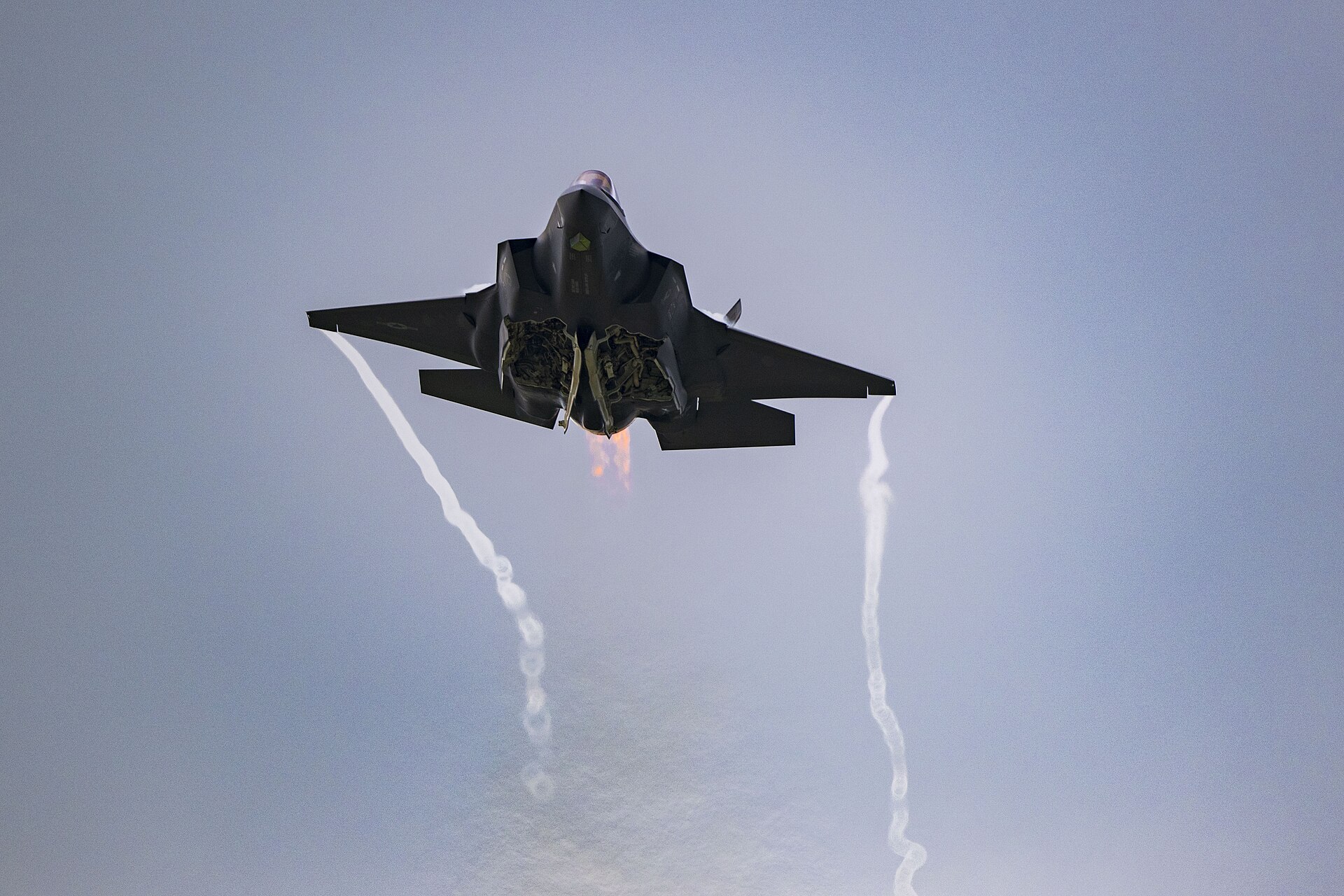

WASHINGTON — The State Department notified Congress on September 17 of a proposed $24.3 billion sale of 48 F-35A Lightning II fighters to Saudi Arabia. In the eleven days since — while Iranian missiles have struck Saudi territory, while PAC-3 interceptor stocks sit at 86 per cent depleted, while the Strait of Hormuz faces its most dangerous weeks in a generation — no floor vote has been scheduled in either chamber, no committee markup has been called, and only one senator, Rand Paul of Kentucky, has introduced a joint resolution of disapproval targeting the sale. In the entire history of the Arms Export Control Act, Congress has never successfully blocked a proposed arms sale through the joint-resolution mechanism.
Paul’s resolution sits in the Senate Foreign Relations Committee without a date. The other two resolutions filed by Democrats address a separate $5 billion conventional-bomb package rather than the F-35 deal, and the 30-day review clock expires around October 17. The structural arithmetic of a Republican-majority Congress working with the administration that approved the sale makes this review window a courtesy rather than a checkpoint, and barring something without precedent in American legislative history, forty-eight stealth fighters will be approved by silence.
Table of Contents
- How Does Congress Actually Block an Arms Sale?
- What Has the Senate Done in Eleven Days?
- The Wrong Fighter for the War Saudi Arabia Is Fighting
- What Does Huawei on a Saudi Air Base Mean for the F-35?
- Does Israel’s Objection Change Anything?
- Why the Arithmetic Makes Silence Inevitable
- What Washington Believes Saudi Arabia Is For
- Frequently Asked Questions
How Does Congress Actually Block an Arms Sale?
Under the Arms Export Control Act’s Section 36(b), the State Department must formally notify Congress of any proposed Foreign Military Sale above a certain threshold, and Congress then has 30 calendar days to pass a joint resolution of disapproval. The word “joint” is where the process stalls, because a joint resolution requires passage in both chambers in identical form and must survive a presidential veto — meaning opponents need two-thirds supermajorities in both the House and the Senate to override. Before the Supreme Court’s 1983 INS v. Chadha ruling, Congress used concurrent resolutions that needed only simple majorities and no presidential signature, but that mechanism was struck down four decades ago, and every arms-sale review since has operated under the higher threshold.
The practical effect, across forty years and dozens of major sales to Saudi Arabia, Israel, the UAE, and other partners, is that the mechanism has never once produced a successful block. The closest Congress has come was in 1986, when the Senate passed S.J.Res. 316 to block a $354 million missile sale to Saudi Arabia — a sum that looks almost quaint next to the current $24.3 billion F-35 notification. President Reagan vetoed the resolution, and the override vote fell one short: 66 to 34, one vote shy of two-thirds, the high-water mark of congressional resistance to Saudi arms sales in the era of the joint resolution, according to CRS Report R47094.
The September 17 notification covered 48 F-35A fighters and 49 Pratt & Whitney F135-PW-100 engines — 48 installed, one spare — along with secure communications, cryptographic equipment, electronic-warfare database support, software, simulators, training, and maintenance, according to the Defence Security Cooperation Agency. The Trump administration used the normal 30-day process rather than the emergency bypass Secretary of State Pompeo invoked in 2019 for $8.1 billion in Saudi and UAE sales, a decision that reads as confidence: the standard procedure was never the obstacle, and the clock, once started, runs in the seller’s favour.
What Has the Senate Done in Eleven Days?
Three joint resolutions of disapproval have been introduced since the State Department’s September 17 notification, and the gap between what they target and what they leave alone tells the story as clearly as their text. S.J.Res. 216, introduced by Senators Ed Markey, Jeff Merkley, and Bernie Sanders on the same day as the notification, takes aim at a separate $5 billion conventional-bomb sale — part of the broader Saudi defence relationship, but not the F-35 deal. S.J.Res. 217, introduced by Rand Paul on September 24, is the only resolution targeting the F-35 sale specifically, and Paul is the sole Republican to have put his name to any of the three, according to GovInfo and the FMEP Legislative Round-Up published September 25.
The Middle East briefing 3,000+ readers start their day with.
One email. Every weekday morning. Free.
Both resolutions have been referred to the Senate Foreign Relations Committee, and neither has a markup date. Paul’s resolution merits scrutiny not because it can pass — it cannot — but because it isolates what opposition to a Saudi arms sale looks like when nobody else is willing to provide it. Paul objects to arms transfers to Riyadh on a principle he has held for years, and his filing tells you about his foreign-policy convictions and almost nothing about the Senate’s collective judgment on whether Saudi Arabia should fly the most advanced fighter in the American inventory. The senators who have debated America’s Gulf posture throughout the war — who have watched US installations in four countries absorb Iranian strikes, who have received classified briefings on the DIA’s technology-transfer concerns — have chosen not to file their own resolutions, not to request hearings, and not to push the committee toward a markup.
“Using U.S.-made weapons to fuel a devastating war.”
Senator Ed Markey, on Saudi Arabia — applied to the $5 billion bomb sale, not the $24.3 billion F-35 deal
Markey’s framing, and the silence from every other Democrat who has spent years publicly opposing Saudi arms sales, carries a particular weight when set against the F-35 notification he did not target. The technology-transfer objections were flagged at notification. The DIA’s classified assessment of Chinese intelligence vectors through Saudi digital infrastructure was reported by NBC News before the review window opened. The Israeli Air Force formally submitted objection papers to Israel’s political leadership, according to the Times of Israel. None of this was secret, all of it was available to the members who chose not to act, and the eleven days of silence that followed represent the Senate’s answer to a question it decided not to ask out loud.
The Wrong Fighter for the War Saudi Arabia Is Fighting
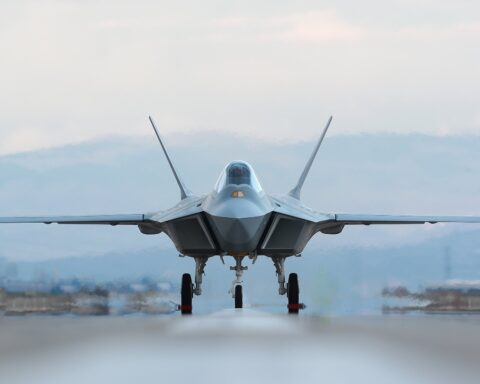
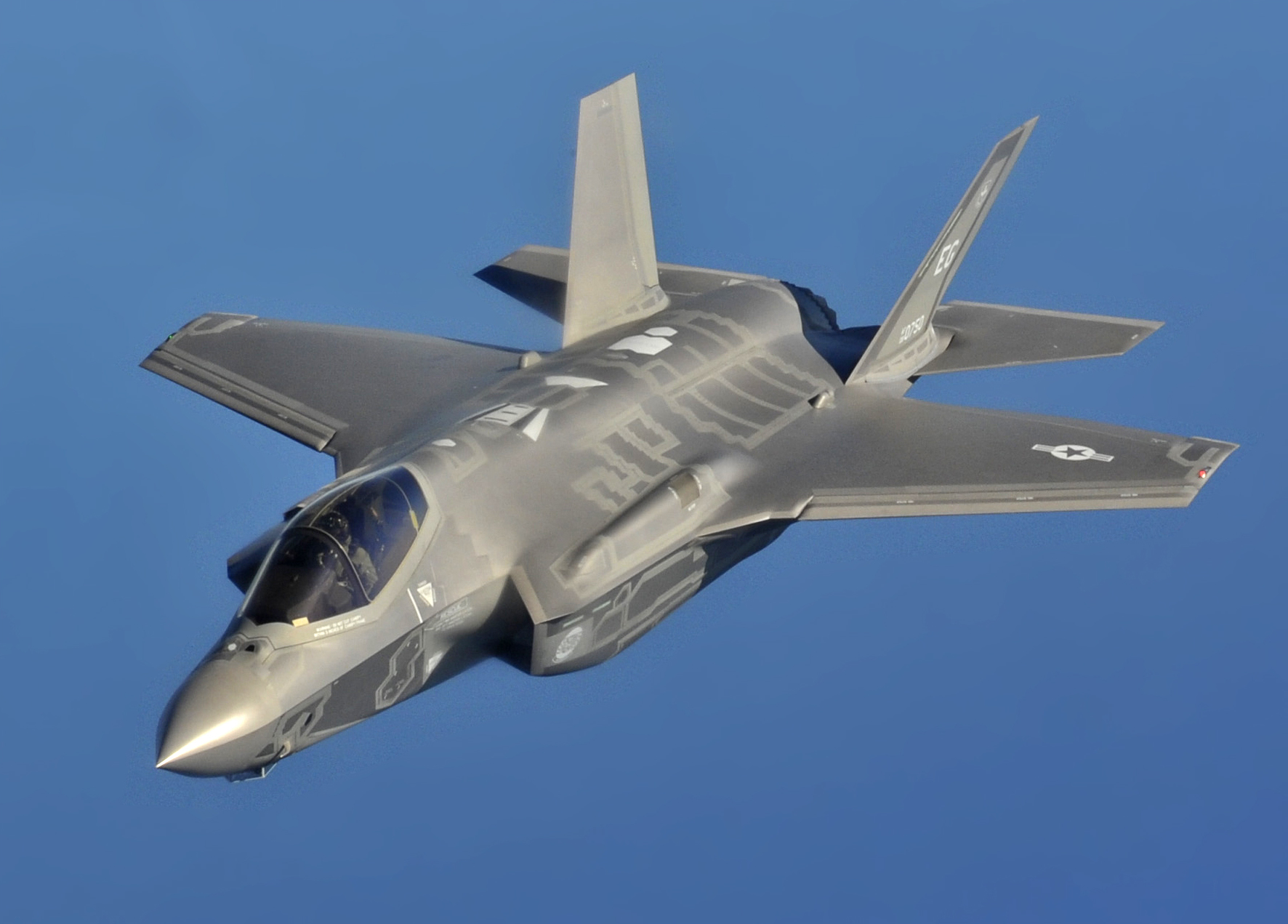
The F-35A is a fifth-generation stealth fighter built for offensive air superiority and deep-strike missions, a platform designed to establish dominance in contested airspace against near-peer opponents. It is not a counter-drone system, not an interceptor, and not the answer to a threat environment defined by Iranian ballistic missiles, Houthi UAVs, and a Saudi air-defence inventory that has been nearly exhausted.
“Sensors, interceptors, counter-UAV capabilities, and integrated air and missile defence.”
Defence Security Asia, 2026 — what Saudi Arabia needs, and none of what the F-35 provides
The mismatch between what Riyadh needs and what the sale delivers is arithmetical. Saudi forces fired approximately 2,400 PAC-3 interceptors in roughly 38 days of intensified Iranian operations, consuming an estimated 86 per cent of their inventory and leaving approximately 400 missiles, according to Defence Security Asia. The sole Western PAC-3 MSE assembly line, operated by Lockheed Martin, produced roughly 620 interceptors in all of 2025 — meaning Saudi Arabia’s 38-day expenditure was equivalent to nearly four years of global production. The air-defence architecture that was supposed to protect Saudi airspace has been consumed by a conflict the F-35 was never designed to fight, and the interceptors Riyadh urgently needs are on a production line that cannot manufacture them fast enough to replace what has already been fired.
The first operational Saudi F-35 squadron is not expected until approximately 2032 to 2035, according to Army Recognition and MiGFlug Afterburner — a timeline that places the platform’s operational debut somewhere between six and nine years from now, well beyond any plausible horizon for the current war. No hearing has been scheduled to ask whether the delivery timeline makes sense for a country whose present-force stockpile has been gutted, and no committee has demanded that DSCA explain the logic of a $24.3 billion future-force acquisition when the weapons Saudi Arabia needs today are on backorder.
The F-35 notification is one component of a broader $142 billion defence package tied to the US-Saudi Strategic Defence Agreement — an agreement that, as HOS has reported, commits the United States to sell weapons to Saudi Arabia, not to use them on Riyadh’s behalf. The jets fit the SDA’s commercial logic precisely: they extend the dependency relationship by decades, because the F-35 requires American maintenance, software updates, spare parts, and permission to integrate weapons, locking Saudi Arabia into the Lockheed Martin and Pratt & Whitney supply chain for the operational life of the aircraft. That life is designed to extend into the 2060s, which means the commercial relationship the sale establishes will outlast the current war, the current administration, and very likely the current reign.
What Does Huawei on a Saudi Air Base Mean for the F-35?
A classified Defence Intelligence Agency assessment, reported by NBC News and the New York Times in September 2026, identified specific pathways through which China could acquire F-35 stealth technologies via Saudi Arabia’s economic and security partnerships with Beijing. The DIA assessed “Chinese personnel’s access to Saudi bases and Chinese equipment in the kingdom’s telecommunications networks” as the primary intelligence exposure vectors — not hypothetical future risks, but descriptions of infrastructure and personnel already present on Saudi soil.
Two installations anchor the concern. Huawei opened a cloud facility in Riyadh in 2023 that supports Saudi government services and artificial-intelligence applications, according to NBC News. China Telecom launched a project in 2024 delivering 5G, cloud computing, and AI services to Saudi government institutions. Both were cited in the DIA assessment as channels through which Chinese intelligence could access sensitive military data — and the F-35, which depends on classified sensor-fusion architecture, encrypted communications, and electronic-warfare databases updated through secure networks, would eventually sit inside that same digital environment.
The precedent for this category of concern already exists. Turkey was removed from the F-35 programme in 2019 after purchasing Russia’s S-400 air-defence system, on the grounds that Russian military hardware on the same bases as F-35s created an unacceptable intelligence-collection risk. The Chinese infrastructure in Saudi Arabia raises the same fundamental question, but with a complication the Turkish precedent does not address: the Huawei and China Telecom installations are not discrete military hardware that can be pointed to and removed — they are embedded in civilian telecommunications and cloud-computing systems that Saudi government institutions already rely on, and their extraction would require a restructuring of Saudi digital infrastructure that neither Riyadh nor Beijing has any interest in undertaking.
Congress has access to the full classified assessment. The Senate Foreign Relations Committee, which holds jurisdiction over the Paul and Markey resolutions, has the clearance to review it. In eleven days, no senator has requested a hearing to examine whether the technology-transfer risk is containable, whether the conditions attached to the FMS notification address the scenarios the DIA warned about, or whether the mitigation approach Washington applied to Turkey’s S-400 purchase can be adapted to a Chinese digital-infrastructure problem that is structurally different and arguably harder to solve.
Does Israel’s Objection Change Anything?
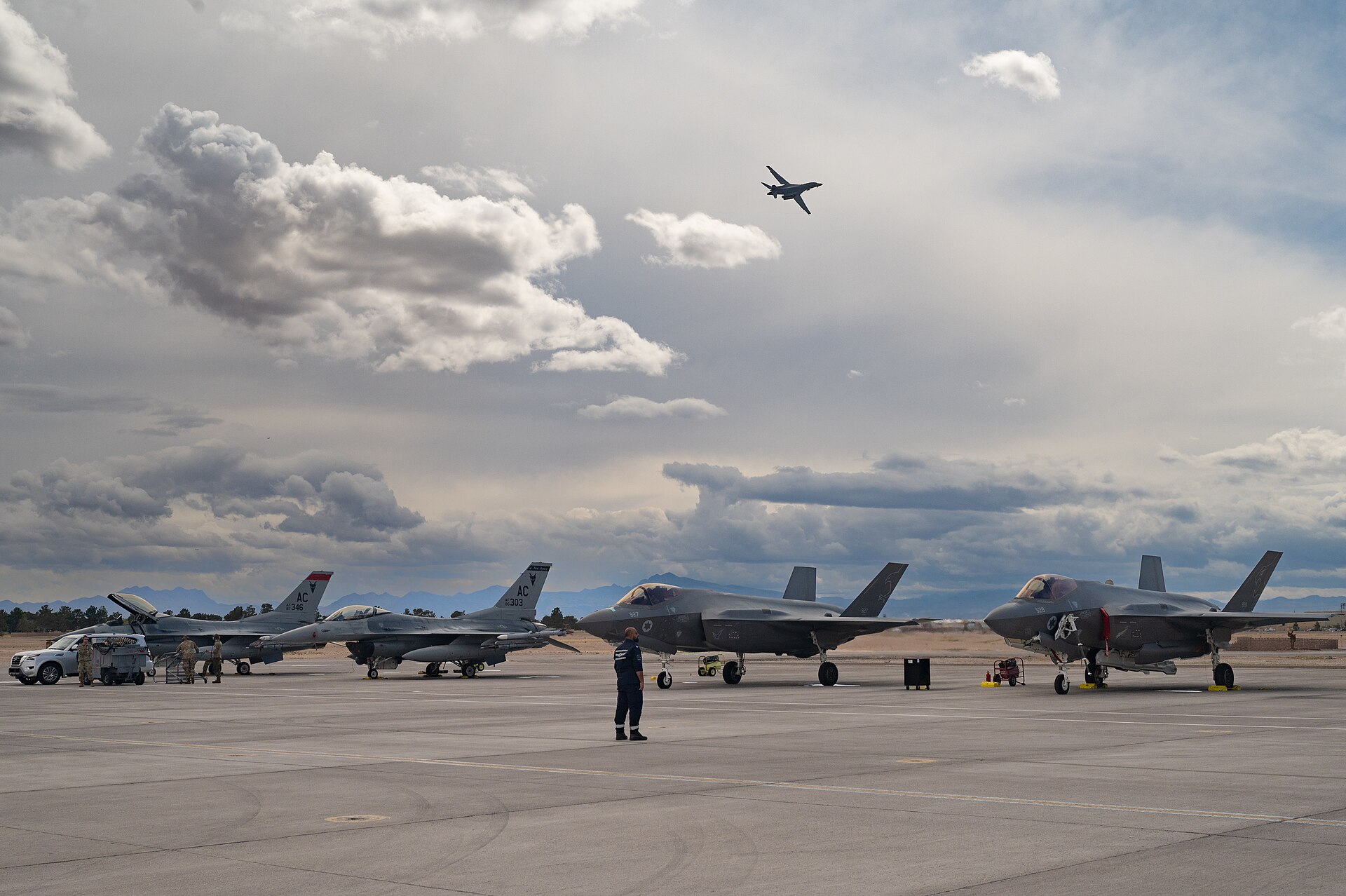
The Israeli Air Force formally submitted objection papers to Israel’s political leadership, expressing concern that the sale would erode the air superiority Israel has maintained unchallenged in the region for decades, according to the Times of Israel. Israel has flown the F-35 — designated the “Adir” — since 2017, and Saudi Arabia would become the first Arab state and the second Middle Eastern country to operate the platform. The IDF’s opposition is on the record, but the American response has been to build the qualitative-military-edge constraints into the aircraft itself rather than to block the sale.
The Saudi F-35s will ship without access to source code, without the ability to independently integrate domestically developed weapons, and likely without the Block 4 upgrade — which includes a new radar, expanded missile capacity, additional weaponry, and advanced electronic-warfare capabilities, according to Eurasian Times, Israel Hayom, and Air Data News. The package also excludes the AIM-260 JATM, the long-range air-to-air missile with a range exceeding 200 kilometres that an unnamed expert told the Eurasian Times “will likely be offered only to Israel.” The result is a two-tier F-35 programme in the Middle East: Israel’s full-capability Adir against a Saudi variant locked out of the upgrades and weapons integrations that define the platform’s operational edge.
The Gulf International Forum assessed that the deal “redrew the monopoly in the skies” but concluded that constrained capabilities delay any operational shift on the qualitative military edge until the early 2030s. Inside Israel, the politics split along institutional lines — the military opposes the sale on air-superiority grounds, while the political leadership appears willing to accept the constraints as sufficient to preserve the gap, per the Times of Israel. Congress, which holds a statutory obligation under QME requirements to ensure that regional arms sales do not erode Israel’s advantage, has not convened a hearing to assess whether the constraints are permanent, whether they survive future Saudi lobbying, or whether the exclusion of the AIM-260 and Block 4 is contractually binding or merely an initial configuration that can be renegotiated once the aircraft are delivered and the dependency is established.
Why the Arithmetic Makes Silence Inevitable
Republicans hold the majority in both chambers of Congress, the Trump administration approved the sale and notified Congress through the normal 30-day process, and the president who signed the notification would veto any joint resolution of disapproval that reached his desk. Opponents would need two-thirds supermajorities in both the House and the Senate to override — a threshold that has defeated every attempt to block a Saudi arms sale in the four decades since INS v. Chadha restructured the mechanism in 1983.
| Year | Sale | Value | Congressional Action | Result |
|---|---|---|---|---|
| 1986 | Missiles to Saudi Arabia | $354M | Senate passed S.J.Res. 316 | Reagan vetoed; override failed 66-34 |
| 2019 | 22 sales to Saudi/UAE/Jordan | $8.1B | Emergency bypass; 22 resolutions filed | All resolutions failed |
| 2026 | 48 F-35A to Saudi Arabia | $24.3B | S.J.Res. 217 (Paul) in committee | No markup (Day 11 of 30) |
The 1986 vote remains the only time Congress has cleared even the first hurdle of passing a disapproval resolution, and it still did not produce a block — Reagan vetoed, and the override fell one short at 66 to 34. In 2019, when Pompeo bypassed the 30-day review entirely for $8.1 billion in sales to Saudi Arabia, the UAE, and Jordan, seven senators from both parties — Young, Menendez, Graham, Murphy, Paul, Leahy, and Reed — introduced 22 separate resolutions of disapproval, and every one of them failed. The bipartisan outrage existed, the procedural grievance was real, and the votes were not there.
The Trump administration’s choice in 2026 to use the normal review process was itself a measure of how little resistance it anticipated. The emergency bypass was available and tested, but the standard procedure posed no threat worth circumventing — inaction is the default outcome of the 30-day window, and the mechanism was rebuilt after Chadha to function precisely this way. A Republican-majority Congress working in alignment with an administration whose broader Saudi strategy includes a $142 billion defence package was never going to produce the supermajority needed to override a veto on a deal the president considers a centrepiece of his Middle East agenda.
When the review window opened on September 17, the question was not whether Congress would block the sale but whether anyone would force a vote that creates a public record of where each member stands on giving Riyadh the F-35 while Saudi air defences are depleted and Chinese telecoms infrastructure sits on Saudi government networks. Paul answered for himself on September 24, and the other 534 members of Congress have answered by choosing a silence that doubles, under the AECA’s rules, as consent.
What Washington Believes Saudi Arabia Is For
Trump signalled his approval of the F-35 sale publicly in November 2025, shortly before MBS visited Washington, according to Al Jazeera — a political commitment that preceded the formal DSCA notification by approximately ten months. The sale was not a wartime reaction or an emergency decision forced by Iranian escalation; it was a commercial and strategic arrangement whose timeline predated the conflict and whose delivery schedule, extending into the mid-2030s, will outlast any plausible conclusion to it. The F-35 notification belongs to the same period in which the broader Strategic Defence Agreement was being shaped, a package The Aviationist valued at $142 billion and of which the 48 fighters are a single line item.
Congress’s silence on that line item — the most technologically sensitive and geopolitically consequential weapon in the American inventory — reads less as oversight failure and more as consensus. A country whose military installations were under active Iranian attack might warrant the kind of emergency floor debate that Ukraine’s war produced in both chambers. A country whose interceptor stockpiles were nearly exhausted might prompt urgent appropriation hearings on production capacity. Instead, the legislative branch treated the F-35 notification as a commercial transaction requiring neither examination nor discussion, a posture consistent with Washington’s broader categorisation of Saudi Arabia as a defence-market client rather than a treaty ally. Marco Rubio defended the broader deal even as his own prior legislation would have constrained it, and that contradiction sat in the open without a single committee requesting an explanation.
The IRGC has already started working to undermine the deterrence premium the F-35’s price tag is supposed to buy. The IRGC Aerospace Force previously claimed to have tracked a US F-35 over the Strait of Hormuz, a messaging effort that CriticalThreats.org assessed as designed “to strengthen regime legitimacy and reassure regional partners that Tehran retains capacity to impose costs against technologically superior adversaries.” Whether the claim is credible matters less than the timeline it exploits: Iran has six to nine years before the first Saudi F-35 flies an operational sortie, which is six to nine years to develop counter-measures, refine the narrative that stealth is penetrable, and remind every Gulf state watching the war that the platform Riyadh has committed $24.3 billion to purchase will not change the air-defence arithmetic until well into the next decade.
The review window closes around October 17. Rand Paul sits alone in committee without a markup date, representing an opposition that is principled, consistent, and numerically irrelevant. When the clock runs out, forty-eight F-35s will proceed toward a country that cannot currently defend itself with the weapons it already owns, approved by a legislature that watched a war for eleven days and found nothing worth saying.
Frequently Asked Questions
Has the United States ever sold F-35s to a country with Chinese telecommunications infrastructure?
No. Saudi Arabia would be the first F-35 customer to operate the platform alongside active Huawei and China Telecom installations serving government networks. Turkey was removed from the programme in 2019 over Russian military hardware — the S-400 air-defence system — but the Chinese digital-infrastructure question represents a different category of risk. The Huawei and China Telecom installations are embedded in civilian telecommunications and cloud-computing systems, which are structurally harder to isolate than a discrete military purchase, and the Joint Strike Fighter programme has no established protocol for managing that kind of exposure.
How many countries currently operate the F-35?
As of 2026, the F-35 is operational with the United States, Israel, the United Kingdom, Italy, Norway, the Netherlands, Australia, Japan, South Korea, Denmark, Belgium, Poland, Finland, Singapore, and several additional partner nations. Saudi Arabia would become the first Arab state and the second Middle Eastern operator after Israel. Turkey was a Tier 3 industrial partner in the original Joint Strike Fighter programme and contributed manufacturing components before its removal in 2019 — a sequence that demonstrates how programme participation, once established, can still be revoked if Washington determines the security conditions have changed.
What is the difference between S.J.Res. 216 and S.J.Res. 217?
S.J.Res. 216, introduced by Senators Markey, Merkley, and Sanders on September 17, targets a separate $5 billion conventional-bomb sale to Saudi Arabia, not the F-35 deal. S.J.Res. 217, introduced by Rand Paul on September 24, is the only resolution addressing the $24.3 billion F-35 sale specifically. The distinction is revealing because the Democratic senators most publicly associated with opposing Saudi arms transfers concentrated their legislative effort on the cheaper, less consequential munitions package rather than the generational fighter-aircraft programme that carries five times the price tag and substantially greater technology-transfer implications.
What did the 2019 Yemen emergency bypass establish as precedent?
In May 2019, Secretary of State Pompeo invoked the AECA’s emergency provision to skip the 30-day review for 22 separate arms sales totalling $8.1 billion to Saudi Arabia, the UAE, and Jordan, citing Iranian threats as justification. A bipartisan coalition of seven senators — Young, Menendez, Graham, Murphy, Paul, Leahy, and Reed — filed 22 matching resolutions of disapproval, all of which failed. The episode proved that even bipartisan procedural outrage could not produce the votes to block Saudi arms transfers, and it gave the Trump administration in 2026 the confidence to use the standard 30-day process, knowing the normal mechanism had never been an obstacle.
Could a future administration restrict the Saudi F-35 programme after the review window expires?
Yes, through several channels. Congress retains the ability to restrict funding for specific sales through annual defence-appropriation legislation even after the AECA review period closes. A future president could suspend or cancel a Foreign Military Sales case, though no president has revoked a major Saudi arms sale after congressional review. More practically, the F-35’s decades-long maintenance and upgrade cycle — encompassing software updates, spare parts, engine overhauls, and potential Block 4 access — gives every subsequent administration continuous leverage over the aircraft’s operational capabilities without needing to reverse the original sale.