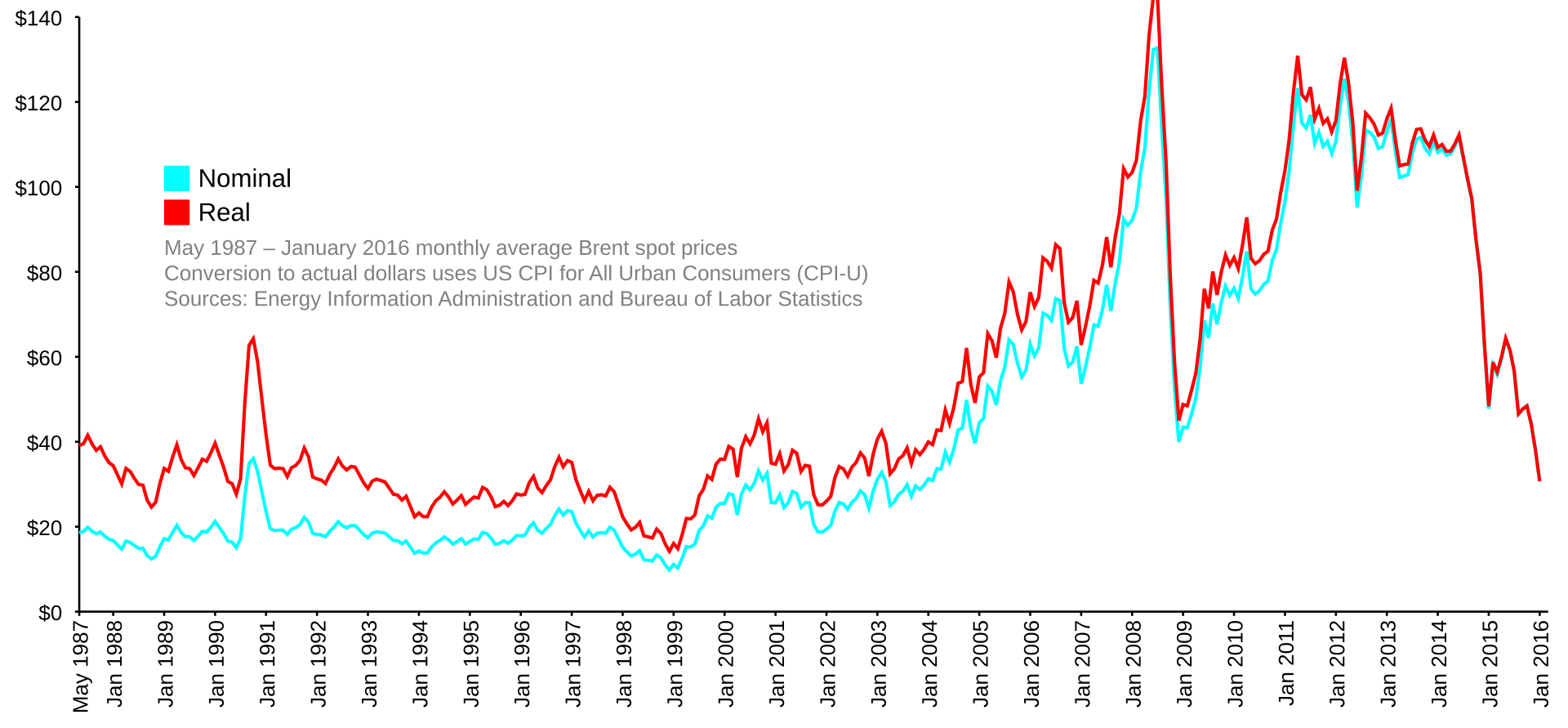
DHAHRAN — Brent crude touched $114.47 per barrel at 0639 GMT on Wednesday, its highest level since May, after Houthis claimed strikes on Saudi Arabia’s Defence Ministry and two airports in a single morning — and the producer whose wrecked infrastructure is pricing every dollar of that fear premium cannot load enough tankers to collect it. Saudi Arabia pumped 8.3 million barrels per day in September according to the International Energy Agency, still 2.18 mb/d below its OPEC+ target, a gap worth roughly $249 million a day at the current price.
The barrels actually selling at $114 belong to the UAE, which hit a record 5.3 mb/d in September, to Iraq, which added 386,000 bpd, and to every other producer whose terminals and tanker routes stayed open while Saudi Arabia’s did not. Aramco has told European customers there will be no October oil, the Strait of Hormuz has narrowed from 85 tanker transits a day to four, and the East-West pipeline — Saudi Arabia’s bypass around the chokepoint — restarted on September 22 but is weeks from full throughput. The fear premium is real, but the revenue is flowing to Abu Dhabi and Basra, not to Ras Tanura.
Table of Contents
- Who Is Selling Oil at $114?
- The Volume That Vanished
- Why Can Saudi Arabia Not Get Its Oil to Market?
- The Freight Tax on What Remains
- How Much Revenue Is Saudi Arabia Losing Each Day?
- The Collectors
- Is Iran Profiting From the Premium It Created?
- What Does the OPEC+ November 1 Meeting Change?
- The Strategic Reserve Countdown
- A War Without Precedent
- Frequently Asked Questions
Who Is Selling Oil at $114?
Producers outside the war zone — the UAE at a record output, Iraq at approximately 3.9 mb/d after a 386,000 bpd surge, US shale, Norwegian offshore, and Brazilian pre-salt — are shipping into a $114 market that Saudi Arabia’s infrastructure damage created but Saudi Arabia cannot service. Gulf crude exports recovered to 13.9 mb/d in September according to the IEA, but Saudi Arabia accounted for a shrinking share of that total.
The House of Saud Daily Briefing
Saudi Arabia's news in 3 minutes, every morning. Free. See today's issue
The IEA’s October Oil Market Report confirmed the rebound but added a warning: it was “unclear how far the rebound has withstood a new wave of Iranian attacks on tankers transiting Hormuz.” Those attacks have included an IRGC claim of seven tankers damaged in a single overnight period on October 21, a figure that UKMTO confirmed for only two vessels. Whether the number is two or seven, every incident pushes insurance premiums higher, VLCC spot rates further into six figures, and more cargo toward producers who do not require a Hormuz transit to reach open water.
The distinction determines who benefits from the next leg up. If Brent reaches $120 or $130 on further disruption, Saudi Arabia gains nothing unless it can move crude to a loading terminal and onto a tanker. Abu Dhabi, which exports much of its crude from Fujairah on the Gulf of Oman — outside the Strait of Hormuz — faces none of those constraints, and its September output broke every record the country has set. Brent’s September monthly average of $114 per barrel, a $23 jump from August according to the EIA, is a price that exists because Saudi barrels are missing, and non-Saudi producers are filling the gap at that price.
The Volume That Vanished
Saudi Arabia entered the war producing at roughly its OPEC+ target of 10.5 mb/d. By August, output had collapsed to 5.97 mb/d — a loss of more than 4.5 million barrels per day, or roughly 4.5 percent of global supply. Houthi missile and drone strikes had damaged terminals, storage farms, and the distribution network connecting wellheads in the Eastern Province to loading berths on the coast. The IEA’s October report showed a partial recovery to 8.3 mb/d in September, but even that improvement left the kingdom 2.18 mb/d short of its target and 3.81 mb/d below its sustainable production capacity of 12.11 mb/d.
Fresh attacks on Saudi Arabia threatening to derail a recovery on the supply side.
International Energy Agency, Oil Market Report, October 2026
The September rebound was real but built on a single chokepoint. Gulf crude exports rose 4.4 mb/d to 13.9 mb/d, reaching what the IEA called “over 75 percent of pre-war levels,” and Saudi Arabia contributed to that recovery primarily through its East-West pipeline — which before the September 12 attacks had been carrying more than 5.0 mb/d of crude to Yanbu on the Red Sea coast, bypassing Hormuz entirely. When the pipeline was struck and halted on September 12, Saudi exports through that bypass fell to near zero until the line restarted ten days later.
The pipeline’s design capacity is 7 mb/d. Reuters reported at the time of the restart that full throughput could take six or more weeks, placing the earliest return to pre-attack levels in early November. Current pipeline throughput has not been publicly disclosed by Aramco or the Saudi energy ministry, and that missing number is the single most consequential unreported figure in the oil market right now. North Sea Dated crude, the IEA’s benchmark for European-delivered cargoes, averaged $116.89 per barrel in September — $26.17 above the prior month — and the question of whether Saudi supply can recover before October’s price trajectory cements is one that only the pipeline data can answer.
Why Can Saudi Arabia Not Get Its Oil to Market?
Saudi Arabia faces three simultaneous export bottlenecks, and none of them can be fixed by higher prices alone. The IRGC mine blockade has reduced Hormuz to a fraction of its pre-war capacity, the East-West pipeline to Yanbu runs below its 7 mb/d design capacity after the September attacks, and Houthi strikes have damaged Red Sea coastal infrastructure and the logistics chain connecting oilfields to ports.
Hormuz is the core constraint. CENTCOM has acknowledged that 135 ships have turned around since the blockade began on July 14, and the daily transit count has collapsed to single digits — each vessel threading a narrow swept channel under minesweeper escort. Insurance underwriters have priced Hormuz war risk at 10 percent of hull value, a cost that can add tens of millions of dollars to a single VLCC voyage and has made some flag states and P&I clubs refuse Gulf-origin coverage altogether.
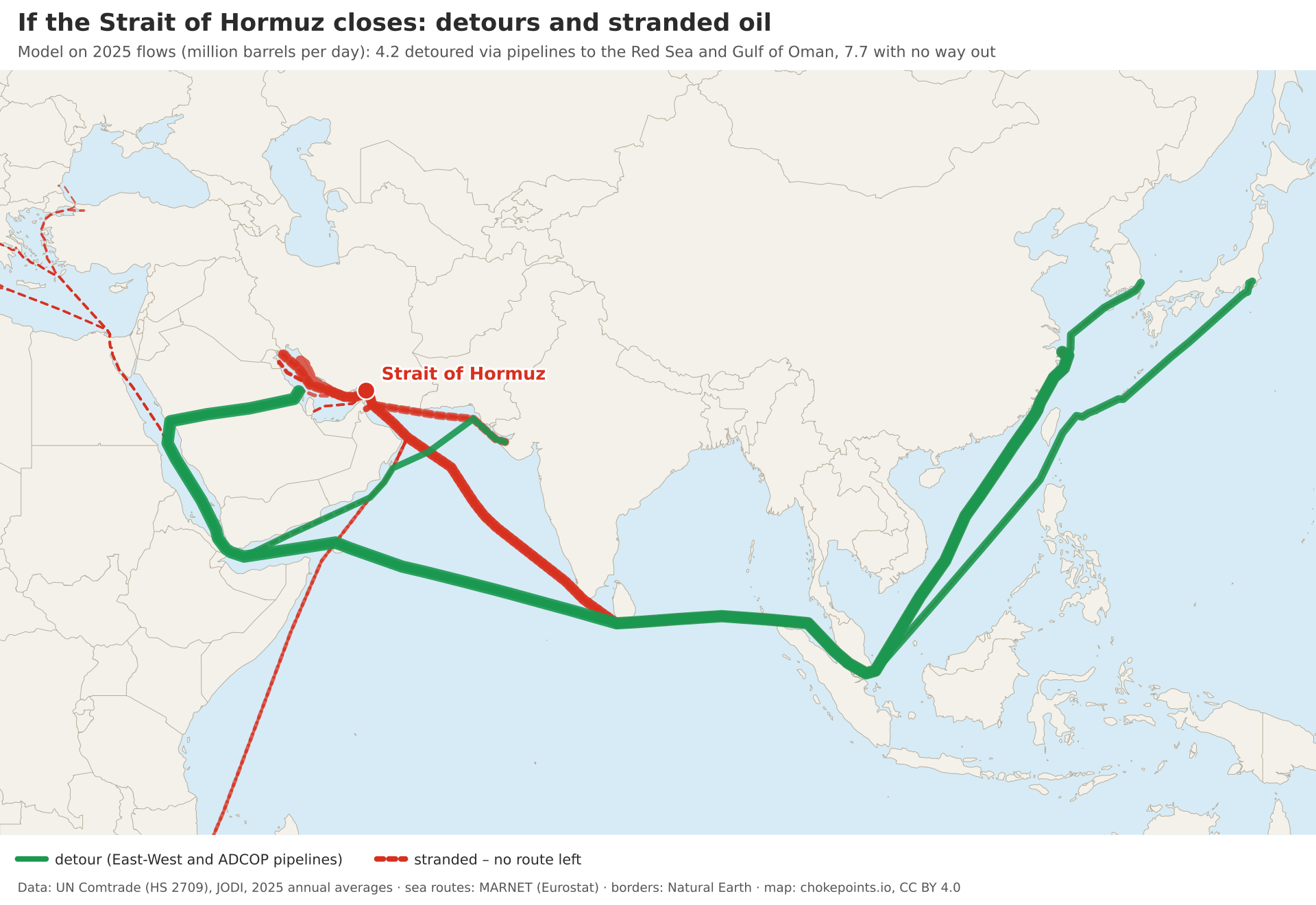
The East-West pipeline was supposed to insulate Saudi exports from exactly this scenario. Stretching 1,200 kilometres from Abqaiq in the Eastern Province to Yanbu on the Red Sea, the line was carrying more than 5 mb/d before Houthi cruise missiles struck pumping stations on September 12 and halted flow for ten days. Aramco CEO Amin Nasser told Saudi Gazette at the time that disruptions typically lasted “days, not weeks or months” — a claim that the six-week-plus timeline to full capacity, reported by Reuters, has quietly overtaken.
The third bottleneck is the Red Sea itself. Houthis have seized Mayyun Island at the Bab el-Mandeb strait, cutting transits there by 47 percent, and have struck King Fahd International Airport — Aramco’s logistics hub for Eastern Province operations — twice in eleven days, killing one person and injuring eight in the October 21 attack. Even if the pipeline reaches full capacity and Hormuz reopens, the Red Sea route from Yanbu faces its own escalating threat from the same forces that closed the eastern exit.
The Freight Tax on What Remains
What Saudi Arabia can ship costs far more to move than it did a year ago. A Very Large Crude Carrier on the Gulf-to-China route now commands $1.2 million per day in spot charter rates, according to LSEG data from early October — fifteen times the roughly $80,000 per day that the same voyage cost twelve months earlier. That freight premium does not appear in the Brent price, but it lands directly on Aramco’s netback per barrel, compressing the margin between the headline price and the revenue that actually reaches the Saudi treasury.
Aramco’s pricing decisions show the squeeze in two directions. For November-loading Arab Light, the company cut its official selling price to Asian customers by $3 per barrel, widening the discount to $5 below the Oman/Dubai benchmark — the deepest since June 2020, when pandemic demand destruction forced similar concessions. Aramco simultaneously raised its northwest Europe price by $3. The geographic split reflects the logistics: Asian buyers load Gulf cargoes that must transit Hormuz, where insurance and freight costs have surged, so Aramco compensates with deeper discounts. European buyers who might receive Yanbu-loaded cargoes via the Red Sea — a route that avoids Hormuz — are charged more for access to a comparatively safer delivery path.
The freight premium compounds the volume loss — Saudi Arabia’s realized revenue per barrel sits below the Brent headline because of shipping costs, and its total revenue sits below capacity because it cannot produce or ship at target volumes. ING noted on October 23 that “the threat profile has shifted away from historical Red Sea shipping lanes toward core Persian Gulf industrial installations,” a shift suggesting that the cost structure is moving in the wrong direction.
How Much Revenue Is Saudi Arabia Losing Each Day?
At $114 per barrel, Saudi Arabia’s 2.18 mb/d production shortfall below its OPEC+ target costs approximately $249 million per day in foregone revenue. At the August low of 5.97 mb/d, the gap was 4.53 mb/d — roughly $517 million per day at current prices. The fiscal breakeven needed to balance the Saudi budget sits at $96 per barrel according to the IMF, or approximately $112 when Public Investment Fund spending is included, per Bloomberg Economics.
At $114, the headline price nominally clears both breakeven thresholds, but only if the kingdom produces and sells at its target volume of 10.5 mb/d. At 8.3 mb/d, the effective breakeven rises because the same fixed government expenditure must be covered by fewer barrels, each of which also faces higher freight and insurance costs that reduce the net revenue reaching the treasury. The war’s fiscal cost is already recorded: Saudi Arabia’s 2026 deficit has reached SAR 245 billion — roughly $65 billion — according to Zawya and Reuters reporting from September 30, and oil sector GDP is forecast to contract 21.8 percent, dragging the broader economy down 3.6 percent.
These are not projections conditioned on low oil prices but on low oil volumes, a fundamentally different problem that no rally in Brent can fix on its own. Each extra dollar per barrel on 8.3 mb/d adds roughly $8.3 million per day to revenue at the margin, meaning Brent would need to reach approximately $144 per barrel for Saudi Arabia’s daily revenue at current output to match what 10.5 mb/d would earn at $114 — and even that arithmetic assumes every barrel produced can be loaded and shipped.
Those missing barrels have not vanished from the global market — they are being pumped and sold by producers with open routes. The revenue that Saudi Arabia cannot collect is accruing to every competitor with an intact terminal and a tanker that can reach it.
The Collectors
The IEA’s October data mapped the beneficiaries by geography as much as by volume. The UAE’s record September crude output — above 4.4 mb/d at the wellhead level — flows to Fujairah, outside Hormuz, without the war-risk insurance surcharge that Gulf-exit cargoes carry. Iraq reached quota-breaking levels that the cartel has little reason to enforce when Saudi Arabia cannot meet its own target. Non-Gulf producers have also responded — US shale output remains near record highs, Norway and Brazil have maintained offshore production — and all are shipping at the highest Brent price since May.
| Producer | September 2026 Output | Change | Collecting at $114? |
|---|---|---|---|
| Saudi Arabia | 8.3 mb/d | +2.33 mb/d from August; still 2.18 mb/d below target | Partially — Hormuz at 4 transits/day, pipeline below capacity |
| UAE | 5.3 mb/d (record) | All-time high | Yes — Fujairah terminal bypasses Hormuz |
| Iraq | ~3.9 mb/d | +386,000 bpd | Yes — Basrah terminal operational |
| Iran | Near zero exports | Shadow fleet depleted to <1 million bbl | No — US sanctions, no seaborne stock |
| Russia | Near capacity | Urals at ~$80/bbl FOB | Partially — freight surge compresses netback |
Saudi Arabia, the producer whose damaged infrastructure created the $114 price, is shipping well below its 8.3 mb/d production through a Hormuz chokepoint that handles only four tanker transits a day. The UAE, with its Fujairah terminal sitting on the Gulf of Oman outside Hormuz entirely, pumps at record levels with intact shipping routes and no war-risk insurance surcharge. The freight premium that suppresses Saudi Arabia’s netback does not apply to Abu Dhabi cargoes that never enter the strait.
Russia’s position is a variation of the same dynamic. Urals crude fell to approximately $80 per barrel FOB at Russian ports by October 21, even as Brent touched $114, because the surge in global freight rates driven by Hormuz disruption has compressed Russian netbacks on cargoes from Baltic and Black Sea ports. Moscow is selling, but not at the headline price — the same freight crisis that created the premium is consuming it for Russian exporters, leaving a $34-per-barrel gap between Urals and Brent that rewards neither of the two governments most associated with the current market disruption.
Is Iran Profiting From the Premium It Created?
Iran’s seaborne crude stockpile, held on shadow fleet tankers in Asian waters, has fallen from a peak near 90 million barrels to below 1 million barrels as of October 5 according to Kpler tracking data. The US Treasury sanctioned 17 additional shadow fleet tankers on October 8, and Washington estimates total denied revenue at approximately $24.9 billion. Iran helped drive Brent to $114 and has no barrels left to sell at that price.
There’s no more oil to discharge to China anymore.
Kpler analyst, reported by the Wall Street Journal, October 2026
The position contains its own incoherence. Tehran’s proxy forces — the Houthis — drove Saudi output from 10.5 mb/d to a low of 5.97 mb/d and halted the East-West pipeline in September, while the IRGC’s mine blockade reduced Hormuz to four transits a day and forced 135 vessels to turn around since July. Both actions contributed directly to the $23-per-barrel premium that took Brent from $91 in August to $114 in September and October. Yet Iran’s own shift to an offensive military doctrine has coincided with the near-total depletion of its ability to export crude — not because of its own decisions, but because Washington’s maximum-pressure sanctions campaign and the US Navy’s blockade operated on a parallel track.
That stockpile — once spread across tankers anchored off Malaysia, Singapore, and southern China — was drawn down over months as Chinese refiners bought sanctioned crude at steep discounts, but the accelerated US enforcement campaign closed the last channels before Tehran could rebuild. The sanctions and the Hormuz blockade target different chokepoints in the global supply chain, and neither campaign was designed to complement the other, which is why Iran finds itself in the position of having shut down a shipping lane without having any cargo to put through it.
Iran’s inability to export does not, however, remove its capacity to disrupt, and the gap between those two capabilities — the power to damage a market versus the power to profit from one — defines Tehran’s war economy heading into the winter. How OPEC+ accounts for that disruption, and for Saudi Arabia’s own production shortfall, is the business of the cartel’s next scheduled meeting.
What Does the OPEC+ November 1 Meeting Change?
OPEC+ meets on November 1 with Saudi Arabia’s official production target still at 10.5 mb/d — a figure the kingdom fell 2.18 mb/d short of in September and is unlikely to reach before the East-West pipeline returns to full capacity. Whether the cartel adjusts targets to reflect wartime reality or maintains quotas that several members are already exceeding will signal how the group manages a market defined by involuntary supply loss.
The tension is between admission and leverage. If OPEC+ formally lowers Saudi Arabia’s quota to match its actual output, the kingdom loses the implicit commitment to restore production — a commitment that, even unfulfilled, signals to the market that supply is coming and moderates the fear premium to some degree. If the quota stays at 10.5 mb/d, Saudi Arabia retains the fiction of imminent restoration but cannot use the quota to influence price because it has no spare barrels to offer or withhold.
Other members face the opposite problem. The UAE and Iraq are both producing above their OPEC+ quotas, ordinarily a source of internal tension, but Saudi Arabia is in no position to demand quota compliance from competitors when it cannot meet its own target. The EIA’s October outlook forecast Q4 2026 Brent at approximately $105 per barrel, $14 higher than its prior estimate — a projection that assumes some supply recovery but not a full return to pre-war Gulf output levels.
The meeting also arrives eleven days before the November 3 US midterms, which have frozen American military action against Iran. Trump has ruled out strikes before the election, and the EIA’s forecast implicitly assumes no US-Iran military escalation in Q4 — an assumption that could be invalidated within 48 hours of the OPEC+ meeting adjourning. Whatever the cartel decides on November 1, it will be deciding without knowing whether Washington strikes Iran on November 4.
The Strategic Reserve Countdown
The supply crisis is eating into the world’s emergency buffers at a rate that narrows the margin for any further disruption. The US Strategic Petroleum Reserve stood at 283 million barrels as of October 9 — its lowest level since October 1982 — after the Trump administration authorized a 172-million-barrel drawdown as part of a coordinated IEA release totalling 400 million barrels across member nations. The Department of Energy issued a request for proposals in early October for an additional 40-million-barrel exchange, with deliveries scheduled for November and December 2026.
Globally, the picture is tighter. Strategic stocks excluding China and Iran have fallen by 327 million barrels since December 2025, according to Al Jazeera’s analysis published on October 23. Usable reserves worldwide stand at approximately 400 million barrels, with nearly half held in Japan — a country that imports virtually all of its oil and would need those barrels for its own consumption before releasing them to stabilize a global market. India and Pakistan, among the most exposed importers, face a geography problem on top of the volume problem: their nearest alternative supply from West Africa is 25 to 28 days by sea, compared with two days from Fujairah.
At current consumption rates, 400 million barrels of usable strategic reserves represents roughly four days of global demand, and that number continues to decline with each coordinated release. The IEA projected global oil supply at 100.7 mb/d in 2026, down 5.8 mb/d from the prior year, with a 7.7 mb/d rebound forecast for 2027 and demand falling 2.6 mb/d in 2026. Those forecasts assume a supply recovery that has not materialized, and every new attack on Saudi infrastructure pushes the rebound further into the future while the reserves that were supposed to bridge the gap drain a little faster.
A War Without Precedent
Oil-market history offers three models for a major producer under stress, and 2026 fits none of them. In 1973, Saudi Arabia deliberately withheld supply during the Arab oil embargo, cutting production and collecting the resulting price spike — an act of agency in which the kingdom chose to reduce output and profited from the scarcity it created. In 1990, Saudi Arabia did the opposite during the Gulf War, ramping up production to replace the roughly 4.5 mb/d lost when Iraq invaded Kuwait and international sanctions removed Iraqi and Kuwaiti barrels from the market. In both cases the kingdom’s infrastructure was intact and its role was deliberate.
The 2026 model is different because Saudi Arabia is neither agent nor compensator — it is the target. Its infrastructure has been degraded by an external campaign it did not choose, its production is involuntarily reduced, and the price increase that follows from the missing barrels is being collected by competitors whose export routes remained open. The kingdom is bearing the costs of a supply disruption — wrecked terminals, a halted pipeline, a ballooning deficit, a contracting economy — without the offsetting revenue that a deliberate supply cut would have delivered.
At freight rates fifteen times the pre-war cost, a tanker operator needs guaranteed cargo at a terminal it can reach without crossing a four-transit-per-day chokepoint. Fujairah, the UAE’s open-water export hub, qualifies. Ras Tanura, Saudi Arabia’s largest oil terminal, does not.
Frequently Asked Questions
What is Saudi Arabia’s fiscal breakeven and why does production volume change it?
The IMF places Saudi Arabia’s fiscal breakeven at $96 per barrel, while Bloomberg Economics raises it to approximately $112 when Public Investment Fund spending is included. Both estimates assume production at or near the OPEC+ target of 10.5 mb/d. At September’s actual output of 8.3 mb/d, each barrel must carry roughly 27 percent more fiscal weight to fund the same government expenditure, which pushes the effective breakeven above the current $114 spot price even on the IMF’s more conservative basis — meaning that Brent at $114 is not, in practice, generating a surplus for a government producing 2.18 mb/d below target.
How long until Saudi Arabia’s East-West pipeline reaches full capacity?
The pipeline restarted on September 22 after a ten-day shutdown, and Reuters estimated six or more weeks to full throughput — placing the earliest return to pre-attack levels in early November. Before the strikes, the EIA reported the line carried more than 5 mb/d, well below its 7 mb/d design capacity. The pipeline is Saudi Arabia’s only bypass around Hormuz, which means it is simultaneously the kingdom’s most critical and most vulnerable piece of energy infrastructure — a second strike on its pumping stations would eliminate the sole alternative to a chokepoint running at four transits per day.
How does the Aramco OSP discount affect Asian refiners?
Aramco’s $3 cut to its November Arab Light official selling price for Asia — widening the discount to $5 below Oman/Dubai, the deepest since June 2020 — is an acknowledgment that Gulf-loaded Saudi crude is harder to insure and more expensive to ship than it has been in decades. The June 2020 precedent came during a demand collapse, not a supply disruption, making the current discount structurally different. Asian refiners still face charter rates that have surged to fifteen times their pre-war level on the Gulf-to-China route, which means that even with the discount, the total delivered cost of Saudi crude may approach or exceed that of rival grades from less disrupted origins — pushing Asian buying toward UAE and Iraqi barrels shipped from Fujairah and Basrah at lower freight and insurance costs.
What is the current Brent-Urals spread and what does it mean for Russia?
Russian Urals crude fell to approximately $80 per barrel FOB at Russian ports by October 21, even as Brent touched $114, creating a spread of roughly $34 per barrel. The gap is wider than the post-2022 sanctions-era discount and is driven by a different mechanism: global freight rates have surged because of Hormuz disruption, and buyers of Russian crude, which still sails primarily from Baltic and Black Sea ports, demand deeper FOB discounts to offset the higher delivered cost. Russia is exporting, but at a FOB price roughly $34 below Brent — the same freight crisis that created the premium is consuming it for Russian exporters.
The House of Saud Daily Briefing
Saudi Arabia's news in 3 minutes, every morning. Free. See today's issue