
TEHRAN — Iran’s military says three more oil tankers caught fire after hitting naval mines east of the Strait of Hormuz on the evening of November 18, the same day an ADNOC vessel was struck in those waters. Taken at Tehran’s word, at least four merchant ships were hit in a single day, one day after Iran’s foreign minister left Muscat without a deal.
The morning attack is on the record. The UK Maritime Trade Operations centre confirmed the ADNOC vessel incident, with one crew member missing and 11 injured. The evening claim is a different animal: nobody released a vessel name, flag, owner or cargo, and Reuters could not independently confirm it.
The gap between what Iran says and what anyone can verify is where the story sits. The tempo, the timing and the language all point the same way, toward a mine campaign east of Hormuz run as diplomatic coercion with a calendar attached rather than a string of lucky hits. Its targets are softer than steel hulls: the credibility of the US escort corridor, the fragile oil surplus the International Energy Agency announced five days earlier, and the patience of the Gulf exporters paying for all of it, Saudi Arabia first among them.
The House of Saud Daily Briefing
Saudi Arabia's news in 3 minutes, every morning. Free. See today's issue
Table of Contents
- What Did Iran Claim Happened East of Hormuz on November 18?
- Two Forces, One Map
- Is Iran’s Mine Tempo Deliberate Coercion or Opportunism?
- The Ships Without Names
- Why Haven’t US Escorts Deterred the Mines?
- The Declaration Is the Weapon
- Can the IEA’s Oil Surplus Survive Iran’s Mine Campaign?
- How Much Is the Hormuz Mine Campaign Costing Saudi Arabia?
- What Comes After Muscat
- Frequently Asked Questions
What Did Iran Claim Happened East of Hormuz on November 18?
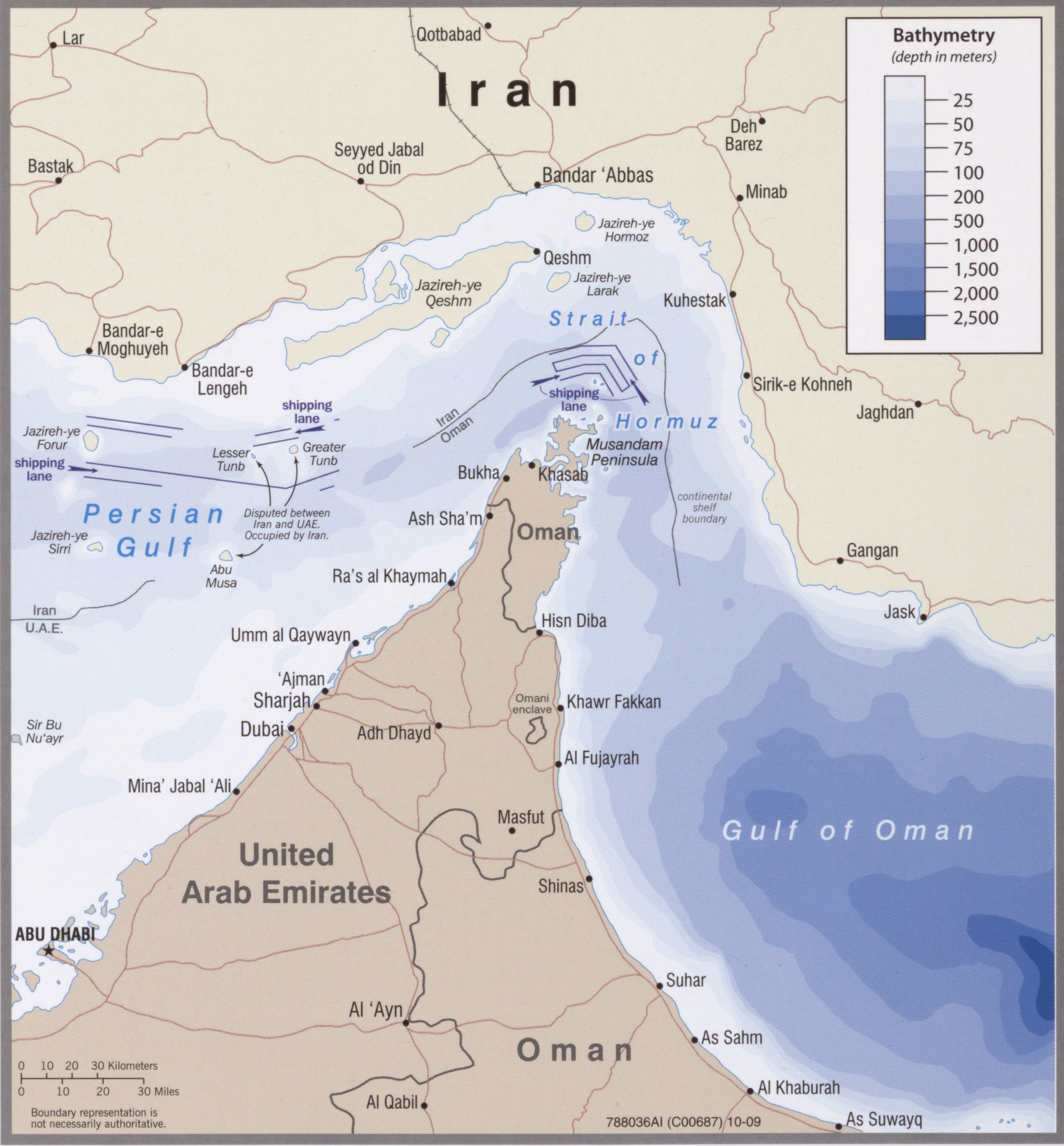
Iran’s military claimed three oil tankers caught fire after striking naval mines east of the Strait of Hormuz on the evening of November 18. ANI, citing state broadcaster IRIB, attributed the claim to the IRGC, while Al Jazeera attributed it to “Tehran’s army.” No ship was identified, and Reuters could not confirm the incident.
That is the whole of the public record. There is no casualty figure, no position more precise than “east of the Strait,” and no shipowner, flag state or insurer stepping forward to say one of its hulls was hit. For a claim involving three burning tankers in one evening, the evidence trail is remarkably thin.
The claim did not arrive alone. ANI’s November 19 report of the IRGC statement, relayed through IRIB, carried a line that reads less like a battle report than a rulebook: “Passage through the waterway must be coordinated with Iranian authorities.” Iran is not merely reporting fires. It is attaching a condition to every ship that has not yet caught one.
Set beside the morning ADNOC incident, the evening claim pushes the day’s count to at least four vessels, but only by Iran’s account. One of those four is independently confirmed. The other three rest entirely on the word of the forces that say they mined the water, and any honest tally has to carry that caveat everywhere it goes.
Two Forces, One Map
The split attribution is not a clerical detail. Iran fields two separate naval forces, the Revolutionary Guards’ maritime arm and the conventional army’s navy, and both have been issuing statements about Hormuz in the past week. The evening claim may be one announcement reported two ways, or two separate statements from two forces telling the same story; until ANI or Al Jazeera clarifies, both attributions stand.
What is clear is that both forces are drawing from the same map. On November 14, Iran’s conventional army navy said a tanker had been “navigating through the unsafe and prohibited zone east of the Strait of Hormuz” with its tracking systems switched off, according to Middle East Eye’s live coverage. Four days later, “east of the Strait” is precisely where three tankers are said to have burned.
Tehran drew a line on the chart, labelled the water beyond it prohibited, and then reported ships catching fire on the wrong side of it. Whether those fires happened as described is unverifiable. The sequence of warning, zone and incident, though, is a coherent piece of messaging that no single random mine strike would produce.
The IRGC built its own half of the frame two days later. Its November 16 statements, carried by Tehran Times via Mehr, singled out what it called the “illegal and dangerous southern route,” its term for the US escort corridor. Between the army’s “prohibited zone” and the Guards’ “illegal” route, Iran has now put names on both the water and the behaviour it says will get a ship burned.
Is Iran’s Mine Tempo Deliberate Coercion or Opportunism?
The evidence leans heavily toward coercion. The evening incident came the day after Araghchi’s talks with Oman’s foreign minister ended without a Hormuz agreement. The IRGC pre-announced “walls of fire” two days earlier, and its claims escalated in a steady sequence rather than clustering at random.
Start with the calendar. On November 17, Iranian Foreign Minister Araghchi met Omani Foreign Minister Busaidi in Muscat, and the two parted without any agreement on Hormuz, according to multiple press reports including Arab News and The National. By the following evening, Iran’s forces were claiming three more burning tankers. Opportunism rarely keeps such a tidy diplomatic schedule.
Then the script. On November 16, the IRGC issued a formal warning, carried by Tehran Times via Mehr, that “the southern American-created route in the Strait of Hormuz has been mined with walls of fire.” Language written in that register two days before the evening incident reads like a campaign brief, published in advance so that every subsequent fire could be read as a promise kept.
“Trusting the lies of American military officials and cooperating with them will make you prey to the flames.”IRGC statement, November 16, 2026, via Tehran Times/Mehr News
The sequence fits as well. As of November 16, the IRGC claimed six tankers had hit mines “since Sunday,” meaning since November 15, according to Trend.az. UKMTO, working from its own reporting rather than Tehran’s statements, confirmed a projectile strike that set a ship’s engine room on fire on November 16 with all crew safe, a tanker struck about seven nautical miles north of Khasab, Oman, on November 17, and the ADNOC vessel on November 18. Three consecutive days produced three confirmed incidents, with Iranian claims running well ahead of all of them.
Analysts saw this shape coming months ago. A May analysis from the Observer Research Foundation, republished by Eurasian Review, described Iranian mine warfare as a tool of “time-limited coercion and increased costs, not a silver bullet.” November fits that description closely: a pressure campaign designed to raise the price of the status quo for Washington and the Gulf while Iran’s diplomats wait for a better offer.
The opportunism case deserves a hearing. Mines, once laid, do not consult the diplomatic calendar, and a field sown weeks earlier could claim a hull on any given evening without anyone in Tehran giving an order. But Iran’s statements are not drifting ordnance, and the decision to announce three fires the day after Muscat, in the vocabulary of a pre-declared prohibited zone, was made by people.
The likeliest reading combines the two. Whatever the mines are doing on their own, Iran is choosing when and how loudly to tell the world about it, and it chose the day after the talks failed. The ordnance may be indiscriminate; the publicity is surgical.
The Ships Without Names
Every tanker at sea has a name, a flag, an owner and a cargo manifest. Iran’s mine claims across November 13 to 18 have supplied none of them, and the omission looks deliberate rather than careless. Naming a ship forces a reaction from whoever flagged it, and Tehran has good reasons to avoid forcing anyone’s hand.
Consider the two possibilities. If the burning tankers flew neutral flags, Indian or Chinese, naming them would open a diplomatic rift with exactly the non-aligned buyers Iran needs to keep onside. If they belonged to coalition states, naming them would hand those governments a documented grievance and invite direct military retaliation.
Anonymity lets Iran collect the deterrent effect of an attack without paying the political bill for any particular victim. It also makes the claims impossible to disprove. A shipowner cannot deny an incident involving a vessel nobody has named, and an underwriter cannot price a risk it cannot locate.
That ambiguity falls hardest on the people who have to make decisions every morning: charterers choosing whether to fix a cargo, masters choosing whether to sail, insurers choosing whether to quote. None of them can wait for confirmation that may never come. They have to treat an unnamed fire as a possible fire, and that is all the claim needs to achieve.
The tactic carries a cost for Tehran too. Every unconfirmed claim makes the next one easier for markets and navies to discount, and a campaign that relies entirely on being believed is only as strong as its last verified incident. Iran is betting that fear will outrun scepticism, and the price of moving oil through the Gulf suggests that, for now, the bet is paying.
Why Haven’t US Escorts Deterred the Mines?
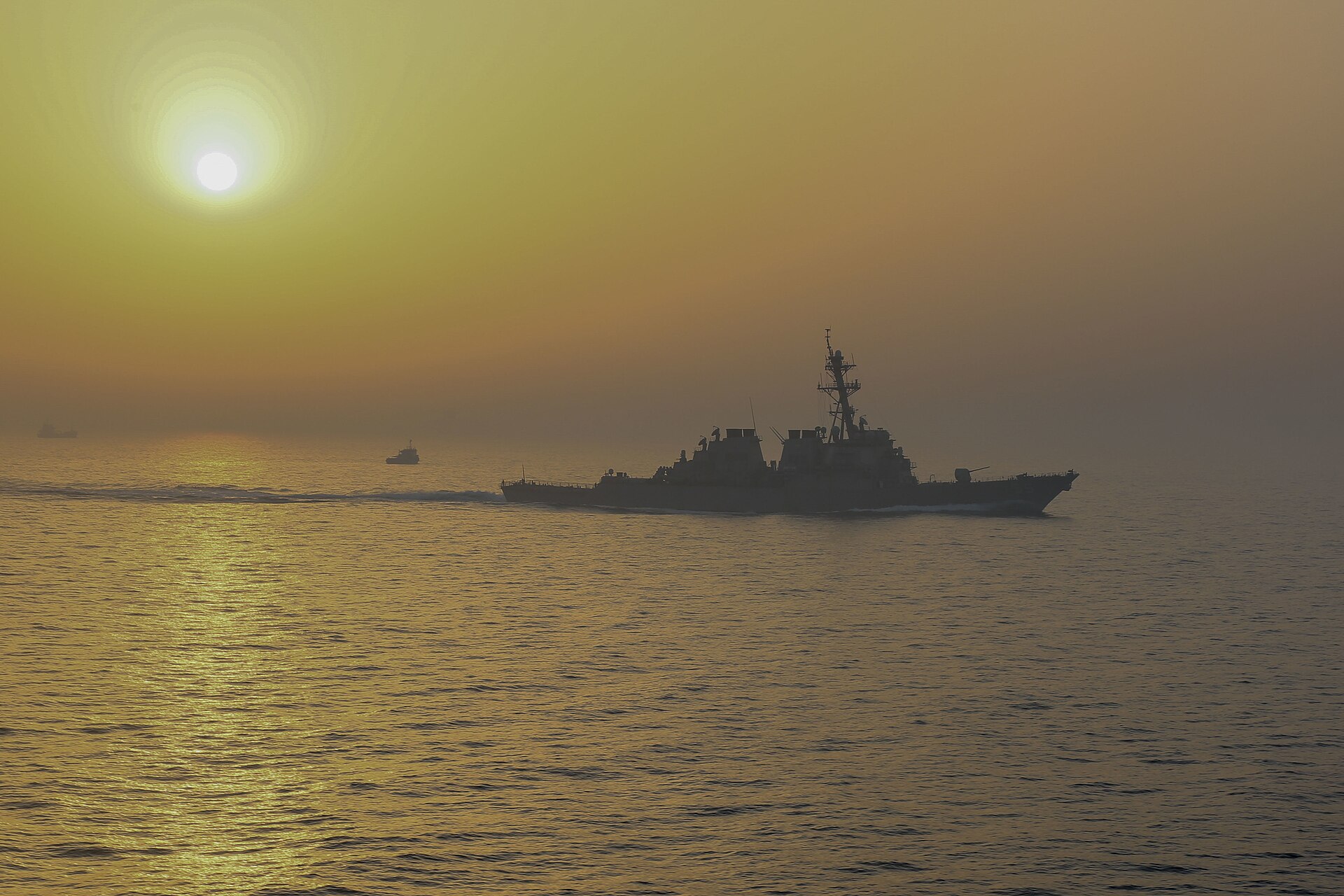
Escorts protect the ships they accompany, not the water around them. The USS Michael Murphy has made 12 contested Hormuz transits but escorted only four merchant tankers, according to Army Recognition, while Iran’s minelaying is dispersed and hard to trace. History, from the Bridgeton incident onward, shows escorted hulls can still hit mines.
The Michael Murphy’s record describes a destroyer proving the route can be sailed, which is different from a convoy system moving the Gulf’s oil. Against a pre-war baseline of 138 vessels a day through the strait, per the Joint Maritime Information Center, four escorted tankers barely registers. The corridor is real, but it is narrow, and Iran has worked out that a narrow corridor is easy to stigmatise.
That is why the IRGC keeps attacking the corridor’s reputation. Its November 16 statements, reported by Anadolu Agency, said targeted tankers had been operating “under the direct guidance of US officers and with support from American fighter jets” and had disabled their navigation and identification systems. True or not of any given ship, the message to every charterer is that the American route is the dangerous one.
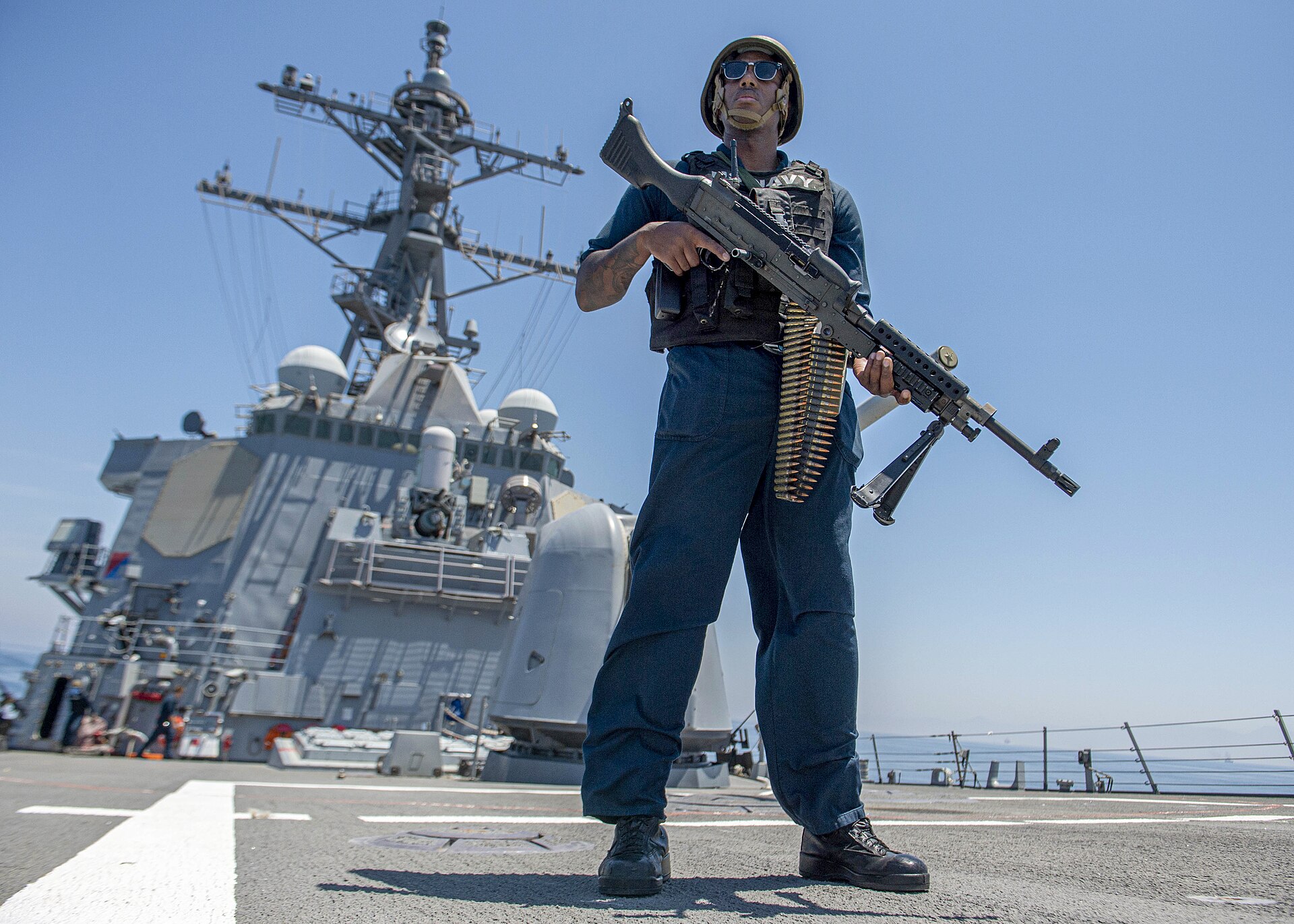
The ordnance problem is decades old. During the 1987–88 Tanker War, Iran laid contact mines covertly in international waters, and in the Bridgeton incident a US-flagged supertanker struck one while under US Navy escort. Warships can deter fast boats and shoot down missiles, but they cannot see every mine below the surface, and the Bridgeton’s crew learned that with their escort close at hand.
Iran’s inventory makes the arithmetic worse for the escorting side. Navy Lookout estimated in May that Tehran holds up to 6,000 naval mines of various types. US defence policy experts Grieco and Westermann, writing in Arab News in March, said the IRGC has “built its mine warfare capability around speed, redundancy and concealment,” spreading minelaying across numerous highly mobile platforms that are far harder to hunt than a single dedicated minelayer.
The American presence also thinned around the time of the attacks. ABC News reported that the USS George Washington had left CENTCOM’s area of operations on or before November 18, returning to Yokosuka, Japan, while the USS Theodore Roosevelt and USS George H.W. Bush remain in the region. Two carriers is still a formidable force, but coincidence or not, Iran’s evening claim landed as Washington’s naval footprint was getting smaller.
The Declaration Is the Weapon
The sharpest line on Iranian mine warfare this year came from a retired British admiral. Rear Admiral James Parkin, who commanded the multinational Task Force Sentinel in 2019 and 2020, said in comments published by Navy Lookout in May that “there is still no conclusive evidence of laid mines.” He then explained why that hardly mattered.
“The declaration is the weapon, not the mines.”Navy Lookout, May 11, 2026, drawing on a Daily Telegraph podcast interview with Rear Admiral James Parkin (Royal Navy, retd.), former commander, Task Force Sentinel
Parkin was speaking six months before November, and UKMTO’s confirmations since then show ships are being hit. His point has aged well regardless. Iran does not need every claimed mine to exist; it needs shipowners, insurers and the Pentagon to behave as though it might, and an unverified, unnamed claim of three burning tankers does exactly that work.
The table below sets the past week’s Iranian claims against what has been independently confirmed. The gap between the two columns is the space in which Iran’s coercion operates.
| Date (2026) | Iranian claim | Independent confirmation |
|---|---|---|
| November 14 | Iran’s army navy: tanker in “unsafe and prohibited zone east of the Strait” with tracking off (Middle East Eye) | None reported |
| November 15–16 | IRGC: six tankers hit mines “since Sunday” (Trend.az) | UKMTO: projectile strike, engine-room fire, all crew safe (November 16) |
| November 17 | — | UKMTO: tanker struck about 7 nautical miles north of Khasab, Oman |
| November 18, morning | — | UKMTO: ADNOC vessel struck, with casualties |
| November 18, evening | IRGC (ANI/IRIB) or “Tehran’s army” (Al Jazeera): 3 tankers caught fire after hitting mines | None; Reuters could not independently confirm |
Read down the columns and the shape is obvious. UKMTO has confirmed one incident on each of three consecutive days, while Iran’s two mine statements alone add up to nine tankers. Neither column is the full truth, but the market prices off the left-hand one, because the cost of disbelieving it and being wrong is a burning hull.
Can the IEA’s Oil Surplus Survive Iran’s Mine Campaign?
Only if the tankers keep sailing. The IEA’s November report projected fourth-quarter supply of 105 million barrels a day outpacing demand by about 1.7 million bpd, a surplus of that size. That cushion leans on “dark crossings” through Hormuz and on oil-on-water stocks, exactly the flows a mine campaign is built to frighten.
The IEA’s November Oil Market Report, published on November 13, delivered the first projected surplus since the Iran war began and the best news the oil market had seen in months. The agency spoke of “tentative signs of rebalancing.” OPEC+ pumped 41.23 million bpd in October, up 2.04 million from September and back to 97 percent of its pre-war February volume, and Brent stood at $95.71 a barrel when the report landed, according to BNN Bloomberg.
Underneath, the surplus rests on two fragile supports. The first is the “dark crossing,” a tanker running Hormuz with its tracking systems switched off. The second is oil on water, which jumped 86 million barrels to its highest level since January 2026, a floating stock equal to roughly 50 days of the IEA’s projected surplus.
Now set those supports against Iran’s own words. The IRGC’s November 16 statements accused targeted ships of disabling their navigation and identification systems, and the army’s November 14 warning singled out a tanker running dark in a “prohibited zone.” Tehran is publicly naming the dark crossing as the offence that gets a ship burned, which puts one of the two pillars of the IEA’s rebalancing directly in its sights.
The Gulf’s export numbers show how little slack there is. Gulf exports averaged about 18.4 million barrels a day in October, roughly 26 percent below pre-war levels, according to IEA figures cited by Anadolu Agency, which leaves something like 6.5 million barrels a day still missing. A campaign that frightens even part of the dark-crossing traffic back into port would erode the projected cushion quickly.
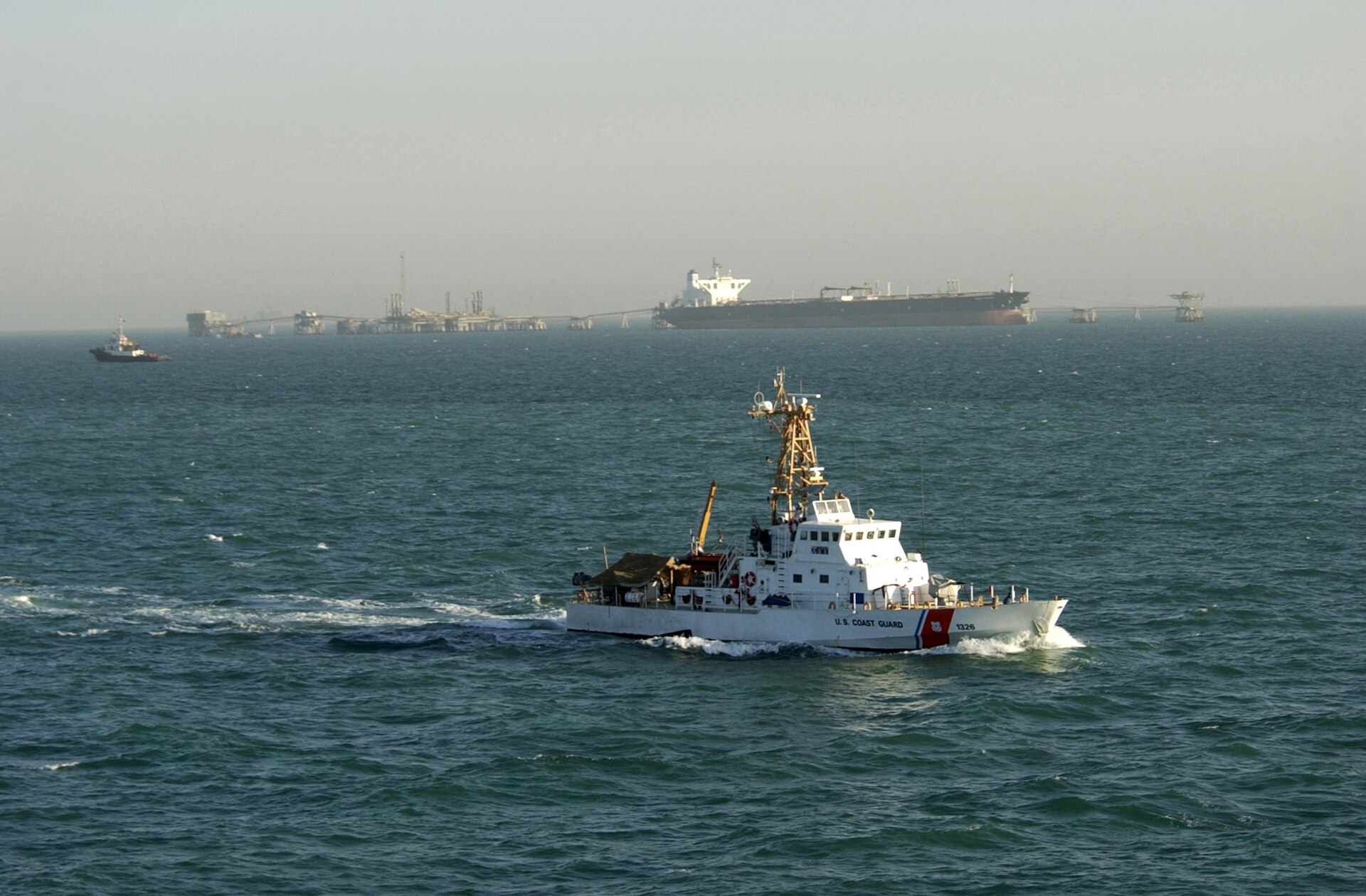
The American blockade adds a second filter on the same water. CENTCOM said 135 ships had been turned around since the blockade began on July 14, in a press release on October 10. Between US interdiction on one side and Iranian mines on the other, the ships still moving through Hormuz are threading a channel that two navies each claim the right to police.
How Much Is the Hormuz Mine Campaign Costing Saudi Arabia?
Saudi Arabia pays twice: in lost volume and in higher costs on every barrel still shipped. Saudi output fell 2.6 million bpd in August and crude shipments dropped to 6 million bpd, per the IEA. Riyadh’s 2026 deficit estimate was raised to 245 billion riyals from a budgeted 165 billion, Reuters reported.
Aramco’s escape hatch is the East-West pipeline. Chief executive Amin Nasser told CNBC in May that its capacity had been raised to 7 million bpd, with roughly 60 to 70 percent of Saudi crude exports rerouted to Yanbu on the Red Sea. That keeps most of the kingdom’s oil clear of the mines, but it leaves the remainder exposed in the Gulf and does nothing to shield Riyadh from the war’s effect on everyone else’s barrels.
Nasser’s verdict at the time was blunt: “The Hormuz disruption has left the global oil supply cushion scarily thin.” By his account, the market had already lost roughly 880 million barrels net since the war began, and more than 1 billion barrels gross. Those figures date from May, and every confirmed hit since has been added to a bill that was already enormous.
The cost of moving whatever oil still passes Hormuz has gone vertical. Marsh’s global head of marine, Marcus Baker, told Insurance Business in October that war-risk premiums for a Hormuz transit had reached 6 to 10 percent of hull value, against about 0.25 percent before the war, adding up to $20 million to a single supertanker voyage into the Gulf. On the Baltic Exchange’s TD3C Gulf-to-China route, VLCC rates hit $1,412,594 a day on October 15, more than 12 times the $112,394 charged before the war.
Goldman Sachs, cited by Rigzone, put average global crude freight above $20 a barrel, against $3 a year earlier. On a VLCC carrying a full cargo, freight alone now consumes a meaningful slice of the oil’s value before it reaches a refinery. Every new mine claim, verified or not, is priced into that bill the next morning.
| Indicator | Pre-war | Latest wartime figure | Source |
|---|---|---|---|
| Hormuz daily vessel traffic | 138 ships/day | “Single-digit to low-double-digit” per day | JMIC |
| War-risk premium, Hormuz transit | About 0.25% of hull value | 6%–10% of hull value (October) | Marsh / Insurance Business |
| VLCC rate, Gulf–China (TD3C) | $112,394/day | $1,412,594/day (October 15) | Baltic Exchange |
| Average global crude freight | $3/barrel (a year earlier) | Above $20/barrel | Goldman Sachs via Rigzone |
| Gulf crude exports | About 26% higher than October level | About 18.4 million bpd (October) | IEA via Anadolu Agency |
| Saudi 2026 deficit | 165 billion riyals (budgeted) | 245 billion riyals (revised estimate) | Reuters via Zawya |
For Riyadh, those numbers land on a budget already stretched. The kingdom has been absorbing the war’s costs while US-Iran talks stall, and the Reuters-reported revision leaves it running about 80 billion riyals beyond its own plan, a figure set in September before November’s mine claims added a fresh layer of risk. Each failed round of diplomacy between Washington and Tehran now arrives in Saudi Arabia as an invoice.
What Comes After Muscat
If the mine tempo is coercion, it comes with a stated price. The IRGC’s demand that passage be “coordinated with Iranian authorities” is a claim to administer the strait, which is a more ambitious goal than simply shutting it. Every ship that turns around, every charterer that waits and every underwriter that declines to quote helps convert that claim into practice.
Washington’s response, so far, consists of an escort corridor Iran has publicly branded illegal, a destroyer making headline transits and a carrier force in the region now down to two. Muscat produced no agreement. The IEA’s rebalancing, meanwhile, depends on tankers willing to sail dark through water Tehran has declared prohibited.
None of this proves that a specific order went out from Tehran on the evening of November 18. It does show that Iran has built a system in which mines, statements and diplomatic setbacks reinforce each other, and in which the absence of verification works in its favour. The campaign is designed so that even an unconfirmed claim does real economic damage.
For Saudi Arabia, the uncomfortable lesson is that the pipeline to Yanbu bought time without buying immunity. The next round of talks will be watched in Riyadh less for what the diplomats say than for what happens at sea the following evening. On November 18, the answer was three fires that nobody would name.
Frequently Asked Questions
Can Iran lay naval mines without using ships?
Possibly. France 24 reported in September, citing researchers at RUSI and King’s College London, that Iran has tested Fajr-5 rocket launchers adapted to deliver naval mines remotely. A land-based delivery option would make minelaying even harder for coalition navies to detect or interdict at sea.
What has Iran offered in exchange for reopening Hormuz?
Araghchi presented a seven-day roadmap at the UN in New York on September 25, conveyed through Qatari mediators. It proposed reopening Hormuz in return for the US lifting its blockade, issuing sanctions waivers and releasing approximately $12 billion in frozen Iranian assets, according to Al Jazeera, but the plan was not accepted.
Have war-risk insurance rates for Hormuz ever come down during the war?
Yes, briefly. Neil Roberts, head of marine at the Lloyd’s Market Association, said rates eased to roughly 2 percent of hull value after the June 2026 US-Iran memorandum, as cited by Xinhua and Alupetra Insights. The later climb to October’s levels shows how quickly diplomatic relief can unwind.
Is the marine war-risk insurance market losing money?
On current estimates, yes. Howden Re put market-wide war, terror and political violence claims at $2 billion to $3 billion, against an estimated annual premium pool for the segment of only $1.5 billion to $2 billion, according to Insurance Business and Alupetra Insights. That points to a structural underwriting loss.
Are emergency oil stocks being released to offset Hormuz disruption?
Yes. The IEA’s November Oil Market Report said 71 million barrels of emergency stocks are due to be released by the end of February 2027, including 15 million barrels of diesel, according to BNN Bloomberg. That release forms part of the supply picture behind the agency’s projected fourth-quarter surplus.
The House of Saud Daily Briefing
Saudi Arabia's news in 3 minutes, every morning. Free. See today's issue