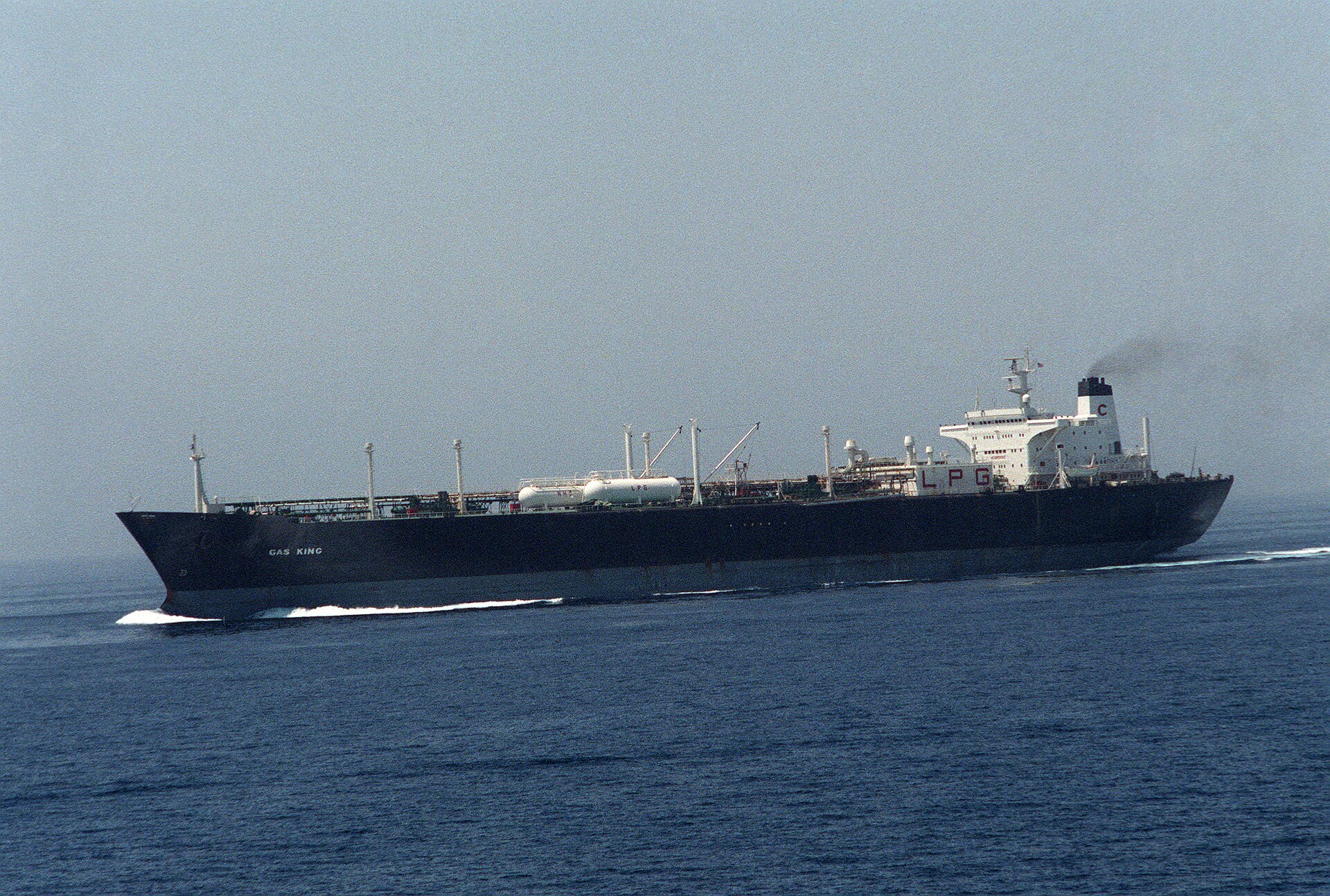

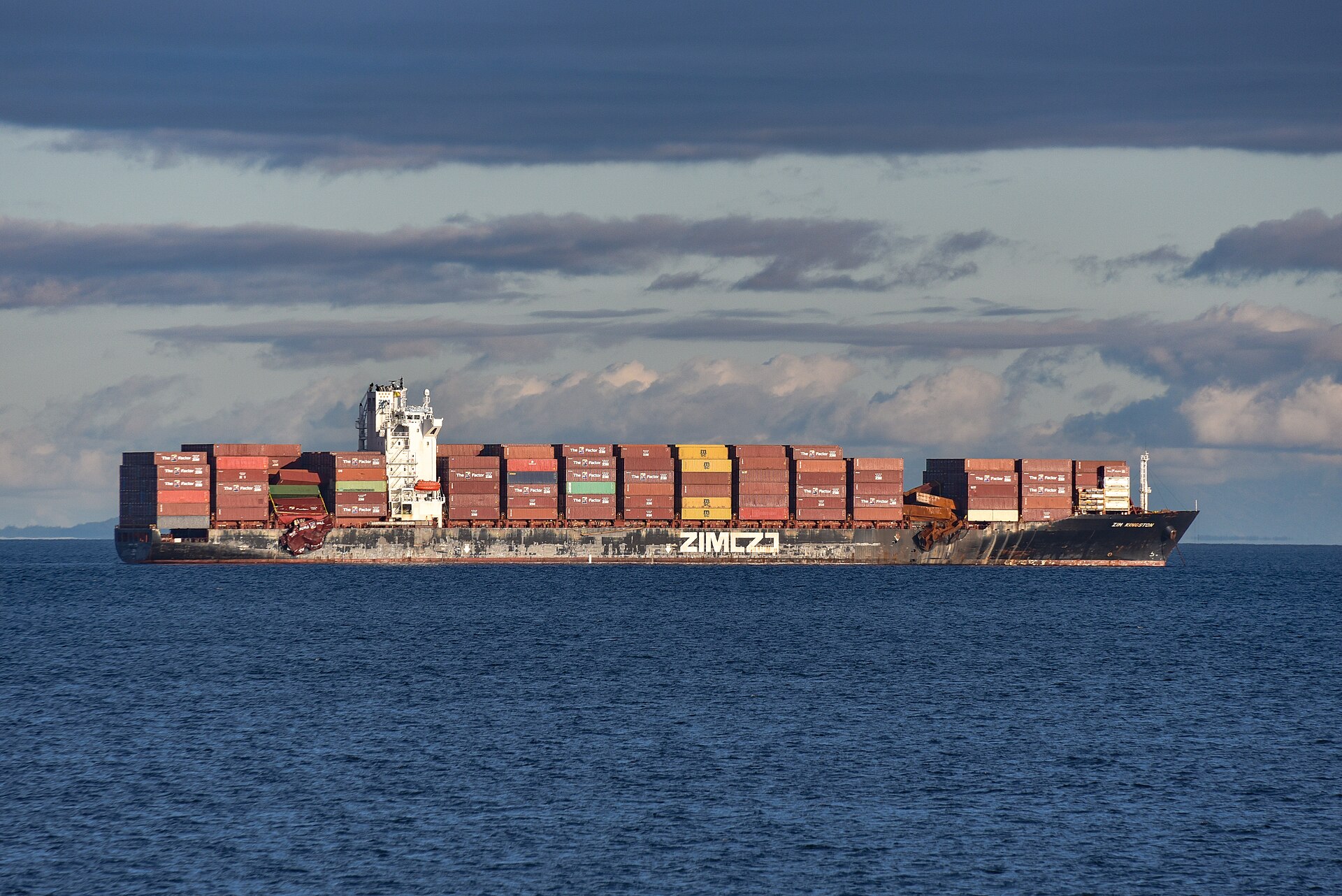
DUBAI — Captain Tim Hawkins, CENTCOM’s spokesman, told Fox News on 18 October that “about 97% of the ships that have sought to transit the Strait of Hormuz have done so successfully without being hit by an Iranian projectile.” Three percent were hit. Among them: the GFS Pride, a 2,824-TEU container ship, Singapore-flagged, operated by Abu Dhabi’s AD Ports Group. It was struck by a projectile on 13 October, caught fire, and sank while under tow off Oman. All 21 crew were evacuated. Also among them: the Cape Dao, registered in Antigua and Barbuda, hit by two projectiles on 23 September. One Indian crew member was killed. The Cape Dao also sank.
The formula is constructed to reassure. Its denominator counts only ships that “sought to transit” — not the 135 vessels that turned around since Iran reimposed its blockade on 14 July (CBS News, 10 October). Its numerator counts only “projectile strikes” — not mines, not RPGs fired from small boats, not drone attacks that UKMTO has struggled to catalogue. Ships that rerouted around the Cape of Good Hope before reaching the strait do not appear in either column. The three percent is what got through and got hit. It says nothing about what stayed away.
Iran has shifted tactics. An Iranian official told Reuters in mid-October that Tehran had “started using different offensive tactics against vessels it considered in violation of its restrictions about 10 days ago.” The move from indiscriminate mining to targeted strikes on container ships is deliberate: it makes the damage specific, attributable, and impossible to absorb into a statistical average. Cargo spills ashore. Ships go down in documented, named incidents — with hull numbers, flag states, crew manifests, and cargo inventories that survivors and port authorities can confirm. The three percent becomes visible in a way the ninety-seven is not.
The four ships damaged off Fujairah in May 2019 were attacked covertly — limpet mines, no claim of responsibility, attribution made after the fact by US intelligence. The 2026 campaign has dispensed with deniability. Iran’s attacks are conducted under a formally declared IRGC permit regime. The campaign is overt, sustained, and officially authorised. The three percent is not an accident of geography. It is the product of a policy.
Fifteen days before the US midterm elections, the 97 percent is not a safety finding. It is a statistic offered by an administration that has ruled out military escalation against Iran until after 3 November (The National, 8 October). Washington’s incentive is to hold the number steady. Riyadh’s interest runs in the opposite direction. For a kingdom that imports the majority of its food through the strait and exports the barrels that fund the state, three percent is not a rounding error. It is sinking ships.
Table of Contents
- What Does Washington’s 97 Percent Actually Measure?
- How Many Container Ships Has Iran Hit This Month?
- Who Is Still Sailing Through Hormuz?
- What Does Saudi Arabia Import Through the Strait?
- The Northern Route and the Permit Regime
- Why Does Washington Need This Number Before November?
- The Insurance Market Has Already Answered
- Frequently Asked Questions
What Does Washington’s 97 Percent Actually Measure?
CENTCOM’s 97 percent measures the share of ships that attempted a Hormuz crossing and were not struck by an Iranian projectile. The metric excludes mines, drones, RPG attacks from small craft, and commercial avoidance — the operators who have stopped sending ships altogether. Ships transiting under IRGC supervision via the Iranian-controlled northern route count as safe in this formula.
The Middle East briefing 3,000+ readers start their day with.
One email. Every weekday morning. Free.
The figure depends on a denominator that no one can independently confirm. UKMTO recorded 254 vessel transits in the week ending 14 October: 125 outbound, 129 inbound. Of those, only 42 were observable by AIS — the transponder system that allows independent tracking. The remaining 212 came from what UKMTO described as “U.S.-reported facilitated transits, which include ships not broadcasting AIS.” UKMTO cautioned that these figures “cannot currently be independently verified” (gCaptain, 17 October).
Admiral Brad Cooper, CENTCOM’s commander, simultaneously claimed approximately 400 merchant ship transits in the same week — a gap of roughly 146 ships that neither UKMTO nor any independent maritime tracking service has accounted for. Cooper did not specify the period or methodology (Kurdistan24/Al Jazeera, 17 October). The discrepancy is not marginal. It is larger than the entire AIS-confirmed transit count.
Before the war, 130 to 140 vessels transited the strait daily (Reuters). UKMTO’s 254 for the most recent reported week works out to roughly 36 per day — about 27 percent of normal traffic. Even CENTCOM’s disputed figure of 400 per week represents less than half of pre-war volume. The 97 percent is calculated against a denominator that is itself a fraction of what once moved through Hormuz. Ninety-seven percent of a diminished flow is not the same as ninety-seven percent of normal commerce.
For a ship captain approaching the strait, the 97 percent offers no operational guidance. It does not specify which flags were hit, which cargo types were targeted, or whether the struck vessels were using the northern or southern corridor. It does not distinguish between ships that transited with IRGC permits and those that did not. It does not tell a captain whether the naval escort he was promised will materialise at the designated rendezvous point. The number answers a political question — is the strait manageable? — not a navigational one.
The exclusion of mines is particularly significant. Iran has laid mines throughout the strait since March. The 97 percent metric captures only one category of weapon while Iran prosecutes its campaign across multiple domains simultaneously. A mine strike does not count against the three percent. Neither does a ship that hit a mine and sank before anyone filed a report.
How Many Container Ships Has Iran Hit This Month?
At least 15 container ships were attacked in the Strait of Hormuz in the 10 days before 19 October (Guardian). UKMTO documented 12 vessel attacks in the week to 16 October and noted that “the majority of vessels targeted are refusing to submit reports” (gCaptain, 17 October). In the first 15 days of October, at least 26 attacks or security incidents involving commercial vessels were recorded — the highest monthly total since the war began on 28 February (Kuehne+Nagel, 16 October).
“The majority of vessels targeted are refusing to submit reports.”
— UKMTO weekly overview, 17 October 2026
The reporting gap means the published numbers are floors, not counts. UKMTO itself stated it is aware of additional incidents through other sources that it cannot include without sufficient verification. Every figure cited here — 12, 15, 26 — understates the total. Operators have reasons not to report: insurance complications, flag-state exposure, commercial sensitivity about routing decisions. The true attack count is, by UKMTO’s own assessment, unknowable from current reporting.
On 13 October, three container ships operated by GFS Ship Management — a subsidiary of Abu Dhabi’s state-owned AD Ports Group — were struck in rapid succession. The GFS Pride caught fire and sank. The GFS Giselle, a 4,350-TEU vessel also registered in Singapore, sustained hull damage but reached anchorage under its own power. A third vessel, the Al Saadiyat, was also hit. All three were operating with their Automatic Identification Systems switched off when struck (Kuehne+Nagel, 16 October). Iran claimed a mine sank the GFS Pride. Maritime security firm Marisks found “no independent evidence” to support the claim and called it “consistent with an ongoing psychological operations campaign aimed at generating fear, increasing uncertainty and discouraging commercial shipping” in the strait (gCaptain, 14 October). Singapore’s Maritime and Port Authority confirmed the sinking.
The October escalation follows a pattern of adaptation. US forces struck hardened Iranian positions along the strait and sank multiple IRGC minelayers in March (CNBC, 9 October). The IRGC absorbed the losses and changed methods. Gulf oil exports had recovered toward pre-war levels by September. Iran’s shift to targeted direct attacks on container ships — timed to reverse that recovery — made the damage specific and undeniable at precisely the moment commercial confidence was returning (Kuehne+Nagel, 16 October).
The attacks have extended beyond the strait itself. An RPG was fired from a small boat approximately 78 nautical miles northeast of Saudi Arabia’s Jubail industrial port, striking a tanker’s aft quarter (Guardian/UKMTO, 19 October). That location is well inside the Persian Gulf — not in the strait’s chokepoint but in waters that serve Saudi Arabia’s eastern industrial coast. The strike was not an isolated engagement in the narrows. It was a demonstration of reach into the Gulf proper, against the shipping lanes that connect Jubail and Dammam to the global economy.
Who Is Still Sailing Through Hormuz?
Almost no major container operator. Lloyd’s List Intelligence data shows the recent rise in containership transits through Hormuz was driven almost entirely by AD Ports Group feeder vessels — a single Abu Dhabi state-owned company (Kuehne+Nagel, 16 October). On 13 October, Iran struck three of its ships in one day, raising the question of whether even that final holdout will continue sending vessels through the strait.
The GFS cluster was not random. Marisks described the concentration of attacks on one operator as raising “the possibility of targeting based on operator affiliation.” AD Ports Group is Abu Dhabi’s sovereign logistics arm. Its feeder services connect Gulf ports to regional and global container networks — the capillaries of intra-Gulf trade. Iran identified the company still moving container volumes through the strait and, in a single day, demonstrated it could hit every ship that company sent.
Control Risks assessed that Tehran’s “broader objective is to sustain uncertainty and demonstrate that it retains the ability to attack vessels across different ownership, cargo and trading patterns” (October 2026). The 13 October strikes suggest something more precise. Iran is targeting selectively, choosing ships whose loss is visible, specific, and difficult to absorb into a comforting average. Containers from the GFS Pride have washed ashore on Iranian beaches. Iranian authorities ordered local fishers not to loot the floating cargo, declaring it “property of the state” (Guardian, 19 October). The wreckage is the evidence that a percentage cannot contain.
When the last container operator withdraws — or is forced out — the consequences extend beyond commercial cargo. The workers and expatriates stranded across the Gulf conflict zone depend on the same maritime corridors. Container feeders carry not only goods but the supply chain that sustains port workers, industrial staff, and the communities built around Gulf shipping infrastructure. Each operator that stops sailing removes a thread from a network that was already fraying.
What Does Saudi Arabia Import Through the Strait?
Fifty-nine percent of Saudi Arabia’s food imports transit the Strait of Hormuz, according to the FAO’s GCC Food Policy Flash published in April 2026. Sugar is 100 percent imported and 98 percent Hormuz-exposed. The kingdom held an estimated two to four months of strategic food reserves as of March 2026 (Netherlands government/agroberichtenbuitenland.nl) — before the current blockade entered its fourteenth week.
| Category | Import Dependency (%) | Hormuz-Exposed (%) |
|---|---|---|
| Sugar | 100 | 98 |
| Cereals | 94 | 39 |
| Pulses | 94 | 60 |
| Overall food imports | — | 59 |
| Source: FAO GCC Food Policy Flash, April 2026 | ||
The Hormuz crisis is usually framed as an export story — barrels out. But Saudi Arabia’s import dependency through the strait is at least as consequential. Cereals are 94 percent imported, with 39 percent arriving through Hormuz. Pulses are 94 percent imported and 60 percent Hormuz-exposed. These figures represent national food security, not commodity pricing. When a container ship carrying agricultural bulk sinks in the strait, the loss is not abstractly commercial. It is directly nutritional.
The disruption extends beyond food. In April 2026, Sadara Chemical Company — the Sabic-Dow joint venture at Jubail — declared force majeure on key products after industrial feedstock shipments through Hormuz were interrupted (The Energy Year; Enterprise AM, April 2026). Jubail is Saudi Arabia’s largest industrial complex, and its maritime dependence is the vulnerability Aramco cannot engineer around. Each force majeure filing pushes downstream customers toward suppliers whose feedstock does not route through a contested strait.
The RPG attack 78 nautical miles northeast of Jubail was not a stray engagement. It demonstrated that Iran can reach the industrial coast Saudi Arabia depends on — not only the chokepoint the world watches. The strategic food reserves estimated in March were calculated before fourteen weeks of intensified blockade ran against them. Whether they have been replenished through Red Sea ports or overland routes from Jordan and Iraq is not publicly documented. The arithmetic is straightforward: reserves built for peacetime supply variability are being drawn against wartime disruption.
The Northern Route and the Permit Regime
The Joint Maritime Information Centre assessed in an advisory on 15 October that approximately 70 percent of AIS-observable transits through Hormuz use the Iranian-controlled northern route (gCaptain). JMIC warned that ships operating with AIS switched on face elevated targeting risk if they use the southern Omani corridor. The practical result: ships CENTCOM counts as “safely transiting” are overwhelmingly sailing through waters the IRGC supervises, on terms the IRGC sets.
Iran codified this control in March 2026 with the establishment of the Persian Gulf Strait Authority, which requires ship captains and operators to apply directly to the IRGC for transit permits. The permits demand detailed cargo manifests, ownership structures, and routing plans (gCaptain/RNZ, March 2026). The PGSA is not recognised under international maritime law — the strait is governed by the right of transit passage under UNCLOS. But legal standing is distinct from operational reality. Seventy percent of the visible traffic is complying with a regime the international community does not recognise.
The intelligence value of the permit system extends beyond traffic control. Every operator that files an application provides the IRGC with a detailed profile: beneficial owner, flag state, cargo type, schedule. The GFS cluster — three ships from one operator, struck on one day — suggests that Iran may be using this information not only to regulate passage but to select targets. Ships that comply gain the northern corridor. Ships that do not — or that sail AIS-dark through the southern channel — face a different category of risk. The system functions as both a gate and a surveillance architecture.
“The Strait of Hormuz is controlled by the United States and our regional partners, not Iran.”
— Admiral Brad Cooper, CENTCOM commander, 17 October 2026
Admiral Cooper declared on 17 October that “the Strait of Hormuz is controlled by the United States and our regional partners, not Iran” (Al Jazeera). The data released the same week by JMIC — a Western-aligned maritime intelligence centre — says that seven in ten observable ships are using the route Iran controls. Both statements were issued within days of each other. They describe different straits.
Why Does Washington Need This Number Before November?
Washington needs the Hormuz narrative to hold for fifteen more days. President Trump ruled out military action against Iran before the 3 November midterm elections (The National, 8 October). The 97 percent statistic frames the strait as contested but functional — avoiding both the political cost of a military response and a formal acknowledgement that the waterway is under effective Iranian interdiction.
The alternative was on the table and rejected. Iran’s Foreign Minister Araghchi proposed a seven-day roadmap in September — Hormuz reopened in exchange for sanctions waivers, a lifting of the US maritime blockade, and approximately $12 billion in frozen assets (Al Jazeera, 25 September). The Wall Street Journal reported that Trump rejected the plan and expects renewed military action after the vote (Hurriyet/WSJ, 26 September). The rejection confirmed the timeline: no response — diplomatic or military — before November.
Oil prices reflect the gap between the statistic and the reality. Brent crude was near $108 on Monday morning, having touched $110 the previous Friday (Guardian, 19 October; Al Jazeera, 17 October). Oil flows through Hormuz in the seven days to 13 October were 11.6 million barrels per day — roughly 68 percent of the 17.1 mb/d pre-war baseline, per Kpler (Al Jazeera, 17 October). The IEA reported that Saudi output fell 2.6 mb/d in August and crude shipments dropped to 6 mb/d (Trend, 14 September). Riyadh is absorbing the economic cost of a disruption that Washington has an electoral reason to minimise.
Saudi Arabia’s November OPEC+ production target is 10.5 mb/d (Enerdata, 4 October). With crude shipments at 6 mb/d and the East-West pipeline’s design capacity at approximately 7 mb/d (Saudi Gazette via Zawya, 25 September), the kingdom cannot physically reach its own production target under current conditions. The constraint is not geological. It is logistical — and it is imposed by a campaign that Washington’s 97 percent statistic is designed to downplay.
For Saudi Arabia, the incentive structure is reversed. The kingdom needs the threat recognised — by Washington, by insurers, by the naval coalitions supposed to secure the waterway. Every reassuring statistic from CENTCOM erodes the case for the escalation response Riyadh cannot deliver alone. Iran is simultaneously prosecuting the war and offering to mediate it. The 97 percent serves both Tehran and Washington for different reasons: it sustains the idea that Hormuz is a manageable risk rather than a chokepoint under active siege. The country it does not serve is the one whose economy sits on both sides of the strait — exporting through it and importing through it at the same time.
The Insurance Market Has Already Answered
War-risk insurance premiums for Hormuz transits stood at 3.5 to 7.5 percent of hull and machinery value per transit as of July 2026 — up from 0.10 to 0.25 percent before the conflict (Singapore Ministry of Transport, 4 August 2026). A $100 million vessel now costs between $3.5 million and $7.5 million to insure for a single passage. Lloyd’s launched a $400 million marine war risk consortium in June 2026 — $200 million for hull and protection and indemnity, $200 million for cargo — specifically for Hormuz transits (Lloyd’s press release, 19 June 2026). The market has priced the danger and packaged it for sale.
“The reason ships are not moving is not through a lack of insurance.”
— Lloyd’s Market Association
The Lloyd’s Market Association stated explicitly: “The reason ships are not moving is not through a lack of insurance.” Coverage remains available. It is the risk that has changed — and the cost of carrying that risk falls on both ends of every trade. An estimated $8 per barrel in war-risk charges is absorbed by exporters and importers alike (AGBI, September 2026). For Saudi Arabia, which sits on both sides of the Hormuz equation — crude out, food and feedstock in — the adder compounds on every barrel and every container.
Freight rates tell the same story in different units. The VLCC rate for Gulf-to-China voyages reached $1.2 million per day in October, compared with approximately $80,000 a day a year earlier (bdnews24/LSEG, 5 October). Aramco cut its November Arab Light official selling price to Asia by $3 per barrel, setting it at $5 below the Oman/Dubai benchmark (bdnews24/Reuters, 5 October). The discount is what a seller offers when the buyer’s shipping lane is contested and the buyer’s alternatives are not. Non-Gulf producers — US shale, Brazilian pre-salt, West African grades — face no comparable war-risk surcharge. Insurers settled the question months ago. Iran’s shift to direct container ship attacks is making their conclusion visible to everyone else.
CENTCOM’s 97 percent and the insurance market’s 3.5 to 7.5 percent describe the same strait in different currencies. The Pentagon’s number is designed for political consumption — a figure to cite in press briefings, a statistic to hold up against accusations of inaction. The insurance premium is a market price, set by underwriters whose capital is at risk with every policy they write. When the two numbers diverge this sharply, the one backed by money is more reliable than the one backed by a microphone.
Frequently Asked Questions
How many seafarers have been killed since the Hormuz conflict began?
The International Maritime Organisation has documented at least 24 seafarer fatalities and more than 100 confirmed maritime security incidents since the conflict began on 28 February 2026 (gCaptain citing IMO, 14 October). The dead include an Indian crew member aboard the Cape Dao, killed when two projectiles struck the ship on 23 September. The fatality count does not include casualties among naval personnel or IRGC forces, and the IMO has acknowledged that reporting from the conflict zone remains incomplete.
Has Russia offered to mediate the Hormuz crisis?
Russian Foreign Minister Sergei Lavrov visited Tehran in October 2026 and proposed a China-Russia-Iran summit on strait security. Lavrov offered to mediate between Iran and President Trump, describing the region as being “on the verge of a full-scale crisis” (Guardian, 19 October). Tehran has not publicly accepted or rejected the proposal. The diplomatic initiative adds another axis to a crisis already involving US, European, and Gulf state interests, and positions Moscow as a potential broker at a moment when Washington has taken itself off the negotiating calendar until after 3 November.
What has Iran’s president said about environmental damage in the strait?
President Masoud Pezeshkian described the regional damage from the conflict as “ecocide” and said that sanctioned or attacked countries should not bear its cost (Guardian, 19 October). Containers from the sunken GFS Pride have been washing ashore in Iranian territory, spilling commercial goods into coastal waters and onto beaches. The environmental framing serves a dual purpose: it positions Iran as bearing the consequences of a war it frames as defensive, while the IRGC continues to prosecute the naval campaign producing the damage.
What military action has the US taken against Iranian strait positions?
In March 2026, US forces dropped 5,000-pound bunker-buster bombs on hardened Iranian anti-ship cruise missile sites along the Strait of Hormuz and sank multiple IRGC minelayers (CNBC, 9 October). The strikes degraded Iran’s fixed coastal battery capability but did not suppress the campaign. The IRGC adapted its tactics — shifting to mobile launchers, small-boat RPG attacks, and pre-positioned mines — and the frequency of attacks on commercial vessels reached its highest level in October 2026. Iran’s Acting Defence Minister Majid Ibn Reza responded that it will be “Iranian missiles, not US bombs, that determine the war’s future” (Al Jazeera, 17 October).