LONDON — The International Monetary Fund published its July 2026 World Economic Outlook Update on July 8 with a foundational assumption already overtaken by events: that the Strait of Hormuz would begin reopening in mid-July, with conditions “broadly returning to the prewar state of affairs by March 2027.” The same day, the memorandum of understanding governing the US-Iran diplomatic track was declared void, and IRGC forces struck 85 US military targets across four bases in Bahrain and Kuwait. The IMF’s commodity price projections were finalized on June 10 — four full weeks before the collapse — locking in an $89-per-barrel Brent average for 2026 that embeds a contradiction the Fund has not resolved. Saudi Arabia’s 1.7% growth forecast for 2026, its 5.5% projected rebound in 2027, and the kingdom’s entire fiscal trajectory flow downstream from a single assumption: that Hormuz normalizes within nine months. Brent closed July 8 at $77.92. Hormuz commercial crossings stood at 31 per day against a pre-war baseline of 120 to 140. The assumption did not survive contact with its own publication date.
Table of Contents
- What Did the IMF Assume About Hormuz?
- The June 10 Data Lock
- How Does the $89 Barrel Survive a Reopened Strait?
- Three Downgrades in Nine Months
- What Happens to Saudi Arabia’s 2027 Growth if Hormuz Stays Closed?
- The Fiscal Gap No Forecast Has Closed
- Aramco’s August Price Says What the IMF Cannot
- What Did the IMF Leave Out of Its Saudi Fiscal Model?
- Frequently Asked Questions
What Did the IMF Assume About Hormuz?
The IMF’s July 2026 WEO Update states it explicitly: “IMF staff projections assume that the reopening of the Strait of Hormuz begins in mid-July, with conditions broadly returning to the prewar state of affairs by March 2027.” This single sentence underpins the Fund’s entire Middle East outlook — 0.7% regional growth in 2026, a 6.5% rebound in 2027, and an oil price projection of $89 per barrel averaged across the calendar year.
The assumption is not a hedge or a caveat. It is load-bearing. The 5.5% Saudi growth figure for 2027 — raised a full percentage point from the April WEO’s 4.5% — is the mathematical residual of a nine-month normalization timeline. Remove the assumption and the number has no structural foundation. Every fraction of the upward revision is downstream of a diplomatic outcome the IMF cannot influence and the MOU collapse has made unreachable on the stated schedule.
The House of Saud Daily Briefing
Saudi Arabia's news in 3 minutes, every morning. Free. See today's issue
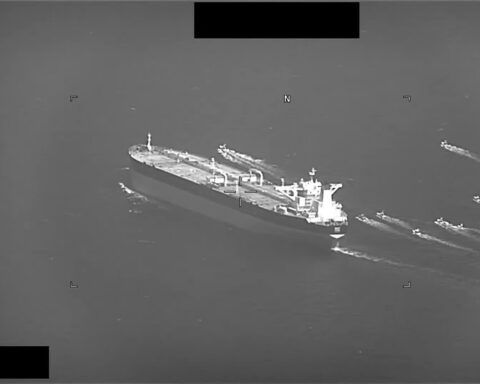
Twenty-seven AIS-visible ships per day transit against 84 at baseline, with 34 million barrels moving on state-fleet and dark tankers outside conventional tracking — meaning the 31 commercial crossings per day the headline figure captures is itself an overcount of freely-moving traffic. The strait is not closing in some future scenario the IMF might have modeled. It is already functionally restricted — and the security environment deteriorated sharply between the June 10 data lock and the July 8 publication.
Fitch Ratings published its own Hormuz assumption on June 9: reopening “by end of July,” with Brent falling to approximately $70 per barrel from September as OPEC+ output hikes and the global inventory surplus reasserted themselves. Fitch projected an $87 full-year average under that scenario. One month later, neither Fitch’s nor the IMF’s timeline has any visible mechanism of fulfillment. The MOU that provided the diplomatic framework is void. The IRGC and the Foreign Ministry issued contradictory statements on July 8 itself — the IRGC declaring Hormuz closed while the Foreign Ministry told Tasnim that shipping was “operating normally.” Iran is managing the economic pressure of full closure while maintaining the threat — a posture incompatible with the orderly reopening both the IMF and Fitch assumed.
The June 10 Data Lock
The WEO’s commodity price projections were finalized on June 10, 2026. The document published twenty-eight days later, on July 8. In those four weeks, the world the IMF modeled ceased to exist.
The MOU between the United States and Iran — the diplomatic instrument the IMF’s reopening assumption implicitly required — was declared void. IRGC forces struck 85 US military targets across four bases in Bahrain and Kuwait. OPEC published its July Monthly Oil Market Report, cutting 2026 global oil demand growth for the second consecutive month to 970,000 barrels per day, down from 1.17 million. Aramco slashed its August Arab Light Official Selling Price to negative $1.50 per barrel versus Oman/Dubai — the first negative differential since June 2020.
None of these events are reflected in the IMF’s numbers. The June 10 lock means the $89 oil price was set before the MOU collapsed, before the strikes, before OPEC’s demand downgrade, and before Aramco’s price signal.
The IMF does not hide the lock date. It discloses June 10 in the WEO PDF. The problem is not concealment. The problem is that the Fund published a nine-month recovery forecast on July 8 whose factual basis was four weeks stale — and the intervening period contained the most destabilizing sequence of events since the Hormuz crisis began. The WEO Update is an interim product, lighter than the full October or April WEO, updated on a compressed timeline and constrained by institutional process. The June 10 lock is standard procedure. What is not standard is a twenty-eight-day gap during which every material input changed direction.
How Does the $89 Barrel Survive a Reopened Strait?
The IMF projects an average Brent price of $89 per barrel for 2026, 9% above its April WEO assumption. Brent closed July 8 at $77.92 — an $11.08 gap below the Fund’s annual average. For the $89 number to hold across the full year, Brent would need to average above $95 for the remaining five months, given the sub-$80 readings already weighted into the first-half calculation.
The $89 figure requires Hormuz disruption to persist. Supply constraint is the mechanism: fewer barrels through the strait means tighter available supply, which supports price. But the IMF simultaneously assumes Hormuz begins reopening in mid-July — which would lift the constraint. Fitch modeled this directly in its June 9 base case: Hormuz reopening by end of July would send Brent to approximately $70 per barrel from September, as OPEC+ output hikes and the global inventory surplus re-emerged.
The oil market is moving forward rapidly into its new-old normal, characterised by ample supplies and producer competition.
Norbert Rücker, Head of Economics, Julius Baer — stated days before IRGC strikes, July 2026
Rücker was describing the world the IMF’s growth forecast requires — one of open supply lines and falling prices. Hours after he spoke, the IRGC struck four US bases, and the world the IMF’s price forecast requires — constrained supply, elevated risk premium — reasserted itself.
The contradiction is structural, not incidental. The $89 price requires the disruption that the IMF’s growth forecast requires to end. The 5.5% Saudi growth rebound assumes normalization — open shipping lanes, restored export capacity, recovered non-oil confidence. That normalization eliminates the supply constraint holding the $89 price. Hormuz disruption is currently the only variable holding Brent above $75. The IMF needs that variable to persist for its price assumption. It needs it to disappear for its growth forecast. The Fund embedded both conditions in a single document without resolving the tension between them.
Three Downgrades in Nine Months
Saudi Arabia’s IMF growth forecast has been revised downward in every successive publication since October 2025: 4.5% in October, 3.1% in April 2026, 1.7% in July 2026. Each revision assumed imminent conflict resolution. Each assumption failed within weeks of publication.
The Saudi government’s own 2026 forecast, embedded in the December 2025 budget, was 4.6% — now 2.9 percentage points above the IMF’s July figure. The kingdom entered 2026 with genuine momentum: 4.5% GDP growth in 2025, driven by unwinding OPEC+ production cuts. The IMF’s June 2026 Article IV acknowledged as much — Saudi Arabia “entered 2026 with strong momentum.” The same Article IV then noted the war “disrupted that momentum, curtailing oil exports and weighing on non-oil activity and confidence.”
| Publication | 2026 Forecast | 2027 Forecast | Implied Hormuz Assumption |
|---|---|---|---|
| October 2025 WEO | 4.5% | — | No major disruption |
| April 2026 WEO | 3.1% | 4.5% | H1 disruption, H2 recovery |
| July 2026 WEO Update | 1.7% | 5.5% | Mid-July reopening, March 2027 normalization |
| Saudi Government (Dec 2025) | 4.6% | — | No conflict scenario |
The pattern across three downgrades is consistent: cut this year’s number, raise next year’s, and assume the conflict resolves on a schedule the IMF cannot influence or enforce. The October 2025 WEO assumed no major disruption. The April 2026 WEO assumed first-half disruption with second-half recovery. The July 2026 Update assumes mid-July reopening with March 2027 normalization. Each assumption was more specific than the last. Each was wrong faster.
The 2027 forecast moved in the opposite direction: 4.5% in April, 5.5% in July. The entire one-percentage-point upward revision is the residual of the March 2027 normalization assumption. Strip the assumption and the 5.5% is not a forecast — it is the arithmetic consequence of assuming the problem goes away.
No major institution has published a baseline scenario in which Hormuz remains restricted through 2027. The absence of that scenario is not an analytical choice. It is an institutional constraint. Sovereign clients on both sides of the strait hold seats on the IMF’s executive board, and publishing pessimistic baselines carries diplomatic costs that the Fund’s governance structure is designed to avoid. The result is a series of forecasts that assume, by construction, that each crisis is shorter than it turns out to be.
What Happens to Saudi Arabia’s 2027 Growth if Hormuz Stays Closed?
If Hormuz does not normalize by March 2027 — and no credible diplomatic mechanism currently exists to deliver normalization on that timeline — the 5.5% rebound has no structural basis. The IMF’s regional forecast makes the dependency explicit: Middle East 2027 growth of 6.5%, contingent on the same March normalization. Both numbers are the output of a single variable.
Saudi crude exports currently run at approximately 6.3 million barrels per day, roughly 90% of pre-war levels. The East-West pipeline — the Petroline — carries approximately 5 million barrels per day of capacity. The remaining 1.3 million barrels per day is Hormuz-dependent even at current reduced export levels — a volume that represents over $100 million per day in gross revenue exposure at current Brent prices if the strait functionally closes to Saudi-flagged or Saudi-destined traffic.
The 5.5% figure also assumes a recovery in non-oil GDP that depends on restored business confidence, resumed foreign direct investment inflows, and stabilized government spending. Q1 2026 data contradicts each condition. Net FDI fell 2.4% year-on-year despite gross inflows rising slightly. Oil revenues fell 3% year-on-year while government spending surged. The non-oil growth the IMF forecasts for 2027 requires the restoration of an investment climate that the conflict is actively degrading.
The PGSA fee mechanism compounds the 2027 problem. The March 2027 normalization implicitly requires PGSA resolution — a framework the MOU collapse has left without a negotiating channel. IRGC-affiliated Tasnim News Agency articulated the pressure from the opposing side in June: “Every minute that the Strait of Hormuz remains open is a major loss.” The demand for closure comes from elements of the Iranian security establishment for whom the IMF’s reopening assumption is not merely optimistic but adversarial to their stated strategic objectives.
The Saudi finance minister acknowledged the structural challenge in April: recovery will take a long time “even if war ends now.” The IMF’s 5.5% implies war ends soon and recovery begins immediately. The minister’s own framing suggests neither condition is likely.
The Fiscal Gap No Forecast Has Closed
Saudi Arabia posted a SAR 125.7 billion ($33.5 billion) budget deficit in Q1 2026 — consuming 76% of the official full-year SAR 165 billion deficit target in a single quarter. Oil revenues fell 3% year-on-year to SAR 144.72 billion. Government spending jumped 20% to SAR 386.69 billion. The full-year deficit target, set in December 2025, assumed 4.6% growth and no sustained conflict. Three of its four premises have failed.
The IMF’s fiscal breakeven for Saudi Arabia stands at $86.60 per barrel, per the Fund’s December 2025 Article IV. Brent at $77.92 on July 8 left a gap of $8.68. At Saudi production of approximately 10.4 million barrels per day, each dollar below breakeven costs roughly $310 to $315 million per month in forgone fiscal revenue. The $8.68 gap implies a shortfall of approximately $2.7 to $2.8 billion per month — roughly $33 billion annualized, or nearly the entire Q1 deficit repeated each quarter for the remainder of the year.
Abu Dhabi Commercial Bank projected an average Brent of $64 per barrel for 2026 in a February assessment. On that basis, the Saudi deficit reaches 5.3% of GDP — well above the official 3.3% projection. Brent has not fallen to $64, but the trajectory since May has been sharply downward. The war premium that once lifted Brent above its pre-crisis level has evaporated: Brent at $70.82 on July 4 traded below the pre-war $72.48 baseline. The premium that was supposed to partially compensate Gulf producers for lost volume has itself become a casualty of OPEC+ output hikes and weakening demand.
A modest reduction in the non-oil primary deficit in 2026 remains appropriate, with spending reprioritization as the first line of action to accommodate any fiscal response to the conflict.
IMF, Saudi Arabia 2026 Article IV Concluding Statement, June 2026
The phrase “spending reprioritization” is the IMF’s institutional language for cuts. The $16 billion in NEOM termination charges already recognized, and the broader deferral of Vision 2030 capital projects, represent the early edge of what the Fund is describing — though it does not quantify the adjustment it considers “appropriate.” At current price and export levels, the kingdom is running a fiscal deficit at roughly twice the pace its own budget projected. The IMF’s July WEO does not model a scenario in which this pace continues through year-end.
Aramco’s August Price Says What the IMF Cannot
Aramco set its August 2026 Official Selling Price for Arab Light crude to Asia at negative $1.50 per barrel versus the Oman/Dubai benchmark — the first negative differential since June 2020 and the largest single-month cut on record in Reuters data going back to 2003. The premium collapsed $21 per barrel in eleven weeks: from plus $19.50 in May to minus $1.50 in August.
An OSP is not a forecast. It is a market signal — Aramco’s real-time assessment of buyer willingness to take Saudi crude at a given differential. A negative differential means the company is discounting its flagship grade below the regional benchmark to attract purchases. Sinopec — historically Aramco’s largest single customer — has made zero purchases for two consecutive months. The August OSP announcement came alongside OPEC+’s approval of a fifth consecutive 188,000-barrel-per-day output hike, raising Saudi Arabia’s August production quota to 10.4 million barrels per day.
OPEC’s July Monthly Oil Market Report cut 2026 global oil demand growth to 970,000 barrels per day — the second consecutive downgrade, down from 1.17 million. The cartel flagged “downside risk” explicitly. The IEA separately identified a 3.84-million-barrel-per-day surplus in global supply. The surplus exists independent of Hormuz: non-OPEC production from US shale, Guyana, and Brazil continues to expand, and OPEC+ members have now added five consecutive monthly quota increases into that oversupply.
Aramco’s Q1 2026 free cash flow came in at $18.6 billion against a quarterly dividend obligation of $21.89 billion — a coverage ratio of 0.85 times. The company is distributing more cash than it generates. The Arab Gulf States Institute questioned base-dividend sustainability if oil prices remain below $80, back-calculating Saudi Arabia’s implied planning price at approximately $65 per barrel at 10 million barrels per day of production. The last time Saudi Arabia faced a comparable breakeven inversion — revenue structurally below fiscal requirements while output expanded — was 1986.
The IMF’s $89 average assumes a market that Aramco’s own pricing decisions have abandoned. The June 10 data lock means the Fund’s numbers were set before the OSP collapse, before the Sinopec withdrawal, and before the fifth OPEC+ hike. Aramco, which has access to the same forward curves and buyer data the IMF uses, moved its price $21 in eleven weeks. The IMF did not move its projection at all.
What Did the IMF Leave Out of Its Saudi Fiscal Model?
Three material exposures are absent from the IMF’s published Saudi fiscal framework.
The PGSA fee mechanism. Iran’s Persian Gulf Security Authority has accumulated $253 million in outstanding transit fees at $5.5 million per day, with the waiver expiring August 18. The fees are accruing against every vessel transiting the strait. The MOU collapse has eliminated the diplomatic instrument that might have resolved them. If the waiver lapses without renewal, the fee becomes an enforceable claim under Iran’s declared Hormuz regulatory framework — whether or not other states recognize it. No IMF document models this exposure. The IMF’s “March 2027 normalization” implicitly requires PGSA resolution, but the Fund has not acknowledged the mechanism’s existence in its published analysis.
Aramco’s dividend gap. At 0.85 times FCF coverage in Q1, Aramco is funding its $87.56 billion annual base dividend from a combination of operating cash flow, reserve drawdown, and borrowing. The base dividend is the Saudi government’s single largest revenue line — more significant to the budget than any tax instrument or non-oil revenue stream. If oil prices remain below $80 through Q3 and Q4, the coverage ratio deteriorates further, and the question of whether the base dividend is structurally sustainable moves from analyst commentary to board-level decision. The IMF’s Article IV discusses fiscal adjustment but does not model a scenario in which Aramco’s dividend becomes a source of fiscal pressure rather than fiscal stability.
The security-cost escalation. The US drawdown from Prince Sultan Air Base — including IESP contractor departure, Link-16 maintenance withdrawal, and PAC-3 resupply uncertainty — imposes replacement costs the Saudi defense budget has not yet absorbed. With 400 of an original 2,800 PAC-3 interceptors remaining and M-SAM-II replacements not expected until 2028, the gap between air-defense capacity and the threat environment is widening on a timeline the IMF’s fiscal models do not capture.
| Metric | Value | Source |
|---|---|---|
| Q1 2026 budget deficit | SAR 125.7B ($33.5B) | Saudi MoF / Gulf News |
| Full-year deficit target | SAR 165B (3.3% of GDP) | Saudi 2026 Budget |
| Q1 share of full-year target consumed | 76% | Calculated |
| IMF fiscal breakeven oil price | $86.60/bbl | IMF Dec 2025 Article IV |
| Brent crude (July 8 close) | $77.92/bbl | Market data |
| Breakeven gap | $8.68/bbl | Calculated |
| Estimated monthly revenue shortfall | ~$2.7–2.8B | Calculated at 10.4 mb/d production |
| Aramco August OSP (Arab Light, Asia) | -$1.50 vs Oman/Dubai | Reuters |
| OSP collapse (May to August) | +$19.50 to -$1.50 ($21/bbl swing) | Reuters / BOE Report |
| Aramco Q1 FCF dividend coverage | 0.85x | Aramco Q1 2026 results |
| PGSA outstanding fees | $253M ($5.5M/day accrual) | HOS reporting |
| PGSA waiver expiry | August 18, 2026 | HOS reporting |
| Hormuz daily crossings (July 5) | 31/day vs 120–140 pre-war | Bloomberg / tracking data |
| East-West pipeline (Petroline) capacity | ~5 mb/d | Industry estimates |
| Hormuz-dependent Saudi exports | ~1.3 mb/d | Calculated (6.3 minus 5.0) |
| OPEC 2026 demand growth (July revision) | 970,000 b/d | OPEC MOMR July 2026 |
These omissions are individually significant. Together, they describe a fiscal environment materially worse than the one the IMF has modeled. All three sit outside the June 10 data lock, and none are addressed in the WEO Update’s published assumptions.
Frequently Asked Questions
What Brent price would H2 2026 need to average for the IMF’s $89 annual projection to hold?
If first-half 2026 Brent averaged approximately $82 to $83 per barrel — a reasonable estimate given the range from $70 to $95 across Q1 and Q2 — the second half would need to average approximately $95 to $96 per barrel to pull the annual mean to $89. Brent has not sustained $95 since late April and early May 2026, when the war premium was at peak intensity. Forward curves as of July 8 implied $78 to $80 for the second half, roughly $15 to $18 below the level the IMF’s annual average requires.
Does the IMF publish alternative scenarios in its WEO Updates?
WEO Updates are point-estimate interim products issued in January and July, between the full April and October WEOs. They do not include the scenario analysis or risk-modeling boxes that occasionally appear in full editions. The July 2026 Update contains no downside scenario for prolonged Hormuz closure, no alternative oil-price path, and no sensitivity analysis showing how Saudi growth responds to Brent at $70 versus $89. The full October 2026 WEO may include such analysis, but by October the Fund’s July assumptions will have been tested against three additional months of events on the ground.
What is the PGSA and why does it not appear in IMF fiscal models?
The Persian Gulf Security Authority is an Iranian-declared regulatory body asserting authority to levy transit fees on vessels passing through the Strait of Hormuz. Iran established the framework as part of its Hormuz sovereignty claim, with fees that have accumulated to $253 million at $5.5 million per day. The PGSA was sanctioned by OFAC on May 27, 2026. Its absence from IMF fiscal models reflects both its disputed legal status — the United States, Saudi Arabia, and most GCC states do not recognize the PGSA’s authority — and the practical difficulty of modeling a liability that most of the Fund’s major shareholders consider illegitimate. The August 18 waiver expiry will force a binary outcome — renewal or enforcement — that the Fund cannot indefinitely exclude from its analysis.
Has the IMF previously built forecasts on conflict-resolution assumptions that failed?
The pattern is institutionally familiar. WEO forecasts during the 2011 Libya crisis and the 2014 Iraq-ISIS period were built on similarly optimistic conflict-resolution timelines and required repeated downward revision as the assumed endpoints passed without resolution. The IMF’s mandate requires it to produce point forecasts for all member states; its governance structure, in which affected countries hold executive-board seats, creates institutional pressure toward baseline scenarios that assume diplomatic progress rather than prolonged disruption. The July 2026 Saudi forecast sits within this pattern — each successive revision more specific in its assumptions, each more quickly overtaken by events.
That market bet was tested directly on July 10, when Lloyd’s List Intelligence recorded zero commercial transits on July 9 — the halt in AIS-visible crossings that the IMF’s price model had implicitly required but had not priced. The IMF’s decoupling problem deepened further when US strikes on Asaluyeh on the same day produced no war premium — a direct strike on the South Pars processing hub that Brent absorbed with The IMF’s three consecutive downgrades of Saudi economic growth — from 4.5 percent in January to 3.1 percent in April to 1.7 percent in July — track the same Hormuz assumption that its commodity price model embedded in June.
The House of Saud Daily Briefing
Saudi Arabia's news in 3 minutes, every morning. Free. See today's issue