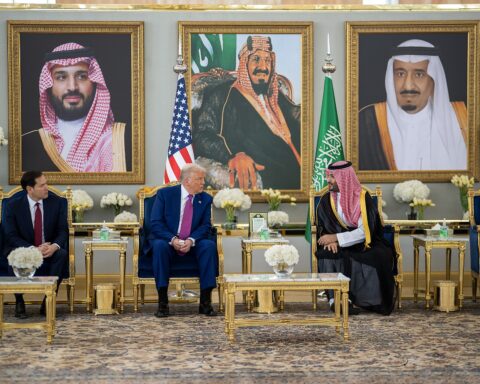
WASHINGTON — The War Powers Resolution clock expires on May 1 — five days from now — and the man with the most to lose has no vote. Mohammed bin Salman sits at the intersection of three possible futures for the US-Iran war, each one determined by a constitutional mechanism in Washington over which Riyadh exercises zero formal authority. Trump notified Congress on March 2 that US forces had conducted strikes against Iran; under Section 5(b) of the 1973 War Powers Resolution, he must withdraw those forces within 60 days unless Congress declares war, passes an Authorization for Use of Military Force, or extends the deadline by statute. None of those things has happened. None appears imminent.
This article maps the three paths Trump can take after May 1 — seek an AUMF, begin withdrawal, or defy the clock — and traces what each one costs Saudi Arabia in air defense sustainability, fiscal exposure, and strategic alignment. The answer is asymmetric: defiance is the safest outcome for Riyadh, withdrawal the most catastrophic, and an AUMF vote the most unpredictable. MBS has indirect leverage over each path through oil-state senators, arms dependency, and defense diversification — but he cannot use any of it directly without confirming the very vulnerability it is designed to conceal.
Table of Contents
- The 60-Day Clock: How It Works and Why It Cannot Be Paused
- What Does the Senate Vote Count Tell Us?
- Path One: The AUMF — What Would Congressional Authorization Look Like?
- Path Two: Withdrawal — What Happens to Saudi Arabia If Trump Pulls Out?
- Path Three: Defiance — The Libya Template at Iranian Scale
- The Saudi Exposure Matrix: Three Paths, Three Price Tags
- Can Saudi Arabia Defend Itself Without US Forces?
- The Inversion: MBS’s Indirect Congressional Leverage
- How Does Iran Read the War Powers Deadline?
- Five Days
The 60-Day Clock: How It Works and Why It Cannot Be Paused
The War Powers Resolution of 1973 requires the president to notify Congress within 48 hours of introducing US armed forces into hostilities. Once that notification is filed, Section 5(b) starts a 60-day countdown: Congress must authorize the action, or the president must withdraw. Trump filed his notification on March 2, 2026, reporting that US forces had conducted “precision strikes against numerous targets within Iran including ballistic missile sites, maritime mining capabilities, air defenses and command and control capabilities.” That puts the legal deadline at May 1. Some legal scholars count the clock from the first strikes on February 28 rather than the March 2 notification, which would place the deadline at April 29 — a reading the administration has not addressed publicly.
A single 30-day extension is available if the president certifies that military necessity requires additional time to complete a safe withdrawal — not to continue operations, but to pull out. If Trump invokes that extension without beginning withdrawal, he faces the same legal confrontation on May 31 that he faces on May 1, with the added complication of having spent political capital on a stalling mechanism. The total maximum window for unauthorized military action under the statute is 90 days.
The ceasefire that took effect on April 8 does not stop the clock. Katherine Yon Ebright of the Brennan Center for Justice told CNN that “the 1973 law provided no mechanism for pausing the 60-day clock when a cease-fire is in effect.” This matters because the administration has already floated the argument informally. Yon Ebright’s assessment: “It is very likely that the administration would have lawyers internal to it promulgating interpretations of the War Powers Resolution and this conflict that will say this can go beyond 60 days.” The legal template exists — but the statute does not support it.
No federal court has ever adjudicated WPR compliance as a justiciable question. Every past confrontation between Congress and the White House over the 60-day clock has been resolved politically, not judicially. This means enforcement depends entirely on whether Congress has the votes and the will to force the issue — a calculation that runs through the same Senate arithmetic that has already failed five times.
The Middle East briefing 3,000+ readers start their day with.
One email. Every weekday morning. Free.
What Does the Senate Vote Count Tell Us?
The Senate vote count on war powers enforcement tells us that the status quo holds — barely, and for structural rather than ideological reasons. Five separate votes to block or constrain Trump’s Iran operations have failed, all by margins of 46-51 or 47-52. The arithmetic is remarkably stable: Senator Rand Paul of Kentucky is the only Republican who has voted with Democrats on every resolution, and Senator John Fetterman of Pennsylvania is the only Democrat who has voted against every one. That consistency suggests neither party is experiencing meaningful internal pressure to move.
But the 60-day deadline introduces a variable that the previous votes did not carry. Three Republican senators — Susan Collins of Maine, Thom Tillis of North Carolina, and John Curtis of Utah — have publicly stated they will not support continuing military action beyond the 60-day window without congressional authorization. Collins told reporters that “the President’s power is not unlimited as Commander in Chief” and named ground troop deployment as a red line. Tillis framed it as a binary: “After 60 days, either the administration must articulate an exit plan that would make an AUMF moot, or if they’re planning to be there for an extended period of time, the AUMF is necessary.” Curtis published an op-ed in the Deseret News declaring he “will not support ongoing military action beyond a 60-day window without congressional approval.”
Three Republican defectors plus the existing Democratic bloc would produce a 49-51 result — still not enough to pass a binding resolution, but close enough to generate a procedural crisis. Senator Tim Kaine told Al Jazeera that “we should not fail to note how extraordinary it is that our Senate Republican leadership has declined to do any oversight of a war.” The oversight vacuum is itself a data point: it tells MBS that the mechanism most likely to protect Saudi interests — continued US military engagement — depends on congressional inaction rather than congressional support.

Path One: The AUMF — What Would Congressional Authorization Look Like?
An Authorization for Use of Military Force would end the War Powers clock permanently and place the Iran campaign on the same legal footing as the post-9/11 wars in Afghanistan and Iraq. Senator Lisa Murkowski of Alaska is reportedly drafting AUMF language “in the background,” though no text has been released publicly. For Saudi Arabia, an AUMF is the second-best outcome after outright defiance — it provides legal certainty, removes the withdrawal threat, and signals long-term US commitment to the theater.
The problem is the vote. An AUMF requires simple majorities in both chambers, but the political cost of voting for one is far higher than the cost of simply declining to enforce the WPR. House Minority Leader Hakeem Jeffries has called the campaign “this war of choice, this reckless and costly war” that was “entered into without any plan.” House Foreign Affairs Chair Brian Mast dismissed the war powers debate as “all pure politics” — a framing that avoids the substantive question of whether Congress should authorize the war while simultaneously ensuring it does not. Both positions serve their holders; neither produces legislation.
An AUMF vote would also force senators to take a recorded position on Iran that would follow them through the 2028 cycle. Oil-state Republicans from Texas, Oklahoma, Louisiana, and Wyoming face a peculiar incentive: their constituents benefit from the $105 Brent war premium that has kept domestic producers profitable, but voting to authorize a war that could escalate further carries electoral risk if casualties mount. The AUMF path is rational for Saudi Arabia but irrational for the median senator, and that gap explains why Murkowski is drafting “in the background” rather than on the floor.
Path Two: Withdrawal — What Happens to Saudi Arabia If Trump Pulls Out?
If Trump complies with the War Powers Resolution and begins withdrawal after May 1, the United States would need to remove the largest concentration of naval power assembled since the 2003 Iraq invasion. Three aircraft carriers are currently deployed to the Middle East simultaneously — Carrier Strike Group 10 arrived April 23 — along with 27 Navy vessels representing 41% of active US global deployments. A compliant withdrawal within the 30-day window would require dismantling this entire architecture while Iran retains its full conventional and asymmetric capability.
For Saudi Arabia, withdrawal is the catastrophic scenario. The kingdom has no formal mutual defense treaty with the United States — unlike NATO allies, Japan, or South Korea. After the 2019 Aramco strikes, Trump explicitly stated the US “had no obligation to defend Saudi Arabia,” according to analysis published by the New Lines Institute. That statement was made during peacetime; its logic applies with greater force during a withdrawal mandated by domestic law. The distinction matters: a treaty obligation survives a change in presidential preference, while a discretionary military commitment does not survive a statutory deadline.
The withdrawal scenario also eliminates the US naval blockade that has been in effect since April 13, which controls Arabian Sea entry while both sides of Hormuz are now blocked. Removing the US component would leave Iran’s IRGC as the sole authority managing Strait transit — precisely the outcome Tehran has been pursuing through its 12-article Hormuz sovereignty law, through Ghalibaf’s formal linkage of reopening to blockade removal on April 22, and through the choke-by-attrition approach that has cut commercial transits to a fraction of pre-war levels since April 8.
Saudi Arabia’s fiscal position makes prolonged isolation from Hormuz unsustainable. March 2026 production fell to 7.25 million barrels per day from 10.4 million in February — a 30% collapse — according to the International Energy Agency. The kingdom’s fiscal break-even, including off-budget PIF spending, sits at $108-111 per barrel (Bloomberg), and Brent closed April 25 at $105.33. Goldman Sachs estimates the war-adjusted deficit at 6.6% of GDP, roughly double the official 3.3% forecast. Every week without full Hormuz access deepens a fiscal hole that no amount of Yanbu bypass throughput can fill. Goldman’s own analysis of a “sloppy peace” scenario shows why even a partial Hormuz reopening locks in the export gap rather than closing it: the fiscal arithmetic of the Yanbu bottleneck is permanent, not temporary.
Path Three: Defiance — The Libya Template at Iranian Scale
The third path — and the one Vice President JD Vance has signaled most clearly — is to declare the War Powers Resolution unconstitutional and continue operations. Vance told CNN that “the War Powers Act is fundamentally a fake and unconstitutional law.” That is not a legal argument made in passing; it is a doctrinal position that the administration appears to be constructing deliberately.
The template is Libya 2011. When the 60-day WPR deadline passed in late May of that year with no congressional authorization, the Obama administration argued through State Department Legal Adviser Harold Koh that ongoing US operations — Predator strikes, aerial refueling, intelligence and surveillance — did not constitute “hostilities” within the meaning of the statute. Koh testified to the Senate Foreign Relations Committee that “hostilities” was deliberately left undefined by Congress in 1973 and that the US role in Libya was “intermittent” and carried limited risk of US casualties. The Senate rejected the argument; the House passed a resolution rebuking Obama. Operations continued through October 2011 without authorization.
The Iran campaign makes the Libya argument harder to sustain on the facts but easier to sustain politically. The US has lost aircraft in combat, Saudi Arabia has intercepted 894 aerial threats between March 3 and April 7 — including 86 ballistic missiles — according to data compiled from official Saudi military briefings, and Iran launched over 500 ballistic missiles and approximately 2,000 UAVs at GCC states following the February 28 strikes, per the New Lines Institute. By any conventional reading, these are “hostilities.” But Trump’s legal team is unlikely to use Obama’s semantic distinction between hostilities and non-hostilities. The more probable approach, signaled by Vance, is to challenge the WPR’s constitutionality outright — arguing that the Commander-in-Chief power under Article II cannot be constrained by a 60-day statutory timer.
The War Powers Act is fundamentally a fake and unconstitutional law.— Vice President JD Vance, CNN, April 2026
For Saudi Arabia, defiance is the optimal outcome. It preserves the US military presence, avoids the uncertainty of an AUMF vote, and shifts the confrontation from the battlefield to a constitutional dispute between Congress and the White House — a dispute that has never been resolved by the courts and is unlikely to be resolved before the campaign reaches a negotiated or military conclusion. The risk is reputational: if the constitutional challenge collapses or triggers impeachment proceedings, the entire US commitment becomes hostage to domestic politics. But that risk is already priced in. MBS is already hostage to domestic US politics; defiance merely keeps the captor in the room.
The Saudi Exposure Matrix: Three Paths, Three Price Tags
| Variable | AUMF (Authorization) | Withdrawal (Compliance) | Defiance (Ignore Clock) |
|---|---|---|---|
| US military presence | Permanent legal basis; 3 CSGs + 27 vessels remain | Full drawdown within 30 days; 27 vessels exit theater | Continues at current level; no legal basis but no enforcement |
| Hormuz blockade status | US blockade continues; dual-blockade persists | US blockade lifted; IRGC sole Strait authority | US blockade continues; legal challenge deferred |
| Saudi air defense | US THAAD/Patriot integration continues; PAC-3 resupply prioritized | US air defense assets withdraw; ~400 PAC-3 rounds on hand | Status quo maintained; resupply timeline unchanged |
| Brent price effect | Stabilizes $100-110 range (certainty premium) | Spikes above $120 (supply panic) then volatility | Remains $100-110 with legal-risk discount |
| Saudi fiscal impact | Deficit narrows if production recovers via Hormuz | Deficit widens to 8-10% GDP (Goldman baseline + Hormuz loss) | Deficit holds at 6.6% GDP (Goldman current estimate) |
| Iran negotiating posture | Pressured to concede; US commitment credible | Vindicated; maximum leverage over Hormuz | Uncertain; WPR challenge adds domestic US variable |
| MBS risk level | Medium (depends on AUMF conditions) | Critical (existential air defense gap) | Low-medium (status quo with legal overhang) |
The matrix reveals an inversion that defines MBS’s predicament. The constitutionally cleanest outcome — compliance with the WPR and withdrawal — is the most dangerous for Saudi Arabia. The constitutionally most aggressive outcome — defiance — is the safest. And the middle path — an AUMF — introduces the most variables, because authorization could come with conditions (geographic scope, duration, prohibition on ground forces) that constrain the very operations MBS needs.
Collins’s insistence that ground troops constitute a red line illustrates the risk. Any AUMF that prohibits ground deployment would formalize the air-and-sea posture that has already proven insufficient to reopen Hormuz. Tillis’s demand for an “exit plan” implies a time-limited authorization. Curtis’s op-ed framed the issue as one of congressional prerogative rather than strategic necessity. None of the three Republican wobblers is arguing for the kind of open-ended authorization that would give MBS maximum security — they are arguing for the kind of constrained authorization that gives them maximum political cover.
Can Saudi Arabia Defend Itself Without US Forces?
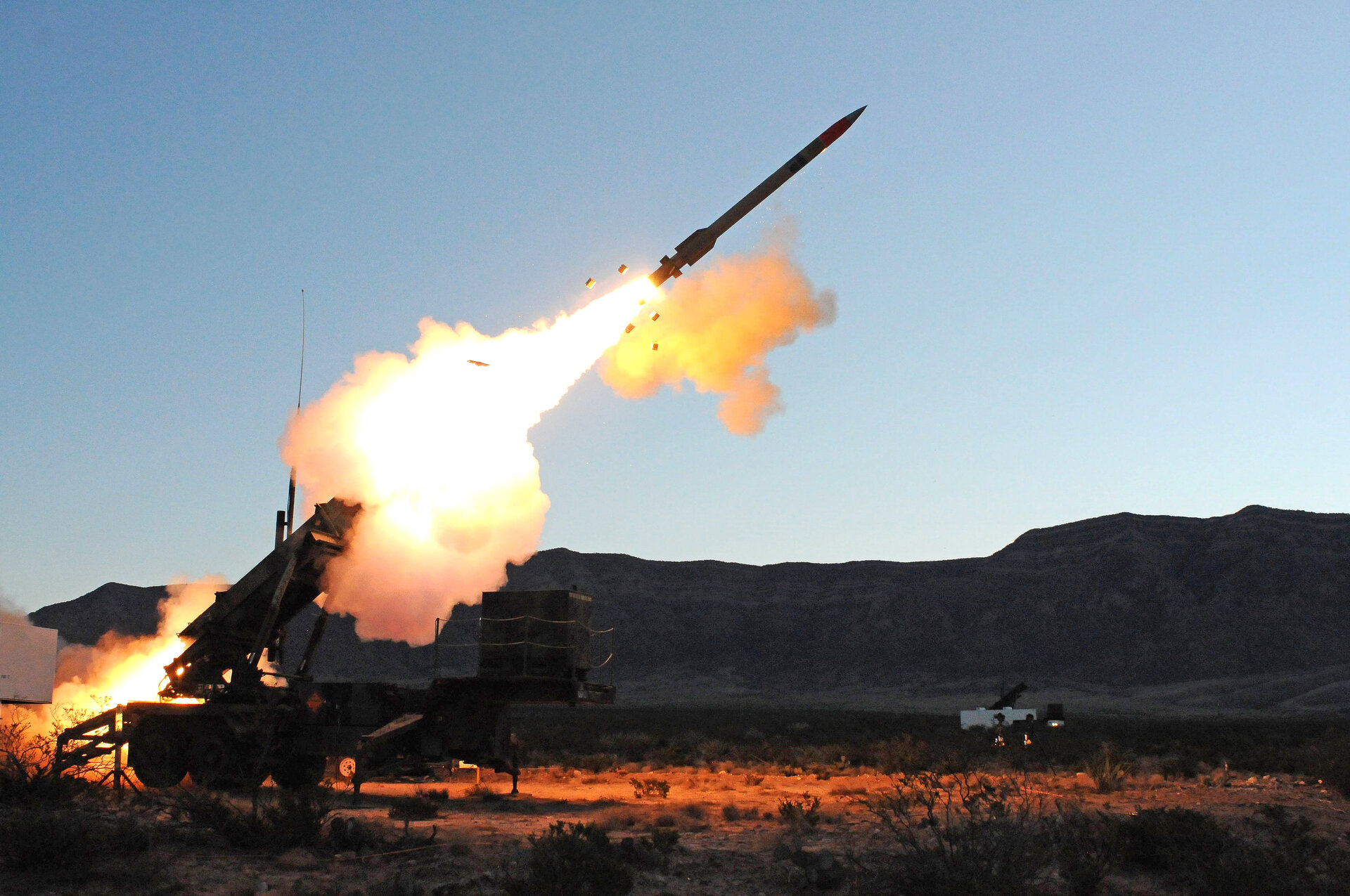
Saudi Arabia’s ability to defend itself without US forces is constrained by a single number: approximately 400 PAC-3 MSE interceptor rounds remaining after 38 days of combat, based on figures reported by this publication since the war’s opening hours. Pre-war inventory stood at roughly 2,800 rounds. The 86% drawdown reflects the intensity of Iran’s campaign — the scale of which has been detailed above — and the degradation of Saudi Arabia’s layered defense architecture after Iranian strikes damaged THAAD radar systems in the first 48 hours of the war.
At pre-ceasefire consumption rates, 400 rounds would sustain approximately six to seven days of combat. Lockheed Martin’s Camden, Arkansas facility — the sole global production line for PAC-3 MSE — produces around 620 rounds per year for all customers worldwide. The 730-round emergency sale approved in January 2026 represents more than 14 months of that facility’s total output. Replenishment before Hajj pilgrims begin arriving — the cordon sealed April 18, the Day of Arafah falls on May 26 — is a manufacturing impossibility, not a diplomatic one.
Loss of THAAD radar coverage forces Patriot batteries to engage incoming threats at lower altitudes, which both reduces reaction time and increases the number of interceptors fired per engagement. Without US forces providing integrated air and missile defense — the Aegis-equipped destroyers, the carrier-based early warning aircraft, the intelligence feeds that enable shoot-look-shoot doctrine rather than shoot-shoot protocol — Saudi Arabia’s 400 rounds shrink further in effective terms. The withdrawal scenario does not just remove US forces; it degrades the efficiency of every Saudi system that remains.
MBS has begun hedging. A Ukrainian drone procurement deal announced April 24 and ongoing Chinese ballistic missile acquisitions signal that Riyadh is building a military that doesn’t need Washington’s permission. But hedging is a medium-term strategy operating on procurement timelines measured in years, and the War Powers clock expires in days.
The Inversion: MBS’s Indirect Congressional Leverage
The structural irony of MBS’s position is that he possesses several forms of indirect leverage over the congressional vote — none of which he can deploy openly without confirming the dependency he needs to deny. The leverage operates through three channels, each with its own logic and its own constraint.
The first channel runs through oil-state senators. Republican members from Texas, Oklahoma, Louisiana, and Wyoming represent constituencies where the domestic energy industry is profiting from the war premium described above — a premium that would partially evaporate if withdrawal signaled a path toward normalized Iranian production. These senators have a constituent-level incentive to support continued operations, which means supporting either an AUMF or tolerating defiance. MBS cannot call them and make this argument directly — he does not need to. The price of crude makes the argument for him every day the war continues.
The second channel runs through the Saudi lobby and defense-hawk Republicans who view the Iran campaign through the lens of regional power projection. Saudi Arabia has been the largest single purchaser of US defense equipment for decades, and the relationship generates jobs, contracts, and campaign contributions distributed across dozens of congressional districts. An AUMF vote that fails — especially one that fails because defense-aligned Republicans defected — would raise questions about the durability of the entire US-Gulf security architecture. The lobby cannot whip votes for an AUMF directly, but it can ensure that the cost of voting against one is visible to every member who has a Lockheed Martin or Raytheon facility in their district.
The third channel is the most counterintuitive: MBS’s diversification away from US arms serves as a signal to Washington that Riyadh has alternatives. The Ukrainian drone deal and Chinese missile procurement are not militarily significant in the near term — they will not replace PAC-3 rounds before May 1 or May 26. But they are diplomatically significant because they communicate that a post-withdrawal Saudi Arabia would not remain a captive US customer. That message reaches Congress through the defense industry, which reads Saudi diversification as a threat to future contracts and lobbies accordingly.
The constraint on all three channels is the same: they work only if MBS does not acknowledge them. The moment Riyadh publicly pressures Congress for an AUMF, it confirms that Saudi Arabia cannot defend itself alone — a confession that undermines the diversification signal, weakens the lobby’s “partnership of equals” framing, and invites the question Trump asked in 2019: why should the United States defend a country that can spend $108 billion on a sovereign wealth fund but cannot intercept its own incoming missiles?
How Does Iran Read the War Powers Deadline?
Iran reads the War Powers deadline as confirmation of its core narrative: that the US war lacks domestic legitimacy and will collapse under its own constitutional weight. Those five Senate defeats are amplified by PressTV and IRGC-aligned media outlets including Tasnim, Fars, and Mehr as evidence that even American legislators oppose the campaign. The 12-article Hormuz sovereignty law and Ghalibaf’s April 22 formal linkage of reopening to blockade removal — both detailed in the withdrawal section above — operate on the assumption that the American presence is temporary.
The legal architecture reinforces this reading. Neither the United States nor Iran has ratified the UN Convention on the Law of the Sea, which means Tehran argues that only “innocent passage” — not the broader “transit passage” regime — applies in the Strait. Under innocent passage, the coastal state retains authority to impose conditions, which is precisely what the IRGC has been doing since declaring “full authority to manage the Strait” on April 5 and again on April 10 while Araghchi was in Islamabad negotiating a deal he could not deliver. Iran’s WPR argument and its Hormuz argument are structurally identical: the US is an aggressor operating outside legal frameworks, both domestic and international.
The operational implication is that Iran has an incentive to wait. If the WPR clock runs out and Trump either withdraws or enters a constitutional confrontation with Congress, Iran’s negotiating position strengthens without firing a shot. Trump cancelled the Witkoff and Kushner Islamabad trip on April 25, citing “infighting” in Iran — removing the only US-side negotiating channel that could have produced a pre-May 1 deal rendering the WPR moot. Araghchi visited Muscat on April 26 to meet Sultan Haitham, then returned to Islamabad before heading to Moscow; the itinerary suggests process, not breakthrough. Iran’s calendar and America’s calendar are moving in opposite directions, and Tehran knows it.
Five Days
The precedents all point in the same direction. In 2019, a bipartisan Senate majority of 54-46 passed a Yemen war powers resolution; Trump vetoed it; the override failed at 53-45, thirteen votes short of the two-thirds threshold. After the Soleimani strike in January 2020, the Senate passed an Iran-specific WPR resolution 55-45 with eight Republican defectors; Trump vetoed it and no override was attempted. The pattern is consistent: majorities exist to challenge presidential war-making, but supermajorities do not exist to enforce the challenge. Trump’s veto pen is the structural guarantee that the WPR will not compel withdrawal.
That guarantee reshapes the decision tree. Trump does not need to seek an AUMF if he is confident Congress cannot force withdrawal — and five failed votes suggest he should be. He does not need to articulate a legal theory of defiance if the practical consequence of defiance is a lawsuit that no court will hear and a resolution that will not survive a veto. The most likely outcome after May 1 is not a dramatic constitutional confrontation but a quiet continuation, with the administration citing the ceasefire as a de facto pause, the Senate declining to force the issue, and the 60-day clock becoming another precedent in the long history of WPR non-enforcement.
For MBS, that quiet continuation is the least bad option — but it carries a cost that compounds over time. Every day the US presence operates without legal authorization is a day that Iran can credibly argue the war lacks legitimacy. Every week that the 30-day extension window ticks down without a withdrawal order is a week that Collins, Tillis, and Curtis face mounting pressure to convert their public statements into votes. And every month that Saudi Arabia’s 400 PAC-3 rounds sit in their canisters without replenishment is a month closer to the moment when the ceasefire’s operational logic expires and the interceptor math becomes the only math that matters.
MBS reportedly urged Trump privately for US ground troops and regime change, according to the New York Times, citing people briefed by US officials — a request that would require the very AUMF that Congress shows no appetite to pass. The gap between what Saudi Arabia needs and what the American constitutional system can deliver has been widening since February 28. On May 1, it becomes structural. Saudi Arabia’s financial relationships with mediator states and US shoot-on-sight orders for mine-laying crews may sustain the operational status quo for weeks or months. But the legal status quo — the fiction that a 1973 statute can govern a 2026 war — has five days left.
Frequently Asked Questions
Has any president ever been forced to withdraw troops under the War Powers Resolution?
No president has ever been compelled to withdraw forces solely because the 60-day WPR clock expired. The closest case was Lebanon in 1983, where Congress and the Reagan administration negotiated an 18-month authorization after Marines were deployed to Beirut, but Reagan withdrew forces in February 1984 after the barracks bombing killed 241 servicemembers — a decision driven by casualties, not by the statute. The WPR has functioned as a political constraint rather than a legal one since its passage over Nixon’s veto in 1973, and federal courts have consistently declined to treat compliance disputes as justiciable.
Could Congress cut funding for the Iran campaign instead of relying on the WPR?
Congress possesses the power of the purse under Article I, Section 9, and a targeted appropriations rider prohibiting expenditures on Iran operations would be legally enforceable in a way the WPR’s withdrawal mandate is not. The Boland Amendments of 1982-1984, which restricted funding for Contra operations in Nicaragua, provide the closest template. The obstacle is procedural: appropriations riders require passage through both chambers and presidential signature or a veto-proof majority, and the same 46-51 arithmetic that has blocked WPR enforcement would likely block a funding cutoff. A government shutdown triggered by Iran funding disputes is theoretically possible but would require Democrats to hold all other appropriations hostage — a political risk that leadership has shown no willingness to take.
What happens to US defense contracts with Saudi Arabia if Trump withdraws?
Active Foreign Military Sales cases — including the 730-round PAC-3 MSE emergency order from January 2026 — would remain legally binding regardless of troop withdrawal, because FMS contracts are government-to-government agreements independent of operational deployments. However, withdrawal would disrupt the integration architecture: US military personnel currently operate, maintain, and provide targeting data for THAAD and Patriot systems on Saudi soil, and their departure would require Saudi operators to assume full responsibility for systems they have not independently managed in combat conditions. The 2017 THAAD deployment to South Korea offers a partial analogy — Seoul assumed operational control gradually over 18 months with continuous US technical support, a luxury that a 30-day withdrawal window would not provide.
Does the April 8 ceasefire give Trump a legal basis to argue the clock should reset?
Legal scholars across the political spectrum have rejected the clock-reset theory. Maryam Jamshidi of the University of Colorado Law School told Al Jazeera that “beyond this 90-day window, the president is required to terminate the deployment” regardless of ceasefire status. The WPR’s text addresses “hostilities or situations where imminent involvement in hostilities is clearly indicated” — and 27 Navy vessels maintaining a blockade, carrier aircraft flying combat air patrols, and shoot-on-sight orders for Iranian mine-laying crews all satisfy even the narrowest reading of “imminent involvement.” The administration’s more likely argument, following Vance’s public framing, bypasses the clock entirely by challenging the WPR’s constitutionality.
Is Saudi Arabia exploring alternatives to US military protection?
Riyadh has accelerated defense diversification since the war began, but the timelines are incompatible with the May 1 deadline. The April 24 Ukrainian drone procurement deal focuses on medium-altitude ISR and strike platforms that require 12-18 months for delivery, integration, and training. Chinese ballistic missile procurement — Saudi Arabia’s CSS-5 (DF-21) arsenal at Al Watah provides a retaliatory capability but no air defense coverage. South Korea’s KM-SAM, deployed in limited quantities, and the UK’s Sky Sabre system — an 8-kilometer range Royal Artillery battery operational in Saudi Arabia since late March — fill specific gaps but cannot substitute for the layered US architecture. The structural reality is that no combination of non-US systems can replicate the integrated detection-tracking-engagement chain that three carrier strike groups provide. On the same weekend as the May 1 deadline loomed, Faisal’s four-capital consultation blitz on the same weekend — Baghdad, Amman, Ankara, and Madrid in a single day — underscores that Riyadh is pursuing diplomatic leverage precisely because military substitution cannot be achieved in time.
On April 27, as the May 1 deadline closed in, Putin received Araghchi at the Kremlin with Lavrov and Deputy General Staff chief Kostyukov present — Moscow signalling it intends to be at the table for any nuclear framework that emerges from the US-Iran negotiations.
Iran’s three-phase proposal, transmitted via Pakistan on April 25–27, adds a further constraint to the War Powers calculus: Phase 1 acceptance without nuclear preconditions would validate the toll architecture Iran’s parliament is racing to codify into law, turning the May 1 deadline into a binary between legitimizing Hormuz sovereignty claims or owning $107 Brent. The mechanism is examined in Iran’s Hormuz-First Proposal Is Not a Concession. It Is a Sovereignty Claim Dressed as a Peace Plan.
The War Powers clock ticked through a concrete example of diplomatic paralysis on April 26: Witkoff and Kushner’s cancellation of the Islamabad trip confirmed that no US envoy was positioned for face-to-face engagement with Iran as the May 1 statutory deadline arrived — leaving military resumption as the default rather than a last resort.