JEDDAH — Iran filled roughly a third of its Hajj 2026 quota, dispatching approximately 30,000 pilgrims against an allocation of 87,550, and its state news agency IRNA attributed the shortfall to the “wartime situation” following US-Israeli strikes in February. The phrasing accomplished something no communiqué, UN address, or state broadcast had done since the conflict began — it named the war inside the one institution Saudi Arabia administers as custodian for all Muslims, not as a sovereign with adversaries and allies.
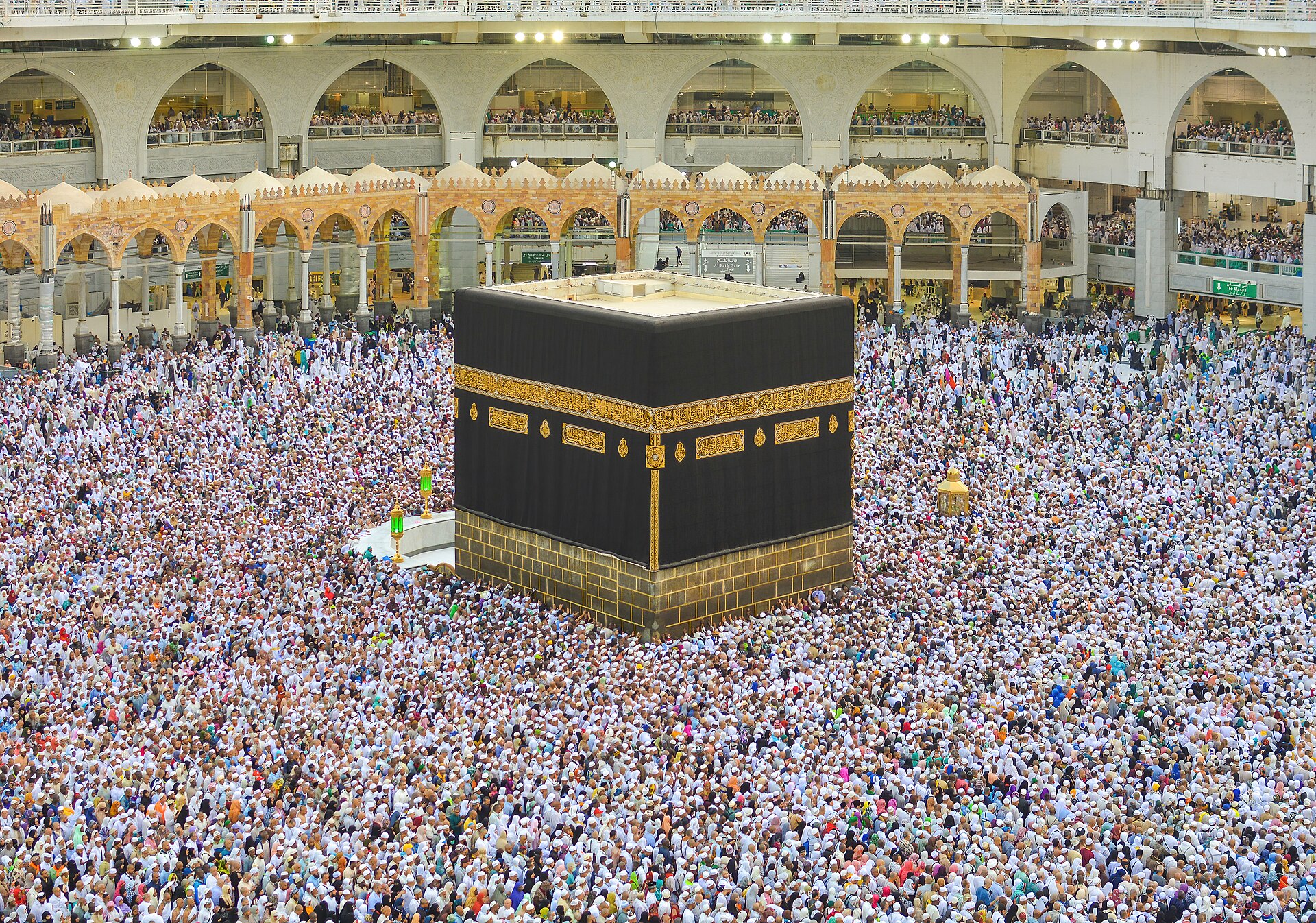
Hajj 2026 closed with 1,707,301 pilgrims from 165 nationalities, according to the General Authority for Statistics, up from 1,673,230 the year before. The Makkah Route Initiative processed 388,694 arrivals, a 23.7 percent year-on-year increase. Minister of Hajj and Umrah Tawfiq Al-Rabiah credited King Salman and Crown Prince Mohammed bin Salman for “mobilizing all resources” to ensure pilgrims could “perform rituals with ease and comfort.” The season’s operational numbers were strong — and entirely beside the point that Iran’s 57,550 empty places, and the two-word explanation IRNA offered without elaboration, had already established.
Table of Contents
- How Many Iranian Pilgrims Attended Hajj 2026?
- The Word Iran Used Was ‘Wartime’
- Why Has Iran Used Hajj as a Diplomatic Instrument for Four Decades?
- Why Did Mojtaba Khamenei Address the Pilgrims on the Day of Arafah?
- The Convoy Through Iraq
- Saudi Arabia’s Operational Record
- What Does Iran’s Absence Cost Saudi Arabia’s Religious Tourism Model?
- The June 9 Convergence
- Can Saudi Arabia Respond Without Naming the War?
- Frequently Asked Questions
How Many Iranian Pilgrims Attended Hajj 2026?
Approximately 30,000 Iranian pilgrims attended Hajj 2026 out of an official quota of 87,550 — a fill rate of roughly 34 percent, according to IRNA and multiple regional outlets. The shortfall of 57,550 pilgrims represents the largest voluntary Iranian Hajj reduction since the complete three-year boycott of 1988 through 1990.
In 2025, the last pre-war season, Iran filled its entire allocation. Saudi airline flynas had resumed direct Iran-Saudi charter flights for the first time in approximately a decade, and combined Hajj and Umrah traffic from Iran exceeded 290,000 religious travelers annually. The bilateral Hajj agreement signed November 12, 2025 — 108 days before the February 28 strikes — was the final pre-war diplomatic instrument between the two governments. Alireza Rashidian, head of Iran’s Hajj and Pilgrimage Organization, used the November session to formally request a quota increase proportionate to Iran’s population of 91 million, according to Iran International.
The 30,000 figure amounts to roughly one pilgrim for every 3,000 Iranian citizens — less than a third of the ratio the OIC allocation was designed to produce. In a country where Hajj registration routinely generates waiting lists of hundreds of thousands of applicants, the reduction did not reflect demand. Iran International reported in November 2025 that Rashidian had specifically asked Saudi Arabia to raise the quota beyond 87,550, citing population growth since the formula was last calibrated.
Total Hajj 2026 attendance reached 1,707,301 from 165 nationalities, per GASTAT — a modest increase from 2025 but below the 2024 record of 1.83 million. Iran’s shortfall accounts for part of the gap. The rest reflects a season where Strait of Hormuz disruptions drove jet fuel costs to record levels across Muslim-majority sending countries: India approved an additional $117-per-pilgrim airfare surcharge, Indonesia reported fuel adjustments of $120 to $200, and IATA Director General Willie Walsh warned in April that supply “will still take months to recover” even after the Strait reopens.
The Middle East briefing 3,000+ readers start their day with.
One email. Every weekday morning. Free.
The Word Iran Used Was ‘Wartime’
IRNA did not attribute the shortfall to logistics, cost, or security concerns. The agency’s formulation was “wartime situation” — a phrase that names the conflict, assigns its cause to the US-Israeli strikes of February 2026, and places that attribution inside the Hajj. This is the one institutional context where Saudi Arabia speaks as custodian of Islam’s holiest sites rather than as a state engaged in alliance politics and hosting foreign military infrastructure.
The framing matters because of what it forecloses. As Hajj host, Saudi Arabia does not issue political commentary on the season. The Ministry of Hajj and Umrah’s post-season communications praised operational execution without mentioning Iran, the shortfall, or the war. The custodianship role requires a posture of universal welcome — the Kingdom opens the doors and serves whoever arrives. When Iran says its people came in reduced numbers because of a war, the custodian has no register for disputing the claim without first acknowledging the conflict that produced it.
Tasnim News Agency — the IRGC-linked outlet — added a second layer. It reported that the 30,000 figure was determined “in accordance with the command, approval, and viewpoint” of Supreme Leader Mojtaba Khamenei. Where IRNA’s language suggested constraint — Iran would have sent more but could not — Tasnim asserted sovereignty: the Supreme Leader decided the number. Both narratives circulated simultaneously, from outlets with different institutional affiliations, reaching different audiences, and they did not contradict each other so much as divide the labor of explanation.
The New Arab, which published the most granular pre-existing analysis of Hajj 2026’s geopolitical dimensions, captured the negotiation behind the number: “There had been talk of cancelling Iran’s pilgrimage entirely; the reduced allocation is the compromise.” The November 2025 bilateral agreement under which the pilgrims were dispatched had been signed for a full quota of 87,550.
Why Has Iran Used Hajj as a Diplomatic Instrument for Four Decades?
Iran has treated Hajj participation as a bilateral signal since 1987, when clashes between Iranian pilgrims and Saudi security forces in Mecca killed over 400 people. Saudi Arabia severed relations, cut Iran’s quota from 150,000 to 45,000, and Iran boycotted Hajj entirely from 1988 through 1990 — establishing a pattern that has recurred with every major bilateral rupture since.
The 1991 restoration confirmed the pattern’s reciprocal logic. Under President Rafsanjani, Iran and Saudi Arabia normalized relations on terms explicitly linked to Hajj re-authorization, with the quota set at 115,000. Withholding participation had been punitive; restoring it was conciliatory. The pilgrimage functioned as both the measure and the medium of the bilateral relationship — the one channel where rupture and repair could not be disguised as routine diplomatic adjustment.
The cycle repeated after the Mina stampede of September 24, 2015, which killed at least 2,426 pilgrims by AP count, including over 450 Iranians according to Iranian officials. Supreme Leader Ali Khamenei accused Saudi Arabia of “mismanagement.” Saudi Arabia’s Health Minister blamed “undisciplined pilgrims.” The accountability dispute remained unresolved when Saudi Arabia executed Shia cleric Nimr al-Nimr in January 2016 and Iran severed ties. No Iranian pilgrims attended Hajj 2016 — the first complete absence since 1990.
Iranian pilgrims returned in 2017. The Beijing agreement of March 2023, brokered by China, reopened embassies and re-established consular coordination, and the Hajj channel was among the first to benefit. By 2025, the normalization had produced the highest bilateral religious traffic in years: a full Hajj quota and more than 210,000 Umrah travelers. Rashidian’s November 2025 request for a quota increase — submitted during what would prove to be the last bilateral pilgrimage meeting before the February strikes — reflected a trajectory that was still pointing upward.
| Year | Quota | Pilgrims Sent | Context |
|---|---|---|---|
| Pre-1987 | 150,000 | ~150,000 | Full participation under bilateral arrangement |
| 1987 | 150,000 | Attended | Mecca clashes: 400+ killed; quota subsequently cut |
| 1988–1990 | 45,000 | 0 | Full boycott; diplomatic relations severed April 1988 |
| 1991 | 115,000 | ~115,000 | Relations restored under Rafsanjani; quota linked to normalization |
| 2015 | ~86,000 | ~86,000 | Mina stampede: 2,426+ killed (AP), 450+ Iranians |
| 2016 | ~86,000 | 0 | Full boycott after Nimr al-Nimr execution and diplomatic break |
| 2017 | 86,500 | ~86,500 | Return; de-escalation begins |
| 2025 | 87,550 | 87,550 | Full quota; flynas direct charter flights resumed |
| 2026 | 87,550 | ~30,000 | 34% fill rate; “wartime situation” cited by IRNA |
The 2026 reduction departs from every previous entry in the table. Each prior Iranian Hajj action — boycott, reduction, return — occurred during peacetime or, at worst, cold-war diplomatic tension. Iran and Saudi Arabia had never been in armed conflict when a Hajj contingent was determined. The bilateral agreement governing this season was signed 108 days before the strikes that killed Ali Khamenei and set in motion the succession that made his son both Supreme Leader and the author of the Hajj message delivered seventy-nine days later on the plains of Arafah.
Why Did Mojtaba Khamenei Address the Pilgrims on the Day of Arafah?
On May 26, 2026 — the Day of Arafah — Supreme Leader Mojtaba Khamenei issued his first official Hajj address, declaring the “American era” over and instructing 30,000 Iranian pilgrims to narrate “Iran’s victory in the Third Imposed War” to the 1.7 million Muslims assembled from 165 countries. It was his first communication to the broader Muslim world in the institutional format his father had used annually for over three decades.
“The hands of time will not turn back, and the nations and lands of the region will no longer serve as shields for US bases.”
— Mojtaba Khamenei, Supreme Leader of Iran, Hajj address, Day of Arafah, May 26, 2026 (PressTV)
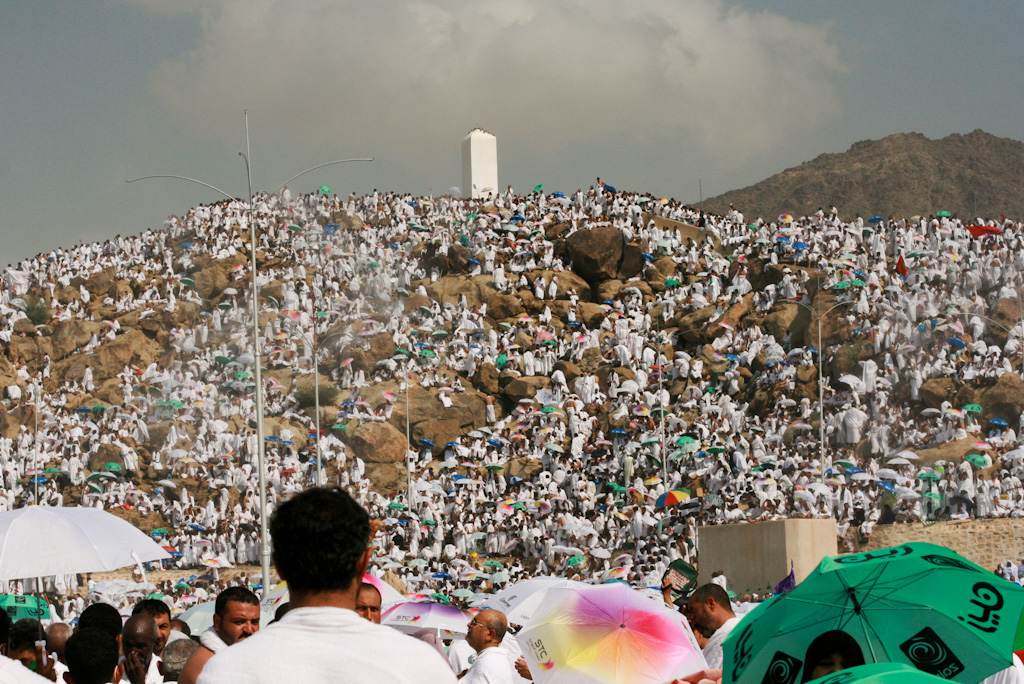
The address reframed the 30,000 not as a diminished contingent but as a deployed one. PressTV, Iran’s English-language state broadcaster, described the pilgrims as “ambassadors of the Third Imposed War victory” and ran the characterization across its English and Arabic feeds alongside standard Hajj imagery. Khamenei told the pilgrims they bore “an effective and prominent role” in conveying Iran’s war narrative to fellow Muslims. The 30,000 who carried his message shared the plains of Arafah with 1.7 million pilgrims who had arrived under Saudi Arabia’s custodial guarantee of safe passage and neutral hospitality.
Mojtaba Khamenei was named Supreme Leader on March 8, 2026, seventy-nine days before the Day of Arafah, following the assassination of his father Ali Khamenei in the February 28 strikes. Ali Khamenei’s archived Hajj messages followed a template — solidarity with Palestine, criticism of “arrogant powers,” calls for Islamic unity — statements general enough to be absorbed without action by non-Iranian pilgrims. His son’s first Hajj address named a specific war, assigned a specific mission to those present, and identified specific targets: US military bases and the American-led regional order.
Tasnim reported that the pilgrim dispatch itself was made under the Supreme Leader’s “command, approval, and viewpoint.” The 30,000 were not merely permitted to attend — they were, in Iran’s own institutional language, sent with instructions. Saudi authorities issued no public response to the address. No Saudi-aligned outlet — Arab News, Asharq Al-Awsat, Al Arabiya — engaged with or quoted from the speech. The custodian has no mechanism for policing the political content of a Supreme Leader’s Hajj message without appearing to restrict religious expression at the pilgrimage itself.
The Convoy Through Iraq
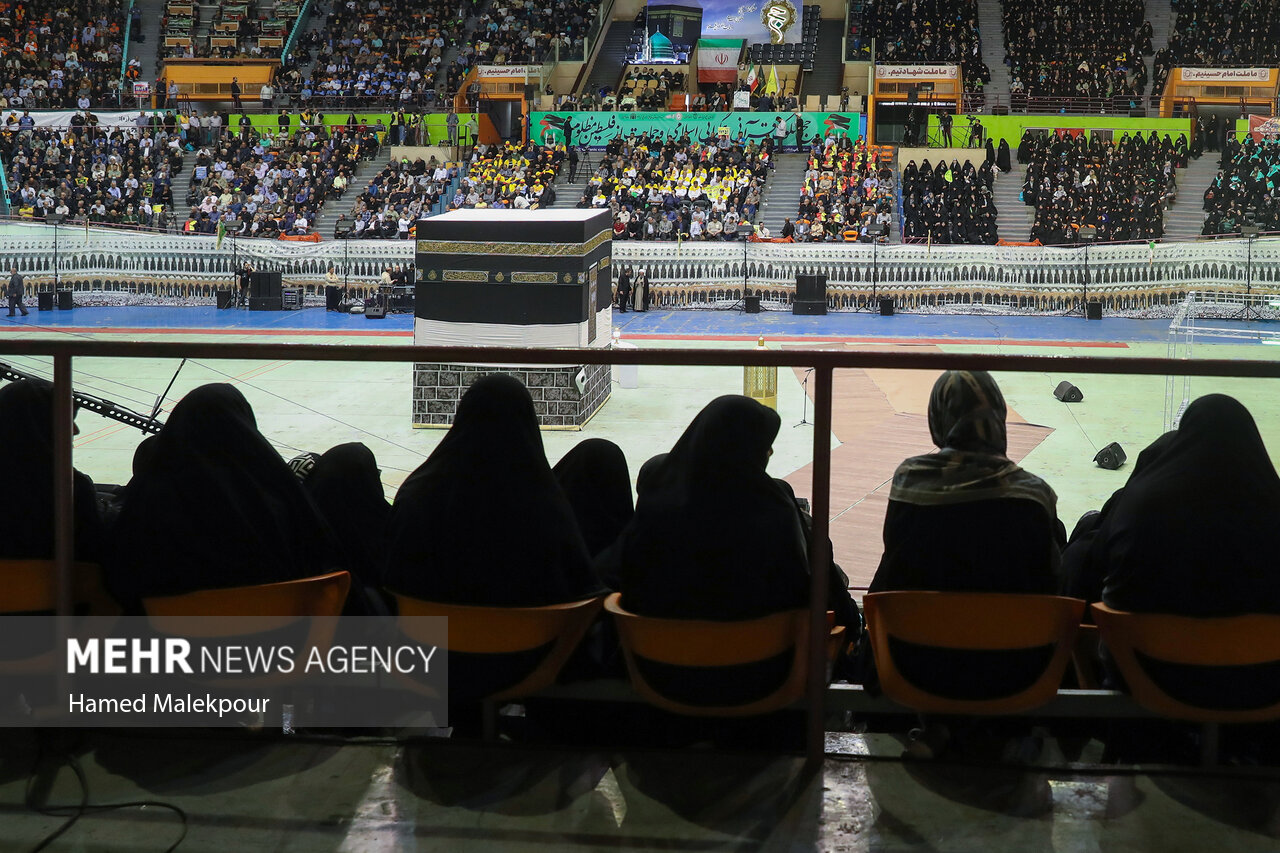
Iran’s pilgrims reached Saudi Arabia through a combined land-air route that bypassed closed airspace entirely. Buses and rail carried them from Iran through Iraq to the Arar border crossing — the northernmost Saudi-Iraqi entry point — where they crossed into the Kingdom overland. From Arar, flights took them to Medina; they returned via Jeddah airport. Iranian pilgrims entered Saudi Arabia from the direction of Baghdad, not Tehran.
Iraq’s Interior Minister announced that Iraqi security forces would escort the Iranian convoy under an intensive security plan originating in Karbala — a city of paramount significance to Shia Islam and to the Iranian-backed militia networks that operate in southern Iraq. The Arar border Hajj terminal, which covers 9,000 square meters, can process over 20,000 pilgrims and 400 buses per day across 94 passport counters and 13 inspection areas, according to the Logistics Cluster and Arab News. The terminal was built for volume; 30,000 Iranian pilgrims represented less than two days’ worth of its designed throughput.
The overland route required Iraqi state facilitation at every stage — border coordination, security escorts, transit permissions. Iraq, which has maintained diplomatic relations with both Tehran and Riyadh and whose leadership has sought to mediate between Gulf capitals, served as the physical corridor connecting a nation at war with the country hosting the pilgrimage. ABNA English reported that Iran’s Hajj and Pilgrimage Organization coordinated logistics with both Iraqi and Saudi authorities under the terms of the November 2025 bilateral agreement.
The routing itself was a product of the diplomatic collapse. flynas charter flights between Iran and Saudi Arabia — the direct air corridor restored in 2025 as a normalization marker — were grounded by the airspace closure. Pilgrims who flew to Jeddah in 2025 traveled by bus and rail through Iraq in 2026, adding days of transit time and the cost of Iraqi border processing. The November 2025 agreement that governed the pilgrimage made no provision for overland routing; the convoy was an improvisation within a bilateral framework designed for direct flights.
Saudi Arabia’s Operational Record
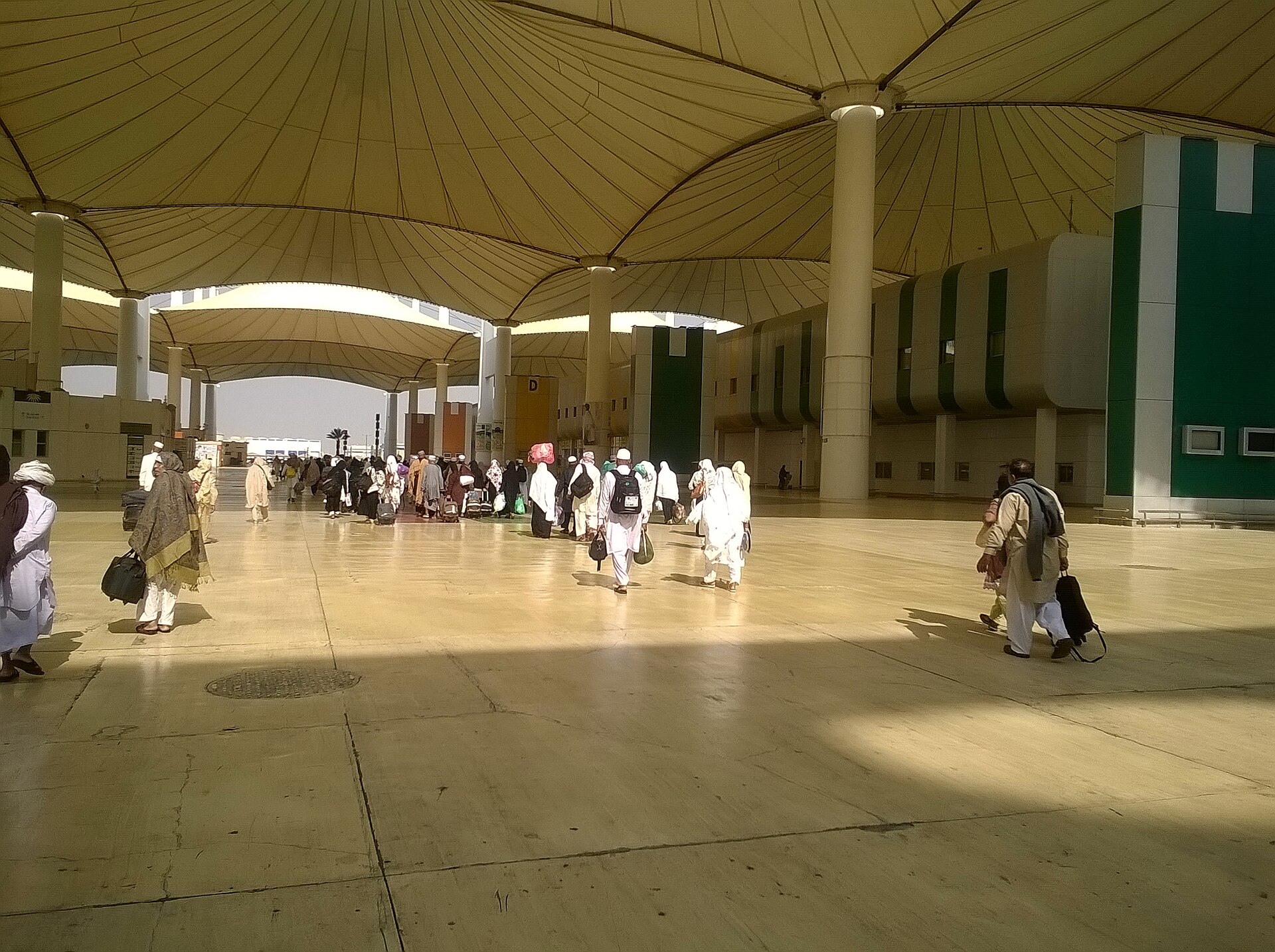
The Kingdom’s Hajj 2026 execution, measured against its own benchmarks, was strong. The 1.7 million total exceeded the prior year by 34,071 pilgrims. The Makkah Route Initiative — a pre-departure processing system launched in 2019 that clears customs and immigration in pilgrims’ home countries before they board flights — handled 388,694 arrivals, up 23.7 percent from 2025. The initiative has become Saudi Arabia’s flagship Hajj modernization program, and the 2026 numbers extended its growth trajectory despite the regional disruption.
The operational achievement is not trivial given the environment. Hajj 2026 was conducted under regional airspace constraints, jet fuel disruptions linked to the Hormuz restrictions, and elevated security requirements along Saudi Arabia’s northern and eastern borders. That 165 nationalities participated — the same breadth as pre-war seasons — reflects logistics infrastructure that functioned under conditions that had grounded commercial aviation across parts of the Gulf. Al-Rabiah said the Kingdom “mobilized all resources under the directives of King Salman bin Abdulaziz and Crown Prince Mohammed bin Salman.”
The competing international coverage, however, tells a different story about what survived the news cycle. Arab News led with “Saudi Arabia wraps up successful Hajj 2026.” Al Jazeera led with “over 1.5 million pilgrims begin Hajj amid regional tensions.” CNN chose “nearly two million gather despite war in Iran.” The operational success became context rather than headline across every outlet except the Saudi domestic press. The New Arab stated it without equivocation: “The Hajj season is shaped less by religious ritual than by geopolitics.”
What Does Iran’s Absence Cost Saudi Arabia’s Religious Tourism Model?
The 57,550 Iranian pilgrims who did not attend represent an approximate revenue gap of $310 million in foregone spending, based on the 2025 average of roughly $5,400 per pilgrim. Vision 2030 targets 30 million annual pilgrims and $50 billion in religious tourism revenue by decade’s end, and the model’s growth assumptions depend on conditions — open airspace, normalized Hormuz, stable bilateral relations — all simultaneously compromised.
The sector currently generates approximately $12 billion annually, comprising roughly 20 percent of the Kingdom’s non-oil economy and an estimated 7 percent of GDP. The pilgrim economy was supposed to grow alongside other Vision 2030 investment pillars that have themselves faced restructuring under fiscal pressure. The 30-million-pilgrim target requires every major Muslim-majority sending market to grow, not shrink, and the trajectory in 2026 pointed the wrong direction: Iran’s participation collapsed while fuel surcharges priced some applicants out of the season in Indonesia and India — two of the three largest sending countries.
Iran’s pre-war religious travel footprint extended well beyond the Hajj quota. Combined with approximately 200,000 Umrah pilgrims annually, Iran was sending roughly 290,000 religious travelers to Saudi Arabia each year before February. The Umrah pipeline — year-round and not governed by the same quota system — has been disrupted by the same airspace closures and fuel inflation that shaped the Hajj shortfall. Walsh’s April warning that recovery “will still take months” applies to both pilgrim streams.
The $310 million from Iran is a fraction of the $12 billion annual total. But the gap between the 2026 attendance of 1,707,301 and the 2024 record of 1.83 million — a shortfall of roughly 123,000 pilgrims — suggests the fuel-cost inflation suppressed participation from price-sensitive origin countries well beyond the Iranian reduction. The 30-million-pilgrim target was calibrated during the normalization period that produced the Beijing accord and the November 2025 bilateral Hajj agreement, before Hormuz disruptions and war economics arrived in the same season.
The perceptual cost compounds the financial one. Saudi Arabia invested in the Hajj experience — the Makkah Route, expanded terminal capacity, the crowd management systems developed after the 2015 Mina disaster — and the 2026 season demonstrated that these investments function under wartime conditions. But the narratives traveled on separate frequencies: Al-Rabiah’s Makkah Route numbers appeared in Arab News and Asharq Al-Awsat, while Iran’s “wartime situation” appeared in Al Jazeera, CNN, Al-Monitor, and The New Arab.
The June 9 Convergence
The final Hajj 2026 attendance data arrived the same week Iran formally rejected the US memorandum of understanding on nuclear terms. On June 9, Foreign Ministry spokesperson Esmaeil Baghaei called the MOU “not acceptable” and confirmed Tehran would submit a counteroffer through Omani mediators. The rejection had been expected since Iran suspended talks on June 1, but its formalization landed in the same news cycle as the closing Hajj statistics.
The temporal overlap is partly a function of independent calendars: the Islamic lunar calendar fixed Hajj’s dates, and the MOU timeline followed its own diplomatic rhythm. But the convergence meant Riyadh absorbed two Iranian signals within a single week — a Hajj season in which Iran named the war from inside Mecca, and a formal rejection of the diplomatic framework that might have wound it down. The nuclear talks Washington described as “close” produced neither a deal nor a pause, only a counteroffer whose terms remain undisclosed.
For Saudi decision-makers, the week of June 9 compressed three distinct pressures. The Hajj data confirmed Iran’s reduced engagement with the Kingdom’s most protected institution. The MOU rejection closed the diplomatic track most likely to produce a Hormuz resolution. And Aramco’s quarterly dividend — $21.89 billion, payable June 9, against $18.6 billion in free cash flow — arrived on the same day Baghaei said “not acceptable.”
The Aramco dividend is itself a product of the war’s fiscal pressure. At a coverage ratio of 0.85x — the company paying shareholders more than it earned — the figure reflects both the revenue compression from Hormuz-constrained exports and the political impossibility of cutting a payout that funds the state budget. Saudi Arabia made the payment and received the MOU rejection in the same twenty-four-hour window. The full structural context — a kingdom that simultaneously runs the Gulf’s only open airports and posts a record $34 billion quarterly deficit — is examined in Riyadh won the Gulf’s wartime traffic; the treasury lost everything else.
Can Saudi Arabia Respond Without Naming the War?
Saudi Arabia’s official response to Hajj 2026 was entirely operational — logistics praised, attendance figures published, Iran’s shortfall unmentioned. The custodianship of the Two Holy Mosques requires a posture of universal welcome that structurally precludes political commentary on which nations sent fewer pilgrims and why.
The silence is not a choice in the ordinary diplomatic sense but a structural consequence of the role the Saudi monarchy holds. King Salman’s formal title — Custodian of the Two Holy Mosques — binds the institution to a register above bilateral disputes. Any direct response to Iran’s “wartime situation” framing would require the custodian to acknowledge the war, the bilateral grievance, and the military infrastructure on Saudi soil that Iran cited as cause. The most recent Saudi state communication on Hajj 2026, issued by the Ministry of Hajj and Umrah, contained no reference to any bilateral dispute.
Iran understood the constraint when it chose its language. IRNA’s “wartime situation” was not addressed to Riyadh directly — it was addressed to the 1.7 million pilgrims from 165 countries, to the global media covering the season, and to the Muslim-majority publics who follow Hajj as both a spiritual and political event. The audience for Iran’s framing was the same audience Saudi Arabia serves as custodian: 1.7 million pilgrims and the international press corps, from Al Jazeera to CNN, that covered their arrival.
The pattern of severed channels makes the Hajj signal harder to absorb in isolation. The Lebanon ceasefire has not produced a durable resolution. Hormuz transit remains restricted. The Omani mediation channel carries a counteroffer whose terms are undisclosed. Iran’s Hajj reduction arrived in sequence — after the MOU suspension on June 1, after Hormuz talks stalled, after Lebanon — in the one venue Saudi Arabia is institutionally bound to keep open.
In November 2025, Rashidian met his Saudi counterparts and asked for more pilgrims, not fewer. The agreement they signed was the last diplomatic document to pass between the two governments before the February strikes. Hajj 2027 begins in approximately eleven months, and the bilateral agreement governing that season has not been negotiated.
Frequently Asked Questions
What is the OIC quota formula that determines Iran’s Hajj allocation?
The Organization of Islamic Cooperation adopted a standardized formula of one Hajj pilgrim per 1,000 Muslim citizens following the 1987 Mecca incident, which prompted Saudi Arabia to impose uniform quotas across all member states. The formula replaced an earlier system of bilateral negotiation under which Iran had held a quota of 150,000 — roughly three times what the OIC formula produced. Iran’s current 87,550 allocation reflects an estimated Muslim population of approximately 87.5 million within a total population of 91 million. The formula is administered by the Saudi Ministry of Hajj and Umrah in coordination with OIC member states, though individual countries may negotiate marginal adjustments during bilateral Hajj coordination meetings.
Could Saudi Arabia have reallocated Iran’s unused Hajj places to other countries?
The OIC system allocates slots on a per-country basis, and unused quotas from one nation are not automatically redistributed to others. Saudi Arabia has historically managed undersubscription by offering additional Umrah visas or by accommodating overflow demand from countries with multi-year waiting lists — Indonesia and Pakistan typically maintain backlogs of hundreds of thousands of approved applicants. Whether any of Iran’s 57,550 unused places were offered to other nationalities in 2026 has not been publicly disclosed. The overall attendance increase of 34,071 pilgrims over 2025 suggests some additional capacity was absorbed elsewhere, but not nearly enough to offset the Iranian shortfall.
How does Hajj 2026 attendance compare to the COVID-19 era?
Hajj 2020 was restricted to approximately 1,000 pilgrims — all Saudi residents — in the most severe limitation in modern history. Hajj 2021 expanded to 58,745, and the 2022 season reached approximately one million as pandemic caps were lifted. The 2024 season set a record at 1.83 million before the 2026 figure of 1,707,301. Iran’s 30,000-pilgrim contingent in 2026 exceeded the entire global Hajj attendance of 2020 and represented more than half of the 2021 total — a comparison that illustrates both the severity of COVID-era compression and the fact that Iran’s 2026 number, though dramatically reduced from its quota, was not a token presence.
What does Iran mean by the ‘Third Imposed War’?
The designation places the current conflict in a lineage beginning with the Iran-Iraq War of 1980–1988, which Iran officially calls the “Imposed War” or “Sacred Defense” — framing that emphasizes Iraq’s invasion under Saddam Hussein as externally imposed aggression rather than a mutually escalated conflict. Iranian state media has not consistently used “Second Imposed War” as a formal term; the numbering appears to skip directly to “third,” with Mojtaba Khamenei’s May 26 Hajj address among the earliest high-level deployments of the phrase. The designation frames the February 2026 US-Israeli strikes as unprovoked external aggression analogous to Saddam’s 1980 invasion — a framing that activates deep institutional memory within the IRGC and positions the current conflict as existential and defensive rather than elective.
The Hajj pilgrimage that Iran filled at only 34 percent of quota also functioned as a passive bilateral deterrent: with 30,000 Iranian nationals inside Saudi sovereign territory throughout the war, both governments operated under mutual exposure constraints. That deterrent expired on June 9 as the last pilgrims departed — analyzed in Mecca Held 30,000 Iranians for Thirty-Nine Days — Today the Shield Expires.