RIYADH — Pete Hegseth told the Shangri-La Dialogue on Friday that America wants “partners, not protectorates” and praised the Gulf States as model allies — without mentioning that Saudi Arabia, the Gulf’s largest military spender, devotes 7.1 percent of GDP to defense, double his own 3.5 percent benchmark, and has no mutual defense treaty with the United States. The $142 billion arms deal announced in May 2025 was supposed to function as that treaty’s commercial substitute, a relationship so large and so embedded that its legal shallowness would never be tested, and Hegseth just told every defense minister in Asia that the substitution is void.
Saudi Arabia is not a protectorate — it spends $83.2 billion a year on its own defense, more than all but seven countries on earth. It is not a partner in any contractual sense — it has no binding security guarantee, no mutual defense clause, no Senate-ratified pact, and no emergency waiver to resupply the interceptors it has been burning through since February at a rate that will exhaust its remaining stockpile within days of any resumed full-intensity conflict. It hosts 2,700 American troops without a Status of Forces Agreement, and when Washington launched strikes from that base without consulting Riyadh, Saudi Arabia shut the operation down within 36 hours. Hegseth’s doctrine did not redefine this relationship — it described it, and told Saudi Arabia, publicly and from a stage in Singapore, that Washington considers the description adequate.
Table of Contents
- What Did Hegseth Say at Shangri-La?
- The Country That Already Pays Double
- What Does $142 Billion Actually Buy?
- Troops Without a Treaty
- Abqaiq Was the Proof of Concept
- Why Did Saudi Arabia Sign an Article 5 with Pakistan?
- Who Gets a Chair at the New Table?
- Can Hegseth’s Partners Defend Themselves?
- Frequently Asked Questions
What Did Hegseth Say at Shangri-La?
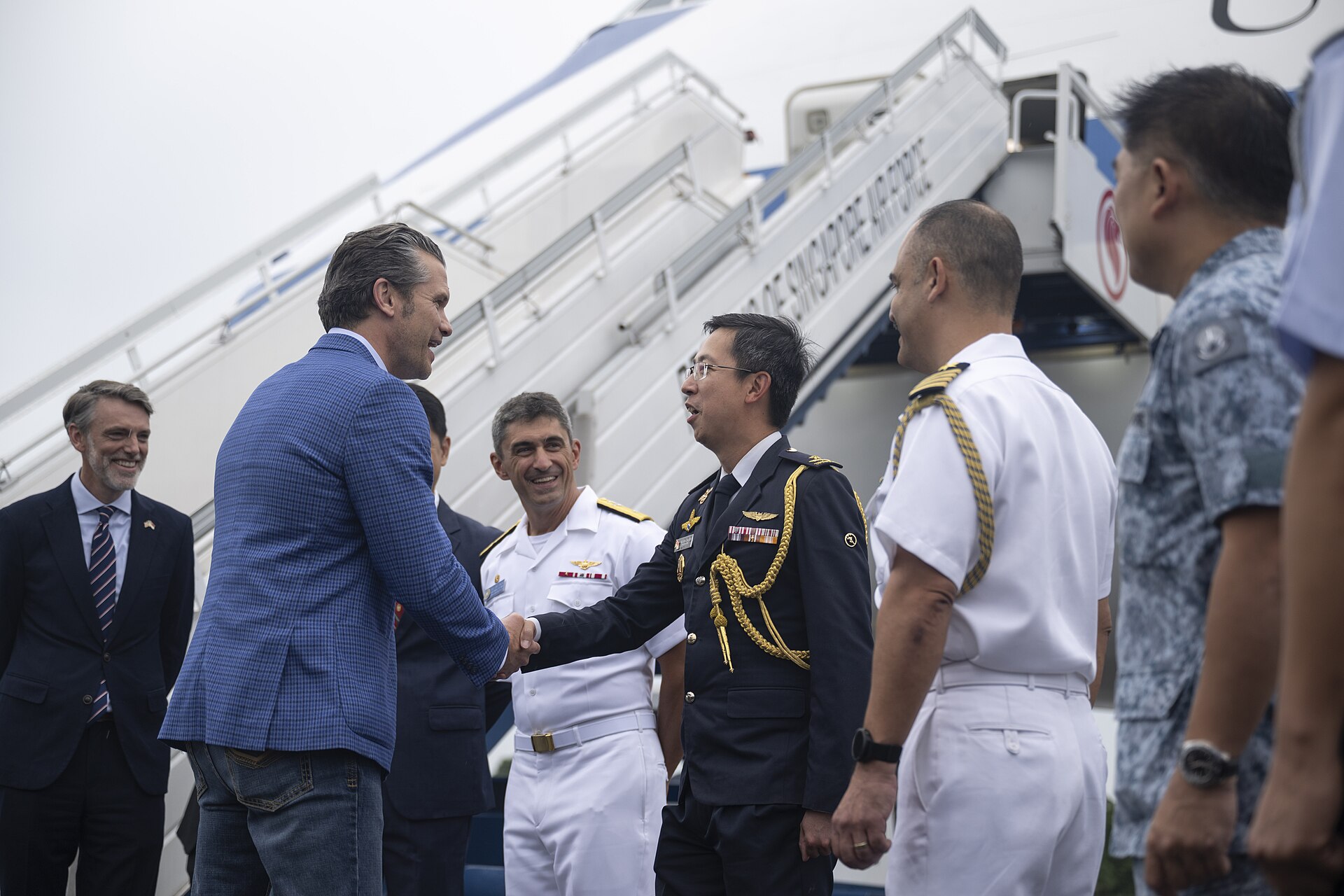
The US Secretary of Defense delivered his keynote at the 23rd IISS Shangri-La Dialogue in Singapore on May 30, 2026, and the speech was built around a single proposition: wealthy countries that depend on American military protection without investing adequately in their own are freeloading, and the United States will no longer subsidize them. “The era of the United States subsidizing the defense of wealthy nations is over,” Hegseth said. “We need partners, not protectorates.”
He set the terms in plain language. The old NATO benchmark of two percent of GDP — a standard most European allies still fail to meet — is now, in Hegseth’s framing, the floor for freeloading rather than the ceiling for commitment. “Two percent is not enough, and so two percent is freeloading,” he told reporters when asked about New Zealand’s defense spending. The new threshold is 3.5 percent, and even that earns partnership rather than protection — “an alliance cannot be ironclad,” Hegseth said, “if in reality or perception it is seen as one-sided.”
Hegseth listed the countries he considers models: Poland, the Baltic States, Israel, and the Gulf States. Zack Cooper, a senior fellow at the American Enterprise Institute and the S. Rajaratnam School of International Studies, noted the oddity immediately — the defense secretary named four “model allies,” none of which are in Asia, at an Asian security forum, and most of which are not US treaty allies at all. Israel has no mutual defense treaty with the United States; the Gulf States have none. Poland and the Baltics sit inside NATO’s Article 5 architecture, a distinction Hegseth did not draw, treating countries America is contractually bound to defend and countries it merely sells weapons to as members of the same category.
In the same session, asked about Iran, Hegseth said US forces remain “more than capable” of renewing strikes and that American stockpiles are “more than suited” for resumed operations. He was standing at a podium in Asia, telling allies they must defend themselves, while simultaneously reminding the room that Washington retains the capacity to launch wars from bases it does not treaty-guarantee — including Prince Sultan Air Base in Saudi Arabia, where an American AWACS worth up to $500 million was destroyed by Iranian fire three months earlier, under circumstances that $83 billion in Saudi annual defense spending could not prevent.
The Middle East briefing 3,000+ readers start their day with.
One email. Every weekday morning. Free.
The Country That Already Pays Double
Saudi Arabia spent $83.2 billion on defense in 2025, making it the eighth-largest military spender on earth, according to SIPRI’s April 2026 fact sheet. That figure represents approximately 7.1 percent of GDP — not merely above Hegseth’s 3.5 percent threshold but double it, a level of military investment that exceeds every NATO member including the United States. By the metric the US Secretary of Defense chose to define partnership at Shangri-La, Saudi Arabia is the most qualified partner in the Middle East, and possibly on the planet.
It is also the only one of Hegseth’s “model” Gulf States without a mutual defense clause in any agreement with Washington. The Major Non-NATO Ally designation that Trump granted Riyadh on November 18, 2025 — one day before signing the Strategic Defense Agreement — is, as the Atlantic Council’s Tressa Guenov wrote, “a favorite tool of US presidents to cap off major visits with a symbolic flourish to indicate elevated relations.” The statutory framework is explicit: MNNA status “provides foreign partners with certain benefits in the areas of defense trade and security cooperation” but no binding defense guarantees, no commitment to intervene, and no obligation beyond preferential procurement terms.
The Strategic Defense Agreement signed the following day contains no mutual defense language either. Daniel B. Shapiro, also at the Atlantic Council, observed at the time that “Trump has not announced whether he is giving the Saudis a one-way security guarantee, or whether there are mutual-security commitments.” Seven months and a war later, the answer is visible in the wreckage at Prince Sultan Air Base: neither. The agreement is an executive document requiring no Senate ratification, carrying no treaty force, and creating no obligation on the United States to defend Saudi Arabia under any circumstances — including the current one, in which American aircraft have been destroyed on Saudi soil by Iranian missiles.
Hegseth’s speech did not create this gap between spending and security — it formalized it, converting an unspoken arrangement into stated doctrine from a stage where the statement would be reported in every defense ministry in the Indo-Pacific. For decades, Riyadh operated on the premise that massive arms purchases functioned as a de facto alliance, that if Saudi Arabia spent enough the legal absence of a treaty would never be tested. The $142 billion arms deal announced in May 2025 was the apex of that premise, and its actual contents reveal how hollow it always was.
What Does $142 Billion Actually Buy?
The headline figure was always aspirational rather than contractual. The $142 billion arms deal framework announced during Trump’s May 2025 visit to Riyadh was presented as the largest single defense package in history — a number so large it functioned as its own argument for the relationship’s seriousness. But the Stimson Center, which tracks US arms transfers with forensic precision, found that actual Foreign Military Sales notifications to Saudi Arabia between 2017 and 2025 totaled $34.6 billion, roughly a quarter of the announced figure. The $142 billion is, in Stimson’s assessment, “more likely an optimistic expression of long-term ambition than a concrete financial commitment.”
| Metric | Saudi Arabia | Comparison |
|---|---|---|
| Annual defense spending (2025) | $83.2 billion | 8th globally (SIPRI) |
| Defense spending as % GDP | 7.1% | 2× Hegseth’s 3.5% standard |
| Arms deal announced (2025) | $142 billion | — |
| Arms actually delivered (2017–2025) | $34.6 billion | 24% of headline (Stimson Center) |
| Mutual defense treaties with US | 0 | NATO: 32 members with Art. 5 |
| Senate-ratified security pacts | 0 | Japan, S. Korea, Australia: all ratified |
| Status of Forces Agreement | None | Japan, S. Korea, Germany: all have SOFAs |
| US troops stationed | ~2,700 | Japan: ~54,000; S. Korea: ~28,500 |
| Emergency interceptor waiver | Not issued | Qatar: $4.01B waiver approved May 2 |
The gap between announcement and delivery reveals the relationship’s structure. What Saudi Arabia receives through FMS is equipment — fighter jets, interceptors, radar systems, maintenance contracts — sold at market rates through a commercial transaction that benefits the American defense industry as much as it benefits Saudi security. What it does not receive is the institutional architecture that distinguishes a customer from an ally: intelligence fusion, joint command structures, interoperable planning, and the binding political commitments that make the cost of abandonment higher than the cost of intervention. NATO members pay far less than Saudi Arabia for access to all of these; Saudi Arabia pays more than almost anyone and receives none.
This distinction would be academic if Saudi Arabia were not currently at war. Since February 28, 2026, the kingdom has burned through approximately 2,400 rounds of air defense ammunition in 38 days of full-intensity conflict — PAC-3 MSE interceptors produced at a single Lockheed Martin facility in Camden, Arkansas, with an annual capacity of roughly 620 rounds. Saudi Arabia’s order of 730 has an 18-month delivery floor even at maximum production priority, and no emergency waiver has been issued to accelerate it.
Qatar received its waiver on May 2, with Secretary Rubio’s signature, $4.01 billion in PAC-3 MSEs processed under Section 36(b) in weeks. The country that has fired more American-made interceptors than any nation in the system’s history has not.
Troops Without a Treaty
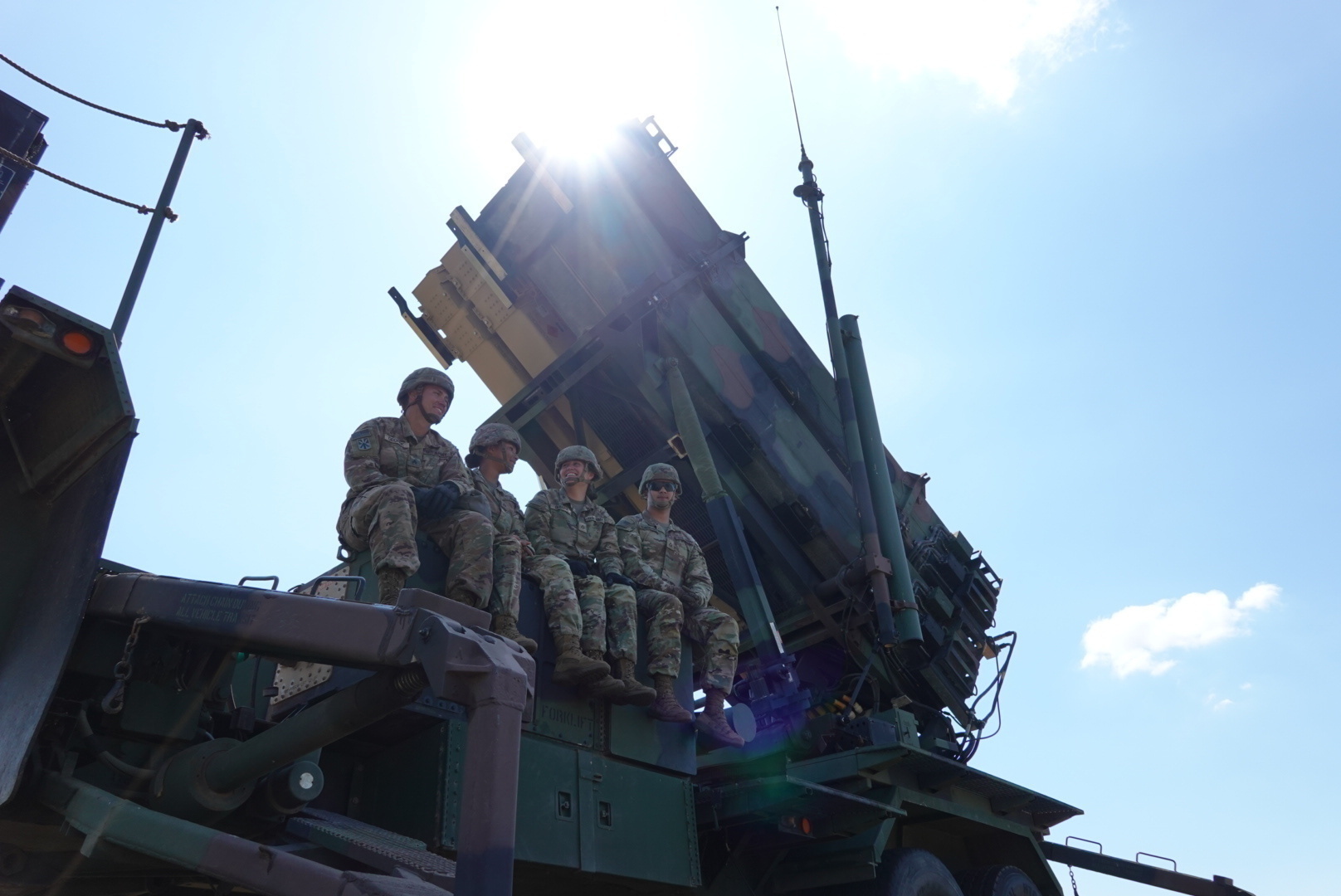
Prince Sultan Air Base sits roughly 60 kilometers southeast of Riyadh, hosting between 2,500 and 2,700 American troops on Saudi sovereign territory — not under a Status of Forces Agreement, not under a treaty, and not under any legal instrument that gives the United States a right to remain beyond Saudi Arabia’s continuing invitation. When Iran struck PSAB in March 2026, an E-3G Sentry AWACS valued between $270 million and $500 million was destroyed, at least five KC-135 Stratotankers were damaged, and at least ten US service members were wounded. The base from which the United States was prosecuting strikes launched partly from Saudi soil became a target because of that prosecution, and the Americans stationed there had no treaty guaranteeing their host country’s protection or their own country’s commitment to defending the host.
Hegseth’s “partners, not protectorates” framing implies that conditionality runs in one direction — Washington deciding which allies qualify for support. But the PSAB legal structure makes conditionality bilateral, and Riyadh demonstrated this in real time. On May 4, 2026, Trump announced Project Freedom, an escalation of operations against Iran, without consulting the Saudi government. Within 36 hours, Saudi Arabia suspended American access to PSAB and its national airspace, grounding the operation under a legal framework that gave the host nation every right to do exactly that.
Andrew Leber of the Carnegie Endowment identified the logic before Hegseth articulated it from the other side: Gulf citizens will wonder “why they should bear the risk of hosting U.S. forces when the United States is unable or unwilling to protect the Gulf from Iranian attacks.” The American troops at PSAB are not a tripwire in the NATO sense — like the forces targeted at Camp Buehring in Kuwait, their presence does not automatically trigger American intervention because no treaty exists to trigger. They are a capability deployed at Washington’s discretion, from a base occupied at Saudi Arabia’s discretion, in a war where both parties’ commitment is provisional and both have already demonstrated their willingness to suspend it.
Abqaiq Was the Proof of Concept
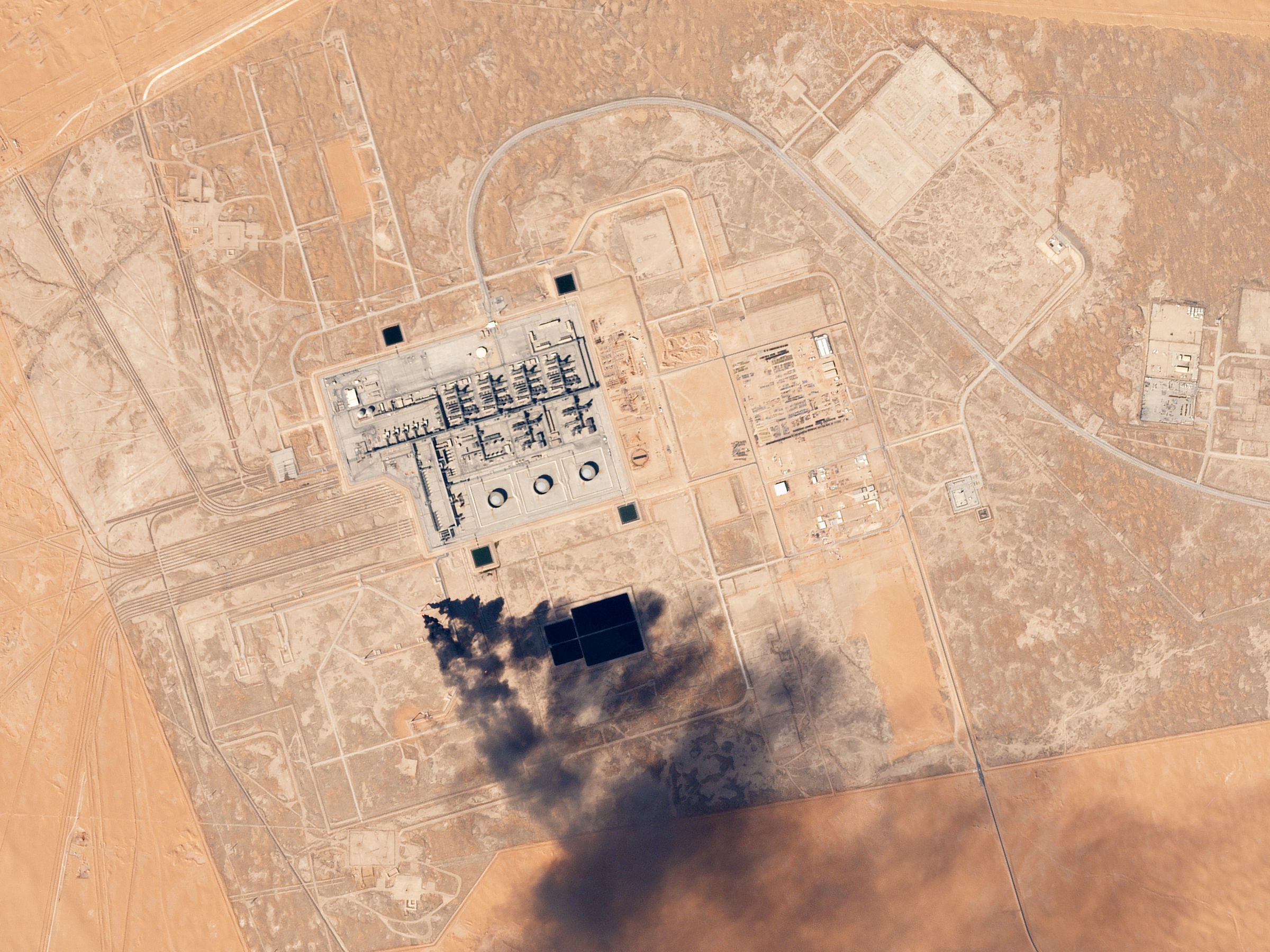
Everything Hegseth said at Shangri-La was legible in the wreckage at Abqaiq on September 14, 2019, when Iranian-linked drones and cruise missiles struck the kingdom’s largest oil processing facility and the Khurais oil field, temporarily knocking out 5.7 million barrels per day of production — roughly half of Saudi Arabia’s output and five percent of global supply. It was the single largest disruption to oil infrastructure since Saddam Hussein torched Kuwait’s fields in 1991, and the United States did nothing. Trump’s assessment, delivered two days later, was seven years ahead of his defense secretary’s doctrine.
“That was an attack on Saudi Arabia, and that wasn’t an attack on us.”
Donald Trump, September 16, 2019, two days after the Abqaiq-Khurais strike
The Carter Doctrine, articulated in January 1980, had committed the United States to defending the Persian Gulf “by any means necessary, including military force” against any outside power seeking control of the region. Reagan extended it the following year, pledging that Washington would not allow Saudi Arabia to “become another Iran.” For four decades, these declarations underpinned a security architecture in which Saudi defense spending was supplementary — a contribution to a system guaranteed by American power, an order in which the question of whether the United States would respond to an attack on Saudi oil infrastructure was not supposed to have the answer Trump gave it.
Marwan Muasher of the Carnegie Endowment framed the consequence precisely: “When Tehran hit Saudi oil installations in 2019 without Washington coming to its rescue, Riyadh decided it was time to indirectly poke Washington.” The PSAB suspension seven years later was that poke — a sovereign demonstration that if the United States would not defend Saudi Arabia, Saudi Arabia would not host the United States unconditionally. But Hegseth’s Shangri-La speech answered with something worse than non-response: doctrine. The 2019 inaction could be explained as Trump’s personal reluctance, a one-off decision by a president who did not want another Middle Eastern war — but the 2026 speech embedded that reluctance in institutional language, delivered by a Secretary of Defense at a premier security forum with the clear intention of being reported and quoted.
Anthony Cordesman of CSIS, who has tracked US-Gulf security relationships for decades, offered the structural assessment: “Dependence on the United States is now coupled to a region-wide lack of trust,” and “no one in the Gulf can now predict the level of U.S. commitment to staying in the region or of the risk that U.S. pressure on Iran will provoke a war.” Both assessments predate Shangri-La by months. Hegseth’s speech confirmed that Washington considers them accurate — and, under the “partners, not protectorates” framework, considers them an acceptable cost of a doctrine that serves American interests more than Gulf ones.
Why Did Saudi Arabia Sign an Article 5 with Pakistan?
On September 17, 2025 — two months before Trump granted Saudi Arabia MNNA status and two months before the Strategic Defense Agreement — Riyadh signed the Strategic Mutual Defence Agreement with Pakistan containing language that 81 years of US-Saudi relations have never produced: “any attack against either state shall be considered an attack against both.” The clause directly mirrors NATO’s Article 5, the provision that distinguishes an alliance from an arrangement, and it sits in a bilateral agreement with a country whose military budget is a fraction of Saudi Arabia’s own rather than in any document signed with the United States. Joshua T. White of Brookings identified the motivation without ambiguity: Saudi Arabia is responding to “the increasingly capricious nature of U.S. policymaking toward the Middle East.”
The timing constitutes its own argument. Riyadh signed an Article 5-equivalent with Islamabad before it signed the American documents that contain no equivalent language — hedging against Washington’s unreliability before Washington had even finished drafting what it was prepared to offer. What Washington offered turned out to be MNNA designation, a procurement discount, and an executive defense agreement with no mutual protection clause, no Senate ratification, and no mechanism that would obligate the United States to treat an attack on Saudi Arabia as an attack on itself. Pakistan’s agreement contains exactly that mechanism, backed by a potential deployment of approximately 80,000 troops and an unspoken but widely understood nuclear dimension that no American document addresses.
Those troops are configured for a land war with India, not for air and missile defense against Iran, and they would not fill the specific capability gap — interceptor supply — that is currently depleting Saudi Arabia’s remaining defenses. But the SMDA provides the one thing the American relationship does not: a written obligation to fight. When Hegseth told Singapore that alliances require “skin in the game” and must be “true partnerships,” he was describing a standard that Pakistan’s agreement with Saudi Arabia meets on paper and that every American document signed with Riyadh across eight decades does not.
Who Gets a Chair at the New Table?
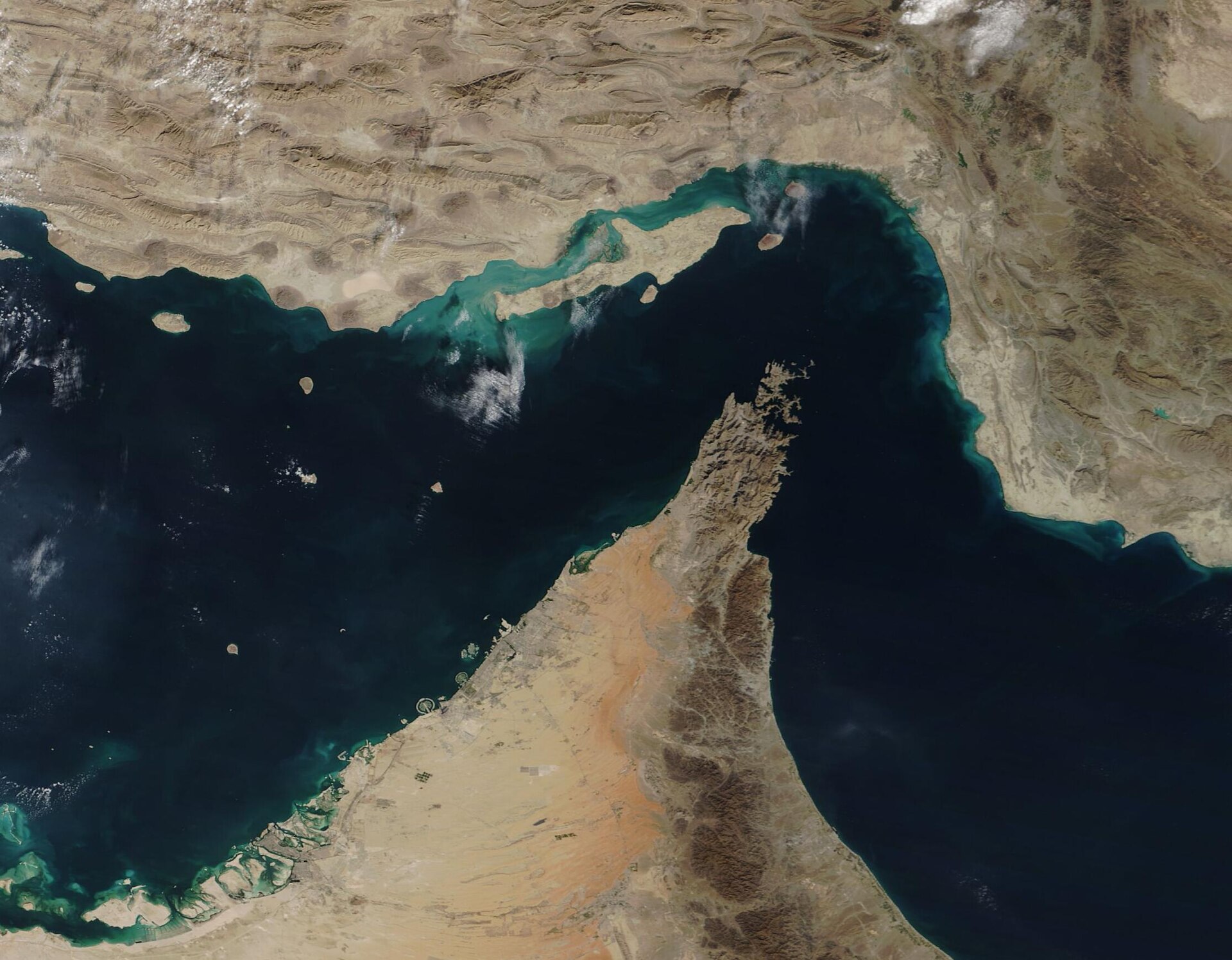
Three security architectures are currently competing to govern the Strait of Hormuz, and Saudi Arabia has a seat in none of them, despite having 2.5 million barrels per day of crude production that depends on transit through the strait. The UK-France coalition launched from Northwood in April counts 27 signatories and 40 participating nations; Riyadh refused to join, preserving the sovereign independence it exercised when it shut PSAB and forfeiting influence over the naval operations that determine whether Saudi crude reaches market. Iran’s PGSA toll system, sanctioned by OFAC on May 28, charges $2 million per transit for Saudi tankers while exempting India and Iraq through bilateral carve-outs. And Oman — the only Gulf state that refused to sign the IMO circular protesting Iran’s Hormuz claims — is negotiating a permanent co-management framework with Tehran that would give it structural authority over the strait’s inbound shipping lane, which runs through Omani territorial waters under a 1974 boundary treaty.
“Neither the Abraham Accords nor the presence of large U.S. bases are enough to protect Arab Gulf states.”
Marwan Muasher, Carnegie Endowment for International Peace, March 2026
Hegseth’s doctrine would matter less if Saudi Arabia had fallback options, but the new architectures are forming around the kingdom rather than with it, and its exclusion is a structural consequence of the non-alliance he described. Saudi Arabia’s answer to that exclusion is the quadrilateral security framework it has quietly assembled with Egypt, Pakistan, and Turkey — three foreign ministers’ meetings in 31 days, no communiqués, and no treaty language that Washington could read as a counter-alliance. Treaty allies get integrated into coalition command structures and have legal standing to demand partner-state exemptions from adversary enforcement regimes — Saudi Arabia was not consulted on the Northwood command and has no exemption from the PGSA toll system. The result is a country spending double the defense secretary’s benchmark, fighting a war alongside the United States, and carrying a Q1 fiscal deficit of $33.5 billion against a $108–111 breakeven, with no seat at any table where the strait carrying its exports is being divided.
The MOU that was supposed to reopen Hormuz remains unsigned on Day 94, and Iran is collecting tolls on every transit day the signature is delayed — $2 million per vessel, an estimated $1–2 billion annually. That revenue funds the very force Hegseth says the United States is “more than capable” of confronting, but confronting it is not the same as defending the partner whose exports pass through its enforcement zone.
Can Hegseth’s Partners Defend Themselves?
The operational question behind the doctrine is whether Saudi Arabia can function as the self-sufficient partner Hegseth’s framework demands, and the answer is embedded in the ammunition count. Since February 28, Saudi air defenses have engaged an estimated 2,400 threats in 38 days of full-intensity combat — a rate that has left the kingdom with an estimated 80 to 150 PAC-3 MSE interceptors, enough for between 1.3 and 2.4 days of resumed full-intensity operations. The Camden, Arkansas production line that manufactures them turns out approximately 620 rounds per year, and Saudi Arabia’s 730-round order has an 18-month delivery floor even at maximum production priority.
Qatar received its emergency resupply waiver on May 2 — Rubio signed it, $4.01 billion in PAC-3 MSEs, Section 36(b) notification processed in weeks. Saudi Arabia, which has fired more of these interceptors than any country in the system’s history, in a war that began with American strikes launched from Saudi territory, has not received equivalent treatment. The gap between Qatar’s experience and Saudi Arabia’s is difficult to attribute to process alone, and it maps precisely onto the non-alliance Hegseth formalized at Shangri-La: Qatar hosts Al Udeid Air Base, home to over 10,000 US troops and CENTCOM’s forward headquarters, under a deeper institutional security relationship than the one governing PSAB’s 2,700.
The IRGC has tested the boundary with deliberate precision, specifically targeting Saudi installations co-owned by American companies — the Sadara complex in Al Jubail, a joint venture between Saudi Aramco and Dow, and Chevron Phillips facilities in Al Juaima’h — to determine whether American commercial presence on Saudi soil triggers American military protection. It does not, and Hegseth’s doctrine explains why: commercial presence is a business relationship, and the United States defends partners, not investments. The IRGC made the adversary logic explicit through Tasnim in April, warning that if its red lines are crossed, its response “will deprive [the US and its allies] of the region’s oil and gas for years,” while Ali Akbar Velayati, the Supreme Leader’s senior adviser, declared from Tehran that the era of security imposed “from across the oceans” is over and the Strait of Hormuz is now guaranteed “under the shadow of our power and that of our strategic partners.”
The partnership Hegseth described in Singapore — where allies defend themselves with American equipment at American prices — requires a supply chain that functions during wartime and a seller willing to expedite when the buyer runs dry. Saudi Arabia’s supply chain produces 620 interceptors per year for a customer that burned through 2,400 in 38 days, and the emergency waiver that would accelerate delivery was signed for Qatar on May 2 and has not been signed for Saudi Arabia as of May 31.
Frequently Asked Questions
Does Saudi Arabia have a formal military alliance with the United States?
No, and it never has. In 81 years of bilateral relations — dating to Franklin Roosevelt’s meeting with King Abdulaziz aboard USS Quincy on February 14, 1945 — no mutual defense treaty has been signed or submitted for Senate ratification. The Carter Doctrine (1980) and Reagan Corollary (1981) were unilateral presidential declarations, not treaties, and neither contained enforcement mechanisms or congressional approval. Operation Earnest Will in 1987–88, in which the US Navy escorted Kuwaiti tankers through the Persian Gulf during the Iran-Iraq Tanker War, remains the closest the United States has come to treating Gulf maritime defense as a standing operational commitment rather than a discretionary presidential decision.
What is the legal difference between MNNA status and a mutual defense treaty?
MNNA (Major Non-NATO Ally) is a statutory designation under 22 USC §2321k that provides preferential access to US defense equipment, loan guarantees for arms purchases, cooperative research and development, and access to US War Reserve Stockpiles. It creates no mutual defense obligation and does not commit the United States to intervene if the designated country is attacked. There are currently 19 MNNAs globally, including Bahrain, Egypt, Israel, Japan, South Korea, and Australia — several of which also hold separate bilateral defense treaties that provide the binding commitments MNNA status alone does not. For Saudi Arabia, which has no underlying treaty, the MNNA designation is the ceiling of the security relationship rather than a supplement to deeper commitments.
How does the Saudi-Pakistan SMDA compare to the US-Saudi agreements?
The Saudi-Pakistan Strategic Mutual Defence Agreement, signed September 17, 2025, contains an explicit collective defense clause — “any attack against either state shall be considered an attack against both” — that directly mirrors NATO Article 5 and has no equivalent in any US-Saudi agreement. The SMDA builds on a decades-long military relationship: Pakistani military advisers have served in Saudi Arabia since the 1960s, approximately 80,000 Pakistani troops are potentially deployable under the agreement, and Pakistan’s nuclear capability introduces a deterrence dimension that no American-Saudi document acknowledges. The SMDA was signed two months before the MNNA designation, suggesting Riyadh viewed the Pakistani commitment as the higher strategic priority.
Has the United States ever militarily defended Saudi Arabia under the Carter Doctrine?
The only arguable case is Operation Desert Shield and Desert Storm in 1990–91, when the United States deployed over 500,000 troops to Saudi Arabia and led a coalition to expel Iraq from Kuwait. That operation was authorized under UN Security Council Resolution 678, not the Carter Doctrine or any bilateral agreement with Saudi Arabia, and was driven as much by the threat to global oil supply as by any commitment to Saudi sovereignty. Since then, the United States declined to respond militarily to the 2019 Abqaiq-Khurais attack that knocked out 5.7 million barrels per day of Saudi production, did not invoke any defense obligation during the 2026 Iranian strikes on PSAB that destroyed an American AWACS, and has not activated any mutual defense mechanism throughout the current conflict — because no such mechanism exists.
What did Iran say about Hegseth’s Shangri-La remarks?
Mohsen Rezaei of the Expediency Council said on May 30, 2026, that Trump is “betraying diplomacy for the third time” — a reference to the 2018 JCPOA withdrawal, the 2025 reimposition of maximum pressure sanctions, and the current MOU non-signing — arguing that “by continuing the naval blockade and making excessive demands in negotiations, he has once again proven that he is not inclined toward negotiation and is pursuing other objectives.”
The IRGC interprets Hegseth’s simultaneous claims — that allies must defend themselves and that the US is “more than capable” of restarting strikes — as confirmation that American military presence in the Gulf generates liability for host nations without generating protection, a reading that aligns with Iran’s operational strategy of targeting US-co-located Saudi infrastructure to demonstrate the gap between presence and commitment.
That gap between presence and commitment has a procurement corollary: Kuwait’s separate procurement track — a SOFA, a DCA, 13,500 troops at Camp Arifjan, and a $1.02 billion NASAMS emergency contract that cleared without congressional objection — illustrates what the “partners not protectorates” doctrine yields for states that made the basing commitment Saudi Arabia declined. On June 3, the US House of Representatives passed H.Con.Res.38 by 215–208 — the first war powers resolution on Iran to clear either chamber — adding a congressional clock to the same structural gap Hegseth described from the Shangri-La stage.