
DHAHRAN — Saudi Aramco will disburse $21.89 billion to shareholders on June 9, and its cash reserves will drop from $75.2 billion to approximately $53.3 billion — the lowest post-dividend floor since the company committed to an $87.6 billion annual payout that its free cash flow, constrained by the Hormuz closure, can no longer cover from operations. The question that matters is not whether Aramco can fund the June 9 payment (it can, from the balance sheet rather than from earnings) but what the balance sheet looks like on September 8, when the next $21.9 billion comes due and a full quarter of production at $92-99 Brent will not have rebuilt the cushion.
Q1 2026 free cash flow came in at $18.6 billion against the quarterly dividend — a coverage ratio of 0.85 — the first time reported FCF has fallen below the base dividend since the pandemic years (Aramco Q1 2026 results, May 10). The wartime oil price is simultaneously too low to restore the cash buffer — Saudi production sits at roughly 7.25 million barrels per day, 30 percent below its OPEC+ quota, because the Strait of Hormuz remains closed — and too high to survive a peace deal, which Goldman Sachs estimates would strip $14 per barrel from current Brent. That paradox, not the June 9 cheque, is what defines the next two quarters.
Table of Contents
- The $53.3 Billion Starting Point
- Why Did Q1 Free Cash Flow Fall Below the Dividend?
- The Pipeline Ceiling and the 3 Million Barrel Gap
- What Does Aramco’s Balance Sheet Look Like on September 8?
- Can Aramco Borrow Its Way Through?
- The Price That Aramco Needs Does Not Exist
- How Much of the Dividend Reaches the Saudi Treasury?
- Nasser’s Window Closed on Schedule
- Frequently Asked Questions
The $53.3 Billion Starting Point
After the June 9 payment, Aramco’s residual pre-Q2-inflows cash position sits at approximately $53.3 billion, a figure first calculated by Sahm Capital and published through Argaam on May 10. That sum represents 2.43 quarters of base dividend coverage at zero new free cash flow — enough in theory to fund both the September and December payments, but only under the assumption that the world’s most productive oil company earns nothing at all for six months.
The trajectory tells the story more clearly than the snapshot. Aramco held $135 billion in cash at end-2022, when Brent averaged $99 and tankers moved freely through the Strait of Hormuz (AGSI, “High Dividend Payments Continue to Drain Saudi Aramco’s Liquid Assets”). A steady drawdown through 2023 and 2024 — driven by a dividend commitment that consumed more than the company earned — brought the figure to $74 billion by Q3 2024 before a brief stabilisation that now appears to have been temporary. The post-June floor of $53.3 billion returns Aramco to balance-sheet territory it last occupied in approximately 2018, before the commodity supercycle and before the annual payout was ratcheted to a level that requires either triple-digit Brent or unimpeded export access to sustain.
The performance-linked dividend — introduced in Q3 2023 at 70 percent of residual FCF after capex and base payments — was the first casualty of the tightening. FY2025 total dividends fell to $85.5 billion from $124.3 billion in FY2024, a 31 percent decline (Argaam; BNN Bloomberg), with the entire payout consisting of base dividend and the performance component having reached zero. What remains is the rigid floor, escalating at 3.5 percent annually, that Aramco now funds from reserves when quarterly cash generation falls short.
Why Did Q1 Free Cash Flow Fall Below the Dividend?
A $15.8 billion working capital build — driven by the Hormuz closure disrupting tanker scheduling and leaving excess inventory on Aramco’s books — compressed Q1 reported free cash flow to $18.6 billion, below the $21.89 billion quarterly dividend. Stripped of that timing effect, adjusted FCF was up 62 percent year-on-year, but the dividend is paid from reported cash, not adjusted figures.
The Middle East briefing 3,000+ readers start their day with.
One email. Every weekday morning. Free.
The working capital drag was a direct consequence of the broader shipping collapse: Chinese refiners switching to discounted Russian crude, Hormuz-routed tanker schedules failing to clear, and Aramco carrying more barrel-equivalents in inventory and receivables at period-end than it normally would (Aramco Q1 2026 earnings call, Investing.com transcript). The Q1 result, down from $19.2 billion in the year-ago quarter (Reuters via Investing.com, May 9), reflected a business that is structurally capable of generating more cash than it reported but physically prevented from doing so by export constraints the company cannot unilaterally solve.
CEO Amin Nasser’s earnings call leaned on the adjusted figure and framed the East-West Pipeline as proof of operational resilience, and the pipeline has been exactly that — but the same pipeline that kept Saudi crude moving is also the ceiling that prevents the production recovery Aramco’s dividend arithmetic requires. No amount of OPEC+ quota adjustment or market-driven price movement changes what a pipeline and a port can physically move.
The Pipeline Ceiling and the 3 Million Barrel Gap
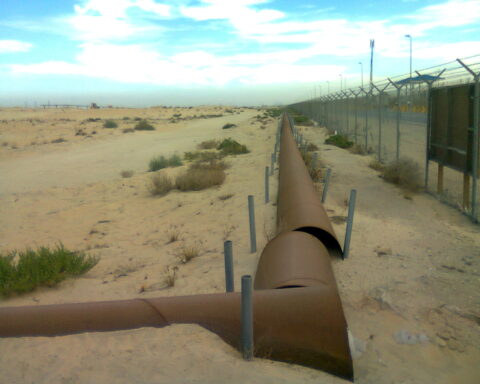
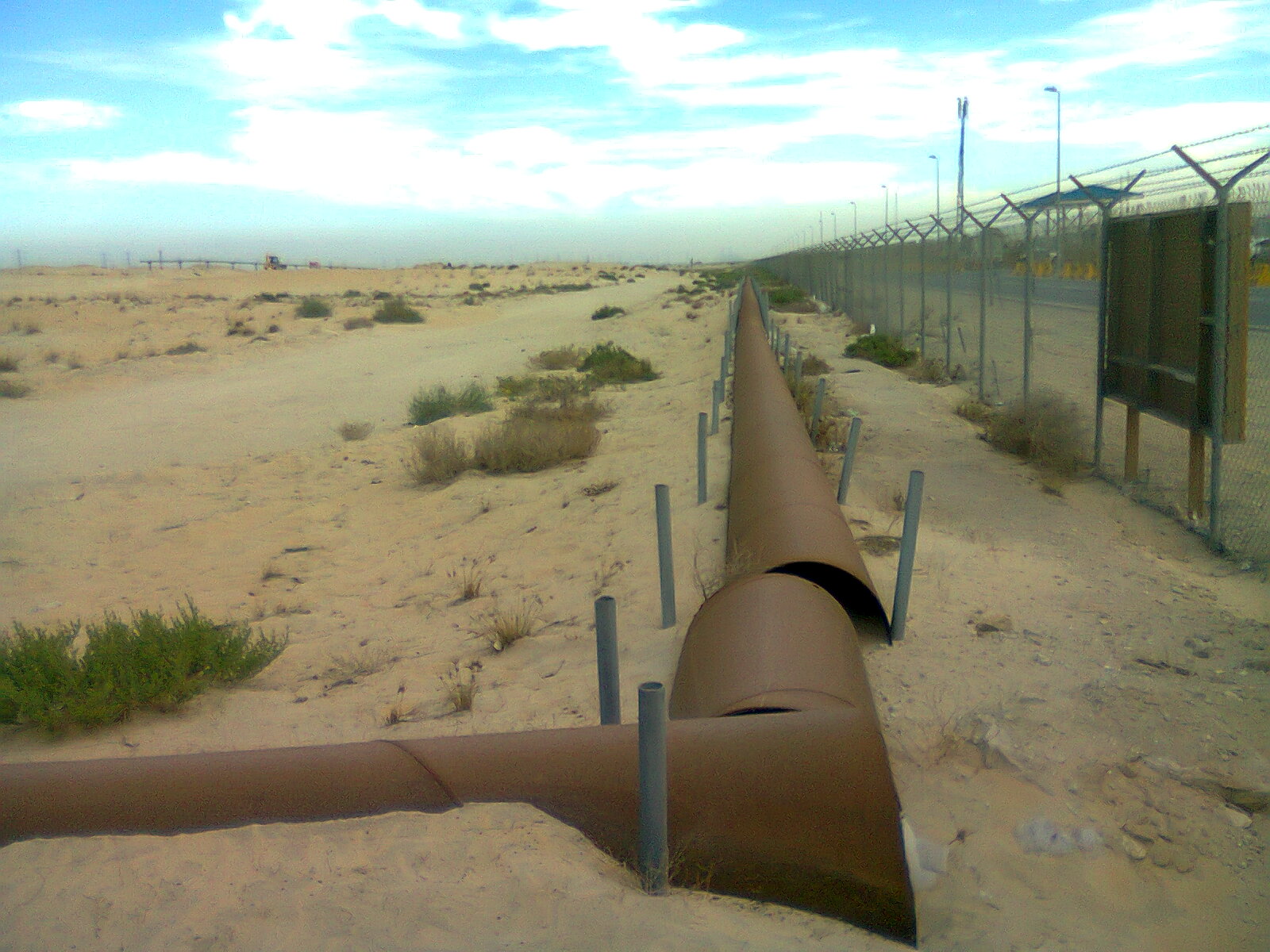
Nasser described the East-West Pipeline as “a critical supply artery” on the Q1 earnings call, and it is — having reached its maximum capacity of 7.0 million barrels per day by mid-March (S&P Global Commodity Insights, March 10). But the pipeline’s throughput ceiling runs into a harder constraint at Yanbu, where export loading capacity is capped at approximately 5.0 million barrels per day (gCaptain; Lloyd’s List), leaving a 2 million barrel-per-day structural gap between what the pipe can move and what the terminal can ship. No amount of operational adjustment closes that gap without new terminal infrastructure — additional single-point mooring buoys, deeper dredging, expanded tank farms — that would compete for capital with Aramco’s production-sustaining investment programme at a time when every discretionary dollar is under pressure from the same cash-flow constraints threatening the dividend.
Saudi actual production, at roughly 7.25 million barrels per day (Bloomberg, March 9), sits 3.04 million barrels below the kingdom’s 10.291 million barrel OPEC+ quota. The gap represents approximately $280-300 million per day in forgone revenue at current Brent — a figure larger than the quarterly dividend shortfall itself, which frames the entire cash-flow problem as one of physical constraint rather than commercial weakness. Aramco is not running an unprofitable business; it is running a landlocked one, with 30 percent of its capacity stranded behind a chokepoint that IRGC cruise missiles struck as recently as June 2.
“If trade flows resume immediately through the Strait of Hormuz, it will take a few months for the oil market to rebalance, but if trade and shipping remain curtailed by more than a few weeks from today, the supply disruption is expected to persist, and the market to normalize only in 2027.”
— Amin Nasser, Aramco CEO, Q1 2026 earnings call, May 11
Nasser delivered that binary on May 11, defining “a few weeks from today” as the outer boundary of a rapid-normalisation scenario. Twenty-six days have passed, the Strait remains closed, and the IRGC’s attacks on Gulf shipping and military infrastructure have intensified rather than subsided. By Nasser’s own framing, the normalisation has now defaulted to 2027 — meaning the pipeline ceiling and the production gap define Aramco’s export capacity for at least three more quarters.
What Does Aramco’s Balance Sheet Look Like on September 8?
At $92-99 Brent with volume constraints unchanged, Aramco’s estimated cash reserves drop from the post-June 9 floor to approximately $48-51 billion by the September 8 payment — a decline, not a recovery — because Q2 free cash flow of $17-20 billion does not cover the $21.9 billion quarterly obligation. The cash position erodes each quarter, not rebuilds.
The AGSI’s analysis of Q1 results puts annualised FCF at approximately $74 billion at current Brent and volume constraints — $13.6 billion below the annual base dividend, a structural quarterly shortfall of roughly $3.4 billion (AGSI, “Aramco’s Latest Financial Results Suggest That Its Dividend Policy Is Unsustainable”). The Q2 outturn will depend partly on whether the working capital build from Q1 reverses — if it does, Q2 FCF could spike to $25-26 billion, funding one quarter’s dividend with a small surplus — but a single-quarter reversal does not close the underlying gap between what Aramco earns at $95 per barrel on constrained volumes and what it owes shareholders annually.
“Aramco is unlikely to be able to sustain its current dividend payout absent a strong rebound in oil revenue.”
— AGSI, “Aramco’s Latest Financial Results Suggest That Its Dividend Policy Is Unsustainable”
| Metric | $80 Brent (Peace) | $95 Brent (Current) | $108 Brent (Breakeven) |
|---|---|---|---|
| Estimated Quarterly FCF | ~$14-16B | ~$17-20B | ~$22-24B |
| Quarterly Dividend Obligation | $21.9B | $21.9B | $21.9B |
| Quarterly Surplus / (Deficit) | ($5.9-7.9B) | ($1.9-4.9B) | $0.1-2.1B |
| Estimated Cash, Sept 30 | ~$45-47B | ~$48-51B | ~$53-55B |
| Estimated Cash, Dec 31 | ~$38-42B | ~$44-50B | ~$54-58B |
| FCF Coverage Ratio | 0.64-0.73x | 0.78-0.91x | 1.00-1.10x |
The table makes the structural bind visible: at every Brent price within the current wartime range, Aramco’s cash position declines quarter over quarter, with only the $108-111 band — the fiscal breakeven the IMF identified in its Article IV assessment — generating enough FCF to stabilise reserves. Brent has not sustained $108 since early 2023, and the 58 million barrels Washington has drained from strategic reserves have kept the price in the band that maximises Saudi fiscal discomfort: high enough to sustain the war premium, low enough to prevent balance-sheet repair.
Can Aramco Borrow Its Way Through?
Aramco’s gearing ratio stands at 4.8 percent as of March 31, up from 3.8 percent at end-2025, giving the company substantial borrowing headroom before credit concerns emerge. The 2020 precedent — when Aramco borrowed explicitly to maintain its dividend after Brent averaged $42 — confirms that the company will use that headroom before it cuts the payout.
The gearing increase — a 26 percent deterioration in a single quarter (Aramco Q1 2026 results) — remains low by the standards of global oil majors, where ExxonMobil and Shell both operate above 15 percent. Aramco could theoretically absorb tens of billions in additional debt before its credit metrics crossed the thresholds that typically trigger negative rating actions, and the political economy of the dividend makes borrowing the default response to a cash shortfall: the base distribution is the primary fiscal transfer mechanism from Aramco to the Saudi state, and a cut would require the Ministry of Finance to explain a revenue gap it has no other channel large enough to fill.
The 2020 parallel holds up to a point. When Brent averaged $42 that year, Aramco’s FCF collapsed to the point where the company explicitly issued debt to sustain the $75 billion annual dividend then in force (Global Finance Magazine; AGSI). The decision was political rather than financial — the company’s willingness to lever up rather than cut has been the operating assumption of every subsequent dividend escalation. The difference in 2026 is that the FCF shortfall is driven not by demand destruction (as in the pandemic) but by supply destruction: the oil is there, the demand is there, the price is elevated, but the shipping lane is closed, and no amount of corporate borrowing resolves a physical chokepoint that only a geopolitical settlement or a military outcome can reopen.
The government is already borrowing in parallel. The NDMC raised $11.5 billion in recent bond issuance against $31 billion in demand — a 2.7x oversubscription that signals persistent market appetite for Saudi sovereign debt (Arab News). But Aramco borrowing to fund a dividend while the sovereign simultaneously borrows to fund expenditure the same dividend is supposed to cover is leverage built on leverage — individually manageable at today’s gearing levels, but compounding in ways the headline ratios do not capture.
Aramco also announced, alongside its Q1 results, a $2-3 billion share buyback programme over 18 months (Aramco Q1 2026 press release) — an additional cash outflow initiated at precisely the moment when the company’s challenge is preserving liquidity, not distributing it. The buyback commits $1.3-2 billion annually to repurchases at the same time the company weighs whether to borrow to maintain the dividend those same shares entitle holders to receive. That makes sense only if the board expects Hormuz to reopen before the cash trajectory forces a harder choice.
The Price That Aramco Needs Does Not Exist
Goldman Sachs estimates that current Brent embeds a $14-per-barrel war premium — the spread between the price the market pays with Hormuz closed and the price it would pay if shipping normalised. Wood Mackenzie’s “Quick Peace” scenario, modelling the removal of that premium, puts post-deal Brent at approximately $80 per barrel (cited in OilPrice.com and multiple outlets). At $80, Aramco’s FCF does not improve but deteriorates sharply, because the volume gains from a hypothetical Hormuz reopening would take months to materialise — Nasser’s own estimate was “a few months to rebalance” — while the price drop would register within days of a credible agreement.
The trap is circular. The war generates a premium that keeps Brent in the $92-99 band, and that premium is the only thing preventing a collapse toward $80 that would blow the dividend arithmetic wide open. But the same war holds production at the constrained volumes described above, ensuring the elevated price applies to a base too small to generate the $87.6 billion commitment from earnings. Peace is more expensive than war at $80 because revenue falls faster than volume recovers, and war is more expensive than peace at $95 because the volume constraint prevents the price from translating into sufficient cash flow.
The timing mismatch compounds the bind. A credible Hormuz resolution would strip the war premium from Brent within days — Goldman’s $14 would collapse the moment markets priced in a settlement — but the volume recovery would take months, per Nasser’s own timeline. The transition period therefore delivers the worst of both scenarios simultaneously: lower prices on the same constrained volumes, before higher volumes eventually arrive at lower per-barrel margins. Whether full production at $80 Brent generates enough FCF to cover the annual commitment depends on assumptions about Aramco’s marginal cost structure and tax take at lower prices — assumptions the company has not publicly modelled — but the AGSI and OilPrice.com assessments both treat the peace scenario as fiscally worse for Saudi Arabia than the current wartime stalemate, at least through the adjustment period.
The price Aramco actually needs — $108-111 per barrel at full production capacity — requires both Hormuz access and the continuation of the war premium, conditions that are mutually exclusive by definition. The OPEC+ June 7 meeting added supply into a market where Saudi Arabia’s own production cannot reach its quota, and Goldman Sachs’s projection of a 6.6 percent GDP deficit for 2026 reflects the arithmetic of a state trapped between the premium it depends on and the production capacity it has lost.
How Much of the Dividend Reaches the Saudi Treasury?
Of Aramco’s annual base dividend, roughly $14 billion flows to PIF — which holds approximately 16 percent of the company — with the remainder directed to MoF-controlled accounts and other sovereign entities. AGSI’s analysis of the fiscal transfer chain puts the portion reaching the Ministry of Finance’s active budget at approximately $60-63 billion annually, after accounting for shares held by GOSI and SANABIL (AGSI, “Aramco and the Saudi Government Budget”). Oil revenue accounts for 63 percent of total government fiscal revenue over the past three years (AGSI, “Aramco and the Saudi Government Budget”), making the Aramco distribution the single largest line item in Saudi Arabia’s budget.
PIF’s $14 billion annual flow does not reduce the fiscal deficit; PIF operates as a sovereign wealth vehicle with its own commitments, including the NEOM standalone pillar and remaining Vision 2030 programmes, and its spending obligations exist independently of the state budget. The structural effect is that the Saudi government is both the beneficiary and the hostage of the dividend: it needs that direct budget transfer to fund the state, it needs PIF to hold its 16 percent to preserve the fund’s investment capacity, and it needs Aramco to borrow rather than cut so that both flows continue — even as the FCF that supports them has fallen below the combined commitment.
The Q1 2026 fiscal results make the dependency concrete. The Saudi deficit reached SAR 125.7 billion ($33.5 billion) in Q1 alone — 76 percent of the full-year deficit target consumed in a single quarter (MoF via Zawya). Military spending ran SAR 64.7 billion, up 26 percent year-on-year, and subsidies rose nearly threefold as the government absorbed the domestic cost of the war’s economic disruption. The dividend that is supposed to cushion these expenditures is itself being cushioned by the balance sheet, creating a fiscal chain in which every link — Aramco’s cash reserves, the dividend commitment, the government’s revenue base, PIF’s capital allocation — is weaker than it was twelve months ago, and the chain’s most vulnerable point — Aramco’s quarterly FCF gap — is also the one over which Saudi policymakers have the least control, because it is determined by a Brent price set in global markets and a production volume dictated by a strait that Iran holds closed. Saudi Arabia’s airports remaining open while every other Gulf hub shuts is the war’s only commercial windfall — and as Riyadh’s record $34 billion quarterly deficit makes plain, that windfall covers roughly five percent of the fiscal hole.
Nasser’s Window Closed on Schedule
Amin Nasser drew a line on May 11: reopen Hormuz within weeks, or normalisation slides to 2027. Twenty-six days later, the IRGC has struck a container ship inside the Persian Gulf, fired on the Fifth Fleet for the third time, hit Kuwait’s passenger terminal 48 hours after it reopened, and Saudi Arabia’s private de-escalation track with Iran remains the only diplomatic channel that has not collapsed. The mid-June threshold Nasser identified passed without a Hormuz resolution, and by his own stated logic, Aramco’s production and export normalisation has defaulted to 2027.
That means at least three more quarterly dividends — September, December, and March — must be funded from a cash-generation base that does not cover them, from a reserve that is declining rather than rebuilding, and from a balance sheet whose gearing trajectory, if sustained, approaches double digits by mid-2027. The September 8 payment is not a crisis; it is a data point on a trajectory that does not inflect without either a Hormuz resolution or a dividend restructuring, and as of June 6, the kingdom has shown no willingness to consider either.
Frequently Asked Questions
Has Aramco ever cut its base dividend?
Aramco has never reduced its base dividend since the December 2019 IPO, which set the original floor at $75 billion annually. The base has risen each year through the 3.5 percent escalator, reaching $87.6 billion for 2026. Aramco’s prospectus described the distribution as “intended” rather than contractually guaranteed, giving the board legal discretion to reduce it — but no board has tested that discretion, because a cut would force the Ministry of Finance to explain a revenue shortfall it has no other source large enough to replace, and the political cost of that explanation has consistently exceeded the financial cost of borrowing to maintain the payout.
What happens to Aramco’s credit rating if gearing keeps rising?
Moody’s rates Aramco at A1 (stable) and S&P at A+, both one notch above the Saudi sovereign rating — a gap that allows Aramco to borrow more cheaply than the state it funds. A gearing ratio above 15 percent would likely trigger a negative outlook at current agency thresholds, but at 4.8 percent the company has substantial headroom before that boundary. The binding constraint is the sovereign link: if the Saudi sovereign is downgraded, Aramco’s rating follows regardless of its own balance-sheet metrics, because rating agencies treat majority-state-owned entities as credit-linked to their sovereign.
How does Aramco’s dividend yield compare to other supermajors?
At Aramco’s approximate market capitalisation of $1.7 trillion in June 2026, down from a $2.1 trillion peak in mid-2022, the $87.6 billion base dividend implies a forward yield of roughly 5.1 percent — the highest among the supermajors. ExxonMobil’s current yield is approximately 3.6 percent, Shell’s approximately 4.2 percent, and TotalEnergies approximately 5.0 percent. The narrowing of Aramco’s yield advantage reflects a declining share price rather than dividend growth, an indication that the equity market is pricing the sustainability question even if the credit market has not.
Could Saudi Arabia use SAMA reserves to backstop the dividend?
SAMA held approximately $430 billion in foreign reserves as of Q1 2026, but these reserves exist primarily to defend the SAR/USD peg at 3.75 — a fixed exchange rate whose credibility depends on the perception that reserves are allocated to currency defence, not fiscal backstopping. In the 2015-16 oil crash, SAMA reserves fell from $732 billion to $536 billion as the government drew on them to finance spending, triggering sustained speculation about a devaluation that the central bank spent months suppressing. Using SAMA reserves to fund a corporate dividend would cross a line between monetary and fiscal policy that has never been publicly crossed, and the reputational cost to peg credibility would likely exceed the financial benefit of avoiding a dividend restructuring.