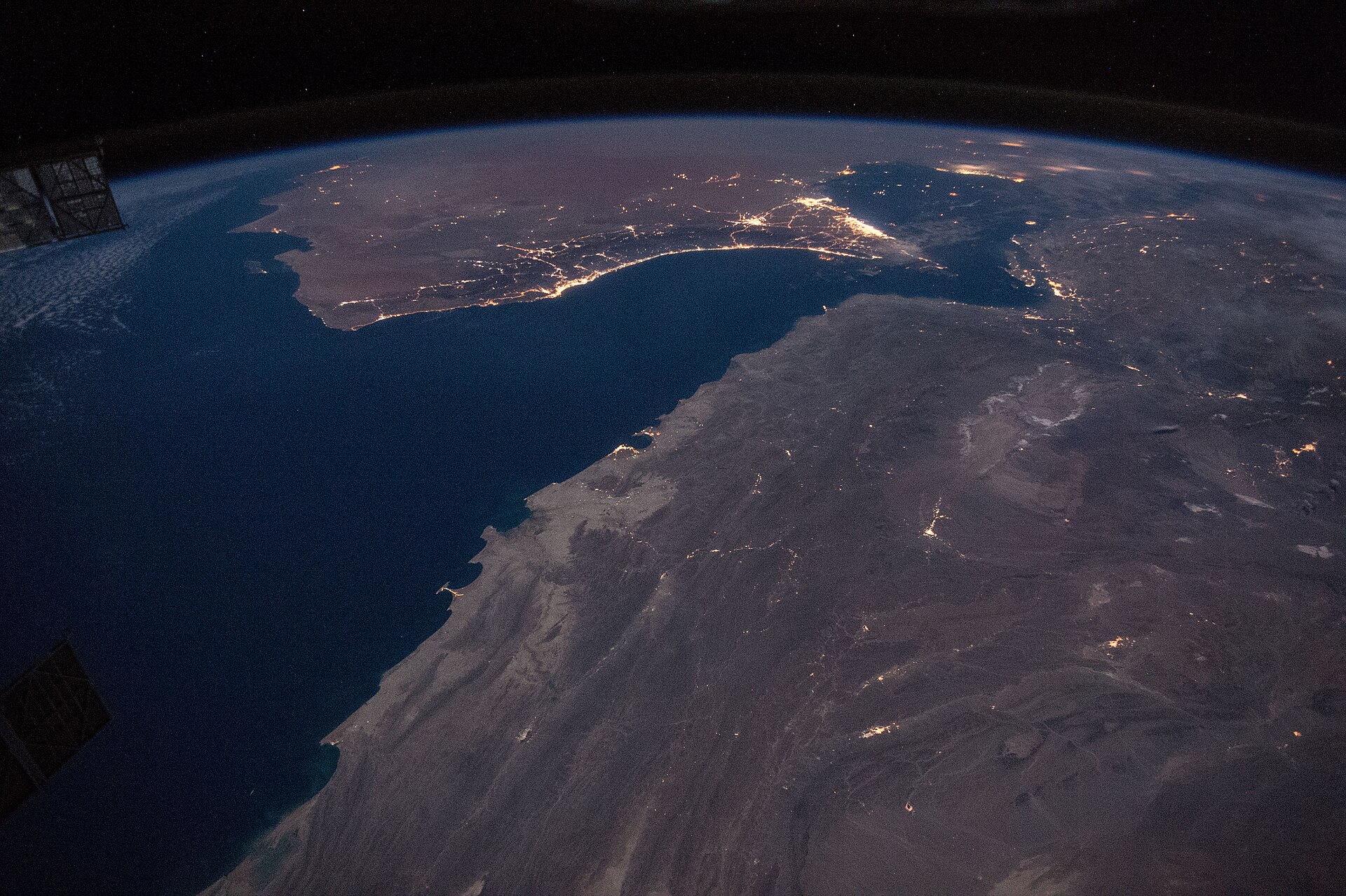

TEHRAN — Iran has mounted about 14 attacks on vessels in and near the Strait of Hormuz in the first 19 days of November, according to a United Kingdom Maritime Trade Operations count cited by Bloomberg. The escalation has included a shift to anti-ship cruise missiles, which an unnamed U.S. official described to the Jerusalem Post as “far more lethal than drones,” and has followed the collapse of Muscat-hosted diplomacy between Iran and Oman on November 17.
Yet the attacks have not produced the economic pressure Tehran appears to need. Brent crude futures have fallen approximately one-fifth in November, Bloomberg reported, and total Middle East oil flows have largely recovered to near pre-war levels through alternative routes and ship-to-ship transfers. The International Energy Agency projected in its November Oil Market Report that global oil supply will exceed demand in the fourth quarter of 2026 for the first time since the Iran conflict began.
The House of Saud Daily Briefing
Saudi Arabia's news in 3 minutes, every morning. Free. See today's issue
For Saudi Arabia, whose pre-war exports ran overwhelmingly through the Hormuz-side terminal at Ras Tanura, the question is what happens next. Anonymous Iranian officials, cited by the New York Times and reported by the Jerusalem Post and UA.NEWS, said Tehran is considering further escalation, reading the Republicans’ midterm defeat as a signal that it can afford to make fewer concessions.
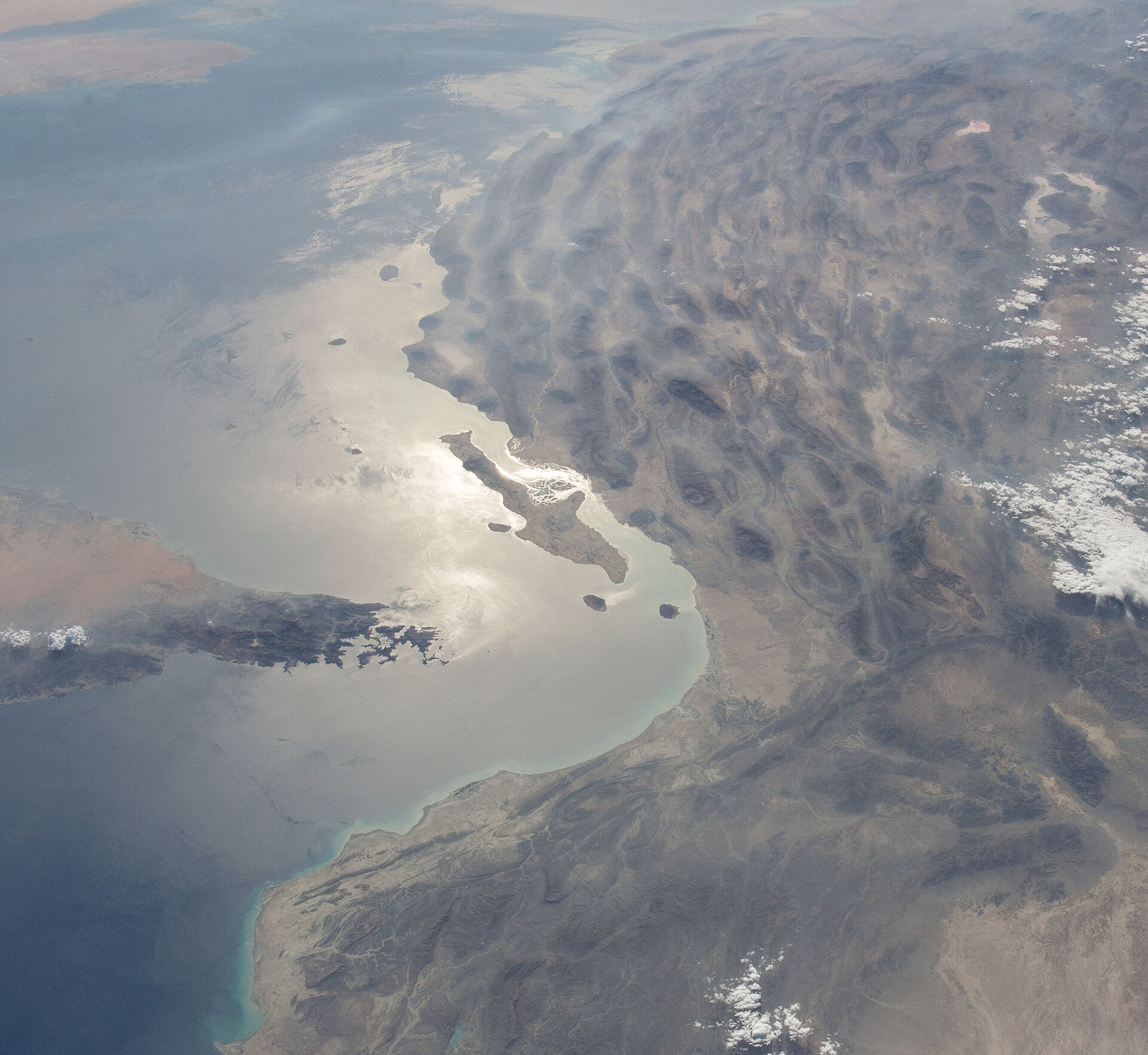
Table of Contents
The Attack Tempo
The pace of attacks in and around the strait has settled into what Georgios Sakellariou, an analyst at Signal Ocean, described to Bloomberg as “the new normal: Something like a war, but not exactly a war, with attacks on ships virtually every day.” He added that “oil is going out, but being certain about the volumes is complicated by the attacks and the secrecy.”
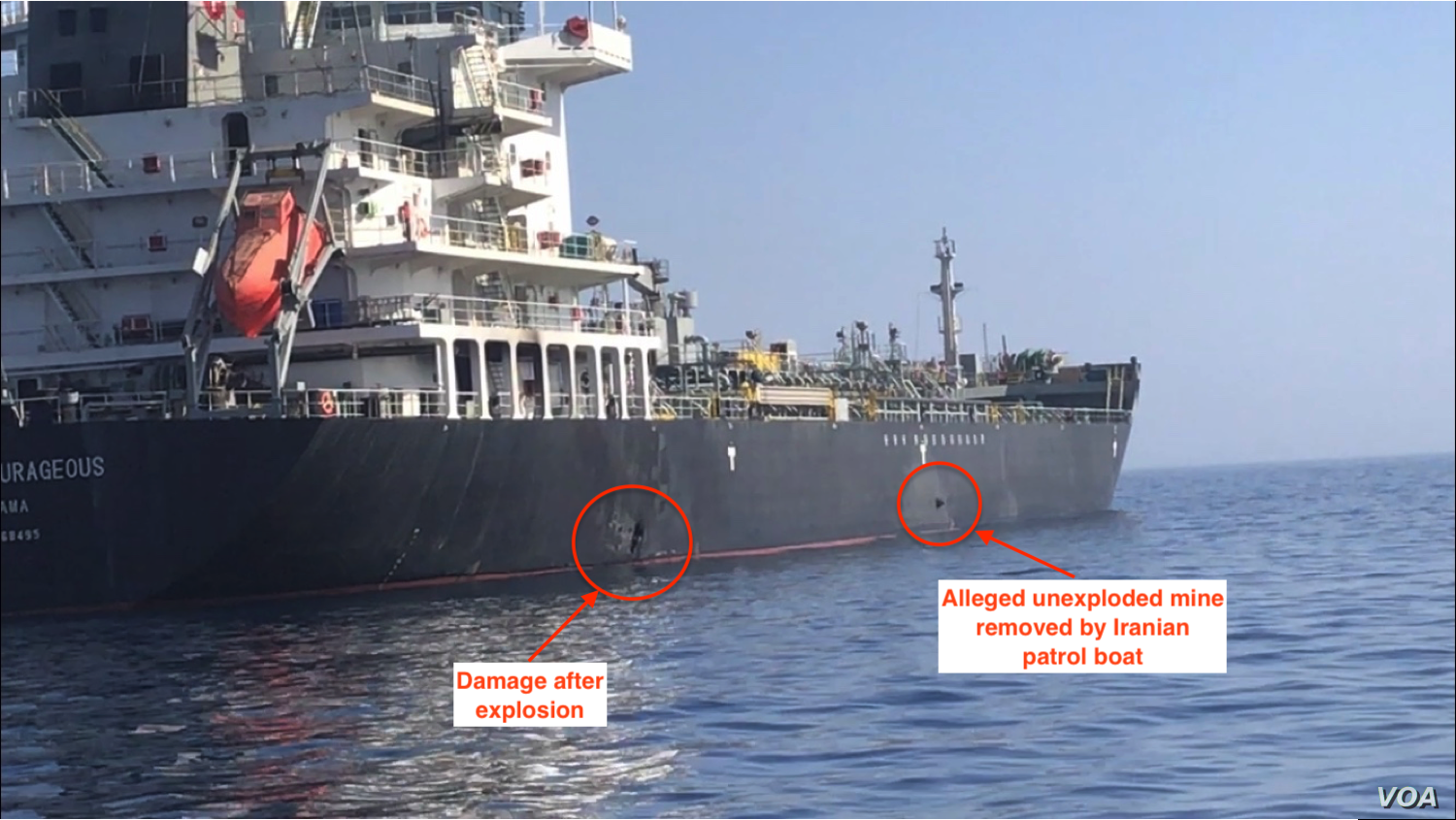
The incidents have spanned limpet mines, naval mines and the cruise missiles referenced by the unnamed U.S. official. On November 17, an ADNOC-linked vessel was hit in the strait; ADNOC initially reported one crew member missing and 11 injured, though India’s Minister of Ports, Shipping and Waterways posted on November 18 that all crew were safe and accounted for. Earlier on November 17, Iran’s Navy said a fourth tanker had been struck in Hormuz, with UKMTO confirming an attack near Khasab. On November 16, Iran reported two more tankers hit by mines. After the Muscat talks collapsed on November 17, Iran claimed three additional tankers hit mines east of Hormuz.
The shift to cruise missiles represents a qualitative escalation, moving beyond the mines and drones that defined earlier phases of the Hormuz confrontation. Mines require a vessel to transit the mined area; cruise missiles can be targeted from a distance and are harder for commercial shipping to avoid through route changes alone. The International Maritime Organization estimates that about 80 mines remain in the strait’s historic shipping lanes, Hellenic Shipping News reported, but the cruise missile threat extends the danger beyond the mined corridors.
Kuwait wrote to the International Maritime Organization this month about attacks on eight of its tankers in recent weeks, Bloomberg reported. The complaints reflect a widening circle of affected states beyond the Gulf producers: an Indian-crewed gas carrier was also attacked in the strait, with one crew member still missing, according to Ship Management International.
Where Did the Oil Go?
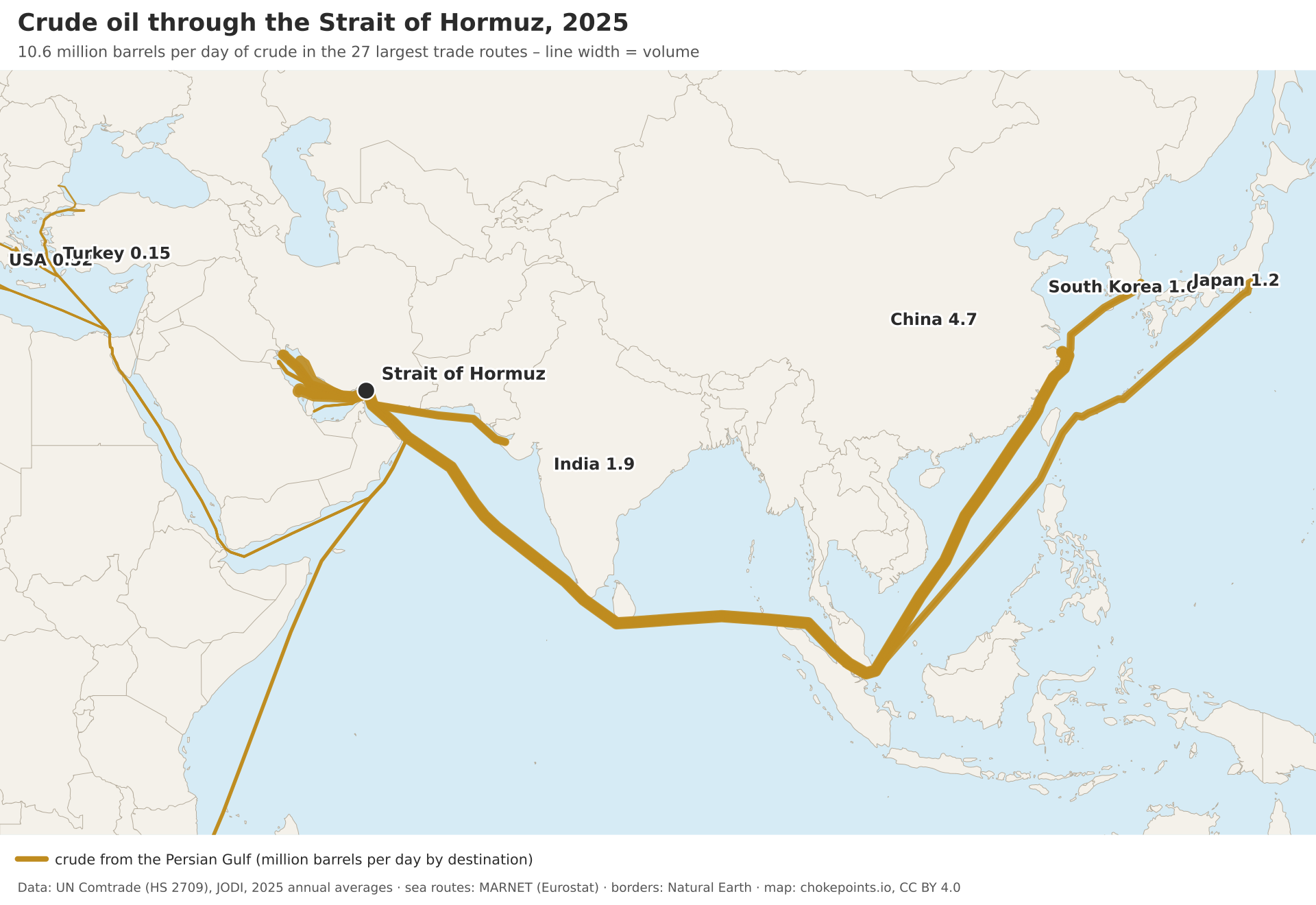
The number of tankers physically transiting the Strait of Hormuz has collapsed. IMF PortWatch, which tracks vessels using Automatic Identification System data, recorded just 11 tanker transits through Hormuz between November 1 and 15 — an average of 0.7 per day, compared with 665 in the same period of 2025. That is a 98 percent fall from a year earlier. The Joint Maritime Information Centre’s pre-conflict baseline of 138 ships per day gives further scale to that collapse.
Yet the oil has found other paths. Kpler, the cargo-tracking firm, estimated that total Middle East oil flows reached 24.5 million barrels per day for the week ending October 18 — slightly above a pre-war average of 24.4 million barrels per day, Breitbart reported. Vortexa, a rival analytics firm, put total flows at approximately 18 million barrels per day for the same period, slightly below pre-war norms, according to PolitiFact. The discrepancy between the two estimates reflects the difficulty of tracking vessels running with transponders off, ship-to-ship transfers at sea, and crude moving through overland alternatives.
Within the strait itself, a two-route system has emerged: a U.S.-protected southern channel hugging Oman’s coast and an Iranian-controlled northern route, with the historic middle shipping lanes considered mined and largely abandoned by commercial traffic. CENTCOM reported that about 400 merchant ships passed through Hormuz in a single recent week, Breitbart reported. That is a fraction of the pre-conflict baseline, but enough to sustain significant oil flows. Kpler data cited by Bloomberg showed Hormuz-specific oil flows fell from approximately 13.4 million barrels per day to about 10 million in the first 10 days of November. That figure remains well below pre-war norms even as total regional volumes recovered through alternative channels.
Why Are Prices Falling Despite the Attacks?
David Oxley, chief climate and commodities economist at Capital Economics, told CNN that “it certainly seems that Iran is either unwilling or unable to prevent the flow of crude oil at present,” though he added that “navigability in the strait is still far short of pre-crisis norms.” The rerouting of flows and the IEA’s projection of a fourth-quarter supply surplus — the first since the conflict began — have changed the dynamics of the crude market. For months, traders assigned a substantial war premium to oil; that premium has collapsed.
Danny Citrinowicz, a senior fellow at Israel’s Institute for National Security Studies, warned in the same CNN report that the price decline poses a strategic problem for Tehran. “If oil prices continue to fall despite Iranian attacks, an important part of that strategy becomes less effective,” he said. “When it feels cornered, it may become more aggressive, not less.”
Hamidreza Azizi, a senior Iran analyst at the International Crisis Group, offered a similar reading. “Markets appear to be increasingly assuming that a return to full-scale war is unlikely,” he told CNN. “But that assumption could change quickly if Iran decides to intensify the confrontation.” Rising non-OPEC production alongside the rerouted Gulf flows — the factors driving the IEA’s fourth-quarter surplus — have together undercut the economic foundation of Iran’s chokepoint strategy at both Hormuz and Bab el-Mandeb.
Saudi Arabia’s Export Exposure
Saudi Arabia’s pre-war export infrastructure was overwhelmingly oriented toward Hormuz. Approximately 5.5 million barrels per day flowed through Ras Tanura on the Gulf coast, against about 760,000 barrels per day loaded at Yanbu on the Red Sea, according to Argus and Kpler pre-war data. The kingdom’s East-West pipeline, which connects the Gulf fields to Yanbu, has a design capacity of about 7 million barrels per day, Saudi Gazette reported via Zawya in September 2026.
Aramco has worked to shift volumes westward. Yanbu loading peaked at 3.66 million barrels per day in March 2026 — roughly half of Saudi pre-conflict exports — according to Bloomberg ship-tracking data cited by Anadolu Agency. Aramco restored full November crude supply to Europe via Yanbu, but the pipeline’s capacity still falls short of replacing the Ras Tanura volumes entirely. The Yanbu corridor has itself faced threats. Drones from Iraq shut the East-West pipeline temporarily in September, SPA and Al Jazeera reported. Houthis claimed strikes on the pipeline and Yanbu facilities on November 12.
The arithmetic exposes the gap between partial adaptation and full resilience. Even at peak Yanbu loading of 3.66 million barrels per day, the westward route handled roughly half of pre-conflict exports. With the pipeline running well below its 7 million barrel-per-day design capacity, a substantial portion of Saudi crude still depends on some form of access through or around Hormuz. Some flows move through the U.S.-protected southern channel; others travel aboard dark-running VLCCs whose opacity contributes to the tracking discrepancies described by Kpler and Vortexa.
The ADNOC chief executive’s public demand that the strait reopen unconditionally, reported by EnergyNow on November 17, reflected the same exposure from Abu Dhabi’s side.
The View From Tehran
Iran’s official position is that the Strait of Hormuz remains closed until seven conditions are met. Brigadier General Mohammad Akraminia, the Iranian Army spokesman, told Tasnim News on October 29 that “the strait remains under Iranian armed forces’ strategic control and will stay closed until Iran’s conditions are fully met.” The sequencing dispute at the heart of the deadlock is straightforward: Iran demands sanctions relief before reopening the strait, while the United States insists the attacks must stop first, the Jerusalem Post reported, citing the New York Times.
Mohsen Rezaei, the Secretary of Iran’s Supreme National Security Council, framed the strategy in explicitly deterrent terms. “We want to impose a cost on the Americans that makes attacking Iran too expensive, and that serves as a deterrent,” he told CNN.
The IRGC has sought to deflect blame for vessel losses. In an October 29 statement to Tasnim News, the Guards said the ships that struck mines had been traveling on “unauthorized routes” with their navigation systems disabled under U.S. instruction, and that vessel owners bear responsibility for the damage. Iran International reported that IRGC-affiliated Fars News warned that if Iranian tankers are targeted, Gulf oil terminals — including facilities in the UAE, Saudi Arabia and Qatar — could be struck in retaliation.
Anonymous Iranian officials told the New York Times, as reported by the Jerusalem Post and UA.NEWS, that Tehran reads the Republicans’ midterm defeat as voter dissatisfaction with Trump’s handling of the Iran conflict. Iran can now afford to make fewer concessions, they suggested. Azizi told CNN that in this context, Iran “may decide to go further, potentially even challenging US naval forces more directly.”
Can Diplomacy Break the Deadlock?
The most recent attempt to negotiate a Hormuz agreement collapsed on November 17, when Iranian Foreign Minister Abbas Araghchi met Oman’s Foreign Minister Badr al-Busaidi in Muscat and reached no agreement. Within hours, Iran claimed three tankers had hit mines east of the strait. The Qatar-Oman channel that has mediated between Washington and Tehran has not produced a breakthrough; Saudi Arabia remains excluded from the direct negotiations.
Trita Parsi, executive vice president of the Quincy Institute for Responsible Statecraft, told CNN that further Iranian escalation alone is unlikely to shift the stalemate. What could break the impasse, he suggested, is a formula offering Trump what Parsi described as a “symbolic” victory that is “ego-soothing and face-saving” — implying that domestic political dynamics in Washington, not military events in the strait, may determine whether the standoff ends.
The diplomatic track faces the same structural problem as the military confrontation. The sequencing dispute remains: Iran demands sanctions relief before any reopening; Washington demands the attacks stop first. With Brent falling and total regional flows near pre-war levels, Washington faces no acute oil-supply crisis to force concessions, while Tehran has so far been unable to restore the price premium through escalation alone. Each side’s leverage is diminishing for different reasons. Iran’s ability to squeeze oil markets has been dulled by rerouting; Washington’s appetite for further military action was weakened by the midterms. Neither dynamic creates obvious pressure toward compromise.
Background
Iran first closed the Strait of Hormuz on February 28, 2026, and the waterway has been intermittently shut since, with re-closures on April 18 and July 12. The United States reinstated its naval blockade on July 14. CENTCOM reported in October that 135 ships had been turned around since the blockade began, Gulf News reported. The JMIC’s pre-conflict baseline of 138 ships per day gives scale to those refusals.
Attempts at negotiation have repeatedly failed. Iran’s Foreign Minister Araghchi presented a seven-day roadmap to the United States via Qatari mediators at the United Nations General Assembly on September 25, Al Jazeera reported. The plan proposed that Hormuz reopen in exchange for sanctions waivers and about $12 billion in frozen assets; the Wall Street Journal reported that Trump rejected it. On October 8, Trump said the United States “will not be attacking Iran at any time prior to the midterm elections” on November 3, CNN reported. The post-midterm Muscat talks on November 17 again produced no agreement.
Frequently Asked Questions
What happened to the crew of the mt Tara Gas?
The gas carrier mt Tara Gas was attacked in the Strait of Hormuz with 24 Indian nationals aboard. Twenty-one crew members were evacuated to Khasab, Oman, two were hospitalized, and one remains missing, Ship Management International reported on November 19. India’s Ministry of External Affairs issued a condemnation of the attack, marking one of the most significant crew-casualty incidents in the strait this month.
What do analysts say about Iran’s strategic approach to the strait?
Analysts have assessed that Iran’s aim is often not to stop every tanker but to impose enough cost and unpredictability to alter shipping patterns and insurance calculations. The JMIC’s pre-conflict baseline of 138 ships per day underscores that current Hormuz transit rates, at fewer than one tanker per day according to IMF PortWatch, represent a near-total collapse from pre-conflict norms.
How many mines does the IMO say remain in Hormuz?
The International Maritime Organization estimates that about 80 mines remain in the strait’s historic shipping lanes, Hellenic Shipping News reported in June 2026. The mined area corresponds roughly to the middle Traffic Separation Scheme, which commercial shipping has largely abandoned in favor of the U.S.-protected southern corridor or the Iranian-controlled northern route. Mine clearance has been complicated by the ongoing conflict and Iran’s stated position that the strait remains under its “strategic control,” as Brigadier General Akraminia put it to Tasnim News.
How have Gulf states responded collectively to the attacks?
The Gulf Cooperation Council told the United Nations that Iran has fired more than 7,000 missiles and drones at Gulf states since the conflict began, in what amounted to a formal accounting of the cumulative toll since the confrontation started in February 2026. Kuwait separately filed a formal complaint with the International Maritime Organization about attacks on eight of its tankers in recent weeks, Bloomberg reported.
The House of Saud Daily Briefing
Saudi Arabia's news in 3 minutes, every morning. Free. See today's issue