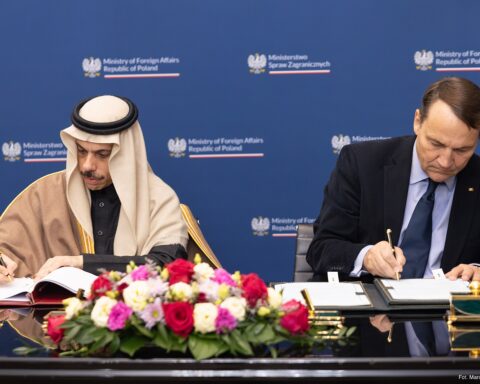
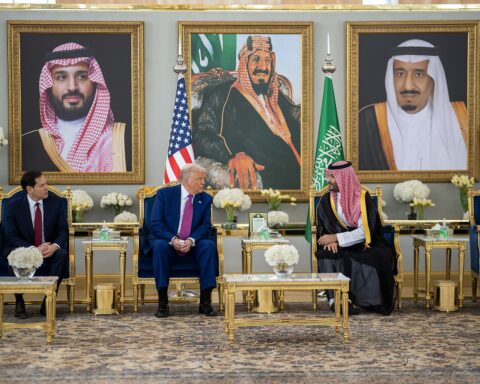
RIYADH — Mohammed bin Salman told the Shura Council on Thursday that Gulf security is “indivisible” and that Saudi Arabia “will not hesitate to respond decisively to any threat.” The alliance he named to back that pledge — the Makkah Joint Defence Agreement, signed on August 7 with Turkey and Pakistan — has no joint command, no permanent secretariat, no standing forces, and no agreed trigger mechanism, and both of its headline partners have spent the past two months finding careful new ways to say they will not deploy combat troops to the Gulf.
The address opened the third year of the Shura Council’s ninth session, delivered on behalf of King Salman. MBS claimed Saudi Arabia “possesses highly capable human and military resources” able to “confront and deter threats from any source” — a line he delivered with PAC-3 interceptors running below fifteen per cent of their pre-war level, Prince Sultan Air Base locked down since May, and a $24.3 billion American arms package that has not moved through Congress in nearly a fortnight. The doctrine is new. The capability gap it was designed to reframe is not.
Table of Contents
What MBS Actually Said — and What He Left Out
The Shura Council address is the closest Saudi Arabia has to a State of the Union — a formal policy declaration delivered under the authority of the king, carried verbatim by the Saudi Press Agency, and parsed by every foreign ministry in the region. MBS used it on October 1, 2026, to introduce a formulation he had never deployed in this setting before: “The attacks targeting the Gulf Co-operation Council states underscore that Gulf security and stability are indivisible.”
That word — “indivisible” — is doing structural work that goes well beyond rhetorical emphasis. In his September 2024 Shura Council address, MBS focused on Palestinian statehood and the conditions under which Saudi Arabia might normalise relations with Israel; there was no reference to a non-American security framework, no suggestion that the Gulf’s defence architecture needed institutional alternatives to the US Fifth Fleet and CENTCOM. Twelve months and a regional war later, the language has pivoted entirely. The security guarantor he named on Thursday was not Washington — it was the Makkah Defence Alliance, a pact that is fifty-five days old and has yet to hold its first joint exercise.
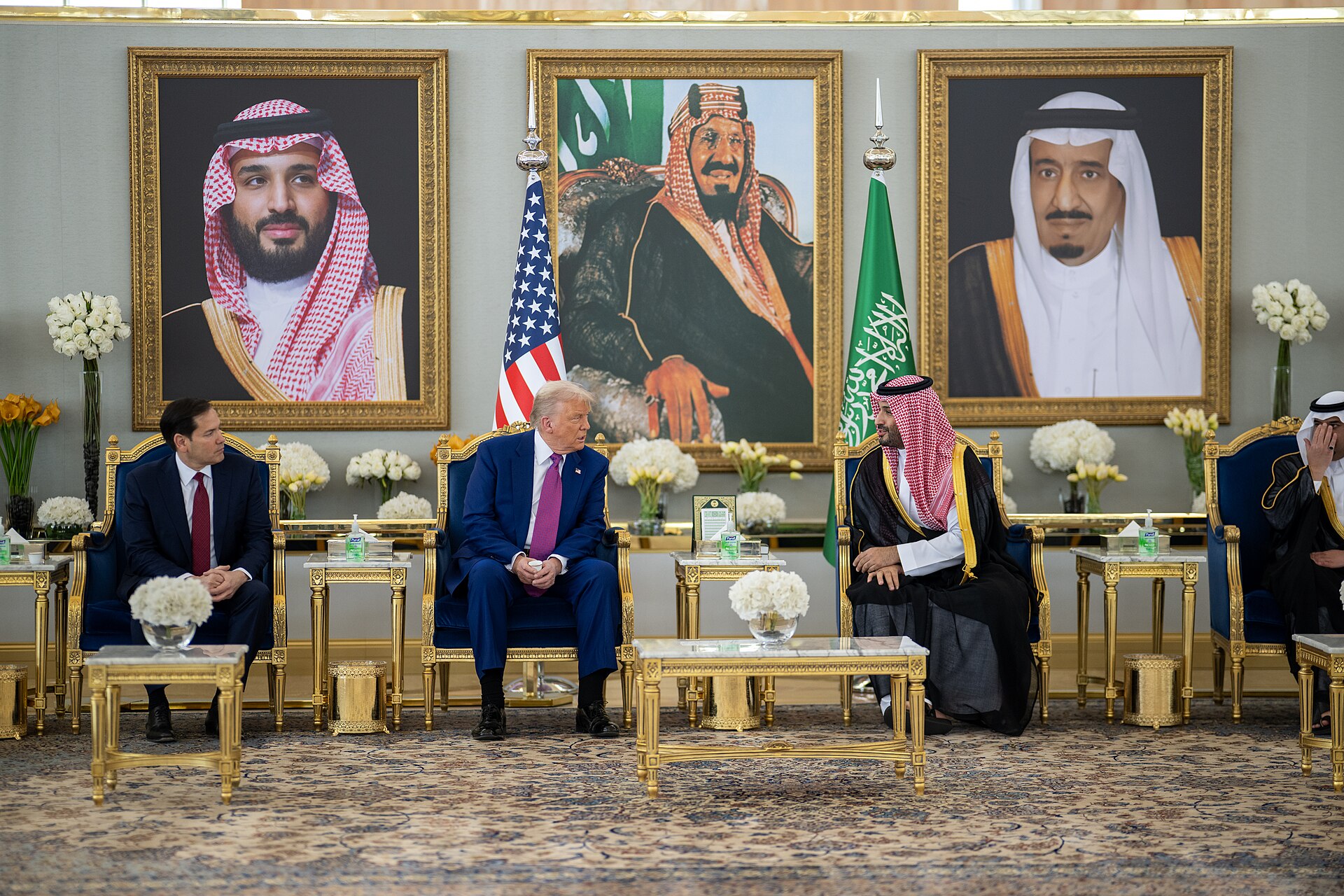
He coupled the “indivisible” formulation with a deterrence pledge — “We will not hesitate to respond decisively to any threat or attack aimed at undermining it” — and balanced it, as MBS habitually does, with diplomatic hedging: “We affirm that we are making every possible effort to reduce escalation and support diplomatic solutions, without the slightest compromise when it comes to security matters.” The construction is designed to sound like strategic resolve. Read more carefully, it is the vocabulary of a leader who is doctrinising a new alliance and simultaneously hedging against anyone expecting it to be tested.
What he left out was any reference to the Makkah Pact’s institutional development, the operational status of its provisions, or the specific capabilities it would bring to bear. Those omissions are not incidental — they are structural, because the answers to each of those questions would have contradicted the sentence that preceded them.
The Middle East briefing 3,000+ readers start their day with.
One email. Every weekday morning. Free.
The Makkah Pact on Paper
The Makkah Joint Defence Agreement was signed in Makkah on August 7, 2026, by MBS, Turkish President Recep Tayyip Erdogan, and Pakistani Prime Minister Shehbaz Sharif. Its core clause mirrors NATO’s Article 5: an armed attack on any signatory constitutes an attack on all. It builds on the bilateral Saudi-Pakistan Strategic Mutual Defence Agreement of September 17, 2025 — a document that predated the Iran-US escalation and was trilateralised by Turkey’s accession ten months later.
The aggregate capability statistics are large and have been circulated with intent to impress. Three nations contributing approximately 1.4 million active military personnel, 3,400 combat aircraft, 6,000 tanks, and more than 340 naval assets — figures that Al Jazeera published in a detailed capability breakdown on August 11. Those numbers describe the total armed forces of three countries separated by thousands of kilometres, three incompatible procurement ecosystems, and three entirely distinct strategic orientations: Turkey watching the Aegean and Syria’s northern border, Pakistan watching the Line of Control and its western frontier, Saudi Arabia watching the Strait of Hormuz. Combined force counts are not expeditionary capability, and the Makkah Pact has built no mechanism for converting the former into the latter.
| Commitment | Treaty Status | Operational Status | Source |
|---|---|---|---|
| Collective defence clause (Article 5 equivalent) | Signed | Not invoked | Makkah JDA, Aug 7 |
| Permanent secretariat (Riyadh) | Mandated | Not established | MEPEI / Belfer Center, Aug 31 |
| Ministers’ Committee | Mandated | Not convened | MEPEI / Belfer Center, Aug 31 |
| Political and Military Committees | Mandated | Not convened | MEPEI / Belfer Center, Aug 31 |
| Joint training programme | Mandated | Not scheduled | MEPEI / Belfer Center, Aug 31 |
| Joint command structure | Implied by Article 5 clause | Does not exist | Arab Center DC, Aug 2026 |
| Force deployment to Gulf | Expected under collective defence | None by any partner | FDD, Sep 2026 |
| Combined active personnel | ~1.4 million (aggregate) | Zero deployed to theatre | Al Jazeera, Aug 11 |
The agreement mandates a permanent secretariat in Riyadh, a Ministers’ Committee, and separate Political and Military Committees, alongside a programme of joint training. As of August 31 — twenty-four days after signature and the date of the pact’s first joint communiqué — none of these structures existed. The secretariat has not been stood up. The committees have not convened. The joint training has not been scheduled.
What MBS described to the Shura Council as a framework for “decisive response” is, as of the day he spoke, a treaty text with an Article 5 equivalent and no institutional machinery behind it — a document that exists on the page it was signed on and, so far, nowhere else.
Where Is the Joint Command?
No joint command exists. The Makkah Pact’s fifty-five days of operational life have produced no standing forces, no agreed activation procedures, and no institutional structure capable of converting the treaty’s collective defence clause into a military response. Every serious policy institution that has examined the agreement since August has reached the same conclusion.
The International Institute for Strategic Studies found that “despite its symbolic significance, it is unclear whether the Makkah Joint Defence Agreement will have its intended deterrent effect.” The Arab Center in Washington was more direct, concluding that the agreement is “unlikely to produce a real military response if an attack happens” and that it “does not establish a joint command, standing forces, or any specified trigger mechanism.” Their analysis — published under the title “Diversification Without Substitution” — advanced an argument whose logic has only sharpened since August: Turkey and Pakistan are themselves American allies, operating largely American equipment and dependent on American supply chains, meaning the pact adds diplomatic options for Riyadh without replacing the US security architecture it was rhetorically positioned against.
War on the Rocks published the most structurally detailed critique, testing the pact against five requirements for alliance credibility: credibility of commitments, operational integration, strategic autonomy, strategic ambiguity, and escalation management. Their conclusion was that the agreement “risks overpromising while underdelivering, and such a gap could not only weaken its deterrent value but also complicate crisis management and increase the risk of further escalation with regional rivals like Israel and Iran.” When the analysts whose professional work is assessing alliance structures conclude that a pact may actively worsen the security environment it was designed to stabilise, a crown prince’s speech does not close the gap — however forcefully it is delivered.
Foreign Policy was blunter still, titling its August 25 assessment “Turkey-Saudi-Pakistan Agreement Is a Pact Without Impact.” In those fifty-five days Saudi Arabia has sustained attacks on military installations, energy facilities, and civilian airports, and the alliance constructed to deter those attacks has produced no joint response, no force deployment, and no public activation of its collective defence clause. The Shura Council heard the word “indivisible”; the operational record since August 7 shows something closer to inert.
Can Pakistan Fight a War It Voted to Avoid?
Not under its current political constraints. Pakistan’s parliament voted in 2015 to refuse Saudi Arabia’s request for military participation in Yemen — a legislative precedent that has never been reversed. Its defence minister’s September 30 commitment offered “whatever means are available,” language constructed to avoid naming troops, offensive operations, or any specific trigger. Its prime minister’s red line covers only Mecca and Medina, not the military and infrastructure targets already hit.
The 2015 vote represented one of the most consequential parliamentary assertions of foreign policy independence in Pakistan’s modern history. Nothing in the Makkah Pact’s text overrides that legislative precedent. The question that attaches itself to every Pakistani commitment under the agreement is whether Islamabad would do in 2026 what it explicitly, publicly, and through democratic process declined to do eleven years ago, under conditions that are by every measure more dangerous.
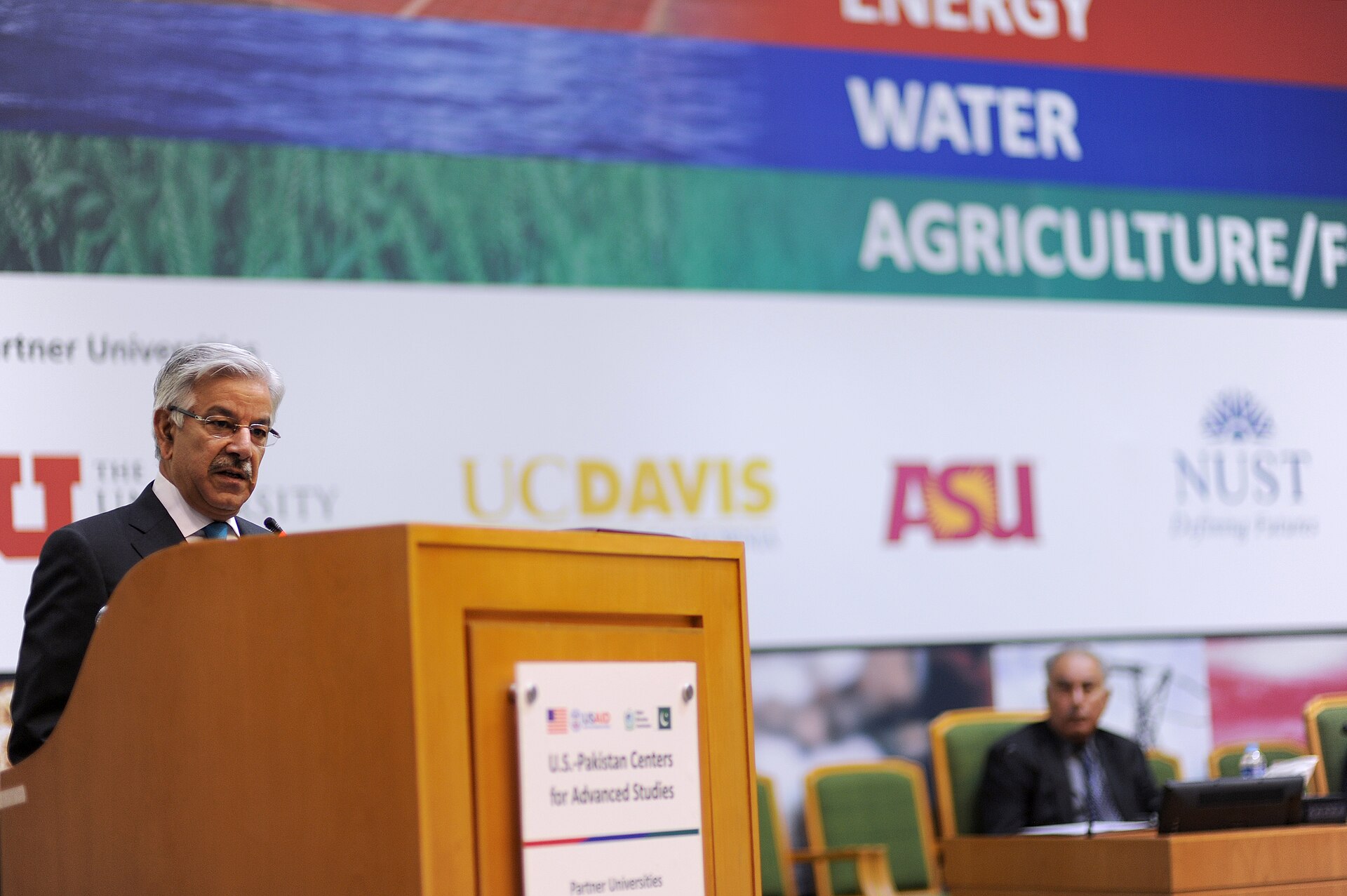
The most recent Pakistani formulation came from Defence Minister Khawaja Muhammad Asif on September 30 — twenty-four hours before MBS addressed the Shura Council, in what appeared to be a coordinated pre-speech positioning exercise. “Whatever means are available at our disposal, they’ll be available to Saudi Arabia also,” Asif told reporters. The sentence is constructed with the precision of a minister who has been thoroughly briefed on what he cannot confirm: it does not name troop deployments, does not confirm participation in offensive operations, does not specify which “means” are under discussion, and does not bind Islamabad to any timeline or trigger.
“Neither Pakistan nor Turkey will ride to Saudi Arabia’s rescue. The pact has only generated excuses for inaction.”
Ahmad Sharawi, Foundation for Defense of Democracies, September 23, 2026
Prime Minister Shehbaz Sharif set a different threshold at the UN General Assembly on September 25, declaring that a Houthi attack on Mecca or Medina would cross a “red line.” The formulation is instructive precisely because of what it excludes — it establishes a trigger that has not been pulled, and in doing so implicitly classifies every attack that has already landed on Saudi territory as falling below the level at which Pakistan’s commitment activates. Strikes on military installations, energy infrastructure, and civilian airports are, by this definition, not red-line events. Only a strike on Islam’s two holiest cities qualifies, and the declaration functions less as a commitment to the alliance than as a fence built to keep Pakistan on the non-intervention side of it.
Then there is the nuclear dimension, and it can be addressed concisely because the evidence is unambiguous. Pakistan’s estimated three hundred nuclear warheads are not available to the Makkah Pact. Islamabad’s Credible Minimum Deterrence posture is designed around a single adversary — India — and Pakistani strategic planners, including those cited in a 2026 Bahria University policy brief by Sara Kazim, have stated consistently that extending nuclear deterrence to alliance partners would require a larger arsenal, a fundamentally different delivery architecture, and a strategic doctrine incompatible with the restraint-based framework that governs Pakistan’s nuclear posture. The Makkah Pact does not shelter under a nuclear umbrella; it has a member state with nuclear weapons whose nuclear weapons are ringfenced for a different confrontation on a different border.
What Did Turkey Trade for the F-35?
Turkey transferred its S-400 air defence systems — the purchase that had blocked it from the F-35 programme since 2019 — to a Gulf state in July 2026, one month before signing the Makkah Pact. The transfer, widely reported as going to either the UAE or Qatar, removed what had been the single largest barrier to Turkish-NATO interoperability for seven years and opened Ankara’s path back into the F-35 consortium. It also removed Turkey’s most capable long-range air defence system at the precise moment it joined an alliance pledging to defend a partner whose own interceptor stocks are near exhaustion.
The S-400 is not a platform that can be replaced quickly, cheaply, or from an alternative supplier. Turkey traded away its primary long-range air defence capability in exchange for re-entry into a next-generation fighter programme whose first deliveries to Ankara remain years away. Ankara signed the Makkah Pact as a country that had just voluntarily degraded its own air defence in exchange for a future American capability it does not yet possess — a defensible strategic bet in peacetime, but a harder position from which to guarantee the air defence of a Gulf partner whose own interceptor stocks are approaching exhaustion.
When Houthi attacks on Saudi Arabia intensified through September, Turkey’s operational response matched the language of its diplomatic statements: “technical assistance” and engagement through dialogue. The FDD’s Sharawi noted that Ankara “prioritised diplomacy” over force deployment — a description that, in the context of a mutual defence pact pledging “decisive response,” captures the distance between treaty obligation and operational willingness that no volume of summitry has closed.
The most concrete Turkish military deliverable to the Makkah framework is not a force deployment or an air defence transfer but a defence-industrial partnership: the Baykar-SAMI agreement for co-production of Akinci armed drones in Saudi Arabia, with up to seventy per cent local manufacturing content and first locally assembled units expected before the end of 2026. The Akinci is a capable platform — a high-altitude, long-endurance UCAV designed for precision strike. But armed drones address ISR and ground-attack requirements, not the integrated air and missile defence that defines Saudi Arabia’s most acute vulnerability right now. An alliance whose most tangible military output to date is a drone factory contract is an alliance that has not yet begun to address the gap it was formed to fill.
Why Does Iran Endorse the Pact?
Because Tehran does not fear it. Iran’s official posture shifted in eight weeks from studied dismissal in August to active public endorsement by September 29 — its foreign ministry framed the pact as a reaction to Israeli behaviour rather than an Iranian threat, while its IRGC spokesman welcomed it as evidence of American withdrawal from the region. When the state a pact was designed to deter publicly welcomes its existence, the deterrent has failed before it has been tested.
Foreign Ministry spokesman Esmail Baghaei said in August that Iran had “no reason to fear” the agreement, framing it not as a military threat to Tehran but as a reaction to Israeli behaviour and declining regional confidence in American security guarantees. The IRGC-affiliated Tasnim News Agency went further, arguing that American inability to contain the threat had “pushed Riyadh to diversify its security relationships and reduce its reliance on the United States” — recasting the pact as evidence that Iranian strategic pressure was working exactly as intended. By September 29, IRGC spokesman Hossein Mohebbi had completed the rhetorical pivot, describing the agreement as “a step towards reducing the presence of foreign powers in the region.”
“A step towards reducing the presence of foreign powers in the region.”
Hossein Mohebbi, IRGC spokesman, on the Makkah Defence Agreement, September 29, 2026
Tehran had recast the alliance built to contain it as a vehicle for American withdrawal from the Gulf — and did so publicly, through official channels, without apparent concern that it was undermining a deterrent designed to constrain Iranian behaviour. When an adversary publicly endorses the structure you built to deter it, the structure has a credibility problem that cannot be resolved by restating the commitment more firmly at a lectern.
Regional outlets including Eesanje reported that Iran was at one point invited to join the Makkah Defence Pact itself. If accurate, that single detail dissolves the deterrence rationale entirely: a defensive alliance that could admit the state it was formed to deter is not a security architecture — it is a diplomatic forum with military language attached. Iran’s posture suggests Tehran reached the same conclusion without needing to accept the invitation.
The Defence Gap MBS Did Not Mention
MBS told the Shura Council that Saudi Arabia possesses military resources “fully able to confront and deter threats from any source.” The inventory he was describing when he said it tells a materially different story, and the Makkah Pact alters none of the numbers that define it.
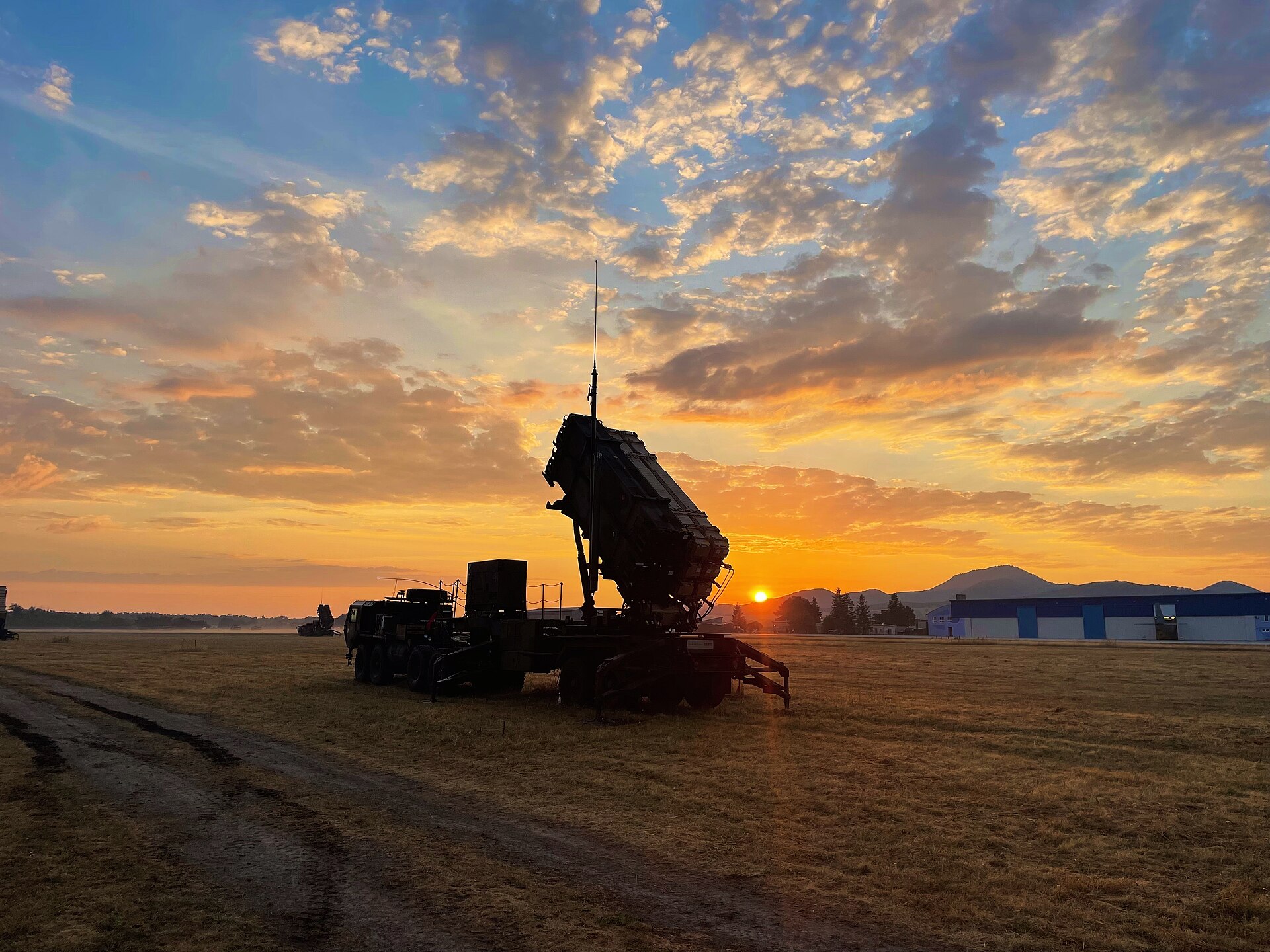
Saudi Arabia retains approximately four hundred PAC-3 MSE interceptors — fourteen per cent of a pre-war stockpile of roughly 2,800. At documented depletion rates, and with no new deliveries confirmed before mid-2027 at the earliest, that number represents the margin between functional integrated air and missile defence and a system that can be exhausted by a sustained Iranian missile campaign. The State Department approved a $9 billion Foreign Military Sale of 730 PAC-3 MSE rounds on January 30, 2026; nine months later, congressional approval has not followed. Lockheed Martin’s production expansion target of 2,000 rounds per year remains contingent on FY2026 appropriations that have not been secured. A broader $24.3 billion arms package including the F-35 has been met with congressional silence stretching past eleven days as of MBS’s address.
Prince Sultan Air Base, the largest US military facility in Saudi Arabia, has been functionally locked down since Saudi Arabia’s Operation Project Freedom grounded forty-three American warplanes in May. The base that was designed to anchor Gulf deterrence is not generating sorties, and the bilateral defence agreement that governs the US-Saudi military relationship has not produced a mechanism to reverse that status.
The Arab Center’s “diversification without substitution” formulation applies here with uncomfortable precision. Turkey operates within a NATO procurement and sustainment framework dependent on American and European supply chains. Pakistan operates F-16s under US Foreign Military Financing constraints that attach end-use monitoring to every deployment. Neither partner manufactures PAC-3 interceptors — only Lockheed Martin does — and neither can supply the munitions Saudi Arabia is running out of.
The Makkah Pact adds a layer of political commitment to Riyadh’s alliance portfolio, but the capability base underneath remains, in almost every technical dimension that matters for the current war, American-supplied, American-maintained, and American-constrained.
The Fiscal Bind
The doctrine MBS announced at the Shura Council arrives at a moment when Saudi Arabia’s capacity to fund any security architecture — American, Makkah Pact, or sovereign — is under greater strain than at any point since the 2020 oil price war that forced the tripling of VAT and the suspension of cost-of-living allowances.
Saudi real GDP contracted 4.8 per cent year-on-year in the second quarter of 2026, driven by Hormuz disruption to oil exports, voluntary OPEC+ production cuts, and the collapse of non-oil investment confidence that followed the onset of the Iran-US air campaign in July. Goldman Sachs projects the 2026 fiscal deficit at six to 6.6 per cent of GDP — nearly double the official budget plan of 165 billion Saudi riyals, approximately $44 billion. Brent crude closed October 1 at roughly $96.76 per barrel, up fifty-one per cent year-on-year, but the price that supports revenue also reflects the supply disruption that is destroying the export volume revenue depends on — a feedback loop that Goldman has warned could push Brent above $120 on an extended Hormuz closure, a level at which demand destruction in key Asian markets would offset the per-barrel gain.
NEOM and the Mukaab — the flagship mega-projects of Vision 2030 — have already been defunded. The fiscal space that was earmarked for Saudi Arabia’s post-oil economic transition is being consumed by wartime expenditure, and the Makkah Pact adds a new category of cost that did not exist before August 7: standing up a permanent secretariat, building integrated command-and-control, financing joint training cycles, developing the interoperable logistics chains that any tri-national alliance requires to operate above the level of communiqué. None of these costs have been publicly estimated, but all compete for the same funds as the $9 billion PAC-3 replenishment sale and the maintenance of a military that is burning through materiel faster than any Gulf state has since 1991.
MBS is doctrinising a new security framework at the precise moment the state’s capacity to fund the existing one is under documented strain. The Shura Council heard a leader who sounded certain. The balance sheet of the state he leads is not.
Frequently Asked Questions
Has Saudi Arabia formally invoked the Makkah Pact’s mutual defence clause?
No. As of October 1, 2026, Riyadh has not triggered the collective defence provision despite sustaining multiple attacks on military installations and energy infrastructure since the pact’s August 7 signing. No public protocol for activation has been disclosed, and neither the treaty text nor any subsequent communiqué has defined the specific conditions or procedures under which the Article 5-equivalent clause would be formally invoked. This distinguishes the Makkah Pact from NATO, where the North Atlantic Council’s unanimous determination process was codified from inception and was tested operationally within hours of the September 11, 2001 attacks.
Does Pakistan’s nuclear arsenal extend to Makkah Pact partners?
No. Pakistan maintains approximately three hundred nuclear warheads under a Credible Minimum Deterrence posture designed exclusively for deterrence of India. The CSIS Nuclear Network and a 2026 Bahria University policy brief by Sara Kazim both confirm that Islamabad has consistently rejected extended nuclear deterrence on the grounds that broadening the umbrella would require a larger arsenal, a different delivery architecture, and a strategic doctrine incompatible with the restraint-based framework governing Pakistan’s nuclear programme. No provision in the Makkah Pact references nuclear deterrence or nuclear sharing.
What is the Baykar-SAMI Akinci co-production programme?
An agreement between Turkey’s Baykar and Saudi Arabian Military Industries for co-production of the Akinci TB3 armed UCAV with up to seventy per cent local manufacturing in Saudi Arabia. The Akinci has a twenty-metre wingspan, an operational ceiling above forty thousand feet, endurance exceeding twenty-four hours, and a payload capacity of up to 1,350 kilograms including SOM-J cruise missiles and MAM-L precision munitions. First locally assembled units are expected before the end of 2026, making it the fastest defence-industrial output of the Turkish-Saudi partnership — though it addresses ISR and precision strike rather than integrated air and missile defence.
How does the Makkah Pact compare structurally to NATO?
Both contain an Article 5-equivalent collective defence clause, and the comparison stops there. NATO maintains a permanent integrated military command (SHAPE/Allied Command Operations) with approximately 6,800 staff, standardised interoperability requirements through STANAGs, a nuclear sharing arrangement covering five European host nations, a common-funded infrastructure budget exceeding three billion euros annually, and seventy-seven years of continuous joint exercise history. NATO took four years from the 1949 Washington Treaty to establish its first permanent integrated command structure; the Makkah Pact has not begun that process fifty-five days after signature.
Could other countries join the Makkah Pact?
No published accession protocol exists. Regional outlets including Eesanje reported that Iran was sounded out about joining — an outreach that, if confirmed, would recharacterise the pact from a defensive military alliance into a regional security dialogue framework. No GCC member state has acceded separately, and the pact runs parallel to the GCC’s Peninsula Shield Force rather than incorporating or replacing it, raising unresolved questions about institutional overlap that the announced-but-unestablished Riyadh secretariat has not addressed.