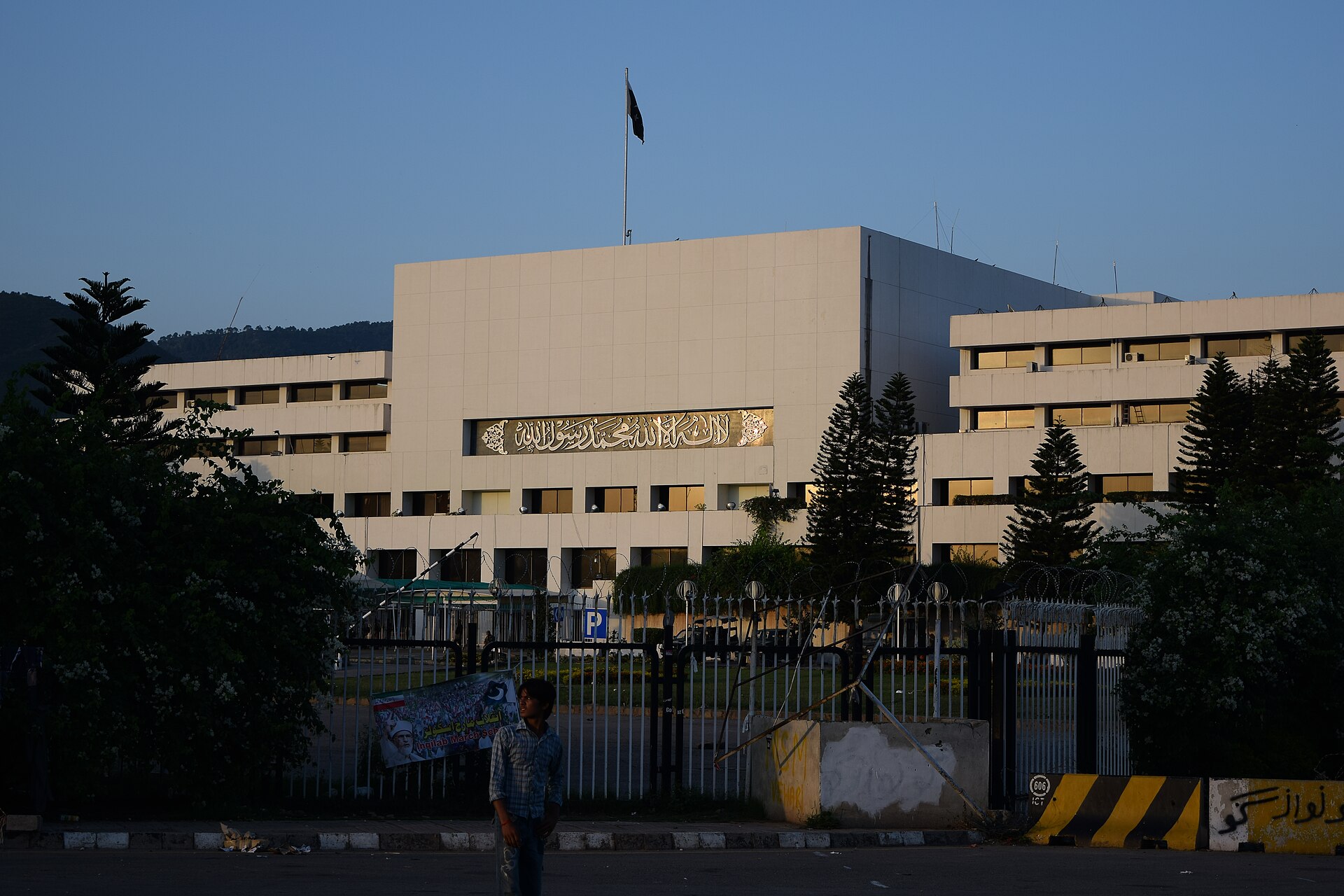
ISLAMABAD — The United States is sending Jared Kushner — a man who collects $25 million a year in management fees from Saudi Arabia’s sovereign wealth fund — to negotiate a deal with Iran whose most likely outcome, sanctions relief, would flood global markets with Iranian crude and crater the oil revenues of the very government that pays him. Washington announced on April 24 that Kushner and special envoy Steve Witkoff will fly to Islamabad on April 26 for direct talks with Iranian counterparts, while Vice President JD Vance, the man Iran actually asked for, stays home “on standby.”
The personnel swap tells you more about American negotiating intentions than any policy document could. Vance walked out of 21-hour talks on April 11 demanding Iran make “an affirmative commitment that they will not seek a nuclear weapon” — a position so maximalist it guaranteed collapse, but at least it was a position. Kushner arrives with no stated red lines, a $2 billion financial dependency on Mohammed bin Salman that comes up for renegotiation in August, and a reputation among Iranian negotiators as someone who represents “Israel’s interests rather than America’s.” The question is not whether he can broker peace. The question is whose peace he is brokering.
Table of Contents
- The Personnel Swap: From Coercion to Transaction
- Why Did Iran Ask for Vance Instead of Kushner?
- The $137 Million Problem
- Saudi Arabia’s Invisible Hand
- What Does Iran’s Written Roadmap Actually Say?
- The Authorization Ceiling Hasn’t Moved
- Can Kushner Deliver What Iran Needs Without Destroying What Pays Him?
- The May 1 Clock
- Key Financial and Diplomatic Data
- Frequently Asked Questions
The Personnel Swap: From Coercion to Transaction
On April 11, the Islamabad round lasted 21 hours before it collapsed. The American delegation numbered roughly 300 people, led by Vance alongside Witkoff and Kushner; Iran brought 70, led by Parliament Speaker Mohammad Bagher Ghalibaf — himself an IRGC Aerospace Force commander from 1997 to 2000 — with Foreign Minister Abbas Araghchi working the diplomatic perimeter. They agreed on ceasefire framework points. They could not agree on Hormuz or the nuclear programme. Vance walked out, and within hours CENTCOM announced a naval blockade targeting Iranian ports and toll-collecting vessels.
That was the coercive register: deadlines, strike-target naming, the explicit threat of kinetic escalation. Vance’s language was the language of a Marine veteran who had read enough intelligence briefs to know that Iran’s 440.9 kilograms of uranium enriched to 60 percent sat roughly 25 days from weapons-grade conversion via IR-6 cascade, and who believed the only pressure worth exerting was the kind that frightened people. The Institute for the Study of War confirmed what everyone in the room already sensed — that IRGC commander Ali Akbar Ahmadian Vahidi was blocking any deal while Ghalibaf pushed for one, the same authorization ceiling that has paralysed Iranian decision-making since the Supreme Leader disappeared from public view more than 50 days ago.
Now the register shifts. Kushner’s negotiating style, honed during the Abraham Accords and a decade of New York real estate, operates on relationships, side-channel assurances, and the kind of transactional flexibility that treats every commitment as a term sheet rather than a treaty. Aaron David Miller, a former State Department Middle East negotiator who has watched every American envoy since Kissinger try to crack the region, gave Kushner and Witkoff a grade of “F in diplomacy” in TIME magazine on April 15 — and called Vance, the man being benched, “the adult in the room.”
The swap mirrors pressure that has been building since Saudi Arabia formally lobbied Washington on approximately April 14 to lift the Hormuz blockade, warning through Arab officials that the blockade risked pushing Iran into Red Sea and Bab el-Mandeb escalation. Riyadh wanted a negotiator who would cut a deal, not a prosecutor building a case. It got one — the same negotiator it has been paying $25 million a year since 2021.
The Middle East briefing 3,000+ readers start their day with.
One email. Every weekday morning. Free.
Why Did Iran Ask for Vance Instead of Kushner?
Iran has repeatedly and specifically requested that Vance lead the American delegation, citing his Marine veteran background and his documented scepticism about foreign military entanglements — a scepticism Tehran reads as a structural constraint on American escalation rather than a negotiating tactic. Pakistani security officials told Al Majalla that Iranian negotiators at the April 11 round “were able to build a rapport with Vance” but “sensed his hands were tied in the presence of Kushner and Witkoff.” The White House dismissed Iran’s preference as “coordinated foreign propaganda,” which is one way to describe a negotiating counterpart telling you which interlocutor they find credible.
The Iranian logic is not complicated. Vance’s maximalism on enrichment — zero tolerance, affirmative commitment, no ambiguity — is paradoxically easier for Tehran to negotiate against than Kushner’s transactional opacity, because maximalism at least defines the parameters of disagreement. You know what the man across the table wants. With Kushner, Iran’s negotiators have concluded they are dealing with someone who is “not participating in discussions in good faith” and whose presence constitutes “a front by the Trump administration to trick Iran,” according to assessments compiled by the Daily Beast and Al Majalla from diplomatic sources close to the Iranian delegation. Whether that assessment is accurate matters less than the fact that Iran’s lead negotiators believe it, because people do not make concessions to interlocutors they believe are performing rather than negotiating.
Al Majalla’s reporting landed a more specific charge: that Kushner and Witkoff had “earned a reputation in the president’s second term as representing Israel’s interests rather than America’s.” Iran’s IRGC-affiliated media apparatus — Tasnim, Fars, Mehr — has amplified this framing, but the assessment originates not from propaganda outlets but from Pakistani intermediaries and Gulf diplomatic channels with direct access to both delegations. An unnamed diplomatic source told the Daily Beast that with the Kushner-Witkoff team leading, “there’s no chance” — a verdict delivered not by an Iranian hardliner but by someone close enough to the process to watch it fail in real time.
The $137 Million Problem
In December 2021, six months after Jared Kushner left the White House, Saudi Arabia’s Public Investment Fund committed $2 billion as the anchor investor in his new firm, Affinity Partners. The New York Times and the Senate Finance Committee subsequently established that PIF’s own senior screening officials had concluded Affinity’s operations were “unsatisfactory in all aspects” — a finding overridden personally by Mohammed bin Salman, who directed the investment over internal objections. By December 2024, Affinity had collected $87.5 million in management fees from Saudi PIF alone, at a preferential rate of 1.25 percent annually against the standard 2 percent charged to other investors. Senator Ron Wyden’s Finance Committee projects total PIF management fees to Kushner will reach $137 million by August 2026 — the month PIF can renegotiate or withdraw its commitment entirely.
Congressman Jamie Raskin wrote directly to Kushner on April 16, ten days before the Islamabad trip: “Your decision to act in these two roles — one public for the government and one private for personal profit — creates a glaring and incurable conflict of interest.” Wyden, three weeks earlier, was blunter: “The guy is literally on the payroll of the Saudi government and trying to take even more.” Kushner’s own response to conflict-of-interest questions, delivered to Axios in February 2024, was a single sentence that will follow him into every negotiating room he enters: “I’m an investor now. I served in government, and I think my track record is pretty impeccable.”
The arithmetic of that track record deserves examination. Affinity Partners draws 99 percent of its assets under management from foreign sovereign wealth funds — primarily Saudi Arabia, the UAE, and Qatar. As of July 2024, the fund had generated zero return on investment for any of these clients. It charges below-market fees to its largest backer. And its largest backer can pull the money in four months. Kushner is not merely negotiating on behalf of the United States in Islamabad; he is negotiating in front of his landlord, while the rent comes due.
The structural conflict is not hypothetical. Any sanctions-relief deal for Iran — the single concession Tehran has identified as non-negotiable — would release Iranian crude onto global markets, depressing oil prices and directly harming the revenues of Saudi Arabia, the UAE, and Qatar, which together constitute virtually all of Affinity’s capital base. Kushner’s financial survival as a fund manager depends, in the most literal sense, on not delivering the thing Iran needs most. This does not mean he will sabotage negotiations. It means the negotiations arrive pre-sabotaged by the identity of the negotiator.
Saudi Arabia’s Invisible Hand
Saudi Arabia is not at the table in Islamabad — it has been explicitly excluded from the bilateral format — but its preferences saturate every dimension of the talks. On approximately April 14, Saudi officials pressed Washington directly to end the Hormuz blockade, warning that continued naval interdiction could trigger Iranian escalation into the Red Sea and Bab el-Mandeb, threatening shipping lanes that carry what remains of Saudi Arabia’s non-Hormuz export capacity. The Wall Street Journal reported Arab officials conveyed the message personally. Vali Nasr at Johns Hopkins SAIS framed Saudi concerns as reflecting “a broader international concern that the U.S. blockade is a dangerous escalation” that “could bring the global economy to a halt.”
Riyadh’s urgency is arithmetical. Saudi March production fell to 7.25 million barrels per day according to the IEA — down from 10.4 million in February, a 30 percent collapse representing the largest single-month disruption the agency has ever recorded. The East-West Pipeline bypass through Yanbu loads at a ceiling of 4 to 5.9 million bpd against a theoretical pipeline capacity of 7 million, and the Khurais field’s 300,000 bpd remains offline with no restoration timeline. Every week the blockade continues, Saudi Arabia bleeds revenue it cannot replace through alternative export routes. Goldman Sachs estimates the war-adjusted fiscal deficit at 6.6 percent of GDP — double the official 3.3 percent projection — and the kingdom’s fiscal break-even requires Brent at $108 to $111 per barrel, while the benchmark sat at $104.63 on April 24.
Into this fiscal emergency, Saudi Arabia has simultaneously deepened its financial architecture with both the Trump family and the Pakistani state that hosts the talks. PIF is financing a $7 billion development with the Trump Organization in Diriyah — a Trump-branded hotel, golf course, and 500 mansions priced between $6.7 million and $24 million — creating a parallel financial dependency that mirrors the Kushner-Affinity relationship. Pakistan, the nominal mediator, carries its own Saudi financial obligations: a $5 billion Saudi loan matures in June 2026, two months after these talks, giving Riyadh structural influence over the host country’s willingness to push for outcomes Saudi Arabia dislikes.
The result is a negotiating environment in which the American lead negotiator, the American president’s family business, and the host country’s treasury all have direct financial dependencies on Saudi Arabia — while Saudi Arabia itself remains formally absent from the room. White House Press Secretary Karoline Leavitt announced on April 24 that “we’ve certainly seen some progress from the Iranian side in the last couple of days,” language calibrated to suggest momentum. But progress toward what, and for whom, depends entirely on which financial relationships you trace.

What Does Iran’s Written Roadmap Actually Say?
Araghchi arrived in Islamabad carrying a document that exists in two versions, and the gap between them contains the entire negotiation. Al Jazeera reported on April 25 that Iran’s written roadmap, presented to Pakistan as intermediary, omits any reference to enrichment rights in its English-language text — the version Washington would see. The Farsi version, approved by Iranian leadership (meaning the Supreme National Security Council apparatus that Vahidi dominates), retains enrichment as a condition. This is not a translation error. It is a negotiating architecture designed to give Araghchi room to explore without giving Vahidi grounds for immediate repudiation.
The 10-point plan’s known demands include continued Iranian control over Hormuz, the lifting of all primary and secondary sanctions, and limitations on some regional proxy support — with missile capabilities explicitly excluded from compromise. At the April 11 round, Iran showed willingness to relocate enriched uranium to Turkey and to lift Hormuz transit fees if sanctions were removed. But these concessions came from the Araghchi-Ghalibaf track, the one that Vahidi has systematically undermined since President Masoud Pezeshkian publicly accused Vahidi and IRGC Khatam al-Anbiya commander Abdollahi on April 4 of wrecking the ceasefire mandate — a confession of presidential impotence that has no precedent in the Islamic Republic’s history.
Araghchi’s three-stop tour — Islamabad, then Muscat, then Moscow — reveals the structural fragility of any roadmap that depends on a single diplomatic channel. He is pursuing the Pakistan backchannel, the Omani diplomatic track, and Russian political cover simultaneously, hedging against the failure of each by maintaining all three. Iran’s Foreign Ministry spokesperson Esmaeil Baqaei simultaneously denied any direct meeting with US envoys was planned, telling IRNA that “Iran’s observations would be conveyed to Pakistan” rather than delivered face-to-face. Tasnim, the IRGC-affiliated agency, echoed the denial — meaning the civilian foreign ministry and the military intelligence apparatus are, for once, synchronised in rejecting the premise of direct Kushner contact while Araghchi positions the roadmap through intermediaries.
The dual-text strategy is clever but brittle. It survives exactly as long as no American negotiator with Farsi-competent staff asks to see the original, and exactly as long as Vahidi’s SNSC apparatus does not leak the Farsi version to collapse Araghchi’s flexibility — which is precisely the kind of sabotage the IRGC commander has executed at every prior inflection point in these talks.
The Authorization Ceiling Hasn’t Moved
Nothing about the personnel swap on the American side addresses the fundamental structural problem on the Iranian side: no one at the table in Islamabad has the authority to make binding commitments. The authorization ceiling — the gap between what Iranian negotiators can discuss and what the IRGC-SNSC apparatus will ratify — remains exactly where it was on April 11, when ISW confirmed that Vahidi was actively blocking agreement while Ghalibaf pushed for it. Pezeshkian’s April 4 accusation, naming Vahidi and Abdollahi by name as ceasefire wreckers, established under Article 110 of Iran’s constitution that the elected president has zero authority over IRGC operations. Supreme Leader Khamenei, the only figure who can override the IRGC commander, has been absent from public view for more than 50 days, with his son Mojtaba communicating only by audio.
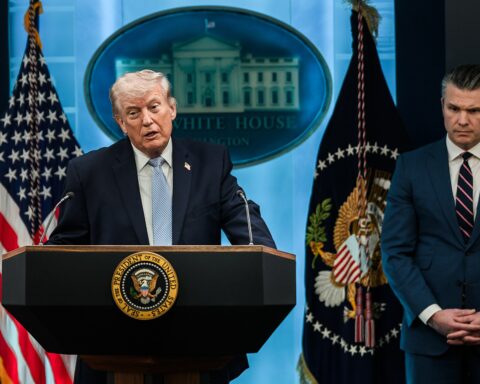
The US simultaneously demonstrated on April 25 that it understands this problem and has no intention of solving it diplomatically. While confirming Kushner’s travel to Islamabad, Washington named Vahidi as a strike target — the same man whose authorisation any deal requires, now formally designated as someone the US reserves the right to kill. Defense Secretary Pete Hegseth’s framing was carefully ambiguous: “Iran knows that they still have an open window to choose wisely … at the negotiating table.” The “open window” language simultaneously offers diplomacy and threatens its closure by force, maintaining the coercive register on the military track even as the diplomatic register shifts from Vance’s prosecutorial maximalism to Kushner’s transactional flexibility.
This dual-track approach — negotiate with one hand, designate strike targets with the other — is not incoherent if you understand it as pressure designed to fracture the Iranian command structure rather than persuade it. But fracturing a command structure requires the fractured elements to have somewhere to fall, and Kushner has not articulated, publicly or through intermediary channels, what concessions the US would offer to an Iranian negotiator willing to break with Vahidi’s blocking position. Vance at least named his price: an affirmative nuclear commitment. Kushner arrives with a transactional register that implies everything is negotiable, which in practice means nothing is committed.
Can Kushner Deliver What Iran Needs Without Destroying What Pays Him?
The Vance-Kushner internal policy split, reported by the Daily Beast, illustrates where the negotiation actually stands. Vance held a zero-enrichment position — Iran cannot enrich, period — a demand so absolute it functioned as a negotiating ceiling rather than an opening bid. Kushner and Witkoff floated an alternative: the US supplies uranium for civilian use, Iran cannot enrich to weapons-grade. Iran rejected this, but the proposal at least gestured toward a structured compromise that could thread the needle between Iranian enrichment demands and American non-proliferation commitments. The problem is that even this more flexible framework requires sanctions relief as the Iranian side of the bargain, and sanctions relief is the one outcome Kushner’s financial position cannot survive delivering.
The Trump Organization’s $7 billion Diriyah development with PIF — already established — adds a second layer of financial entanglement that makes independent American dealmaking functionally impossible. The president’s family business and his lead negotiator’s investment fund both depend on continued Saudi financial favour, in real time, in the same region, with the same counterparties. No recusal, blind trust, or ethical firewall changes that arithmetic — the conflict is baked into the identity of the negotiator himself.
The May 1 Clock
The domestic calendar compresses everything. President Trump notified Congress on March 2 under the War Powers Resolution; the 60-day clock expires on May 1, six days after the Islamabad talks begin. On April 23, the Senate defeated a war powers resolution for the fifth time, 46–51, with only Rand Paul crossing party lines — a margin comfortable enough to sustain military operations but narrow enough to suggest erosion. The next vote, if it comes, will happen in the shadow of whatever Kushner produces or fails to produce in Islamabad, and a visible diplomatic failure would give wavering Republicans cover to defect.
May 1 does not automatically end military operations — the resolution requires congressional action to force withdrawal, not merely the expiration of a notification period — but it transforms the legal and political terrain. Every military action after May 1 without fresh congressional authorization becomes a litigation target, and every senator who voted to sustain operations becomes personally invested in demonstrating that diplomacy was given genuine opportunity. Kushner’s talks in Islamabad are, in this framing, less a negotiation than a performance of negotiation — proof that the administration exhausted diplomatic options before the legal window shifted.
The ceasefire from the prior round nominally expired on April 22, three days before Kushner’s travel was announced. Indonesia’s 221,000 Hajj pilgrims began departing on the same date. The Hormuz mine threat persists, with the US Navy’s four Avenger-class mine countermeasure ships decommissioned from Bahrain in September 2025 and an estimated 51 days required to clear the strait based on 1991 Kuwait benchmarks — a figure the Pentagon briefed to Congress but that Hegseth publicly called an “impossibility” before declining to offer any alternative, as analyzed here. Brent moved from $104.63 to $106.01 overnight on April 24-25 when Leavitt used “progress” language — a $1.38 move on a single word from a press secretary, which tells you how thin the market’s confidence in these talks actually is.
Key Financial and Diplomatic Data
| Metric | Figure | Source |
|---|---|---|
| Saudi PIF commitment to Affinity Partners | $2 billion | NYT / Senate Finance Committee |
| Management fees collected from PIF (Jun 2021–Dec 2024) | $87.5 million | Senate Finance Committee |
| Projected total PIF fees to Kushner by Aug 2026 | $137 million | Sen. Wyden investigation |
| PIF renegotiation window | August 2026 | Popular.info / Wyden docs |
| Affinity AUM from foreign sovereign wealth funds | 99% | Senate Finance Committee |
| Affinity return on investment (as of Jul 2024) | Zero | Senate Finance Committee |
| Trump Organization–PIF Diriyah development | $7 billion | Popular.info |
| April 11 Islamabad round duration | 21 hours | NBC News / Al Jazeera |
| US vs Iran delegation size (April 11) | 300 vs 70 | NBC News |
| Saudi March 2026 production | 7.25M bpd | IEA |
| Saudi fiscal break-even (Brent) | $108–111/bbl | Bloomberg (PIF-inclusive) |
| War Powers Resolution 60-day deadline | May 1, 2026 | Congressional notification |
| Senate war powers vote (April 23) | 46–51 (defeated) | The Hill |
| Iran HEU stockpile at 60% enrichment | 440.9 kg | IAEA (last access pre-Feb 28) |
“Your decision to act in these two roles — one public for the government and one private for personal profit — creates a glaring and incurable conflict of interest.”
— Rep. Jamie Raskin, letter to Jared Kushner, April 16, 2026
“I’m an investor now. I served in government, and I think my track record is pretty impeccable.”
— Jared Kushner, Axios, February 2024

What Happens in Islamabad This Weekend
Witkoff and Kushner arrive on April 26 into a negotiating environment pre-structured to produce ambiguity rather than agreement. Araghchi has handed Pakistan a written roadmap whose two versions — English without enrichment, Farsi with it — guarantee that any “progress” announced by either side can be simultaneously real and fictitious depending on which text you read. Iran’s Foreign Ministry has denied any direct meeting is planned while positioning Araghchi to be in the same city as the American delegation, a diplomatic posture that allows proximity without commitment and contact without accountability.
The most likely outcome is what diplomats call a “framework for continued engagement” — language that allows all parties to claim momentum without making concessions, that lets Trump point to diplomatic activity ahead of the May 1 war powers date, that gives Saudi Arabia evidence Washington is listening to its blockade concerns, and that preserves Iran’s dual-text ambiguity on enrichment until Vahidi or Khamenei (or Khamenei’s absence) resolves the authorization ceiling from Tehran. Nothing in Kushner’s negotiating history, financial incentive structure, or stated policy positions suggests he will push for the sanctions relief Iran requires, and nothing in Iran’s command fragmentation suggests anyone at the table can deliver what the US demands on enrichment even if Kushner were willing to pay the price.
Pakistan’s role has quietly shifted from venue to something closer to co-guarantor, a transformation that accelerated after army chief General Munir visited Khatam al-Anbiya headquarters on April 16 — Abdollahi’s command, the same apparatus Pezeshkian accused of wrecking the ceasefire. The $5 billion Saudi loan maturing in June gives Riyadh structural hold over Islamabad’s willingness to pressure Iran on terms unfavourable to Saudi interests, while Pakistan’s 27th Constitutional Amendment has concentrated foreign policy authority in the military establishment rather than the elected government. The mediator, in other words, is not neutral — it is financially captured by one interested party and institutionally aligned with the military apparatus of another.
Two numbers will determine whether this weekend produces anything beyond photographs and communiqués. The first is $137 million — the projected management fees Kushner stands to collect from Saudi PIF by August, the month his anchor investor can walk away. The second is 440.9 kilograms — Iran’s stockpile of 60-percent-enriched uranium, sitting roughly 25 days from weapons-grade conversion, which Vance demanded Iran relinquish and which Kushner has not mentioned once in any public statement since his appointment. One number represents what the negotiator wants to protect. The other represents what the negotiation is supposed to resolve. They pull in opposite directions, and no amount of transactional flexibility can make them converge.
Frequently Asked Questions
Why was Vance removed from the Islamabad negotiating team?
The White House has not formally described it as a removal — Vance is “on standby” — but the effect is the same. The shift followed Saudi Arabia’s April 14 lobbying campaign to end the Hormuz blockade, which Vance’s coercive approach had produced. Internally, Vance and Kushner represent a genuine policy split: Vance holds a zero-enrichment position rooted in non-proliferation orthodoxy, while Kushner and Witkoff have explored structured compromises including US-supplied civilian uranium. The April 23 Senate war powers vote — defeated 46–51, with the administration holding 51 against — may also have reduced the perceived urgency of demonstrating hawkish resolve through Vance’s presence.
What is the Affinity Partners preferential fee structure?
Affinity charges Saudi PIF an annual management fee of 1.25 percent on its $2 billion commitment, compared to approximately 2 percent for other investors — a preferential rate that costs Kushner roughly $15 million per year in foregone revenue but secures PIF’s anchor position. The below-market rate was part of the original commitment terms negotiated in late 2021. Private equity industry standard for a fund of Affinity’s size and track record (zero returns as of July 2024) would typically command a 2-and-20 structure — 2 percent management fee plus 20 percent of profits. With no profits to share, the management fee represents Affinity’s entire revenue stream from its largest client, making the August 2026 renegotiation window an existential event for the fund’s economics.
How does the dual-language roadmap work in practice?
Araghchi’s team prepared an English-language 10-point plan that omits enrichment rights and a Farsi version approved by Iran’s Supreme National Security Council that retains enrichment as a condition. In practice, this allows Araghchi to explore ceasefire terms with the US delegation (through Pakistani intermediaries) without triggering immediate IRGC repudiation — because the Farsi version Vahidi’s apparatus approved includes their red lines. The risk is bilateral: if American Farsi-competent analysts surface the discrepancy, it destroys Araghchi’s credibility as a negotiating partner; if IRGC-aligned media leaks the English version domestically, it gives Vahidi grounds to accuse Araghchi of exceeding his mandate, replicating the Zolghadr report dynamic that collapsed the April 11 round. Similar dual-text strategies were employed during the 2015 JCPOA negotiations, where Zarif maintained separate Persian and English talking points — but that process had five years of back-channel development and the direct involvement of Secretary Kerry, conditions absent here.
What happens if negotiations fail before May 1?
A diplomatic failure before the May 1 War Powers deadline would transform the legal and political terrain for continued military operations. While the 60-day notification period does not automatically terminate military authority — Congress must act affirmatively to force withdrawal — failure in Islamabad would give wavering Republican senators cover to support a war powers resolution that has been defeated five times but by shrinking margins (the April 23 vote was 46–51, with Rand Paul the only Republican crossover). More immediately, the blockade’s economic damage compounds daily: the FDD estimates $435 million per day in losses to Iran, but Saudi Arabia’s own export disruption — March production down 30 percent to 7.25 million bpd, Asian exports down 38.6 percent — creates a parallel Saudi urgency to resolve the blockade regardless of Iran’s nuclear posture. A failed round would likely accelerate Saudi Arabia’s parallel diplomatic track through Araghchi’s Muscat and Moscow stops, potentially marginalising the US from a settlement framework it currently controls.
Does Kushner have legal authority to negotiate on behalf of the US government?
Kushner holds no formal government position, confirmed diplomatic title, or Senate-confirmed role. His participation is structured through his relationship with Trump and informal designation alongside special envoy Witkoff, who does hold a formal appointment. The Logan Act (18 U.S.C. § 953) theoretically prohibits private citizens from conducting unauthorised diplomatic negotiations, but the Act has produced only two indictments in its 227-year history and zero convictions, making it effectively unenforceable. Kushner’s legal exposure is more plausible under federal conflict-of-interest statutes (18 U.S.C. § 208), which prohibit government employees from participating in matters affecting their financial interests — but his status as a non-employee may paradoxically shield him from the very regulations designed to prevent the conflict his position creates. The Government Accountability Office has not issued a formal opinion on Kushner’s dual role, despite requests from both Raskin and Wyden.
Iran’s formal refusal to hold direct talks with the American delegation — announced even as Araghchi remained in the same building complex in Islamabad — is reported in Iran Refuses Direct US Talks in Islamabad While Sitting in the Next Room.