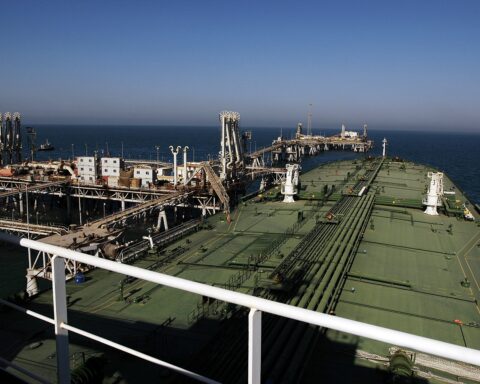
DHAHRAN — OPEC+ is set to approve a fifth consecutive monthly output hike on July 5, adding approximately 188,000 barrels per day to a global market the International Energy Agency projects will carry a 3.84-million-barrel-per-day surplus through 2026, compounding a fiscal crisis that has already pushed Saudi Aramco’s free cash flow below its dividend obligation for the first time on record.
The arithmetic behind the decision is brutal for Riyadh. Aramco’s Q1 2026 free cash flow of $18.6 billion fell short of its $21.89 billion quarterly dividend by 15 percent — a coverage ratio of 0.85x that forced the company to draw down reserves to $53.3 billion, the lowest level since the end of 2018. Simultaneously, Arab Light’s Official Selling Price has collapsed $10 per barrel from its May 2026 peak of $19.50, costing approximately $900 million per month in forgone revenue at a 5-million-barrel-per-day export rate, while China’s Sinopec has made zero Saudi crude purchases for two consecutive months.
The hike itself is not a surprise — three Reuters delegate sources confirmed the 188,000 bpd baseline on July 1. What makes the July 5 vote significant is its context: it arrives while every variable in Saudi Arabia’s fiscal equation is deteriorating simultaneously, and while the precedent for a larger-than-expected increment remains live. OPEC+ approved 411,000 bpd in July 2025 (triple the expected 137,000) and 548,000 bpd in August 2025. The group “seriously considered” a similar doubling before settling on 188,000 bpd for the June and July 2026 decisions, according to Argus Media.
The House of Saud Daily Briefing
Saudi Arabia's news in 3 minutes, every morning. Free. See today's issue
Table of Contents
What the July 5 Vote Decides
Three unnamed Reuters delegate sources confirmed on July 1, 2026, that OPEC+ would approve approximately 188,000 barrels per day for August production — the fifth consecutive monthly increment since the group began unwinding its 2022-era voluntary cuts in April. The 188,000 bpd figure represents what sources described as the pre-meeting baseline, not a ceiling.
Argus Media reported that OPEC+ “seriously considered” doubling the increment to approximately 411,000 bpd before both the June and July decisions, settling on the smaller figure each time. The precedent for a surprise acceleration is recent and documented: the July 5, 2025, meeting approved 411,000 bpd — triple the expected 137,000 — while the August 2025 meeting pushed further to 548,000 bpd. Markets have learned that OPEC+ pre-meeting signals often understate the final outcome.
Whether the group approves 188,000 or something larger on July 5, the directional signal is identical: Saudi Arabia has committed to a volume-recovery strategy in a market where the price consequences are already materializing. Brent crude traded at approximately $69-71 per barrel on July 3-4, down from $126 on April 30 and approximately $100 in May — a collapse of 45 percent in ten weeks that has outpaced any reasonable revenue-recovery timeline from incremental volume.
The Cumulative Hike Math
OPEC+ began unwinding its 2022-era voluntary cuts in April 2026. The cumulative volume restored across four completed 188,000 bpd monthly hikes now approaches 940,000 bpd — a figure that reflects earlier rounds carried into the current sequence — entering a market the IEA projects will carry a 3.84-million-barrel-per-day surplus through the year. The fifth hike pushes the total above 1.1 million bpd: volume that enters a buyer’s market where every additional barrel competes for demand that is not growing fast enough to absorb it.
The strategic logic behind the hikes has always rested on two pillars: punishing quota cheaters (Iraq at 62 percent compliance, Kazakhstan at 55 percent) and signaling that Saudi Arabia will not sacrifice market share indefinitely to prop up a price floor that free-riders exploit. The UAE’s formal OPEC exit on May 1, 2026 — ending 59 years of membership and uncapping ADNOC’s 4.85-million-barrel-per-day capacity — removed the group’s second-largest conventional producer from any coordination framework, making enforcement even more hollow.
But the punishment strategy carries its own cost. Each 188,000 bpd hike into a surplus market does not generate proportional revenue because the price impact of the additional volume offsets the volume gain itself. At $69 Brent — roughly $19 below Saudi Arabia’s most conservative fiscal breakeven of $80-85 per barrel (IMF/Oxford Economics) and $27 below Bloomberg Economics’ $96 estimate — more barrels at lower margins do not close a deficit that is widening on both the price and volume axes simultaneously.
Can Aramco Afford Another Hike at $69 Brent?
Aramco’s Q1 2026 results delivered an answer the company’s dividend architecture was not designed to withstand. Free cash flow of $18.6 billion fell short of the $21.89 billion quarterly dividend obligation — a coverage ratio of 0.85x that marked the first quarter on record in which Aramco could not fund its payout from operations. Operating cash flow fell 3.2 percent year-over-year to $30.7 billion, according to the company’s official quarterly filing.
The June 9 dividend payment drew Aramco’s cash reserves down to approximately $53.3 billion — the lowest since the end of 2018, according to company disclosures. Annualizing Q1’s free cash flow gives approximately $74.4 billion against a full-year dividend obligation of $87.6 billion ($21.89 billion times four), implying a structural shortfall of roughly $13 billion annually at Q1 conditions. Those conditions have since deteriorated: the Arab Light OSP has fallen a further $6 per barrel since Q1 closed, and Brent has dropped from approximately $73 at the end of March to $69 in early July.
The fiscal arithmetic works only if either prices recover or the dividend is cut. The $87.6 billion annual payout was calibrated when Brent traded above $85. At $69, with the OSP premium now compressed to $9.50 over Oman/Dubai (down from $19.50 at the May peak), cash-flow generation cannot sustain the commitment without depleting reserves at an accelerating rate. The $53.3 billion cash floor provides roughly six quarters of buffer at the current $3.3 billion quarterly shortfall — less if conditions deteriorate further, which the July hike makes more probable.
The war premium’s collapse — Brent returning to pre-war $70 levels by July 2 — has since accelerated the arithmetic, removing the price floor the dividend model implicitly assumed would return as Hormuz reopened. The August OSP discount confirmed the fiscal compression: Aramco is now selling below benchmark for the first time since 2020, adding $1.65 billion per month in revenue loss to the OPEC+ production math.
Why Sinopec Stopped Buying Saudi Crude
China’s Sinopec — Saudi Arabia’s single largest customer by volume for the better part of a decade — made zero Saudi crude purchases for July 2026, the second consecutive month of zero offtake. The walkaway began in May, when the price spread between Russian ESPO Blend and Arab Light crossed the $5-7 per barrel switching threshold identified by S&P Global Platts as the point at which Asian refiners begin “semi-permanent” migration to alternative grades.
The shift is structural, not tactical. Refinery recalibration — adjusting distillation column settings, hydrogen requirements, and desulphurization capacity for a different crude slate — requires weeks of planning and cannot be reversed in a single pricing cycle. The shipping-route constraint compounds the pricing problem: war-risk insurance at eight times pre-crisis levels locks independent commercial operators out of Hormuz, concentrating post-ceasefire transit on state-backed fleets and dark tankers. Iranian crude has returned to Asian markets at a 20 percent premium to pre-blockade prices, according to a July CNBC interview with Iranian President Ghalibaf, who claimed 40 million barrels exported since the Hormuz reopening. Iran, which sits outside the OPEC+ quota framework entirely, competes directly with Saudi barrels for the same Chinese buyers while free-riding on any price floor Riyadh attempts to defend.
The Arab Light OSP cut — $6 per barrel for July, bringing the premium to $9.50 over Oman/Dubai from $15.50 in June — was designed to stem the bleeding. It has not. When a $10-per-barrel price concession over two months fails to bring back your largest single buyer, the problem is not price sensitivity. It is a structural reorientation of Asian refining toward cheaper, sanctioned crude that OPEC+ hikes cannot address.
How Fast Is Saudi Arabia Burning Through Its Budget?
Saudi Arabia recorded a Q1 2026 fiscal deficit of SAR 125.7 billion ($33.5 billion) — the largest quarterly shortfall in the Kingdom’s history, consuming 76 percent of the full-year deficit projection of SAR 165.4 billion in just 90 days. Oil revenues came in at SAR 144.72 billion, down 3 percent year-over-year, while military spending surged 26 percent to SAR 64.7 billion, according to Ministry of Finance data reported by Al Jazeera and Gulf News. Gulf States Analytics (AGSI) noted that goods and services spending was 52 percent higher than Q1 2025, subsidies 170 percent higher, and investment projects 56 percent higher.
The Kingdom’s December 2025 budget assumed a production baseline near 10 million bpd and no armed conflict. Actual Q1 2026 production ran at 6.879 million bpd due to Hormuz disruption — a gap of more than 3 million bpd between planning assumption and reality that rendered the budget inoperative within weeks of its approval. Even as production has partially recovered, the price at which those barrels sell has collapsed far below the fiscal breakeven range: $80-85 per barrel according to IMF and Oxford Economics, $96 according to Bloomberg Economics, and $108-111 when including off-budget spending through the Public Investment Fund and giga-projects.
The PIF itself is under acute pressure. Cash reserves have fallen to approximately $15 billion — a six-year low representing a 1.6 percent cash-to-asset ratio. The fund issued its largest-ever single bond ($7 billion) in May 2026 while simultaneously announcing a 20 percent spending cut across its portfolio. NEOM’s The Line has been formally halted until after 2030. The Kingdom’s fiscal margin of safety has been consumed not by a single shock but by the accumulation of simultaneous pressures on the same revenue line: price, volume, and customer diversification all moving against Riyadh at once.

The Cartel Saudi Arabia Can No Longer Enforce
The UAE’s departure from OPEC on May 1, 2026 — adding 3.9 million unconstrained barrels per day to global supply — removed the cartel’s second-largest conventional producer from any coordination mechanism. Iraq, at 62 percent quota compliance, told Reuters on June 25 that it would “consider all options if OPEC quota is not raised, has weighed exit” before walking the statement back within hours. Kazakhstan maintains approximately 55 percent compliance. The pattern is consistent: members either leave or cheat, and Saudi Arabia — which has borne the largest share of voluntary cuts — funds the price floor they exploit.
A larger-than-expected hike on July 5 — the 411,000 bpd option that remains on the table — would serve as both punishment and surrender. It punishes cheaters by flooding the market enough to eliminate the arbitrage between official quotas and actual production. But it simultaneously concedes that enforcement has failed, accepting lower prices rather than continuing to subsidize non-compliance. For Kazakhstan specifically, a larger hike gives formal cover to pump more without being labeled a violator — rewarding the behavior the quota system was designed to constrain.
Saudi Arabia’s strategic position within the group has inverted. The Kingdom that once disciplined members by threatening to flood the market is now flooding the market because it can no longer discipline members. The distinction is between leverage and capitulation, and at $69 Brent — $11 below even the most generous fiscal breakeven — the financial distance between the two has collapsed entirely.
Background: The 1986 Precedent at 4x the Cost
The closest historical parallel to Saudi Arabia’s current volume strategy is Ahmed Zaki Yamani’s market-share campaign of 1985-86. When Saudi Arabia abandoned its swing-producer role in late 1985, OPEC total output climbed from 14.1 million bpd in June 1985 to 21.8 million bpd by August 1986, according to Brookings Institution data compiled by James Gately. Brent fell from $28 per barrel to $8.55 — a 69 percent collapse that bankrupted competitors but devastated Saudi finances.
The critical difference is fiscal breakeven. In 1986, Saudi Arabia’s all-in fiscal breakeven was approximately $15-20 per barrel. The Kingdom could absorb $8.55 Brent painfully but not existentially. In 2026, the breakeven range runs from $80 (IMF/Oxford Economics floor) to $111 (all-in including PIF and off-budget giga-project commitments). Saudi Arabia is running a 1986-style volume strategy at a cost structure four to six times higher in real terms. The Kingdom consumed 76 percent of its full-year deficit projection in Q1 alone — a burn rate that Yamani’s Saudi Arabia, with its minimal domestic spending commitments, never approached.
The OSP compression, the Sinopec walkaway, and the fifth consecutive hike into a surplus market are not three separate problems. They are one problem expressing itself through three channels: Saudi Arabia is producing more oil, selling it at steeper discounts, and losing its most important customers anyway. Each OPEC+ meeting that approves another increment feeds all three channels simultaneously. The July 5 vote adds volume into a market that is already punishing Saudi Arabia for the volume it added in April, May, June, and July — and the 411,000 bpd precedent means the punishment could arrive at double speed. The IMF registered the cumulative damage in its July 2026 WEO Update, cutting Saudi Arabia’s 2026 growth forecast to 1.7 percent — less than half the 3.7 percent the kingdom posted in 2025 — with the conditional 5.5 percent 2027 rebound entirely dependent on Hormuz normalization by March.
Frequently Asked Questions
What happens if OPEC+ approves 411,000 bpd instead of 188,000 bpd on July 5?
A doubling to 411,000 bpd would add approximately 223,000 additional barrels per day beyond the expected baseline. The price sensitivity of such a move is significant: when OPEC+ approved 411,000 bpd in July 2025, Brent fell roughly $4-5 per barrel within a fortnight, according to ICE futures settlement data. Applied to 2026 conditions — with the IEA surplus already at 3.84 million bpd and Sinopec absent from the Saudi buyer base — a surprise doubling could push Brent toward $64-66, roughly $20 below Saudi Arabia’s most conservative fiscal breakeven.
Has Aramco ever cut its dividend?
Aramco has never reduced its base dividend since the IPO in December 2019, though it eliminated the “performance dividend” (variable top-up) in Q3 2024 when Brent fell below $80. The base dividend was increased from $75 billion to $87.6 billion annually in March 2024, during a period when Brent averaged $83. The company’s articles of association do not legally require dividend maintenance, but a cut would directly reduce Ministry of Finance revenue (the government owns 98.2 percent of shares) and could trigger a repricing of Aramco’s $6 trillion market capitalization — the largest on any exchange.
Why doesn’t Saudi Arabia simply refuse to vote for the hike?
Saudi Arabia is not merely voting for hikes — it is leading them. The Kingdom holds the OPEC+ presidency and the volume strategy reflects Crown Prince Mohammed bin Salman’s explicit policy shift, communicated to the group in March 2026, to prioritize market share over price defense. Blocking a hike would signal policy reversal, potentially trigger a rally that re-incentivizes cheating by Iraq and Kazakhstan, and contradict Riyadh’s stated position that members who exceeded their quotas by a cumulative 2.3 million bpd (group-wide non-compliance total through Q1 2026, per OPEC secondary sources) must face consequences.
What is the ESPO switching threshold and why does it matter?
ESPO Blend is a medium-sour crude produced by Russia and delivered via the Eastern Siberia-Pacific Ocean pipeline to Asian buyers. S&P Global Platts identified a $5-7 per barrel discount threshold relative to Arab Light at which Chinese refiners begin shifting procurement contracts semi-permanently — recalibrating refinery hardware, logistics, and blend ratios for the cheaper grade. That threshold was crossed in April 2026 when the Arab Light premium widened while ESPO remained discounted due to Western sanctions. The physical recalibration means the shift cannot reverse in a single pricing cycle even if Arab Light becomes competitive again.
How much of the OPEC+ hike goes to Saudi Arabia specifically?
Saudi Arabia’s individual share of each 188,000 bpd group-wide increment is approximately 78,000-80,000 bpd, based on the April 2023 agreement’s pro-rata allocation among the eight voluntary-cut participants. At $69 Brent and current fiscal terms, 80,000 additional barrels per day generates roughly $5.5 million per day ($2 billion annualized) in gross revenue — but the price impact of the broader group increment may offset or exceed that gain if Brent falls further in response to the additional supply.
The House of Saud Daily Briefing
Saudi Arabia's news in 3 minutes, every morning. Free. See today's issue