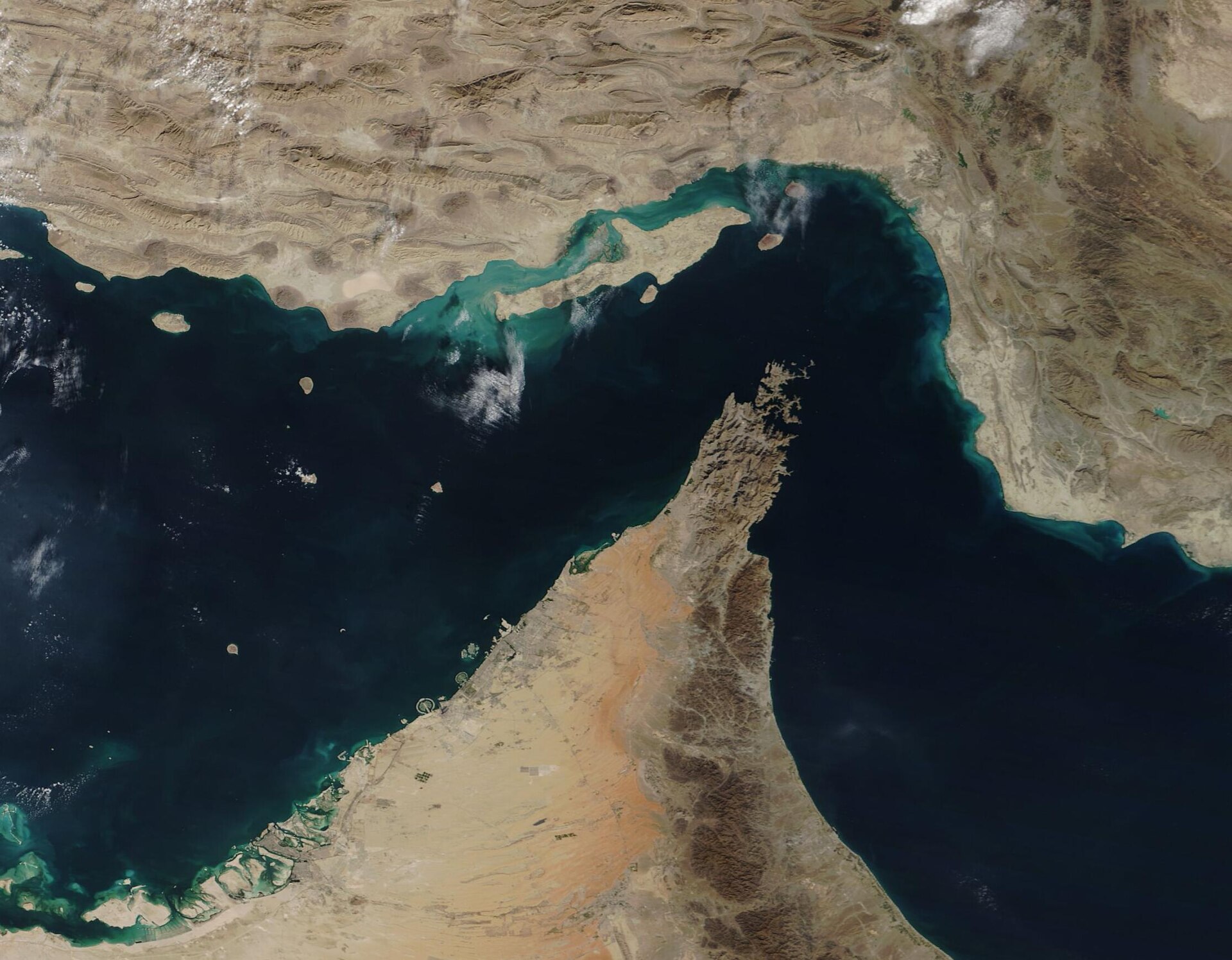
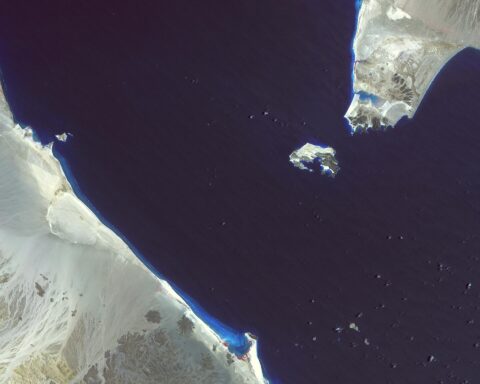
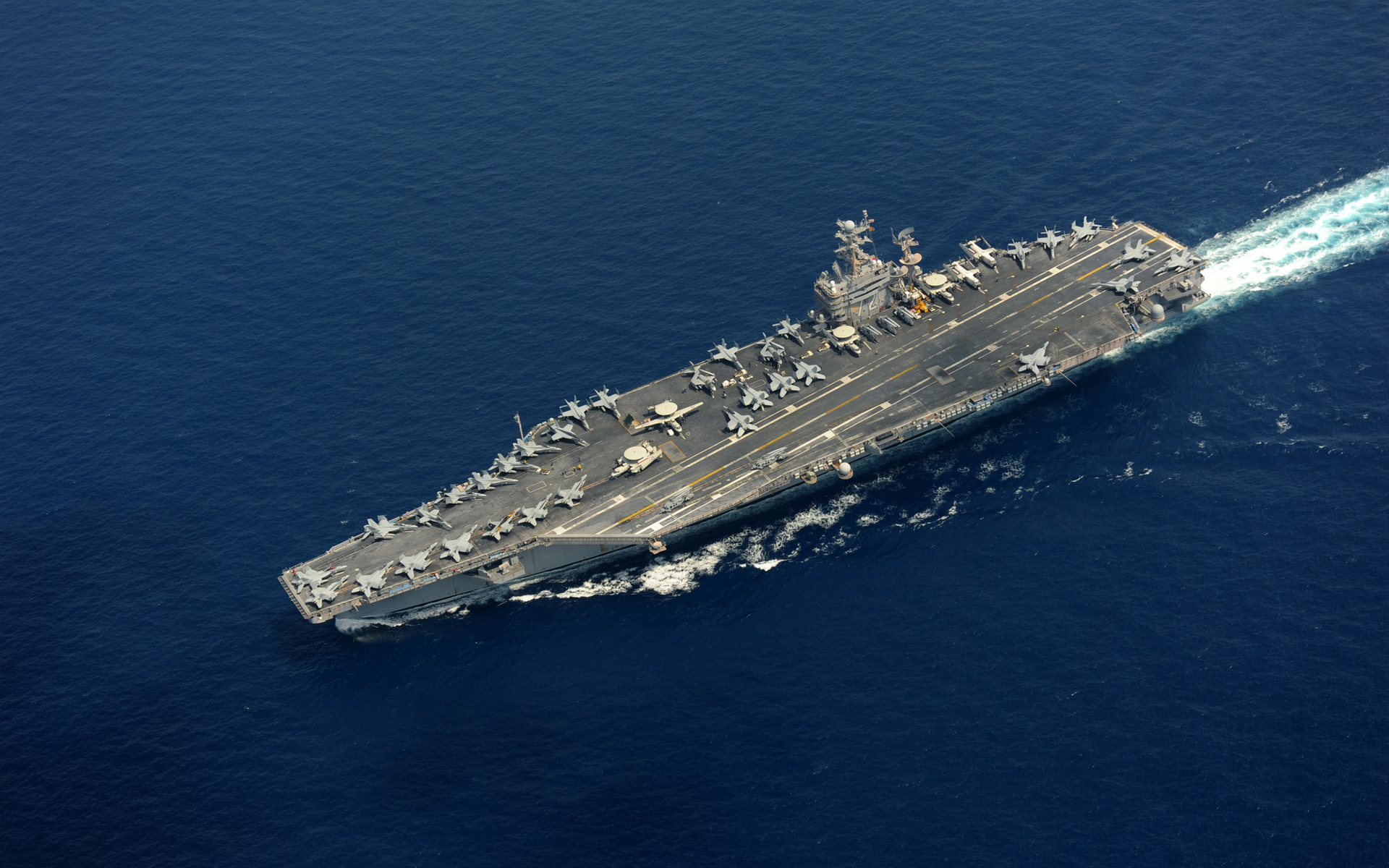
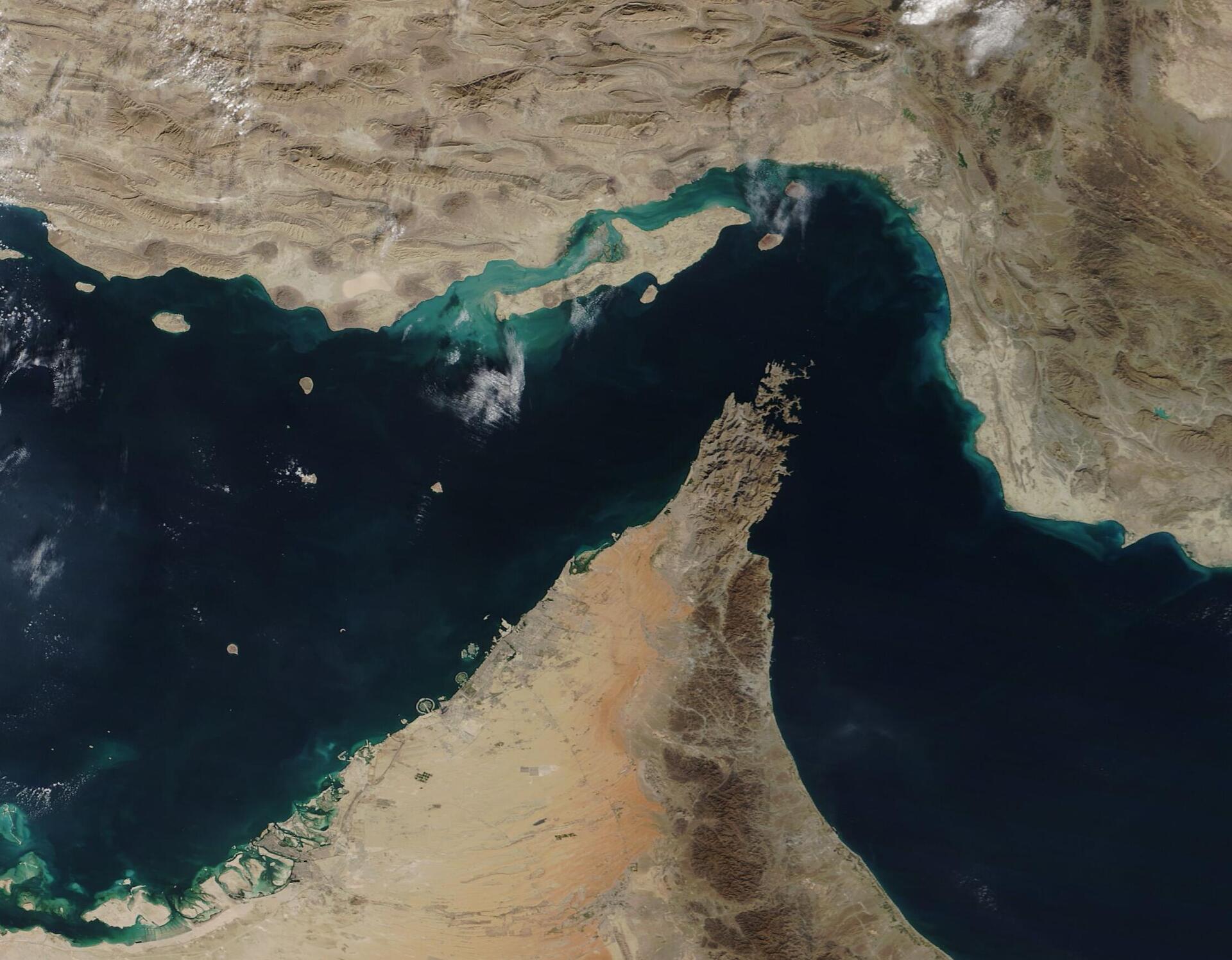
WASHINGTON — The USS George H.W. Bush and its carrier strike group entered the US Central Command area of responsibility on April 23, joining the USS Abraham Lincoln in the northern Arabian Sea and the USS Gerald R. Ford in the Red Sea to create the first three-carrier CENTCOM deployment of the Iran war. Hours after the Bush arrived, President Trump issued what he called a “shoot and kill” order authorizing the US Navy to destroy any vessel laying mines in the Strait of Hormuz “with no hesitation,” a directive aimed at an IRGC Navy that has operated without a named commander for 25 days and whose decentralized provincial corps hold standing pre-authorization to fight without orders from anyone at all.
The convergence of three carrier strike groups, lethal-force rules of engagement, and an adversary whose command structure cannot receive or process calibrated signals does not describe deterrence in any recognizable form. It describes the geometry of an accidental war, and Saudi Arabia — with its PAC-3 interceptor stockpile at an 86 percent drawdown, oil revenue already $93 million a day below baseline, and no seat at the table where either Washington or Tehran makes its decisions — sits in the retaliatory blast radius without a script.
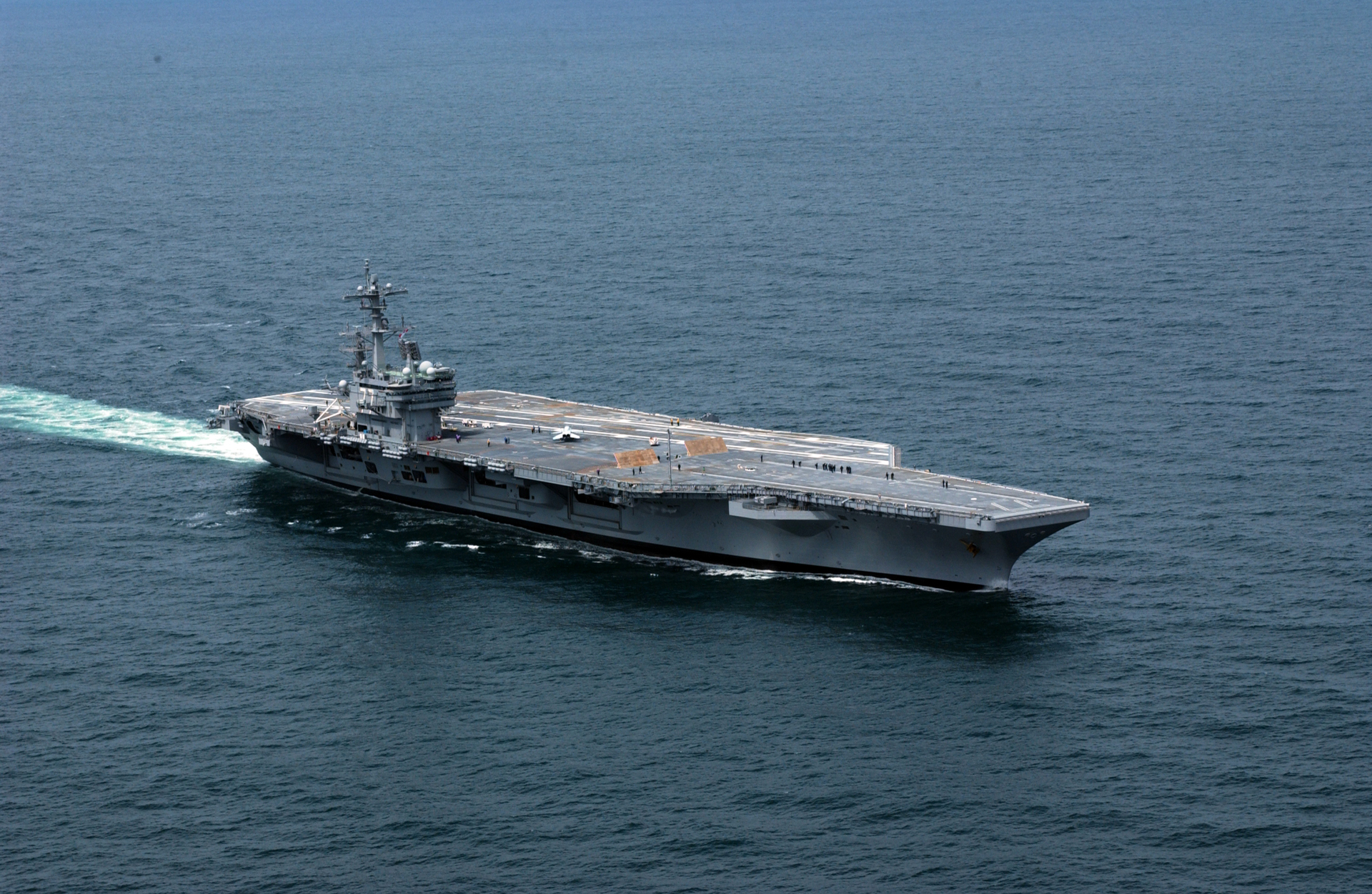
Table of Contents
What Three Carriers in CENTCOM Actually Means
The Bush departed Naval Station Norfolk on March 31, routed via the Cape of Good Hope rather than the Suez Canal and Red Sea — a decision that added weeks to the transit but avoided exposing a $6.2 billion warship to the Houthi anti-ship missile threat that has already forced commercial insurers to impose war-risk premiums on Red Sea passages. The strike group staged through Diego Garcia before entering the CENTCOM area of responsibility, according to Stars and Stripes and USNI News. Carrier Strike Group 10’s composition is substantial: CVN-77 carrying Carrier Air Wing 7 with nine squadrons, guided-missile destroyers USS Ross (DDG-71), USS Donald Cook (DDG-75), and USS Mason (DDG-87), plus the combat logistics ship USNS Arctic (T-AOE-8), with more than 5,000 personnel across the formation.
Mason has been designated Air and Missile Defense Commander for the strike group, a role that places the destroyer at the center of the fleet’s integrated air-defense network. The deployment also marks the first operational use of the CMV-22B Osprey for carrier onboard delivery from an East Coast carrier, replacing the aging C-2A Greyhound, according to Navy.mil.
Three carriers in a single combatant command is not normal. The US Navy operates eleven carriers; placing three in CENTCOM means more than a quarter of America’s carrier fleet is concentrated in a single theater, a commitment the Pentagon has avoided since the early months of the 2003 Iraq invasion. The Lincoln has been operating in the northern Arabian Sea since early March, providing strike and surveillance coverage for the CENTCOM blockade that has turned back 31 vessels since April 13. The Ford, the Navy’s newest and most expensive carrier at $13.3 billion, has been positioned in the Red Sea to maintain pressure on Houthi forces and secure the Bab el-Mandeb chokepoint at the southern end of Saudi Arabia’s Yanbu bypass route.
The Shoot-on-Sight Order and the Fishing-Boat Problem
Trump’s language on April 23 left no ambiguity and no obvious off-ramp. “There is to be no hesitation,” he said, according to CNBC and the Washington Post. He simultaneously claimed “total control over the Strait of Hormuz,” adding: “No ship can enter or leave without the approval of the United States Navy. It is ‘Sealed up Tight,’ until such time as Iran is able to make a DEAL!!!” The phrasing was not a rules-of-engagement adjustment communicated through military channels; it was a public, social-media declaration that converted a blockade into a declared kill zone in the same sentence.
The Middle East briefing 3,000+ readers start their day with.
One email. Every weekday morning. Free.
The operational problem is not political will but positive identification. Iran’s IRGC uses Gashti-class small vessels for mine-laying — fishing-boat-sized craft, each capable of carrying two to four mines, that are visually and electronically indistinguishable from the hundreds of civilian fishing dhows, water taxis, and small cargo vessels that transit the strait daily. Axios sources reported that Iran laid additional mines in Hormuz the same week as Trump’s order, and Iranian officials acknowledged that Iran “lacked the technical capabilities to remove all the mines it had planted,” a statement that served simultaneously as an admission of capability limits and a warning that the minefield is now self-sustaining regardless of any future political decision to stop. The shoot-on-sight ROE asks Navy commanders to make lethal positive-identification calls against small wooden boats in one of the world’s most congested waterways, where a wrong call kills fishermen and a missed call loses a destroyer.
Iran’s formal response was conspicuously legalistic. Foreign Ministry spokesperson Esmail Baghaei told reporters, according to Al Jazeera, that Iran’s Hormuz measures are “entirely lawful” under international and domestic law. He did not address the shoot-on-sight order directly, a silence that reads less like restraint and more like the absence of anyone in the IRGC naval chain with the authority to issue a military counter-statement.
Who Receives the Signal When There Is No Commander?
Commodore Alireza Tangsiri, commander of the IRGC Navy, was killed in an Israeli strike on Bandar Abbas on March 30, confirmed by Iran after a four-day delay. Twenty-five days later, no successor has been publicly named — not by Iran’s defense ministry, not by IRGC-aligned media, not by any second independent source, as tracked by the Foundation for Defense of Democracies and Al Arabiya. A US admiral in the Gulf issued a public message to IRGC Navy personnel, reported by Gulf News: “Abandon your posts or die.” The message confirmed, from the American side, what the 25-day silence from Tehran already demonstrated — that the IRGC Navy’s command architecture is fragmented at the top.
This matters because the entire logic of lethal-force ROE depends on what strategists call signal reception — the assumption that when you shoot at an adversary’s mine-laying boat, someone in that adversary’s command chain receives the signal, evaluates it, and modifies behavior accordingly. The Soufan Center’s INTELBRIEF, published March 9, described Iran’s mosaic defense doctrine as built on the “core assumption” that Iran “may lose senior commanders, key facilities, communications networks and even centralised control, but must still be able to keep fighting.” The IRGC’s 31 provincial corps operate with pre-delegated authority to conduct operations if communications with the center are severed — a design principle that was not an emergency contingency but the explicit purpose of the February 2026 “Smart Control of the Strait” exercise, which tested decentralized naval operations and drone swarms, according to RFERL and the Sunday Guardian Live.
The behavioral evidence arrived the same day as Trump’s order. On April 23, the IRGC fired on three ships in the strait and published propaganda video of recent seizures, including the MSC Francesca — at 363 meters and 174,897 DWT, the largest vessel seized in the 54-day crisis — and the Epaminodes, both taken on April 22. UKMTO’s account directly contradicted IRGC claims, reporting both vessels were fired upon without warning, according to ANI and Fox News. These were not the actions of a command structure processing a new American signal; they were the outputs of provincial units executing standing orders that preceded the signal entirely.
The Mine Gap the Navy Cannot Close
Iran’s mine arsenal is estimated at 2,000 to 6,000 weapons, according to the Stimson Center and Congressional testimony, ranging from crude Soviet-era contact mines to Chinese EM-52 rocket-propelled rising mines and Iran’s domestically produced Maham-3 and Maham-7 sensor-equipped variants. Pentagon officials told Congress on April 22 that full mine clearance of the Strait of Hormuz could take “up to six months” — a timeline that an April 2026 article in USNI Proceedings, titled “The Crisis in Mine Countermeasures,” characterized as arriving at the “worst-case scenario unprepared.” Congressional testimony cited 20 or more mines already deployed, some GPS-guided to resist clearance efforts, according to the Washington Post.
The reason the Navy is unprepared is not a secret; it is a documented procurement failure. The four Avenger-class mine countermeasures ships previously based in Bahrain were decommissioned in September 2025 — five months before the war began. The Foreign Policy Research Institute published a study in March 2026 titled “The Mine Gap: America Forgot How to Sweep the Sea.” Only four Avenger-class MCM ships remain in the entire US Navy fleet, and two of them — USS Pioneer (MCM-9) and USS Chief (MCM-14) — transited the Strait of Malacca northbound on April 11, still two to three weeks’ transit from the Persian Gulf at their maximum speed of approximately 14 knots. The Littoral Combat Ships that were supposed to replace the Avengers’ mine-hunting mission module remain operationally limited, with three deployed to Southeast Asia rather than the Gulf.
The arithmetic is stark. Three carrier strike groups project enormous offensive power against Iranian surface vessels, aircraft, and shore installations, but they cannot clear a minefield. Carriers do not sweep mines; they avoid them. The Navy’s mine countermeasures capability was gutted by deliberate peacetime choices, and the wartime bill has arrived before the replacement is in theater. Farzin Nadimi, a defense analyst, told Defence Security Asia that Iran’s anti-access/area-denial strategy poses “severe operational risks” in “compressed engagement spaces” — a polite description of what happens when a $6.2 billion carrier navigates a 21-mile-wide strait seeded with GPS-guided munitions while its escorts are authorized to shoot fishing boats on suspicion.
Why Does Saudi Arabia Bear the Retaliatory Risk?
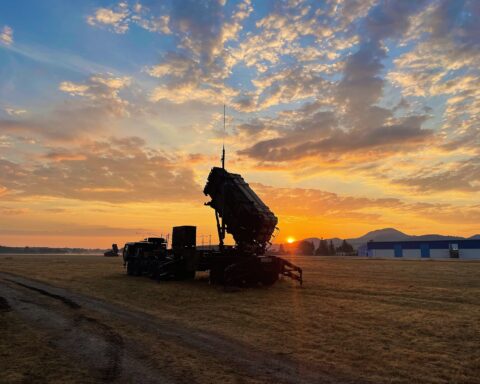
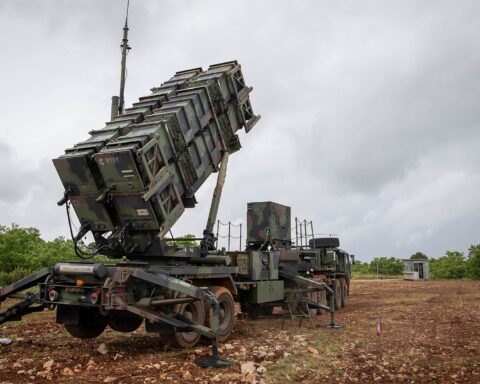
Saudi Arabia has no carrier strike group, no seat in the room where Trump issues lethal-force orders, and no diplomatic channel to the IRGC provincial commanders whose pre-authorized standing orders will determine whether a US strike on a Gashti boat triggers a retaliatory salvo against Ras Tanura or Dhahran. The kingdom’s PAC-3 interceptor stockpile stands at approximately 400 rounds, according to Defence Security Asia — an 86 percent drawdown from the approximately 2,800 rounds held pre-war. Lockheed Martin’s Camden, Arkansas facility produces approximately 620 PAC-3 MSE rounds per year, meaning Saudi Arabia’s wartime consumption has already exceeded one full year of American production capacity, a deficit that cannot be closed by any emergency order, diplomatic request, or congressional authorization before the current crisis resolves itself one way or another.
The kingdom’s fiscal exposure compounds the military vulnerability. Saudi oil production crashed to 7.25 million barrels per day in March, according to the IEA — a 3.15-million-barrel drop from February’s 10.4 million, the largest single-month disruption the agency has ever recorded. The Yanbu bypass pipeline’s loading ceiling of 4 to 5.9 million barrels per day cannot replace the 7 million barrels per day that flowed through Hormuz pre-war, leaving a structural gap of 1.1 to 1.6 million barrels per day that no infrastructure project can close while the strait remains mined. Pakistan has deployed 13,000 troops to Saudi Arabia’s Eastern Province, according to the Middle East Monitor, but ground forces do not intercept ballistic missiles, and the Eastern Province’s oil infrastructure — Abqaiq, Khurais, Ras Tanura — sits within range of IRGC medium-range ballistic missiles that have already demonstrated the ability to penetrate Saudi air defenses earlier in the conflict. Trump’s shoot-on-sight order was issued without consulting any GCC capital — a pattern examined in detail in the April 24 Bahrain bilateral that exposed GCC military coordination’s structural ceiling.
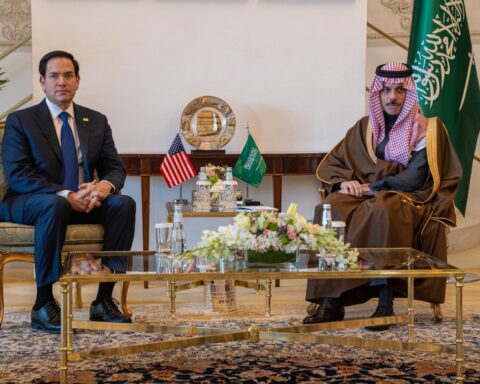
The structural trap is that every American escalation in the strait increases the probability of an Iranian retaliatory strike against Saudi targets, while every Saudi diplomatic attempt to de-escalate runs into Trump’s declared position that Hormuz is “sealed up tight” until Iran makes a deal. Saudi FM Prince Faisal called Iranian FM Araghchi on April 13, the day the blockade began — behavioral evidence, as this publication has previously reported, of a parallel Saudi diplomatic track that has produced no visible results. Iran’s UN envoy has conditioned any resumption of talks on the blockade being lifted first, according to NBC News, a precondition that makes Saudi mediation structurally impossible as long as Washington maintains its current posture.
The 1988 Parallel That Breaks Down
On April 14, 1988, the USS Samuel B. Roberts, an Oliver Hazard Perry-class frigate, struck an Iranian mine in the Persian Gulf that blew a 15-foot hole in the hull, flooded the engine room, and broke the ship’s keel. Four days later, the United States launched Operation Praying Mantis, sinking two Iranian warships in the largest American surface naval engagement since the Second World War. The Reagan administration halted the operation before it escalated further, and the calibration worked — Iran’s naval command structure received the signal, evaluated the cost, and modified its behavior in the strait. The crisis de-escalated within weeks.
The 2026 iteration of this scenario differs in ways that make the 1988 calibration model structurally inapplicable. In 1988, Iran had a functioning, hierarchical naval command. In 2026, the IRGC Navy has been headless for 25 days, its commander killed and unreplaced, while 31 provincial corps operate on standing pre-authorization that was explicitly designed to survive exactly this kind of decapitation. A US strike on a Gashti mine-layer in 2026 does not guarantee that any individual in the IRGC Navy command chain receives the signal, because the doctrine’s entire purpose is to ensure that no individual’s death or incapacitation stops operations. The Soufan Center’s mosaic defense doctrine, described above, was not a theoretical vulnerability assessment; it is a description of current operating conditions.
The mine-laying platform has also changed. In 1988, Iran used identifiable naval vessels — the Iran Ajr, a converted landing craft caught laying mines, was unambiguously military. In 2026, Gashti boats are small, wooden, and indistinguishable from civilian craft, which means the first lethal engagement under Trump’s shoot-on-sight order may not produce the clean, attributable military-on-military exchange that 1988’s Praying Mantis delivered. It may produce a burning fishing boat and a propaganda windfall for Tehran’s provincial information operations, or it may produce a US destroyer with a broken keel because a commander hesitated to shoot at what looked like a fisherman, or — most likely of all — it may produce both on the same day, in different parts of the strait, reported by different IRGC provincial media offices that are not coordinating because coordination is not what the system was designed to do.
Khamenei has been absent for 51 days. Without his ratification, the IRGC Navy’s operational declarations lack constitutional authority under Article 176, but mosaic pre-delegation means operations continue regardless of constitutional authorization — a gap between legal authority and operational reality that is, in the end, the gap between deterrence theory and the war that is actually being fought in the strait.
Frequently Asked Questions
How many US aircraft carriers are currently deployed worldwide?
The US Navy operates eleven nuclear-powered aircraft carriers. With the Bush, Lincoln, and Ford all in the CENTCOM area of responsibility, more than a quarter of the fleet is concentrated in a single combatant command. The USS Ronald Reagan is deployed to the Western Pacific, and the USS Carl Vinson is operating in the Indo-Pacific region. The remaining carriers are in various states of maintenance, training, or pre-deployment workup at US ports, according to USNI News fleet tracker data. The three-carrier CENTCOM concentration is the largest single-theater commitment since 2003.
What is a Gashti-class vessel and why does it complicate the shoot-on-sight order?
Gashti vessels are small, fast patrol craft used by the IRGC Navy, typically under 30 meters in length and visually similar to the commercial fishing dhows and water taxis that operate in large numbers throughout the Strait of Hormuz. Each Gashti can carry two to four naval mines, according to defense analysts cited by Axios. The shoot-on-sight ROE requires US naval commanders to distinguish these vessels from civilian traffic in real time, in a waterway where hundreds of small craft transit daily — a positive-identification challenge that the Navy’s own doctrine acknowledges as one of the most difficult in surface warfare.
Has the US Navy used lethal force against mine-laying vessels before?
Yes. On September 21, 1987, US special operations forces aboard Army MH-6 helicopters observed the Iranian vessel Iran Ajr laying mines in the Persian Gulf at night and attacked it with rockets and machine-gun fire, killing five crew members and capturing 26. The vessel was a 180-foot converted tank-landing craft — unambiguously military and identifiable — and the operation was conducted under controlled conditions with sustained aerial surveillance. The 2026 scenario differs because Gashti boats lack the visual signature that made the Iran Ajr identifiable, and the engagement authority has been broadened from a specific intelligence-driven operation to a standing order covering the entire strait.
Can Saudi Arabia replenish its PAC-3 interceptor stockpile during the current conflict?
Not at a pace that matches consumption. Lockheed Martin’s sole PAC-3 MSE production line in Camden, Arkansas produces approximately 620 rounds per year, according to DSCA filings. Saudi Arabia has consumed approximately 2,400 rounds since the war began — nearly four years’ worth of production in under two months. Even if every round produced were diverted exclusively to Saudi Arabia (which would require suspending deliveries to the US Army, Taiwan, Japan, and other allied customers), the replenishment timeline would extend well beyond the current crisis. The production-rate constraint is structural, not political.
What is Iran’s stated condition for resuming negotiations?
Iran’s UN envoy has stated that talks can resume “as soon as blockade breaks,” according to NBC News — a formulation that makes the lifting of the CENTCOM blockade a precondition rather than a negotiating variable. Trump has declared Hormuz “sealed up tight” until Iran makes a deal, and Iran has declared it will not negotiate until the blockade lifts, leaving no procedural entry point for any third-party mediator.