DHAHRAN — Sadara Chemical Company’s $3.7 billion in guaranteed senior debt becomes payable on Monday, June 15 — less than twenty-four hours after the United States and Iran are scheduled to sign a memorandum of understanding in Geneva — and neither Saudi Aramco nor Dow Inc., the two corporate guarantors backing that obligation, has publicly stated whether it intends to honor the payment. All 26 of Sadara’s manufacturing units in Jubail Industrial City have been offline since late March, revenue has been zero for eleven weeks, and the company’s April regulatory filing with the Saudi Exchange offered five words where a recovery timeline should have been: “cannot provide an estimate.”
Saudi Arabia has positioned its fiscal trajectory around a peace dividend that no draft of the MOU has promised, from a negotiation in which it held no seat, to resolve an industrial shutdown it has not acknowledged as a sovereign fiscal event — and the numbers beneath that positioning have deteriorated past the point where a Sunday signing in Switzerland can produce a Monday reopening in the Eastern Province.
Table of Contents
What Expires on June 15?
A five-year principal grace period on $3.7 billion in parent-guaranteed senior debt — $2.405 billion backed by Saudi Aramco and $1.295 billion by Dow Inc. — granted when the two companies restructured Sadara’s original $12.5 billion project financing in March 2021. The grace period was designed for a company generating some revenue; Sadara has generated none since late March 2026.
In March 2021, Aramco and Dow restructured Sadara’s project debt — originally $12.5 billion raised at the complex’s June 2013 financial close, the largest project financing in Middle Eastern history at the time — replacing approximately $10 billion in completion guarantees with a leaner architecture: $3.7 billion in parent guarantees on senior debt principal, with Aramco assuming 65 percent ($2.405 billion) and Dow assuming 35 percent ($1.295 billion). The restructuring extended final maturity from 2029 to 2038, granted a five-year grace period on principal repayments, and recalibrated the debt service schedule around the assumption that Sadara’s Jubail complex would, at minimum, continue to operate and generate revenue against which the restructured obligations could be serviced.
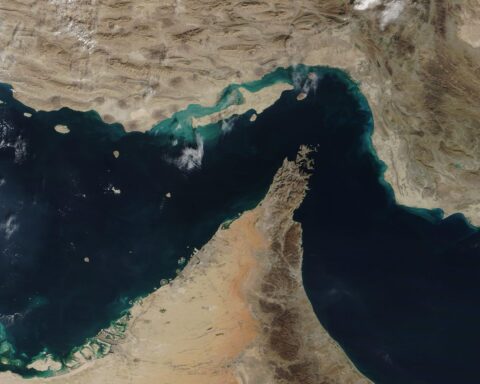
That assumption collapsed on March 31, 2026, when Sadara shut down all 26 manufacturing units in Jubail Industrial City. Argus Media reported the closure was triggered by “uncertainty over maritime access to feedstock supplies” — the Hormuz Strait closure had severed both feedstock import routes and product export corridors simultaneously, stranding a $20 billion industrial asset in the Eastern Province with no inputs and no market. On April 7, the IRGC claimed a strike on Jubail’s petrochemical compound, adding physical damage risk to a facility already paralyzed by logistics.
The Middle East briefing 3,000+ readers start their day with.
One email. Every weekday morning. Free.
“Cannot provide, at the present time, an estimate for the return to production.” — Sadara Chemical Company, Saudi Exchange (Tadawul) regulatory filing, April 2026
The Tadawul disclosure cited unspecified “domestic and international factors” — language calibrated to satisfy regulatory requirements without acknowledging the structural reality that Sadara cannot resume production until the Strait of Hormuz reopens to commercial shipping, a condition that no party to the Geneva negotiations has promised to deliver. The grace period expiring on Monday was designed for a company that was operational but unprofitable — net losses in four of the past five years, accumulated losses exceeding 100 percent of share capital by the end of 2025 — not for a company that has produced nothing since late March and cannot say when, or whether, it will produce again. Even if the MOU enters force, the fee regime governing that reopening is already in place: Araghchi confirmed on June 14 that Iran’s service fee architecture embedded in the MOU survives the deal’s “toll” prohibition by operating under a separate legal classification.
The Guarantors’ Exposure
| Component | Amount | Guarantor | Status (June 2026) |
|---|---|---|---|
| Senior debt guarantee (65%) | $2.405 billion | Saudi Aramco | Grace period expires June 15 |
| Senior debt guarantee (35%) | $1.295 billion | Dow Inc. | $292M EBIT hit recorded Q1 |
| Total guaranteed principal | $3.7 billion | Combined | 26 units offline, zero revenue |
| Original project debt (2013) | $12.5 billion | Syndicate | Cross-default provisions apply |
| US Ex-Im Bank loan (2013) | $4.975 billion | US Ex-Im | Largest single exposure at close |
| Sukuk issuance (April 2013) | $2.0 billion | Capital markets | Part of original debt structure |
The original 2013 financing involved seven export credit agencies — France’s COFACE, Germany’s Euler Hermes, Spain’s FIEM, South Korea’s K-Exim and K-Sure, UK Export Finance, and the US Export-Import Bank — alongside a syndicate of more than 25 commercial banks. The $3.7 billion in parent guarantees that replaced the original completion guarantees do not eliminate the syndicate’s broader claims against the project’s debt structure; they concentrate the immediate default risk on two corporate balance sheets while leaving the underlying $12.5 billion exposure distributed across institutions with their own sovereign relationships, regulatory frameworks, and political constraints on loss absorption.
The multinational composition of the lending syndicate transforms a potential Sadara default from a corporate event into a bilateral and multilateral one simultaneously. The US Ex-Im Bank’s $4.975 billion exposure — the largest single commitment in Ex-Im’s history when it was approved — means a default would immediately become an issue between Washington and Riyadh, at precisely the moment when Washington is attempting to finalize a deal with Tehran that Saudi Arabia has no seat to influence and whose nuclear terms waive the safeguards Washington demands from Iran. The seven ECAs are not passive investors; they are instruments of their home governments’ trade policy, and activating dispute resolution across six countries would introduce a complexity that Dubai World’s 2009 restructuring — a single-sovereign affair resolved with a single Abu Dhabi lifeline — never confronted.
Why Can’t Aramco Simply Write a Check?
Aramco’s Q1 2026 free cash flow of $18.6 billion fell below its $21.89 billion quarterly dividend — a 0.85x coverage ratio and the first shortfall since the pandemic. Its post-dividend cash of $53.3 billion competes against capital expenditures, debt service, and a treasury running a historic quarterly deficit, leaving the Sadara guarantee one claim among many on diminishing sovereign cash.
Aramco’s Q1 2026 financials contain a number that transforms the Sadara question from an isolated corporate obligation into a sovereign fiscal test: free cash flow of $18.6 billion against a quarterly base dividend of $21.89 billion, producing a coverage ratio of 0.85x — the first time reported FCF has fallen below the base dividend since the pandemic. A $15.8 billion working capital build, caused by the Hormuz closure leaving excess crude inventory stranded on Aramco’s books with no export corridor, suppressed the FCF figure, while the company’s post-dividend cash position fell to approximately $53.3 billion from $75.2 billion before the Q1 payout and its gearing ratio rose to 4.8 percent from 3.8 percent at year-end 2025.
In isolation, $53.3 billion in cash against a $2.405 billion guarantee obligation appears manageable — until one accounts for the competing claims on that cash. Aramco must fund its own capital expenditures, service its own debt, maintain a dividend that the Saudi state depends upon for approximately 60 percent of government revenue, and absorb the ongoing revenue losses from a war that has forced production to barely two-thirds of pre-conflict volumes. The Q1 fiscal deficit — the largest quarterly shortfall in the kingdom’s history — was calculated with Aramco’s dividend already flowing into the treasury; any additional diversion of Aramco cash to honor Sadara guarantees reduces the sovereign fiscal buffer at a moment when the buffer is already negative.
The spending that produced the deficit is not discretionary while the war continues: subsidies, military outlays, and government procurement are each running materially above prior-year levels, and Vision 2030 capital commitments, whose termination would trigger an estimated $16 billion in contractor exit liabilities through 2030, cannot be paused without generating costs that rival the savings. Aramco could write a $2.405 billion check to the syndicate — the question is whether doing so quietly, without renegotiation, serves a state burning through its fiscal reserves at three times the projected rate, or whether a managed technical default preserves more flexibility and more liquidity for a sovereign whose first-quarter deficit already consumed the majority of its full-year budget allocation. A subsequent analysis of the disclosure gap explains why neither Aramco nor Dow has filed a material event notice ahead of the June 15 deadline.
Dow Already Priced the Default
Dow’s Q1 2026 earnings call on April 23 offered the clearest public acknowledgment by either guarantor that Sadara’s financial position has crossed from impaired to functionally terminal. The company recorded a $292 million reduction in Operating EBIT attributable to Sadara guarantee revaluation — a charge reflecting Dow’s actuarial assessment of the increased probability that it will be called upon to honor its $1.295 billion share of the parent guarantees. The accounting treatment was more revealing than the charge: Dow suspended Sadara equity loss recognition under GAAP, disclosing that the “carrying value of all liabilities on the balance sheet reached total existing relevant obligations and commitments,” which in practice means Dow has written Sadara’s equity to a level where further losses cannot be recognized without restructuring the commitment itself.
Dow’s cumulative equity loss from Sadara stands at $1.4 billion, with $100 million in annual cash obligations extending through 2038 — the restructured maturity date that the 2021 deal established as its outer horizon. Where Aramco’s exposure is entangled with sovereign fiscal imperatives and the political cost of a first-ever default on an Aramco-guaranteed entity, Dow’s is purely corporate: a legacy investment from the 2011 joint venture announcement, when Dow Chemical committed to a 35 percent stake in what was presented as a generational bet on Saudi Arabia’s feedstock advantage — an advantage that presupposed permanent access to the Strait of Hormuz, which presupposed that the strait would remain open.
Dow, a publicly traded US chemical company with no sovereign obligations and no strategic interest in subsidizing Saudi industrial policy, has every incentive to negotiate rather than pay — to push for a restructuring that reduces its $1.295 billion exposure, extends timelines, or converts guaranteed debt to equity in a company whose equity is already valued at functionally zero. Aramco faces a different set of pressures: honoring the guarantee protects its A1/A+ credit rating and its access to international capital markets, but the payment would represent a transfer from a company already paying more in dividends than it generates in free cash flow, to rescue a joint venture whose operational restart depends on geopolitical conditions that Aramco cannot influence and the Geneva MOU does not address.
Does Geneva Change the Math?
No. The MOU contains no provisions on Sadara’s debt service, Jubail’s operating status, or Hormuz’s commercial access. Phase 1 carries zero nuclear terms; the IRGC — which controls the Hormuz closure — has issued nothing linking its maritime posture to Geneva. Brent has already fallen to $84-86 on deal speculation, widening Saudi Arabia’s breakeven gap before any text is signed.
The memorandum of understanding that Washington and Tehran are scheduled to sign on Sunday — if Iran’s “relevant authorities” approve a text that, as of Friday, Riyadh cannot authenticate and multiple Iranian officials have called unfinalized — contains no provisions affecting Sadara’s debt service, Jubail’s operating status, or the Strait of Hormuz’s commercial accessibility. Phase 1 of the MOU includes zero nuclear terms; all substantive provisions on enrichment caps, stockpile disposition, and IAEA access have been deferred to a sixty-day second phase in which Saudi Arabia holds no seat and exercises no influence over the outcome.
The assumption that a Geneva signing produces a peace dividend — lower war-risk insurance premiums, Hormuz reopening, restored shipping lanes, resumed feedstock flows to Jubail — requires a sequence of events that the MOU’s text does not initiate. Iran’s IRGC, which controls the Hormuz closure independently of the diplomatic track, has issued no statement linking its maritime posture to the Geneva process; Abbas Araghchi told CBS on June 13 that Iran “won the war” and that enrichment dilution inside Iran represents the “only acceptable position,” language indicating Tehran views the MOU as strategic validation rather than the beginning of a de-escalation that would restore commercial normalcy to the Persian Gulf. Iranian officials have framed the prospective deal as an economic victory, with Araghchi claiming $24 billion in frozen assets would be released and military adviser Mohsen Rezaei asserting that Trump privately accepted the asset release but was “unwilling to make the decision public” — claims that, if accurate, would redirect a substantial fiscal windfall to Tehran while Saudi Arabia absorbs the cost of a war those frozen assets helped sustain.
“Very dishonorable people. … These ‘terms’ bear no relation to the agreed-upon text.” — Donald Trump, Truth Social, June 13, 2026, responding to leaked Iranian versions of the MOU
The oil market has responded to deal speculation by moving against Saudi interests, compounding the fiscal damage the MOU was supposed to relieve. Brent crude has fallen to approximately $84-86 per barrel on peace expectations — widening the Saudi breakeven gap to $21-27 per barrel against the $108-111 level the kingdom requires to balance its budget — while the deal itself remains unconfirmed by any party with the authority to confirm it. OPEC+ approved its fourth consecutive 188,000 bpd production increase on June 7, setting Saudi Arabia’s quota at 10.291 million bpd, but the additional volumes cannot exit the Persian Gulf while Hormuz remains under IRGC interdiction; the production hike is a post-peace market signal that presupposes a peace nobody has yet delivered, and if Geneva collapses, the quota increase will depress prices further without producing a single additional exported barrel.
Jubail’s Seven Percent
Jubail Industrial City — home to Sadara, SABIC’s major production complexes, and dozens of downstream manufacturers — contributes approximately 7 percent of Saudi Arabia’s GDP, which makes the Eastern Province petrochemical hub considerably more than a single-company story. When Sadara’s 26 units went offline in late March, they joined a broader Jubail shutdown driven by the same Hormuz-related supply chain disruption, and the aggregate impact registered immediately in national accounts: Saudi non-oil exports declined 27 percent in Q1 2026, driven overwhelmingly by petrochemicals and metals, the two export categories most concentrated in Jubail’s industrial zone.
The GDP contraction is compounding at a pace that the Geneva timeline cannot interrupt. Real oil GDP contracted 7.2 percent quarter-on-quarter (seasonally adjusted) in Q1 2026, and the Arabian Gulf States Institute forecasts a potential 10 percent year-on-year contraction in Q2 — a projection driven not by oil prices alone but by the physical inability to produce and export at pre-war volumes. Saudi production at 6.879 million bpd represents involuntary curtailment rather than voluntary OPEC+ restraint, and the distinction matters because involuntary cuts do not generate the market-balancing price recovery that voluntary discipline is designed to produce; prices have fallen anyway, on deal speculation that has no basis in signed text.
Sadara’s shutdown within Jubail’s broader paralysis illustrates a cost of the war that Riyadh has not publicly quantified: the degradation of the non-oil economic base that Vision 2030 was designed to build. A $20 billion petrochemical complex producing zero revenue is not merely a corporate failure — it is a structural contradiction within a national strategy that budgeted for industrial diversification and received a maritime war instead, a war in which Jubail was both commercially paralyzed by the Hormuz closure and physically targeted by the April 7 IRGC strike, by the same forces whose peace terms Saudi Arabia is now expected to endorse without having participated in drafting them.
What Happens If the Guarantors Do Not Pay?
A missed payment triggers cross-default provisions across the $12.5 billion debt structure — the first default by an Aramco-guaranteed entity. Claims would activate across seven export credit agencies in six countries simultaneously, a multilateral complexity absent from any prior Gulf sovereign-adjacent restructuring; a resulting credit-rating downgrade could cost Aramco more in higher borrowing rates than the $2.405 billion guarantee itself.
The closest sovereign-adjacent precedent is Dubai World’s November 2009 standstill request, which covered approximately $59 billion in liabilities — roughly sixteen times Sadara’s $3.7 billion guarantee figure — and required Abu Dhabi to extend a $10 billion lifeline before creditors accepted extended payment timelines over a two-year restructuring. The comparison is imperfect in both directions: Dubai World lacked operating revenue, while Sadara’s guarantors have functioning businesses with the theoretical capacity to pay; but Dubai World was a single-sovereign problem resolved through a single bilateral relationship, while a Sadara default would activate claims across seven export credit agencies in six countries, introducing a multilateral dimension that no Gulf sovereign-adjacent restructuring has previously navigated.
The reputational cost to Aramco’s investment-grade credit rating could exceed the $2.405 billion guarantee itself, because Aramco’s access to international debt markets at favorable rates is not merely a corporate convenience but the mechanism through which the Saudi state finances its deficit, rolls over its obligations, and sustains the fiscal architecture that connects oil revenue to government spending to Vision 2030 capital commitments. A downgrade triggered by a Sadara default would raise Aramco’s borrowing costs across its entire debt portfolio — a contagion effect that makes the $2.405 billion guarantee look cheap by comparison, and that compounds at scale across an institution carrying tens of billions in external debt.
The alternative — a quiet payment by both guarantors, followed by another restructuring negotiation with the syndicate to extend timelines further — resolves the immediate contractual obligation but does not restart Jubail, reopen Hormuz, or alter a fiscal trajectory that has already consumed three-quarters of its annual budget in one quarter. The payment would amount to a $3.7 billion option premium on the possibility that Geneva eventually produces a peace allowing Jubail to resume operations on a timeline that Sadara itself cannot estimate — paid by guarantors under financial pressure, for an outcome that depends on parties in Washington, Tehran, and the IRGC over whom neither Aramco nor Dow exercises any influence whatsoever.
The Deficit That Consumed Its Own Budget
Saudi Arabia’s Q1 2026 fiscal deficit of SAR 125.7 billion ($33.5 billion) is not merely the largest quarterly shortfall in the kingdom’s history — it is structurally incoherent with the government’s own planning. The Ministry of Finance’s pre-war full-year 2026 budget projected a deficit of approximately SAR 165 billion; Goldman Sachs subsequently revised its estimate to SAR 300-330 billion as the war’s fiscal effects became apparent; the Q1 result consumed 76 percent of the original full-year projection in ninety days, which means the remaining three quarters must either deliver spending cuts of a magnitude no Saudi budget has ever attempted, or produce a full-year deficit that exceeds even Goldman’s wartime revision.
| Indicator | Figure | Source |
|---|---|---|
| Q1 2026 fiscal deficit | SAR 125.7B ($33.5B) | AGSI analysis |
| Full-year deficit (MoF official) | ~SAR 165B | Ministry of Finance |
| Full-year deficit (Goldman revised) | SAR 300-330B | Goldman Sachs |
| Q1 as % of official full-year | 76% | Calculated |
| Aramco Q1 free cash flow | $18.6B | Aramco Q1 2026 |
| Aramco Q1 base dividend | $21.89B | Aramco Q1 2026 |
| FCF-to-dividend coverage | 0.85x | Aramco Q1 2026 |
| Aramco post-dividend cash | $53.3B | Aramco Q1 2026 |
| PIF cash reserves | ~$15B (6-year low) | HOS analysis |
| Saudi oil production (April) | 6.879M bpd | AGSI |
| Brent crude (June 2026) | $84-86/bbl | Market data |
| Saudi fiscal breakeven | $108-111/bbl | AGSI / AGBI |
The spending categories that produced the Q1 deficit resist austerity in every direction. Subsidies rose 170 percent year-on-year — the cost of insulating Saudi consumers from the energy disruptions of a war that has, paradoxically, depressed the kingdom’s own oil revenues through volume losses that exceed the price effect. Military expenditures rose 26 percent, reflecting direct conflict costs that cannot be reduced while the conflict continues and the IRGC retains the capacity to strike Jubail again. Government spending on goods and services surged 52 percent, and the aggregate — SAR 387 billion in Q1 alone, up 20 percent year-on-year — represents a wartime fiscal posture that was adopted without any mechanism for reversal short of a ceasefire that the Geneva MOU does not guarantee.
PIF’s cash position of approximately $15 billion — a six-year low — sits below the estimated $16 billion cost of NEOM contract terminations through 2030, meaning the sovereign wealth fund engineered to finance Saudi Arabia’s post-oil economy currently holds less liquidity than it needs to exit the most visible project of that economy. When the Sadara guarantee obligation is placed alongside the fiscal deficit, the Aramco dividend strain, the PIF crunch, and the oil-price gap that peace-deal speculation has widened rather than narrowed, the $3.7 billion that comes due on Monday morning is not an isolated corporate liability but one node in a fiscal network where every obligation competes for the same shrinking pool of sovereign cash — and the Geneva ceremony that is supposed to inaugurate a new era of stability has not promised to replenish any of it.
Frequently Asked Questions
Who are the lenders in Sadara’s original syndicate?
The US Export-Import Bank contributed a then-record $4.975 billion direct loan alongside seven export credit agencies — France’s COFACE, Germany’s Euler Hermes (now Allianz Trade), Spain’s FIEM, South Korea’s K-Exim and K-Sure, and UK Export Finance — with a $2 billion sukuk issuance and more than 25 commercial banks from Asia, Europe, and the Gulf rounding out the syndicate; Milbank LLP acted as legal counsel to the lending group. The jurisdictional breadth is consequential: a default would simultaneously activate dispute resolution mechanisms under seven separate bilateral investment frameworks, a complexity absent from the Dubai World restructuring, which was resolved entirely within the Abu Dhabi-Dubai sovereign relationship.
Could Sadara be restructured a second time instead of defaulting?
The 2021 restructuring was negotiated under the premise that Sadara’s challenges were cyclical — low petrochemical margins, feedstock cost fluctuations, the lingering effects of COVID-era demand suppression — rather than existential. A second restructuring would require the 25-bank syndicate and seven ECAs to accept that the wartime closure is temporary, a position that Sadara’s own Tadawul filing conspicuously declines to assert by stating it “cannot provide an estimate” for resumption. The key variable is whether Aramco and Dow would agree to increase their combined $3.7 billion guarantee, and Dow’s Q1 accounting treatment — which effectively caps its recognized exposure by suspending equity loss recognition — suggests the American guarantor would resist any expansion of its commitment beyond the existing $1.295 billion.
What happens to the US Ex-Im Bank’s exposure if Sadara defaults?
Ex-Im’s $4.975 billion Sadara commitment was approved in 2013 under the Obama administration as part of a broader US-Saudi economic partnership, and a default would place the agency’s loss reserves under Congressional scrutiny at the precise moment when the same administration that would manage the fallout is attempting to finalize a nuclear agreement with Iran — the country whose military operations caused the Hormuz closure that triggered Sadara’s shutdown. The political optics of absorbing a multi-billion-dollar loss on a Saudi joint venture while signing a deal with the adversary whose actions destroyed its revenue would create a legislative complication that neither the State Department nor Treasury has publicly addressed, particularly given that Ex-Im’s authorization has been a recurring Congressional battleground independent of any specific default scenario.
Has Sadara ever been profitable?
Sadara posted net losses in four of the past five fiscal years before the wartime shutdown reduced revenue to zero, with accumulated losses exceeding 100 percent of share capital by end-2025. The chronic unprofitability reflected a structural mismatch between the capital intensity of its integrated complex — 26 manufacturing units processing ethane and naphtha feedstocks into over 3 million metric tons per year of diversified chemicals — and the commodity pricing environment that prevailed after oil’s 2014 collapse eroded the feedstock cost advantage the project was built to exploit. Dow’s 2017 merger with DuPont and subsequent 2019 separation into three independent companies further complicated governance, as Sadara’s strategic relevance to the new Dow Inc. was materially lower than it had been to the pre-merger Dow Chemical that originally championed the joint venture in 2011. Iran’s foreign ministry canceled the Geneva signing on Friday, confirming the June 14 ceremony would not proceed — leaving the $3.7 billion Sadara deadline on June 15 as the next immovable date on the calendar.