
DOHA — Iran’s Foreign Minister Abbas Araghchi confirmed on November 1 that Qatar-mediated talks had produced a proposal to reopen the Strait of Hormuz within two days — compressed from the seven-day roadmap he presented at the United Nations on September 25. The acceleration tracks the calendar precisely: President Trump’s pre-midterm strike moratorium, announced October 8, expires on Tuesday.
The compression, however, is in the implementation window, not the preconditions. Iran’s five demands remain the same ones Washington has not engaged with since September. The two-day clock does not begin until the United States accepts every one of them — a scheduling revision on an offer no American official has acknowledged. Araghchi framed reopening the Strait as a gateway to further diplomacy, not as the product of it.
The House of Saud Daily Briefing
Saudi Arabia's news in 3 minutes, every morning. Free. See today's issue
For Saudi Arabia, the plan arrives between two competing urgencies: the daily cost of a closed Hormuz in lost Gulf oil revenue, and the risk that any quick deal lifts American military pressure on Iran before Riyadh secures the broader settlement — on Houthi attacks, on the nuclear file, on Iran’s regional proxies — that the kingdom considers essential to its security.
Table of Contents
- From 7 Days to 2: How the Timeline Shrank
- What Are Iran’s 5 Conditions for Reopening Hormuz?
- The IRGC vs. the Foreign Ministry
- What Did Vance’s Letter Actually Propose?
- Saudi Arabia’s Revenue Trap
- Does the 2-Day Plan Represent a Genuine Concession?
- The November 3 Clock
- What Happens If No Deal Is Reached Before Tuesday?
- Frequently Asked Questions
From 7 Days to 2: How the Timeline Shrank
The road from seven days to two can be traced through five weeks of failed proposals, mutual escalation, and a ticking American calendar.
Iran’s first formal bid to unwind the Hormuz standoff came on September 25, when Araghchi presented a seven-day roadmap to Qatari mediators at the UN General Assembly sidelines. Under it, the Strait would reopen over one week if Washington lifted its blockade, issued sanctions waivers, and released approximately $12 billion in frozen Iranian assets. The US naval blockade of Iranian ports had originally begun on April 13; it resumed on July 14 after the collapse of the Islamabad memorandum, a Pakistan- and Qatar-brokered agreement that had provided a 60-day passage window. Trump rejected Araghchi’s plan the following day, according to the Wall Street Journal.
For five weeks, the offer sat. Iran tightened pressure rather than softened its terms. The IRGC declared Hormuz formally closed on October 26, and Tehran raised its frozen-asset demand well beyond the $12 billion originally proposed. The US blockade continued unbroken, with CENTCOM redirecting 144 commercial vessels as of October 31.
On October 8, Trump introduced a variable Araghchi would have registered immediately. Speaking about the broader Iran conflict, he pledged no American strikes “at any time prior to the midterm elections” on November 3. The moratorium created a fixed window — military pressure suspended, diplomatic solutions facing a hard deadline.
By late October, reports surfaced of an intermediate proposal in the range of four to five days. Then, on Saturday, after more than 12 hours of talks between Iranian and Qatari officials in Tehran, Qatar’s mediators carried a revised proposal to Doha. Qatar initially counter-proposed a five-day implementation window. Over the course of the day, the two sides converged on two.
“We have reached a proposal at this stage that reduces the implementation period to two days,” Araghchi said.
| Date | Development | Outcome |
|---|---|---|
| Sep 25 | Araghchi presents 7-day roadmap via Qatar at UN sidelines | Proposal to reopen Hormuz in exchange for blockade end, sanctions waivers, ~$12B in frozen assets |
| Sep 26 | Trump rejects 7-day plan | No counter-offer; WSJ reports administration expects strikes after midterms |
| Oct 8 | Trump pledges no strikes before Nov 3 midterms | Fixed diplomatic window established |
| Oct 25–26 | Iran escalates asset demand; IRGC declares Hormuz formally closed | Frozen-asset figure rises; strait closure made official |
| Oct 28–29 | Reports of 4–5 day intermediate proposal | Negotiation narrows the implementation window |
| Oct 31 | 12+ hours of Iran-Qatar talks in Tehran; Qatar counter-proposes 5 days | Sides converge on 2-day implementation timeline |
| Nov 1 | Araghchi confirms 2-day plan to Al Jazeera | No US response as of publication |
What Are Iran’s 5 Conditions for Reopening Hormuz?
The five conditions Iran has attached to the two-day implementation window, compiled from HNGN and Associated Press reporting of October 31, are unchanged from the broader framework Tehran has demanded for months:
- Lift all sanctions imposed after the collapse of the Islamabad memorandum
- Reduce US military forces in the region
- Restore oil export waivers for Iran
- Release all frozen Iranian assets, including those held in Qatar
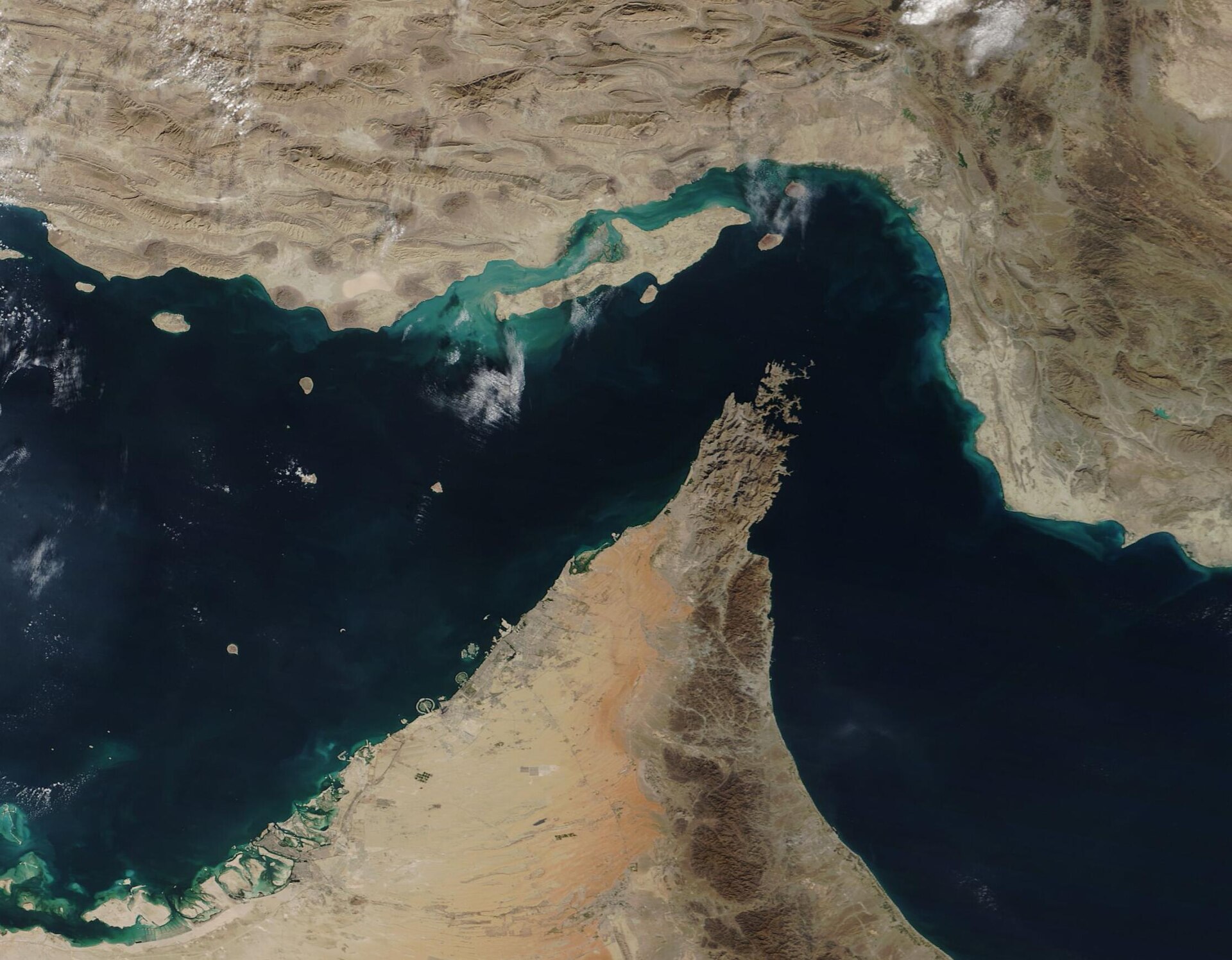
- Recognize the Iran-Oman shipping corridor as the only open Hormuz route
The fifth condition is structurally distinct from the other four. It means that even after an agreement, Iran would dictate which shipping lanes operate in the Strait. All routes outside the Iran-Oman corridor would remain closed under Tehran’s terms. A reopened Hormuz, under this framework, is a single controlled channel — not a restored waterway.
“Reopening the Strait of Hormuz in accordance with our conditions paves the way for the resumption of negotiations.”
Abbas Araghchi, Iranian Foreign Minister, October 31
The nuclear file is not part of the two-day package. Mediators have categorized nuclear proposals as a “second phase,” to be addressed only after the Strait is open and direct or indirect talks with Washington begin. Araghchi’s framing is sequential: conditions met, then implementation, then Hormuz opens, then negotiations resume. Each step depends on the one before it.
The two-day clock, under these terms, does not start when the proposal is accepted in principle. It starts after Washington satisfies all five conditions — a sequence involving sanctions relief across multiple US agencies, military asset movements, and fund releases from third-country banks. No timeline exists for the preconditions themselves. The two days measure only what happens after.
The IRGC vs. the Foreign Ministry
On October 25 — days before Araghchi’s team began the marathon negotiation in Tehran — Iran’s IRGC-affiliated Tasnim News Agency published a statement that read like a preemptive repudiation: Iran does not accept any formula trading access to the Strait of Hormuz for an end to the American blockade.
The contradiction between Iran’s diplomatic and military establishments has shadowed the entire negotiation. Araghchi presents the Hormuz offer as an acceleration reflecting Tehran’s willingness to move quickly toward a resolution. The IRGC treats any Hormuz-for-blockade formulation as a conceptual surrender — trading Iranian sovereign control of the Strait for the removal of what Tehran calls an illegal American siege. These are not nuances of the same position. They are incompatible frameworks.
SNSC Secretary Mohsen Rezaei, who received and read Vice President JD Vance’s letter proposing direct US-Iran talks, has positioned himself between both camps. He called Vance’s tone a “very positive sign” and said Washington’s approach “has changed completely.” Then, in the same period: “There will be no nuclear talks and no Hormuz reopening until the US accepts Iran’s demands.”
On state television, Rezaei went further, telling viewers that Iran was actively debating whether to maintain its religious prohibition on nuclear weapons should hostilities resume. He added that no decision had been made — but the public framing, on camera, was itself a signal. Iran holds approximately 440 kilograms of uranium enriched to 60 percent. Supreme Leader Mojtaba Khamenei ordered on October 31 that any threat to Iran must be met with an immediate and effective response without geographical limitations.
The institutional split has operational consequences beyond messaging. Under Mojtaba Khamenei, the IRGC has maintained its own posture while the Foreign Ministry conducts diplomacy — a structure in which the entity making the offer does not control the asset being offered. The two-day plan requires that the Revolutionary Guard Corps — the organization that declared Hormuz closed on October 26, that deploys the naval assets enforcing the closure, and that operates through Tasnim to reject the entire Hormuz-for-blockade equation — cooperates in physically reopening the Oman corridor on a 48-hour timeline. The Foreign Ministry can negotiate a schedule. Only the IRGC can carry it out.
What Did Vance’s Letter Actually Propose?
Two contradictory accounts have emerged from the Trump administration itself. Sources cited in HNGN and Fox News described the letter as proposing direct US-Iran talks with the nuclear program on the agenda from the first session. Trump said publicly on October 31 it was focused only on getting medical supplies into Iran. Rezaei read the letter but gave no substantive reply.
These are not two descriptions of the same document. A proposal for comprehensive nuclear negotiations and a request to facilitate humanitarian aid occupy different diplomatic registers entirely. That both accounts emerged on the same day suggests either deliberate ambiguity — the letter worded to be readable differently depending on who in Washington describes it — or a gap between what Vance sent and what Trump chose to characterize. An administration divided on Iran, with Vance’s diplomatic wing and Defense Secretary Pete Hegseth’s hawkish camp pulling in opposite directions, may have produced a letter pitched at multiple registers.
Rezaei’s response was calibrated to the uncertainty. He praised the tone, noted the shift, and gave no substantive reply. Iran’s position remains that any talks — direct or indirect — depend on Washington accepting Tehran’s preconditions first. Araghchi said Iran has “no immediate plans” to meet US officials.
The letter’s weight may lie less in its text than in its existence. It is the first direct written communication from the Trump administration to Iran’s security establishment since the blockade resumed in July. Whether it opens a channel or becomes an exhibit in a blame narrative depends on whether anyone in Tehran decides to answer — and whether the answer comes before Tuesday.
Saudi Arabia’s Revenue Trap
The economics of a shuttered Strait create their own pressure on Riyadh, independent of the diplomacy.
Saudi Arabia exported approximately 4 million barrels per day through the Gulf and Hormuz-adjacent routes in October, with another 2.5 million barrels per day shipped from the Red Sea port of Yanbu. Total October export figures are contested: TankerTrackers estimated roughly 6.99 million barrels per day, while Kpler’s figure was 5.4 million — a gap of 1.59 million barrels per day between two commercial tracking services using different methodologies.
| Metric | Figure | Source |
|---|---|---|
| Saudi Gulf/Hormuz exports (Oct) | ~4M bpd | Rigzone, Oct 28 |
| Saudi Red Sea/Yanbu exports (Oct) | ~2.5M bpd | Rigzone, Oct 28 |
| Total Saudi exports (TankerTrackers) | ~6.99M bpd | Rigzone, Oct 28 |
| Total Saudi exports (Kpler) | 5.4M bpd | Rigzone, Oct 28 |
| Hormuz pre-war oil flows | 17M bpd | CNBC, Sep 30 |
| Hormuz 7-day avg (late Sep) | 13.5M bpd (~80% of pre-war) | CNBC, Sep 30 |
| Pre-war Hormuz ship transits | 138/day | JMIC, March 2026 |
| Brent crude (after Oct 30 tanker attack) | $117/bbl | Pre-verified |
Treasury Secretary Scott Bessent offered a strikingly different assessment on October 31, saying Hormuz traffic was “near prewar levels excluding Iranian oil.” The distance between Kpler’s 77 percent figure and Bessent’s “near prewar” characterization is itself informative: the administration has reason to present the blockade as surgically targeted at Iran without broader economic fallout.
Even the Yanbu corridor — Saudi Arabia’s Red Sea alternative — is not insulated from the conflict. The East-West pipeline connecting Gulf fields to Yanbu, with a design capacity of approximately 7 million barrels per day, restarted in late September after a precautionary shutdown, though full-capacity operations were expected to take six weeks or more. Houthi attacks on Saudi oil infrastructure have expanded throughout October, and the pipeline’s vulnerability to long-range strikes has not been tested.
Saudi Vice Foreign Minister Waleed ElKhereiji, speaking at a Bahrain security forum on October 31, said that “efforts are underway to prevent military escalation and reach an agreement ending the crisis.” The language endorsed no specific framework, named no plan, committed to no timeline.
The fiscal pressure runs deeper than daily revenue. Saudi Arabia’s pre-budget statement projected the economy contracting 3.6 percent in 2026 before growing 12.8 percent in 2027, with the fiscal deficit revised upward to 245 billion riyals from a budgeted 165 billion. Hormuz disruptions are a direct contributor to that deterioration.
The dual-track problem is not abstract for Riyadh. Restored Gulf shipments would ease the immediate revenue squeeze — the economist Robin Brooks estimated Saudi annualized oil export revenue at approximately $210 billion in late September, a single analyst’s projection based on elevated prices and constrained volumes. But if reopening Hormuz is the concession that relaxes American pressure on Iran without concurrent progress on Houthi disarmament, the nuclear file, or the proxy network, Saudi Arabia trades a short-term revenue recovery for the erosion of its strongest external security guarantee. The kingdom needs Hormuz open. It cannot afford the price at which Iran is offering to open it.
Does the 2-Day Plan Represent a Genuine Concession?
The two-day implementation window is shorter than the original seven-day proposal, but the five preconditions are identical and the frozen-asset demand has increased. The clock does not start until Washington accepts all conditions, which no US official has done. The compression is operational — Iran says it can execute faster — but the demands have not changed, and the nuclear file remains excluded from the first phase.
The acceleration is real in one narrow operational sense: Iran is signaling it could reopen the corridor faster than previously proposed. But the trigger event — US acceptance of all five conditions — remains unchanged, and no American official has engaged with the proposal in any form.
The Council on Foreign Relations’ Max Boot proposed an alternative framework in April: an “open for open” approach under which both the US naval blockade and Iran’s strait restrictions would end simultaneously, decoupling Hormuz from the nuclear file. “If the US insists on keeping its blockade,” Boot wrote, “there is little chance of progress and a higher risk of escalation.” Araghchi’s plan is not “open for open.” It is conditions-first: Iran’s demands must be met before the implementation clock begins, and the United States receives nothing — no nuclear concessions, no proxy restraint, no IRGC de-escalation — until after the Strait is open and a second phase commences.
What the compression achieves, regardless of substance, is political positioning. If the United States does not respond before Tuesday, Iran can frame any subsequent military action as having come after Tehran shortened its timeline, deferred nuclear demands, and engaged Qatari mediation at length. A seven-day plan rejected could look rigid. A two-day plan rejected under the same conditions shifts the framing: Iran offered to move in 48 hours, and Washington would not engage. The intended audience for that narrative is not the White House. It is Moscow, Beijing, and the non-aligned states whose votes Iran would need at the Security Council and the International Court of Justice if the conflict widens into a formal war. A rejected two-day plan is a diplomatic asset in a way that a rejected seven-day plan was not.
The November 3 Clock
President Trump’s signals about the post-midterm period have been conspicuously contradictory, and his administration’s internal alignment remains unclear.
In a Kansas City radio interview on October 30, Trump said the war was “going to get wrapped up soon.” Asked by Fox News on October 28 whether strikes would resume after November 3: “I can’t tell you that… but anything’s possible.”
“I can’t tell you that… but anything’s possible.”
President Trump on post-midterm strikes, Fox News, October 28
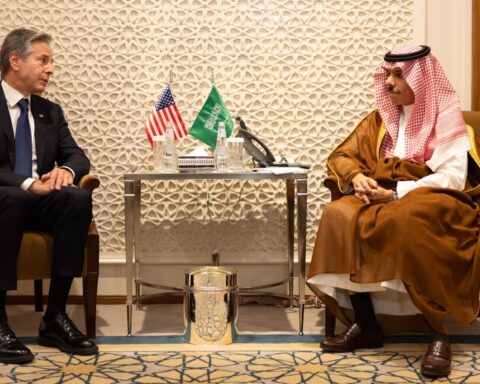
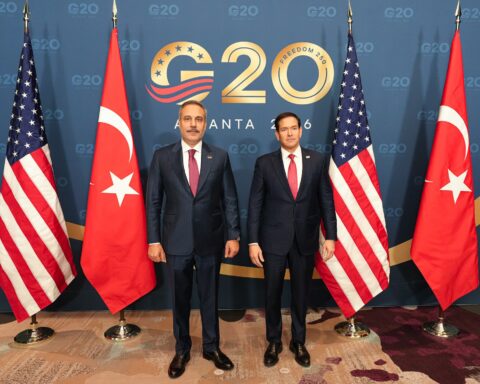
Secretary of State Marco Rubio, meeting Saudi Foreign Minister Prince Faisal at the G20 in Atlanta on October 31, said Trump “hasn’t made a decision” and that the United States “would prefer to do it peacefully.” That the kingdom’s senior diplomat chose to meet Rubio at a multilateral summit — rather than in Washington — may reflect Riyadh’s effort to calibrate its public distance from whatever decision comes next.
Within the administration, reporting by Iran International identified a fault line. Vance, Special Envoy Steve Witkoff, and Jared Kushner favor a negotiated resolution. Defense Secretary Pete Hegseth has appeared opposed. The Vance letter to Rezaei — its contents characterized differently by the vice president’s office and the president himself — suggests the divide runs through the White House’s own correspondence.
Outside the administration, the signals point more clearly toward escalation. The Associated Press reported that US officials privately warned several regional governments that military action after the midterms could provoke Iranian retaliation against their territory. Republican strategist Karl Rove told The Hill he expects Trump to resume “kinetic action” against Iran once the midterm vote is past.
The US blockade has not paused for diplomacy. Iran sent a delegation to Doha on October 31 and called the American outreach a “positive step” — but positive signals and satisfied preconditions are not the same thing, and Tehran has given no indication it will drop or modify any of its five demands before Tuesday.
What Happens If No Deal Is Reached Before Tuesday?
If November 3 passes without an agreement, two clocks expire simultaneously: Iran’s diplomatic window and Trump’s self-imposed restraint.
Four post-midterm scenarios have been mapped, ranging from resumed US strikes on Iran to a negotiated breakthrough, with the most probable outcome being a period of acute ambiguity — neither side committing to a course, each waiting for the other to act first. The two-day plan, if it survives at all, would then operate in the shadow of potential American military action — a fundamentally different negotiating context from the one that produced it.
The nuclear dimension has been introduced deliberately. Rezaei’s public discussion of whether Iran should maintain its weapons prohibition was broadcast on state television — stated for the cameras, not leaked through intermediaries. The message to Washington was not subtle: the cost of rejecting diplomacy is measured in centrifuge output, not tanker traffic.
For Saudi Arabia, the post-Tuesday period holds a specific and asymmetric danger. If Trump resumes strikes but Iran retaliates against Gulf states — as the AP reported US officials privately warned regional governments — then Riyadh absorbs the consequences of an American decision it did not make and may not have endorsed. If instead a deal emerges that reopens Hormuz on Iran’s conditions, the kingdom inherits an environment in which its most valuable external lever — American willingness to use force against Iran — has been spent without addressing a single Saudi security priority.
ElKhereiji’s careful, non-committal language at the Bahrain security forum — “efforts are underway” — reflected a government trying to preserve options without endorsing any specific path. Riyadh has not publicly commented on the two-day plan. That silence, two days before the moratorium lifts, is its own kind of answer.
The unresolved operational questions compound the political uncertainty. No source has specified what physical steps Iran would take during a two-day implementation — which mines are swept, which patrol boats withdraw, which corridor markers are placed. The distance between a political announcement and a navigable waterway remains undefined. Whether Iran’s two-day plan is a genuine offer, a positioning document, or a frame designed to survive its own rejection may depend on which institution in Tehran drafted it — and which one would have to carry it out.
Frequently Asked Questions
What is the Iran-Oman shipping corridor mentioned in the 2-day plan?
The corridor is a single designated shipping lane through the Strait of Hormuz that Iran would reopen under the agreement. All other Hormuz routes would remain closed under Iran’s terms, giving Tehran effective control over transit even after a deal. Separately, US officials have warned commercial shippers that paying Iranian transit fees under any permit system could trigger American secondary sanctions regardless of a diplomatic framework — creating a potential compliance trap in which a political agreement does not automatically translate into sanctions-safe commercial navigation.
Has the GCC taken a collective position on Iran’s proposal?
The GCC secretary-general said on October 31 that Arab states remain open to negotiations with Iran but that diplomacy needs partners who respond in kind. No individual Gulf state has publicly endorsed or rejected the two-day plan. Separately, Iran’s ambassador to Islamabad, Reza Amiri Moghadam, told Pakistani mediators that Tehran would reopen the Strait if Washington ended its blockade — a simplified framing that omitted several of the five conditions Araghchi has laid out publicly.
Who is urging Iran to reconsider its nuclear weapons ban?
Iranian hardliner Hassan Nataj has publicly urged Supreme Leader Mojtaba Khamenei to reconsider the religious prohibition on nuclear weapons originally issued as a fatwa by the late Ali Khamenei. SNSC Secretary Mohsen Rezaei told Pakistani Field Marshal Asim Munir during their October meetings that not one gram of Iran’s enriched uranium would leave the country. No formal decision to reverse the prohibition has been announced, and the fatwa remains officially in force, though Rezaei’s televised discussion of lifting it was unprecedented in its public framing.
What military warnings has Iran issued if strikes resume after November 3?
IRGC spokesman Hossein Mohebbi warned on October 25 of offensive operations against any country that attacks Iran — extending the retaliation doctrine beyond the United States to include Gulf states hosting American forces or providing basing. These warnings align with the AP’s reporting that US officials privately warned several regional governments of exactly this scenario — Iranian retaliation against their territory — if American military action resumes after the midterms.
The compressed timeline Araghchi announced that same morning — while the IRGC simultaneously claimed two tanker mine strikes in the strait by nightfall — is examined in detail in Iran Offered 2-Day Hormuz Reopening as IRGC Claimed 2 Tanker Mine Strikes. Against this backdrop, the pact’s ratification status and its absence of a joint command mean Saudi Arabia enters the post-moratorium window without a fully operational collective defence framework. The diplomatic pace accelerated on November 3, when Khamenei’s decision to grant the government negotiating authority and Iran’s 48-hour reopening offer represented the most concrete movement yet toward a Hormuz settlement.
The House of Saud Daily Briefing
Saudi Arabia's news in 3 minutes, every morning. Free. See today's issue