
WASHINGTON — On the holiest day of the Islamic calendar, with 1.8 million pilgrims standing at Arafat, the Foundation for Defense of Democracies published an article calling Saudi Arabia’s normalization conditions “voodoo diplomacy.” The same morning, Riyadh formally restated those conditions, and FDD’s own Nick Stewart was sitting on the US team negotiating with Iran.
The article, by research fellow Hussain Abdul-Hussain, constructs a double-standard charge: Riyadh pursues unconditional dialogue with Tehran while conditioning engagement with Jerusalem on Palestinian statehood. The asymmetry is real. But the FDD piece omits Saudi Arabia’s domestic constraints, the constitutional structure that makes normalization irreversible in ways Tehran engagement is not, and the fact that Washington dropped its own Palestinian-state precondition before Saudi Arabia moved on anything. The omissions track with FDD’s institutional position, not analytical rigor — and they landed the same week Senators Wicker, Tillis, and former Secretary Pompeo escalated their push to kill the Iran deal, backed by a network FDD has spent 25 years constructing from 17 Congressional testimonies, a revolving-door personnel pipeline, and a dedicated lobbying operation targeting Iran sanctions legislation.
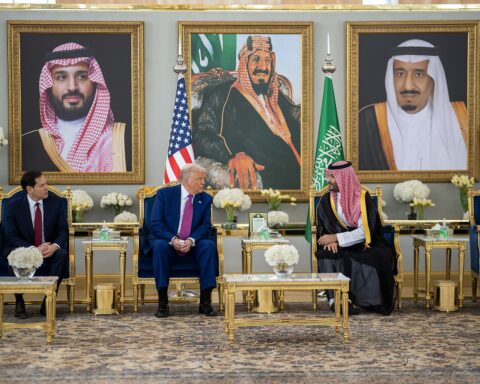
One day later, Trump made normalization the explicit price of the Iran deal itself — telling his Cabinet that Saudi Arabia must join the Abraham Accords as a condition of any agreement. That demand inserted the country excluded from five rounds of nuclear talks as the final closing cost of a deal Riyadh never helped negotiate.
Table of Contents
- What Did the FDD Actually Argue?
- The Asymmetry Charge Is Accurate and Irrelevant
- Who Is Hussain Abdul-Hussain?
- Why Was This Published on Arafah Day?
- FDD’s Congressional Pipeline
- What Did Saudi Arabia Get Without Normalizing?
- The 99 Percent Problem
- Can Saudi Arabia Deliver Irreversible Normalization?
- Frequently Asked Questions
What Did the FDD Actually Argue?
The FDD argued that Saudi Arabia applies an asymmetric diplomatic standard — engaging Iran without preconditions while demanding Palestinian statehood before any normalization with Israel. Abdul-Hussain described Saudi preconditions as “flowery language and voodoo diplomacy,” calling the “irreversible pathway” formulation deliberately undefined and obstructionist.
The core passage reads: “Saudi pundits say the kingdom has no objection to normalization provided Israel first grants the Palestinians a state or at least an ‘irreversible pathway’ toward one. No one quite knows what an ‘irreversible pathway’ means.” Abdul-Hussain classifies Saudi conditioning as a negotiating dodge, contrasting it with the UAE’s unconditional Abraham Accords entry in 2020 and Bahrain’s same-day follow. His argument depends on treating all forms of diplomatic engagement — with Iran, with Israel — as equivalent commitments carrying equivalent domestic and legal consequences.
The May 26 piece was not a standalone argument. FDD published “Saudi Arabia’s Strange War: Appease Iran, Rebuff Israel” on May 12, and that article ran simultaneously on the Times of Israel blog platform. The two pieces form a sequenced case: the first establishes the “strange war” premise, the second converts it into the “voodoo diplomacy” charge on the day Saudi Arabia’s formal rejection would dominate headlines. A two-week arc across two outlets, timed to a confirmed data point, reads as a campaign built for Congressional consumption.
The Middle East briefing 3,000+ readers start their day with.
One email. Every weekday morning. Free.
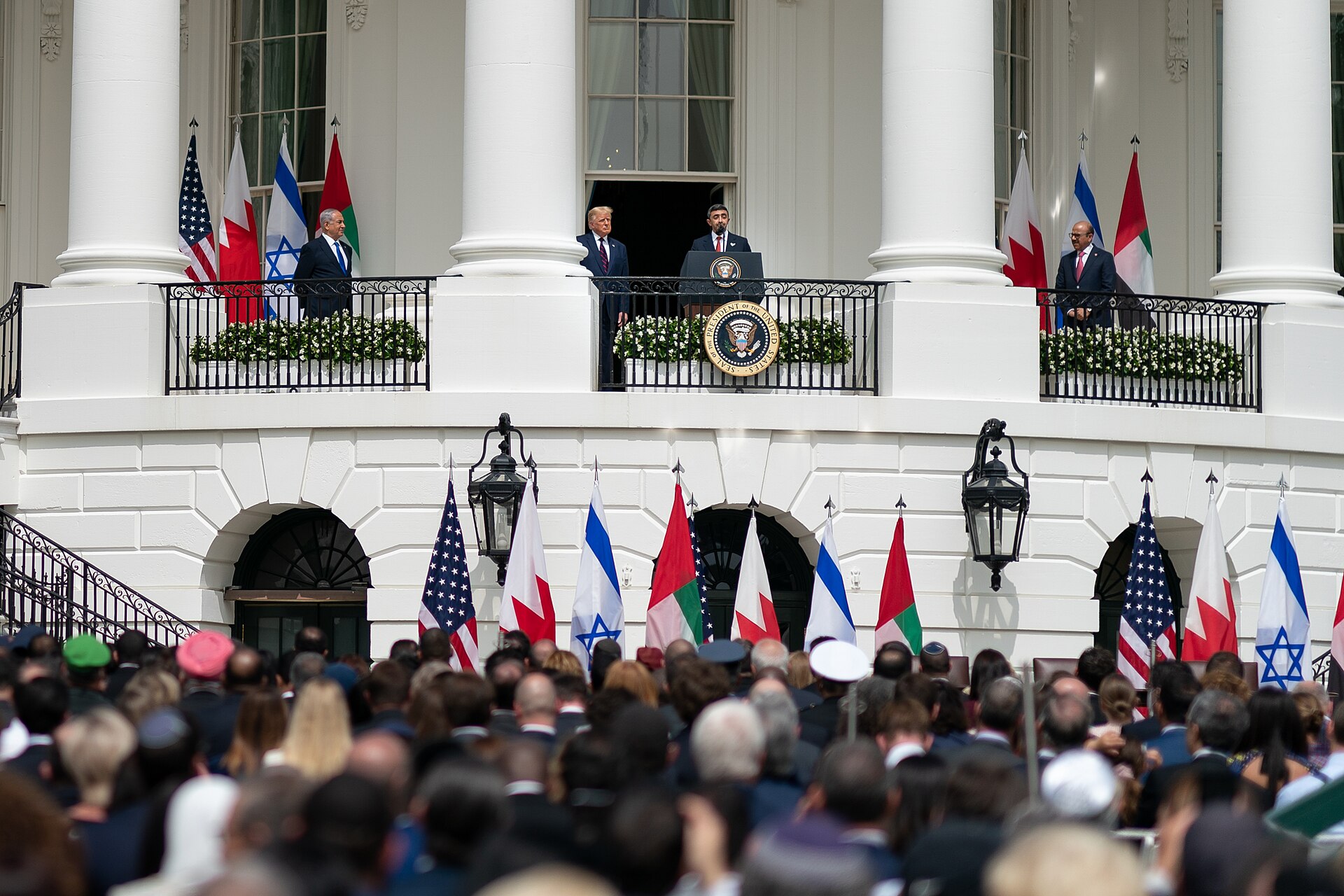
What the argument omits is more instructive than what it contains. There is no reference to the 2002 Arab Peace Initiative — the Saudi-authored multilateral framework that is the source document for the conditions FDD dismisses as voodoo. There is no mention of the Washington Institute’s polling data showing 99% Saudi opposition to normalization. There is no acknowledgment that Washington dropped its own Palestinian-state precondition at the November 2025 MBS visit before Saudi Arabia moved on anything. And there is no analysis of whether normalization with a nuclear-armed state at war carries the same domestic reversibility as diplomatic engagement with a neighbor whose threat profile is already priced in.
The Asymmetry Charge Is Accurate and Irrelevant
Saudi Arabia does, in fact, apply different standards to Iran and Israel. The 2023 Beijing deal committed both sides to “respect state sovereignty and not interfere in each other’s internal affairs” — language that cost Riyadh nothing domestically and required no public endorsement of Iranian political legitimacy. Carnegie described it as “detached pragmatism,” driven by Saudi Arabia’s conclusion that “we cannot get rid of them, and they can’t get rid of us.” Iran engagement served Vision 2030’s economic development agenda without requiring Saudi Arabia to submit to any externally-imposed framework or publicly rewrite its regional alliances.
Normalization with Israel carries a different structural weight. It requires Saudi Arabia to publicly endorse a diplomatic relationship that 99% of its population opposes — a figure the Washington Institute recorded in August 2025. It would make Saudi Arabia a junior entrant to the Abraham Accords, a framework branded by the UAE — its chief intra-Gulf rival. And under Saudi Arabia’s constitutional structure, it would produce a commitment that cannot be institutionally entrenched in a form that survives a change in monarch.
FDD’s asymmetry argument treats all diplomatic relationships as fungible — as if opening a consulate in Tehran and recognizing Jerusalem operate on the same domestic and constitutional register. The Beijing deal was reversible by nature: a joint statement, a handshake, a non-interference commitment that either party could abandon without domestic political consequence. Normalization would be functionally irreversible, because it would restructure Saudi Arabia’s position in the Arab and Islamic world in ways that no subsequent king could quietly undo. The asymmetry in Saudi diplomacy reflects an asymmetry in what each relationship demands — and FDD’s refusal to name that distinction is the analytical failure at the center of the piece.
Abdul-Hussain’s FDD biography describes him as someone who “champions immediate, unconditional, and comprehensive peace between every Arab nation and the Jewish state.” An analyst whose institutional mandate requires unconditional normalization is not well-positioned to evaluate whether conditions are legitimate. The conclusion was embedded in the premise before the research began.
Who Is Hussain Abdul-Hussain?
Abdul-Hussain is an FDD research fellow, former Al-Rai bureau chief in Washington, Chatham House visiting fellow, and author of “The Arab Case for Israel.” He has written on Lebanese, Iraqi, and Gulf politics for two decades, and his analytical framework is consistent: Arab-Israeli normalization should be unconditional, and any Arab state that attaches conditions is obstructing peace.
Within that framework, the “voodoo diplomacy” label is internally coherent. Saudi Arabia is running a conditional policy; Abdul-Hussain considers all conditions illegitimate; therefore Saudi policy is illegitimate. The reasoning is circular, but he has held these positions publicly for years and has not disguised them. His personal consistency is not the issue.
The issue is the institutional amplification structure around his work. FDD does not publish Abdul-Hussain’s analysis as one perspective among several in a competitive marketplace of ideas. It publishes it as a policy input to the Congressional audience that FDD has cultivated through years of Iran-focused testimony, staff-level relationships on the Senate Foreign Relations and Armed Services committees, and a dedicated lobbying arm focused on Iran sanctions and Israel defense legislation. CEO Mark Dubowitz told Al Jazeera in May 2026: “If you know me, you know I live and breathe one mission: stopping a nuclear Iran.” Abdul-Hussain’s normalization track and Dubowitz’s Iran track run parallel, but both terminate at the same Congressional platform.
“If you know me, you know I live and breathe one mission: stopping a nuclear Iran.”
Mark Dubowitz, FDD CEO, Al Jazeera, May 6, 2026
The companion May 12 piece — “Saudi Arabia’s Strange War” — appeared simultaneously on the FDD website and the Times of Israel blog. Cross-publishing is not covert, and FDD does not hide its alignment. But the audience architecture matters: the FDD site targets Congressional staffers and executive-branch policymakers; the Times of Israel targets the Israeli public and diaspora opinion-makers. The same argument, optimized for two audiences, deployed against a country whose state media does not engage FDD directly and therefore cannot contest the framing in either venue.
Why Was This Published on Arafah Day?
The FDD piece appeared on May 26, 2026 — Arafah Day, the holiest day of the Hajj and the Islamic calendar, when Saudi Arabia’s role as custodian of Islam’s holiest sites is most visible to 1.9 billion Muslims. It landed the same day Saudi Arabia formally restated its normalization preconditions and the same day Pakistan’s defense minister publicly rejected the Abraham Accords in language Riyadh itself could not use.
The timing was optimal for FDD’s Congressional audience and structurally damaging for Saudi Arabia’s response capacity. Publishing a piece on Arafah Day that frames Saudi diplomatic conditions as “voodoo” forces a choice that FDD understands Riyadh cannot win: respond during Hajj and politicize the pilgrimage, or remain silent and let the charge settle into Washington’s working assumptions unchallenged. Saudi official channels do not engage FDD directly under any circumstances, and FDD has operated long enough to know this.
The day before, Trump asked eight leaders including Saudi Arabia to join the Abraham Accords on a group call. Axios reported the leaders “said they supported the Iran deal” but fell silent on normalization. Trump reportedly joked: “Are you still there?” By the time the FDD piece appeared the next morning, the Accords rejection was a confirmed data point, not a prediction. Abdul-Hussain was converting a refusal into an argument for Congressional action, with the rhetorical packaging — “voodoo” — designed to make the argument land as contempt rather than analysis.
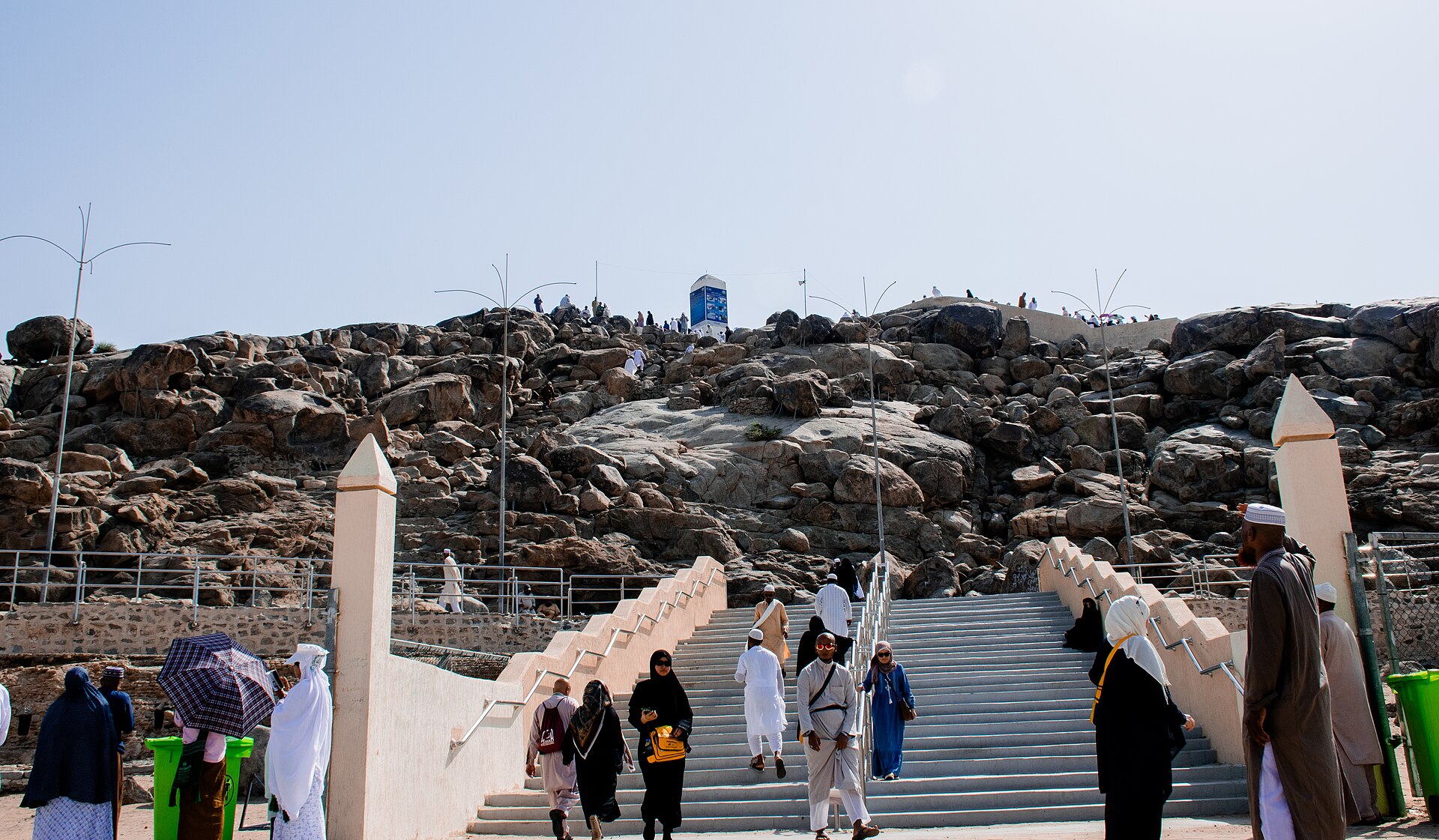
FDD’s publication calendar is not accidental. The think tank has testified before Congress on Iran more often than the Heritage Foundation or the American Enterprise Institute, both of which have larger staffs and broader mandates. A piece published on the day of a newsworthy Saudi rejection, labeling that rejection with a word — “voodoo” — chosen to diminish rather than describe, is designed to appear in Congressional inboxes the following Monday morning. The publication date is part of the argument.
FDD’s Congressional Pipeline
The “voodoo diplomacy” article did not land in a vacuum. On the same day, CNN reported Senator Tillis questioning the fundamentals of the emerging Iran deal. In the preceding week, Senator Wicker called the deal “a disaster” and former Secretary Pompeo amplified the critique from outside government. The Senate opposition and the FDD publication used the same structural argument — Saudi Arabia’s inconsistency — without formal attribution to each other. Synchronized messaging without explicit coordination is the signature of an effective influence network, and FDD has been building this one since its 2001 founding under the name “Emet,” the Hebrew word for truth, with a stated mission to “enhance Israel’s image in North America.”
FDD’s Congressional access is structural, not opportunistic. Its experts have testified before Congress 17 times on Iran alone — a frequency that builds the staff-level relationships determining which arguments make it into markup language and which floor statements cite which data points. When Wicker speaks on the Senate floor about the Iran deal’s dangers, his staff have read FDD’s latest analysis before the speech is drafted. The think tank functions less as a public-facing research institution and more as an outsourced policy shop for a specific Senate bloc.
The personnel pipeline runs in both directions. Nick Stewart, FDD Action’s managing director of advocacy, joined Steve Witkoff’s Iran negotiating team in May 2026 — placing an FDD-affiliated operative inside the deal process that FDD publicly opposes. Trita Parsi of the Quincy Institute responded: “Hiring an FDD staffer strongly suggests that reaching a diplomatic deal is not Trump’s objective.” Richard Goldberg, another FDD senior adviser, served on Trump’s National Security Council during the first term coordinating the “maximum pressure” sanctions architecture that the current deal would partially dismantle. FDD does not merely produce analysis for policymakers — its alumni become the policymakers, and its current staff join the teams they have spent years pressuring from outside.
The institutional position requires no inference. Dubowitz’s self-description — one mission, stopping a nuclear Iran — appeared in an Al Jazeera profile three weeks before the “voodoo diplomacy” piece. The post-9/11 rebrand shifted FDD’s public emphasis from Israel advocacy to democracy promotion and counterterrorism, but the Iran and Israel programming has remained the institutional core through both names and across four presidential administrations.
What Did Saudi Arabia Get Without Normalizing?
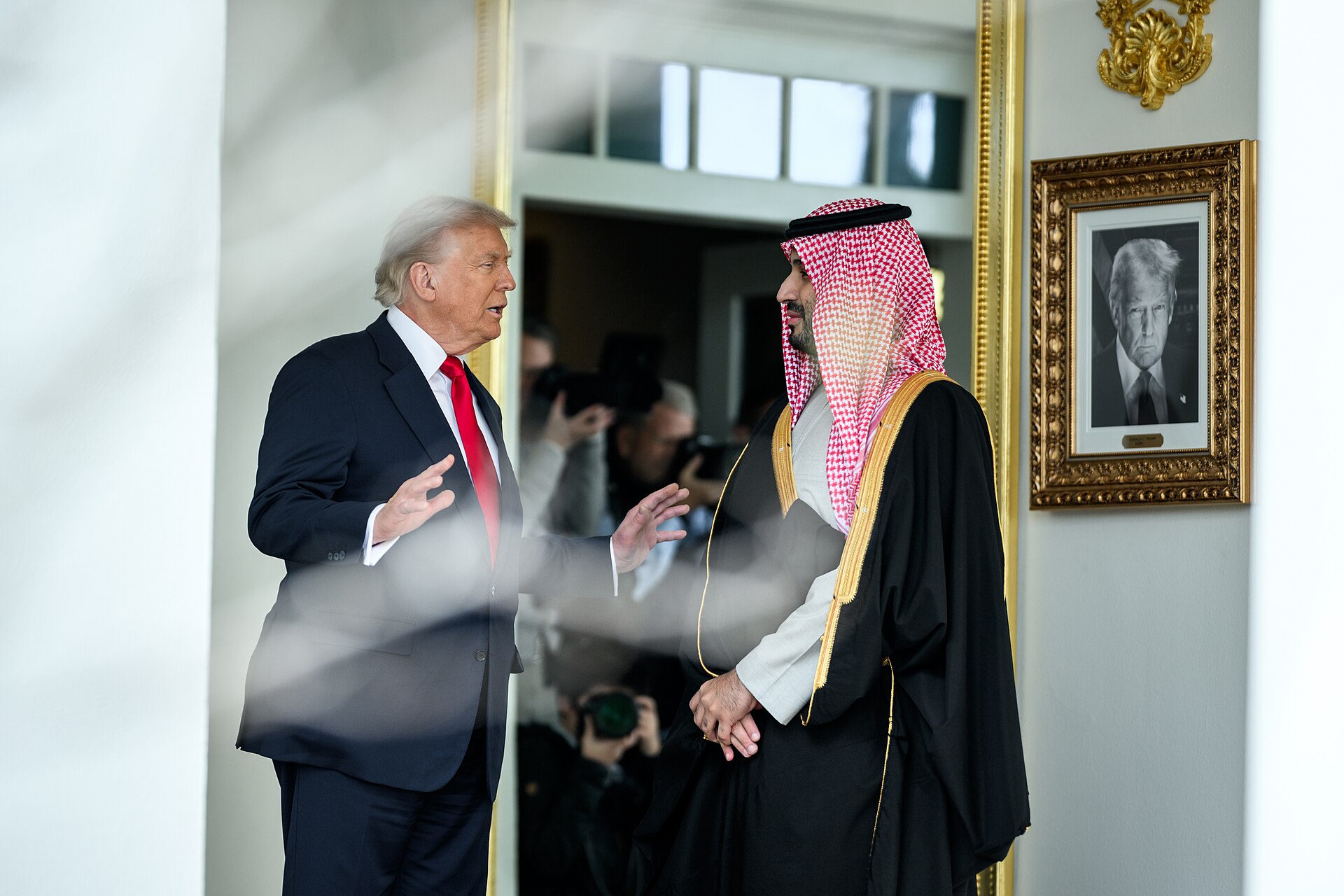
At Mohammed bin Salman’s November 2025 Washington visit, Saudi Arabia secured Major Non-NATO Ally status, F-35 fighter jet approval, access to 35,000 Nvidia AI chips, and the framework for a $1 trillion bilateral investment pledge — none of it conditioned on normalization. Washington dropped its own Palestinian-state precondition during the visit, a concession FDD’s framing entirely elides.
| Deliverable | Date | Normalization Required |
|---|---|---|
| Major Non-NATO Ally status | November 2025 | No |
| F-35 fighter jet approval | November 2025 | No |
| 35,000 Nvidia AI chip access | November 2025 | No |
| $1 trillion investment framework | November 2025 | No |
| US dropped Palestinian-state precondition | November 2025 | N/A — unilateral US concession |
Carnegie’s Aaron David Miller described the dynamic with precision: “MBS’s goal on this trip is to get as much as he can from Trump without making any serious public commitments on normalization.” Miller added the corollary that makes FDD’s framework collapse: “The more Trump gives to the Saudis — a security commitment, F-35s, a pledge to export U.S. nuclear technology and sophisticated semiconductors — the less incentive he’ll have for moving forward on normalization.”
“The more Trump gives to the Saudis — a security commitment, F-35s, a pledge to export U.S. nuclear technology and sophisticated semiconductors — the less incentive he’ll have for moving forward on normalization.”
Aaron David Miller, Carnegie Endowment, November 2025
FDD’s analysis cannot accommodate this structural fact. The table above shows what Saudi Arabia obtained without a normalization commitment. If those deliverables are available without the political cost, the conditions are not obstructionism — they are rational policy executed successfully.
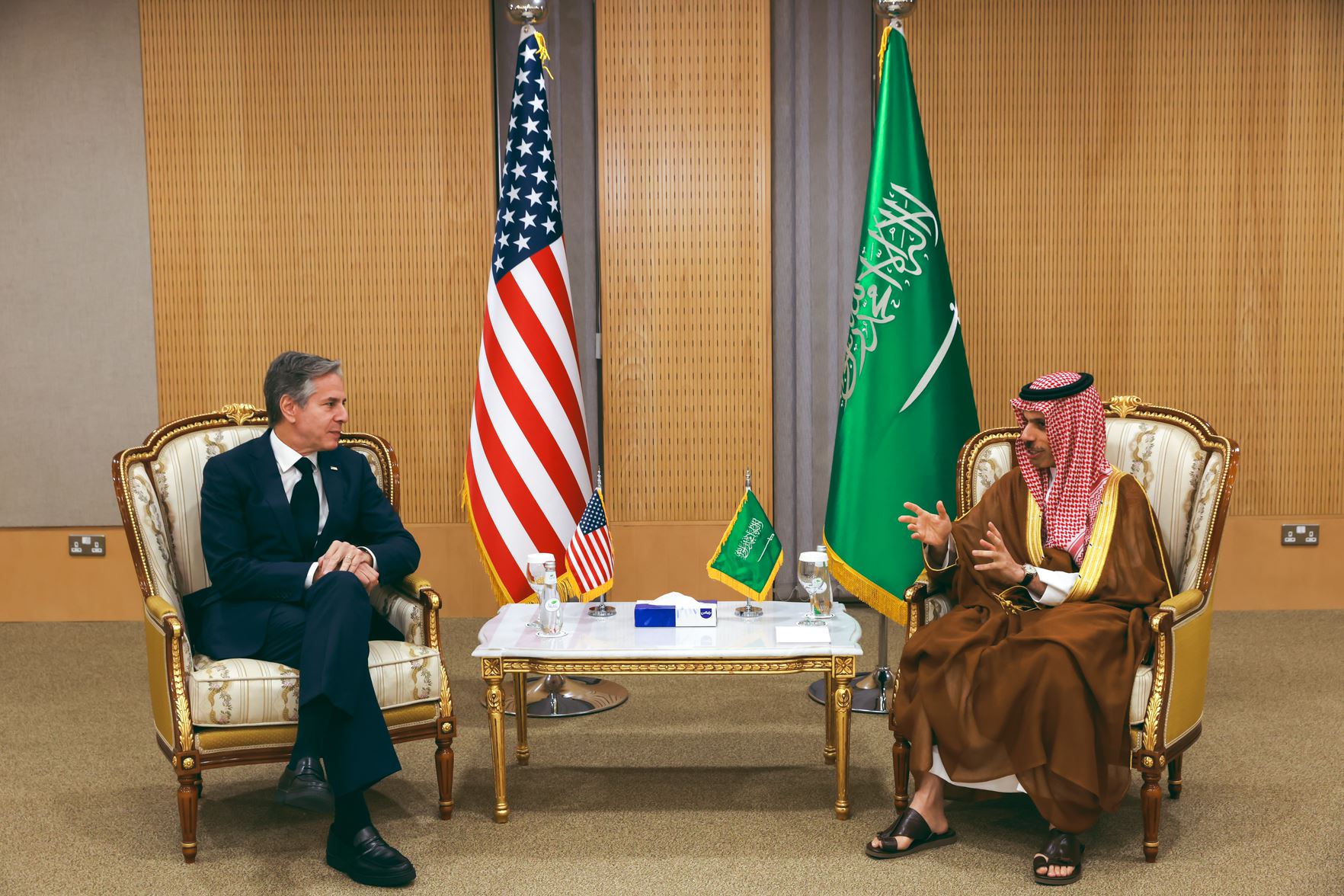
Saudi Arabia also abandoned the formal defense-treaty track after Washington made a NATO-Article-5-equivalent contingent on normalization — and Saudi Arabia was excluded from the Iran deal architecture it is now being pressured to reward with recognition. According to the Congressional Research Service (R48162), the US set conditions on Saudi Arabia for defense cooperation — the same structural move FDD criticizes Saudi Arabia for applying to Israel. Abdul-Hussain does not mention this inversion. The asymmetry runs in more than one direction.
The 99 Percent Problem
The Washington Institute’s August 2025 survey found that 99% of Saudi respondents viewed normal relations with Israel negatively — the highest rejection rate the institute has recorded for any bilateral question in the Gulf. During the Gaza war, 96% of Saudis favored severing all ties with Israel entirely. These are not numbers from a hostile polling outfit; the Washington Institute is a pro-Israel think tank whose data is regularly cited by the same policy community FDD operates within.
| Year | Saudi Support for Abraham Accords | Source |
|---|---|---|
| 2020 | 41% | Washington Institute |
| 2023 | 20% | Washington Institute |
| 2025 | 13% | Washington Institute |
Abdul-Hussain’s article does not mention this data. The omission is difficult to classify as an oversight — the Washington Institute is a primary polling authority on Gulf public opinion, and its 2025 survey was available to any analyst working the normalization beat when the FDD piece was published. Ignoring a 99% figure from a friendly source is an editorial decision, not a research gap.
MBS has described the constraint directly. In a meeting with then-Secretary Blinken in 2024, reported through INSS’s February 2026 analysis, he said: “Seventy percent of my population is younger than me. For most of them, they never really knew much about the Palestinian issue. And so they’re being introduced to it for the first time through this conflict.” To Congressional interlocutors, he added that normalization efforts “put his life at risk.” An MBS who told a Trump ally he would recognize Israel “today” but whose father represents an unfalsifiable constitutional veto is not opposing normalization on principle — he is calculating that the domestic price is currently unpayable, and that saying so openly would destroy the ambiguity Washington still finds useful.
INSS assessed that the 99% opposition figure “will constrain Saudi freedom of action and make it difficult to reverse course,” and that normalization probability “likely grows after King Salman dies.” FDD’s framework requires ignoring this data, because the polling transforms the “voodoo” charge from a critique of Saudi obstruction into an acknowledgment that Saudi leadership is responding to measurable domestic reality — the kind of democratic constraint argument that is difficult to dismiss when the numbers leave no interpretive room, which is likely why Abdul-Hussain did not attempt it.
Can Saudi Arabia Deliver Irreversible Normalization?
Under Saudi Arabia’s current constitutional structure, it almost certainly cannot. Article 55 of the Basic Law requires the King to rule according to Islamic traditions, with no separation of powers and no constitutional mechanism to entrench a peace treaty beyond the reigning monarch’s lifetime. A normalization decree by one king can be reversed by the next — and with 99% public opposition, every successor would face overwhelming domestic incentive to do so.
This is the structural reality FDD’s analysis will not engage. Abdul-Hussain treats Saudi Arabia’s demand for an “irreversible pathway” to Palestinian statehood as obfuscation — “no one quite knows what it means.” But the demand is also an institutional confession: Saudi Arabia knows that its own system cannot deliver irreversibility on its end. Any normalization would be royal-personal, not constitutionally entrenched, and would depend entirely on one monarch’s political calculus surviving into the next reign. The “irreversible pathway” demand is Saudi Arabia telling Washington that it needs external structural conditions to compensate for its own internal structural weakness — a point Abdul-Hussain would recognize instantly if the country in question were not Saudi Arabia.
The contrast with Iran engagement is precise. The 2023 Beijing deal was a joint statement that neither party’s domestic system required to be permanent. If the next Saudi king abandoned it, no alliance structure would rupture, no international framework would unravel, and no Congressional caucus would convene hearings. Abandoning normalization with Israel would trigger a diplomatic crisis with Washington, destabilize the Abraham Accords architecture, and reverse Saudi Arabia’s position in a web of bilateral commitments that the US, UAE, and Israel would treat as binding. The reversibility gap between the two relationships is not a Saudi invention — it is a structural fact that FDD’s analysis depends on suppressing.
Saudi Arabia also cannot join the Abraham Accords framework as currently constituted without accepting the UAE’s brand ownership of the architecture. As the Jerusalem Post reported in May 2026, any future normalization would likely require “an entirely Saudi-authored architecture, almost certainly anchored in the 2002 Arab Peace Initiative.” That initiative is not a recent rhetorical invention or “flowery language” — it is a multilateral framework adopted unanimously by the Arab League in 2002, reaffirmed in 2007 and 2017, and endorsed by the Organisation of Islamic Cooperation. Saudi Arabia authored it 24 years ago. Calling it “voodoo” is a choice that reveals the analyst’s institutional mandate more clearly than it describes Saudi foreign policy.
Frequently Asked Questions
Has Saudi Arabia ever engaged directly with Israel?
Saudi Arabia and Israel have maintained covert security and intelligence contacts for years, including reported coordination on Iran-related intelligence and Saudi overflight permissions for Israeli commercial aviation. In January 2024, Axios reported direct meetings on a normalization package including a US-Saudi defense treaty, civilian nuclear cooperation, and Palestinian statehood benchmarks. The covert engagement makes the public rejection more analytically meaningful — Riyadh can cooperate without formal recognition, which means the public conditions serve a domestic function that informal channels cannot replace.
What is FDD’s funding structure?
FDD does not disclose its donors publicly. Reporting by The New Yorker, The Intercept, and the Center for Responsive Politics has identified the late casino magnate Sheldon Adelson as a major past contributor, along with Home Depot co-founder Bernard Marcus and hedge fund manager Paul Singer. FDD Action, the organization’s 501(c)(4) arm, spent $150,000 on lobbying in early 2025 focused on Iran sanctions and Israel defense legislation. The funding base aligns with maximalist positions on both Iran and Israel tracks — an institutional incentive structure that does not reward nuanced analysis of Saudi domestic constraints.
Does the 2002 Arab Peace Initiative have international support beyond the Arab League?
The initiative was adopted unanimously by the Arab League at its Beirut summit in March 2002 and reaffirmed at summits in Riyadh (2007) and Amman (2017). The Organisation of Islamic Cooperation, representing 57 states, endorsed it. The European Union has described it as “a key element of a comprehensive peace.” The initiative offers full Arab normalization with Israel in exchange for Israeli withdrawal to 1967 borders and a just refugee solution — terms consistent for 24 years, with broader multilateral backing than the Abraham Accords.
Could a future Saudi king normalize without conditions?
Constitutionally, yes — a royal decree can establish diplomatic relations without legislative ratification. Politically, the trajectory runs in the other direction. INSS assessed in February 2026 that normalization probability “likely grows after King Salman dies,” but the August 2025 polling showing a 99-to-1 opposition ratio suggests any post-Salman monarch would face the same public opinion wall. The ADL noted in January 2026 an “intensification of anti-normalization discourse” among Saudi youth — the same demographic MBS identified as the constraining variable. MBS’s September 2024 address to the Shura Council affirming Palestinian statehood as a precondition has also created a public commitment that would be politically costly to reverse, regardless of who occupies the throne.
Why does FDD focus on Saudi Arabia rather than other non-normalizing Arab states?
Saudi Arabia is the prize that gives the Abraham Accords geopolitical weight. The UAE, Bahrain, Morocco, and Sudan normalized without moving regional opinion or creating a cascade effect. Saudi normalization — as custodian of Islam’s two holiest sites and the Arab world’s largest economy — would rewrite the framework entirely. FDD targets Riyadh because its resistance is the largest obstacle to unconditional normalization, and Hajj-season silence creates a window for the charge to circulate without rebuttal.