
DHAHRAN — Saudi Aramco on Tuesday reported a third-quarter net profit of $36.25 billion, a 34 percent increase from a year earlier, even as the company disclosed that Saudi crude output fell to roughly 8 million barrels a day in September — two million below pre-war levels. The result, announced on the same morning that Iran fired on a US aircraft over the Strait of Hormuz, amounts to a financial X-ray of what the war is doing to Saudi Arabia: contracting the economy while enriching the company that underwrites it.
Adjusted net income, excluding a one-off gain from the sale of Aramco’s stake in a Malaysian refining joint venture, was $31.2 billion — up 9 percent from a year earlier and roughly $540 million above the median forecast of $30.66 billion from 12 analysts surveyed by Aramco, according to CNBC. Saudi Arabia’s finance ministry, in its September 30 pre-budget statement, projects real GDP falling 3.6 percent in 2026 with oil activities contracting 21.8 percent, according to Reuters via Zawya, while the IMF’s October World Economic Outlook puts the contraction at 3.3 percent. The gap between Aramco’s earnings and the kingdom’s fiscal trajectory is the arithmetic of a war economy in which higher prices compensate the company for the same lost barrels that are draining the Saudi treasury.
The House of Saud Daily Briefing
Saudi Arabia's news in 3 minutes, every morning. Free. See today's issue
“Geopolitical uncertainty and attacks on key energy facilities continued to amplify the global energy supply crisis in the third quarter of 2026, with serious implications for global energy security.”
— Amin H. Nasser, CEO, Saudi Aramco, Q3 2026 earnings statement
Table of Contents
The Earnings Breakdown
The headline profit — up from $26.9 billion in Q3 2025 — overstates the underlying improvement because it includes a gain from Aramco’s sale of its 50 percent stake in the PRefChem refining and petrochemical joint ventures in Malaysia to Petronas, completed in September, according to Arab News and RTÉ. The adjusted result, which strips out that one-off gain, rose from a Q3 2025 baseline of $28.6 billion, according to Saudi Gazette and CNBC, providing a cleaner measure of what the war economy is generating quarter to quarter.
Free cash flow hit $28.2 billion for the quarter, up from $23.6 billion a year earlier, with operating cash flow of $38.7 billion, according to Egypt Oil Gas and Gulf News — numbers that comfortably covered the quarterly dividend and demonstrate the revenue advantage of selling fewer barrels at sharply higher prices. The consensus beat was driven primarily by a record quarter in refining and petrochemicals, which generated downstream earnings that no analyst had fully priced in.
On a sequential basis, however, the trajectory is less flattering: adjusted net income declined from $33.59 billion in Q1, according to Rigzone, and $33.4 billion in Q2, according to QNA, as the realised crude price retreated from its Q2 peak. The year-on-year comparison flatters because Q3 2025 preceded the worst phase of the war, and the crude prices of that era now belong to a different chapter of Saudi oil economics.
Why Did Upstream Profits Fall Despite Higher Crude Prices?
Aramco’s upstream adjusted EBIT fell 9 percent year on year to $46.8 billion, despite the average realised crude price rising from $70.1 a year ago to $95.2 a barrel in Q3 — itself a retreat from $108.1 in Q2 — according to RTÉ, Gulf News, Saudi Gazette and Investing.com. The explanation is volume: total hydrocarbon production dropped to 11.05 million barrels of oil equivalent per day from 13.3 million a year earlier, a decline of 17 percent that more than offset the price gain, according to RTÉ.
Saudi crude output in September remained roughly 2 million barrels a day below the pre-war level of just over 10 million, RTÉ reported, a gap that reflects both the physical constraints of exporting through a war zone — where the Strait of Hormuz remains under Iranian blockade and attacks on export infrastructure have become routine — and the reality that Saudi Arabia’s OPEC+ target of 10.5 million barrels a day, according to Enerdata, sits well above what the kingdom can actually ship. Total liquids production of 8.7 million barrels a day was up 15 percent from Q2 but still 19 percent below the 10.8 million of a year earlier, according to RTÉ and the earnings call transcript published by Investing.com.
Supply reliability, Aramco’s measure of the proportion of contracted volumes actually delivered, fell to 97.8 percent from 99.9 percent a year ago and 98.4 percent in Q2, according to RTÉ. That 2.1-percentage-point decline translates directly into missed cargoes, insurance repricing, and the kind of delivery uncertainty that Nasser acknowledged on the earnings call when he said Gulf crude exports had not yet returned to pre-conflict levels, according to the Investing.com transcript — a statement that directly contradicts claims from other Gulf outlets that exports have returned to pre-war volumes.
The Downstream Record
If upstream earnings told the story of lost barrels, downstream told the story of what happens to the barrels that remain in the system. Aramco’s downstream adjusted EBIT hit $10.3 billion in Q3, a record, up 234 percent from the same quarter a year earlier, according to CNBC and Saudi Gazette. The surge reflects a refining environment in which crack spreads — the margin between crude input costs and refined product prices — have been elevated by the same supply disruptions that are constraining crude exports, as refineries closer to demand centres in Asia and Europe bid aggressively for every barrel that makes it through the chokepoints.
The PRefChem stake sale to Petronas also simplified Aramco’s downstream portfolio at a moment when the company is pivoting refining capacity toward higher-margin products and shorter supply chains. Nasser, speaking at the Energy Intelligence Forum in London on October 5, said global oil stockpiles had become “scarily thin,” as reported by The National — a framing that helps explain why refining margins have stayed elevated even as crude prices retreated from Q2 peaks, because a world with thin inventories is a world where refiners pay premiums for supply certainty that Aramco, for all its wartime constraints, can still partially deliver.
How Is Aramco Hedging Against Its Own Export Vulnerability?
The most consequential disclosure in Tuesday’s earnings was not a financial figure but an infrastructure one: Nasser confirmed that preliminary engineering is underway for an expansion of the East-West Pipeline, the 1,200-kilometre route from the Eastern Province fields to the Red Sea terminal at Yanbu, according to the earnings call transcript published by Investing.com and a separate report by Asharq Al-Awsat. The pipeline’s current design capacity is 7 million barrels a day, according to Saudi Gazette via Zawya, and Nasser said in October at the Energy Intelligence Forum that Aramco aims to raise it to 10 million, according to The National — a target that would make the overland route capable of handling nearly all of the kingdom’s pre-war crude exports without any traffic through the Strait of Hormuz.
Nasser said in October that oil prices could have reached as high as $200 a barrel without the East-West Pipeline, according to The National’s report from the London forum on October 5 — a statement that frames the pipeline not as a convenience but as the single piece of infrastructure that prevented a global energy crisis from becoming a catastrophe. He also told the October 5 audience that Aramco’s “system is intact,” according to The National, though the supply reliability data disclosed on Tuesday qualifies that claim with numbers the London audience did not have. On the earnings call, Nasser added that Aramco could reach its 12-million-barrel-a-day maximum sustainable capacity “in under three weeks” if ordered to ramp, according to Investing.com.
The company is also building redundancy beyond the pipeline. Nasser said Aramco continues “to explore additional overseas storage capacity and alternative export routes to further strengthen our global supply network,” according to The National and CNBC. The Zuluf crude increment project has begun production and is expected to reach 600,000 barrels a day by the end of 2026, according to RTÉ and Asharq Al-Awsat, adding new supply at a moment when the kingdom’s ability to move oil through the Strait of Hormuz remains constrained by Iranian mines and the continuing blockade.

The War Economy’s Balance Sheet
Aramco’s $21.9 billion base dividend for Q3, up 3.5 percent year on year and payable in Q4, according to CFO Ziad Al-Murshed on the earnings call as reported by Investing.com, flows almost entirely to the Saudi government, which holds approximately 97.6 percent of the company, according to Saudi Gazette — yet the government receiving those dividends is running a deficit that has blown past every forecast made at the start of the year. The finance ministry’s September 30 pre-budget statement revised the 2026 deficit to SAR 245 billion, up from the SAR 165 billion originally budgeted, according to Reuters via Zawya.
Capital expenditure fell to $10.5 billion in Q3 from $12.6 billion a year earlier, according to The National and Saudi Gazette — a reduction that in a normal year would signal capital discipline but in a war year reads as a company rationing investment toward the projects most likely to survive the conflict, including the pipeline expansion and Zuluf. Gearing, Aramco’s measure of net debt to equity, fell to 5.5 percent from 6.2 percent at the end of June, according to Gulf News, a balance sheet strong enough to sustain the dividend for now but one that exists inside an economy both the finance ministry and the IMF expect to contract.
President Trump, during Q2 earnings season in August, criticised oil companies for “making too much money,” according to Fox News — a comment directed at the industry broadly but applicable to Aramco with particular force, given that the US-enforced blockade of Iran and the broader conflict are the primary drivers of the price elevation that makes Aramco’s war-diminished output profitable. The Makkah Pact’s inability to establish a joint command and Tuesday’s exchange of fire over Hormuz only deepen the uncertainty around how long the wartime premium — and the costs it imposes on the Saudi economy — will persist.
Background
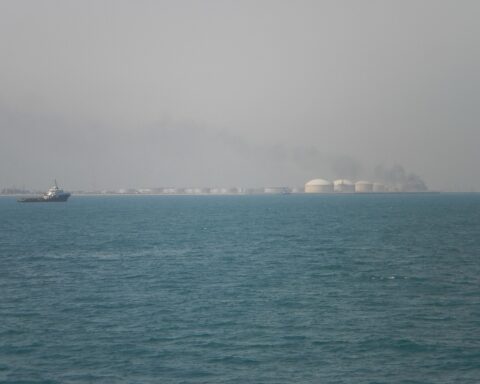
Saudi Arabia has been at war with Iran since the IRGC resumed its blockade of the Strait of Hormuz in July, and Houthi missile and drone campaigns have struck targets from Aramco’s Shaybah oilfield in the Rub’ al Khali to the company’s Dhahran headquarters, which was hit on October 13. The East-West Pipeline, Aramco’s overland alternative to the Hormuz chokepoint, was suspended in September after a pumping station was struck by a missile and restarted on September 22 at reduced capacity, according to Reuters and Saudi Gazette via Zawya.
Full-year 2025 adjusted net income was $104.7 billion, according to Aramco’s investor release in March. Brent crude has traded above $100 for most of the third quarter, standing at $102.94 on October 9 according to CNBC — a price level at which every barrel that Aramco manages to move through the degraded Gulf corridor or across the pipeline earns more than a third more than it did a year earlier, even as fewer barrels make the journey.
Frequently Asked Questions
Does Aramco still pay a performance-linked dividend?
Aramco suspended its performance-linked dividend — the variable payout tied to free cash flow exceeding the base dividend — after Q2 2026, when free cash flow of $12.3 billion fell below the $21.9 billion base dividend for that quarter, according to Egypt Oil Gas. The Q3 base dividend of $21.9 billion was covered by Q3 free cash flow of $28.2 billion, but Aramco has not reinstated the performance-linked component, and management did not address the variable payout on Tuesday’s call.
Has the East-West Pipeline expansion received a final investment decision?
No. Nasser confirmed on Tuesday that preliminary engineering is underway, but said no details would be announced before a final investment decision is reached, according to the Investing.com earnings call transcript. The expansion targets a capacity of 10 million barrels a day, up from the current 7 million, which would require additional pumping stations and pipeline loops along the 1,200-kilometre route from the Eastern Province to the Red Sea terminal at Yanbu.
What did Aramco set as its November crude pricing for Asian buyers?
Aramco cut the November official selling price for Arab Light to Asia by $3, setting it at $5 below the Oman/Dubai benchmark — the widest discount since June 2020, according to Reuters via bdnews24 on October 5. The aggressive pricing signals an effort to retain market share in Asia even as total Saudi export volumes remain below pre-war levels. Aramco simultaneously raised prices to northwest European buyers by $3, according to the same report, redirecting available barrels toward the highest-margin destination markets.
The House of Saud Daily Briefing
Saudi Arabia's news in 3 minutes, every morning. Free. See today's issue