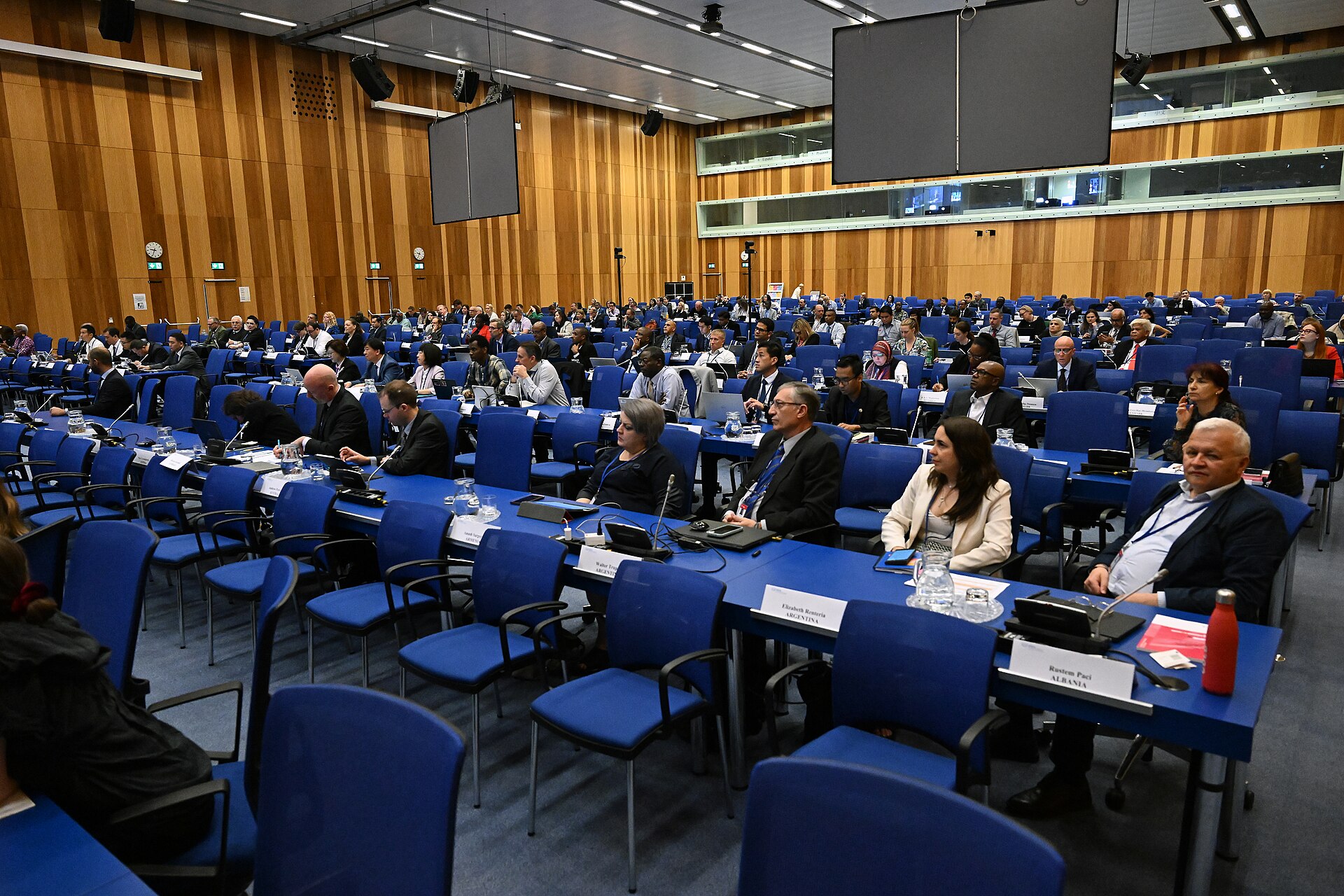
VIENNA — On June 5, IAEA Director General Rafael Grossi told reporters that the United States and Iran appeared “pretty close” to agreeing on a nuclear framework. On the same day, in the same city, the United States circulated a draft Board of Governors resolution condemning Iran and demanding immediate inspector access to nuclear facilities sealed since February 28. Saudi Arabia holds a seat on the thirty-five-member Board through 2027. Within days, it must cast a vote — or visibly decline to cast one.
A yes aligns Riyadh with Washington and signals hostility to Tehran four days before Iran’s expected formal rejection of the American memorandum of understanding. A no breaks from the United States weeks after the $142 billion arms agreement signed on May 13. An abstention gives Iran procedural cover at the moment Tehran is hardening its nuclear posture. Foreign Minister Prince Faisal bin Farhan has not made a substantive public statement on the Iran conflict since May 20. The IAEA Board does not accommodate silence.
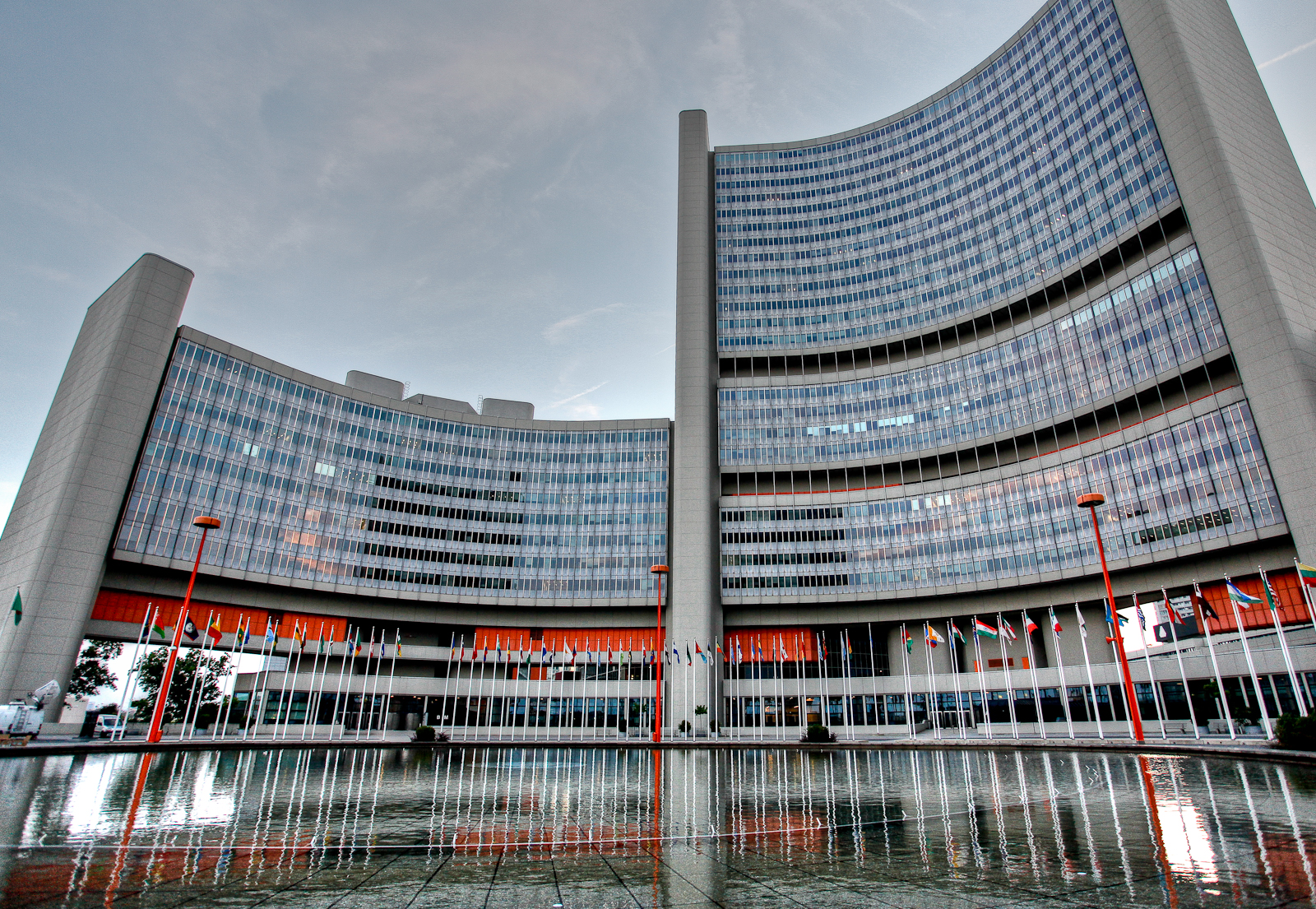
Table of Contents
- What Did Grossi Say About the Status of US-Iran Nuclear Talks?
- The Censure Draft Circulated in the Same Building
- Why Does Every IAEA Censure Trigger Iranian Nuclear Escalation?
- What Are Saudi Arabia’s Three Options on the IAEA Board?
- Grossi Briefed Riyadh Two Days Before Washington Circulated the Draft
- The 123 Agreement Gives Iran a Procedural Weapon
- How Does June 9 Collapse the Censure Timeline?
- Sixteen Days of Silence and a Roll-Call Vote
- Frequently Asked Questions
What Did Grossi Say About the Status of US-Iran Nuclear Talks?
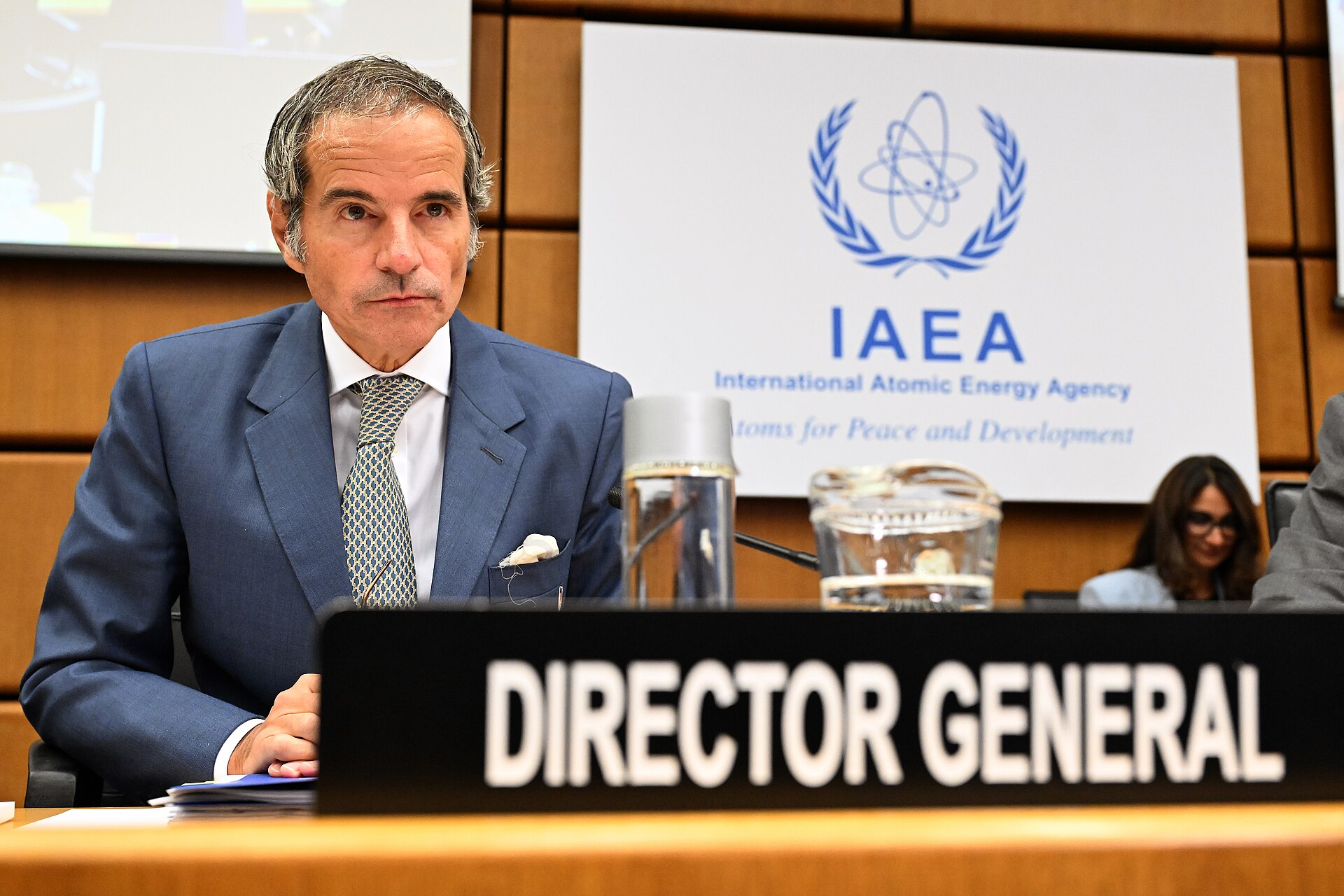
Grossi said on June 5 that the United States and Iran “seem to be pretty close to agreeing on what I would describe more… a framework, organizational structure to give themselves time to look into the different problems.” The language describes proximity to a process, not to a resolution. A framework for further negotiation is the lowest tier of diplomatic architecture — an agreement on what to discuss, not on what to conclude.
“Our sense is that they seem to be pretty close to agreeing on what I would describe more… a framework, organizational structure to give themselves time to look into the different problems.”
— Rafael Grossi, IAEA Director General, June 5, 2026
Grossi outlined three disposal paths for Iran’s stockpile of 60%-enriched uranium: export out of the country, dilution to lower enrichment levels, or in-country storage under IAEA monitoring. None can proceed until inspectors return to Iranian facilities. The last physical verification of Iran’s stockpile — 440.9 kilograms of uranium enriched to 60% U-235 — took place in June 2025, before Iran removed all cameras, seals, and inspectors. The blackout has now lasted ninety-seven days.
The Middle East briefing 3,000+ readers start their day with.
One email. Every weekday morning. Free.
In a separate interview on June 2, Grossi confirmed that the 2015 Joint Comprehensive Plan of Action is no longer a workable model. Iran’s nuclear capabilities have advanced too far for any new agreement to replicate the JCPOA’s terms. Whatever emerges must “reflect today’s realities.” Those realities include an unverified stockpile that has grown without independent measurement for over three months, and a diplomatic channel whose proximity to “framework” status Grossi announced on the same day his own institution became the venue for a condemnation of the other party.
The Censure Draft Circulated in the Same Building
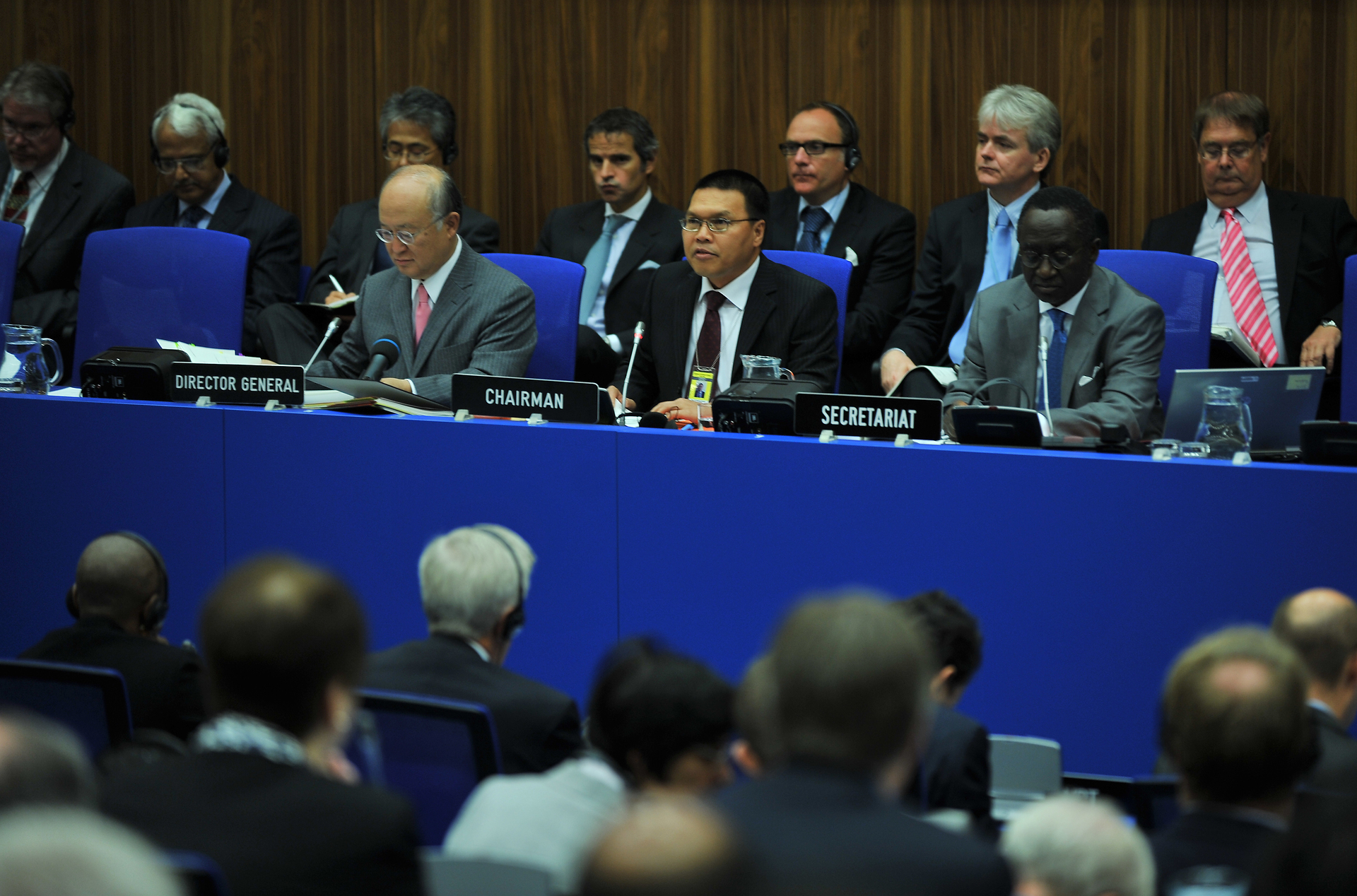
On the same June 5 that Grossi described proximity to a framework, the United States was confirmed to be preparing a draft resolution condemning Iran and calling for immediate IAEA access. The draft targets the same access deficit that the framework negotiations are presumably designed to restore — the absent inspectors, the sealed facilities, the unverified enrichment.
Russia’s Permanent Representative to the IAEA, Mikhail Ulyanov, warned on the sidelines of the Board session that the draft could antagonize Tehran. Ulyanov does not freelance on Iran policy; his public remarks at the Board are coordinated with Moscow’s broader diplomatic posture. Russia and China have voted against every IAEA censure resolution on Iran since June 2022. At the UN Security Council, the two vetoed a Hormuz-related resolution on April 7. The IAEA Board operates without a veto, so Russia and China’s instrument is delegitimization — framing the censure as Western bad faith during active diplomacy.
China has maintained the same opposition without the public commentary. Beijing voted against every Iran censure — June 2022, November 2022, June 2024, June 2025, November 2025. The margin has narrowed from 30-2 in June 2022 to 19-3 in November 2025 as the abstention bloc grew from three to twelve states. Each resolution passes. Each passage triggers an Iranian response.
Washington has combined pressure and negotiation on Iran before. What distinguishes this instance is the calendar: the censure draft circulated on the day Grossi publicly called the talks close, and the Board quarterly meeting the following week falls within the same window as Iran’s expected MOU rejection on June 9. The resolution does not arrive at a safe distance from a deal, where it might serve as an inducement. It arrives four days before the deal’s expected collapse.
Why Does Every IAEA Censure Trigger Iranian Nuclear Escalation?
Every IAEA Board censure resolution on Iran since 2022 has been followed by a specific Iranian nuclear escalation. The pattern holds across five resolutions in four years. Iran does not absorb censure as a diplomatic cost; it converts each resolution into domestic authorization for a step its nuclear program was already technically prepared to take.
| Date | Resolution | Vote | Iranian Response |
|---|---|---|---|
| June 2022 | Censure for undeclared sites | 30–2 | Removed IAEA cameras and monitoring equipment |
| November 2022 | Second censure | 26–2–5 | Began 60% enrichment at Fordow |
| June 2024 | Reaffirmed demands | 20–2 | Expanded enrichment capacity |
| June 2025 | Noncompliance finding | 19–3–11 | Announced new enrichment facility; sixth-generation centrifuges at Fordow |
| November 2025 | Demanded information and access | 19–3–12 | Withdrew from Cairo Agreement; weighed NPT exit |
Sources: Arms Control Association; IAEA; Axios; RFE/RL; Al Jazeera; Iran International
The responses have grown in severity with each iteration. Removing cameras in 2022 was a surveillance countermeasure. Enriching to 60% at Fordow was a production escalation. Announcing a new enrichment facility in a “secure location” with advanced centrifuges, as Iran did after the June 2025 noncompliance finding, was an infrastructure commitment. By November 2025, Iran was weighing withdrawal from the Nuclear Non-Proliferation Treaty — a structural break from the international regime, not a technical adjustment within it. Iran International reported that Tehran submitted a letter to the United Nations warning that sanctions triggered by the censure could prompt NPT exit.
The mechanism is not impulsive. Iran’s post-censure escalations follow a domestic authorization sequence: the Supreme National Security Council frames the resolution as Western provocation, the Supreme Leader’s office authorizes a response in nuclear policy, and the Atomic Energy Organization of Iran executes the technical step. The escalation is predetermined but requires a trigger. Censure resolutions serve as that trigger because they provide political cover for steps the program was already prepared to take.
The Washington Institute for Near East Policy assessed that “how Tehran responds to the new IAEA censure is guesswork, but a response of some sort is almost certain.” The June 2026 censure — if passed — arrives when Iran is already positioned to reject the MOU. A resolution gives Tehran a second vehicle for the same escalation.
What Are Saudi Arabia’s Three Options on the IAEA Board?
Saudi Arabia faces three options when the censure resolution reaches a vote at the Board quarterly meeting. Each carries a distinct cost, and none aligns with Riyadh’s posture of managed ambiguity on the US-Iran confrontation.
A yes vote aligns Saudi Arabia with the United States and the European sponsors of the resolution. It endorses the framing of Iran’s access denial as a violation warranting formal condemnation. The cost is diplomatic: four days before Iran’s expected MOU rejection, a Saudi vote condemning Tehran eliminates any remaining claim to a mediation role — a role Riyadh has constructed through private channels involving Pakistani and Omani intermediaries. A yes vote from Saudi Arabia would be read in Tehran not as a procedural formality but as active alignment with the pressure campaign that Iran has cited as justification for suspending talks.
A no vote places Saudi Arabia alongside Russia, China, and — in November 2025 — Niger. The political symbolism of joining a bloc defined by opposition to Western nonproliferation enforcement is untenable in the same quarter as the May 13 arms agreement and the Section 123 civilian nuclear cooperation deal. A Saudi vote against a US-sponsored resolution on nuclear transparency would enter the congressional record at a moment when the 123 Agreement requires sustained American legislative tolerance for its gold-standard omissions.
An abstention is the path of least immediate damage, and the one Saudi Arabia most likely chose in November 2025, when twelve Board members abstained. But abstention has its own price. In November, Iran’s Foreign Minister Abbas Araghchi responded to the resolution — which passed despite the abstentions — by withdrawing from the Cairo Agreement and calling the vote one that “called into question the credibility and prestige” of the IAEA. The abstentions did not moderate Tehran’s response. In June, an abstention would enlarge the bloc of states declining to enforce access, a signal Iran can interpret as erosion of the consensus behind inspections.
For a country building its own nuclear reactors at Khor Duweihin — two 1.4-gigawatt units discussed with Grossi two days before the censure draft appeared — weakening the IAEA’s inspection mandate is a long-term structural liability, even if it resolves a short-term diplomatic bind. Saudi Arabia’s Section 123 agreement with Washington deepens the bind: the deal permits Saudi enrichment without the Additional Protocol conditions the censure demands of Iran, placing the kingdom’s yes vote in formal contradiction with its own bilateral nuclear terms.
The twelve-state abstention bloc has grown steadily — from three in June 2022 to five in November 2022 to eleven and twelve in 2025. Its expansion tracks the number of Board members unwilling to endorse censure but unprepared to vote against it. The abstention category has become the Board’s diplomatic center of gravity on Iran, a position that allows members to avoid both the cost of opposing Washington and the cost of antagonizing Tehran.
That position was tenable when the Iran file involved enrichment disputes and inspector access negotiations conducted in peacetime. Under active hostilities, with Iranian missiles striking Gulf airports and Hormuz closed to commercial shipping, the abstention carries a different weight. Neutrality on a censure resolution is harder to sustain when the state under censure is firing at your neighbors.
Grossi Briefed Riyadh Two Days Before Washington Circulated the Draft
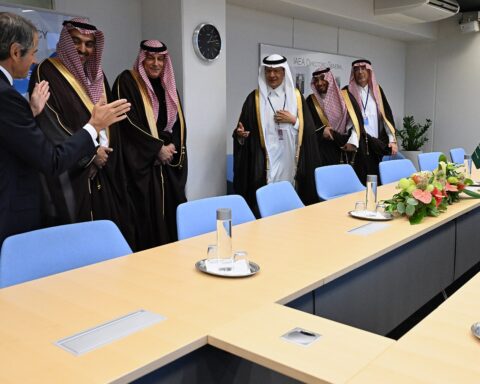
On June 3, Grossi met Saudi Energy Minister Prince Abdulaziz bin Salman and Foreign Minister Prince Faisal bin Farhan in Riyadh, at the conclusion of a Gulf nuclear-safety tour that began with an assessment of drone damage at the Barakah reactor complex in the UAE. The Barakah visit was itself a product of the war — Iranian-origin drones struck the Arab world’s only operational nuclear power plant, damaging non-reactor infrastructure and prompting the IAEA director general’s Gulf itinerary. The Riyadh meetings covered the Saudi National Atomic Energy Project, the Khor Duweihin reactor program, nuclear safety under wartime drone threat, and a December 2026 nuclear-emergency conference that Riyadh will co-host with the IAEA. Grossi told AFP he was visiting Riyadh “because several countries in the region have serious concerns” about operating reactors while a war is underway. The sequence — Barakah, Riyadh, Vienna — compressed the physical-safety and nonproliferation dimensions of the Iran conflict into a single three-stop itinerary.
Two days later, the United States circulated a censure draft at the Board that Grossi chairs — a draft demanding the same Iranian inspector access that Grossi discussed with Saudi officials on June 3. No reporting has connected these events. The gap matters: Grossi’s Riyadh stop means FM Faisal was briefed, in person and at the ministerial level, on the IAEA’s access demands and the state of Iran’s noncompliance before the United States moved to formalize those demands into a Board resolution. Saudi Arabia’s vote will not be uninformed. It will be informed and forced.
The Riyadh visit had a structural dimension as well. The December conference that Grossi and Prince Abdulaziz discussed — on nuclear safety during armed conflict — positions Saudi Arabia as a convener alongside the agency whose access demands are now the subject of a censure vote. Riyadh is not merely a consumer of Board decisions; it is becoming a partner in the IAEA’s institutional agenda. Co-hosting a December conference with the IAEA while declining to support a June resolution on the agency’s core mandate would be a difficult sequence. Grossi, who agreed to the conference during the same June 3 meetings, would have been aware of the implication.
The 123 Agreement Gives Iran a Procedural Weapon
On May 13, the United States and Saudi Arabia signed a Section 123 civilian nuclear cooperation agreement. The agreement omits all three elements of the gold standard that Washington applied to the UAE in 2009: no enrichment ban, no reprocessing ban, no pre-condition for an Additional Protocol with the IAEA. Sharon Squassoni, writing in Arms Control Today in June 2026, called it a “gilded sweetheart deal.”
The omissions give Iran a procedural weapon it has not yet formally deployed. If Saudi Arabia votes to censure Iran for nuclear noncompliance at the same Board where Saudi Arabia’s own nuclear cooperation agreement lacks the transparency requirements being demanded of Tehran, the asymmetry becomes a matter of institutional record. Iran’s argument — that American nonproliferation enforcement is selective — does not need to be constructed. It needs only to be read into the proceedings.
The argument has not appeared in MOU negotiations or public Iranian statements to date. But Arms Control Today published Squassoni’s analysis weeks before the Board vote. Tehran’s UN mission monitors Arms Control Association publications. The question is not whether Iran notices the asymmetry but when it chooses to formalize the observation — and whether a Saudi censure vote provides the occasion to do so.
How Does June 9 Collapse the Censure Timeline?
Three events converge on or around June 9, four days from the censure draft’s circulation. Iran is expected to formally reject — or present an Omani-brokered counteroffer to — the Trump administration’s memorandum of understanding on nuclear terms and Hormuz access. Aramco’s $21.89 billion quarterly dividend payment comes due, exceeding the company’s $18.6 billion free cash flow for the period. And the Board of Governors quarterly meeting — where the censure resolution would be voted on — falls within the same week.
The MOU rejection has been signaled since June 1, when Tasnim — the IRGC-affiliated news agency — announced the suspension of talks. Reuters reported on June 2 that Iran was “preparing to decline” the American proposal, language harder than suspension. Eight of ten conditions set by Supreme Leader representative Mojtaba Khamenei have been violated by the unamended draft. The IRGC’s institutional architecture — a three-node approval system spanning the Supreme Leader’s office, the Supreme National Security Council, and the Revolutionary Guards — contains a veto at every level. Rejection requires only one node. Acceptance requires all three.
The Omani counteroffer — if it materializes alongside the formal rejection — represents a competing diplomatic track that the censure complicates. On June 6, Iran formally confirmed both: the rejection and counter-proposal Iran filed through Oman introduced a sequencing inversion, demanding frozen-assets release before any Hormuz action. Oman has retained the institutional relationship with both Washington and Tehran that a counteroffer requires, even as the Pakistani courier channel replaced Muscat on the MOU text itself. A Board censure passed in the same week as an Omani counteroffer forces Muscat to present Iran with a diplomatic alternative at the moment the institutional order has delivered a condemnation — an environment that rewards rejection over engagement.
If the Board passes the censure before or concurrent with June 9, Iran receives two grievances — the censure and the MOU’s unacceptable terms — to bundle into a single escalation response. The November 2025 precedent, when Iran withdrew from the Cairo Agreement within days of a Board resolution, shows that Tehran does not defer its response to censure. A formal MOU rejection already positioned as retaliatory against American terms becomes, with a censure attached, retaliatory against the institutional order enforcing those terms.
The fiscal dimension compounds the diplomatic one for Riyadh. Saudi Arabia’s revenue gap under Hormuz constraints — with Brent trading $13-16 per barrel below the $108-111 breakeven — means the Aramco dividend exceeding free cash flow is being financed from reserves or debt. A censure vote that triggers Iranian nuclear escalation adds a risk premium to oil markets at the moment Riyadh’s fiscal position can absorb volatility in neither direction: a spike threatens demand destruction and coalition politics, a drop widens the deficit. The Board vote is not isolated from the balance sheet.
Sixteen Days of Silence and a Roll-Call Vote
FM Faisal’s last substantive public statement on the Iran conflict came on May 20 at the EU Gymnich meeting in Cyprus. Since then — through Iran’s MOU suspension, IRGC strikes on Kuwait’s passenger terminal, the House War Powers Resolution vote, and a series of Hormuz confrontations — the Saudi foreign ministry has issued solidarity statements and condolence calls but no policy position on the nuclear standoff, the MOU negotiations, or the IAEA access question.
The silence has had a logic. Saudi Arabia is excluded from all three active Hormuz negotiating tracks — the US-Iran channel, the Omani backchannel, and the UK-France maritime coordination centered at Northwood. FM Faisal broke the quiet on June 2-4 with a cluster of six calls — none to Secretary Rubio, none to Araghchi. The calls addressed Gulf solidarity and Pakistani mediation logistics. They did not touch the nuclear file.
The IAEA Board vote removes the option of continued ambiguity. Resolutions are recorded. Votes are attributed. Saudi Arabia’s position will appear in the official proceedings alongside every other Board member — a permanent record in an institutional setting where Riyadh has its own nuclear program under review. Unlike a UN General Assembly vote, where nonaligned bloc dynamics and triple-digit membership provide cover, the thirty-five-member Board is small enough that each position is individually legible.
“I believe it may antagonize the Iranian side.”
— Mikhail Ulyanov, Russia’s Permanent Representative to the IAEA, June 5, 2026
Ulyanov’s warning was directed at Washington, but it applies with equal force to every Board member whose vote Tehran will read. The Board meets quarterly. The June session is the first since the access blackout began on February 28 and the first since the war started on March 1. Every prior Saudi position on an Iran censure — vote or abstention — predates the current conflict. The June 2026 resolution is the first where a Saudi vote carries the simultaneous weight of active hostilities, a nuclear cooperation agreement that omits the safeguards being demanded of the country under censure, and the arms dependency’s implied expectations of alignment. On June 10, Riyadh cast that vote — and the IAEA Board censure that voided Tehran’s last inspection agreement terminated the Cairo accord within hours of the tally.
The aftermath extended further than the inspection gap: Tehran’s parliament responded to the censure by advancing NPT withdrawal legislation, with hardline MPs citing the vote as proof the treaty framework no longer serves Iran’s interests — the precise outcome that Washington’s simultaneous drafting of the censure and its “close” talks posture had rendered more, not less, likely.
Frequently Asked Questions
Has the IAEA Board ever passed a censure during active negotiations with the target state?
Yes. The June 2022 censure passed while JCPOA revival talks were still technically active — the Doha round between the US and Iran occurred weeks later in June-July 2022. The resolution did not terminate the diplomatic track, but the Iranian response (removing IAEA cameras) degraded the verification baseline that any negotiated outcome would require. The historical pattern suggests that censure during negotiations does not end diplomacy outright but narrows the scope of what inspectors can later verify, making subsequent positions harder to anchor in measurable data. The June 2026 instance differs in that the “framework” Grossi described has not yet produced a written text, meaning the censure arrives before the negotiation has generated anything to protect.
What does 440.9 kg of 60%-enriched uranium represent in weapons-capability terms?
The Arms Control Association estimates that uranium enriched to 60% U-235 has completed approximately 90% of the separative work required to reach weapons-grade concentration (90%+). At Iran’s demonstrated centrifuge capacity — including advanced IR-6 and IR-8 models installed at Fordow and Natanz — the 440.9 kg stockpile could theoretically be further enriched to produce enough weapons-grade material for several nuclear devices within weeks. The precise timeline depends on centrifuge configuration and cascade arrangement. The ninety-seven-day verification blackout means the current stockpile figure is unknown; 440.9 kg is the last physically measured quantity from June 2025. The actual figure may be higher.
Could Saudi Arabia request a procedural delay of the Board vote?
IAEA Board of Governors rules of procedure permit any member to request postponement, but such requests require majority support from the Board. Procedural delays on Iran resolutions have occurred — the November 2022 resolution was reportedly held for several days during negotiations over language. A Saudi request to delay a US-sponsored resolution would itself constitute a political signal: it would be interpreted as Riyadh attempting to shield Tehran from censure, a position inconsistent with the 123 Agreement’s framework and Saudi Arabia’s stated nonproliferation commitments. No Gulf state has requested a procedural delay on an Iran resolution at the Board.
What is the snapback mechanism and could this censure trigger it?
The JCPOA’s snapback mechanism — under which any original JCPOA participant could reimpose UN Security Council sanctions on Iran — expired with the sunset of UN Security Council Resolution 2231 on October 18, 2025. It is no longer available. A Board censure can, however, be referred to the UN Security Council under IAEA Statute Article XII.C, which could initiate a separate sanctions process. Russia and China hold vetoes at the Security Council, making referral effectively blocked. The censure’s practical impact is therefore institutional and reputational — it affects IAEA reporting requirements, the formal record, and the political framing of Iran’s noncompliance — rather than triggering automatic sanctions. Iran’s escalation responses to censure have historically been calibrated to the resolution itself, not to the enforcement prospects downstream.