ISLAMABAD — Pakistan’s Interior Minister Mohsin Naqvi arrived in Tehran on June 7, 2026, carrying not one letter to Iran’s Supreme Leader Mojtaba Khamenei but two — a civilian message from Prime Minister Shehbaz Sharif and a separate military communication from Field Marshal Asim Munir. The dual-letter architecture is not a bureaucratic quirk. It is a deliberate construction that gives Tehran the ability to activate whichever channel suits its negotiating posture on any given day: the civilian PM track for diplomatic cover, or the military back-channel for IRGC deniability.
The structural problem runs deeper than Pakistan’s messaging format. Islamabad simultaneously guards Saudi Arabia’s Eastern Province oil infrastructure with 13,000 troops under the Saudi Military Defence Agreement while operating as the primary intermediary between Washington and the IRGC’s new leadership. Saudi Arabia cannot protest either role without destabilizing the only military security arrangement it has left — on day 100 of a war that has depleted its Patriot interceptor stockpile to 14 percent of pre-conflict levels. While Islamabad mediates and Riyadh absorbs the bind, Abu Dhabi opened its own direct bilateral channel with the IRGC — operating outside the Pakistan architecture and outside any Saudi instrument.
Table of Contents
- Why Did Pakistan Send Two Separate Letters to Khamenei?
- What Naqvi Said — and What Each Outlet Heard
- The Courier Architecture Iran Requires
- Can Pakistan Guard Saudi Oil While Mediating for Iran?
- Tehran’s Silence as Strategy
- The Lebanese Dimension Nobody Expected
- Why Can’t Saudi Arabia Object?
- What the April Islamabad Talks Proved
- June 9 and the Compression of Every Track
- The 1988 Precedent Pakistan Is Invoking
- Frequently Asked Questions
Why Did Pakistan Send Two Separate Letters to Khamenei?
Pakistan sent two separate letters — one from Prime Minister Shehbaz Sharif and one from Field Marshal Asim Munir — to give Iran’s leadership interpretive flexibility over which Pakistani institutional authority it is engaging with at any moment. The dual-message format matches Mojtaba Khamenei’s own preferred communication modality: written, through intermediaries, and structurally deniable.
Naqvi’s own formulation during a press conference on arrival was precise: “I have brought a written message from Field Marshal Munir along with a separate message from Prime Minister Shehbaz for the Iranian leadership.” The word “separate” does the work. This is not one letter with two signatories. It is two discrete communications from two distinct institutional channels — the elected civilian government and the military establishment — arriving through a single courier.
The format is engineered for the receiving end. If Tehran wants to present the exchange as a state-to-state interaction — useful when addressing the UN or non-aligned nations — it activates the PM letter. If the IRGC’s new command structure needs to signal military-to-military engagement without conceding civilian diplomatic progress, it activates Munir’s letter. The bifurcation costs Pakistan nothing and gives Iran everything.
This is Naqvi’s third trip to Tehran in recent weeks. He accompanied Munir himself on May 22–23, when the Field Marshal met President Pezeshkian directly. Dawn reported that PM Shehbaz held a dedicated pre-departure meeting with Naqvi to provide “guidance” before this latest visit — suggesting the civilian messaging was calibrated at the highest level, not delegated to the foreign ministry.
The Middle East briefing 3,000+ readers start their day with.
One email. Every weekday morning. Free.
PM Shehbaz’s epistolary relationship with Mojtaba Khamenei predates the mediation effort. He sent a congratulatory letter on March 10, 2026, expressing “confidence” that the new Supreme Leader would lead Iran “towards peace and stability” (Dawn, March 10, 2026). That initial civilian contact established a precedent the PM track now draws upon.
What Naqvi Said — and What Each Outlet Heard
The divergence in how regional media reported Naqvi’s Tehran arrival reveals precisely how the dual-letter architecture functions in practice — different outlets selected different frames depending on their institutional alignment, and every frame is technically accurate.
Geo TV framed it as a balanced duality: “Interior Minister Naqvi reaches Tehran amid Pakistan’s push to revive US-Iran talks… to deliver PM-CDF messages to Khamenei.” The use of Munir’s designation as Chief of Defence Forces (CDF) places his authority as equivalent in institutional weight to the Prime Minister’s. Both messages treated as equally consequential.
Daily Pakistan went further. Its headline — “Naqvi engages Momeni ahead of handing over Field Marshal’s Letter to Iranian Supreme Leader” — omits the PM letter entirely. In this framing, Pakistan is conducting a military-to-military communication between its Army Chief and Iran’s Supreme Leader, bypassing the civilian apparatus altogether.
Arab News chose deliberate ambiguity: “messages from country’s leadership.” Neither confirming nor denying dual authorship. Neither civilian nor military. A construction that protects Saudi Arabia’s principal English-language outlet from acknowledging details that would force Riyadh to react.
ANI, India’s wire service, offered a different interpretation: “letter from Field Marshal General Asim Munir AND Prime Minister Shehbaz Sharif” — the one-letter-two-signatories reading, which is factually wrong based on Naqvi’s own statement but serves India’s interest in presenting Pakistan’s military-civilian apparatus as a single entity.
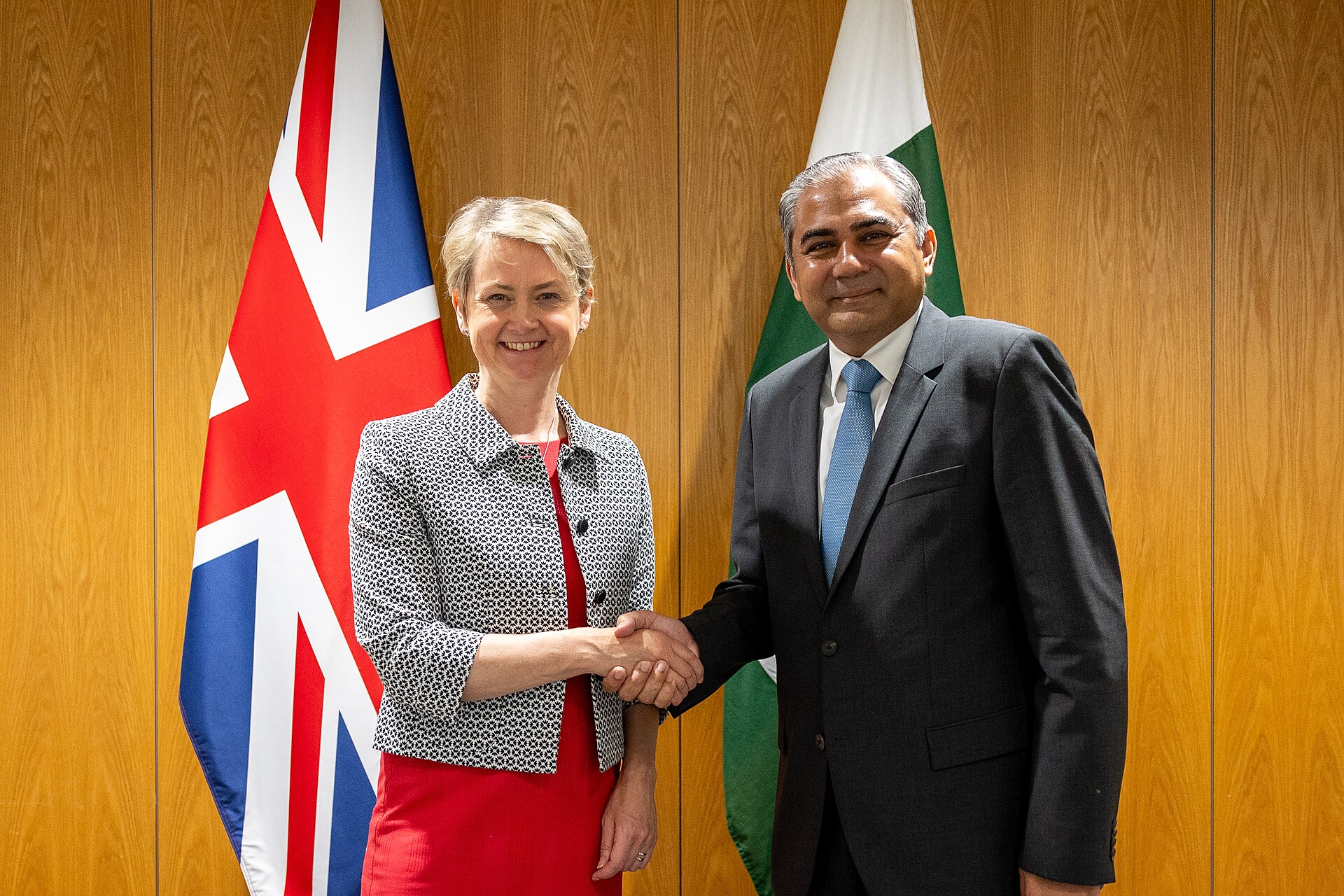
The Iranian outlets produced the most instructive divergence of all.
Tasnim News Agency — IRGC-linked, the outlet that announced Iran’s MOU suspension on June 1 — chose state-to-state framing: “Pakistan Sends Special Letter to Ayatollah Seyed Mojtaba Khamenei.” The full constitutional title. No separation of PM and Army Chief messages. Pakistan presented as a sovereign governmental actor delivering a unified communication. This framing gives Tehran maximum diplomatic cover for engagement.
PressTV — the English-language state broadcaster aimed at international audiences — took the opposite approach: “Pakistan’s interior minister visits Tehran to discuss Iran-US talks.” Direct war-mediation framing. No pretense of routine diplomacy.
Mehr News Agency, the semi-official domestic wire, ignored the letters altogether. It reported the Iran-Pakistan interior ministerial meeting covered “bilateral issues including border security, combating drug trafficking, and countering terrorism” and an agreement to increase bilateral trade from $3 billion to $10 billion per year. In Mehr’s framing, Naqvi came to Tehran to discuss trade and borders. The war does not exist.
Three Iranian outlets. Three incompatible frames. All accurate on their own terms. The dual-letter architecture makes every interpretation defensible.
The Courier Architecture Iran Requires
Secretary of State Marco Rubio described Mojtaba Khamenei’s engagement method with unusual specificity during his Senate Foreign Relations Committee testimony on June 2: “I think there are indications out there that [Mojtaba Khamenei] is increasingly engaging at some level, although all of his communications have been in writing and through intermediaries.” The phrasing is diagnostic. Not “through diplomats” — through intermediaries. Not phone calls or meetings — in writing.
Pakistan’s letter format matches this modality exactly. Khamenei cannot reject the communication medium without rejecting his own preferred architecture. The courier model — physical letters carried by a cabinet minister on a third or fourth visit — satisfies every constraint the new Supreme Leader has imposed on engagement: deniability, written record, intermediary delivery, no direct exposure to foreign principals.
The Islamabad talks of April 11–12 failed partly because they violated this architecture. Both sides sent negotiators without decision-making power — civilian legacy figures rather than the new IRGC commanders who now hold operational authority. The people at the table could not commit the people who mattered.
Pakistan learned from that failure. Initial reporting framed the delivery as Munir’s letter alone — but wire confirmations later on June 7 revealed the dual-communication structure. Munir’s letter goes not to Pezeshkian — whom he already met on May 22–23 — but directly to Khamenei. The Field Marshal, as Army Chief, oversees Pakistan’s Inter-Services Intelligence directorate. The ISI and IRGC share a structural relationship that the American Enterprise Institute has characterized as a model for Iranian intelligence operations — both services maintain a veto over political leadership while operating in parallel institutional channels. Munir speaks the IRGC’s operational language in a way that Araghchi cannot.
The 15-point US proposal that Pakistan delivered to Tehran on March 25 — after Munir spoke directly with Trump on March 22–23 — produced the April 8 ceasefire. That ceasefire held for five days before collapsing under eight violations of its own terms. The courier model worked once. Islamabad is betting the architecture is repeatable even if the content changes.
Can Pakistan Guard Saudi Oil While Mediating for Iran?
Pakistan maintains approximately 13,000 troops in Saudi Arabia’s Eastern Province under the Saudi Military Defence Agreement, with an authorized ceiling of 80,000, according to the Times of Islamabad (May 18, 2026). These forces operate HQ-9 air defense systems with a 200-kilometer engagement range — positioned to defend Aramco’s Ras Tanura terminal, Abqaiq processing facility, and the broader Dammam-Dhahran petrochemical corridor from Iranian missile and drone attack.
Simultaneously, Pakistan serves as the primary courier between Washington and Iran’s new IRGC leadership. The Stimson Center’s 2026 assessment captured the contradiction precisely: Pakistan “sought to position itself both as a mediator between Iran and the United States and as a security guarantor for Saudi Arabia, while maintaining a delicate balance between preserving its strategic ties with Riyadh and the need to avoid a deterioration in relations with Tehran.”
The INSS analysis from 2026 offered the structural limit: “Pakistan can hold both roles [mediator + Saudi security guarantor] only if any military deployment remains strictly defensive, time-bound, and transparently limited. The moment the theatre shifts to offensive operations, or the perception of offensive coordination emerges, the dual role collapses.”
One hundred days into the Iran war, the SMDA deployment has remained defensive. Pakistani forces have not engaged Iranian assets. The HQ-9 batteries have not fired. But the architecture creates a permanent structural trap for Saudi Arabia: the country defending your oil fields is the same country carrying letters to the leadership attacking them.
Saudi Arabia’s financial relationship with Pakistan removes any leverage Riyadh might otherwise exercise. The kingdom provided $3 billion in additional financial support on April 17, 2026, and extended a $5 billion facility rollover for three further years (Stimson Center, 2026). Pakistan imports more than 85 percent of its oil and nearly all its liquefied natural gas from Saudi Arabia, Qatar, and neighboring Gulf states (Stimson Center, 2026). The SMDA is not charity — it is the security architecture that keeps Pakistan’s energy lifeline open.
Al Jazeera’s April 14 analysis asked the question directly: “Can Pakistan juggle US-Iran mediation with Saudi defence commitments?” The answer is that Pakistan has managed the contradiction by keeping the two tracks institutionally separate — the PM letter for the mediation role, the Field Marshal’s letter for the military channel — while preventing Saudi Arabia from formally objecting to either.
Tehran’s Silence as Strategy
Iran has made no public statement confirming or characterizing the content of either letter. Tehran has not claimed the state-communication interpretation (which would imply diplomatic engagement) or the military-channel interpretation (which would imply IRGC coordination with a foreign army). The silence is not an oversight. It is the functional equivalent of keeping both options open simultaneously.
Tasnim’s excerpt from the PM Shehbaz letter reveals only anodyne language: “Pakistan’s commitment to continue working closely with the Islamic Republic of Iran to further strengthen bilateral cooperation across all spheres of mutual interest for the benefit of the two brotherly peoples.” This is the diplomatic wallpaper around whatever substantive content remains unreported.
The content of Munir’s letter remains entirely undisclosed. No Iranian outlet has quoted from it. No Pakistani outlet has characterized its substance beyond confirming its existence. This asymmetry — public civilian letter, private military letter — is itself a feature of the architecture. The PM letter provides the cover story. Munir’s letter is the operational communication.
Mojtaba Khamenei’s response pattern — documented since his accession in March 2026 — provides the template for what happens next. Iran International noted that his first message as Supreme Leader was “read out” by another official; he is “Iran’s unseen new leader” who “issues first message in writing.” Any reply to Pakistan will follow the same modality: written, delivered through intermediaries, never directly attributable to a live conversation. The exchange could proceed for weeks through letters carried by cabinet ministers without either side ever occupying the same room.
The Lebanese Dimension Nobody Expected
On the same day Naqvi arrived in Tehran, Lebanese Army Chief General Rodolphe Haykal departed Beirut for Pakistan at the personal invitation of Field Marshal Munir. A source briefed on the visit told the Times of Israel that Haykal’s trip is “linked to US-Iran talks.”
The timing is not coincidental. The June 4 US-Israel-Lebanon ceasefire — in which Hezbollah was named as a condition, not a signatory — left the Lebanese state as the formal counterparty to an agreement its southern territory cannot enforce. Haykal commands the only Lebanese institution that retains operational credibility in both Washington and Islamabad. His presence in Pakistan while Naqvi is in Tehran suggests a secondary channel: Pakistan brokering not just US-Iran but potentially US-Iran-Lebanon simultaneously through military-to-military laterals that bypass the foreign ministries entirely.
Lebanon’s border with Israel is 120 kilometers. Pakistan’s border with Iran is 909 kilometers. Both militaries face the structural problem of operating adjacent to a conflict they cannot influence through civilian diplomacy. Munir’s invitation to Haykal appears to recognize this shared condition — and to position Pakistan as a hub connecting multiple military channels that no diplomatic capital currently hosts.
The deeper implication for Saudi Arabia: Riyadh excluded itself from Lebanon engagement when Saudi envoy Yazid bin Farhan told President Aoun not to meet Netanyahu on April 25. Now a military track connecting Beirut to Islamabad to Tehran exists that Saudi Arabia’s foreign ministry has no visibility into and no institutional mechanism to join.
Why Can’t Saudi Arabia Object?
Saudi Arabia’s foreign minister broke fourteen days of silence between June 2–4, contacting six counterparts — none of them American, Iranian, or Lebanese. The kingdom cannot object to Pakistan’s Tehran shuttle without triggering a cascade of structural consequences it is not prepared to manage.
The first constraint is military. Saudi Arabia’s Patriot interceptor stockpile has depleted to approximately 80–150 PAC-3 MSE rounds — roughly 14 percent of pre-war levels. Camden, Arkansas, produces 620 missiles per year. The Pentagon’s FY2027 order of 2,798 rounds claims the entire production line through 2030. Saudi Arabia’s standard FMS order of 730 rounds with mid-2027 delivery has no Section 36(b) emergency acceleration path because Riyadh has no Status of Forces Agreement with Washington.
The SMDA’s 13,000 Pakistani troops and HQ-9 batteries are, right now, a larger functional air defense contribution to Eastern Province protection than Saudi Arabia’s own remaining Patriot capacity.
The second constraint is financial. Objecting to Pakistan’s mediation role would force Islamabad to choose between Saudi money and Iranian access. Pakistan’s energy dependency on Gulf imports — documented above — makes such a rupture existential for Islamabad. But forcing the choice risks Pakistan pulling SMDA forces, which Saudi Arabia cannot replace from any other source while Camden’s production is committed to the Pentagon.
The third constraint is informational. Pakistan is now Saudi Arabia’s only window into what Iran’s new IRGC leadership is actually saying. The quadrilateral security bloc Saudi Arabia assembled with Egypt, Pakistan, and Turkey produced zero communiqués across three ministerial sessions in 31 days. But the SMDA relationship means Pakistani military intelligence shares certain threat assessments with Saudi Arabia that no other channel provides. Cutting Pakistan’s Tehran access would blind Riyadh to IRGC decision-making at the moment it most needs visibility.
The result is paralysis dressed as patience. Saudi Arabia’s MOFA has been silent for more than ten days. No Al Arabiya coverage of the dual-letter delivery. No diplomatic protest. No public acknowledgment that Pakistan — the country operating air defense systems on Saudi soil — just delivered a military communication from its Army Chief to the Supreme Leader of the country attacking Saudi Arabia’s oil infrastructure and its Gulf neighbors.
What the April Islamabad Talks Proved
The Islamabad talks of April 11–12, 2026, were Pakistan’s first formal hosting of US-Iran negotiations. They failed to produce a framework. But their failure revealed the structural architecture that Pakistan’s current courier approach is designed to circumvent.
The United States sent Steve Witkoff and Jared Kushner. Secretary Rubio was absent — a calibrated signal about the level of commitment Washington was willing to display. Iran sent Foreign Minister Abbas Araghchi and Parliament Speaker Mohammad Bagher Ghalibaf. Both are legacy figures from the Khamenei I era. Both lack operational authority under the new IRGC command structure that consolidated power after the senior Supreme Leader’s death.
Quwa Defence Analysis identified the core failure: “The United States misread who in Iran actually held the authority to make a deal.” The new IRGC commanders — “considerably more hawkish than legacy negotiators” — did not attend. Their absence was not logistical. It was a statement about who holds decision-making power in the post-succession Islamic Republic.
Pakistan’s dual-letter format is an architectural response to this failure. By sending a military communication from an army chief who oversees intelligence services to a supreme leader who communicates only in writing through intermediaries, Islamabad addresses the counterparty problem. Munir’s letter does not route through Araghchi or Pezeshkian — the civilian figures who showed up in April and lacked the authority to commit. It goes directly to the authority that Rubio confirmed is “increasingly engaging” but only through precisely this modality.
The failure also demonstrated that formal multilateral settings — conference rooms, press conferences, joint statements — do not match the new Iranian leadership’s operational preference. Washington and Tehran are negotiating two different deals, and the format of engagement determines which deal gets traction.
June 9 and the Compression of Every Track
June 9, 2026, sits two days away. On that date, three events converge: Iran’s formal rejection of Trump’s MOU proposal via Oman, Aramco’s $21.89 billion quarterly dividend payment against only $18.6 billion in free cash flow (a 0.85x coverage ratio), and the expiration of the 72-hour window in which Pakistan’s dual letters might produce a response from Khamenei’s intermediaries.
The MOU’s death — first signaled by Tasnim’s suspension announcement on June 1, now hardening toward formal rejection — eliminates the US-Iran direct track. Washington nullified Iran’s counteroffer without responding to it, and Tehran’s Omani channel has produced no alternative framework. When the formal rejection arrives, Pakistan’s courier becomes not a supplementary channel but potentially the only active one.
Aramco’s dividend arithmetic compounds the pressure. The $21.89 billion payment to shareholders — primarily the Saudi state — exceeds free cash flow by $3.29 billion. Saudi Arabia’s Q1 2026 deficit reached SAR 125.7 billion, or 76 percent of the full-year target in a single quarter. Military spending hit SAR 64.7 billion in Q1 alone, a 26 percent year-over-year increase. The kingdom is paying for a war it cannot sustain, drawing dividends it has not earned, and depending on a Pakistani military deployment it cannot publicly acknowledge as its primary air defense layer.
One hundred days of war have produced a Saudi Arabia that is structurally dependent on Pakistan for physical security, informationally dependent on Pakistan for visibility into IRGC decision-making, financially committed to Pakistan through $8 billion in direct support and facility extensions, and institutionally excluded from every active negotiating track between Washington and Tehran.
The dual-letter architecture is not designed for Saudi Arabia’s benefit. It is designed for Tehran’s interpretive convenience and Washington’s plausible deniability. Saudi Arabia’s interests are represented in none of the letters. Its troops are represented in one of the sender’s deployments. That asymmetry — Pakistan’s security presence in Saudi Arabia funding Pakistan’s diplomatic access to Iran — is the structural condition that fourteen days of Saudi foreign ministry silence cannot resolve.
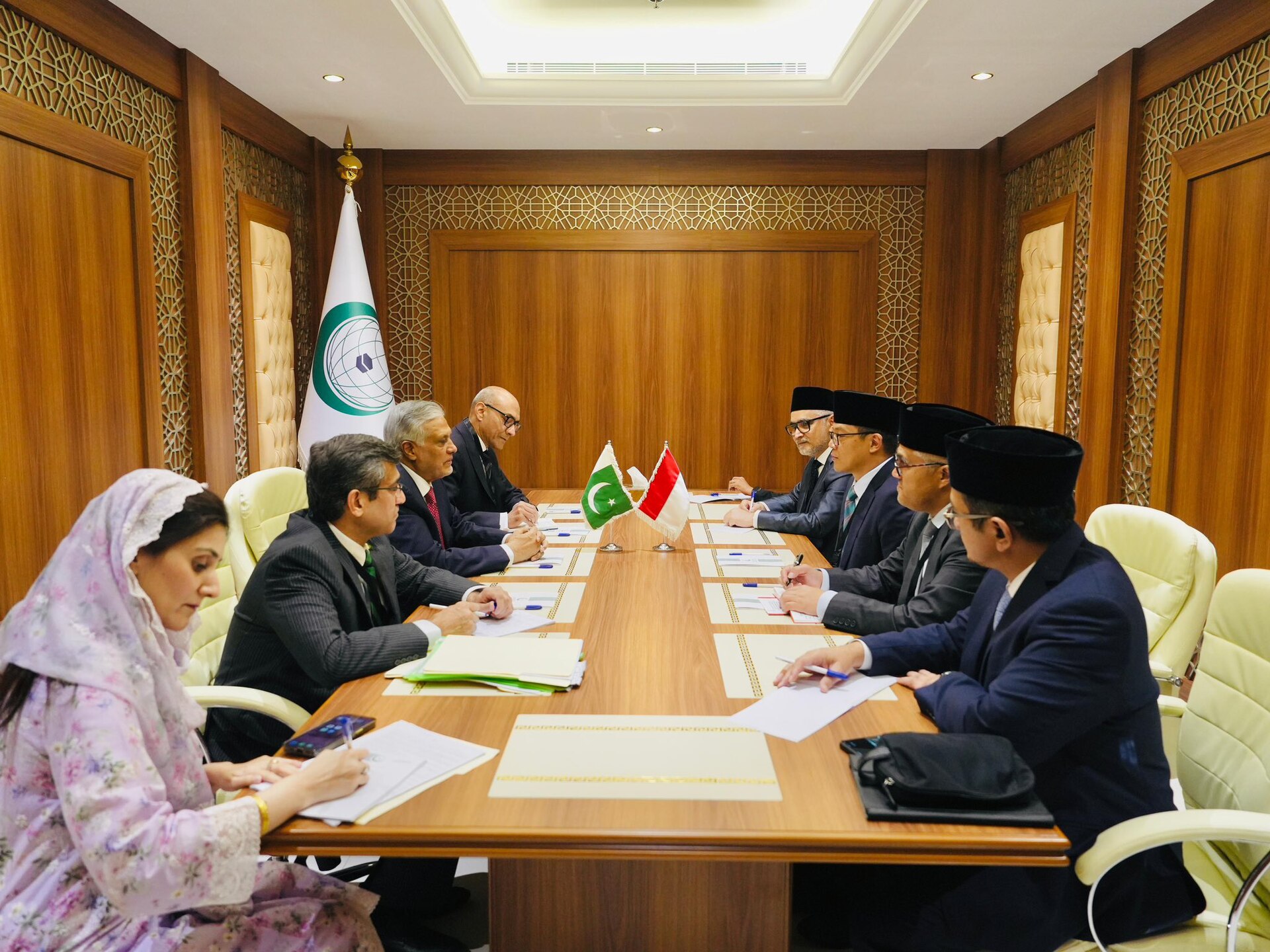
The Dual-Track Balance Sheet
| Dimension | Pakistan–Saudi Track (SMDA) | Pakistan–Iran Track (Courier) |
|---|---|---|
| Troops deployed | ~13,000 (80,000 authorized) | None |
| Air defense systems | HQ-9 (200km range) | N/A |
| Financial flows (2026) | $3B support + $5B facility extension (Saudi→Pakistan) | Trade target: $3B→$10B/yr agreed June 7 (Mehr News) |
| Institutional channel | Military-to-military (SMDA command) | Army Chief→Supreme Leader (letter); PM→Supreme Leader (letter) |
| Shared border | None (forces deployed by air/sea) | 909 km (INSS, 2026) |
| Energy dependency | 85%+ of Pakistan’s oil/LNG from Gulf states (Stimson) | Iran gas pipeline (dormant) |
| Intelligence relationship | Threat assessment sharing via SMDA | ISI-IRGC structural parallels (AEI) |
| Visits (May–June 2026) | Naqvi + Munir (Riyadh, ongoing rotation) | Munir May 22–23; Naqvi June 7 (3rd visit) |
The 1988 Precedent Pakistan Is Invoking
Pakistan’s dual-message structure mirrors a specific Iranian institutional memory: Akbar Hashemi Rafsanjani’s dual-hat role in ending the Iran-Iraq War in 1988. Rafsanjani simultaneously served as Speaker of Parliament and acting Commander-in-Chief, combining civilian legislative authority with military operational control to persuade Ayatollah Khomeini to accept UN Resolution 598 — the ceasefire Khomeini described as “drinking poison.”
The parallel is not accidental. Pakistan is offering Tehran an analogous interpretive frame: a combined military-civilian communication architecture that allows the Supreme Leader to accept engagement without ceding authority to either the civilian government (weakened by Pezeshkian’s resignation crisis) or the IRGC command alone (which cannot negotiate without diplomatic cover).
The difference in 2026 is that the dual authority resides in the sending country, not the receiving one. Rafsanjani held both mandates personally. Pakistan distributes the mandates across two letters from two institutions, giving Tehran the choice of which mandate to engage with. This is structurally more flexible for Iran’s fractured post-succession governance — where Pezeshkian’s civilian authority is contested, the IRGC’s new commanders have not appeared at any negotiating table, and Khamenei himself communicates only through written intermediaries.
For Saudi Arabia, the 1988 precedent carries a specific warning. Rafsanjani’s combined authority produced a ceasefire that ended the Iran-Iraq War on terms that Iraq’s backers — primarily Saudi Arabia and Kuwait, which had funded Baghdad — did not control and were not consulted on. The kingdom financed the war and was excluded from the peace. Thirty-eight years later, Saudi Arabia finances Pakistan’s economy, hosts its troops, and watches Pakistan broker a potential end to a different war with Iran — again without Saudi input into the terms.
Frequently Asked Questions
What is the Saudi Military Defence Agreement (SMDA) with Pakistan?
The SMDA is a bilateral defense pact signed in 2024 authorizing up to 80,000 Pakistani military personnel for deployment to Saudi Arabia. Unlike the earlier 1982 arrangement that stationed Pakistani troops in non-combat advisory roles, the SMDA includes operational air defense deployment — HQ-9 surface-to-air missile systems with 200-kilometer engagement range positioned in the Eastern Province. Pakistan receives financial compensation and guaranteed energy supply access in return. The agreement’s text has never been made public, and neither government has disclosed its duration, termination clauses, or rules of engagement.
Has Pakistan’s ISI historically cooperated with Iran’s IRGC?
The ISI-IRGC relationship predates the current crisis by decades. Both intelligence services operate under structures that give them institutional autonomy from elected civilian governments — the ISI reports to the Army Chief (currently Munir), while the IRGC intelligence organization reports to the Supreme Leader directly. The American Enterprise Institute has characterized Pakistan’s ISI as “a model for Iranian intelligence,” noting structural parallels in how both services maintain political vetoes while conducting external operations. During the Taliban era, ISI and IRGC operated competing Afghan proxies while maintaining a backchannel on border management. The current Munir-Khamenei written channel builds on institutional familiarity, not personal relationships.
Why is an Interior Minister — not the Foreign Minister — delivering these letters?
Naqvi’s role is structural, not accidental. Pakistan’s interior ministry controls border management along the 909-km Iran-Pakistan frontier, counter-narcotics cooperation (the shared border is a primary heroin transit corridor), and domestic intelligence coordination with ISI on cross-border threats. His portfolio gives him a standing bilateral agenda with Iranian counterparts that does not require justification as “war mediation” — as Mehr News demonstrated by reporting the visit entirely through the lens of border security and trade. Foreign Minister Ishaq Dar’s presence would make the mediation dimension undeniable; Naqvi’s presence allows Tehran to frame the visit however suits its posture.
What happens if Iran formally rejects the MOU on June 9?
Formal rejection via the Omani channel — distinct from Tasnim’s June 1 suspension announcement — would eliminate the only US-Iran framework currently under discussion. The Omani track has served as the principal diplomatic conduit since the war began on February 28. Its closure would leave Pakistan’s courier channel as the sole active intermediary architecture between Washington’s interests and Tehran’s decision-making authority. Brent crude, which added 7 percent on the June 1 suspension news alone, would likely test $100 per barrel — still $8–11 below Saudi Arabia’s $108–111 fiscal breakeven but approaching the threshold where war-premium pricing becomes self-sustaining regardless of OPEC+ output decisions at the June 7 meeting.
Could Saudi Arabia terminate the SMDA if Pakistan’s mediation produces unfavorable terms?
Termination would require Saudi Arabia to identify an alternative air defense source for the Eastern Province at a moment when its own PAC-3 stockpile sits at approximately 80–150 rounds, Camden’s production is committed to the Pentagon through 2030, and no Section 36(b) emergency waiver has been issued for the kingdom. The Emirates closed their Tehran embassy on March 1, 2026, and cannot serve as an alternative intermediary. Egypt lacks the IRGC access. Turkey maintains a Fidan-Araghchi channel but has not deployed military assets to the Gulf. In practice, Saudi Arabia has no replacement for either Pakistan’s security contribution or its diplomatic access — which is precisely why Islamabad can maintain both roles without consequence. Six days after Naqvi’s dual-letter mission, PM Sharif stepped into the open: he declared the deal text “final and agreed upon” in a public statement — the first head-of-government confirmation that a finished text existed, and one that put Islamabad ahead of both Washington and Tehran in definitiveness. Vance’s simultaneous “still TBD” created a direct contradiction between Pakistan’s intermediary and the US principal: Sharif Calls the Iran Deal Text Final. Vance Says ‘Still TBD.’ On May 28, Washington moved to eliminate the third indirect route available to Riyadh — the Omani channel — by threatening Muscat with military and financial consequences: the full mechanics are in Trump Threatened to Bomb Oman: Saudi Arabia’s Last Channel to Tehran. As Pakistan’s deniability eroded through public documentation, a third relay option became the operative channel: Qatar, which on June 8 fielded calls from both FM Faisal and FM Araghchi on the same day — the structure and implications are in The Back-Channel Saudi Arabia Cannot Name.