RIYADH — The US Army’s FY2027 budget request for 2,798 PAC-3 MSE interceptors is a $12.2 billion claim on the only factory in the Western hemisphere that builds the missile keeping Saudi cities defended — a Lockheed Martin plant in Camden, Arkansas, that produced 620 rounds last year for every customer on earth combined. Add the Navy’s 405 and the Pentagon is ordering more than five years of that factory’s output in a single budget cycle, from a production line that Saudi Arabia needs to deliver roughly 2,400 rounds before its air-defence network — already at 14 per cent of pre-war capacity — degrades from a shield into a symbol.
This is not a question of political will or alliance management. It is a question of factory-floor physics: one assembly line, one sole-source seeker supplier in Huntsville, Alabama, and a combined global demand that exceeds planned capacity through 2030. The arithmetic does not require a policy decision to become binding — it is already binding. Every month that Camden’s output goes to the Pentagon, to Poland, to Germany, to Ukraine, or to any of the twelve-plus countries holding production-slot reservations is a month that Saudi Arabia’s 400 remaining interceptors get older, the Iranian threat compounds, and the deficit between what Riyadh needs and what the factory can physically deliver grows wider.
Table of Contents
- The Largest Single Interceptor Order in Modern American History
- How Many Rounds Does Camden Actually Produce?
- Who Else Is Waiting for the Same Missile?
- Why Can’t Saudi Arabia Use the Emergency Delivery Track?
- What Does the Boeing Seeker Bottleneck Mean for Saudi Delivery?
- The Ratio Iran Designed
- What Hegseth Told the Senate — and What the Production Schedule Shows
- The Queue Saudi Arabia Cannot Jump
- Frequently Asked Questions
The Largest Single Interceptor Order in Modern American History
The $12.2 billion breaks into two components that tell different stories about how urgently the Pentagon views the interceptor shortage. The discretionary tranche — $1.3 billion — moves through the standard defence appropriations process and would fund procurement at roughly FY2026 levels. The mandatory tranche — $10.9 billion, nearly 90 per cent of the total — requires separate congressional action and sits outside normal budget mechanics, a structure the Pentagon adopts only when it considers a procurement too large and too urgent for the regular cycle.
In FY2026, the Army procured 357 PAC-3 MSE rounds at $1.7 billion. The FY2027 request represents a 7.8-fold increase in quantity, the kind of jump that does not emerge from incremental planning but from a recognition — documented in classified briefings that senators have since discussed publicly — that existing stockpiles are functionally inadequate for the threat environment Washington now faces. US forces fired between 1,060 and 1,430 Patriot missiles during the Iran conflict, consuming nearly half of pre-war American stockpiles, with replenishment expected to run through mid-2029 according to CSIS analysis cited by Defense News.
The Navy’s separate request for 405 PAC-3 MSE rounds pushes combined US services demand for FY2027 to approximately 3,200 interceptors at roughly $14 billion total. Army Recognition described the Army component as “one of the largest missile defence buys ever,” which understates what the combined number means in industrial terms: at Camden’s 2025 production rate of 620 rounds, the Pentagon’s single-year request would take more than five years to manufacture if no other customer on earth received a single round.
The per-unit arithmetic carries its own weight. The Army’s FY2027 request implies roughly $4.36 million per interceptor — the cost of the missile, its canister, and associated support. Saudi Arabia’s $9 billion FMS case for 730 rounds works out to approximately $12.3 million per unit, a 2.8-times premium covering logistics, training infrastructure, canisters, and support equipment. That premium does not purchase a single day of earlier delivery, and it does not move Saudi Arabia ahead of the Pentagon in the production queue.
The Middle East briefing 3,000+ readers start their day with.
One email. Every weekday morning. Free.

How Many Rounds Does Camden Actually Produce?
Every PAC-3 MSE interceptor in the Western hemisphere comes off a single final-assembly line at Lockheed Martin’s facility in Camden, Arkansas — a plant in a town of roughly 12,000 people that constitutes simultaneously the most critical node in Saudi Arabia’s air-defence supply chain and the most oversubscribed production line in the global defence-industrial base. In 2025, Camden set a company record by delivering 620 PAC-3 MSE rounds across all customers worldwide, a figure that Lockheed described with some corporate pride and that the broader missile-defence community received with the sobering recognition that 620 rounds per year is the entire global supply of the interceptor on which six GCC states, more than a dozen NATO allies, Japan, and the US military itself all depend.
The Lockheed-Pentagon framework agreement targets a production ramp from 620 to 2,000 rounds per year, with the higher rate scheduled to arrive no earlier than 2030. The interim target — 650 rounds per year — is what Camden expects to reach by the end of 2027, meaning the effective production increase over the next eighteen months amounts to 30 additional rounds, or roughly one extra missile every twelve days. Breaking Defense reported in January 2026 that the 2,000-round annual target “is not achievable before the end of 2030 — four and a half years from now, and two full years after the Saudi order is supposed to be complete.”
A secondary facility in Okinawa produces PAC-3 MSE under licence for Japan’s Self-Defense Forces, but that output is contractually reserved for Japanese domestic requirements and does not enter the global allocation pool. For Saudi Arabia, for Poland, for Germany, for Ukraine, and for every other customer purchasing through Foreign Military Sales, Camden is not the primary production source — it is the only one.
Who Else Is Waiting for the Same Missile?
The combined FMS backlog across at least twelve countries now exceeds 4,300 rounds — approximately seven years of Camden’s 2025-rate output, according to analysis published by RealClearDefense and the Foreign Policy Research Institute in May 2026. That figure does not include the US military’s own 3,200-round FY2027 request, which pushes combined known demand past 7,500 rounds against a factory that will make 650 this year and will not reach 2,000 for another four years.
| Customer | PAC-3 MSE Rounds | Delivery Window | Source |
|---|---|---|---|
| US Army (FY2027) | 2,798 | FY2027–FY2030 | Defense News |
| US Navy (FY2027) | 405 | FY2027–FY2029 | Defense News |
| Saudi Arabia (FMS) | 730 | Mid-2027–2029 | DSCA / FR Doc 2026-10920 |
| Poland (Wisła Phase 2) | ~600 | 2027–2029 | GLOBSEC |
| Germany | 120 | 2028–2029 | Army Recognition |
| Ukraine (monthly consumption) | 60–180/month | Ongoing | United24 Media |
| Other FMS customers (10+ countries) | ~2,350+ | Through 2030+ | RealClearDefense / FPRI |
| Total known demand | ~7,500+ | Through 2030+ | — |
| Camden 2025 output (record) | 620/year | — | Lockheed Martin |
| Camden 2027 target | 650/year | — | Lockheed Martin |
| Camden 2030 target | 2,000/year | — | Lockheed Martin |
Poland’s Wisła Phase 2 contract calls for approximately 600 PAC-3 MSE rounds with delivery windows spanning 2027 to 2029 — the exact production period during which Saudi Arabia’s 730-round FMS case is supposed to begin arriving. When the United States asked Poland on March 31 to transfer one of its two operational Patriot batteries to the Middle East, Polish Defence Minister Władysław Kosiniak-Kamysz publicly refused, making Poland the only NATO ally to put its rejection on the record. Warsaw has its own air-defence emergency along its eastern border, and Kosiniak-Kamysz made clear that Poland would not yield production slots or operational hardware for a Gulf crisis it views as geographically and strategically remote from its own security requirements.
Germany’s order of 120 rounds — 75 for delivery in 2028 and 45 in 2029, at a cost of €763.5 million — occupies another tranche of Camden’s output during the same window. Switzerland was informed in February 2026 that its five contracted Patriot fire units would arrive four to five years behind the original schedule, pushed back after a July 2025 US decision to reprioritise deliveries for Ukraine — a concrete demonstration that Washington has already shown willingness to resequence the queue for its preferred customers, and that Saudi Arabia is not among them.
Ukraine’s consumption alone illustrates the compression bearing down on Camden. Routine PAC-3 MSE expenditure runs between 60 and 70 rounds per month on quiet weeks; during intensive Russian attack waves, the figure rises to 150 to 180 per month, a rate that at the upper bound would consume an entire year of Camden’s 2025 output in roughly three and a half months. Defence analyst Colby Badhwar documented that “the United States previously modified the Foreign Military Sales delivery schedule for Ukraine’s benefit, giving them priority for PAC-3 MSE & AMRAAM over all other FMS customers” — a precedent that remains active and that structurally disadvantages every country behind Ukraine in the queue.

The DSCA-notified Saudi FMS case of January 30 covers 730 rounds at $9 billion with a minimum 18-to-36-month delivery window. FR Doc 2026-10920, published June 1, establishes the standard FMS delivery unit as 50 PAC-3 MSE rounds with an 18-month delivery minimum per unit. Completing the 730-round Saudi order would require more than fourteen months of Camden’s entire global output — and 730 rounds is less than a third of the approximately 2,400 that Saudi Arabia needs to restore pre-war coverage levels.
Why Can’t Saudi Arabia Use the Emergency Delivery Track?
When Washington has needed to rush interceptors to an ally in active combat, it has used Section 36(b) of the Arms Export Control Act — the presidential authority to waive normal FMS procedures and redirect production-line output for emergency transfer. The mechanism has been exercised for Ukraine in 2022 and 2023, for Israel repeatedly across multiple conflicts, and most recently through Secretary of Defense Pete Hegseth’s $8.6 billion May 2 emergency waiver that accelerated deliveries to multiple regional allies during the Iran conflict. Every country that has ever received interceptors through the emergency-waiver track shares one structural prerequisite: a Status of Forces Agreement with the United States.
Saudi Arabia does not have a SOFA. Prince Sultan Air Base hosts rotating US deployments but operates without the legal framework that would allow Washington to pre-position US-owned interceptors for emergency transfer, redirect rounds already in the delivery pipeline, or invoke the presidential waiver authorities that have enabled every other major emergency shipment in this conflict. The $142 billion arms package signed on May 13, 2025, included PAC-3 expansion on standard FMS delivery timelines — it did not include a SOFA, it did not embed an emergency delivery mechanism, and Hegseth’s May 2 waiver explicitly excluded Saudi Arabia from the accelerated track.
The gap between Saudi Arabia’s defence relationship with Washington and the legal architecture governing emergency resupply — examined in detail through Kuwait’s $1.02 billion NASAMS procurement — is the structural constraint that transforms the production-line arithmetic from inconvenient to binding. Bahrain, which hosts the Fifth Fleet’s 9,000 personnel under a 1992 SOFA, has been struck by the IRGC three times and sits at approximately 8 remaining PAC-3 MSE rounds — an 87 per cent depletion rate — yet even Bahrain was excluded from the May 2 emergency waiver. The emergency track exists in statute but has not been activated for any GCC state during this conflict.
“Iran’s simultaneous strikes on Saudi Arabia, UAE, and Kuwait have consumed 86% of the GCC’s Patriot interceptors in five weeks, with resupply measured in years, not months.”
— CSIS (Bergmann, Svendsen, Burchell), May 2026
What Does the Boeing Seeker Bottleneck Mean for Saudi Delivery?
Every PAC-3 MSE interceptor requires a seeker head — the Ka-band active radar system that acquires and tracks an incoming target in its terminal phase — manufactured by Boeing at a single facility in Huntsville, Alabama. Boeing’s own engineers identified the seeker at the Paris Air Show in June 2025 as the primary production bottleneck for the entire PAC-3 programme, and the component’s status as a sole-source part produced at a single location means its production rate sets an absolute ceiling on how many PAC-3 MSE interceptors can exist, regardless of how quickly Lockheed expands final-assembly capacity at Camden.
Boeing signed a seven-year framework agreement with the Pentagon in April 2026 to triple seeker output, supplemented by a separate October 2025 contract valued at approximately $2.7 billion targeting more than 3,000 seekers at up to 750 per year through 2030. The company has committed over $200 million to expanding the Huntsville facility, but the expansion will not be fully operational before 2030 — meaning that for the remainder of this decade, the seeker line operates at or near its pre-expansion capacity while demand from the FY2027 budget alone exceeds what the expanded facility is designed to produce.
“Modern missile production moves at the speed of its weakest indispensable supplier.”
— Foreign Policy Research Institute / RealClearDefense, May 2026
For Saudi Arabia, the weakest indispensable supplier is a Boeing facility in northern Alabama, operating at capacity, midway through a multi-year expansion sized for pre-war demand forecasts, with its planned throughput already committed to a Pentagon order that exceeds the expansion’s design parameters. Even if Lockheed doubled Camden’s assembly capacity tomorrow, the factory could only ship what Huntsville finishes — and Huntsville will not finish enough for everyone before the decade is over.
The Ratio Iran Designed
The Islamic Revolutionary Guard Corps did not stumble into a favourable cost-exchange dynamic — it engineered one. Iran’s Shahed drone programme was built around the principle of asymmetric cost imposition: design the cheapest possible offensive system that forces the adversary to expend the most expensive possible defensive response, and produce it at a scale that makes the mathematics inescapable. Against a PAC-3 MSE intercept costing approximately $4.1 million, a Shahed-136 manufactured for between $20,000 and $50,000 produces an exchange ratio of between 40-to-1 and 60-to-1 in Iran’s favour — not an incidental feature of the drone’s design but its organising principle, documented by defence analysis outlet Quwa as an engineered structural feature of IRGC doctrine.
When the IRGC struck Kuwait’s Terminal 1 on June 3 using drones rather than ballistic missiles, the weapon selection was a deliberate calibration: each $30,000 drone forced the expenditure of a roughly $4 million interceptor. A 90 per cent interception rate across a saturation wave of 40 drones translates to four penetrations per salvo while consuming roughly $148 million worth of PAC-3 MSE inventory in a single engagement — inventory that took Camden weeks to produce and that Saudi Arabia cannot replace for years. The IRGC does not need to defeat the air-defence network through it; it needs to empty the magazines behind it, and the Camden production line cannot refill them at anything approaching the rate the IRGC can drain them. Israel’s Day 100 strike on Mahshahr added a second cost-imposition vector the depleted belt cannot address: dual-use industrial targeting that bypasses air defense entirely by selecting petrochemical infrastructure as a legitimate military object — a doctrine with a direct address in Jubail.
JINSA’s March 2026 report, “The Eroding Shield,” documented a second dimension of the same strategy targeting the sensor architecture upstream of the interceptor batteries themselves. Iran struck the AN/FPS-132 early-warning radar at Al Udeid Air Base in Qatar, the AN/TPY-2 radar at Muwaffaq Salti Air Base in Jordan, and a radar installation tied to missile defence in the UAE — degrading the detection and tracking systems that feed acquisition data to Patriot and THAAD batteries, which means that even interceptors still available in dwindling inventory may not receive targeting data in time to engage incoming threats. The IRGC is not just depleting the interceptor stockpile; it is blinding the systems that tell the missiles where to aim.
CENTCOM responded by adopting tiered engagement protocols, reserving PAC-3 MSE for ballistic threats and relying on short-range air-defence systems against Shaheds, as Military Times reported in its “Race of attrition” analysis — an operational acknowledgment that the interceptor supply had become too scarce to use against the most frequent threat in the Iranian arsenal. The Small Wars Journal, citing CSIS, characterised the Saudi drawdown — from approximately 2,800 rounds to roughly 400 in 38 days — as “a depletion rate with no comparable precedent in the system’s operational history.”
What Hegseth Told the Senate — and What the Production Schedule Shows
At the Senate Armed Services Committee posture hearing on April 29, Secretary of Defence Pete Hegseth told senators that stockpile replenishment would take “months and years” depending on the weapon system, that new production facilities were “being built in real time,” and that characterisations of fully depleted stockpiles were overstated. Senator Mark Kelly of Arizona, citing a classified briefing covering THAAD, SM-3, Tomahawk, and precision-strike missiles alongside PAC-3 MSE, offered a sharper assessment: “We’re talking about years.”
The gap between those statements and the Camden production schedule is precisely the space in which Saudi Arabia’s resupply timeline lives. CSIS warned that the US “may need three years to rebuild missile stockpiles depleted during the Iran conflict,” an estimate covering only American military replenishment — not the simultaneous demands of every FMS customer in the queue. Hegseth’s “months and years” framing applies to a US military that sits at the front of the Camden queue; Saudi Arabia sits behind the Pentagon, behind Ukraine, behind Poland, and behind Germany, facing a timeline measured in the same units but from a starting position several places further back.
The overall US missile-defence budget seeks a 32 per cent increase in FY2027, with $23 billion earmarked for interceptors across all programmes according to Shephard Media — numbers that do not represent expansion but replacement. The Pentagon’s April 2026 PAC-3 contract of $4.76 billion was, as Inside Defense reported, “fuelled by foreign orders,” with 94 per cent of funding drawn from Foreign Military Sales appropriations. That contract structure reveals a feedback loop worth understanding: FMS revenue funds the production expansion that the Pentagon needs for its own order, but the expansion it enables does not increase allocation to FMS customers — it allows the Army to take a larger share of a marginally larger output.
The Queue Saudi Arabia Cannot Jump
Saudi Arabia entered the Iran conflict with approximately 2,800 PAC-3 MSE rounds distributed across 16 Patriot batteries and 108 M902 launchers, covering an infrastructure geography spanning more than 1,200 kilometres from Riyadh to the Eastern Province oil fields to the Red Sea coast. It now holds roughly 400 — an inventory level that provides what defence analysts characterise as residual rather than functional coverage, meaning individual high-value targets might be defended in a single engagement but the network cannot sustain multi-axis defence across simultaneous threats, which is precisely the attack pattern the IRGC has employed in every major barrage since February.
Restoring pre-war capacity requires approximately 2,400 rounds from a production line that will make, at best, 650 for all global customers in 2027. If Saudi Arabia received every interceptor Camden produced for the next four years and no other customer on earth took delivery — not the US Army, not the Navy, not Poland, not Germany, not Ukraine — Riyadh would barely reach its pre-war inventory level by 2031. The current FMS case covers 730 rounds, deliverable in 50-round standard units over 18 to 36 months, which at full completion restores approximately 30 per cent of what was lost. The remaining 1,670 rounds would require a second FMS notification, a second production-slot allocation, and a second passage through a queue that already extends seven years beyond current capacity. What Iran has left to fire into that gap is a separate intelligence dispute — one that spans a fourfold range between Trump’s 21 percent claim and classified NSC briefings citing 70 percent, with Saudi Arabia’s procurement ceiling unchanged at either end.
The $142 billion arms package signed on May 13, 2025, embedded no emergency delivery mechanism and granted no SOFA. The IMF’s June 3 Article IV assessment conditioned Saudi Arabia’s economic recovery on the normalisation of Hormuz traffic — which Iran has reclassified from a concession to an invoice. Saudi Arabia’s Q1 fiscal deficit already reached 76 per cent of its full-year target, with military spending up 26 per cent year on year. The air-defence gap is not an isolated military shortfall but a fiscal vulnerability that compounds every other pressure bearing on a government spending faster than it planned on a war it cannot defend against at current inventory levels.
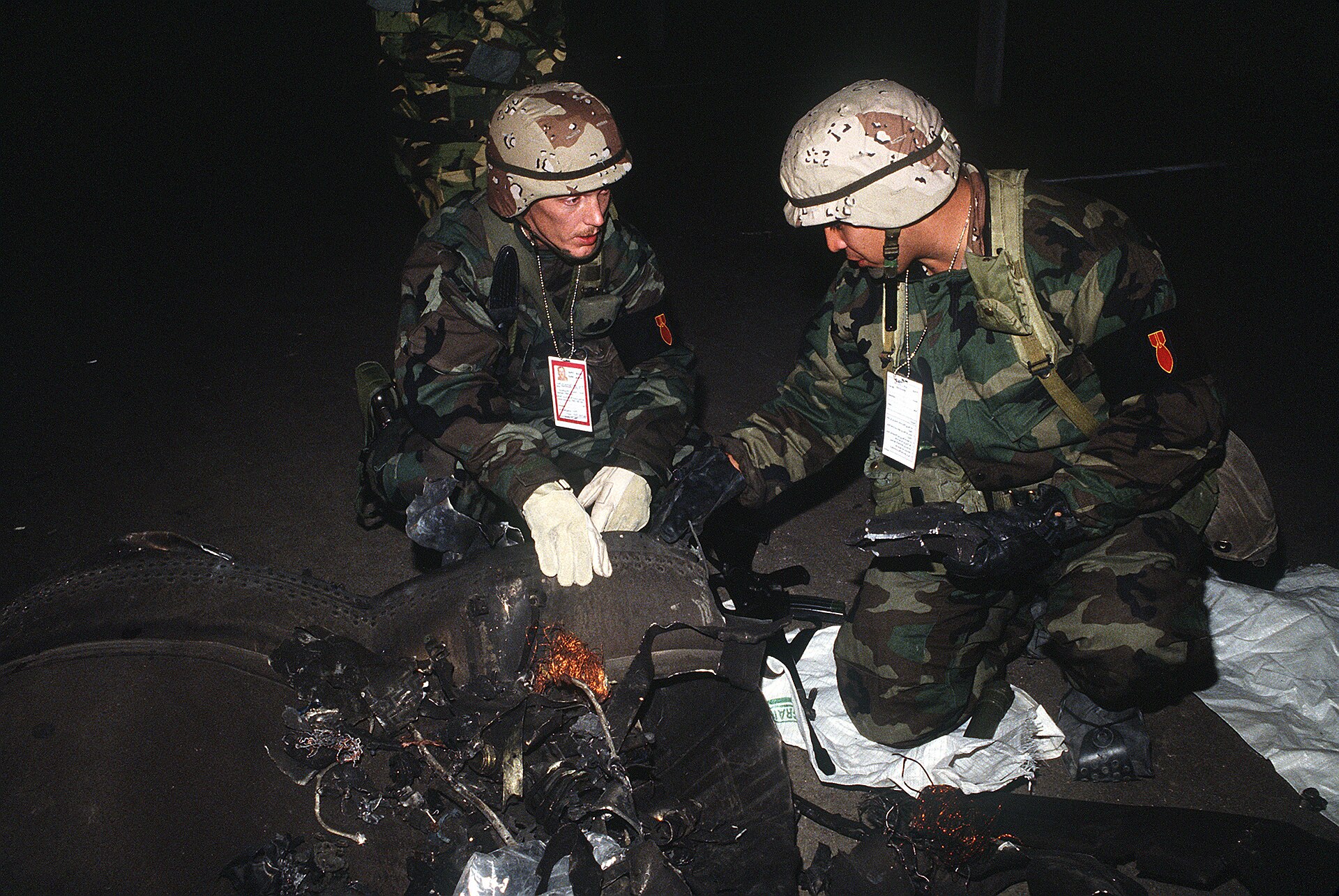
The Abqaiq-Khurais attack of September 2019 demonstrated what happens when Saudi air defences face a coordinated drone and cruise-missile strike against critical infrastructure: six Patriot battalions operating at full inventory failed to intercept a single incoming projectile that approached from an unexpected azimuth. That was a peacetime environment with complete stocks, no sustained threat tempo, and no adversary campaign designed to empty the magazines methodically over weeks. The current environment involves daily multi-axis attacks against a network at 14 per cent of its designed capacity, defended by interceptors whose replacement depends on a single factory that will produce at most 650 rounds this year for the entire world — and a Boeing seeker line in Huntsville that will not reach 750 units per year until 2030, for every customer on earth. Saudi Arabia’s 2,400-round deficit will still exist when that milestone arrives. On June 6, the consumption rate accelerated again: seven IRGC ballistic missiles hit Kuwait and Bahrain in the first all-ballistic dual-capital salvo, consuming intercepts that Camden cannot replace for years.
Frequently Asked Questions
Could Saudi Arabia license-produce PAC-3 MSE domestically to bypass the Camden queue?
ITAR classifies the PAC-3 MSE seeker as Category IV Significant Military Equipment, requiring individually validated licences for any technology transfer. Japan’s Okinawa facility — the only licensed PAC-3 MSE line outside Camden — required approximately eight years of bilateral negotiation to establish and is contractually restricted to Japan Self-Defense Forces procurement, with no rounds entering the global market. Saudi Arabian Military Industries currently lacks missile-integration capability; its highest-tier domestic production is the Turkish-designed HISAR-O+ medium-range system under a technology transfer agreement. Building a PAC-3 MSE line from scratch would require Boeing seeker technology transfer — which the US has never authorised to any Middle Eastern state — Aerojet Rocketdyne propulsion licensing, and a minimum five-year facility qualification period, meaning first domestic output could not begin before 2031 at the earliest, well after the military requirement it is meant to address.
What alternatives to PAC-3 MSE could Saudi Arabia procure to close the air-defence gap?
THAAD addresses a different threat tier — exo-atmospheric ballistic missiles — rather than the cruise missiles and armed drones that constitute more than 70 per cent of IRGC attack volume, and its interceptor faces its own sole-source production backlog at Lockheed Martin. The Franco-Italian SAMP/T uses Aster 30 interceptors that are not interoperable with Saudi Patriot fire-control architecture, and MBDA’s Aster 30 Block 1NT production rate runs at approximately 30 to 40 rounds per year across all customers. South Korea’s L-SAM completed its final development test in March 2026 but has not received export clearance from Seoul. The Norwegian-developed NASAMS — which Kuwait purchased for $1.02 billion in May 2026 — addresses short-to-medium-range threats and cannot substitute for PAC-3 MSE’s role against ballistic missiles and high-altitude cruise missiles. Kuwait compounded that investment on June 6 with a $1.98 billion Anduril counter-drone package that adds a dedicated lower-tier counter-UAS layer — the layered approach to counter-drone procurement that Saudi Arabia’s missing SOFA structurally prevents it from replicating on emergency timelines. No available system is both interoperable with Saudi Arabia’s existing Patriot architecture and producible at the scale required within the relevant timeframe.
If Congress blocks the $10.9 billion mandatory PAC-3 funding, would that free Camden capacity for Saudi Arabia?
Paradoxically, it would likely make Saudi delivery timelines worse rather than better. The discretionary component — $1.3 billion for approximately 357 rounds — proceeds through normal appropriations regardless, and existing FMS commitments are not contingent on the Army’s order volume. More critically, the planned Camden ramp from 650 to 2,000 rounds per year depends on multi-year procurement contracts providing the capital-investment justification for Lockheed to expand tooling, hire additional production shifts, and qualify secondary component suppliers. Congressional rejection of the mandatory tranche would reduce Lockheed’s financial incentive to accelerate the expansion, potentially pushing the 2,000-round annual target past 2032 and leaving Camden at or near 650 rounds per year for several additional years — worsening rather than improving the production queue for all international customers including Saudi Arabia.
Has any country received PAC-3 MSE outside the standard FMS delivery process?
Israel does not use PAC-3 MSE for upper-tier defence, relying instead on domestically produced Arrow-2, Arrow-3, and David’s Sling interceptors, which means it does not compete for Camden production slots in the same category. The only established mechanism for accelerated PAC-3 delivery is Section 36(b) of the Arms Export Control Act, exercised for Ukraine in 2022 and 2023 and for Israel across multiple conflicts. Every recipient of emergency-waiver interceptor delivery has held a Status of Forces Agreement with the United States, and no precedent exists for emergency transfer to a country without one. Establishing such a precedent for Saudi Arabia would require either congressional authorisation of a new legal mechanism or the negotiation and ratification of a SOFA — which Riyadh has consistently declined to sign due to domestic political constraints around foreign military basing sovereignty and the sensitivity of formalising the American military presence on Saudi soil. That structural exclusion from the emergency transfer mechanism has produced a second consecutive omission: the $8.6 billion May 3 authorization covered Qatar, Kuwait, Jordan, and the UAE — and once again left Saudi Arabia off the list, a pattern analyzed in Washington’s two-tranche SOFA exclusion from emergency arms transfers. By Day 100, that structural exclusion had compounded across every GCC Patriot state: the synchronized GCC Patriot belt collapse shows what happens when four allied countries exhaust their interceptors at the same time with no common resupply mechanism.