RIYADH — Treasury Secretary Scott Bessent’s directive to assess whether frozen Iranian assets can fund Gulf reconstruction and Iran’s stated precondition that those same assets be released as the price of reopening the Strait of Hormuz are claims on a single, finite pool of money. The $24 billion cannot simultaneously rebuild what Iran’s missiles destroyed and serve as what Mohsen Rezaei, secretary of Iran’s Expediency Council, called a “test of trust” that America must pass before any deal proceeds. This is not a sequencing dispute. It is a zero-sum collision over assets that can only move in one direction. Riyadh, which needs Hormuz reopened to survive its current fiscal trajectory but cannot be seen lobbying for the release of Iranian funds, has no public position on either claim. The legal mechanism Bessent would use, the Iranian demand it forecloses, the 1981 precedent Tehran will invoke, and the June 9 fiscal convergence that makes Saudi neutrality unsustainable are the four axes of a collision that arrived without warning.
Table of Contents
- The Zero-Sum Arithmetic
- What Did Bessent Direct?
- What Is Iran Demanding for the Same $24 Billion?
- The IEEPA Mechanism and the Point of No Return
- Why Does the 1981 Algiers Precedent Haunt This Plan?
- How Does June 9 Trap Saudi Arabia?
- Trump’s Public Rejection and Iran’s Three Registers
- Can Riyadh Afford to Stay Silent?
- Frequently Asked Questions
The Zero-Sum Arithmetic
On June 6, Reuters reported that Bessent had directed Treasury staff to assess war damage sustained by Gulf allies and examine whether frozen Iranian assets under US control could fund reconstruction. Treasury stated it would use “all tools available.” No executive order has been filed. No vesting order has been signed. The directive, as of June 7, remains at the assessment stage.
One day earlier — before the Bessent directive became public — CNN aired an exclusive interview with Rezaei, a Supreme Leader adviser who sits on the body that arbitrates disputes between Iran’s parliament and Guardian Council. Rezaei named the same $24 billion and described it in terms that leave no room for ambiguity.
If he wants to reach an agreement with Iran, this $24 billion is a test of trust that Iran wants to have with Trump — this is a test that America must pass and the path will be opened.
Mohsen Rezaei, Secretary of Iran’s Expediency Council, CNN exclusive, June 5, 2026
The figure is not approximate. Iran’s formal position, pressed by parliament speaker Mohammad Bagher Ghalibaf in Doha, demands $12 billion released immediately upon signing and $12 billion within 60 days (The National, May 26). Bessent’s directive targets the same tranches for the opposite purpose. Two claims. One account. The arithmetic does not permit compromise — every dollar redirected to Gulf reconstruction is a dollar Iran cannot receive, and every dollar released to Tehran is a dollar unavailable for rebuilding Kuwait’s Terminal 1 or Bahrain’s Mina Salman pier.
The Middle East briefing 3,000+ readers start their day with.
One email. Every weekday morning. Free.
The $24 billion is itself a subset. Iran International estimates total frozen Iranian assets globally at $100–120 billion, scattered across South Korea, Japan, China, Iraq, and accounts in Luxembourg (Iran International, June 5). But the negotiation-relevant sum — the money both sides have named, priced, and attached conditions to — is the $24 billion. Everything outside it is either inaccessible, in litigation, or beyond US jurisdictional reach.
What Did Bessent Direct?
Bessent’s June 6–7 directive instructed Treasury staff to request comprehensive cost estimates from Gulf allies for war damage and to assess whether frozen Iranian assets could be applied to reconstruction. The language — “all tools available” — signals legal preparation without committing to a specific mechanism (Reuters, via Fortune and Japan Times, June 6–7).
The most consequential tool available is the International Emergency Economic Powers Act of 1977. IEEPA, as originally enacted, authorized the president only to “block” foreign government assets — to freeze them in place, preventing any transaction. Blocking is an administrative act. It is reversible by executive order. Every president since Carter has used it.
The PATRIOT Act of 2001 added a second power. Section 106 amended IEEPA to allow “vesting” — the transfer of title from the foreign government to the United States — but only when the US is engaged in armed hostilities with the asset owner or has been attacked by it (Lawfare; CRS Report R45618). The US is currently in armed hostilities with Iran. The statutory threshold is met.
The distinction between blocking and vesting is the distinction between a pause and a point of no return. A blocked asset can be unblocked by the next president, the next Treasury secretary, or the same one who blocked it. A vested asset — once title has transferred and funds have been disbursed to Gulf states and spent — cannot be recovered. The money is gone. The concession is consumed.
As of June 7, Bessent has not crossed that line. He is still assessing damage. But every procedural step toward vesting narrows the political space for any future administration to offer Iran the asset release Tehran has named as its non-negotiable opening condition.
What Is Iran Demanding for the Same $24 Billion?
Iran’s demand is specific, staged, and — since the June 6 formal rejection of the US MOU and submission of a counteroffer through Oman — documented in writing. The counteroffer inverts the sequencing of the US draft. Where Washington’s text opened with Hormuz (passage guarantees, mine removal within 30 days), Iran’s text opens with frozen asset release as a precondition. Only after verifiable, spendable access to the first $12 billion tranche does Iran’s counteroffer address enrichment — offering reduction to 3.67% U-235, the JCPOA ceiling.
Deputy Foreign Minister Kazem Gharibabadi has characterized the frozen assets as “illegally frozen” and their release as a “central requirement in any potential understanding” (PressTV/GlobalSecurity, May–June 2026). Foreign Ministry spokesperson Esmaeil Baghaei, speaking to CNN on June 7, reduced the position to a single sentence: “They simply need to let Iranian assets be released and be available for the Iranians.”
The phrasing — “simply need to” — is not diplomatic understatement. It is a statement of sequencing priority. Iran will not discuss enrichment ceilings, Hormuz passage, or mine clearance until the asset question is resolved. Bessent’s directive does not resolve it. It eliminates the possibility of resolving it.
The 2023 Qatar prisoner-swap precedent explains why Iran insists on immediate, verifiable access rather than staged release. In that deal, approximately $6 billion in frozen South Korean-held oil revenues were transferred to Qatari accounts. Iran says access was subsequently denied — a claim US officials have not publicly rebutted (Iran International). The experience hardened Tehran’s position: money at signing, not at completion, because Iran has learned that funds transferred to intermediary accounts can be frozen again.
Rezaei made the strategic context explicit in the same CNN interview. If the US resumes conflict or fails the “trust test,” Iran will “drag the war” beyond the Persian Gulf — to the Indian Ocean, Bab al-Mandab, the Red Sea, and the Mediterranean. He described the Hormuz passage fees not as a toll but as a “maintenance fee,” asserting that Iran and Oman have “sovereignty” over the waterway and will “manage it together.” These statements were issued before the Bessent directive became public, which means they were calibrated for a world in which Iran still believed asset release was possible. The directive moved the world.
The IEEPA Mechanism and the Point of No Return
Only one president has ever used IEEPA’s vesting authority. On March 20, 2003 — the day the Iraq War began — President George W. Bush signed an executive order vesting blocked Iraqi government property into the US Treasury. The assets were subsequently used for Iraqi reconstruction under the Development Fund for Iraq. No other vesting order has been issued in IEEPA’s 49-year history (Lawfare; CRS R45618).
The Bush precedent is legally clean but politically radioactive. Iraq in 2003 was a regime the US was actively overthrowing. Its government ceased to exist within weeks. The vested assets were redirected to rebuild the same country they came from. None of those conditions apply to Iran. Tehran’s government remains intact, claims sovereign ownership of every dollar, and will treat vesting as an act of theft under international law — a framing that will find sympathy in capitals beyond Tehran.
| Action | Legal mechanism | Reversibility | Precedent |
|---|---|---|---|
| Blocking (freeze) | IEEPA Section 203(a)(1)(B) | Reversible by executive order | Used by every president since Carter (1979) |
| Vesting (title transfer) | PATRIOT Act Section 106 amending IEEPA | Practically irreversible once disbursed | Bush, March 20, 2003 — Iraqi assets only |
| Bessent directive (June 7) | Assessment phase — no order filed | Fully reversible | First assessment of Iranian assets for Gulf reconstruction |
The table clarifies what Bessent has done and what he has not. He has directed an assessment. He has not signed a vesting order. He has not requested one from the president. But the assessment itself is a signal — and in the architecture of US-Iran negotiations, signals travel faster than orders. Iran’s counteroffer, submitted through Oman on June 6, was built around the assumption that asset release remained a viable US concession. Bessent’s directive, reported the same day, nullified that assumption without responding to the counteroffer itself.
The reversibility distinction matters because it defines the negotiating window. While Bessent remains at the assessment stage, the concession can still be made — a future Treasury secretary, or even Bessent himself, could unblock the assets by executive action. Once a vesting order is signed and funds are disbursed to Kuwait, Bahrain, or Saudi Arabia, the concession is permanently consumed. The point of no return is not the assessment. It is the disbursement.
Why Does the 1981 Algiers Precedent Haunt This Plan?
Iran will invoke the Algiers Accords. The precedent is structurally precise enough to be dangerous for Washington. The structural lesson it established: the United States could not unilaterally redirect Iranian assets to third parties. Every distribution required Iranian consent or an adjudicated legal claim. The Algiers Accords remain in force. The Claims Tribunal still sits in The Hague.
On November 14, 1979 — ten days after Iranian students seized the US Embassy in Tehran — President Carter invoked IEEPA and blocked approximately $12 billion in Iranian assets held in US banks and their overseas branches. The freeze lasted 444 days. Its resolution, negotiated through Algerian intermediaries and signed on January 19, 1981, required both parties’ consent for every dollar’s disposition. Of the $12 billion, $5.1 billion repaid US bank loans with Iran’s agreement, $2.8 billion was returned directly to Iran, $1 billion was deposited into a security account at The Hague for the Iran-US Claims Tribunal, and the remaining balance was allocated to disputed claims accounts under Tribunal jurisdiction.
Bessent’s plan would require a different legal architecture — vesting under the PATRIOT Act rather than negotiated distribution under Algiers-style diplomacy. But Iran’s legal team will argue that the Algiers framework establishes a norm: frozen Iranian assets are Iranian property under dispute, not American property awaiting allocation. The argument will play well in European courts, at the International Court of Justice, and in the Luxembourg litigation where approximately $1.6–2 billion in Iranian funds are already contested in terrorism-judgment proceedings (Al Jazeera, April 15).
The practical effect is asymmetric. Bessent’s plan may be legally executable under US domestic law. But it will be diplomatically toxic in every forum where Iran has standing to object — including the Omani channel through which Tehran just submitted its counteroffer, and the European capitals where Iran holds sovereign immunity claims that predate the current conflict.
How Does June 9 Trap Saudi Arabia?
June 9 is a convergence date. Aramco’s $21.89 billion quarterly dividend becomes payable the same day Iran’s formal Omani counteroffer is expected to receive a US response — or a studied silence that functions as one. Both events impose costs that compound Saudi Arabia’s inability to take a position on the Bessent directive.
The Aramco dividend exceeds the company’s free cash flow. Q1 FCF was $18.6 billion against the $21.89 billion payout — a coverage ratio of 0.85x. Cash reserves will drop to approximately $53.3 billion after the payment. Saudi Arabia’s Q1 fiscal deficit reached SAR 125.7 billion, already consuming 76% of the full-year target in the first quarter alone. What that cash position means for Sadara Chemical’s $3.7 billion parent guarantee — whose grace period expires June 15 — is analysed in Saudi Arabia’s wartime fiscal arithmetic.
The fiscal arithmetic runs through Hormuz. Saudi actual production sits at approximately 7.25 million barrels per day against a quota of 10.291 million bpd — the gap is involuntary, imposed by the strait’s partial closure. Brent has traded in the $91–98.50 range over the past week against a Saudi fiscal breakeven of $108–111 per barrel. At current production levels, the gap between Brent’s recent trading range and the $108–111 fiscal breakeven costs the kingdom roughly $100 million per day in foregone revenue.
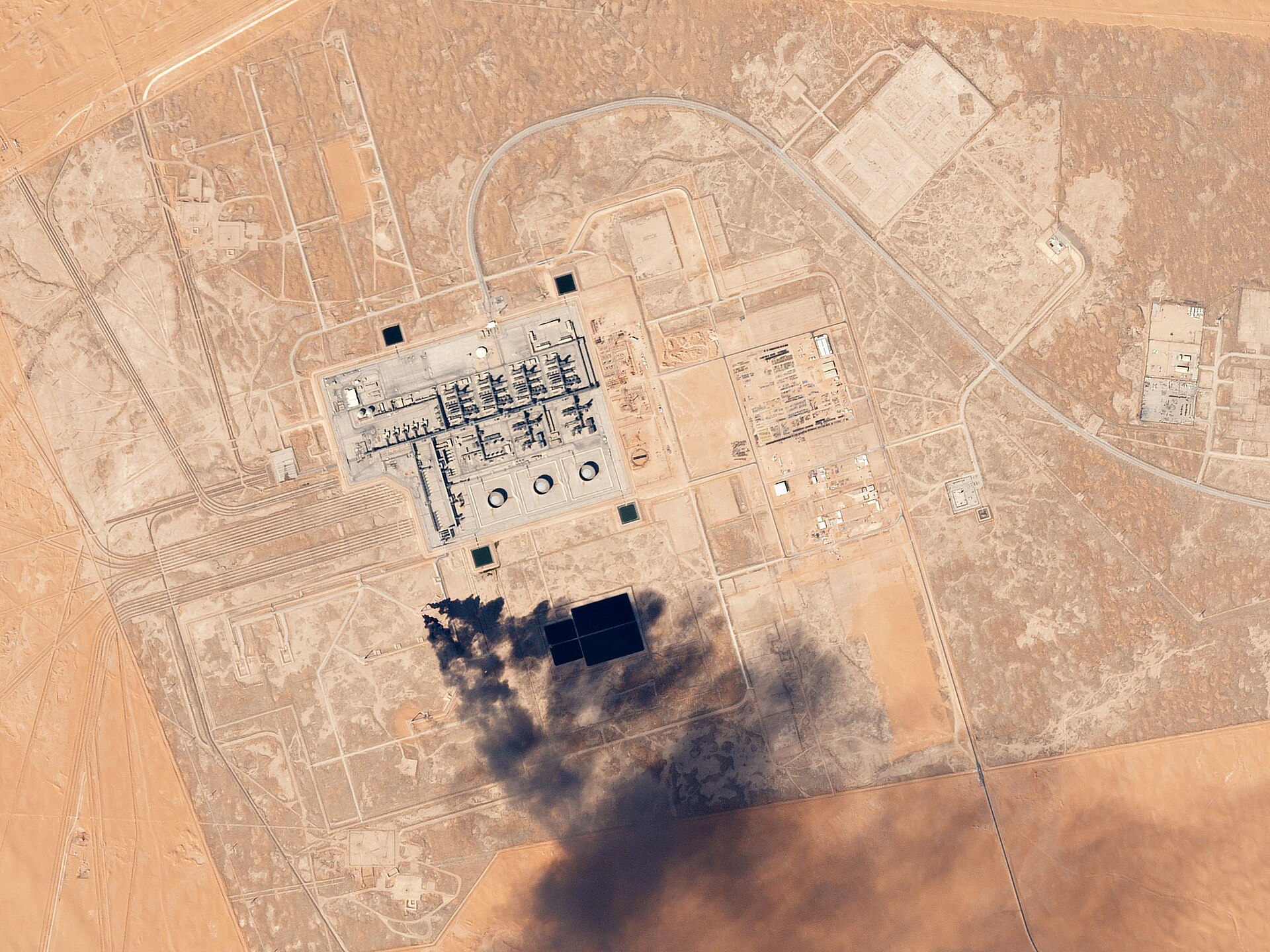
This means Saudi Arabia needs Hormuz reopened. The fastest path to reopening — according to both Rubio’s own June 2 Senate testimony and Iran’s public demands — runs through frozen asset release. Bessent’s directive blocks that path. Saudi Arabia cannot publicly object because objecting would mean lobbying Washington to hand $24 billion to the country whose missiles struck Saudi airspace, destroyed an E-3G AWACS at Prince Sultan Air Base on March 27, and reclassified the strait from a concession to an invoice.
The kingdom’s private bilateral de-escalation track with Tehran — the only back channel that survived the MOU’s collapse — depends on Riyadh maintaining enough distance from Washington’s maximalist position to remain a credible interlocutor. Every Bessent assessment meeting, every damage estimate requested from Gulf allies, narrows that distance. And every day Hormuz remains partially closed costs the kingdom revenue it cannot recover and fiscal runway it cannot extend.
Trump’s Public Rejection and Iran’s Three Registers
On June 7 — the same day Reuters published the Bessent directive — President Trump stated publicly that he “will not unfreeze Iranian assets before a ceasefire deal is reached” (Al Jazeera). The statement contradicts Iran’s sequencing demand, dismisses the Omani counteroffer’s opening premise, and aligns with Bessent’s redirection plan in a single sentence.
Baghaei responded by characterizing US positions as “contradictory” — the main issue in negotiations (CNN, June 7). The word choice was diplomatic. The substance was not. From Tehran’s perspective, Washington is simultaneously claiming the assets cannot be unfrozen (Trump), preparing to redirect them to Gulf allies (Bessent), and expecting Iran to negotiate Hormuz passage as if the asset concession still exists.
Iran’s institutional response to the collision breaks into three registers.
The first is legal-moral. Gharibabadi and Iranian state media characterize frozen assets as sovereign property seized in violation of international law. PressTV ran the framing on May 28: “Iran urges ‘unconditional’ release of all its frozen assets; US defies.” The legal argument is that no US domestic statute can transfer sovereign property without the owner’s consent, regardless of armed hostilities — a position grounded in the Algiers Accords precedent and Iran’s pending sovereign immunity claims in European courts.
The second is negotiating. Baghaei’s CNN statement — that when Washington discusses frozen assets “they’re not going to give us any concession” — registers Bessent’s directive as having foreclosed the asset concession Iran was counting on as its opening move. The Omani counteroffer was structured around asset release as step one. Trump’s public rejection dismissed its sequencing premise the same day the counteroffer arrived in Washington’s diplomatic inbox.
The third is strategic escalation. Rezaei’s warning that Iran will extend the war to four additional theaters — Indian Ocean, Bab al-Mandab, Red Sea, Mediterranean — was issued before the Bessent directive became public. The directive’s publication retroactively validated the hard-line argument that negotiations cannot produce asset release, only asset loss. For the IRGC-aligned faction around Mojtaba Khamenei, the Bessent assessment is not a threat — it is confirmation of a thesis they have held since the 2023 Qatar funds were frozen post-transfer.
The three registers serve different audiences. The legal-moral register plays to The Hague and European capitals. The negotiating register plays to Oman and the remaining diplomatic architecture. The escalation register plays to Tehran’s domestic hard-liners and to Gulf capitals — including Riyadh — that must calculate the cost of a war with no diplomatic off-ramp.
Can Riyadh Afford to Stay Silent?
Saudi Foreign Minister Faisal bin Farhan’s last confirmed contact with Secretary Rubio dates to March 2026. During the June 2–4 diplomatic cluster — six ministerial-level contacts in three days — Faisal spoke to counterparts in Pakistan, Qatar, Egypt, and Turkey. He did not call Rubio. He did not call Araghchi. He did not issue a statement on the Bessent directive.
The silence is structural, not accidental. Saudi Arabia is excluded from all three Hormuz negotiating tracks: the US-Iran channel through Oman, the UK-France naval coordination at Northwood, and US bilateral discussions with individual Gulf states. Chatham House noted in May 2026 that the exclusion reflects “the limits of US ability to manage its allies.” The kingdom is being managed, not consulted.
Supporting the Bessent plan would mean endorsing the seizure of Iranian sovereign assets — a position that contradicts Riyadh’s private bilateral de-escalation track with Tehran and sets a precedent that any country’s frozen assets can be redirected to its adversaries by the freezing power. Saudi Arabia holds substantial dollar-denominated reserves across multiple jurisdictions. The precedent is not abstract.
Opposing the Bessent plan would mean lobbying — publicly or through diplomatic channels — for Washington to release $24 billion to the government that struck Prince Sultan Air Base, killed personnel, and destroyed equipment valued at over $4 billion. Kuwait expelled two Iranian diplomats on June 3 after its passenger terminal was hit. Bahrain’s PAC-3 interceptor inventory has been depleted by 87%, leaving approximately eight missiles. Neither country would accept Saudi Arabia arguing for Iran’s payday while their own reconstruction bills mount.
The result is paralysis dressed as neutrality. Riyadh cannot move toward Washington without losing Tehran. It cannot move toward Tehran without losing the GCC. And it cannot hold position indefinitely — the fiscal bleed from Hormuz’s partial closure compounds daily at a production level the kingdom did not choose and a price it cannot control.
The Bessent directive did not create this trap. It made the trap visible. The $24 billion was always going to be claimed by both sides. The only question was whether the collision would happen before or after Saudi Arabia had enough fiscal runway to wait it out. The Aramco dividend schedule answered that question. June 9 arrives in two days. The money moves in one direction. Riyadh does not get to choose which one.
Frequently Asked Questions
What happens to the Bessent plan if the US and Iran reach a deal before a vesting order is signed?
A negotiated agreement would likely require the US to unblock — not vest — the frozen assets, returning them to the pre-Bessent status quo. The assessment work would be shelved. However, the damage estimates compiled by Treasury staff would remain on file, creating a documented claim that future administrations or Congress could revive at any point. The Congressional Research Service has noted that IEEPA assessments, once completed, often inform subsequent legislative action even when the original executive initiative stalls (CRS R45618). Gulf allies who submitted cost estimates would retain those figures as a formal, quantified record of losses attributed to Iran — a political asset with a long shelf life regardless of the current diplomatic outcome.
Could Congress block or accelerate the vesting of Iranian assets independently of the president?
Congress cannot vest assets directly — only the president holds that authority under PATRIOT Act Section 106. But Congress can constrain or compel presidential action through appropriations riders or standalone legislation. The REPO Act, signed into law in April 2024 as part of the Ukraine supplemental, authorized the seizure of Russian sovereign assets for Ukrainian reconstruction — establishing a legislative template that could be adapted for Iran. Senator Lindsey Graham introduced analogous legislation targeting Iranian assets in May 2026, though it has not advanced past committee. A legislative path would be slower than an executive order but harder to reverse, since repeal requires both chambers and a presidential signature rather than a single stroke of the pen.
How do European courts factor into Iran’s legal strategy against asset redirection?
Approximately $1.6–2 billion in Iranian assets held in Luxembourg’s central bank accounts are currently subject to terrorism-judgment litigation from US plaintiffs. Iran has filed counterclaims asserting sovereign immunity under the 1961 Vienna Convention. If the US vests assets under its domestic jurisdiction, Iran would likely file parallel claims at the International Court of Justice under the 1955 Treaty of Amity — the same treaty Iran used successfully in 2018 to obtain an ICJ provisional order against US sanctions. European governments holding Iranian assets in their jurisdictions — Germany, Italy, the UK — would face pressure to choose between US requests for asset coordination and their own courts’ sovereign immunity rulings. The legal proceedings would stretch years, but the interim uncertainty itself becomes a negotiating variable that benefits Tehran’s delay strategy.
Has Saudi Arabia ever publicly endorsed the seizure of another country’s sovereign assets?
No. Saudi Arabia abstained from the 2022 UN General Assembly vote on establishing a register of damage caused by Russian aggression against Ukraine — the procedural precursor to the REPO Act asset-seizure framework. The kingdom has consistently maintained that sovereign assets are protected under international law, a position rooted in direct exposure: the Public Investment Fund holds over $930 billion in global assets, and the Saudi Central Bank (SAMA) maintains approximately $440 billion in foreign reserves, much of it held in US Treasuries and Western financial institutions (SAMA, Q1 2026). Any precedent allowing a blocking power to unilaterally redirect frozen sovereign assets to third parties applies, in principle, to Saudi holdings in any jurisdiction that might one day freeze them. Riyadh’s silence on Bessent is not indifference. It is self-preservation.
When Iran declared on June 8 that US talks were “no longer feasible” and that Hormuz remains closed pending Washington’s concessions, the 4 billion asset dispute Bessent triggered effectively entered indefinite suspension. Hormuz Stays Closed as Iran Halts Strikes, Declares Talks Dead covers the June 8 diplomatic breakdown and Saudi Arabia’s position outside all three active negotiating tracks.