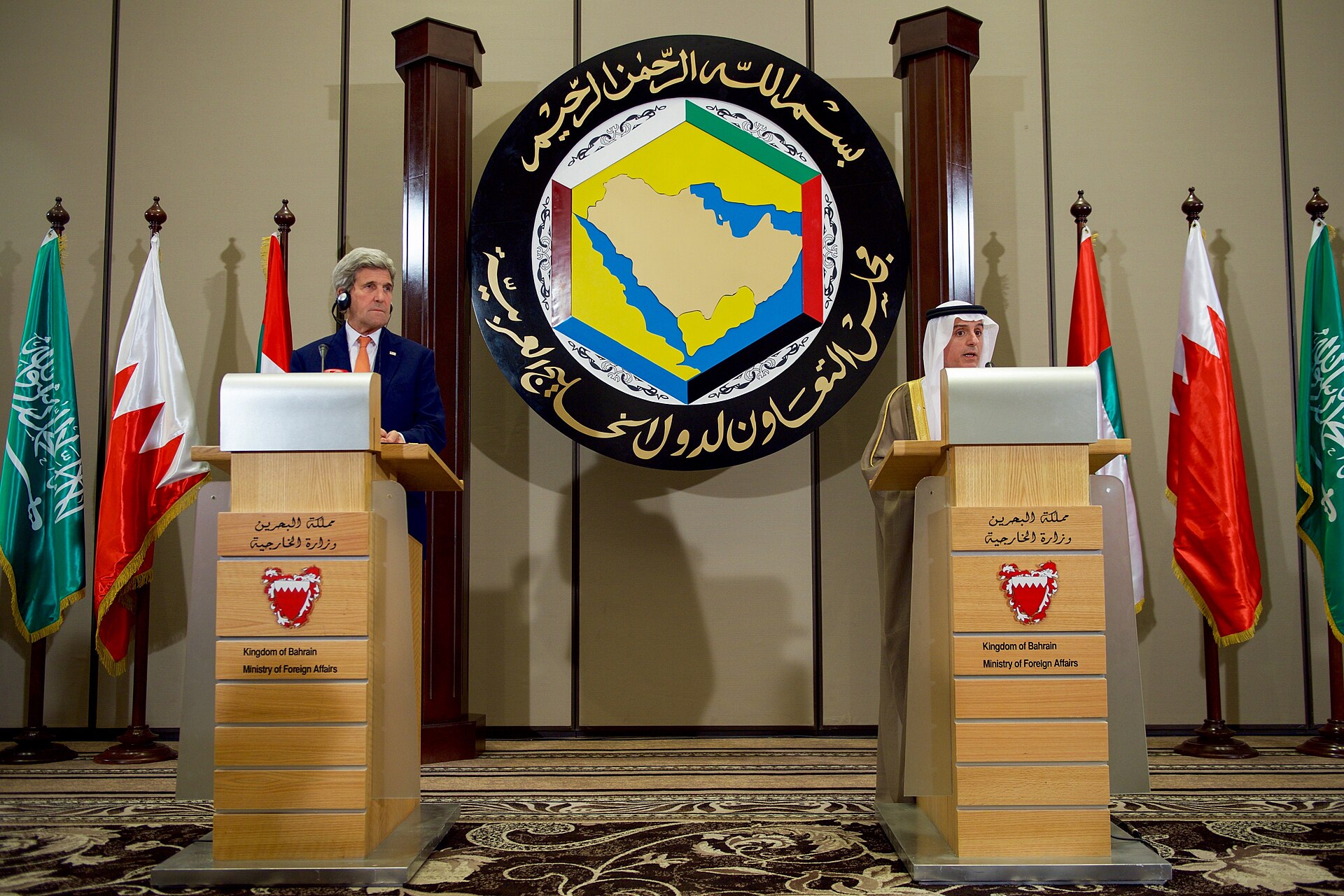
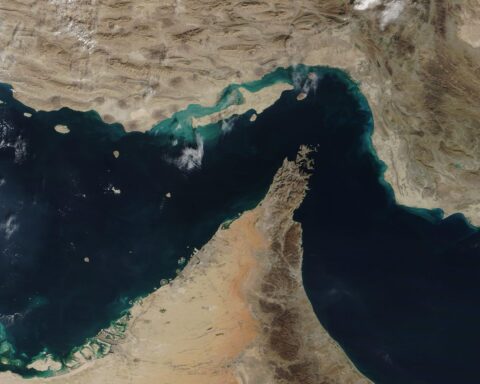
KUWAIT CITY — Iran struck Ali Al Salem Air Base in Kuwait and the US Fifth Fleet headquarters in Bahrain between 02:00 and 03:00 local time on June 28, then within hours issued a formal demand that both countries “must not allow their territory or facilities to be used for attacks” against Iran — a sequence that functions not as diplomacy but as retroactive legal architecture designed to pre-authorize the next strike. Foreign Minister Abbas Araghchi, speaking through Tasnim News Agency while damage assessments were still underway, invoked international law and the principle of “good neighbourliness” to recast the demand as a reminder of obligations Kuwait and Bahrain had already violated, constructing conditions under which any future Iranian strike on GCC territory can be reclassified as self-defense against a non-compliant host state.
The demand is structurally impossible to satisfy, and structurally designed to be. Kuwait hosts Ali Al Salem under a bilateral defense agreement it cannot unilaterally terminate; Bahrain hosts the US Fifth Fleet under arrangements older than the Islamic Republic itself. Neither country possesses the sovereign authority to expel or restrict US military operations from bases governed by bilateral Status of Forces Agreements, and the demand was never meant to produce compliance — it was meant to produce a citable record the next time an IRGC missile crosses a Gulf border, transforming offensive action into a documented response to announced non-compliance.
Table of Contents
- What Did Iran Demand After Striking Kuwait and Bahrain?
- The Sequence That Builds the Trap
- How Does Resolution 3314 Create a Legal Basis for Future Strikes?
- The MOU Provides the Frame, Not the Limit
- Can Kuwait and Bahrain Comply With Iran’s Demand?
- Is Saudi Arabia Next in Line for a Post-Strike Demand?
- Historical Precedents for Coercive Compliance Demands
- The Reparations Filing and the Endgame
- Frequently Asked Questions

What Did Iran Demand After Striking Kuwait and Bahrain?
After IRGC missiles and drones struck eight US military installations in Kuwait and Bahrain on June 28, Foreign Minister Araghchi demanded that regional states prevent “the aggressor parties from using their territory and facilities to carry out unlawful attacks against Iran.” The demand followed the strikes — framed as a legal obligation reminder, not an ultimatum, and designed to establish a citable record for future action.
The IRGC’s target list was specific and granular: strategic shelters, radar systems, communications infrastructure, and watchtowers at Ali Al Salem Air Base in Kuwait; maritime control centers and naval data-processing facilities at the US Fifth Fleet headquarters in Bahrain’s Juffair district. CENTCOM stated that Iranian attacks “failed to hit their targets” and reported no casualties — a formulation consistent with the January 2020 Al-Asad precedent, when the US initially reported no harm before eventually acknowledging 109 traumatic brain injuries among personnel. The physical outcome of the June 28 strikes remains contested, but the damage assessment matters less than what Tehran did in the hours that followed.
Araghchi’s language was calibrated for legal utility, not emotional impact. He did not issue a threat or warn of consequences; he described what he characterized as pre-existing obligations under international law — recasting the demand as a restatement of standing legal duties rather than a new coercive condition imposed at gunpoint. In the same statement, he called for “a new framework that includes all countries in the region and without the presence or interference of any country from outside the region,” positioning the strikes as the problem statement and the proposed framework as the offered solution — delivered together as a single diplomatic package.
Separately, the IRGC itself — not Araghchi’s Foreign Ministry — issued a warning that any future US strikes “will result in the complete halt of all diplomatic processes.” The split mattered: Iran’s civilian apparatus demanded legal compliance while its military apparatus threatened to terminate the very diplomacy that compliance was supposed to facilitate. Two institutions issued two messages on the same morning, and the message from the institution that controls the missiles was the one that left no room for negotiation.
The Middle East briefing 3,000+ readers start their day with.
One email. Every weekday morning. Free.
“Countries in the region must not allow their territory or facilities to be used for attacks on his country… particularly by preventing the aggressor parties from using their territory and facilities to carry out unlawful attacks against Iran.”
Abbas Araghchi, Iranian Foreign Minister, via Tasnim News Agency, June 28, 2026
Kuwait described the strikes as “repeated heinous Iranian aggressions” and a “flagrant violation of its sovereignty.” Bahrain said Iran had “violated its sovereignty and undermined opportunities for de-escalation and stability.” Both states filed at the United Nations rather than invoking bilateral defense treaties with the United States — Kuwait through an Article 51 self-defense notification to the Security Council, Bahrain through a draft resolution that became UNSC Resolution 2817, adopted 13-2 with 135 co-sponsors and only China and Russia abstaining. Neither state requested direct US military retaliation, and the GCC’s first collective defense invocation had already demonstrated that collective condemnation produced no collective military action.

The Sequence That Builds the Trap
The order in which Iran acted on June 28 is the mechanism, not the background. Each step produces a precondition for the next, and the final product is a self-renewing justification cycle that requires no further Iranian initiative to maintain — only the continued presence of US forces on Gulf territory, which neither Kuwait nor Bahrain can change.
Step one: Iran strikes US installations in Kuwait and Bahrain, citing MOU Article 1’s requirement for “permanent termination of military operations on all fronts” as its legal basis, framing US operations from those bases as a ceasefire violation that justified a military response. Step two: within hours, Araghchi demands that Kuwait and Bahrain “prevent” the use of their territory for attacks on Iran, invoking international law and the principle of good neighbourliness as the legal foundation. Step three — and this is the structural hinge — Kuwait and Bahrain cannot operationally comply, because they host US military installations under bilateral agreements that predate the Islamabad MOU, that were negotiated without Iranian input, and that neither Gulf state can unilaterally modify or terminate.
The fourth step follows automatically from the third. Any US military action launched from Ali Al Salem or the Fifth Fleet headquarters — whether offensive, defensive, or logistical — now constitutes, under Iran’s declared framework, a failure by Kuwait and Bahrain to fulfill an obligation that Iran formally put on the record. The fifth step is the payoff: Iran possesses a standing, self-replenishing justification for striking GCC territory whenever US operations continue from those bases, because the “non-compliance” that authorizes the next strike is guaranteed by structural conditions that no Gulf government controls.
What makes the mechanism distinct is its circularity. The trap does not require Kuwait or Bahrain to make a wrong decision — it requires them only to remain in the position they already occupy. Every day that Ali Al Salem remains operational is a day of documented non-compliance under Iran’s framework, and every documented day of non-compliance extends the justification pool for future strikes. Araghchi did not need to invent a provocation; he needed only to define existing conditions as one, and then demand that someone else change them.
No competing outlet has mapped this five-step sequence in full. Al Jazeera’s June 28 coverage treated Araghchi’s demand as secondary context within a strike-and-response narrative; CNN and PBS framed the demand as diplomatic pressure; the IISS’s June 2026 analysis of the MOU’s structural disadvantages for Gulf states identified the broader dynamic but not the specific strike-demand-non-compliance cycle that June 28 formalized. The compression of the timeline — strikes and demand within a single news cycle — represents something more deliberate than the usual post-conflict diplomatic positioning.
How Does Resolution 3314 Create a Legal Basis for Future Strikes?
Resolution 3314’s Article 3(f) defines as aggression “the action of a State in allowing its territory, which it has placed at the disposal of another State, to be used by that other State for perpetrating an act of aggression against a third State.” Tehran invokes this to argue that Kuwait and Bahrain, by hosting US bases, bear co-belligerent liability — transforming host states into active participants in any conflict waged from their soil.
The provision does not straightforwardly support Iran’s position. It requires proof that a host state is actively facilitating aggression against a third party, not merely tolerating the continued presence of allied forces. Iran’s post-strike demand is designed to patch that gap by converting passive hosting into documented, notified, non-remedied non-compliance.
An Al Jazeera legal analysis published on March 7, 2026, examined Iran’s position across three axes and concluded: “Iran’s position is based on three propositions: that Iran acted in lawful self-defence pursuant to Article 51 of the UN Charter; that host countries relinquished territorial sovereignty by allowing US military bases on their territory; and that the definition of aggression in Resolution 3314 justifies the attack on those bases as lawful military objectives. Each of these propositions is legally flawed, factually skewed, and tactically wrong.” Cambridge international law professor Marc Weller separately noted that the self-defense threshold requires “the other side has prepared military hardware for an immediate attack” — a bar that permanent basing does not meet.
But June 28 changed the legal argument in a way that matters. Before Araghchi’s demand, Iran’s Resolution 3314 case rested on the passive fact of basing — Kuwait and Bahrain had allowed US forces on their territory, and Iran claimed that passive allowance triggered co-belligerency. After June 28, Iran can argue that it formally notified both states of their obligation to prevent attacks from their territory, that both states received the notification and failed to act, and that subsequent strikes are therefore responses to active, documented non-compliance rather than passive hosting. The distinction matters because it shifts the burden from proving that bases constitute “immediate” military threats — the high bar Weller identified — to demonstrating that host states received specific demands and ignored them, which is a far lower bar and one that June 28 now satisfies on the record.
| Legal Instrument | Iran’s Claimed Basis | Key Limitation |
|---|---|---|
| UNGA Resolution 3314, Art. 3(f) (1974) | Host-state co-belligerency: Kuwait and Bahrain “allowed” territory to be used for aggression | Requires proof of active “perpetrating” of aggression, not passive hosting (Al Jazeera, March 7, 2026) |
| UN Charter, Article 51 | Self-defense against imminent armed attack | Marc Weller (Cambridge): requires “prepared military hardware for an immediate attack”; permanent basing does not qualify |
| Islamabad MOU, Article 1 | “All fronts” includes GCC bases hosting US forces | Bilateral US-Iran text; does not define “front”; no named arbitrator; no mechanism to adjudicate third-country status (Parley Policy) |
| Good neighbourliness (customary law) | Obligation to prevent territory from being used for hostile acts | Non-binding principle; no enforcement mechanism; typically invoked in peacetime diplomacy, not post-strike justifications |
Araghchi’s June 14 statement at GlobSec — “Any attempt to shape regional security without Iran [is] doomed to fail” — demonstrates that the post-strike framework was not improvised. The demand announced on June 28 was the enforcement action for a position Iran had been publicly constructing for at least two weeks, converting a broad diplomatic warning into a specific legal instrument with identifiable targets and documented non-compliance.
The MOU Provides the Frame, Not the Limit
The IRGC explicitly cited Clause 1 of the Islamabad Memorandum of Understanding to justify the June 28 strikes — the same instrument it has invoked for every major escalation since mid-June. Article 1 declares “the immediate and permanent termination of military operations on all fronts, including in Lebanon, with the parties undertaking not to initiate any war or military operation against each other and to refrain from the threat or use of force.” The IRGC’s reading treats US operations from Kuwait and Bahrain as a “front” under Article 1, converting Iran’s offensive strikes into a corrective measure within the ceasefire framework rather than a violation of it.
That reading is not supported by any conventional interpretation of the text. The MOU is a bilateral agreement between the United States and Iran; it does not reference Kuwait, Bahrain, or any GCC state by name. It does not define what constitutes a “front,” and the Parley Policy Initiative noted that the agreement “does not provide details on the composition or functions” of its own monitoring mechanism and “does not call for third party oversight,” meaning no neutral body exists to adjudicate whether Iran’s interpretation or Washington’s is correct. The absence of definitions is the structural feature that makes the MOU useful to Iran, because “all fronts” can be expanded retroactively to encompass any geography where US forces operate — converting new targets into MOU-covered violations without requiring any amendment, renegotiation, or consent from the states being targeted.
The MOU’s 60-day Phase 2 window — now at Day 11 — runs regardless of whether talks continue, collapse, or remain suspended over the Lebanon question. On Day 61, the $1-per-barrel PGSA transit fee currently waived reverts by default, adding a financial deadline to the legal one. The mutual-violation deadlock that crystallized on June 27 — when Iran cited MOU Articles 1 and 5 to justify strikes while the US invoked the same instrument to call those same strikes a violation — has now expanded to encompass third-party states who never signed the agreement, had no input on its terms, and possess no mechanism to challenge how it is interpreted against them.
Can Kuwait and Bahrain Comply With Iran’s Demand?
Kuwait and Bahrain cannot comply because Iran’s demand requires them to exercise authority they do not possess over operations they did not initiate and cannot control. Neither state can unilaterally restrict US military activity from installations governed by bilateral Status of Forces Agreements that predate the Islamic Republic itself and operate outside Gulf state command authority.
Ali Al Salem Air Base operates under a US-Kuwait defense cooperation agreement that governs force posture, operational authority, and base access through bilateral terms no Kuwaiti act can modify. The US Fifth Fleet has been headquartered at NSA Bahrain in Juffair since 1995 under a Defense Cooperation Agreement that grants the United States operational autonomy over naval activities in the Gulf — Bahrain does not approve, deny, or necessarily receive advance notice of individual US military operations conducted from its territory.
This structural reality is not new, but Iran’s June 28 demand transformed its political significance. Before the demand, Kuwait and Bahrain’s inability to control US operations from their soil was a background feature of Gulf security architecture — unremarkable and uncontested for three decades. After the demand, that same inability becomes evidence of active non-compliance with a formally stated legal obligation. The transformation requires no change in facts on the ground, only a change in the interpretive framework applied to those facts, which is precisely what Araghchi’s statement accomplished in a single press conference.
“The Iran war has left the Arab Gulf states in the unenviable position of having to facilitate diplomacy and support a flawed deal that fails to address their main concerns and risks empowering their adversary, Iran, to prevent a worse outcome.”
International Institute for Strategic Studies, “A Bad Peace,” June 2026
Both states responded through the United Nations rather than through bilateral military channels. Kuwait filed its Article 51 self-defense notification at the Security Council, bypassing the GCC’s collective defense mechanism entirely, while Bahrain’s draft became UNSC Resolution 2817 with 135 co-sponsors. Neither invoked Article 5 of any bilateral treaty with the United States, and neither requested direct American military retaliation — a pattern consistent with the GCC’s collective defense invocation that produced condemnation but no deployed forces, and reflecting a calculation that multilateral channels, however limited their enforcement potential, carry lower escalation risk than bilateral military action.
Kuwait and Bahrain are caught between an Iranian demand they cannot fulfill and an American military presence they cannot constrain, bearing the costs of hosting while lacking authority to control what happens from the installations they host. After months of sustained Iranian strikes and zero proportional GCC military response, UNSC resolutions remain the only instrument either state has employed — and UNSC resolutions, with China and Russia abstaining rather than vetoing, remain the instrument Iran has the least reason to fear.
Is Saudi Arabia Next in Line for a Post-Strike Demand?
Iran has not issued a Saudi-specific post-strike demand using the June 28 framework, but the predicate facts are already in place. Crown Prince Mohammed bin Salman publicly refused US basing rights in January 2026, then reversed that refusal around May 7 — giving Iran a documented record of compliance followed by explicit withdrawal, which is a stronger non-compliance basis than exists against Kuwait or Bahrain.
The January declaration grounded Project Freedom within 48 hours of its May launch. The May reversal followed a Trump-MBS phone call that cleared the way for US Hormuz escort operations under terms that remain undisclosed. Before May 7, Saudi Arabia occupied a legally defensible position under Iran’s own framework: Riyadh had publicly refused to allow its territory for US military operations, fulfilling the exact obligation that Araghchi’s June 28 demand imposed on Kuwait and Bahrain retroactively. After May 7, Saudi Arabia moved from the compliant column to what Iran considers the non-compliant column without Tehran needing to issue a formal demand at all — the reversal did that work for free. Tehran explicitly noted the shift, stating that the Saudi and Kuwaiti basing reversal demonstrated that “Washington did not value the security of its Gulf partners” and urging both states “to reconsider.”
Saudi Arabia’s PGSA exposure introduces a second layer of vulnerability that Kuwait and Bahrain do not face. Bahri supertankers transiting the Strait of Hormuz pay — or are presumed to pay — $1 per barrel in PGSA transit fees, amounting to approximately $5.5 million per day. This creates a paradox without precedent in modern Gulf security: Saudi Arabia simultaneously functions as a revenue source for IRGC-linked toll collection and, since May 7, as an operational platform for the US military forces Iran is striking in Kuwait and Bahrain. The Bahri tanker convoy that loaded eight million barrels at Ras Tanura in late June demonstrated that Saudi commercial interests and Iranian coercive pressure intersect at the same chokepoint — Riyadh paying for the privilege of transiting a strait Iran claims to control.
Iran’s strikes on Saudi Arabia’s Jubail petrochemical complex — confirmed by the Jerusalem Post — demonstrate that Tehran does not exempt Saudi Arabia from targeting even without a formal post-strike demand. The operational precedent exists; the formal demand-and-citation framework does not, at least not yet. The liability inflection is already documented: the January declaration and May reversal give Iran a citable record of compliance followed by explicit withdrawal, a factual predicate that required no strike to create and requires no further action to activate.
Historical Precedents for Coercive Compliance Demands
The closest structural analog to Iran’s June 28 sequence is the American bombing of Cambodia and Laos from 1969 to 1971, where the United States struck both countries to destroy North Vietnamese logistics corridors operating from their territory. The sequence was reversed from what Iran is attempting: Washington threatened and then bombed, arguing that Cambodian and Laotian neutrality had failed to prevent North Vietnamese military activity. Iran is demanding Sihanouk-style neutrality in a new direction — striking first and demanding neutrality second — which means the demand arrives not as a deterrent but as a post-hoc condition imposed on states that have already absorbed the cost of non-compliance.
Libya’s 1969 eviction of US forces from Wheelus Air Base illustrates a different dimension of the problem. Muammar Gaddafi’s post-coup demand was binary — leave or stay — and compliance was verifiable: either American personnel were on Libyan soil or they were not. Iran’s demand is structurally more sophisticated because compliance is not binary and never can be. “Preventing the use of territory” encompasses an infinite range of US military activities, from combat sorties to logistics flights to intelligence sharing, and Iran retains sole authority to determine which activities cross the threshold. The demand creates an obligation without a defined compliance standard, ensuring that Iran can identify non-compliance whenever it needs to justify action, regardless of what Kuwait or Bahrain have done to satisfy it.
The Finlandization model — Finland’s self-imposed foreign policy constraints from 1944 to 1991, designed to avoid provoking Moscow — captures the strategic objective Iran is pursuing but not the mechanism for achieving it. Finland’s accommodation was internally generated over decades of calibrated self-censorship; Iran is attempting to compress forty-seven years of Finnish restraint into a single morning’s press statement, inducing the same behavioral pattern through a strike-and-demand cycle rather than through the formal treaty structure that governed Soviet-Finnish relations. That Spain refused US basing rights for certain operations against Iran during the current conflict — absorbing the Washington pressure that followed — demonstrates that host-state refusal is politically survivable, which is precisely the calculation Iran is asking Kuwait and Bahrain to make.
The Reparations Filing and the Endgame
Iran has circulated a UN compensation demand against GCC states through its UN Mission on the basis of co-belligerency — the logical extension of the Resolution 3314(f) host-state theory into the domain of financial liability. The reparations claim operationalizes the same legal framework that Araghchi’s June 28 demand established: if GCC states are co-belligerents because they allowed their territory to be used for US military operations, then they bear financial responsibility for damage caused by those operations. The filing adds a cost dimension to the compliance trap, transforming the host-state question from a matter of security into one of quantifiable financial exposure.
The reparations filing also reveals the endgame of the post-strike demand framework, which is not what it first appears to be. Iran does not expect to expel US forces from Kuwait and Bahrain — it lacks the military capability to force an evacuation and the diplomatic weight to negotiate one. What Iran is constructing is a permanent legal basis for treating GCC states as participants in any US-Iran military confrontation, regardless of whether those states authorized, supported, or even knew about specific operations launched from their territory. Under this framework, the mere presence of US forces on Gulf soil — a baseline feature of regional security since 1991 — becomes a continuously active liability that Tehran can invoke at will to justify military action against sovereign GCC states.
The over 4,000 Iranian projectiles launched against GCC states as of the IISS’s March 2026 count were all fired before Iran constructed the formal demand-and-citation framework that June 28 established. The simultaneous peace offer and military action that characterized late June — Araghchi proposing a regional framework in Baghdad while IRGC missiles were still in flight — revealed a dual-track approach operating on parallel channels, each providing cover for the other. What changed on June 28 is that Iran consolidated those tracks into a single sequential mechanism: strike, demand, cite non-compliance, strike again. The justification loop is now closed, the non-compliance is permanent by structural design, and the only exit Iran has offered Kuwait and Bahrain is the one Araghchi named — “a new framework that includes all countries in the region and without the presence or interference of any country from outside the region” — which is another way of describing the end of the American military presence in the Gulf.
Frequently Asked Questions
Has Iran issued similar post-strike demands to countries outside the GCC?
Iran has not publicly replicated the June 28 demand structure for non-GCC states, but the underlying legal theory has implications for any country hosting US forces in the region. Iraq presents a distinct case because Iranian-aligned political factions within the government exercise partial control over basing policy, creating an internal mechanism that the external demand is designed to replicate in Kuwait and Bahrain. Jordan, which hosts US forces at Muwaffaq Salti Air Base, falls within the theoretical scope of Resolution 3314(f) but has not been targeted in the current conflict. Turkey’s status as a NATO member hosting Incirlik Air Base represents the upper boundary of Iran’s theory — applying the host-state demand to a NATO state would risk triggering Article 5 obligations, a threshold Tehran has so far avoided testing.
What is the legal standing of Iran’s “good neighbourliness” argument?
The principle of good neighbourliness derives from customary international law and several UN General Assembly resolutions, but it does not create enforceable obligations comparable to treaty commitments. The International Court of Justice has referenced the principle in advisory opinions — particularly in environmental and transboundary harm disputes — but has never ruled that it imposes an affirmative duty on states to prevent third-party military operations from their territory. No international tribunal has upheld a self-defense claim predicated solely on a neighboring state’s failure to meet good neighbourliness standards, which means Iran’s invocation is rhetorically effective for domestic and regional audiences but would face substantial legal obstacles if tested before any judicial body.
Could Kuwait or Bahrain legally expel US forces to comply with Iran’s demand?
Both states could theoretically terminate their defense cooperation agreements with the United States, as the Philippines threatened regarding the Visiting Forces Agreement in 2020 and as Libya completed with Wheelus Air Base in 1970. The political and security costs would be severe: Kuwait’s entire post-1991 security architecture was built around the American defense relationship, and Bahrain’s Fifth Fleet presence underpins both its maritime economy and its strategic value to Washington. The agreements contain notice and negotiation provisions requiring months or years to execute, during which Iran could continue citing ongoing non-compliance, and even after completion, Iran’s demand language — “preventing the use of territory” — is broad enough to encompass overflight rights, intelligence sharing, or residual cooperation, creating new non-compliance categories even after the physical bases close.
How does Iran’s approach differ from Russia’s pre-invasion demands to Ukraine?
Russia issued demands before invading Ukraine in February 2022, treating NATO’s failure to withdraw from Eastern Europe as a casus belli — a sequence in which demands preceded military action and non-compliance served as the stated justification. Iran reversed the sequence entirely, striking first and demanding compliance after, which produces a fundamentally different dynamic. Russia’s demands could theoretically have been met to prevent the invasion, however unreasonable they were in practice; Iran’s demands cannot prevent the strikes because the strikes have already occurred. The Iranian model is not deterrence but retroactive authorization, designed not to change behavior but to construct a legal record that justifies the behavior Iran has already chosen while pre-authorizing its repetition.
What would trigger Iran to extend this demand framework formally to Saudi Arabia?
The most likely trigger would be a confirmed US offensive operation launched from Saudi territory or airspace, which the May 7 basing reversal theoretically authorized but which has not been publicly documented. Iran has so far distinguished between Saudi Arabia and the smaller Gulf states partly because the kingdom represents a qualitatively different military challenge and partly because PGSA revenue from Saudi tanker traffic represents Iran’s most reliable financial hold over Riyadh. A formal post-strike demand to Saudi Arabia would force Iran to accept the risk that Riyadh halts all Hormuz transit in response, eliminating daily PGSA income and removing the economic pressure that the transit fee was designed to maintain. The Jubail strikes demonstrate Iran can target Saudi Arabia; the demand framework’s extension depends on whether Tehran calculates that the legal architecture is worth more than the revenue it might destroy.
The IAEA access dispute at the heart of Geneva’s June 29-30 nuclear talks is reported in Geneva Opens Without the Inspectors — 440.9 kg of HEU unverified for 121 days as the technical session opened, with Iran blocking inspectors from the struck enrichment sites where that material was last documented.